Frederick Douglass’s Fight Against Scientific Racism – The New York Times

Good read and reminder of early attitudes and beliefs, and the struggle to overcome them:

The 200th birthday of one of America’s greatest thinkers, Frederick Douglass, is being celebrated this month. Douglass is remembered as many things: a fugitive slave who gained his freedom, an abolitionist, an advocate for women’s rights, a gifted writer and orator. But we should also remember him as someone whose insights about scientific theories of race are every bit as relevant in our era as they were when he wrote them.

When Douglass rose to prominence, in the 1840s, he was living in a world just as excited and anxious about his era’s new inventions, like the railroad and the telegraph, as we are about modern-day innovation. But he understood that the ends to which science could be used were forever bound up with the moral choices of its practitioners. “Scientific writers, not less than others, write to please, as well as to instruct,” he wrote in 1854, “and even unconsciously to themselves (sometimes) sacrifice what is true to what is popular.”

That statement was part of a lecture in which he attacked one of the most prominent scientific fields of the antebellum era: ethnology, or what was sometimes called “the science of race.” Though often dismissed today as pseudoscience, at the time Douglass was writing, it was considered legitimate. The most accomplished scientists engaged in it, and the public eagerly consumed it.

Ethnology was not embraced just by Southerners who supported slavery. Its most important theorists lived in the North: one, Louis Agassiz, taught at Harvard; the other, Samuel George Morton, was president of one of the nation’s leading scientific societies, in Philadelphia.

Agassiz and Morton rejected the 18th-century view of race, which held that all human beings descended from a single pair and that physical differences emerged because of changes in the natural environment.

In preparation for the 1854 lecture, Douglass read dozens of books on ethnology, then dismantled polygenists’ claims one by one. Among the most important to Douglass was Morton’s claim that ancient Egyptians were white. To support his claim that black people were inferior, Morton needed to explain away the fact that ancient Egyptians were Africans, since if they were, it meant that people of African descent had the potential for similar greatness. As proof, Morton noted that the Bible made no mention of Egyptians’ color.

Douglass would have none of it.

He cited text after text, all written by respected European scientists, that noted that ancient Egyptians bore a striking resemblance to modern-day Africans. But more important, he argued that racial descriptors were not mentioned in the Bible because, at that historical moment, race did not exist. It was, as we now say, a social construct, something better understood as a product of history rather than of science.

When Morton assumed that the ancient Israelites, who he believed were white, would have never married ancient Egyptians if they were black, he failed to realize that racial prejudice was a “genuine American feeling,” Douglass wrote. “It assumes that a black skin in the East excites the same prejudice which we see here in the West.” Douglass was saying that we learn racism — we are not born with it.

Of course, engaging with ethnology on its own terms was a dangerous game. It sometimes meant that Douglass perpetuated scientific ways of thinking about race rather than simply dismantling its logic and insisting on race as a product of history. He borrowed from the ethnological theories of his friend James McCune Smith, a fellow black abolitionist and the nation’s first credentialed black physician, to argue that both black and white people would be improved by racial mixing.

Yet it would be wrong to dismiss these ideas as merely the result of Douglass’s own mixed racial heritage — his father, possibly his owner, was white — or as a backhanded insult to black history, to black culture. They were always written in the service of a clear political agenda, one that was radical for his time: full black integration rather than segregation.

In 1887, Douglass traveled to Egypt and published another essay about how the ancient Egyptians were, in fact, African. “I have long been interested in ethnology,” he wrote, and “I have wanted the evidence of greatness under the colored skin to meet and beat back the charge of natural, original and permanent inferiority.” He found it in the ancient pyramids and the majestic sphinxes, with their undeniably African features.

But even as Douglass refused to allow racist scientific theories to go unchallenged, he always understood that science was not the antidote to white people’s racism. There were only so many facts you could give to prove black people’s humanity.

In 1893, two years before his death, he was disturbed by the way the nation’s white scientific elite had represented people of African descent at the World’s Fair in Chicago. Scientists from Harvard and the Smithsonian helped design the exhibition, which mirrored what they took to be humankind’s racial progress from savage to civilized.

The pavilions for Haiti and for African nations, designed as primitive huts, came first. As you walked through the exhibition, you eventually crossed a bridge into the “White City,” which housed marbled pavilions for white nations, showcasing their marvelous scientific inventions.

One day was set aside for black Americans to present their own culture, and the press came ready to lampoon the event. White vendors had their fun too, bringing watermelons by the cartload. Some black leaders called for a boycott, but Douglass insisted that black people engage — after all, here was a chance to showcase black excellence.

But Douglass also wanted to set the record straight about race, or rather, about racism. This time, he did not bother making a scientific argument about black equality. Instead, he got to the heart of the matter and wanted the clutch of white reporters at the event to listen closely, to print it in all their papers.

The problem was not with black people, he said, it was with white people. If they loved their democracy as much as they said they did, they would stop looking to science to make excuses for their own failure to treat black Americans as equal citizens. As he put it: “The true problem is a national problem. There is no Negro problem. The problem is whether the American people have honesty enough, loyalty enough, honor enough, patriotism enough to live up to their own Constitution.”

via Frederick Douglass’s Fight Against Scientific Racism – The New York Times
Minister Joly Launches the New Paul Yuzyk Youth Initiative for Multiculturalism – Canada.ca

Funny to see the Paul Yuzyk award relaunched under the Liberals.

The Conservatives launched it when I was the DG – Citizenship and Multiculturalism in 2009, largely in part to counter the prevailing narrative that multiculturalism originated with the Liberals as well as responding to wishes of the Ukrainian Canadian community.

Now the Liberals are trying to appropriate Yuzyk, a former Conservative senator. That being said, it is positive when governments adopt or appropriate other party programs that support integration.

This, along with the related initiative Holodomor National Awareness Tour 2017–2020, also demonstrate the influence and sophistication of the Ukrainian Canadian community, who worked closely with the previous government on such initiatives as the Historical Recognition Program, Holodomor recognition and foreign policy issues.

Text of press release follows:

Diversity is Canada’s strength. Our young leaders play a critical role in shaping our country’s future and fostering a stronger, more prosperous Canada, where everyone has the ability to reach their full potential.

Today, the Honourable Mélanie Joly, Minister of Canadian Heritage and Minister responsible for Multiculturalism, announced the launch of the new Paul Yuzyk Youth Initiative for Multiculturalism. This annual funding initiative will award micro-grants of up to $1000 to dozens of young Canadians to fund projects that promote diversity and inclusion in their communities. This initiative will empower young leaders to make a positive impact on their communities, while addressing racism and discrimination. Canadian citizens or permanent residents aged 18 to 24 will be able to submit their applications online starting today, until April 20, 2018.

The new Paul Yuzyk Youth Initiative for Multiculturalism is in keeping with the Government of Canada’s commitment to promoting multiculturalism and strengthening our diverse communities, while working to eliminate discrimination, racism and prejudice in all its forms. The new initiative will honour the legacy of the late Senator Paul Yuzyk in developing and promoting Canadian multiculturalism by inspiring young leaders to continue advancing cultural understanding and inclusion in‎ communities across the country.

The initiative will be administered by Inter-Action, the Government of Canada’s multiculturalism grants and contributions program, which funds community engagement and development projects which promote intercultural understanding and equal opportunities for people of all cultures.

via Minister Joly Launches the New Paul Yuzyk Youth Initiative for Multiculturalism – Canada.ca

Press release on Holodomor National Awareness Tour:

Today, Arif Virani, Parliamentary Secretary to the Minister of Canadian Heritage (Multiculturalism) and Member of Parliament (Parkdale–High Park), announced that the Government of Canada is providing more than $1.4 million to the Canada-Ukraine Foundation in support of the Holodomor National Awareness Tour 2017–2020. Mr. Virani made this announcement on behalf of the Honourable Mélanie Joly, Minister of Canadian Heritage and Minister responsible for Multiculturalism.

The ongoing Holodomor National Awareness Tour 2017–2020 has launched a Holodomor Mobile Classroom that tours the country both to raise awareness of the Holodomor and to promote tolerance and mutual understanding. This project is expected to reach 65,000 participants across the country.

The project is receiving $1,459,730 in total funding over three years through the Projects component of Inter-Action, the Government of Canada’s multiculturalism grants and contributions program. Inter-Action funds community engagement and development projects that promote intercultural understanding and equal opportunities for people of all cultures.

via Parliamentary Secretary Virani Announces $1.4 Million in Funding for the Holodomor National Awareness Tour – Canada.ca

WARMINGTON: Anti-racism meeting turns into The Jerry Springer show

Sharp contrast to the session organized by the Riddell Centre for Political Management about a month ago in Ottawa:

It was racism industry on full display.

In one corner you had the “anti racists” who gathered together to talk about racism in Canada and new legislation to end it. In the other you had the so-called “racists.”

Needless to say this was set up to be a powderkeg.

What was billed as an “Anti-Racism Town Hall” at the Grant African Methodist Episcopal Church on Gerrard St. at Woodbine Ave. on Thursday evening turned into part socialism lecture and part The Jerry Springer Show.

Actually it was so surreal it seemed more like a Simpson’s town hall meeting, complete with characters like Mayor Quimby, Sideshow Bob, Mr. Burns and Krusty the Clown.

And yes Toronto Police 55 Division was called in.

First things first. On the stage you had the author of the M-103 motion to protect criticism of Islam and other religions MP Iqra Khalid, Minister Responsible for Anti-Racism MPP Michael Couteau, MPP Beaches-East York MPP Arthur Potts and MP Beaches-East York Nathaniel Erskine-Smith, all of whom had a similar message about the existence of racism in Canada and Ontario and the need to fix it.

There was talk about how it costs $60 million a year to “incarcerate” youth in the Jane and Finch area and how 22% of black university graduates don’t get jobs while it’s at just 10% for white “drop outs,” how “colonial Canada” supplanted the Indigenous and how government needs to make sure “every person can reach his or her full potential” by “looking for ways to eliminate systematic racism barriers.”

Well this was not sitting well with some of the proud to be rednecks in the crowd. And it boiled over when Khalid started talking about M-103 was not anti blasphemy law but more a tool to foster stronger diversity.

“You are a fraud,” yelled one guy.

“Is this going to be Sharia law,” a woman shouted.

“This is only about protecting Islam and designed to bring more Muslims over here,” said another man.

The most vocal and animated was none other than Eric Brazau who has spent nine months in jail for “promoting hatred” and at one point held up a copy of the Q’uran in protest.

The crowd grew impatient with the constant interruptions and started yelling “shut up” and “racist’s out.”

The bad behaviour was mostly from those protesting M-103 but there were some outbursts from the anti-racism crowd as well — including one man pointing out white supremacist Council of Conservative Canadians founder Paul Fromm and telling him to F… off.”

Fromm did not engage but instead quietly wrote notes in the corner of the room. However, others were fully inflamed. At one point it got so heated in the room it felt like it could explode.

“The police have been called and some people will be asked to leave,” said Erskine-Smith.

The police did come but stayed outside in their car and didn’t escort anybody out.

“It was a strange night,” said Jewish Defence League National Director Meir Weinstein, who was not impressed with the yelling at the politicians.

“I did have a question about why it is politicians accept awards from Islamic terror groups that want to kill Jews and annihilate Israel but this is not part of any conversation?” said Weinstein. “Isn’t that racism?”

It was a fair question but the grandstanding behaviour of some drowned it out. Ironically the rude shouting played right into the hands of the politicians who never lost their cool, composure or even sense of humour.

But the fact there were politicians on one side suggesting Canada is systemically racist and people on the other side acting exactly like they are indeed racist is no laughing matter.

Source: WARMINGTON: Anti-racism meeting turns into The Jerry Springer show

US Citizenship and Immigration Services drops ‘nation of immigrants’ from mission statement

Words matter (but I agree with dropping the word customers, citizenship and visas are not consumer products):

Tired, poor, huddled masses yearning to breathe free need not apply.

The United States Citizenship and Immigration Services no longer uses language that describes the country as “a nation of immigrants” in its official mission statement, an agency official said Thursday.

The USCIS, the federal agency tasked with granting visas and citizenship, has changed to a new statement that “clearly defines the agency’s role in our country’s lawful immigration system and the commitment we have to the American people,” according to a letter sent to employees by agency director L. Francis Cissna that was obtained by NBC News.

“The agency’s new mission statement was developed and debuted within the agency by USCIS Director Cissna during his first conference with USCIS senior leadership from around the world,” a USCIS public affairs officer said in a statement to NBC News. “It reflects the director’s guiding principles for the agency. This includes a focus on fairness, lawfulness and efficiency, protecting American workers, and safeguarding the homeland.”

The previous mission statement said the agency, “secures America’s promise as a nation of immigrants by providing accurate and useful information to our customers, granting immigration and citizenship benefits, promoting an awareness and understanding of citizenship, and ensuring the integrity of our immigration system.”

The new statement now reads:

“U.S. Citizenship and Immigration Services administers the nation’s lawful immigration system, safeguarding its integrity and promise by efficiently and fairly adjudicating requests for immigration benefits while protecting Americans, securing the homeland, and honoring our values.”

Cissna also said the new mission statement will also no longer refer to visa applicants as “customers” because the term “promotes an institutional culture that emphasizes the ultimate satisfaction of applicants and petitioners, rather than the correct adjudication of such applications and petitions according to the law.” He added that the term implied that the agency serves anyone other than “the American people.”

President Donald Trump’s pick, Cissna was sworn in as director of USCIS in October.

The wording change was not welcomed by some pro-immigration groups.

“Our nation is one built by immigrants — removing this language does nothing to change that fact, it only reveals the insidious racism harbored by those in this administration,” said Eleanor Acer, senior director for refugee protection at the Human Rights First, in a statement. “We cannot separate ‘immigrants’ from ‘Americans’ — we are intrinsically linked as children, parents, neighbors, and loved ones. By seeking to distinguish between the two, the administration is turning its back on our nation’s proud history and engaging in dangerous revisionism.”

Source: US Citizenship and Immigration Services drops ‘nation of immigrants’ from mission statement

Secretive Fraternities Are Feeding Anti-Semitism in Austria – The Atlantic

Good long but disturbing read:
Like many Austrian fraternities, Germania zu Wiener Neustadt sometimes uses a songbook at its get-togethers. It looks ordinary enough, with its red cover, gold crest, and curling script. The cover is studded with metal nails called “Biernagel” that keep the book slightly elevated so it doesn’t get wet when lying in beer.Unlike most other songbooks, however, it contains lyrics about killing Jews. “Step on the gas,” one line reads. “We’ll manage the seventh million.”

When the Vienna-based newspaper Falter (for which I am a frequent contributor) wrote about the book in January, it promptly derailed the political career of one of the fraternity’s most notable members: Udo Landbauer, who was running as a candidate for Austria’s right-wing Freedom Party (FPÖ) in state elections on January 28. One day before the vote, the Austrian president suggested he step down. On February 1, Landbauer resigned from all political positions. He had been a city councillor in Wiener Neustadt and the head of the FPÖ’s district office in that city.

Landbauer, 31, who was also the deputy chairman of the fraternity for a couple of years, claimed he hadn’t known about such lines: “Not being a gifted singer, I didn’t go through all the pages,” he said in a television interview. The songbook outraged the nation anyway. The prime minister of Lower Austria, Johanna Mikl-Leitner of the conservative People’s Party (ÖVP), said she wouldn’t work with Landbauer. Bad international press followed, causing embarrassment the FPÖ could ill afford. In the six weeks since it had become the junior partner in a coalition government with the ÖVP at the federal level, it had struggled to appear respectable. The party had gotten negative press just two weeks earlier, when its minister of the interior proposed “concentrating refugees into camps.” The Jewish community of Vienna, where the majority of the country’s 12,000 to 15,000 Jews live, has been boycotting the FPÖ; it refused to participate in the government’s official Holocaust memorial ceremony last month.Heinz-Christian Strache, Austria’s vice chancellor and head of the FPÖ, announced that he would install a committee of historians to examine the party’s ties to anti-Semitic groups. The party revealed last week that former FPÖ parliamentarian Wilhelm Brauneder will head the commission. Brauneder, who during his tenure as the dean of Vienna University’s law faculty in the late 1980s permitted an event organized by a German right-wing extremist, gets to choose the members of the commission, which is set to issue its first report this October. Whether or not the historians will also study the fraternities’ history depends on whether the fraternities, which are private organizations, voluntarily grant them access to their archives.

Then, this week, the FPÖ suffered another blow. Falter published a new story, this one reporting that the Viennese fraternity Bruna Sudetia also used a songbook containing the same anti-Semitic song. Its head, Herwig Götschober, works on social media for the cabinet of Norbert Hofer, the FPÖ’s minister of infrastructure, and is a district councillor for the FPÖ in Vienna. Götschober reacted by saying that he rejects these lyrics, and added that he had never seen this songbook before. The fraternity is now under investigation, as the circulation of Nazi content is prohibited by Austrian constitutional law; Götschober went on leave from his post.On its homepage, Götschober’s fraternity has a section about its history: World War II is only mentioned when the bombing of its Vienna headquarters in 1944 is described. This silence about the Nazi era has been typical of Austria for much of the 20th century, when the nation saw itself as the first victim of Hitler’s expansionist politics. In 1986, the Nazi past of former UN general secretary and presidential candidate Kurt Waldheim resulted in international pressure. Consequently, then-chancellor Franz Vranitzky acknowledged Austria’s complicity in the war and Nazi crimes in 1993. It took until 2012 for the government to recognize May 8, the anniversary of the capitulation of the Wehrmacht in 1945, as the Day of Liberation. German-nationalistic fraternities still commemorate the dead soldiers on that date. Arguably, scandals like those involving anti-Semitic songbooks keep bubbling up because Austria has yet to grapple with its WWII past as thoroughly as has, say, Germany.

The far right in Austria has a long and vocal history of anti-Semitism, but recently it has been trying to shed that image, instead prioritizing anti-Muslim rhetoric. As part of this shift, members of the far right at times claim they want to protect Jews against Muslims. But their relationship with the fraternity system proves they haven’t shed their anti-Semitism either.The chances are extremely slim that a reassessment of the sort Strache announced would eliminate anti-Semitism in the FPÖ. In order for the party to rid itself of anti-Semitism, it needs to cut its ties to the fraternities—a structural problem that is nearly impossible to tackle.

Austria has many high school and university student associations. What makes these fraternities (“Burschenschaften”) unique is that they’re infused with German nationalism. They originated in German university towns in the first half of the 19th century and stood for a united German nation. During the Nazi era, the fraternities were merged with the Nazi students’ associations. They reemerged after the war. Today, not all members of these fraternities are far-right extremists, anti-Semites, or neo-Nazis; some are right-wing conservatives who adhere to old traditions, like a mask-free fencing ritual that often leaves members with scarred faces.

Members swear to secrecy about what happens during their gatherings—which is why the songbooks shocked many. It also means that people don’t know how much other Nazi material is being circulated. In his most recent book, the journalist Hans-Henning Scharsach lists several fraternities that still include former Nazis, such as Rome’s Gestapo chief Herbert Kappler, among their honorary members. Another group organized a carnival party in 2008, photos of which appear to show guests dressed up as Ku Klux Klan members and Orthodox Jews.

In total, there are no more than 5,000 members of such fraternities nationwide, yet these members are important because they’re overrepresented in the ranks of the FPÖ. Strache himself is a member of the fraternity Vandalia. (He is also known to have had frequent contact with neo-Nazi groups in his youth, which he described as a “youthful folly” but never said was a mistake.) Among the party’s MPs alone, roughly one-third are members of various fraternities. The fraternities are an important source of highly educated and loyal personnel.

Which makes Strache’s announcement somewhat hard to believe: “Fraternities have nothing to do with the FPÖ,” he said the day after the Germania zu Wiener Neustadt songbook was made public.“That was a real slap in the face for the fraternities,” said Nina Horaczek, a journalist with Falter who broke both stories, adding that Strache’s attempt to distance himself from them isn’t a good long-term strategy for him. After all, his brothers backed him when he became the head of the party in 2005. “If fraternities need to leave the party, Strache would be the first to go.”

Although the fraternities are by no means the only source of anti-Semitism in the FPÖ, they are considered a gateway into the party. Severing these ties isn’t just difficult, it’s undesirable for the party—which means that the FPÖ will continue to at least indirectly foster a safe space for anti-Semitic thought.

“As long as Strache doesn’t say, I was a neo-Nazi in my youth and I apologize for it, any sort of historical examination is worth very little,” said Doron Rabinovici, an author and historian of Austrian Jewry.

Martin Engelberg, a Jewish MP for the conservative ÖVP, is more optimistic. In a TV debate on the Austrian channel Puls4, he said, “This process won’t happen in just one day,” referring to the plans of his coalition partner, the FPÖ. At a recent MP swearing-in ceremony, the FPÖ’s MPs didn’t show up wearing cornflower pins—the symbol Nazi party members used in Austria before 1938—as they had in previous years. Instead, they wore edelweiss flowers, a rather neutral symbol of Austria. Strache had also given a speech at the fraternities’ annual ball a few days earlier, saying that they had to stand against racism and anti-Semitism. “Those are [positive] signs,” Engelberg said.

The FPÖ has also been trying to present itself in recent years not as anti-Semitic, but as decidedly supportive of Jews—a stance that seems politically opportunist. One way they attempt this is by showing support for the Jewish state: Strache and other party officials have been visiting Israel and meeting with far-right membersof the ruling Likud party (official Israeli policy, however, is to boycott the FPÖ). In December, Strache said it would be his wish to move the Austrian embassy from Tel Aviv to Jerusalem. He has also said Israel has the right to build West Bank settlements.Several scholars, a few of whom were featured in a recent Haaretz article, have made the case that some European far-right parties have adopted similar stances:

Cas Mudde, a political science professor at the University of Georgia … highlighted the stance of many radical rightists on the Jews. Jews, says Mudde, are seen to embody a modernity to be defended. Europe’s large Roma minority, on the other hand, are seen as barbarians living on the fringes of modernity, while Muslims are seen as barbarians living inside modernity—the enemy already inside the gates, according to the far right.

As a result, the philo-Semitic turn of many far-right parties, in the words of sociologist Rogers Brubaker, comes directly from these parties’ preoccupations with Islam. Writing earlier this year, Brubaker argues that the far right has come to redefine Jews as fellow Europeans and exemplary victims of the threat from Islam.

Another far-right European party that has tried this strategy is France’s National Front. Founded in 1972 by Jean-Marie Le Pen, who made statements offensive to both Jews and Muslims, the party was taken over in 2011 by his daughter Marine Le Pen. She expelled her father from the party and gave it a facelift, publicly embracing Jews while continuing to speak negatively about Muslims. In 2014, she told French Jews, “Not only is the National Front not your enemy, but it is without a doubt the best shield to protect you. It stands at your side for the defense of our freedoms of thought and of religion against the only real enemy, Islamist fundamentalism.”

As the historian Ethan B. Katz has written, “The extreme right in France has repeatedly invoked Muslims and Jews in the same breath, at once highlighting both groups as different from the rest of the population and seeking to rally them against one another.”

These kinds of tactics may have influenced the FPÖ. “It’s possible that Marine Le Pen played a role in the FPÖ’s move away from anti-Semitism,” said Danny Leder, an Austrian journalist who has been based in France for decades and has covered the right-wing parties of the two countries extensively. “On a European level, the FPÖ was always the National Front’s junior partner.”Leder emphasized that “the threat [against Jews] is real.” In recent years, France has experienced several deadly Islamist terrorist attacks directed at Jews. The Austrian watchdog NGO Forum gegen Antisemitismus reports a steady increase in anti-Semitic incidents over the past few years, and in its 2015 report the increase in Islamist anti-Semitism was significant.

Both the National Front and the FPÖ have used these incidents to foment further hatred. There’s plenty of evidence to suggest anti-Muslim sentiment has become more widespread. Le Pen, in 2010, compared Muslim prayers in the streets to the Nazi occupation. And in Austria, “Daham statt Islam” (“Home instead of Islam”) was Strache’s campaign slogan in 2006. Last November, Landbauer called Johanna Mikl-Leitner, his rival in the state elections, “Moslem-Mama Mikl,” and claimed that she was “pushing Islamization in kindergartens” because a syllabus for kindergartens required that children be introduced to holidays from various religions.

Oskar Deutsch, the president of Vienna’s Jewish community, does see Islamist anti-Semitism as a significant threat, but he doesn’t believe the far-right is a true ally in combatting it. “Muslims, Roma and Sinti, and Jews—as minorities, we’re all sitting on the same branch,” he said. “If you’re sawing off one of our seats, we’re all falling.” But some Jewish leaders, like Engelberg in Austria, or the French Jews who voted for Le Pen, have seemed willing to give far-right parties a chance, perhaps encouraged by public displays of philo-Semitism.

Meanwhile, anti-Muslim sentiment helps to keep the far-right base happy. This base, however, has not abandoned its anti-Semitic strain, and party leaders still at times project anti-Semitic signals. Strache’s 2010 visit to the Yad Vashem Holocaust memorial, where he wore his fraternity hat when head-covering was required, perhaps illustrates this best.

Still, the FPÖ keeps framing scandals such as the songbooks as isolated cases, in its attempt to convince people that Jews are no longer the enemy of the party. Fraternities are clearly enmeshed with the FPÖ, which means that—despite all public claims to the contrary—the party will likely keep its ties to anti-Semitism intact.

Source: Secretive Fraternities Are Feeding Anti-Semitism in Austria

Canada’s merit-based immigration system is no ‘magic bullet’ : Mireille Paquet

Very good overview:

President Donald Trump has made comprehensive immigration reform in the United States one of his key legislative goals.

He’s proposed bringing the U.S. immigration system “into the 21st century” by providing a path to citizenship for some undocumented migrants and by fully securing the country’s southern border.

Central to his plans is a merit-based, Canada-style immigration systemthat would replace the current American system that focuses on family reunification and a diversity lottery.

But is merit-based immigration the simple solution for the complex set of immigration-related issues facing the United States?

Canada’s “merit-based” system provides some lessons for the United States. Despite the relative success of the Canadian merit-based system, Canada’s experience shows there’s no magic bullet.

What does “merit-based” mean?

“Merit-based” immigration systems are based on the principle of selecting newcomers according to their skills, education, adaptability, language proficiency and overall human capital.

These metrics, proponents argue, allow immigrants to fill specific labour market needs. But they also act as predictors of how a newcomer might adapt to a new social, economic and cultural environment.

Yet the notion of merit is complex, contextual and highly politicized.

All immigration selection programs are rooted in implicit and explicit definitions of merit, whether they’re based on economic criteria, ideas of cultural compatibility or family relationships. From that standpoint, all immigration programs are “merit-based” systems.

Current U.S. political debates tend to pit the programs of some countries such as Canada, Australia and New Zealand against the U.S. system as it exists today.

As several analysts and researchers have shown, however, family ties and social links can also be considered a form of merit, and may have positive impacts on immigrants’ future contributions to their new home.

Consequently, when it comes to immigration, there is no objective definition of what “merit” really means.

Merit-based systems have also been criticized for reinforcing global human capital inequalities and for indirectly sorting candidates based on ethnic and cultural origins.

But proponents see merit-based systems as yielding better integration outcomes. They also argue that they allow for better management of immigration levels, build public trust and are more responsive to labour market dynamics.

Trump says the system will help ensure economic growth, economic mobility for both native-born Americans and immigrants and will close the door to unwanted immigrants.

Canada’s “merit-based” system

Canada implemented a points system in 1967 in order to move away from origin-based selection of immigrants. Fifty years later, in 2017, Canada admitted 296,346 permanent legal immigrants. About 52 per cent of them entered through different categories of the “economic” class of the immigration program, Canada’s own version of a “merit-based” immigration system.

Under this system, economic immigration candidates are evaluated and ranked using a Comprehensive Ranking System (CRS). It’s a 100-point selection grid that considers factors such as age, education, work specialization, work experience in Canada and abroad as well as arranged employment in Canada.

Would-be immigrants to Canada are also evaluated for adaptability, measured by elements such as past experiences in Canada, but also by the presence of relatives in the country and their spouses’ language proficiency.

So even when measuring for “merit,” the Canadian immigration system does include a recognition of the importance of family ties and social networks.

What’s more, not all of the 159,125 individuals who entered Canada through the economic class in 2017 were selected using the economic criteria.

Between 2006 and 2015, only 41 to 49 per cent of these individuals were selected directly based on their potential for contributing to the Canadian economy. The rest of the economic class is comprised of close family members of the main applicant, like spouses and children.

Nonetheless, Canada’s experience overall with its immigration program has been positive. Among other benefits, it’s been credited with building the Canadian public’s support for relatively high immigration levels.

But merit-based immigration programs demand investment into the system, and they may have unintended consequences. Canada’s merit-based program provides three important lessons for U.S. policymakers and citizens:

Lesson 1: “Merit-based” is only the beginning

A central argument by proponents of merit-based immigration is that it will lead to better immigrant integration outcomes.

While that’s largely true, a constellation of social and state actions also affect how immigrants fare in their newly adopted homes.

Two are especially important: Immigrant integration services and efforts to find jobs for immigrants.

Canada funds immigrant integration programs that range from language training to information on jobs, bridging programs to jobs and job training. While Canada offers specific social programs for refugees, several services are also available to all classes of permanent immigrants.

Indeed, Canada plans to spend just over $1 billion on immigrant integration services in 2018.

Experience and research have shown these programs are critical to helping merit-based immigrants succeed economically and socially. They also increase immigrants’ overall sense of belonging to their new society and encourage social participation.

But integration services are not enough: Canada’s experience shows that while immigrants selected based on their economic criteria fare better in the labour market than others, many of them still endure economic difficulties.

Underemployment, trouble entering the labour market and the need to go back to school, despite having university degrees, are all too common experiences for Canadian immigrants even if they meet the “merit-based” criteria.Skills-based immigration programs can easily run amok if the labour market can’t accommodate foreign education and skills credentials. As a consequence, both Canada’s federal and provincial governments have had to invest in educating employers — and are still working to create and enforce standards for foreign skills recognition.

Canada’s experience proves that a merit-based system demands much more than simply choosing “the right” immigrants. Governments must invest in supporting them once they’ve been admitted.

Lesson 2: Immigrants & labour market needs

Matching the demands of the labour market to new immigrants is a challenge. That’s due in part to the difference between the speed at which labour markets evolve and how quickly an immigration system can operate to bring job-ready candidates to any given country and employer.

The challenge is compounded by popular and political ideas about who is an “ideal” economic immigrant — for example, a doctor or an engineer — and the actual labour needs of the country.

In the last 30 years, those types of disconnects have been a constant testin Canada but also in other countries.

In the early 1990s, the Canadian government’s preferred solution was to select immigrants based on predictions about their capacity to adapt to a changing labour market. To do so, they used human capital as the main merit criterion. That had several unintended effects, including the underemployment of many immigrants and labour shortages in several technical sectors.

Since then, the Canadian government has made a move towards a more demand-based model, and provides provinces and territories as well as employers with a bigger say in the selection system.

More recently, the system was again amended to reintroduce human capital factors because the immigrants selected by the demand-driven model were not considered skilled enough.

Canada’s experience is one of a tug of war between planning for long-term labour needs and short-term labour supply.

Despite these adjustments, current Canadian programs still struggle to address the needs of labour markets that are increasingly divided between the need for high-skilled versus low-skilled workers, like those in short supply in the service sector.

Consequently, Canada relies increasingly on temporary immigration to meet market demands. In the last 10 years, the number of so-called temporary foreign workers has grown tremendously, as have concerns about worker abuses and overall precarity.

And despite reforms aimed at providing temporary workers a path to permanent residency, the need for those low-skilled labourers runs counter to the long-term social and economic objective of Canada’s merit-based system.

What is “best” for the economy, and what types of immigrants are most needed, often eschews simple answers.

Lesson 3: The need for bureaucrats

Trust in the bureaucracy is critical to a successful merit-based system. Any immigrant-selection system relies on a comprehensive, technical method of assessing would-be newcomers, the gathering of information on the labour market and on global migration trends, as well as the monitoring and evaluation of programs.

On the ground, considerable work is required to assess individual applications based on merit criteria. While technology makes these tasks easier than before, well-trained public servants and well-funded public infrastructure are needed.
In Canada and elsewhere, government workers use research, field expertise and discretion to assess applicants. The need for accurate data along with the complexity of these programs often make elected officials dependent on the expertise and advice of public servants.

Bureaucrats are uniquely positioned to see the negative consequences of selection programs, and to propose innovative solutions based on their hands-on experience.

What’s more, experiments that have involved employers in immigrant selection programs remain inconclusive. While they remain important partners, bureaucrats still have the advantage over employers in assessing immigrants.

The move to merit-based systems often politicize not only overall immigration levels, but also the very definition of “merit.”

The cacophony of partisan advice and political opinion on these often highly technical assessments of immigrants means it’s crucial to have reliable data on immigration and unbiased analysis. The trust of Canadian elected officials in the country’s immigration bureaucracy is one of the secret ingredients of its success.

Hardly a ‘magic bullet’

A merit-based immigration might address some of America’s immigration challenges.

But it could also have negative consequences, especially as long as state-funded integration services remain comparatively limited and not accessible to all immigrants in the U.S..

The U.S. government will also need work to ensure that the immigrants it selects will respond to the actual labour market needs of its diverse economy. The distrust the Trump administration clearly harbours towards the American federal bureaucracy might also create considerable challenges to the design and implementation of a merit-based system.

Canada’s experience shows that selecting immigrants based on economic merit is not a silver bullet. Finding the “right” immigrants is the only one step in a large group of government actions that support immigrants and the country overall.

via Canada’s merit-based immigration system is no ‘magic bullet’

Neo-Nazi Groups Explode Under Trump, Southern Poverty Law Center Finds

Not encouraging:

Neo-Nazi organizations saw the greatest growth among hate groups last year, according to a new report by Southern Poverty Law Center released Wednesday.

There were 954 active hate groups in the United States in 2017, SPLC found, the greatest total since 2011’s record-breaking year. About half of the groups are white supremacist groups, including Neo-Nazis, Neo-Confederates, white nationalists, skinheads, and Christian Identitarians. Almost one-quarter of 900 hate groups are black nationalists, and 114 groups are anti-Muslim. Other groups with specific hatred for the LGBTQ community, the government, and women have risen, albeit in smaller numbers.

“Within the white supremacist movement, Neo-Nazi groups saw the greatest growth—soaring by 22 percent from 99 to 121,” since 2016, according to the SPLC report.

“The overall number of hate groups likely understates the real level of hate in America,” SPLC said, “because a growing number of extremists, particularly those who identify with the alt-right, operate mainly online and may not be formally affiliated with a hate group.”

The report comes after a year of notorious violence by the so-called alt-right. In August 2017, white supremacists gathered for a “Unite the Right” rally in Charlottesville, Virginia that led to the deaths of Heather Heyer and two local law enforcement officials.  In January 2018, a California man who allegedly murdered his gay, Jewish high school classmate trained with Florida-based Neo-Nazi group Attomwaffen, ProPublica reported. In December 2017, a man who frequented alt-right forums and websites like The Daily Stormer killed three people including himself at a New Mexico school, The Daily Beast previously reported.

Since 2014, 43 people have been killed and 67 people have been injured by men associated with the alt-right or white supremacists, SPLC reported earlier this month. Dylann Roof, the man who murdered nine black churchgoers in Charleston nearly three years ago, regularly commented on The Daily Stormer and admitted to planning the race-based attack. “I chose Charleston because it is most historic city in my state, and at one time had the highest ratio of blacks to Whites in the country,” Roof wrote in a note used in his prosecution.

SPLC also counted the murders of Elliot Rodger, the California man who killed seven people, including himself, as one of the first massacres killings carried out by the “alt-right” before the movement went mainstream. Nikolas Cruz, the alleged Florida school shooter who killed 17 people on Valentine’s Day, commented “Elliot rodger will not be forgotten” on a YouTube video last year. Law enforcement said it is investigating whether Cruz was affiliated with a white supremacist group in Florida that initially claimed he was a member.

In a first for the organization, SPLC added two male supremacy groups to its annual report on extremism: Texas-based A Voice for Men and Washington, D.C.-based Return of Kings.  “The vilification of women by these groups makes them no different than other groups that demean entire populations, such as the LGBT community, Muslims or Jews, based on their inherent characteristics,” SPLC said in a statement.

Heidi Beirich, director of SPLC’s Intelligence Project, said that the organization compares male supremacy groups’ methods—using slurs and saying women are “destroying” men—to white supremacist groups like the New Century Foundation, which publishes a magazine that “focuses on the demonization of black people.”

President Donald Trump blamed “many sides” for alt-right violence in Charlottesville, and the SPLC report says Trump’s presidency has emboldened white supremacists. “They believed they finally had a sympathizer in the White House and an administration that would enact policies to match their anti-immigrant, anti-Muslim and racist ideas,” the report stated.

The only hate group that decreased its chapters in 2017 was the Ku Klux Klan, the oldest hate group in the country. “It’s clear that the new generation of white supremacists is rejecting the hooded movement that was founded after the Civil War,” the authors of the SPLC report wrote.

Source: Neo-Nazi Groups Explode Under Trump, Southern Poverty Law Center Finds

Overseas teens left vulnerable by lucrative Canadian student visa program, experts say

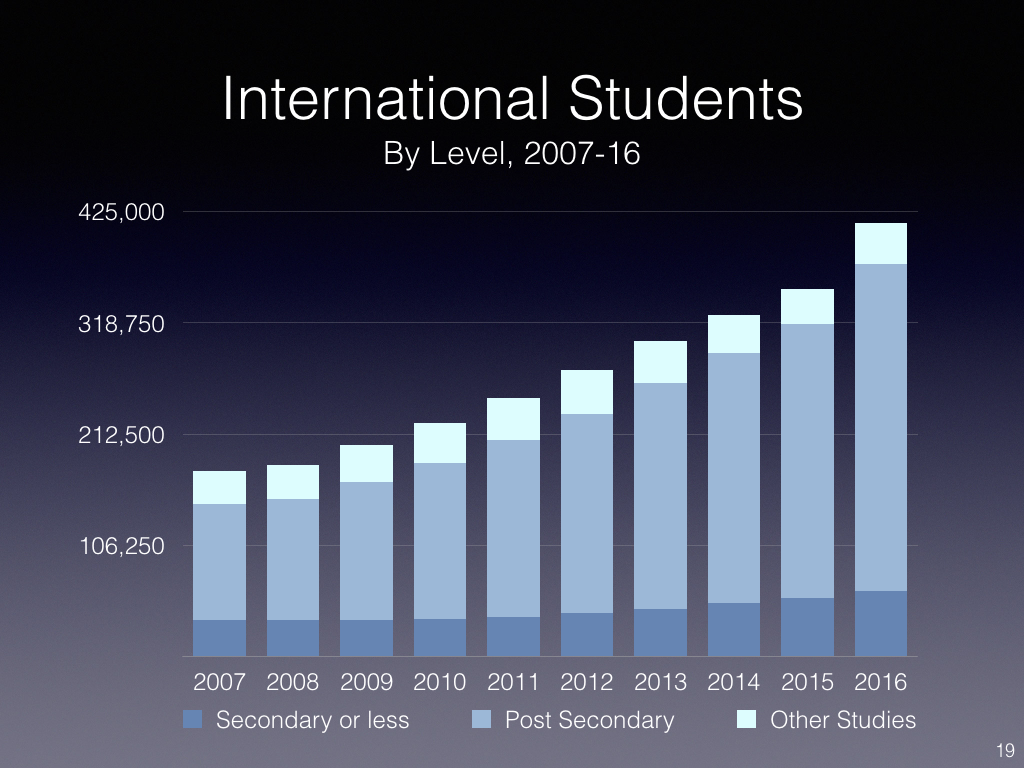
The chart below provides the breakdown by students by education level, showing a significant number of minors where these issues present themselves (about 18 percent in 2016 – haven’t updated with 2017 numbers yet):

…Hundreds of thousands of international students are here from around the world, many even younger than Tina, and largely fending for themselves in a new country without adequate support from school boards, provincial governments and the federal government, industry experts say. And now settlement agencies, student recruiters and host family companies are urging these bodies to regulate the industry.

Moy Wong-Tam, executive director of the Centre for Immigrant and Community Services (CICS) in Toronto said the unregulated industry leaves students vulnerable to scams and poor treatment at the hands of the people responsible for the kids’ well-being, she said.

“It’s concerning because we’re seeing many gaps,” Wong-Tam said. “The system is full of holes right now.”

Custodians and host families

When minors arrive in Canada, they have two main points of contact — a host family or homestay, and a custodian, who is a delegate appointed by the parents to check in on their children and help them in case of any emergencies.

But Wong-Tam, whose settlement agency provided services to 20,000 newcomers in 2016, about 300 of whom were international students, said the industry supporting temporary residents is largely unregulated. Furthermore, she told CBC News it’s unlikely homestay families and custodians can replace a student’s parents, particularly when there’s money to be made from the system.

The students’ families typically pay between $950 and $1,300 a month to the homestay family for meals and a place to live, and between $1,000 and $2,500 a year to the custodian, depending on the range of services he or she offers.

…School boards, firms have their own rules

Currently, Immigration, Refugees and Citizenship Canada (IRCC) requires parents of foreign students under 18 to sign a custodianship declaration form. The federal government’s only stipulation is “a custodian is a responsible adult (Canadian citizen or a permanent resident) who takes care of and supports the child.”

School boards or companies that help families find a custodian have their own rules, including criminal background checks and mandatory insurance. Some, like the York Catholic District School Board, require that the guardian sign an affidavit for his or her role in the student’s welfare and a separate agreement accepting responsibility for any “inappropriate behaviour” from the student.

Alex Mazzucco, program co-ordinator of international education at the Toronto Catholic District School Board, said the students sometimes bring up issues to the board, which can get parents involved, but there’s no way to take a complaint further with the federal government.

“There’s no mechanisms with IRCC where you can file a complaint where they’ll respond,” he said. “We’ve filed complaints but have not received any response.”

Culturally, students often don’t report issues to the school board or even their parents, said Liu.

“Being polite, not speaking up, it’s part of Chinese culture,” he said. “They don’t want to fight with others. When something happens, they first think about themselves. ‘Did I do something wrong?'”

CBC News contacted both the public and Catholic school boards for Toronto, Peel and York Region. The York Region school boards and the Toronto District School Board did not respond to requests for an interview.

Filling the seats

CICS’s Wong-Tam said institutions have a moral obligation to care for the underage students, particularly since “classrooms need international students to fill the seats.”

An international high school student pays an average of $14,000 in tuition a year, according to Greater Toronto Area school boards’ websites. The latest federal government data shows spending associated with international students in 2014, including their visiting families and friends, amounted to $11.4 billion a year, contributed $9.3 billion to Canada’s GDP and helped sustain 123,000 jobs.

A 2015 Ontario report said international students contribute more than $4 billion to the province’s economy annually, generating more than 30,000 jobs.

With this much money coming in, Wong-Tam is calling on the institutions to have a dialogue.

“I know tragedies happen to all Canadians but international students are so much more vulnerable,” she said. “They need a little more help since they’re paying more tuition.”

In an email to CBC News, IRCC said: “Parents or legal guardians are ultimately best placed to select the custodian of their child and to determine whether the custodian is fulfilling the duties entrusted to them.”

Liu said there’s little the parents can do from so far away, so the institutions bringing them in should take more responsibility, including the provincial government, which oversees the school boards.

Ontario’s Ministry of Education told CBC News in a statement: “If a [school] board chooses to have homestay programs, they are responsible for monitoring homestay families’ compliance with applicable requirements (i.e. insurance, safety standards, etc.).”

Wong-Tam, Liu and another homestay company that CBC News interviewed said all the parties need to take responsibility.

Source: Overseas teens left vulnerable by lucrative Canadian student visa program, experts say

UK immigration latest: EU net migration falls over past year as Brexit uncertainty continues | The Independent

Not surprising:

EU net migration is falling as more European citizens leave the UK and fewer arrive in the wake of the vote for Brexit, new statistics show.

The Office for National Statistics (ONS) said overall net migration in the year to September was 244,000 – a similar level to early 2014 and down on record levels in the next two years.

The number of European citizens arriving has plummeted since the EU referendum, while the number of people from outside the bloc has increased.

“EU net migration has fallen as fewer EU citizens are arriving, especially those coming to look for work in the UK, and the number leaving has risen – it has now returned to the level seen in 2012,” said Nicola White, head of international migration statistics at the ONS.

“The figures also show that non-EU net migration is now larger than EU net migration, mainly due to the large decrease in EU net migration over the last year. However, migration of both non-EU and EU citizens are still adding to the UK population.

“Brexit could well be a factor in people’s decision to move to or from the UK, but people’s decision to migrate is complicated and can be influenced by lots of different reasons.”

The number of EU citizens coming to the UK plummeted by 47,000 in the year and the number leaving – 130,000 – is the highest recorded level since the 2008 financial crisis.

Almost a quarter of a million people arrived in the UK to work in the period 2017, with the number of EU citizens falling by 58,000.

Most of the Europeans arriving had a definite job lined up, while a smaller proportion were looking for work.

The biggest nationality starting work in the year to September, according to National Insurance number registration data, was Romanian, followed by Polish, Italian, Bulgarian, Spanish and Indian – who accounted for over half of all skilled work visas granted.

The ONS said that the overall employment rate for EU nationals was 81.2 per cent, followed by Brits at 75.6 per cent and non-EU nationals on 63.2 per cent.

George Koureas, a partner at immigration law firm Fragomen, said: “The UK has become a significantly less attractive place for European citizens to work since Brexit, so it’s no surprise that more EU workers are leaving the country.

“Although the Government may see this as good news, it presents a significant threat to UK businesses, already struggling to hire the skilled workers they need to thrive.”

He said there could be a further impact from the Government’s plan to double the Immigration Health Surcharge, which is paid by migrants to use the NHS, and caps on visas for skilled workers.

via UK immigration latest: EU net migration falls over past year as Brexit uncertainty continues | The Independent

ICYMI: Australia – Dutton pushes on with citizenship changes

More Australia news:

Peter Dutton will try again to pass a controversial suite of citizenship changes shot down in the Senate last year.

The Home Affairs Minister wants to extend the waiting time for permanent residents to apply for citizenship, create tougher English language tests and give himself additional powers.

“I can assure you that the government remains committed to this reform,” Mr Dutton told the National Press Club in Canberra on Wednesday.

“We will work with the crossbench on the basis of a new package of measures flagged at the end of last year.”

Mr Dutton has signalled he is willing to cede some ground in negotiations with the crossbench.

However, he would prefer to secure bipartisan support rather than dealing with an unpredictable assortment of independents, urging the Labor Party to shift its position.

“If they don’t, I’m confident that (Citizenship Minister) Alan Tudge can deal with the independent senators and negotiate an outcome to the package.”

The government initially wanted to lift English requirements from “basic” to “competent”, which would require aspiring citizens to understand fairly complex language and have an effective grasp of English.

It has since agreed to accept a “modest” level, meaning would-be Australians must be able to handle basic communication and have a partial command of the language, while making many mistakes.

The government also wanted to impose its crackdown retrospectively, capturing everyone who applied for citizenship since its policy was announced on April 20, 2016.

It is now willing to hold fire on the changes until July 1 this year.

The Nick Xenophon Team, whose bloc of votes was critical last year, were not immediately won over by the watered-down changes, but their power has since been diminished by the fall-out from the dual citizenship saga.

via Dutton pushes on with citizenship changes