Dr. King Said Segregation Harms Us All. Environmental Research Shows He Was Right.@NYTimes

Speaks for itself:

A half-century ago, the Rev. Dr. Martin Luther King Jr. was killed in Memphis on the balcony of the Lorraine Motel. To get to the site, which is now the National Civil Rights Museum, you can cross through neighborhoods that are as much as 97 percent black or as much as 93 percent white.

Dr. King preached that segregation was harmful not only to black Americans but also to the nation as a whole. He died before the modern environmental movement, but a growing body of research around pollution and health shows that his belief about segregation hurting everyone extends to the environment as well. Many American cities that are more racially divided have higher levels of pollution than less segregated cities. As a result, both whites and minorities who live in less integrated communities are exposed to higher levels of pollution than those who live in more integrated areas.

“The price that America must pay for the continued oppression of the Negro is the price of its own destruction,” Dr. King wrote in a 1962 address, “An Analysis of the Ethical Demands of Integration.” In it, he set out the political, ethical and spiritual reasons he believed that segregation was harmful for all. Some historians say his thoughts are applicable to understanding environmental issues today.

Researchers have known since at least the 1980s that black and Hispanic communities have higher levels of pollution and its associated harmful health effects than white communities, even when controlling for income. Studies show that racial discrimination leads governments and companies to place polluting facilities, like landfills, power plants and truck routes, in black and Hispanic communities. Race is not the only factor in environmental inequality — poorer people experience more pollution than wealthier people. But for blacks, race trumps income. Middle-class blacks experience higher levels of pollution than low-income whites.

Over the past decade, more researchers have focused on the correlation between segregation and broad pollution exposure. Residents of a city like Memphis, they have found, are exposed to more pollution than those living in a city like Tampa, Fla., which is less racially divided.

“Even though white residents in segregated cities were better off than residents of color in those segregated cities, those white residents were worse off than their white counterparts in less segregated cities,” said Rachel Morello-Frosch, a professor of environmental health at the University of California, Berkeley.

Studies have found this relationship between segregation and air pollution, water pollution and even noise pollution. A large body of literature shows that high exposure to certain pollution can cause asthma, heart disease and many other negative health effects.

“It’s so much pollution that it led not only to very high exposure to minorities but it actually bounces back to at least some whites,” said Michael Ash, a professor of economics at the University of Massachusetts, Amherst, and an author of a study that looked at the impact of segregation on pollution levels.

There are several ways to look at segregation: by isolation, defined as the degree to which ethnic groups are clustered together, or by dissimilarity, defined as how evenly two groups are spread across an area. By either method, pollution is higher in more segregated communities.

The average white person in metropolitan America lives in a neighborhood that is 75 percent white. The average black person lives in a neighborhood that is 35 percent white and 45 percent black. Those numbers have not changed much since 1940.

These studies do not prove that segregation leads to more pollution, or vice versa. But the outcomes showing that all people who live in racially divided communities are exposed to higher levels of pollution probably would not have surprised Dr. King, according to King scholars.

“King thinks that racism divides the people who are most vulnerable and most disempowered for economic and political reasons,” said Brandon M. Terry, an assistant professor of African and African-American studies at Harvard and an editor of a new book on Dr. King’s political theories.

“In a community where there are really stark racial tensions it’s going to be really difficult to organize a large enough group to fight back against exploitative industries or corporations that don’t want to do their fair share to take care of environmental hazards,” Dr. Terry said. “All those people have to do is invoke the idea of a racial interest and they can split those groups quite easily.”

Several studies have shown that unequal societies invest less in environmental policies, monitoring and research.

“In more segregated cities, communities of color and the poor might be less able to have civic engagement power and influence land-use decision making,” said Dr. Morello-Frosch. “They have less ability to resist” when decisions are made about polluting activities, she said.

Dr. King may have foreshadowed this in his 1963 speech in Detroit. “Segregation is a cancer in the body politic,” he said, “which must be removed before our democratic health can be realized.”

via Dr. King Said Segregation Harms Us All. Environmental Research Shows He Was Right. – The New York Times

Should justice be delivered by AI?

Interesting discussion. My understanding is that more legal research is being done by AI and my expectation is that more routine legal work could increasingly be done by AI.

For government, the obvious question is with respect to administrative decisions such as immigration, citizenship, social security etc in routine cases. As the article notes, AI would likely be more consistent than humans, but the algorithms would need to be carefully reviewed given possible programmer biases:

It is conventional wisdom, repeated by authoritative voices such as the former chief justice of Canada Beverley McLachlin, that Canadians face an access-to-justice (A2J) crisis. While artificial intelligence (AI) and algorithm-assisted automated decision-making could play a role in ameliorating the crisis, the contemporary consensus holds that the risks posed by AI mean its use in the justice system should be curtailed. The view is that the types of decisions that have historically been made by judges and state-sanctioned tribunals should be reserved exclusively to human adjudicators, or at the very least be subject to human oversight, although this would limit the advantages of speed and lowered cost that AI might deliver.

But we should be wary of prematurely precluding a role for AI in addressing at least some elements of the A2J crisis. Before we concede that robust deployment of AI in the civil and criminal justice systems is to be avoided, we need to take the public’s views into account. What they have to say may lead us to very different conclusions from those reached by lawyers, judges and scholars.

Though the prospect of walking into a courtroom and being confronted by a robot judge remains the stuff of science fiction, we have entered an era in which informed commentators confidently predict that the foreseeable future will include autonomous artificial intelligences passing bar exams, getting licensed to practice law and, in the words of Matthew and Jean-Gabriel Castel in their  2016 article “The Impact of Artificial Intelligence on Canadian Law and the Legal Profession,” “perform[ing] most of the routine or ‘dull’ work done by justices of the peace, small claims courts and administrative boards and tribunals.” Hundreds of thousands of Canadians are affected by such work every year.
Influential voices in the AI conversation have strongly cautioned against AI being used in legal proceedings. Where the matter has been addressed by governments, such as in the EU’s General Data Protection Regulation or France’s Loi informatique et libertés, that precautionary approach has been rendered as a right for there always to be a “human in the loop”: decisions that affect legal rights are prohibited from being made solely by means of the automated processing of data.

Concerns about the accountability of AI — both generally and specifically in the context of legal decisions — should not be lightly dismissed. There are significant and potentially deleterious implications to replacing human adjudicators with AI. The risks posed by the deployment of AI in the delivery of legal services include nontransparency and concerns about where to locate liability for harms, as well as various forms of bias latent in the data relied on, in the way that algorithms interact with those data and in the way that users interact with the algorithm. Having AI replace human adjudicators may not even be technically possible: some observers such as Frank Pasquale and Eric L. Talley have taken pains to point out that there is an irreducible complexity, dynamism and nonlinearity to law, legal reasoning and moral judgment, which means these matters may not lend themselves to automation.

Real as those technological constraints may be at the moment, they also may be real only forthe moment. Furthermore, while these constraints may apply to some (or even many) instances of adjudication, they don’t — or likely won’t — continue to apply to all of them. Law’s complexity runs along many axes, including applying to many areas of human endeavour and impacting many different aspects of our lives. This requires us to be careful not to treat all interactions with the justice system as equivalent for purposes of AI policy. We might use algorithms to expeditiously resolve, for example, consumer protection complaints or breach of contract disputes, but not matters relating to child custody or criminal offences.

Whether and when we deploy AI in the civil and criminal justice systems are questions that should be answered only after taking into account the views of the people who would be subject to those decisions. The answer to the question of judicial AI doesn’t belong to judges or lawyers, or at least not only to them — it belongs, in large part, to the public. Maintaining public confidence in the institution of the judiciary is a paramount concern for any liberal democratic society. If the courts are creaking under the strain of too many demands, if resolutions to disputes are hobbled by lengthy delays and exorbitant costs, we should be open to the possibility of using AI and algorithms to optimize judicial resources. If and to the extent we can preserve or enhance confidence in the administration of justice through the use of AI, policy-makers should be prepared to do so.

We can reframe the issue as an inquiry into what people look for from judicial decision-making processes. What are the criteria that lead people who are subject to justice system decisions to conclude that the process was “fair” or “just”? As Jay Thornton has noted , scholars in the social psychology of procedural justice, such as Gerald Leventhal and Tom Tyler, have done empirical work that provides exactly this insight into people’s subjective views. People want their justice system to feature such characteristics as consistency, accuracy, correctability, bias suppression, representativeness and ethicality. In Tyler’s formulation, people want a chance to present their side of the story and have it be considered; they want to be assured of the neutrality and trustworthiness of the decision-maker; and they want to be treated in a respectful and dignified manner.

It is not obvious that judicial AI fails to meet those criteria — it is almost certainly the case that on some of the relevant measures, such as consistency, judicial AI might fare better than human adjudicators. (Research has indicated, for example, that judges render more punitive decisions the longer they go without a meal — in other words, a hungry judge is a harsher judge. Whatever else might be said about robot judges, they won’t get hungry. When deciding between human adjudication and AI adjudication, we should also attend to the question of whether existing human-driven processes are performing adequately on the criteria identifiedby Leventhal and Tyler. That is not a theoretical inquiry but an empirical one: it should be assessed by reference to the subjective satisfaction of the parties who are involved in those processes.

There may be certain types or categories of judicial decisions that people would prefer be performed by AI if so doing would result in faster and cheaper decisions. We must also take fully into account the fact that we already calibrate adjudicative processes for solemnity, procedural rigour and cost to reflect conventional views of what kinds of claims or disputes “matter” and to what extent they do so. For example, the rules of evidence that apply in “regular” courts are significantly relaxed (or even obviated) in courts designated as “small claims” (which often aren’t so small: in Ontario, Small Claims Court applies to disputes under $25,000). Some tribunals that make important decisions about the legal rights of parties — such as the Ontario Landlord and Tenant Board — do not require their adjudicators to have a law degree. We have been prepared to adjust judicial processes in an effort to make them more efficient, and where technology has been used to improve processes and facilitate dispute resolution, as has been the case with British Columbia’s online Civil Resolution Tribunal, the results appear to have been salutary. The use of AI in the judicial process should be viewed as a point farther down the road on that same journey.

The criminal and civil justice systems do not exist to provide jobs for judges or lawyers. They exist to deliver justice. If justice can be delivered by AI more quickly, at less cost and with no diminishment in public confidence, then the possibilities of judicial AI should be explored and implemented. It may ultimately be the case that confidence in the administration of justice would be compromised by the use of AI — but that is an empirical question, to be determined in consultation with the public. The questions of confidence in the justice system, and of whether to facilitate and deliver justice by means of AI (including the development of a taxonomy of the types of decisions that can or should be made using AI), can only be fully answered by those in whom that confidence resides: the public.

via Should justice be delivered by AI?

Women in tech gain experience but their pay gap with men gets worse – Recode

Scope for more analysis here to explain the growing disparity beyond the possible explanation of more balance between work and family:

The pay disparity between women and men is often framed as a difference in experience. But women actually miss out on pay as they gain experience, according to new data from tech job platform Hired.

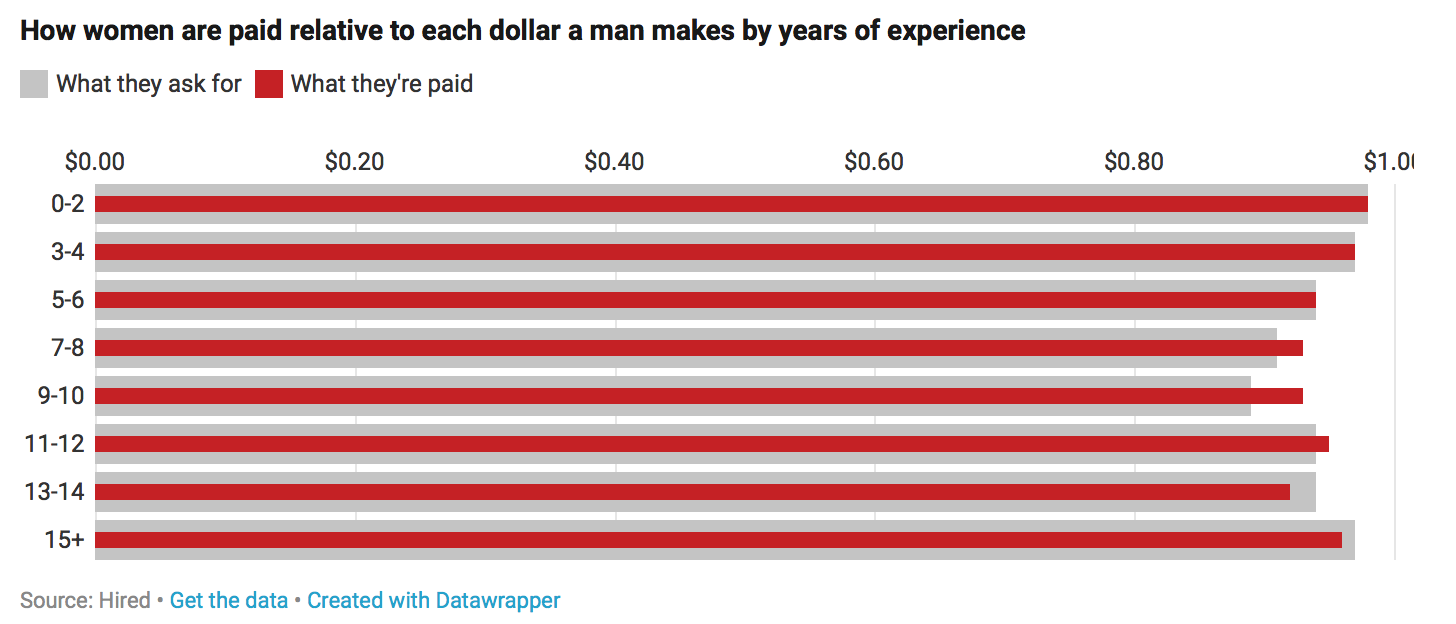
Within the first two years of working in a tech job, women in the U.S. ask for and receive 98 percent of what their male counterparts make in the same job at the same company, according to the report.

Over time, that disparity grows.

On average, women with seven to 10 years of experience, for example, ask for about 90 cents on the dollar and are offered slightly more — 93 cents for every dollar a man is offered. Women with 13 to 14 years of experience ask for 94 cents for every dollar and receive just 92 cents.

There are a number of reasons for this gap beyond simply asking for less and in turn receiving less. Entry-level jobs usually have more clear-cut salary data, so men and women alike know what a specific position is worth. As job candidates advance in their careers, data on a position’s salary becomes spottier, and raises and promotions are not dealt out equally between men and women.

Exacerbating this is the fact that salary requests tend to be based on current salary. That means that if, say, a woman doesn’t receive the same promotions and raises as her male counterparts, she will ask for less than men in each subsequent position, compounding the salary disparity over time.

Additionally, as women get older, they’re also more likely to have children, which is also linked to lower salaries.

The situation is worse for women of color or those who identify as LGBTQ.

Black and Latina women in tech make 90 cents for every dollar a white man makes. That’s a marked improvement over last year but the gulf is still substantial.

Overall, the study found that, in the U.S., men are offered higher salaries than women for the same position 63 percent of the time. It also found that companies offer women 4 percent less than men for the same role, on average. This is basically the same as last year’s findings.

Salary data reflects base pay only and is drawn from a sample of 420,000 interview requests and job offers among 10,000 participating companies and about 98,000 job candidates. Demographics data is self-reported. Hired job seekers set a preferred salary, and companies have to include compensation information for every interview request.

via Women in tech gain experience but their pay gap with men gets worse – Recode

The making of a gender-balanced foreign service

Good mix of data and female foreign service officer perspectives by Catherine Tsalikis of OpenCanada:

…Over the decades, being a woman in the foreign service has gotten easier, but life as a diplomat today is not without its sacrifices. In a job that requires setting up shop in a different country every few years, is it really possible for women to “have it all”?

“I got married at 35 and I had thought, oh my god, maybe it’ll never happen!” Gervais-Vidricaire laughed. She says that when she was in her thirties, “very, very few women became EXs and had a family…I think it was good to show that it was possible to do it; I got married, I had two kids.”

Bogdan describes her time in Belgrade as being hard on her family. But she points out that her children have benefited over the years from being exposed to different cultures and now have a deeper appreciation of what it means to be Canadian. “My daughter was with me the weekend we went through that kind of revolution where a million people came out into the streets to defend their vote,” she remembers. “At such a developmental age, [she] actually saw the birth of democracy…it was such an incredibly powerful experience.”

And ultimately, of course, “having it all” means different things to different people.

Blais points out that even with all the progressive measures the department has put in place over the years — maternity leave, paternity leave, leave (without pay) for child-rearing or taking care of elderly relatives, a compressed work week — numbers have yet to reach parity at the upper management levels.

“I’m not sure we have a full diagnostic of why that is,” she says, adding that it would be helpful to set up longer, extended exit interviews with women who don’t return after taking a period of leave without pay, or after maternity leave.

“If I’m going to be truthful, I have to say that I think part of the reason why we’ve got this issue of not enough representation in the senior ranks is that there are a lot of women in the department who are incredibly talented but decide to have different priorities. And that’s okay too.”

McDougall agrees, and says that when it comes to supporting and promoting women in all industries, “it’s not necessarily so that they get to be president of the corporation or the managing partner of the law firm, but so that they have more choices.”

But for those who do aspire to have a spouse and a family while fulfilling ambitious career goals, Blais believes it’s possible, although not without some hardship and, often, sheer exhaustion.

She looks back on her first decade or so with kids as her “Wonder Woman” years, juggling her priorities as a foreign service officer, wife and mother. She made it a point to always have breakfast during the week with her sons, never accepting early-morning meetings unless she was travelling. On the flip side, weekday evenings were fair game for representing Canada at receptions and work functions. “There were two worlds, and I was running in between them, and I was working very, very hard,” Blais recalls.

As her kids grew into teenagers, and the “adrenaline stopped pumping,” Blais did go through a period of intense burnout and soul-searching. “I was petering on the edge for a while there, and finally it went off balance altogether.” Looking back, she thinks maybe she could have “dialled down the intensity a little bit” and still have made her way. “But I am pretty convinced that I am where I am today because I was very dedicated to my work,” she said.

Now, with her team at the UN, she is careful to apply what she knows about the importance of mental health and maintaining a “very fragile equilibrium.”

“What I try to do now as a manager is to let my staff know that perhaps you don’t need to be here until eight or nine o’clock. Do you really need that, or are you doing it because that’s what you feel you must do to do a good job? Sometimes those are two different things.”

This is something Blais wishes someone had done for her. “I think women tend to be very intense. We care so much about the work, and not to say that men don’t, but there’s a real, almost emotional attachment to the quality of our work that can be dangerous if we don’t manage it better.”

With two decades of diplomacy under her belt, Blais says that a sense of perspective is perhaps the most important tool a woman in the foreign service can have in her arsenal — no second-guessing, no getting emotionally drawn into whether her advice is being retained, or whether she handled a negotiation perfectly.

“When you become a leader, people count on you to be strong, and in order to be strong you have to have perspective,” she said.

“You know how people say, well, if I don’t do this right, no one’s going to die…you know what, actually somebody could die! It’s larger than life, what we do.

Over the decades, being a woman in the foreign service has gotten easier, but life as a diplomat today is not without its sacrifices. In a job that requires setting up shop in a different country every few years, is it really possible for women to “have it all”?

“I got married at 35 and I had thought, oh my god, maybe it’ll never happen!” Gervais-Vidricaire laughed. She says that when she was in her thirties, “very, very few women became EXs and had a family…I think it was good to show that it was possible to do it; I got married, I had two kids.”

Bogdan describes her time in Belgrade as being hard on her family. But she points out that her children have benefited over the years from being exposed to different cultures and now have a deeper appreciation of what it means to be Canadian. “My daughter was with me the weekend we went through that kind of revolution where a million people came out into the streets to defend their vote,” she remembers. “At such a developmental age, [she] actually saw the birth of democracy…it was such an incredibly powerful experience.”

And ultimately, of course, “having it all” means different things to different people.

Blais points out that even with all the progressive measures the department has put in place over the years — maternity leave, paternity leave, leave (without pay) for child-rearing or taking care of elderly relatives, a compressed work week — numbers have yet to reach parity at the upper management levels.

“I’m not sure we have a full diagnostic of why that is,” she says, adding that it would be helpful to set up longer, extended exit interviews with women who don’t return after taking a period of leave without pay, or after maternity leave.

“If I’m going to be truthful, I have to say that I think part of the reason why we’ve got this issue of not enough representation in the senior ranks is that there are a lot of women in the department who are incredibly talented but decide to have different priorities. And that’s okay too.”

McDougall agrees, and says that when it comes to supporting and promoting women in all industries, “it’s not necessarily so that they get to be president of the corporation or the managing partner of the law firm, but so that they have more choices.”

But for those who do aspire to have a spouse and a family while fulfilling ambitious career goals, Blais believes it’s possible, although not without some hardship and, often, sheer exhaustion.

She looks back on her first decade or so with kids as her “Wonder Woman” years, juggling her priorities as a foreign service officer, wife and mother. She made it a point to always have breakfast during the week with her sons, never accepting early-morning meetings unless she was travelling. On the flip side, weekday evenings were fair game for representing Canada at receptions and work functions. “There were two worlds, and I was running in between them, and I was working very, very hard,” Blais recalls.

As her kids grew into teenagers, and the “adrenaline stopped pumping,” Blais did go through a period of intense burnout and soul-searching. “I was petering on the edge for a while there, and finally it went off balance altogether.” Looking back, she thinks maybe she could have “dialled down the intensity a little bit” and still have made her way. “But I am pretty convinced that I am where I am today because I was very dedicated to my work,” she said.

Now, with her team at the UN, she is careful to apply what she knows about the importance of mental health and maintaining a “very fragile equilibrium.”

“What I try to do now as a manager is to let my staff know that perhaps you don’t need to be here until eight or nine o’clock. Do you really need that, or are you doing it because that’s what you feel you must do to do a good job? Sometimes those are two different things.”

This is something Blais wishes someone had done for her. “I think women tend to be very intense. We care so much about the work, and not to say that men don’t, but there’s a real, almost emotional attachment to the quality of our work that can be dangerous if we don’t manage it better.”

With two decades of diplomacy under her belt, Blais says that a sense of perspective is perhaps the most important tool a woman in the foreign service can have in her arsenal — no second-guessing, no getting emotionally drawn into whether her advice is being retained, or whether she handled a negotiation perfectly.

“When you become a leader, people count on you to be strong, and in order to be strong you have to have perspective,” she said.

“You know how people say, well, if I don’t do this right, no one’s going to die…you know what, actually somebody could die! It’s larger than life, what we do.”

via The making of a gender-balanced foreign service

Trudeau tweet caused influx of refugee inquiries, confusion within government, emails reveal

Not surprising. I can only imagine the internal conversations.

Of course, compared to Trump tweets, contradictions and reversals … (not intended as a benchmark):

When Prime Minister Justin Trudeau used Twitter to welcome refugees to Canada last winter, it prompted a spike in inquiries from would-be refugees to Canadian embassies abroad, and resulted in confusion within the federal government, newly released emails reveal.

“To those fleeing persecution, terror & war, Canadians will welcome you, regardless of your faith. Diversity is our strength #WelcomeToCanada,” Trudeau said on Twitter Jan. 28, 2017, the day after Trump put out an executive order banning refugees and visitors from Muslim-majority countries Iran, Iraq, Libya, Somalia, Sudan, Syria and Yemen.

It was widely seen as a comment on Trump’s policy. To date the message has been retweeted over 400,000 times and liked more than 750,000 times. International commentators wondered whether Canada was announcing it would take in all those banned from entering the U.S. Some Canadian officials wondered about that too, according to records the National Post obtained through an access-to-information request.

Noting that Trudeau’s message had been picked up by the New York Times, an Immigration, Refugees and Citizenship Canada official anticipated in an email to colleagues, the same evening as the tweet, that “there will be more pressure” to respond the following day.

Two days later, officials stickhandling media requests were worrying about overloading spokespeople. “I’m sorry, I’m trying to figure out how not to max you out,” one said in an email.

In addition to requests from media there were queries from Canada’s own officials posted abroad. Concerns from the embassy in Mexico appear in an email chain with the subject line “Guidance required on how to respond to increasing number of refugee enquiries in the region following change in US administration and Prime Minister’s tweet.”

The first secretary and “risk assessment officer” at the embassy, whose name is redacted, sent an initial message on Feb. 1, 2017, four days after the tweet.

“I am seeking official guidance/response from Ottawa on how to address refugee enquiries following all the publicity around the US ban on some nationalities, and our Prime Minister’s tweet on welcoming refugees,” the email began.

“We are receiving an increasing number of enquiries from the public about requesting refugee status in Canada, and a number clearly having links with our Prime Minister’s tweet this weekend. A significant number of the enquiries received since the weekend have been from nationals of the ‘US banned countries’, but we are also receiving them from all nationalities, both through emails and directly at our reception.”

The first secretary went on to say that some of the requests had come from Cuban nationals, and that the mission in Costa Rica had been in touch to express concerns about inquiries being received there, too.

“In the current situation, other missions in our area of responsibilities are probably seeing the same thing happening and I think we need to liaise with them and provide formal guidance on how to address these enquiries given the Prime Minister’s tweet,” the official wrote. “A number of clients are asking if it is true that Canada will accept the refugees the US are rejecting, and what is the process to do so. … I would imagine that missions all around the world are seeing these enquiries increasing since the weekend.”

Much of the ensuing conversation — shared with nine Global Affairs Canada email accounts, another six from IRCC and a few that are blanked out — is redacted.

But it shows immigration officials responding with lengthy messages containing response lines developed to clarify Canada’s intentions after the tweet.

An IRCC official told diplomats on Feb. 2 that the lines, approved by the Privy Council Office, were also being shared with officials at the Canada Border Services Agency. The suggested response started with: “We are working with the United Nations Refugee Agency, U.S. officials and our missions abroad to clarify the current situation and determine what our next steps might be.”

Trudeau ultimately stood by the message in his tweet but began adding, during public appearances, that “there are steps to go through” to be considered a refugee. Canada did not change the number of refugees it would accept through resettlement programs. But Conservative politicians would go on to blame the tweet for encouraging an uptick in irregular crossings by asylum seekers at the Canada-U.S. border, particularly in Manitoba and Quebec.

Trump’s travel ban was met with widespread protest and challenged in court. After parts of the executive order were struck down, Trump twice reissued altered versions, both of which include the same list of countries minus Iraq. The U.S. Supreme Court is expected to rule on the legality of the latest iteration, issued in September, by June.

Source: Trudeau tweet caused influx of refugee inquiries, confusion within government, emails reveal

Iran’s Leader Is Worse Than Hitler and Wants to Spread Islam to America, Says Saudi Prince Mohammed bin Salman

Bit rich given the considerable Saudi funding provided in many countries to support their fundamentalist strain of Islam. Will that stop?:

The heir to the Saudi throne has lambasted Iran, saying its Supreme Leader is the first side of a “triangle of evil” along with the Muslim Brotherhood and extremist Islamist groups like Isis.

In an echo of former U.S. president George W. Bush’s 2002 reference to Iran’s supposed role in an “axis of evil,” Crown Prince Mohammed bin Salman told The Atlantic that Ayatollah Ali Khamenei was akin to Hitler and headed a regime that wanted to spread “extremist Shiite ideology.”

The crown prince added that if Tehran got its way, “the hidden Imam will come back again and he will rule the whole world from Iran and spread Islam even to America,” referring to the final savior of humankind according to Iran’s Twelver Shia faith.

He said: “The second part of the triangle is the Muslim Brotherhood, which is another extremist organization. They want to use the democratic system to rule countries and build shadow caliphates everywhere… And the other part is the terrorists, al-Qaeda, ISIS, that want to do everything with force.

“I believe that the Iranian supreme leader makes Hitler look good. But the supreme leader is trying to conquer the world. He believes he owns the world. They are both evil guys. He is the Hitler of the Middle East,” he added.

The wide-ranging interview will be seen as the latest move by the royal to present a different image of his country. In November he ordered a crackdown on businessmen and officials accused of corruption, which has reportedly recovered 100 billion dollars in financial settlements, although critics said it was a purge of his rivals to consolidate power.

Women will also be allowed to drive for the first time in the kingdom, although the country’s guardianship laws, which he describes as only “customs,” which restrict women’s freedoms, remain in place.

The crown prince insists his country is part of a group of moderate Muslim nations which include Jordan, Oman, Kuwait and the United Arab Emirates which are, in his view, countries based on the founding principles of the United Nations whose values are at odds with those of the “evil triangle.”

But Salman puzzled his interviewer when he denied that Wahhabism, the austere fundamentalist strand of Islam which is the bedrock of the country, even existed in Saudi Arabia.

“No one can define Wahhabism. There is no Wahhabism. We don’t believe we have Wahhabism. We believe we have, in Saudi Arabia, Sunni and Shiite. We believe we have within Sunni Islam four schools of thought,” he said, adding that Shiites held many positions of power in government and society.

He said he has no religious objections to the right of Israel to exist, and that his concerns were solely about the fate of the holy mosque in Jerusalem and the rights of the Palestinian people.

“I believe that each people, anywhere, has a right to live in their peaceful nation. I believe the Palestinians and the Israelis have the right to have their own land. But we have to have a peace agreement to assure the stability for everyone and to have normal relations.

“We have religious concerns about the fate of the holy mosque in Jerusalem and about the rights of the Palestinian people. This is what we have. We don’t have any objection against any other people.

“Our country doesn’t have a problem with Jews. Our Prophet Muhammad married a Jewish woman. Not just a friend—he married her. Our prophet, his neighbors were Jewish. You will find a lot of Jews in Saudi Arabia coming from America, coming from Europe. There are no problems between Christian and Muslims and Jews. We have problems like you would find anywhere in the world, among some people. But the normal sort of problems,” said the crown prince.

via Iran’s Leader Is Worse Than Hitler and Wants to Spread Islam to America, Says Saudi Prince Mohammed bin Salman

Un élu presse le SPVM (Montreal police) d’intégrer le hijab et le turban

Other police services have managed to do so:

Le Service de police de la Ville de Montréal (SPVM) doit autoriser ses agents à porter le hijab ou le turban, réclame un élu montréalais. Le conseiller Marvin Rotrand estime que le silence du corps policier sur ces accessoires religieux représente une barrière invisible pour les communautés culturelles.

Marvin Rotrand a récemment écrit à la responsable de la sécurité publique de Montréal, Nathalie Goulet, afin de réclamer l’intégration du hijab et du turban dans l’uniforme réglementaire du SPVM. «Ça envoie un message positif aux communautés : “Vous êtes les bienvenus. Si vous avez les qualifications, vous réussissez les tests, personne ne va s’opposer à votre candidature”», écrit M. Rotrand dans la lettre obtenue par La Presse.

Démarche en 2016

Ce n’est pas la première fois que l’élu presse le SPVM d’inscrire noir sur blanc que ces signes religieux soient acceptés dans l’uniforme des agents. En 2016, le corps policier lui avait répondu ne pas avoir «de politique précise en lien avec le port d’un hijab, ni un modèle d’approuvé». «Toutefois, nous restons ouverts à évaluer toute éventuelle demande à ce sujet.»

La Presse a tenté de savoir si le SPVM avait mis à jour ses politiques depuis deux ans, mais nous n’avons pas reçu de réponse à ce jour.

Marvin Rotrand estime que le SPVM fait fausse route en attendant de recevoir des demandes pour modifier ses règles. Le simple fait de ne pas intégrer le hijab représente une barrière invisible, selon lui.

«La communauté musulmane ne devrait pas avoir à le demander. On devrait le modifier avant. Ça ne devrait pas reposer sur les épaules des minorités de demander un traitement équitable.»

Plusieurs corps policiers ont déjà modifié leurs règles vestimentaires pour autoriser le hijab et le turban, dont Toronto et Edmonton. La Gendarmerie royale du Canada (GRC) a intégré le turban en novembre 1990 et le hijab en janvier 2016.

En fait, la police montée fournit même des hijabs et des turbans qui ont été approuvés. Ceux-ci ont fait l’objet d’essais pour s’assurer qu’ils ne nuisent pas au travail des agents. «Les essais ont démontré que le port du hijab et du turban ne nuit pas à l’efficacité des membres dans l’exercice de leurs fonctions», indique la sergente Marie Damian, porte-parole de la GRC.

Autorisation et déclaration

À noter, les policiers qui veulent être exemptés du port du chapeau traditionnel de feutre de la GRC doivent obtenir une autorisation et faire une déclaration de croyance religieuse. Depuis 2013, seulement onze policiers ont porté le turban et une seule policière a demandé à porter le hijab.

«Je m’explique mal comment d’autres corps policiers canadiens ont su adapter leurs exigences en matière d’uniforme afin de faciliter l’intégration des femmes musulmanes dans leurs rangs alors que la Ville de Montréal n’a toujours pas agi en ce sens», se désole M. Rotrand.

Selon lui, le SPVM se prive de candidats de qualité. Il estime par exemple que le corps policier n’aurait jamais recruté Harjit Singh Sajjan, l’actuel ministre de la Défense, qui a servi au sein de la police de Vancouver et en Afghanistan au sein des Forces armées.

via Un élu presse le SPVM d’intégrer le hijab et le turban | Pierre-André Normandin | Grand Montréal

Why Trump’s Census Change Could Hit Asian-Americans Especially Hard

Some interesting analysis of how certain groups of Asian Americans will be more affected (and the corresponding groups that overall are doing well and are unlikely to be affected, which the article does not mention):

The Trump administration’s decision to add a question about citizenship to the census does not bode well for Asian-Americans and Pacific Islanders, civil rights groups fear.

Research has already shown that the minority group is significantly undercounted in the survey, with one-fifth of Asian-Americans and one-third of Native Hawaiians and Pacific Islanders living in hard-to-count census areas. This is partly due to the fact that some Asian-American and Pacific Islander, or AAPI, subgroups have relatively high rates of poverty, unemployment and educational attainment, among other factors.

Experts say the question about citizenship will significantly reduce participation in the census, and Asian-American civil rights organizations are worried about how the question could affect the growing minority group.

“Given the high number of Asian immigrants, any question regarding citizenship is likely to scare the Asian community. We are very concerned that the addition of citizenship question will disproportionately cause an undercount in the Asian community,” John C. Yang, president and executive director of the civil rights group Asian Americans Advancing Justice | AAJC, told HuffPost by email.

“The community already is fearful of the anti-immigrant rhetoric and immigration policies advanced by this administration,” Yang added. “At a minimum, the addition of this question will make it even more challenging to ensure that the community has sufficient trust in the census such that they will respond.”

Treating AAPIs as a monolith ignores how poverty and other factors contribute to undercounting in particular AAPI subgroups, according to a joint fact sheet by the Leadership Conference Education Fund and Georgetown Law’s Center On Poverty and Inequality. While it’s often assumed that AAPIs are financially well-off, reports show that Cambodian-, Hmong- and Laotian-Americans, who predominantly came to the U.S. as refugees, experience higher than average rates of poverty and lower levels of income. More than one-third of Nepalese-Americans also live in poverty.

Communities with lower educational attainment are more difficult to count, too. And Southeast Asian-Americans have some of the highest dropout rates in the country, with about 34.3 percent of Laotian-American adults lacking high school diplomas, as well as 40 percent of Hmong-American and nearly the same percentage of Cambodian-American adults. Yet about 90 percent of the general U.S. adult population finishes high school or gets a GED certificate.

Lower rates of English proficiency contribute to undercounting in the census as well. More than one-third of AAPIs have limited English proficiency, defined as a limited ability to read, speak, write or understand English. And the majority of AAPIs speak a language other than English.

What’s more, much of the AAPI community in the U.S. is made up of immigrants. In fact, almost 60 percent of AAPIs were born in another country, and an estimated 1.7 million undocumented AAPI immigrants live in U.S. The concept of a census is completely foreign for many new immigrants, Yang said, which, along with the citizenship question, would further discourage many AAPIs from participating.

Increased undercounting of AAPIs could have notable repercussions, Yang noted. A report from the GW Institute of Public Policy shows that more than $800 billion of federal funding in fiscal year 2016 relied on census data. And with census data meant to determine political representation, lower participation in the survey could mean AAPI concerns go ignored while resources for hospitals, disaster relief services, health care services and more are misallocated, Yang said.

“Undercount of the Asian American Pacific Islander community will leave the community underrepresented, under-resourced, and under-protected,” he explained. “An undercount will mean that congressional districts will be allocated and drawn without an accurate understanding [of] the Asian American community.”

Already, several AAPI organizations have spoken out against the citizenship question. The Congressional Asian Pacific American Caucus (CAPAC) chair, Rep. Judy Chu (D-Calif.), issued a statement condemning the new measure and expressing her commitment to using the legislative process to stop its implementation.

“The census is essential for ensuring fair and accurate representation and distribution of government resources,” Chu wrote. “But by including a question on citizenship, which is not required by the Constitution, the Trump Administration is exploiting the fear of immigrant communities who are already reticent to divulge personal information to the federal government.”

Social services nonprofit Asian American Federation, along with 35 partners, sent letters to both the CAPAC and the New York Congressional Delegation to advocate against the question. Citing the cost of hiring additional staff for follow-up on unanswered census questions, the question’s lack of testing, and the concerns of immigrant communities, the federation’s executive director, Jo-Ann Yoo, called on legislators to speak out.

Yang is now encouraging members of the public to fight back and make their views known once the U.S. Census Bureau seeks public comment on the questions. He also urges people to call members of Congress to show them how important the issue is to them.

via Why Trump’s Census Change Could Hit Asian-Americans Especially Hard

Parental sponsorship rules are antifeminist

Well I suppose. But assuming one needs to have criteria and limits to parental sponsorship in terms of overall levels of immigration (and of course assuming one supports managed immigration and levels), what alternative criteria should one use?

2018 levels plan has target of 6.5 percent for parents and grandparents:

Can you imagine being required to show proof of income of $39,000 a year for three years just to be able to have your parents close by? That’s about how much new Canadians must show to be reunited with parents through Canada’s parental sponsorship program. And only a few thousand Canadians and permanent residents are allowed, each year, to make the application to bring parents and grandparents here. As if that weren’t tough enough, the processing time is so long and the process can be so cumbersome that aging parents might die before the application is processed.

That’s what happened to the Jaffers, a family forcibly displaced from Kenya when they fled persecution of ethnic South Asians, as the Toronto Star’s Nicholas Keung reported in early March. When Shabbir Jaffer applied to sponsor his mother to come to Canada from the UK in 2007, after the death of his father, he did not know that the application would take 11 years instead of the promised 36 months. He did not know that she would be denied on the basis of the possible costs of a medical procedure that, as it turned out, she did not require. He did not know that the family would incur additional costs because of the appeal process, nor that his mother would pass away in January 2018 from pneumonia with the application stuck in processing, so that all these efforts came to naught.

Here’s the problem: simply put, Canada views parents as a burden. Canada’s parental sponsorship system is set up so that we let as few parents into this country as possible. The requirements imposed on a Canadian citizen or permanent resident submitting the application are onerous. The applicant must undertake to provide their parents with financial support for 20 years, show three years’ worth of income of at least $39,000 per annum and hope that they literally win the lottery: applicants first submit an expression of interest, and then are randomly selected (10,000 spots are available in 2018) to be allowed to apply.

Moreover, medical inadmissibility laws remain on the books; they prevent the granting of permanent residence to someone who may cause “excessive demand” on Canada’s health care system. For most aging parents, this is effectively a bar to admission that can be overcome only through an additional costly application on humanitarian and compassionate grounds. That’s why the Minister of Immigration, Refugees and Citizenship has said that medical inadmissibility rules are not aligned with “our country’s values of inclusion of persons with disabilities in Canadian society.” With changes promised by April 2018, Canadians and permanent residents wait for meaningful reform to the discriminatory requirement, eager to be reunited with their families.

Critics argue that liberalizing parental sponsorship will cost taxpayers money, burdening the system with the disproportionate health care needs of parents and grandparents. We know that the cost savings from medical inadmissibility rules are negligible: 0.1 percent of all provincial and territorial health spending. Moreover, most sponsored parents and grandparents arrive in Canada with assets, many find employment upon arrival, and new Canadians are, as a result, able to keep their savings in Canada rather than sending them home as remittances.

The existing program also discriminates against many new Canadians, because a significant proportion are low- and middle-income families unable to afford the high costs associated with sponsorship. Nor can they afford the high-priced “super visa,” which also requires private medical insurance and is often difficult to obtain; what’s more, this channel is currently plagued by a large processing backlog. Further, family separation hurts not just new Canadians but also the economy. It is the cause of anxiety and emotional distress that can lead to more sick days and less productivity.

But these cost arguments do not account for the emotional and child care support that parents provide. By providing mental and emotional support to their children, parents help set new Canadians up for success. Moreover, without affordable child care, many newcomer parents, particularly single mothers, are shut out of the workforce. By making it easier to sponsor parents, the government can uplift an entire cohort of workers otherwise unable to work.

It should be clear, particularly to this government, that existing parental sponsorship rules are decidedly antifeminist. They keep families apart, cost thousands of dollars to newcomers and hold single parents, particularly women, back from success. If the government is serious about governing through a feminist lens, it could start by overhauling this system that creates two tiers of citizens: one of Canadians who have their families here by accident of birth, and one of new Canadians who must pay thousands in fees, wait many years and win a lottery to be reunited with theirs.

Canadians should have the right to be with their children, and children with their parents. The Jaffers told their story in the hope that nobody else will suffer the heartache forced upon them by the Canadian government. As we reflect after International Women’s Day on building a country that is truly feminist, let’s act by reuniting parents with their children.

via Parental sponsorship rules are antifeminist

The Far-Right Arms Dealer Playing on Germany’s Migrant Fears

Interesting account of the dynamics between the xenophobic Hungarian government and the limits to its support of the far right:

The mechanic who ordered a gun from a website called Migrantenschreck (‘migrant deterrent’) told the German reporter who came to his home in the outskirts of Berlin that he did not intend to “kill” anyone. But still, he insisted: “The problem is (German Chancellor Angela) Merkel. Something needs to change here or there will be civil war.“

The founder of Migrantenschreck, Mario Rönsch—a German banker with a bald spot who describes himself as a “full-time activist”— was arrested in his fancy apartment in Budapest last Wednesday for illegally selling guns on the site. He advertised the arms as defense weapons against “Merkel’s raping invaders“ and “unwashed and impudent antifascists.“

The 34-year-old is accused of using the Internet and lax Hungarian gun-control laws to illegally export permit-requiring guns, along with rubber bullets that can kill from a short distance, back home to Germany.

Rönsch, who used to hang out at esoteric peace rallies in Berlin before he was radicalized, fled from his hometown in eastern Germany to Budapest in 2016. Back then he was already suspected of operating Anonymous.Kollektiv and Anonymousnews.ru— propaganda blogs that published various conspiracies to fuel hate against refugees and left-wing politicians. These sites got more readers than certain popular German news sites.

Rönsch’s sudden arrest comes a week before what some are calling the “last somewhat free and fair elections” in Hungary, which its strongman leader Viktor Orban looks set to win—not least because he has used his past eight years in power to rig the electoral system, the constitution and the judiciary in his favor.

For the international far right, Orban, who talks about protecting “Christian Europe” from “Muslim invaders,” is a hero. And yes, Milo Yiannopoulos has already been invited to attend a conference about the future of Europe in Budapest, which is organized and funded by Hungary’s foreign ministry.

But Orban’s government does not roll out the red carpet for every white nationalist who is ready to come and express support for, as one alt-right publisher put it last year, “the strong nationalist feelings.”

In fact, Cas Mudde, a Dutch scholar on the European far right at the University of Georgia, says that “former mainstream” parties like Orban’s Fidesz Party (which is still a member of the European People’s Party, an association of Christian Democratic and center-right parties in the EU) that co-opt the radical right’s agenda, “are usually extra repressive towards the ‘real’ far right. This serves to prove they are not really radically right themselves.“

Last year, 81-year-old and wheelchair-bound Horst Mahler, a German right-wing extremist and former Marxist urban guerilla (he got inspired to switch sides after reading Hegel in prison) tried to ask Orban for political asylum. He wrote the Hungarian prime minister a note in which he promised to “put my destiny in the hands of (Orban’s) regime.”

But when the old man then skipped a court date in Berlin and arrived in a city at the western Hungarian border to try his luck, police officers greeted Mahler with handcuffs and sent him back to Germany, where he was given a 10-year prison sentence for denying the Holocaust.

For his part, Rönsch did not write a personalized letter to Orban asking for political asylum before he settled down in the capital to allegedly traffic 193 guns to customers in Germany, Austria and Switzerland (buyers included a doctor and a single mom who kept her gun by the bedside table because she had read online that “they assault women and grope them.“)

But Rönsch still appears to have had political contacts: the radical right-wing Jobbik Party—Orban’s main electoral competitor—invited him to view the Hungarian Parliament last year. A photograph taken on the balcony shows Rönsch standing and smiling with two Jobbik party members.

In recent years, the Jobbik Party has become more moderate by focusing its wrath on the “corrupt tyrant” Orban rather than on Hungary’s Jewish and Roma communities. If the party joins forces with the other opposition parties this week, then there is a chance that the prime minister will be unseated. But the radical party’s neo-fascist past remains the same (and right-wing extremists are still sitting in its ranks). Even though Fidesz tries to outflank Jobbik on the right, Mudde points out that the Fidesz Party can “weaken Jobbik” by “linking them to crime, extremism and violence.”

Since Rönsch’s arrest, Magyar Idok, a pro-government daily, has run the group picture with Rönsch on the balcony multiple times, while Index.hu, which is considered to be one of Hungary’s few trustworthy news sites but belongs to Orban’s Jobbik-supporting enemy Lagos Simicska, has remained silent on the case. One Fidesz politician called on Jobbik’s leader Gabor Vona to explain his contact with the German weapons dealer and accusing him of having relations with “Islamist and other extremist organizations.” (Vona denied that he had any contact to Rönsch.)

Ferenc Almassy (a pseudonym) is a national conservative French blogger who moved to Budapest when he was young. The 30-year-old used to be the Jobbik Party’s “advisor for French-speaking countries.” Now, Almassy says he no longer wants to work with a party that he sees as “corrupted“, because they “converted to liberalism“ and are doing things like promising to combat official corruption “only to get into power.”

A few years ago, Almassy appeared on Echo TV, a national television channel that belongs to Orban’s childhood friend, where the anchor cheekily asked him: “Where has the shine of France gone?” Almassy grinned and replied: “The France that I love doesn’t exist anymore. The ethnic proportions are changing so fast.”

Still, Almassy is skeptical of the other ultranationalist “expats” in Budapest. He says that most of the “other guys who came here, thinking it was a ‘white race safe space’ or whatever,” have already left again. He believes the reason is that “these men understood that being white and ‘right-wing’ was not enough to be warmly welcomed.”

The notorious Swede Daniel Friberg, who arrived in 2014 with a criminal record that includes weapons offenses and a dream to run his alt-right publishing company from the most expensive living quarter in the Budapest, has moved back to Stockholm, for example.

Meanwhile, Mario Rönsch is waiting to be extradited to Germany. The latest headline on Anonymousnews.ru reads “Civil Courage against Left-Wing Extremism: Brave Citizen Beats Jutta Ditfurth with Spirit.” The post celebrated the current real-life allegations that a young man ambushed a well-known leftist politician on the train with a metal pole last week. After four years of online terror, it looks to be his last post for now.

via The Far-Right Arms Dealer Playing on Germany’s Migrant Fears