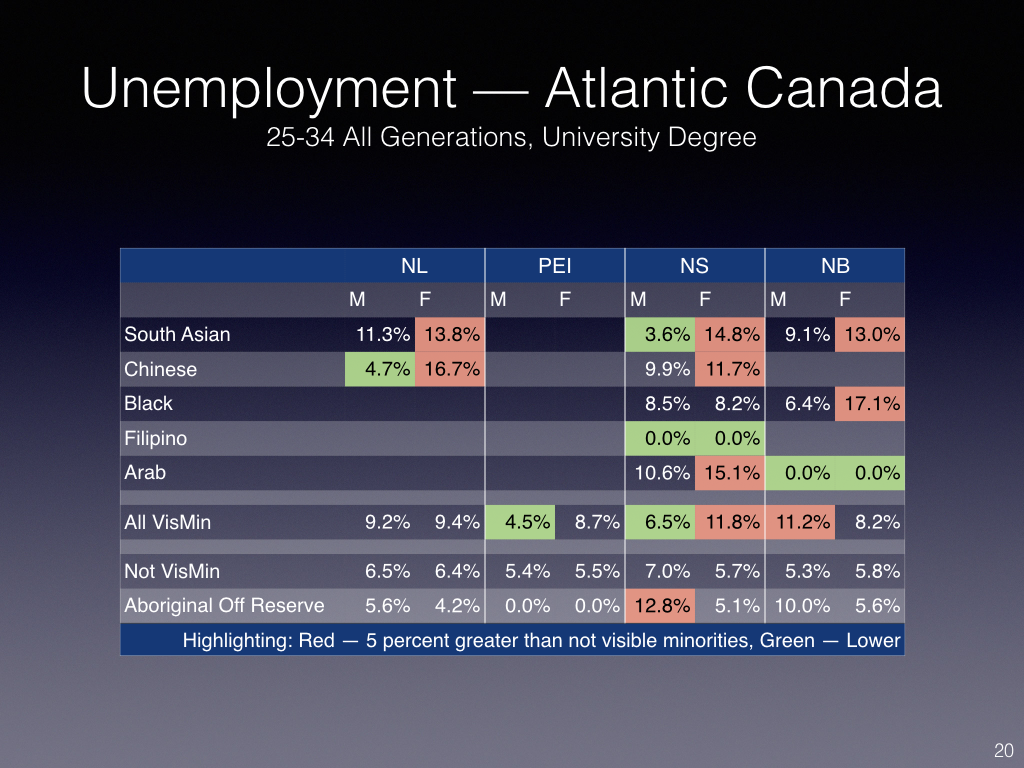
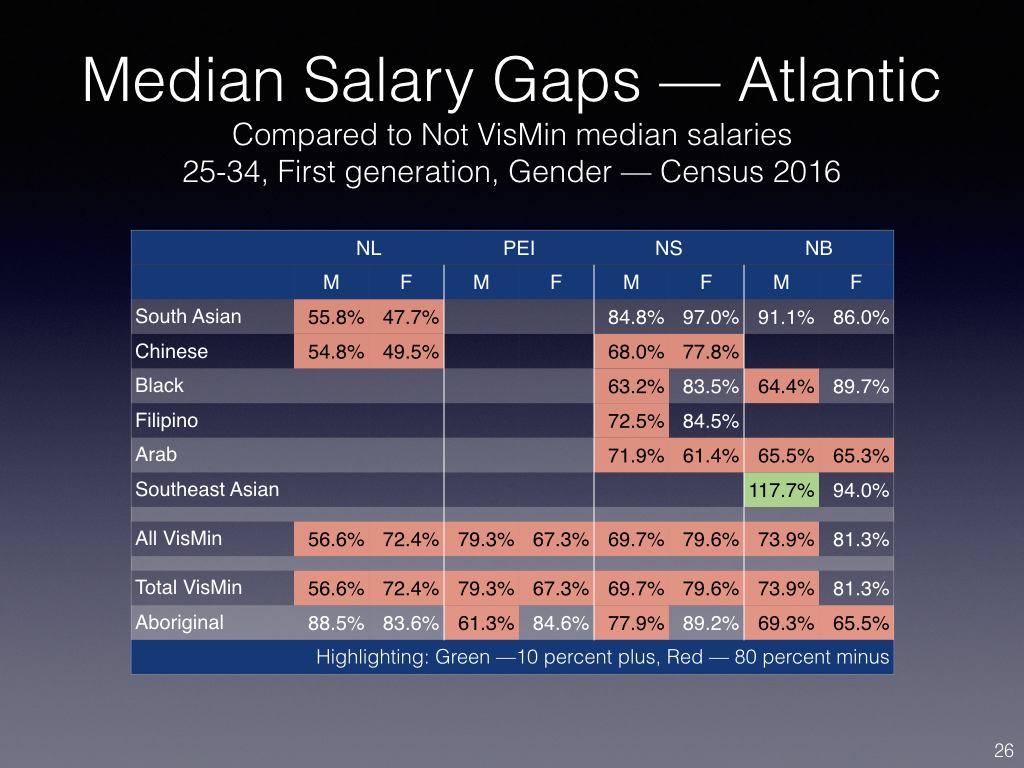
Some good data and analysis in this article, which conform with the unemployment data I have looked at but not median income(slides below):
Immigrants who stay in Atlantic Canada have higher employment levels, higher wages and face less discrimination than immigrants to other parts of Canada, yet the region struggles to attract newcomers and has the lowest retention rates in Canada.
Atlantic Canada is engaged in a radical experiment in population management that has profound implications not just for this region, but for the country as a whole. The demographic bomb that threatens Canada is set to go off here first:
— Atlantic Canada has Canada’s lowest birth rate, highest median age and often sends more residents to other parts of Canada than it takes in.
— Francis McGuire, president of the Atlantic Canada Opportunities Agency, points out that there are more than 20,000 jobs unfilled in the region.
— Across Atlantic Canada, one in every five residents is already over the age of 65. That compares to a rate of one in six across Canada.
— Newfoundland and Labrador schools have lost a third of their students since 1996; more people have died than were born in the province for each of the last three years and the average age is almost three years older than the Canadian average of 41. The Harris Centre of Regional Policy and Development at Memorial University predicts the provincial population will drop 10 per cent by 2036 and that some towns could see drops of 30 per cent or more.
— New Brunswick had an actual population decline in 2016 and has lost one fifth of its school-age children in the last two decades.
— In Nova Scotia, the resilient economy of Halifax is the only factor propping up the province’s population. Every region outside the provincial capital declined in the last census.
Immigration the solution
Many agree that a massive increase in immigration is an inescapable part of the solution. All four provincial governments have made boosting immigration a key priority and Ottawa has stepped in with Canada’s first regional immigration program: The Atlantic Immigration Pilot.
But deciding to transform your society with new blood is easier than actually doing it.
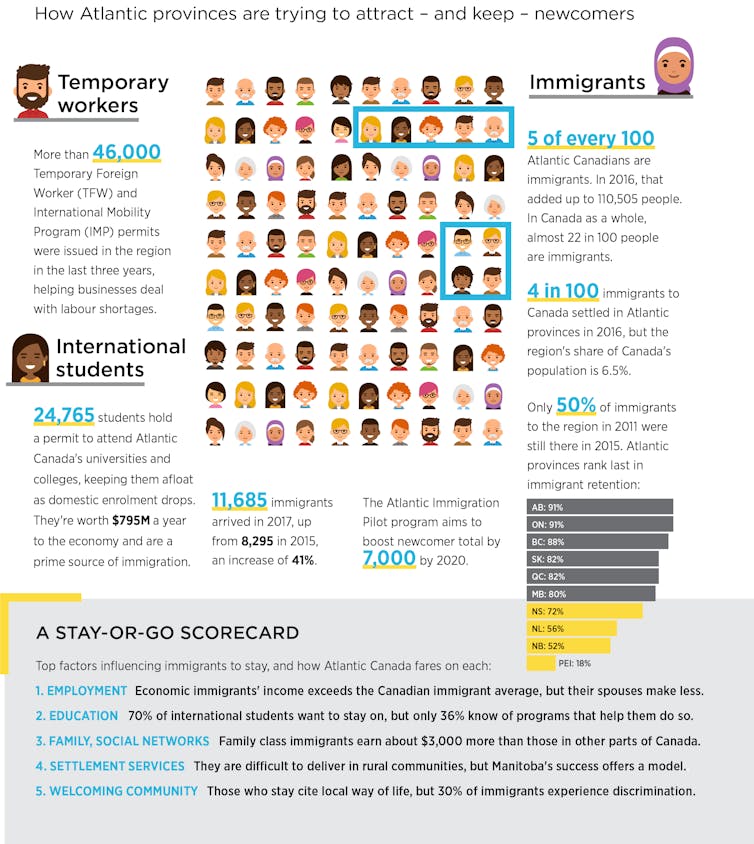
Only 18 per cent of the immigrants who landed in Prince Edward Island in 2011 were still there five years later. The rates are better in New Brunswick (52 per cent), Newfoundland and Labrador (56 per cent) and Nova Scotia (72 per cent), but they still fall far behind Ontario and Alberta, which kept 91 per cent of the immigrants who arrived in 2011, and British Columbia, which had a retention rate of 88 per cent over the same period.
Ottawa began shifting immigration responsibility to the provinces about 20 years ago.
The learning curve was steep. Initial programs in several provinces fell apart.
Now provincial recruiters target specific countries, make sure that potential newcomers know that Atlantic Canada is cold, rural and not particularly diverse, and they design immigration programs that encourage newcomers to settle.
How Canada’s Atlantic provinces are trying to attract – and keep – newcomers.Public Policy Forum, Author provided
The decision to come to Atlantic Canada and the decision to stay are two very different things.
Surveys show that immigrants leave the region in search of better jobs, but research suggests that’s not what they will find. In fact, immigrants in Atlantic Canada fare better economically than the average immigrant across Canada, and in some cases better than native-born Canadians.
Higher wages in Atlantic Canada
A profile of immigrant tax filers in Atlantic Canada published by Dalhousie University professors Yoko Yoshida and Howard Ramos found that immigrants to Nova Scotia, New Brunswick and Newfoundland were more likely to be employed and earned higher wages than the average immigrant in Canada who landed at the same time. Immigrants to P.E.I. were below the Canadian average, as were spouses of primary applicants and refugees.
Research also disputes the familiar assumption that urban areas are more welcoming than small towns.
Dalhousie University’s Ramos recently looked at actual experiences of discrimination based on ethnicity, race and language. Overall, the incidence of discrimination was far lower in rural areas than in big cities. Atlantic Canada came out particularly well, with very low rates of discrimination compared to Ontario, the Prairies and British Columbia.
To be sure, newcomers do encounter hate and discrimination in Atlantic Canada, as in any other place.
Highly unusual for the EE data not to be included in the annual report (can’t recall this happening in recent years). The report’s explanation suggests that this is collateral damage of the Phoenix pay system.
That being said, better to take the necessary time for data verification than publish inaccurate data:
The 2016 to 2017 annual report features a 10-year trend analysis of the representation of the 4 designated groups and reports on results of initiatives that advance employment equity, diversity and inclusion. (Data for 2016 to 2017 will be provided at a later date and included with the report as an annex.) Over the past 4 years, the representation of each employment equity group in the core public administration has exceeded workforce availability. However, gaps persist in some departments and in certain occupational groups. We will continue our efforts to close these gaps.
…. Statistical tables for the 2016 to 2017 fiscal year in 7 areas will be published following:
retrieval of data from the Phoenix pay system
reconciliation of data with sources from the Public Service Commission of Canada and from departments and agencies
validation of the accuracy of the data to be published
As always, Kingwell both amusing and serious ruminations on Canadian identity (“nation as conversation”), with some worthy suggestions on how to strengthen it:
Those of a certain age may recall the first episode of Monty Python’s Flying Circus, aired on the BBC in October of 1969. It was called “Whither Canada?” Canada doesn’t actually figure in the episode, naturally. That interrogative, seminar-style phrase was also among the finalists for the legendary comedy troupe’s name. Why? Well, you have to imagine that the question was so inherently hilarious that it seemed appropriate for a gang of clever English absurdists in their 20s.
I think that’s funny, but not everyone does. And we’re still whithering on. You go to bed one night thinking that the existence of Canada is a more or less a settled issue, or at least one of those things, like Donald Trump’s hair, that are no longer open questions. And then you wake the next morning to headlines about cross-border beer disputes reaching the Supreme Court, and fuel-pipeline arguments that threaten to overturn the confederation. Hands are suddenly wringing. Canada: nation or notion? Provinces: evil or just standing up for themselves? How many best-selling Québécois authors can you name? How far north have you ventured?
We have been on this cultural merry-go-round so many times before that this semi-hysterical discourse about Canadian identity might in fact be what constitutes Canadian identity. In polite Canadian fashion, I acknowledge that this meta-level argument is not original to me. I also note, reputation aside, that Canadians are often more passive-aggressive than polite.
And so the grab-bag of clichés and stereotypes opens, with everyone taking a hockey slash at everyone else’s list. Poutine, hockey, canoes, toques, Ski-Doos (not snowmobiles), distance in klicks, the Hip, couches (not sofas), garbage (not trash), beer, maple syrup, hating Americans, hating Americans hating us, hockey again, maybe some duck-confit poutine this time, snowshoes, anything winter really, eh, oot-and-aboot (in fact, more like oat-and-aboat) and the Mounties always get their man. He shoots, he scores.
You can now add a couple of other parlour games of identity-insecurity. Famous Canadian who succeeded elsewhere! Bieber, Jepson, Rogen, Mitchell, Young; Trebek, Nielsen, Carrey, Meyers, Sutherland, The Shat and all those people who run New York magazines. For the olds, Hume Cronyn, Raymond Massey and Mary Pickford. Spot fictional Canadian characters – Rex Mottram in Brideshead Revisited, Richard Hannay in The Thirty-Nine Steps, Frances in The Sun Also Rises. Keep a chart!
Next, map your national travel. As a brat of the Air Force and a blessed adult traveller, I’ve been lucky to go from St. John’s to Tofino and lots of places in between. As a teenager, I was a guest of the Bloodvein First Nation in central Manitoba, which felt a lot farther north, at 51 degrees, than Edmonton does at 53, or Lake Waskesiu at just under 54, two other stops I’ve made. Sadly, I was only ever north of 60 in Reykjavik – hipster north. This game is what Glenn Gould called “northmanship,” one of those competitions that you can’t win for losing. I’m pretty sure that my neighbours in Toronto’s Regent Park won’t feel they ever need to play it, for example. The local basketball team, meanwhile, claiming the motto “We the North,” is actually situated farther south than two of its American competitors. Canada, where north is a state of mind.
Nation-states may be defined many ways, from textbook-version ideas such as a distinct land mass defensible at the borders and an identifiable citizenry. Or shared bloodline, ethnicity, history and culture. Or an enforceable monopoly on the legal use of force. Or maybe the set of laws themselves which govern a populace. Or even, at a minimum, a scheme of swapping taxes for services in a more or less reliable way.
As a loose confederation of regions and jurisdictions, assembled over a period of more than 80 years, Canada is an unlikely country, yet not an impossible one. The optimists among us find it impressive that such a place exists at all, let alone with sustaining vitality. Like so many other Western states, it was founded on force, money and colonial bigotry. There are deep wounds in our body politic, but so far they fall short of fatal ones. There is no monoculture here, as we all know, nor even a myth of one when vast differences become obvious, marked in red and blue.
This vaporous quality of the country has led many people to label Canada a postmodern, or postnational, or postpatriotic country. We might debate the possible meaning of those terms forever. I prefer to think that Canada survives as a collective act of suspended disbelief, a feat of constant reinvention. Call it the discursive state, or the nation as conversation – not always polite conversation, indeed, yet civil in the sense of confronting disagreement without violence.
Even the current pipeline dispute is subject to the judgment of the courts, after all, and while a decision there could leave nobody happy, that’s how liberal justice works. Parties to dispute accept the authority of an outcome because that is what a just regime demands. Equalization payments and national pensions enrage some citizens, just as threats of secession have done and may well do again. Even secession could not be achieved by provincial fiat, however. We came together through deal-making and discussion, and so far the deal continues.
A country can’t be all talk, though. What would bolster the national consciousness practically? Well, there should be compulsory national service for young people, as in Austria, Switzerland and other countries. Those not willing to serve in the military can opt for national parks, tree planting or community assistance. Guaranteed basic income is likewise essential, even if flawed. Wealth inequality is a much more divisive force in Canada than provincial haggling will ever be – not that the two aren’t sometimes related.
Although education is a provincial file, college and university tuition should be equalized from coast to coast. Likewise – sorry Alberta – we need a consistent sales tax, not just GST. A civics and history curriculum must be standardized for every high school in the land. National debating and youth-parliament programs, which already exist, should be funded lavishly. Subsidies should be available for all students to visit Ottawa.
The list could go on, and some are dreams destined for failure. But no practical measure will matter unless there is decisive leadership in Ottawa and respect for the rule of law everywhere else.
The current Prime Minister’s father was much criticized for his staunch nationalism. Cranky Westerners can still be coaxed into apoplexy with mention of the National Energy Program, official bilingualism or progressive immigration policies. (Not just Westerners.) What we should remember is that Pierre Trudeau’s vision of the Just Society was a powerful vision of equity without leveling differences or diminishing opportunity. It was an idea to connect the country in a manner more concrete than the airwaves of the CBC ever could – and can still less now.
Justice is long and hard work, never-ending, the work of citizens. In our increasingly networked and decentralized lives, we may only rarely consider citizenship the most important fact about us. Metaphysically speaking, it’s probably not. “Canadian” is not an identity; it’s a relationship.
I have a PhD student, from Whitehorse, who chaffs me for saying I’m proud to be Canadian. I see his point: Despite our habitual complacency, there are depredations and deficits of trust, systemic injustices and cultural bigotry that must be acknowledged. Also poverty and misery everywhere from Vancouver’s Downtown Eastside to the streets of Inuvik and the dirt roads of Nova Scotia’s South Shore.
No nation is perfect. Our job is not to make Canada perfect, only better.
Given the ongoing and continuing issue, this National Post basics article is helpful in understanding the trends although point 5 (government response) overstates the effectiveness of the government response even if there are no easy solutions:
The number of illegal border crossings is up significantly this year compared with the same period last year, so federal and law enforcement officials have been preparing for possibility of another spike as the weather warms up.
Departmental, RCMP and border officials provided a technical briefing this week on the plans they have developed as a result of lessons learned from pressures and concerns arising from last year’s spike in irregular migrants coming across the Canada-U.S. border.
Here’s what was learned:
1. The numbers are trending upward. Last year, RCMP intercepted a total of 20,493 people who crossed the border illegally. That means they did not present at an official port-of-entry and instead came across the border through unofficial paths to make a refugee claim in Canada. So far this year, 6,373 irregular migrants have arrived in Canada this way. That’s an increase of 128 per cent over the number who arrived in Canada between January and April 2017, which was 2,784.
2. Quebec is the hotspot. Of the 6,373 border crossers that have arrived so far in 2018, the majority — 5,609 — have done so in Quebec. However, about 40 per cent of say they are planning to settle elsewhere in Canada, mainly in Ontario. That’s why Quebec and the federal government are working on a plan to try to encourage asylum seekers away from highly saturated areas like Montreal and Toronto, in the hopes they might instead settle in outlying regions of the two provinces where labour shortages exist and migrants could find more employment opportunities.
3. Housing remains a question mark. Quebec has told the feds it will only open four temporary shelters for refugee claimants this year, with a total of 1,850 spaces. The province says it will not open Olympic Stadium or the nine other temporary shelters it operated last year for migrants because these were spaces not intended for accommodations, such as school gymnasiums. That’s why Ottawa is now working with Quebec and Ontario on processes that could be used to triage asylum seekers from the unofficial entry point in Lacolle to other shelters in those provinces.
4. Countries of origin are shifting. Last year, the majority of irregular migrants who arrived in Canada were Haitian, which is largely attributed to the Trump administration’s decision to lift the temporary protected status for immigrants from Haiti living the U.S. This year, the majority of illegal migrants in Canada are Nigerians with U.S. travel visas. Other countries of origin this year include: Columbia, the United States and Pakistan.
5. Lessons have been learned. After last summer’s unexpected influx caused some major headaches, a national strategic plan has been put in place to respond to any future spikes. It was described by a senior official as “collaborative, flexible, scalable and phased.” It allows for increased resources to be brought into an area quickly, as needed. It is designed to move asylum seekers through the system in a timely manner while also ensuring all of Canada’s rules for refugee claimants are properly followed. That being said, Ottawa continues to try to get the message out that entering Canada between ports of entry is “not a free ticket” into Canada.
Good commentary by Ibbitson, highlighting that this is one of the three key political challenges facing the government (the other two being NAFTA and pipelines):
A third challenge is emerging, on the border. Last year, more than 20,000 people crossed from the United States into Canada by avoiding regular crossing points. Thanks to a legal loophole, by committing this illegal act, they stood a better chance of being accepted as refugees than if they showed up at a proper crossing. Mr. Trudeau may have worsened the situation when he tweeted in January, 2017: “To those fleeing persecution, terror & war, Canadians will welcome you, regardless of your faith. Diversity is our strength #WelcomeToCanada.” It seemed like an open invitation to those fleeing the deportation efforts of the Trump administration.
If the past three months are any indication, the number of illegal crossers could more than double this year, beyond 40,000, putting the entire immigration and refugee system at risk. We could have more people flooding across the border illegally than arrive legally each year from the Philippines, Canada’s largest source country of immigrants. If the Liberals can’t find a way to stem this flow, voters will punish them.
“So we know what works and what doesn’t. Migration programs, a multicultural society, need to have a commitment, an understanding and the trust of the people, that the government, their government, is determining who comes to the country,” he said.
“So being in control of your borders is absolutely critical. I think that is a fundamental foundation of our success as a multicultural society, as a migration nation as people often describe us.
“You have to exert your sovereign right to control your own borders.”
Valid points on the process of dialogue and understanding with respect to religions but applicable more broadly:
By walking down the street of any major city, you are likely to see more diversity than an 18th-century explorer did in a lifetime. People with very different ideas of how society should function must live together, and there is no idea more divisive than that of religion. Many of the most important moral disagreements break out along religious lines. Indeed, differing religious views on freedom, sexuality and justice threaten social cohesion. That must not be allowed to happen.
One crucial way that people can best learn to live with one another is by increasing their religious literacy. In 1945, the British author C S Lewis said that one will gain greater insight into other belief systems by stepping inside and looking ‘along’ them, rather than looking ‘at’ them from the outside. He explained this by analogy. Think of the difference in the experience of looking at a beam of light through a window, in comparison with the experience of looking along it. It is from within that we can test a system’s internal consistency and its ability to form and inform the believer. The idea is to see religion not merely as a set of propositions held in the head, but, in the words of the Canadian philosopher Charles Taylor, as a ‘lived experience’.
The key to this kind of understanding is dialogue. This isn’t the all-too-common conversation in which the goal is to poke holes in another’s religious argument. Rather, the purpose is only to understand, however fanciful or wrong the beliefs might appear. It requires moral imagination, letting the human voice of a believer express in concrete terms how his or her world is experienced. When questions are asked, they are there to reveal rather than eviscerate. It’s similar to how you experience stories, entering into them imaginatively and empathising with the characters. Stories are at the heart of human life, and also at the heart of religions. It is through understanding the way that human stories are affected by religious ones that we begin to look along that beam of light, rather than at it.
Becoming literate is a predicate of a stable and peaceful multicultural society. Countries throughout the world are seeing the emergence of a poison-breathing hydra that has never been taught to understand anything other than itself. The inevitable result of this has been the scapegoating, racism, tribalism and isolationism that have marked our recent politics. Increasing religious literacy will not necessarily lead to more agreement – indeed, it might even steel our convictions. But it will lead to being able to ‘disagree better’ (the aim of the Scriptural Reasoning movement) by tampering cheap stereotypes and petty caricatures.
In educational theory, religious literacy could be considered a ‘threshold concept’ for 21st-century citizenship. The word threshold comes from the word threshing: to separate the wheat from the chaff, filtering out what does not nourish in order to be left with what does. A concept that establishes a threshold is one that disabuses us of superficial understandings, and creates something more profound, complex and paradigmatic. For example, a threshold concept in physics would be understanding ‘temperature gradient’, or in literature it could be learning to deconstruct text for analysis. They are a boundary through which one must pass in order to advance in the understanding of a subject, allowing one a fuller grasp of a discipline.Similarly, in the study of religion, and indeed global citizenship, religious literacy should also be deemed a threshold concept, as it moves towards a perspectival understanding of religion rather than a reductionist one. Religion moves from being a set of propositions and practices, to an animating force behind human behaviour – something that needs to be heard in its own key.
Teaching religious literacy requires a focus on process rather than content. Since religious literacy is predicated on meaningful dialogue, the purpose is to develop these skills in students: active listening, honest questioning and humility. Teachers need to create and facilitate encounters of the ‘I-Thou’ variety, in the words of the Jewish theologian Martin Buber – where encounters are deep and genuine, rather than the instrumentalised and utilitarian ‘I-It’ encounters. Buber, unlike Jürgen Habermas (another major proponent of the educational value of dialogue) emphasises the need for dialogue to be based around a common focus – understanding of faith positions provides a worthy and generous focus.
Without developing religious literacy on a societal scale, it is difficult to see how our great multicultural experiment will avoid descending into the tribal warfare that so many are spoiling for. To take a small but current example from the United Kingdom, one could look at the ongoing controversy of Sharia councils. Sharia councils provide legal rulings and advice to Muslims based on interpretation of Sharia law. While they do not carry legal weight in the UK, they effectively arbitrate on a number of issues. The idea that Sharia operates as a parallel legal system in the UK is anathema to some, and petitions are being made to ban such councils.In much of the debate, what is lacking is an ability to see that justice is understood and reasoned differently from different perspectives. Of course, this does not suggest that Sharia courts should have a place in the British justice system, but rather that without some understanding and empathy, without some religious literacy, debates about such issues are liable to create more heat than light.
The challenges of culture and tradition changes. Not aware of any similar studies in Canada (this one has the main methodological flaw that responses are voluntary rather than systematically collected and analyzed):
At over three thousand years old, caste hierarchy is one of the oldest forms of social stratification in the world: the community you’re born into in places like India, Pakistan and Nepal has designated where you can work, who you can marry, and what your reputation is in life. Even today in South Asia, caste conflict and discrimination remain a potent force in everyday life. In the United States, though, caste tends to be a relatively muted topic.
But a new survey, “Caste in the United States,” finds that caste discrimination is playing out in the United States as well — a finding that raises questions around how South Asian Americans understand themselves and their history.
The survey, which is the first of its kind, was commissioned by Equality Labs, a South Asian American human rights startup, and includes the experiences of about 1200 people who volunteered their answers.
The report on the survey’s results said that two-thirds of members of the lowest caste, called Dalits, said they have faced workplace discrimination due to their caste. Forty-one percent have experienced discrimination in education because of it. And a quarter of Dalits say they’ve faced physical assault — all in the United States.
Thenmozhi Soundararajan is the executive director of Equality Labs and co-authored the report. She said increased immigration from South Asia — including more and more people from lower castes — fuel this discrimination.
This survey provides data for what many in the community already know: any time there’s a dominant population of South Asians — whether they’re living in Silicon Valley or New Jersey, or working at an office or a restaurant — caste biases emerge. It could be anything from refusing to date or marry someone from a lower caste, to being on the receiving end of a casteist slur, to being made to sit separately because of your perceived “untouchability.”
“We have people who responded who were in the assembly lines for a Campbell soup factory in Central Valley, as well as people who work for Google, Facebook and the other big tech companies,” Soundararajan said, naming workplaces that employ large numbers of South Asians.
But because most Americans don’t understand caste dynamics, it’s hard for people to speak up about it, or bring discrimination cases to court. That includes many people living of South Asian ancestry as well.
Anupama Rao is a historian and anthropologist at Barnard College who studies caste. She said for years, many of the so-called “model minority” of South Asians, who have earned the status of being “good immigrants” in the U.S., came from upper-caste families.
“Many of them, once they are upwardly mobile in the United States, tend to be extremely cagey sometimes, but most often I think embarrassed, to think of themselves as the beneficiaries of caste privilege,” she said.
And when being from a privileged caste obscures what this discrimination looks like — because it isn’t a part of you or your family’s experience — caste itself can become invisible. This is especially true in a new country like the U.S., where immigrant groups of all kinds must navigate their place in an American racial and class hierarchy.
What makes caste discrimination even harder to combat in this new context is that some lower caste people hide their identity as well — 52 percent of Dalits surveyed worry about being “outted” as lower caste.
And the issue is polarizing.
Suhag Shukla is the executive director of the advocacy group the Hindu American Foundation. She said it’s important to get rid of caste prejudice, but that this new survey unfairly essentializes and villainizes Hinduism. It’s one of the most complex arguments surrounding caste; as the survey notes, caste first appeared in Hindu scriptures. It now pervades all religions of South Asia.
“The single most problematic issue with this survey is that it traffics in the most dangerous and false tropes about Hinduism,” she said.
“So instead of demanding an honest conversation about caste and privilege, or its contested relevance among South Asian kids of the third and fourth generation who are now coming of age that are all brown regardless of caste, this report kind of alienates Hindus by scapegoating them,” Shukla said. Caste discrimination isn’t on the radar for many South Asian kids of later generations, she added. What they’re worried about is the discrimination they face for being brown in America. Hate crimes against Muslims and South Asians are at their highest levels since the year after 9/11.
Yet others — both Hindu and non-Hindu — see this defense as helping to preserve the caste system itself. It may not be exactly the same as it functions in South Asia, but a denial of accountability, they say, maintains a hierarchy of privilege.
Last month, over a hundred people packed into the auditorium of the First Church in Cambridge, Massachusetts, to talk about what the survey found. It was a special kind of Black Lives Matter event: an evening with Dalits.
Dr. Cornel West was part of the panel introducing the topic to the crowd, which included both South Asians and non-South Asians. He emphasized the parallels between the struggles of Black Americans and those of South Asians on the lowest rungs of the caste system.
“We will not be crushed! And we will struggle for love and justice, not hatred and revenge! Love and justice,” West roared to the crowd.
There has been a long history of Dalit and Black leaders finding common ground in their struggles. The Black Panthers in Oakland, for example, inspired the formation of another resistance group, the Dalit Panthers, in Mumbai. And Dr. B.R. Ambedkar, often recognized as the most renowned Dalit leader of the 20th century, and an architect of India’s constitution, exchanged letters with W.E.B. Du Bois in the 1940s, after seeing the similarities between the plight of India’s Dalits and African Americans in the US. This history was front and center at the event that evening in Cambridge.
“Let us never forget Ambedkar!” West insisted, as applause rung through the room. “And the spirit of W.E.B. Du Bois is here as well!”
Thenmozhi Soundararajan pointed out the shared experiences of those in the room.
“Places like this, where oppressed people are starting to build their connections, this is freedom,” she said.
One of several articles picking up on this “too quick to fit into a narrative” approach of the alt-right and fellow conspiracy travellers:
When a van plowed into pedestrians over a long stretch of Toronto sidewalk Monday, many immediately assumed it was the work of a terrorist following in the tracks of lone-wolf jihadists in Europe and the United States.
A portrait has since emerged of the accused, Alek Minassian, as someone motivated not by radical Islam but more likely by sexual frustration and social awkwardness.
Yet in the darker corners of the web, where conspiracy theories take hold, alt-right voices cling to the flimsiest evidence to suggest Canadian authorities are covering up what was actually an Islamist attack.
On Tuesday afternoon, Robert Spencer of the Jihad Watch web site drew on courtroom sketches to imply that the man who was charged Tuesday was not the same one arrested Monday. The key for him was that the sketches showed the suspect with hair while the man arrested had appeared bald.
“Was Minassian supplied a toupee in court today? . . . Was he wearing a bald wig yesterday? Or are authorities once again not being honest with us?” Spencer wrote.
“Again, I’m not saying that this is necessarily a jihad attack. But as oddities such as these court sketches multiply, we have to wonder what the Canadian authorities are trying to hide. And what else are authorities hiding when jihad attacks occur?”
In an earlier post, Spencer had written that it is “likely that this was not a jihad attack.” But after being asked on Twitter Wednesday whether he thought the man arrested and the man in court were different people, he replied, “I have no idea. But something very odd is going on.”
The internet provides fertile ground for those inclined to see a jihadi in every corner and a false flag on every ship. American mass shootings from Sandy Hook to Parkland have been fodder for conspiracy theorists, and Canada is not immune.
After the 2017 attack on a Quebec City mosque by a white francophone gunman, Alexandre Bissonnette, a theory stubbornly took hold that there had been a second, Muslim, gunman. Police clarified that the arrest at the scene of a Muslim man was a mix-up – he was a worshipper who had been helping victims and ran off thinking the police officer was the gunman returning. But the Canadian right-wing news site The Rebel repeatedly peddled the theory that there was more to the story. Even today, after Bissonnette pleaded guilty and a courtroom saw security video of the attack, the Rebel site asks, “What are the facts? And can we trust the mainstream media to tell us the truth about such a controversial and sensitive subject?”
The most vocal advocate of the theory that Toronto suffered a jihadi attack has been Alex Jones, whose InfoWars site is a breeding ground for alt-right conspiracy theories. Jones was in the middle of a Periscope live-stream Monday when Minassian’s name was first reported. He had been analyzing cell phone video of the arrest, concluding that the suspect spoke with “a classic Middle Eastern accent.”
When the name was published, and an associate informed Jones it was a common Armenian surname (less than one per cent of Armenians are Muslim), Jones dismissed the information and said it was an Iranian/Turkish name.
“So, another Islamic truck attack,” he concluded. “They’ll try to sweep it under the rug, but we won’t let it be swept under the rug. The truth will get out.”
As more of the truth came out in the following hours, indicating no Islamist connection, Jones stuck to his “Islamic terror attack” narrative. Pronouncing Minassian’s first name “Aleek” to make it sound Arabic, he suggested there was something suspicious in the fact that the arresting officer had not killed him: “I’m asking the question, why is this guy not dead? And why haven’t we learned his religion?”
On Wednesday afternoon, the fourth most popular item on the InfoWars site was: “Video of Truck Attack: Suspect Has Middle Eastern Accent.”
The fomenters of conspiracy theories often rely on the tactic of simply “asking the question,” letting their followers fill in the desired answer.
In Canada, a contributor to the Vlad Tepes blog — run by a frequent Rebel contributor who writes there under the name Victor Laszlo – commented Tuesday that the Toronto attacker followed the Islamic State modus operandi to the letter.
“(He) looked like an IS jihadi but our government released the clean cut school photo to push the mental illness narrative, which is patent BULL—-,” wrote contributor Eeyore, who is described as a “counter-jihad and freedom of speech activist.”
Many alt-right commentators were quick to declare the attack the work of a jihadi, including Rebel and InfoWars contributor Paul Joseph Watson, who accused Toronto Mayor John Tory of “virtue signalling” after “a jihadist has just killed nine people.” His Rebel colleague Katie Hopkins, a Brit, tweeted Tuesday morning mocking a message of sympathy from Prime Minister Justin Trudeau and reinforcing the notion that it was an Islamist attack.
“You brought this. You are complicit in it. Politicians like you are terrorist shills,” she wrote.
On Wednesday, Trudeau declined to comment on the ongoing police investigation. “A lot of people have questions as to why, and there may or may not be actual answers,” he warned. Which is music to the ears of the conspiracy theorists eager to fill the void.
Rob Vineberg and I did a further refinement of our arguments against unlimited voting rights for Canadian expatriates in the Vancouver Sun:
With the Supreme Court of Canada hearing the challenge to the current five-year limit on expatriate voting rights, advocates for expansion continue to date their case.
One common feature to such advocacy: a reliance on anecdotes and assertions, completely bereft of any serious effort to assess available data on the strength of connection to Canada.
Common arguments emphasize connections to Canada, a recent example being that of Frédéric Mégret of McGill University. Long-term expatriates “may decide to come back” but is this for family reasons or to access Canadian medicare? They “are, in fact, affected by the laws and policies of Canada” but this is largely limited given that they don’t access or are affected by government services and policies that apply to residents. “Many expatriates, even though they do not reside in Canada, do a considerable amount for Canada, directly or indirectly” but is silent that equally “many” do not. And in a theoretical sense, citizenship can be defined by “how committed one is to its ideals, how ready to give back and to invest in its political life?,” in a practical sense governments can only use crude proxy measures to assess the degree of connection to Canada.
So what do these proxy measures tell us? If we take the Asia Pacific Foundation’s estimate of the number of expatriates, and adjust by voting age and citizenship, we arrive at a baseline of just under two million. Looking at government data, we know that the number of expatriates holding valid Canadian passports is approximately 630,000 adult Canadians who have lived abroad for five years or more. We also know that the number of non-resident Canadian tax returns, a deeper measure of connection, was about 112,000 in 2015 (the last year for which information is available). And while hard to assess the potential interest of long-term Canadian expatriates in voting, the data for those who qualify under the current rules suggest there is not widespread demand (about 16,000 in the 2015 election) although this number may be depressed by the difficulty in meeting current registration requirements. These more formal indicators, albeit imperfect, suggest a smaller number of connected expatriates than some of the arguments would suggest.
An argument for unlimited voting rights means that any citizen who left Canada as a baby or small child would have unlimited voting rights. As such, the proposal disconnects voting from any experience of living in Canada, being subject to Canadian laws, accessing Canadian public services or paying Canadian taxes and thus devalues the votes of Canadians who do reside in Canada and are subject to these day-to-day realities of Canadian life.
Moreover, first generation Canadians born abroad, entitled to citizenship, would similarly be able to vote, irrespective of whether they had ever set foot in Canada.
The government has understandably chosen to await the Supreme Court decision on whether the current five-year limit is constitutional. However, it signalled its intent in Bill C-33, tabled more than a year ago, to support unlimited voting rights for expatriates. This is more generous than the practices of the UK, the USA, Australia and New Zealand, all of which impose significant conditions in order to qualify to vote abroad. While France, Italy and Portugal all allow expatriates to vote, they have established overseas constituencies in their legislatures. This prevents the will of the domestic electorate being changed by expatriate voting. In our view, residency matters.
While one can argue for a minimum of three years (as required to obtain citizenship), five years as in the current electoral rules, or some other number, citizenship is not just a theoretical construct of connection and commitment: it needs to include some measure of physical presence. The longer one has lived in Canada, the longer one should have the right to vote if living abroad. For example, if one has lived in Canada for 25 years or more, the right to vote abroad could be permanent while shorter periods of residence in Canada could entitle people to a shorter period of voting as an expatriate.
However the Supreme Court may rule on expatriate voting, the government will have to decide whether it continues to favour unlimited voting rights for expatriates or take a more measured approach to providing expanded voting rights for expatriates without the unintended consequence of diminishing the value the votes cast by Canadians resident in Canada.
The related but distinct issue of municipal voting rights for Permanent Residents was subject to this cautionary editorial in the Vancouver Sun. In my opinion, enthusiasm for municipal voting rights is misplaced given that Canadian citizenship, which provides the full panoply of national, provincial and municipal voting rights, is to be preferred than partial rights.
Moreover, the arguments in favour of municipal voting rights are more valid in European countries with long residency period requirements compared to Canada’s three years:
About 250 years ago, colonists in New England rebelled against the Stamp Tax that Britain had imposed to recover the cost of defending the colonies during the Seven Years War. Their complaint was that the tax was illegal because they had no say in the matter. “No taxation without representation” not only became a popular bumper sticker, but ultimately led to the American Revolution.
Perhaps it was in the spirit of that principle that Vancouver city council this week unanimously passed a motion to ask the province to “make the necessary changes” to allow permanent residents to vote at the local level.
Vancouver has an estimated 60,000 permanent residents (based on 2011 statistics) — those who have gone through the immigration process but are not Canadian citizens. Permanent residents must live in Canada for two out five years to maintain their status. Although they work, own homes, pay taxes and are entitled to social benefits, including health care coverage and protection under Canadian law and the Charter of Rights and Freedoms, they do not have the right to vote. The authors of that restriction had their reasons.
Coun. Andrea Reimer said extending the right to vote to permanent residents would advance Vancouver’s ability “to be a welcoming and inclusive city.” Municipal Affairs Minister Selina Robinson added that “a local government … keen to do more engagement in our democracy is a good thing overall.” A few other municipalities, including Halifax and Toronto, have also asked their provincial governments to change the rules.
The argument that people who pay taxes should have the right to determine who is managing the money and implementing policies that affect them is compelling. Besides paying income, property and sales taxes, permanent residents are part of their communities, send their children to nearby schools, shop in local stores and put their garbage out for collection like everyone else. But if permanent residents are granted the right to vote in civic elections, why wouldn’t the same principles apply to federal and provincial elections? And if they do, what then is the value of citizenship? Is it nothing more than a passport and a guarantee against deportation?
Besides, the notion that permanent residents would rush out to exercise their newly acquired right to vote in civic elections might be wishful thinking. It seems more likely their voting patterns would mirror those of the population at large. Turnout for the last civic election in 2014 was 44 per cent, up from 34 per cent in the 2011 election. Engagement is not top of mind for a majority of Vancouver’s citizens.
Advocating for the vote for permanent residents is a feel-good initiative for city council, but the provincial government must consider the serious implications of such a move. Although many permanent residents have lived in Canada for a long time and know the ropes, many are newcomers, some from countries where social norms are quite different from Canada’s, particularly on matters of gender equality and free speech. Some may not appreciate the sanctity of the secret ballot or freedom from duress in casting a vote.
The provincial government should respond to the city’s request cautiously. Its deliberations will require all-party committee work and extensive debate, which probably cannot be completed on time to take effect before the October 20 civic election. Fortunately, Minister Robinson has not committed to having legislation in place before then. She should not rush the changes council has requested.
Interesting and relevant historical and social context:
With attacks on Jews in Germany increasing, DW spoke with the renowned theologian Reuven Firestone, about the complex relations between Islam and Judaism, and how Muslims and Jews could be brought closer together.
Deutsche Welle: There are studies that claim that the religion of Islam is essentially against Judaism? Do you agree with this theological position?
Reuven Firestone: Islam emerged in an environment in which major religions already existed. The birth of a new religion is always seen as a critique of the old religions. Its very existence is a statement that says, “Well, the old religion is not good enough; otherwise why would God reveal a new scripture that corrects or nullifies what is currently practiced?” So the followers of established religions always resent the newcomer.
At the time of Islam’s birth in Arabia in the seventh century, all established religions resented it and attacked its prophet. The Quran records their criticisms and their attacks, and it replies with attacks of its own, criticizing Jews and Christians and believers of the local religions, whom it calls “mushrikun,” or “those who join” other deities with God — i.e., polytheists.
So, yes, the Quran does contain negative references to Jews, but not only about them. It talks negatively about other threatening communities (I should add that it also contains positive references to Jews and Christians, although not to polytheists). The important point is that the Quran and the early Muslims did not criticize Jews exclusively.
We must not forget that the same scenario played out with the emergence of Christianity. The Jews resented those who claimed that Jesus was the Messiah, and especially that he was God’s incarnation. And the New Testament criticizes Jews in response to attacks on the new community.
Similarly, the Hebrew Bible (Old Testament) slams the older religions that were clearly against the Israelites.
During the early phase of Islam, Muslims and Jews coexisted peacefully. When did the rifts begin to appear, and were the reasons more political than theological?
As I said, there were always tensions between Muslims and Jews over the authority of their respective faiths. It was both a political matter and a theological issue. When Islam became the dominant power, like all pre-modern and non-democratic powers, it privileged the people it identified as its own over all others. Therefore, while Jews (and Christians) were considered citizens of the Muslim world and protected by the law of the land (including religious law, the Sharia), they were given a second-class status that was defined by restrictions in position, prestige and freedom. How this actually worked out in history varied from time to time and place to place. In some situations, Jews were treated essentially as equals, but in others they were persecuted severely.
Explanations such as mine should be understood in a context. Keep in mind that minority communities were not treated equally under law or custom in pre-modern, non-democratic regimes. All historians agree that, on average, Jews suffered more under Christian rule than they did under Muslim rule.
The Prophet Muhammad’s time in exile in the city of Medina provides some great examples of Muslim-Jew coexistence, but at the same time violent conflicts marred their ties. How do you see that phase of Islam, and do the events in Medina, in which the Jewish tribe of Qurayza was said to have betrayed Muhammad, shape present day “Muslim anti-Semitism”?
The tensions, and the violent conflict that eventually broke out between Muhammad and the Jews of Medina, have become points of heavy stereotyping on both sides. A separation between the two communities has grown over the years. Jews were accused of betraying their equal religious and civil status in Medina by trying to aid an enemy intent on destroying Muhammad, and even of trying to assassinate him. As a result, the Jewish communities of Medina were forcibly exiled, and one Jewish community was massacred.
Many Jews and Christians point to this period as a prime example of what they consider the fundamentally violent behavioral norms exhibited by Muhammad that are established in Islam. Many Muslims point to this as a prime example of how Jews are, by nature, deceitful, corrupt and can never be trusted.
There are mixed accounts of those events, and we have no Jewish versions of the story. What is tragic about this is that an incident a millennium and a half ago has become a tool for some radicals in both communities to try to vilify and defame the other.
Although both Judaism and Islam are Abrahamic religions, why do they appear to be so far apart?
Actually, Judaism and Islam are essentially quite close in many ways. In fact, most religious scholars consider them closer to one another than either is to Christianity. The theology of divine unity in Judaism and Islam is understood in Christianity through the Trinitarian nature of God. Jews and Muslims agree that this is simply impossible to accept. Even the theological terminology between Judaism and Islam is quite similar. For example, iḥūd in Hebrew and tawḥīd in Arabic are linguistically related terms that refer to the same essential nature of the absolute unity of God.
What needs to be done to bridge the gulf between Muslims and Jews? What inspirations can be taken from the religious texts?
The tension between Muslims and Jews today cannot be resolved simply by taking inspiration from the sacred texts. Both Judaism and Islam are great and complex religious civilizations. The sacred texts have been read in a variety of ways by people through the ages. One can cite texts that inspire fear and hatred in both religious traditions, and one can cite texts that inspire appreciation and love.
The core of the conflict between Muslims and Jews is a willingness to be manipulated by fear. Fear allows people to draw false conclusions that would not otherwise be possible. All people, with very few exceptions, strive to do good and avoid evil. We must check our impulse to draw negative conclusions based on fear and rumor. Both the Bible and the Quran emphasize that one should not succumb to the fear brought about by evil, but one should only fear God.
Reuven Firestone is the Regenstein Professor in Medieval Judaism and Islam at the Hebrew Union College – Jewish Institute of Religion, which has campuses in Cincinnati, Ohio, New York, Los Angeles and Jerusalem. Firestone has written over one hundred scholarly chapters and articles and eight books, with translations into many languages. Having lived with his family in Israel, Egypt and Germany, he regularly lectures in universities and religious centers throughout the United States, Europe, the Middle East and Asia.
Another good and detailed poll from Pew Research, showing less of a partisan divide on some basics (i.e., voting, paying taxes, obeying the law) with greater variation on others (e.g., jury duty, following politics, pledge of allegiance):
When it comes to what it takes to be a good citizen, the public has a long list of traits and behaviors that it says are important. And there’s a fair amount of agreement across groups about what it takes to be a good citizen.
Still, there are differences when it comes to which aspects are considered veryimportant (as opposed to somewhat important), and points of emphasis differ by party identification as well as by age.
Overall, 91% say it is either very (74%) or somewhat (17%) important to vote in elections in order to be a good citizen; just 8% say this is not too or not at all important.
Large shares also say it is important to pay all the taxes you owe (92%) and to always follow the law (96%), including about seven-in-ten who say each is very important (71% and 69%, respectively).
For several other traits and behaviors, about nine-in-ten say they are at least somewhat important to good citizenship. However, the share saying each is very important varies significantly. For example, 89% say it’s important to serve jury duty if called, including 61% who say this is very important. While a comparable 90% say it’s important to follow what’s happening in government and politics as part of good citizenship, a smaller share (49%) says this very important.
Protesting government actions you think are wrong and knowing the Pledge of Allegiance are considered important parts of what it means to be a good citizen, though they rank somewhat lower on the public’s list. Displaying the American flag ranks last among the 11 items tested in the survey. Still, a majority says this is either a very (36%) or somewhat (26%) important part of what it means to be a good citizen.
Republicans and Democrats largely agree on the importance of most responsibilities of citizenship.
About three-quarters of Republicans and Republican leaners (76%) and Democrats and Democratic leaners (75%) say it’s very important to vote in elections.
Similarly, comparable majorities of Republicans and Democrats say it’s very important to pay all the taxes you owe, serve jury duty if called, respect the opinions of those you disagree with and participate in the census. There also are no partisan divides over the importance of volunteering to help others and following what’s going on in government and politics.
However, Republicans (79%) are more likely than Democrats (61%) to say it’s very important to always follow the law to be a good citizen.
Knowing the Pledge of Allegiance ranks higher on Republicans’ list (71% say it’s very important) than Democrats’ (just 34% say it’s very important). In addition to placing greater importance on the Pledge of Allegiance, Republicans are twice as likely as Democrats to say it is very important to display the American flag (50% vs. 25%).
By contrast, Democrats are more likely than Republicans to think it is very important to protest if government actions are believed to be wrong: About half of Democrats (52%) this is very important to what it means to be a good citizen, compared with just about a third (35%) of Republicans.
Partisans and ‘leaners’ differ over importance of aspects of citizenship
On many items, the views of independents that lean toward one of the two major parties diverge from those of self-identifying Republicans and Democrats. In general, partisan leaners tend to be less likely than straight Republicans and Democrats to view a range of responsibilities as important to what it means to be a good citizen.
Overall, 83% of Republicans say voting in elections is a very important aspect of being a good citizen, compared with a smaller majority of Republican leaners (67%). There is an even wider 28-point gap between the share of Democrats (86%) and Democratic leaners (58%) who say this is very important.
Similarly, roughly two-thirds of both Republicans (64%) and Democrats (68%) say participating in the U.S. census every 10 years is very important to being a good citizen; slightly fewer Republican leaners (55%) and Democratic leaners (53%) say the same.
This pattern is seen across other items as well: Those who identify with a party are more likely than independents who lean to a party to say it is very important to serve jury duty if called, pay all owed taxes and to follow what is happening in government.
While large shares of Republicans (96%) and Republican leaners (87%) say it is important to know the Pledge of Allegiance, Republican identifiers are somewhat more likely than leaners to say this is very important to good citizenship.
By comparison, smaller majorities of Democrats (67%) and Democratic leaners (60%) say it’s important to know the pledge. Self-identifying Democrats (42%) are significantly more likely to say knowing the pledge is a very important part of good citizenship than Democratic leaners (24%).
There is a 22-point gap between the share of Republicans (90%) and Republican leaners (68%) who say displaying the American flag is at least somewhat important to being a good citizen. And 63% of Republicans call this very important, compared with 35% of Republican leaners. About half of Democrats (52%) think this is a very or somewhat important aspect of good citizenship; 43% of Democratic leaners say the same.
In contrast to the patterns seen on many items, Republican leaners (81%) are more likely than Republicans (66%) to say protesting government actions you think are wrong is an important part of being a good citizen. The views of Republican leaners place them closer to those of Democrats and Democratic leaners in terms of the overall importance they place on this aspect of citizenship.
Age differences in views of the responsibilities of citizenship
Young adults place less importance on many aspects of citizenship than older adults, especially when it comes to the share that describes a trait or behavior as very important for being a good citizen.
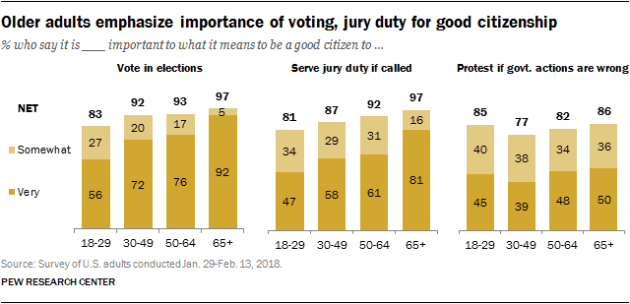
Majorities of adults across all ages say it is very important to vote in elections in order to be a good citizen. Still, a smaller majority of those under 30 say this (56%), compared with larger shares of those ages 30 to 49 (72%), 50 to 64 (76%) and 65 and older (92%).
And while fully 81% of those 65 and older say that to be a good citizen it is very important to serve jury duty if called, just about half (47%) of those under 30 say the same.
On other items, the pattern is similar. Young adults are less likely to call paying the taxes you owe, following the law, participating in the census, and following government and politics very important. Still, large majorities of young adults say each of these is at least somewhat important to being a good citizen.
There is no meaningful age gap in views of the importance of protesting government actions you think are wrong. Overall, 85% of those ages 18 to 29 say this is either very (45%) or somewhat (40%) important to being a good citizen. Views among those ages 65 and older are similar (50% very important, 36% somewhat important).
Displaying the American flag and knowing the Pledge of Allegiance do not rank particularly highly for young adults on their list of important characteristics for good citizenship. Among those ages 18 to 29, 63% say it is important to know the Pledge of Allegiance (38% very important) and 53% say it is important to display the American flag (19% very important). These items do not top the list of older adults either, though those 65 and older are more likely than the youngest adults to say both are important parts of being a good citizen.