Former Toronto police chief Bill Blair takes charge of Canada’s borders

Reasonable political and operational management approach to address the influx. Having a more dedicated junior minister, with law enforcement experience, won’t change the fundamentals of the impact of US policies but may help both internal government discussions and public debates:

Former Toronto police chief Bill Blair has been given the task of managing the migrant crisis at the border as part of his new cabinet appointment – a move that will require him to work directly with Ontario Premier and long-time adversary Doug Ford.

Prime Minister Justin Trudeau chose Mr. Blair, an experienced senior public servant, to lead the new ministry of Border Security and Organized Crime Reduction as a part of a federal cabinet shuffle Wednesday. Mr. Blair will oversee the surge in asylum seekers at the Canada-U.S. border, gun violence and the cannabis file. Mr. Trudeau said he trusts Mr. Blair to counter the “politics of fear” that he says the Conservatives have been using, especially when it comes to asylum seekers.

“I am reminded of the very first conversation I had with Bill Blair years ago when I was asking him to think about running for the Liberal Party,” Mr. Trudeau told reporters in Ottawa on Wednesday.

“One of the things he said stuck with me and certainly echoes in my mind today as we give him these new responsibilities − he said the No. 1 enemy of public security is fear.”

Mr. Blair’s new role puts him on a potential collision course with Mr. Ford, with whom he has a fraught history. Mr. Blair infuriated Mr. Ford in 2013 when the then-Toronto police chief said he was disappointed by a video of Mr. Ford’s brother and then-Toronto mayor Rob Ford smoking crack cocaine. Doug Ford, a city councillor at the time, unleashed on Mr. Blair and called on him to step down as police chief.

Nearly five years later, now in new political jobs, the pair will face off once again. As a part of his irregular migration portfolio, Mr. Blair will have to navigate a tense relationship between the Trudeau and Ford governments over the resettlement of asylum seekers who cross the border illegally. Earlier this month, Mr. Ford withdrew the province’s support for the resettlement, saying that the federal government created the problem and should pick up the tab to fix it.

Speaking to reporters in Ottawa on Wednesday, Mr. Blair said he looks forward to working with all three levels of government, which “have a responsibility for the safety of their communities and to uphold the rule of law.”

In a statement, Mr. Ford’s office maintained the the federal Liberals are to blame for the influx in border-crossers.

“Premier Ford is hopeful that Minister Blair will be interested in standing up for respect of the law, and encourages his Liberal colleagues to take responsibility for the mess they’ve created,” spokeswoman Laryssa Waler-Hetmanczuk said.

The Prime Minister’s Office said Mr. Blair will head up the government’s work on the migrant issue, while working closely with Public Safety Minister Ralph Goodale, who is responsible for the border agency, and Immigration Minister Ahmed Hussen, who will still oversee the refugee determination process.

Conservative immigration critic Michelle Rempel said the appointment of a new cabinet minister to the migrant file is yet another sign that the Liberal government is “normalizing” the situation at the border. More than 31,000 asylum seekers have entered Canada between authorized points of entry since January, 2017. She invited Mr. Blair to testify to the House of Commons immigration committee this summer when it holds a series of emergency meetings on asylum seekers.

Refugee advocates expressed concern about the government’s decision to put the migrant issue under the ministerial umbrella of border security and organized-crime reduction.

“Now they are going to have an enforcement approach, to be stronger at the border,” said Francisco Rico-Martinez, co-director of the FCJ Refugee Centre in Toronto.

“Don’t forget that people in the middle are human beings, refugee claimants … . Don’t blame them.”

via Former Toronto police chief Bill Blair takes charge of Canada’s borders – The Globe and Mail

What good data mean for black youth in foster care – The Globe and Mail

Without this kind of data, can’t identify issues and possible policy approaches and solutions. One of the better elements of the former Liberal government was the emphasis its anti-racism strategy placed on better data (unlikely to survive under the current government, however):

Not enough snacks, not enough privacy, not enough allowance: Many of the complaints shared by the teenagers at the Power Up conference in Mississauga were common, even timeless.

But other concerns voiced by many of the 130 attendees, all black and all current or former Ontario foster youth, were less universal.

Some spoke about not being invited out to restaurant dinners with their foster families, or not being trusted with a house key. One 19-year-old young man started crying at the microphone. He had bumped into his sister at the conference, but they’ve been in different foster homes for so long that he didn’t recognize her.

After the formal workshops and panel discussions, kids hugged, took selfies and made plans to hang out again. “This cannot end here,” one girl declared loudly. It was a sweet, important gathering and it wouldn’t have happened without race-based data.

“The issue of the African-Canadian community and how it experiences child welfare is something that the community has been speaking to for decades,” said Kike Ojo, the program manager for One Vision, One Voice, an organization dedicated to improving the lives of black youth in foster care.

For years, she said, black parents had been sharing their anecdotal experiences of children’s aid services across Ontario: of being watched more closely than white parents; of having their children apprehended at higher rates; and of having black youth placed largely with non-black foster families, which might be loving but were often unable to help them cope with the daily realities of racism.

But it wasn’t until 2015, when the Toronto Children’s Aid Society released race-based data of the children in its care, that those who work in child welfare began taking the issue seriously. That year, 30 per cent of children in Toronto foster care were black, though only 8.5 per cent of the city identifies that way.

“That was the first time that I saw the data in print,” Ms. Ojo said in an interview. “I can’t overstate how important Toronto doing that was to getting to this moment.”

One Vision, One Voice was formed within months of the data release. It’s since toured cities around the province to give presentations on anti-black racism and equity practices, as well as to hear the experiences of youth, care workers and both biological and foster parents.

It’s also made a list of 11 recommendations to the Ontario Association of Children’s Aid Societies (OACAS), which cover everything from recruiting more black foster parents, especially those who can care for babies, to providing better transition services for youth approaching the age of 21 to help them avoid poverty and homelessness as adults.

And it’s recruiting both youth and black care workers for advisory councils, meant to be a permanent resource for OACAS to draw on when needed.

“So often the system could use a resource to help them … understand how a particular policy or program could impact black youth,” Ms. Ojo said. “Today, other than tapping a random black youth on the shoulder, they don’t have somewhere to go to kind of get that support.”

The Toronto CAS has committed to collecting and releasing race-based statistics annually: In 2017, 34 per cent of children in care were black, compared with 9 per cent of the city’s population, a small but disappointing increase that shows that identifying a problem is just the first step in solving it.

Elsewhere in the province, the current state of such data is patchwork and full of holes. In April, an Ontario Human Rights Commission (OHRC) report on black and Indigenous youth in care stated that a full 20 per cent of the province’s 49 children’s aid societies aren’t collecting it. Perhaps worse, some that do use cringe-worthy, outdated terminology: More than one tracks “mulatto” or “Gypsy” children.

In December, 2017, the Liberals’ Ministry of Child and Youth Services made collecting race-based data on foster children mandatory. All children’s aids societies were supposed to start entering information into an online portal this past February, but a number still don’t have access to the tool.

And while analysis is meant to start in early 2019, there’s been an election in the interim, and the new Conservative Ministry of Children, Community and Social Services hasn’t yet made any announcements about foster care.

That’s a tenuous state for information that’s crucial to providing Ontario’s 12,000-plus foster children with services that allow them to become healthy adults with a strong sense of self. A sense of belonging was another common desire shared by the youth at Power Up, the first gathering solely for black Ontario foster youth.

One 15-year-old said she had been to 15 different schools. She had also never had a black foster parent. “This is the family I’ve been searching for, for a really long time,” she said. A hopeful moment, thanks to good data.

via What good data mean for black youth in foster care – The Globe and Mail

USA: Dozens of infants [babies] ordered to appear in immigration court: report

Speaks for itself:

At least 70 children under the age of 1 have been ordered before immigration judges since last October, some without any form of legal representation present, according to newly released government data.

Information from the Department of Justice (DOJ) reported by the Texas Tribune on Wednesday states that the number of infants summoned before immigration judges tripled in 2017 compared to the previous year.

A total of 1,500 “unaccompanied” children ages 3 and younger have been ordered before immigration judges since October 2015, the Tribune reported, citing DOJ data provided by Kaiser Health News.

About three-fourths of those children had legal representation, while the remainder only had access to a list of legal aid attorneys their caregiver can contact. In some cases, young children appear before judges with little to no knowledge of their situation or where their families are, the report noted.

While officials said many children under the age of 1 come into the U.S. with a parent and their case proceeds together, some of the children arrived in the U.S. without their parents or legal guardians, according to the Tribune.

Others were only deemed to be “unaccompanied” minors after being separated by their parents under the Trump administration’s “zero tolerance” border policy, which prioritized prosecuting all illegal border crossers.

President Trump signed an executive order last month to end the separation of families at the border, and his administration has been working to reunite affected families after thousands of young children were separated from adults.

“This is to some extent a … crisis of the creation of the government,” Robert Carey, the former head of the Department of Health and Human Services’ (HHS) Office of Refugee Resettlement, told the Tribune. “It’s a tragic and ironic turn of events.”

One immigration attorney based in Virginia noted to the Tribune that many children are unaware that they face life-threatening situations in their home country.

“Think about it as a parent. You’re not going to tell your child they might be killed, right?” Eileen Blessinger told the newspaper. “A lot of the kids don’t know.”

Asylum claim denials, according to the data, are at an all-time high of 42 percent.

Earlier this month the Trump administration issued guidance ending asylum claims for migrants fleeing domestic abuse or gang-related violence, a move that was heavily criticized by immigrant rights activists.

“The Trump administration just handed a death sentence to thousands of women and families fleeing domestic and gang violence by barring them from accessing asylum in the U.S.,” Jess Morales Rocketto, political director of the National Domestic Workers Alliance, said in June.

Source: Dozens of infants ordered to appear in immigration court: report

Documents reveal DHS knew ending protections could cause more, not less, illegal immigration – CNNPolitics

Not that surprising:

The Trump administration was warned by intelligence analysts that ending protections for hundreds of thousands of Central Americans living in the US would likely drive a spike in illegal immigration. They did it anyway.

That intelligence assessment was made public late Tuesday as part of an ongoing lawsuit against the Department of Homeland Security over the termination of Temporary Protected Status for citizens of multiple countries, many of whom have lived in the US upwards of two decades.

Questions have swirled since the administration began systematically terminating the majority of TPS designations on the books, impacting more than 400,000 immigrants who have lived in the US for years. The administration justified the moves by citing the law, saying that the Department of Homeland Security was compelled to end the protections because conditions from the original disasters that precipitated the protected status had improved.

But the intelligence report and another email from the acting secretary last year to White House chief of staff John Kelly add to other uncovered documents that raise serious questions about whether the Trump administration ignored its own experts’ analysis and recommendations to fulfill a pre-ordained objective.

The email explains that the administration was intending to “send a clear signal that TPS in general is coming to a close.”

The analysts’ report and email were revealed as part of a dispute in the lawsuit over the production of the internal documents that were used to come to the decision. Attorneys representing the immigrants suing in the case argue the government has been too slow to produce the documents.

The immigrants suing the government allege, among other things, that the decision to end the protections was racially motivated and not based on reasoned decision-making.

In supporting their request to the judge to order more document production, the attorneys released the assessment and a November email from then-acting Secretary Elaine Duke to Kelly laying out her reasoning to postpone deciding on TPS for Honduran immigrants for six months. Current Secretary Kirstjen Nielsen ended it this spring when that time ran out.

DHS did not immediately respond to request for comment on Tuesday’s documents.

Intelligence analysts warned of illegal immigration

The intelligence assessment, dated November 2, 2017, concluded that there was a chance of “illegal return” for protected immigrants from the four main countries covered: El Salvador, Honduras, Nicaragua and Haiti. The analysts found the first two would have the “highest rates” of individuals trying to sneak back into the US, whereas Haitians would be impeded by the island’s location and Nicaragua would be mitigated by the low numbers of protectees relative to the other countries.

The report cited terrible conditions in the home countries, including an inability to absorb the returning immigrants, as well as deep ties to the US.

TPS beneficiaries have more than 200,000 US citizen children, analysts said. Many beneficiaries have home mortgages and far higher incomes than available in their home countries.

The assessment’s confidence level was “medium,” since the information was based on a lot of NGO reports and because migration is based on a number of complicated factors.

The email from Duke to Kelly last November came a few days before CNN reported alongside other media outlets that Kelly tried to pressure Duke to change her mind on Honduras — the only Central American country covered by TPS that had its status extended temporarily under this administration.

he email is dated November 6, the date the TPS decision was publicly announced.

DHS decision to end Haitian immigrant protections questioned

In the email, Duke went to great lengths to explain to Kelly that she believed postponing a decision on Honduras would still “send a clear signal that TPS in general is coming to a close” and “is consistent with the President’s position on immigration” — an apparent attempt to pre-empt any objections that she was not living up to the administration’s goals.

“This decision is a strong break with past practice and sends a strong message that this Administration will no longer routinely end TPS with little for the statute (sic),” Duke wrote. “By not affirmatively extending, I’m stating that I’m not satisfied that the country conditions remain — but not yet sure how to best end TPS for this country.”

The administration has denied, in general, that their objective was ending TPS overall. In public they have mainly said that they are merely restoring the law when it comes to TPS and have to end TPS for these countries because conditions have improved.

Announcements on the termination of protections have emphasized a “review of the disaster-related conditions upon which the country’s original designation was based … as required by statute.” Officials and the statements have also placed the responsibility on Congress to come up with a more permanent solution.

Duke wrote to Kelly that she had received “multiple intelligence reports” the prior week that “TPS termination for Honduras could have strong consequences for other immigration, (transnational criminal organizations), and drug reduction priorities.”

“I want to understand this better so I can adequately determine the appropriate plan and path for termination,” she said, adding it would be critical to work with Honduras on the plan.

How Trump’s policies could worsen the migration issue he says he wants to solve
Duke also denied that she is making the choice “for fear of criticism” because “every decision” she makes gets criticized.

“I take seriously my role as Deputy and currently acting Secretary and would not make a decision based on anything but the facts,” Duke wrote. “While some are portraying this differently, this decision is really just a difference in strategy to get to the President’s objectives.”

In response to reporting that she and Kelly had clashed over the decision, Duke days later released a statement saying she had “received input” from across the administration, and that “at no time” did Kelly “pressure” Duke to terminate TPS for Central American countries.

Previous doubts raised

CNN has previously reported that ending TPS for Central Americans and Haiti ignored the recommendations of diplomats and that a staff-level report contradicted the idea that Haiti had recovered from the initial conditions that precipitated its TPS designation.

In response to the attorney’s allegations of not producing enough documents, attorneys for the government said it was actually their opponents who were acting in “bad faith.”

“Defendants have been working around the clock to respond to Plaintiffs’ ever-increasing volume of discovery requests and to comply with the Court’s orders,” the government wrote. “Agency counsel have been working weekends and through the night with no sleep to review and produce the documents Plaintiffs identified as being necessary for their preliminary injunction motion. Yet, at every turn Plaintiffs have demanded more and repeatedly threatened to go to the Court.”

via Documents reveal DHS knew ending protections could cause more, not less, illegal immigration – CNNPolitics

Silicon Valley needs to figure out how to promote women and people of color. Andreessen Horowitz is doing that by changing one of its founding rules.

Interesting illustration of how criteria developed for valid corporate reasons led to the realization of who they excluded, with the criteria being changed:

The high-profile venture capital firm has elevated Connie Chan to general partner — and scrapped a rule that the firm candidly admits was outdated.

During its first decade of existence, Andreessen Horowitz — one of Silicon Valley’s premier venture capital firms — held fast to a seemingly minor rule about the types of people who comprised its top investors: To become a general partner, you had to have founded or led a company as CEO. No exceptions.

But amid the broader conversation nationally — and in Silicon Valley specifically — about gender diversity, the firm earlier this year quietly scrapped a rule that its critics said, unintentionally or not, made front-of-the-pack partnerships like Andreessen Horowitz’s just a collection of (mostly white) guys.

The firm said today it was elevating Connie Chan, a well-regarded expert on the intersection of Chinese and American tech trends, to general partner. It’s the first time the firm has internally promoted someone to that post, or the level when an investor leads their own deals and splits the firm’s profits.

“When I first started at the firm, I didn’t think this was a path,” Chan said in an interview with Recode.

The rule change amounts to some inside baseball, but it also speaks to how venture capital firms — powerful institutions that control which types of people and ideas get funded and which don’t — are changing. Due to Andreessen Horowitz’s big profile, the rule has been frequently criticized in hushed tones in Silicon Valley by diversity advocates as an example of the types of hurdles that women and minorities face professionally.

The firm isn’t saying the change was a reaction to those concerns, though Chan did say the change was a “testament” to how Andreessen Horowitz managed to move with the times. Last month, the firm announced it had hired Katie Haun — also not a founder or a CEO — as its first female general partner.

Jeff Jordan, a longtime Andreessen Horowitz general partner, described the rule to Recodeas initially useful for the firm — which was only founded in 2009 — as it battled the existing, dominant venture capital players in its early days.

But now? It limits their pool of talent, he said.

“When we were out there looking for [general partner] candidates, I found myself comparing them to Connie,” Jordan said. “Frankly, Connie’s abilities and track record compelled us to do this.”

The firm is being pretty candid and forthcoming about how the rule grew to be outdated. For more, here’s two excerpts from firm co-founder Ben Horowitz’s blog post on Chan’s promotion:

“I felt an immediate conflict with where she was going and the way we had constructed the firm. When we founded the firm, we made a brand promise that if you raised money from us, we would put a Founder or CEO of a significant technology company on your board. That was our General Partner requirement, because we were determined to be the best place for technical founders to learn how to be CEO. To make good on the promise, we built the most powerful platform for giving founders a big time CEO-like network from capital markets to talent to big company customers to the press. On top of that, we committed to putting someone on the board who could help develop the CEO skill set. Finally, we wanted everyone in the firm to culturally understand the struggle of building a company. These were great ideas, but it meant that we did not promote General Partners from within. And in my heart, I knew that one day we would have to promote Connie or miss out. The thought was making me a little insane.”

…

“Fortunately, as things evolved, our culture became stronger than the GP no-promotion rule. Everyone in the firm became all about the entrepreneurial struggle and helping founders grow into CEOs. Founders didn’t just get a person; they got a platform. The old rule started to seem dated and out of place. So, four months ago we dropped the criteria and the promotion rule.”

Source: Silicon Valley needs to figure out how to promote women and people of color. Andreessen Horowitz is doing that by changing one of its founding rules.

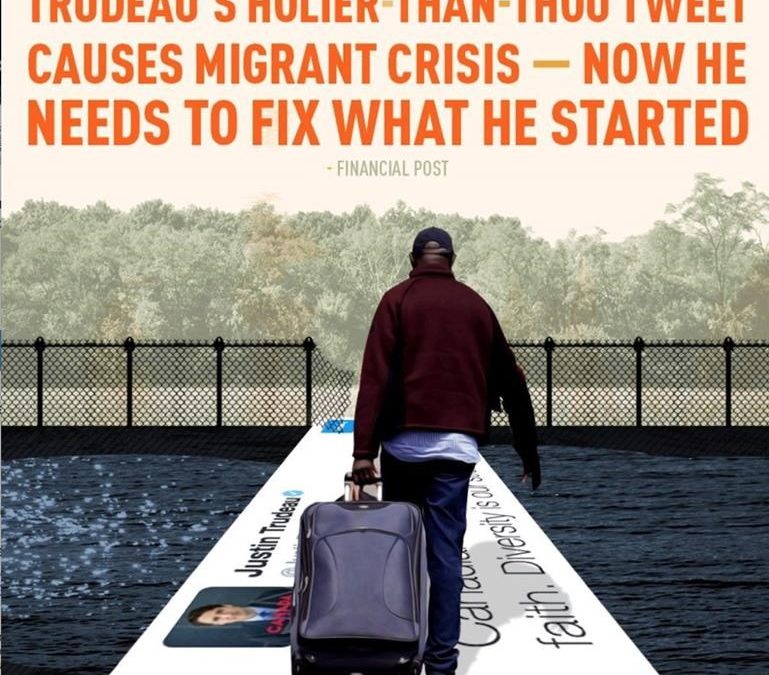
Conservative party pulls attack ad of black man walking over Trudeau tweet

The Conservative party pulled an attack ad from its Twitter feed Tuesday that depicted a black man carrying a suitcase walking over a tweet from Prime Minister Justin Trudeau.

The tweet is rolled out as a carpet entering a broken fence and the words “faith” and “diversity” are visible.

The Tories have argued that a Trudeau tweet from January 2017 is partly to blame for the influx of asylum seekers crossing into Canada from the United States.

Conservative party spokesman Cory Hann says the ad was axed because the situation at the border is not about any one group of people.

Hann says the image, which shows an actual person “illegally” crossing over the Canadian border, was originally used by a number of media outlets with stories about the surge in asylum seekers.

The full photo shows the man with a group of people carrying suitcases in Quebec, while the edited image used by the Conservative party singled out one man.

A quote from a story in the Financial Post is superimposed on the image which says, “Trudeau’s holier-than-thou tweet causes migrant crisis — now he needs to fix what he started.”

In an opinion piece published Tuesday, Immigration Minister Ahmed Hussen accused the Tories of “peddling false information to stoke fear” and called it “ridiculous” that they blame the flow of asylum seekers on Trudeau’s tweet.

Source: Conservative party pulls attack ad of black man walking over Trudeau tweet

‘Morally repugnant’: Homeland Security advisory council members resign over immigration policies

Less impact given appointees under the Obama administration:

Four members of a Homeland Security advisory council have resigned in protest over the Trump administration’s immigration policies, citing the “morally repugnant” practice of separating immigrant families at the border.

Richard Danzig, former secretary of the Navy in the Clinton administration, and Elizabeth Holtzman, a former Democratic congresswoman, were among the group that announced their resignation Monday in a letter to Homeland Security Secretary Kirstjen Nielsen.

The group noted that the Department of Homeland Security did not consult its advisory council before implementing the policy, which separated more than 2,500 children until President Trump reversed his endorsement of the practice amid an international outcry and signed an order instructing the agency to stop doing so.

“Were we consulted, we would have observed that routinely taking children from migrant parents was morally repugnant, counter-productive and ill-considered,” the group wrote. “We cannot tolerate association with the immigration policies of this administration, nor the illusion that we are consulted on these matters.”

Two former Obama administration officials — David Martin, a former DHS deputy general counsel, and Matthew Olsen, who served as director of the National Counterterrorism Center — also signed the letter.

Bill Bratton, a former New York City police commissioner who is vice chairman of the advisory council, thanked the group for their service in an email reply, but he did not respond directly to the criticism.

“Each of you was appointed owing to lifelong dedication to the nation and her people, and, indeed, I can appreciate that each of you sees this resignation as part of that dedication,” Bratton wrote.

Tyler Houlton, a DHS spokesman, said it was “disappointing, but not surprising, that appointees from the previous Administration would resign.”

He added: “It is unfortunate that instead of first bringing their concerns directly to the Secretary in the spirit of an Advisory Committee member, they chose to simply resign four weeks after the Administration ended the practice of concern.”

Advisory council members are appointed by the homeland security secretary to two-year terms. After the resignations, there are 24 members, according to the DHS website. The council meets infrequently, usually no more than twice a year, and includes subcommittees to conduct research and recommendations on DHS policies.

The Trump administration began routinely separating immigrant families who did not have authorization to enter the United States under a new policy that aimed to criminally prosecute all adults who entered the country illegally. To do so, DHS officials said, the administration was required to take away minor children because U.S. law prevents them from being held in adult jails. The agency is struggling to reunite the children with their parents, despite a court order to do so.

In separate letters also sent to Nielsen, Martin and Holtzman also cited objections more broadly to the administration’s immigration policies, including an entry ban on immigrants from several majority-Muslim countries, the pursuit of billions of dollars for a border wall and Trump’s attempts to end a deferred action program for younger immigrants who have lived in the country illegally since they were children.

“These actions have fueled polarization, alienated state and local governments, and moved us much further from a sustainable, effective, and strategically sensible immigration enforcement program,” Martin wrote.

Holtzman, who like Martin was appointed by former DHS secretary Jeh Johnson during the Obama administration, wrote to Nielsen that under Trump, “DHS has been transformed into an agency that is making war on immigrants and refugees.”

In an interview, Holtzman said she did not believe the resignations would have an impact on Trump’s decision-making on immigration. But she added, “I do think it’s important for the American people to see that not everybody connected with the government is a brute, is a lawbreaker and that actually some of us do have a measure of conscience.”

Source: ‘Morally repugnant’: Homeland Security advisory council members resign over immigration policies

Australia: State politicians not safe as dual citizenship crisis rolls on

Possible expansion of the Australian dual citizenship problems for elected state-level politicians, but narrower in its application:

It has been widely assumed that any dual citizenship problems are confined to the federal parliament. But that may need a rethink.

Over the past year, 15 federal parliamentarians have left the Australian parliament because of dual citizenship.

Under Section 44(i) of the Australian Constitution – which has been given a strict interpretation by the High Court of Australia in recent cases – a person is not eligible to nominate for, or be elected to, the federal parliament if they are a dual citizen. The removal of such a large number of parliamentarians in such a short space of time is unprecedented.

Throughout this controversy, it has been assumed that any dual citizenship problems are confined to the federal parliament. Certainly, it is widely acknowledged that state constitutions do not contain the same general prohibition of dual citizenship and that dual citizens are at least initially eligible to be elected to state parliaments.

Unfortunately, the analysis generally stops at this point. There has been little consideration given to the important follow-up question of whether there are any other disqualification provisions that might affect any dual citizens sitting in our state parliaments.

An examination of state constitutions (and relevant electoral laws) reveals that while a dual citizen is eligible to be elected, this citizenship status may subsequently put them at risk of disqualification if they engage with that foreign citizenship while serving in the parliament.

In particular, in New South Wales, Queensland, Western Australia and Tasmania, the state constitutions, or relevant electoral laws, provide that a parliamentary seat will become vacant if a member commits any act that acknowledges allegiance to any foreign power.

This disqualification does not apply in Victoria, the ACT or the Northern Territory, and in South Australia it has been expressly limited to make it clear it doesn’t apply in particular circumstances.

Clearly, these state provisions are substantially different from the dual citizenship prohibition at the national level. A dual citizen is eligible to be elected as a state member of parliament, and will only be disqualified if there is a positive action taken by them that acknowledges a foreign allegiance.

And that’s the pertinent question: what exactly constitutes an “acknowledgement of allegiance”?

A plain reading of this phrase would seem to suggest that any positive act that seeks to exercise any right arising from citizenship would be disqualifying. In essence, a person who seeks to rely on their foreign citizenship in some way (however trivial) is making an acknowledgement of that foreign allegiance. Some obvious examples would be travelling on a foreign passport, or even renewing a foreign passport.

If a state MP from NSW, Queensland, WA or Tasmania did either of these things, they would appear to be in breach of the state constitutional requirements, resulting in their disqualification from parliament.

This issue has been flagged as a potential problem in the past. For example, leading constitutional expert Professor Gerard Carney suggested almost 20 years ago that if an elected state member subsequently acts to affirm the foreign citizenship, such as by renewing or applying for a foreign passport, disqualification will be incurred.

The question was also considered by the NSW Parliamentary Joint Committee on the ICAC, which recommended repealing this grounds for disqualification back in 1998.

This broad interpretation is further reinforced by the fact that South Australia saw a need back in 1994 to insert a qualifying provision into its state constitution to provide that members would not be disqualified simply because they acquired or used a foreign passport.

The fact that such a qualification was thought necessary highlights that acquiring or using a foreign passport will ordinarily fall into the category of being an “acknowledgement of allegiance”.

It is important to note these issues have never been tested before the state courts, and there is no particular evidence to suggest any current state parliamentarians are in breach.

It is also worth noting that some jurisdictions – notably Queensland – have provisions that allow parliament to resolve to disregard a “trivial” disqualifying event.

Source: State politicians not safe as dual citizenship crisis rolls on

Andrew Coyne: We have a problem with border crossers — but this is no crisis, John Ivison: The Liberals’ Band-Aid solutions won’t fix asylum seeker problem

Good and balanced analysis:

Bowing to the opposition parties’ demands, the Commons Citizenship and Immigration committee will hold special hearings this month on what Conservative immigration critic Michelle Rempel is calling the “border crisis.”

The notion that there is a crisis on the border — that Canada is being inundated by a tide of asylum claimants crossing the border in defiance of our laws — has been heard with increasing frequency in recent weeks, coinciding with the election of Doug Ford’s Conservatives in Ontario.

Last week’s meeting of federal and provincial immigration ministers broke up in acrimony over the issue, with the feds’ Ahmed Hussen decrying the Ford government’s use of the term “illegal border crossers” as “not Canadian” (Liberals prefer “asylum seekers”) while his counterpart Lisa MacLeod accused him of bullying her. Followed by the usual performative outrage online — he called her un-Canadian! she called them illegal! etc.

All of this mounting fury, while the number of people claiming asylum after crossing the border between regular ports of entry — the neutral and factual description — is in decline.

In June, the Immigration department recorded just 1,263 “RCMP interceptions” — for that is what happens to them after they cross — less than half what it was in April and barely a quarter of the rate last summer.

Still, the 10,744 such interceptions so far this year is two and a half times the number recorded by this point last year. Perhaps the rate will continue its recent decline. But even if the year-end total were the same as last year’s, it would still be considerably higher than has been the norm in recent years.

That’s a problem, no doubt. The monthly rate may be declining, but the accumulated total of more than 30,000 claims over the last 18 months is by all accounts putting a strain on refugee services in Toronto and Montreal. The growing backlog of unprocessed claims, moreover, now at about 43,000, leaves claimants waiting months or years to have their claims assessed: unpleasant for them, costly for taxpayers.

But a crisis? What distinguishes this from any of the many other pressing problems on the public agenda? What, in particular, justifies the kind of massive media coverage and opposition hyperventilating the issue has received?

It is, of course, entirely proper that the opposition should ask questions of ministers, and criticize the government’s response to the surge in claims as inadequate, botched or worse. It may even be fair to suggest the government shares the blame for precipitating it, notably via the prime minister’s notorious “Welcome to Canada” tweet.

But you can tell a lot about what a politician is up to by how much emphasis they put on an issue. It isn’t that what they are saying about it is necessarily untrue: it’s the lack of proportion, the fevered pitch, the exaggerated stakes.

It was perfectly legitimate, for example, for Dalton McGuinty to disagree with John Tory’s proposal to extend public funding to religious schools in the 2007 election, though the proposal would have affected roughly 50,000 of the province’s two million schoolchildren. But to elevate it to the central issue of the campaign, as if the province would dissolve into civil strife if it went through? That’s where the demagoguery lies.

So what is it about the prospect of roughly 60 asylum seekers a day crossing our border that is cause for such uproar? Yes, they are crossing “illegally,” even if the charge is stayed pending the hearing of their asylum claim: Liberal delicacy on this point is not helpful. That’s obviously not something we should wish to encourage.

But on the scale of illegal acts, doing an end run around a border post to get your asylum claim heard in Canada, rather than the United States — especially in its present state of mind — ranks somewhere between a traffic offence and listing a dubious expense on your income tax return. People shouldn’t be allowed to get away with it, and they aren’t: the first thing that happens after they cross the border is they are arrested.

They aren’t dodging any “queue,” because there isn’t a queue for refugees. You plant your feet on Canadian soil, you have a right to have your claim for asylum heard, period — not just under UN treaties to which we are a signatory, but under the Canadian Constitution. But that’s all you have a right to: a hearing. If your claim doesn’t stand up, you’re deported to your country of origin.

If that’s taking too long, that’s a good argument for spending more money on the process for assessing claims. It is not an argument for the kinds of wild, blunderbuss measures being tossed about, most of them illegal, unworkable or both: building a fence along one short stretch of road in Quebec, for instance, when claimants have 8,000 kilometres of border to choose from.

Or — the Conservatives’ favourite — declaring the entire border an official port of entry under the Safe Third Country agreement, as if we could impose our definition on the Americans, under an agreement we begged them to sign. Or “just sending them back” — as if, again, we could force the Americans to take them. To say nothing of the legal and moral implications of doing so.

To say nothing, again, of the logistical impossibility of patrolling an 8,000-km border. Right now, claimants willingly surrender at the border, even having crossed it illegally, because they know they’ll get a hearing. Were we somehow to deny them that — by invoking the notwithstanding clause, say — you’d have a lot more people arriving surreptitiously: not just crossing illegally, but living here illegally.

Sometimes, it is true, you have to do desperate things in a crisis. But this isn’t a crisis and, if it were, these wouldn’t solve it.

Source: Andrew Coyne: We have a problem with border crossers — but this is no crisis

John Ivison focuses on the IRB, the lengthy and almost indefinite processes and delays in removals for those found ineligible , and the recommendations of the Yeates report on possible solutions:

The Liberal government didn’t create the problem of floods of asylum seekers crossing the border illegally. Donald Trump did that when he signalled the U.S. would allow temporary protected status on significant migrant populations from countries like Haiti to expire.

But the Liberals can be fairly blamed for making decisions that have exacerbated the problem — and for fomenting the issue for political ends.

Gerald Butts, the prime minister’s principal secretary, tweeted on the weekend: “Enough is enough. It’s time to stand up to this divisive fear-mongering about asylum seekers. Let’s not allow the alt-right to do here what they’re doing elsewhere.”

But pointing out failures in the system is not an act of partisanship – it’s certainly not an invocation to bash people already on the bones of their arse. The numbers don’t lie and, by every metric, the system is under more pressure now than when the Liberals came to power.

The government is touting the fact that there were just 1,263 border crossings in June — “the lowest since June, 2017.” But 10,744 migrants arrived in the first six months of the year – more than enough to outpace the budgeted processing capacity.

The Commons Citizenship and Immigration Committee met Monday and agreed to produce a report on “irregular” (more correctly “illegal”) border crossings by Aug. 3, and to invite the ministers of immigration (Ahmed Hussen), public safety (Ralph Goodale) and families, children and social development (Jean-Yves Duclos) to appear.

Hussen boasted Monday the government “has a clear plan for managing asylum seeker pressures,” as the city of Ottawa suggested it will support Toronto and other municipalities facing temporary housing pressures (many migrants are housed in two college dormitories that they have to vacate before classes start). Toronto said it needs around $90 million; the federal government has, to this point, offered $11 million.

But whatever is offered is a Band-Aid – and a Band-Aid does not constitute a plan.

Before all sides engage in more pointless partisan point-scoring, they should sit down and read a report on the refugee system already made public.

Neil Yeates, a former deputy minister of citizenship and immigration, produced an independent review of the system that was released in April. It makes stark reading. The refugee determination system, he said, is “at a crossroads,” dealing with a surge of claimants that it is ill-equipped to manage. If not tackled promptly, a large backlog will build that will take years to clear.

The nearly 50,000 claims made in 2017 were mostly from people avoiding the Safe Third Country Agreement with the U.S. that would likely have rendered them ineligible. By the simple act of crossing between ports of entry, they have been able to access Canada and its generous welfare provisions.

But sudden surges in migrant numbers is not a new problem.

The government made significant reforms between 2010 and 2012 to address a similar increase. The Balanced Refugee Reform legislation was aimed at making sure bona fide claimants would be approved more quickly and failed claimants removed just as judiciously.

The goal was a system that was “fast, fair and final.”

Alongside the imposition of visas on Mexicans and Czechs because of concerns over bogus claims, there were structural changes that allowed public servants, rather than political appointees, to be the first level decision makers at the Immigration and Refugee Board’s Refugee Protection Division. There was also an increase in operating funds that allowed for the elimination of the backlog within two years. Stable funding was put in place to facilitate a system that handled 22,500 claims annually.

The numbers between 2010 and 2017 are instructive.

In 2010, before the changes, there were 52,023 pending cases; the intake was 25,783; and the output was 34,260.

In 2013, the corresponding numbers were 22,544; 10,227; and 21,091.

By 2017, those numbers were 47,209; 47,425; and 23,102.

A more streamlined system saw the backlog cut in half and bogus claimants dissuaded from trying to enter Canada – only 10,227 people claimed asylum here in 2013.

Since then, the backlog has more than doubled and claimants quadrupled, as visas were waived for Mexicans and Romanians, and floods of Haitians and Nigerians were attracted by word that the Canadian system is a push-over.

Part of the reason the backlog went down was that failed claimants were actually removed. In 2012/13, 14,490 failed claimants were returned to their country of origin. In 2016/17, that number was just 3,892.

The result is a refugee population that “significantly exceeds the funding capacity,” in Yeates’ words. “Resourcing and prioritization of refugee removals are not fully at the level envisaged under the reforms,” he said.

Hussen is right to say that providing asylum claimants due process is not a choice, “it’s the law” under the UN Convention on Refugees and the Charter of Rights.

But due process should not be indefinite. Yeates talks about a “failure of finality” that creates a “pull” factor for asylum seekers, increasing the likelihood they will find a pathway to stay in Canada.

He is critical of the Refugee Appeal Division, which was never intended to provide a new hearing for failed claimants. If they are refused at the appeal division, would-be refugees can then proceed to the Federal Court, meaning “final is a distant goal,” according to Yeates.

Immigration Minister Ahmed Hussen says the government “has a clear plan for managing asylum seeker pressures.”

If the system is not reformed to make it faster and more final, there clearly needs to be a significant increase in a budget that has averaged around $216 million in the past five years.

Hussen said there is a plan, but Yeates points out “there is no contingency framework to increase capacity.”

Any report by the immigration committee should lean heavily on the Yeates report, which suggests dozens of technical reforms that might improve the situation, such as creating a new agency to recommend an annual plan, establish operational performance targets and confirm forecasts. The plan should be tabled in Parliament, Yeates suggested.

But no amount of bureaucratic tinkering will compensate for lack of political will.

The government must get serious about removing claimants, particularly from countries that don’t normally produce refugees.

Alternatively, it must admit that it accepts the idea of the refugee system being used by people seeking a better economic life and allocate hundreds of millions of dollars to increase the capacity of a system creaking under the challenge of dealing with twice as many people as it was designed for.
Source: John Ivison: The Liberals’ Band-Aid solutions won’t fix asylum seeker problem

South Koreans Learn to Love the Other

A bit more of a positive take compared to other articles I have seen but clearly government is making efforts:

From Japan to the United Kingdom, developed countries face a two-pronged problem: aging populations and a deepening hostility toward the immigrants who could keep their aging economies growing. One country may have found the answer to both. In South Korea, a top-down campaign begun in 2005 to remake the nation’s ethnic self-image has had remarkable results. In less than a generation, most South Koreans have gone from holding a narrow, racial concept of nationality to embracing the idea that immigrants of Chinese, Nigerian, Vietnamese, or North American descent can be as Korean as anyone else.

Part of what makes South Korea’s story so striking is its speed. Until the early 2000s, the country’s textbooks, immigration policies, and national imagery had placed a heavy value on the purity and unity of what was known as the Korean bloodline. The fixation with national uniqueness stemmed in part from the 20th-century trauma of Japan’s 35-year occupation, during which Koreans were portrayed as a subordinate part of a wider Asian empire. After Japanese rule was lifted in 1945, educators in the newly created South Korea drew on the works of independence activists such as Shin Chae-ho, who claimed that the Korean race-nation (minjok) had existed for millenniums, in writing the country’s new textbooks. Ethnonationalist rhetoric became commonplace among both teachers and politicians.

But in 2005, the national mood began to shift. Korean society was aging, with the fertility rate dropping to just 1.08 births per woman, a historic low. South Korean men were responding to the demographic decline by increasingly seeking foreign brides from poorer neighbors — first from China and then, as China got richer, from Vietnam and Cambodia.

That year, the total percent of marriages to foreigners was already 13.6. In some areas, such as North Jeolla, nearly 50 percent of Korean men were marrying Chinese women. At the same time, prejudices remained strong: Children regularly verbally abused their mixed-race classmates, sometimes with teachers’ approval. One Korean-American blogger, on his popular left-leaning English-language site Ask a Korean!, said gloomily that he feared the prospect of race riots if attitudes didn’t change.

Such fears prompted the formation of the Presidential Committee on Aging Society and Population Policy, which pushed a pro-natalist agenda, including increased child care and tax breaks for parents. But the South Korean media also began to host fervent discussions of multiculturalism. In 2005-2006, the number of articles on the topic tripled from previous years. The media shift was echoed by a change in policy from the top, initially driven by President Roh Moo-hyun. The campaign then crossed ministerial divisions and party lines, surviving the changeover from the liberal Roh administration of 2003-2008 to the more conservative administration of President Lee Myung-bak. Lee’s government sought both to persuade the public to embrace immigrants and to promote integration by educating new foreign-born brides in the intricacies of Korean culture. The Ministry of Gender Equality and Family simultaneously started a campaign to persuade the public to accept multiculturalism. Immigration commissioners and the presidential committee on aging set multiculturalism as a national priority to combat a maturing society. South Korea was to become a “first-class nation, with foreigners” — a phrase echoed throughout government documents and speeches.

The campaign rapidly picked up pace, especially after the passage of the 2008 Support for Multicultural Families Act. The bill increased the national budget for multicultural programs from just $96.9 million a year in 2009 to $197.5 million by 2012. South Korea also held in 2008 its first Together Day, a nationwide festival designed to make multicultural families feel more accepted, mixing ads of happy children and parents with talent shows and cultural displays. Not every move succeeded: Explicit anti-discrimination legislation was blocked repeatedly in the National Assembly.

Then, in 2009, the Ministry of Justice established the Korea Immigration and Integration Program to smooth the route to citizenship for foreign residents — one previously accessible only to a few professional elites — by introducing a clear points system. Official materials began to promote the term damunhwa (multicultural) to describe mixed families, since honhyol (mixed blood) had taken on derogatory connotations. Politicians spoke of multiculturalism in glowing terms; in a 2010 speech to the nation, then-President Lee described all foreign brides as his own daughters-in-law. Public school teachers received training in how to address the bullying of mixed-race children, and images of multicultural families started to appear on posters in government offices.

Public school teachers received training in how to address the bullying of mixed-race children, and images of multicultural families started to appear on posters in government offices.

The language introduced in 2005-2006, and backed up by later legislative action, produced a striking change in attitudes. By 2010, the Korean Identity Survey, a national poll run by two research institutes and a South Korean newspaper, found that more than 60 percent of Koreans supported the idea of a multicultural society. As of July 2016, more than 2 million foreigners lived in South Korea, up from just 536,627 in 2006. The country elected its first lawmaker of foreign birth, the Philippine-born Jasmine Lee, in 2012. By 2020, an estimated one-third of all children born in South Korea will be of mixed South Korean and other Asian descent.

Local efforts across the country have matched the government’s top-down publicity campaign. “South Korea’s system to dispatch counselors to help multicultural families has helped a lot of people,” said Shin Suk-ja, the head of the Multicultural Family Support Center group, a network of 218 offices across the country that provides aid to immigrant families. Popular culture has also embraced the idea of a multicultural society. Some of the country’s most popular young stars are Koreans of African descent, such as Han Hyun-min, a Nigerian-Korean teenage model who shared his story on the TV series My English Puberty of being sacked from a modeling job because he only spoke Korean, not the English that his appearance suggested. In 2016, Jeon So-mi, then a 15-year-old Canadian-Korean, won the popular talent competition show Produce 101 — probably in part because the voting audience at home saw her foreignness as cool.

Despite the success of the government’s multicultural campaign, there has been some backlash in recent years. Between 2011 and 2015, the Korean Identity Survey polling data revealed an increase in public concerns about multiculturalism, with support dropping to 49.7 percent. The data also showed that many Koreans associated foreigners with crime, job losses, or a greater tax burden. Academics and activists have criticized the government for reinforcing the sexist stereotype that multicultural families mean a Korean man and a foreign woman.

Source: South Koreans Learn to Love the Other