Laïcité: la CAQ «erre gravement», selon Gérard Bouchard

Speaks for itself (as did Charles Taylor’s similarly critical take):

Gérard Bouchard, coprésident de la commission sur les «accommodements raisonnables» il y a une douzaine d’années, affirme que le gouvernement Legault «erre gravement ou cède à la démagogie» en voulant interdire aux enseignants de porter des signes religieux à l’école.

M. Bouchard est le coauteur du rapport de 2008 qui est abondamment cité comme source d’inspiration pour le projet de loi 21 du gouvernement de la Coalition avenir Québec sur la laïcité de l’État. Le projet de loi vise à interdire à plusieurs catégories d’employés de l’État de porter des signes religieux dans l’exercice de leurs fonctions, notamment les enseignants du primaire et du secondaire du secteur public et les directeurs d’écoles.

Dans une lettre d’opinion parue vendredi dans La Presse, l’historien et sociologue Bouchard se demande si le premier ministre François Legault ne cède pas à la démagogie avec son projet de loi interdisant les signes religieux.

À la suite d’audiences publiques tenues dans tout le Québec, la commission présidée par M. Bouchard et le philosophe Charles Taylor proposait en 2008 d’interdire les signes religieux aux employés de l’État «détenant un pouvoir de coercition»: les policiers, les juges, les procureurs de la Couronne et les gardiens de prison. Mais pour tous les autres «agents de l’État» – enseignants, fonctionnaires, professionnels de la santé et autres-, la «commission Bouchard-Taylor» estimait que le port de signes religieux devrait être autorisé.

M. Bouchard affirme aujourd’hui que le gouvernement Legault «erre gravement (ou cède à la démagogie) en assimilant le pouvoir extraordinaire de coercition» aux enseignants. Il estime que l’ajout des enseignants dans cette catégorie constitue une «restriction ou une suppression» d’un droit fondamental.

Il considère aussi que le recours par le gouvernement à la disposition dérogatoire pour bloquer toute contestation judiciaire «engage ainsi le Québec sur une voie périlleuse».

M. Taylor, qui s’était déjà dissocié de son propre rapport, a dénoncé cette semaine le projet de loi «clairement discriminatoire» du gouvernement Legault; il a déclaré à La Presse canadienne qu’il le combattrait par tous les moyens.

Source: Laïcité: la CAQ «erre gravement», selon Gérard Bouchard

The longer someone lives in Canada, the more critical they may be of immigration: federal survey

Interesting poll and findings that presents new data on immigrant views (from time of arrival, the number question has been asked in other surveys). In many ways, it shows how immigrants integrate over time:

The longer an individual or their family have lived in Canada, the more critical their views may be towards immigration.

However, roughly half of Canadians are still broadly in favour, regardless of whether they’re newcomers or more established.
That appears to be one of the indications from a survey conducted for federal immigration officials, tracking Canadians’ views on immigrants and ultimately helping shape federal policy on the matter. It asked 2,800 Canadians for their views on immigration in August and September 2018 via landline and cellphone, and claims a margin of error of +/- 1.9 per cent, 19 times out of 20.

The 2018-19 Annual Tracking Survey conducted for Immigration, Refugees and Citizenship Canada asked respondents a number of questions, including whether “in your opinion, do you feel that there are too many, too few or about the right amount of immigrants coming to Canada?”

Twenty-seven per cent of immigrants in Canada for more than 20 years said they feel there are too many immigrants here.

That’s compared with 19 per cent of immigrants who have been here between five and 19 years, and 16 per cent of those here for less than five years.
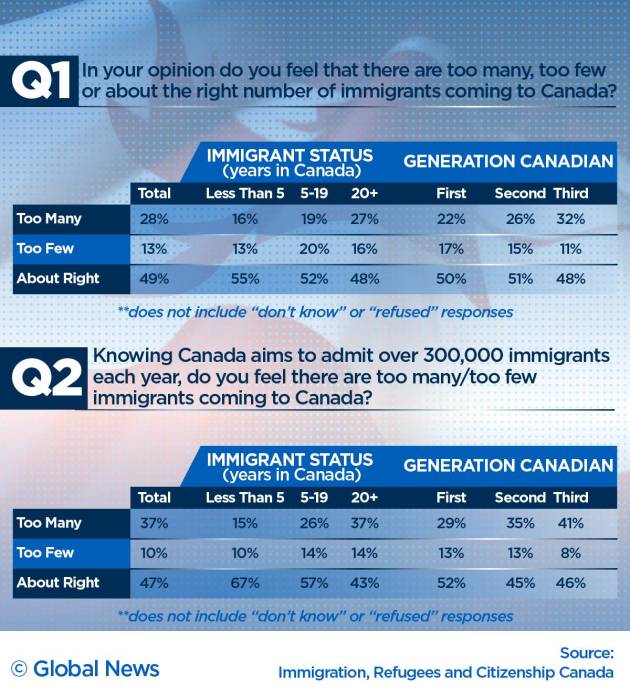
Among those who identified as first, second or third-generation Canadian, there were also differences.

Thirty-two per cent of those who identified as third-generation Canadians said there are too many immigrants.

That compares to 26 per cent of those who identified as second-generation and 22 per cent of those who identified as first-generation who said the same.

Roughly half of respondents across all of those categories said the immigration levels in Canada right now are “about the right number.”

“It’s clearly a pattern that shows up pretty repeatedly, for a couple of fairly obvious reasons, but also some more subtle things. The obvious thing is the more salient the immigration experience is for you, the more sort of open to immigrants you will tend to be,”said Michael Donnelly, an assistant professor of political studies at the University of Toronto’s Munk School of Global Affairs.

“It’s also harder to stereotype immigrants if you are yourself a recent immigrant,” he continued, noting the effect of being more closely linked to immigration may also be reflected in the changes in views among those who said their families have been here longer.

“If your parents were immigrants, there’s at least some sort of family lore of that experience and it’s going to have some influence on you.”

Donnelly noted that while studies done in other countries have yielded similar results, he has seen suggestions of a link between how long someone has lived in Canada and their views on immigration in only “one or two” studies in Canada over the years.

Disapproval appeared to increase in all but one demographic category when respondents were asked specifically about their views on immigration in the context of the government’s plan to bring in 300,000 immigrants per year.

“Knowing Canada aims to admit over 300,000 immigrants each year, do you feel there are too many/too few immigrants coming to Canada?” the questionnaire conducted for the report asked.

The percentage of immigrants here more than 20 years who said they feel there are too many immigrants coming to Canada increased from 27 to 37 per cent when asked that question with reference to the specific number.

The same was true for immigrants here between five and 19 years, with the number who responded in kind increasing from 19 per cent to 26 per cent.

Among those born in Canada, disapproval of immigration levels rose roughly 10 per cent when asked about the specific plan.

Forty-one per cent of those who identified as third-generation Canadian and 35 per cent of second-generation Canadians said so, compared to 32 and 26 per cent when asked the same question without the reference to the number of immigrants planned.

Christina Clark-Kazak, an associate professor in the Graduate School of Public and International Affairs at the University of Ottawa, and President of the International Association for the Study of Forced Migration, offered an explanation as to why that appears to be the case.

“I think that as an abstract idea, people are not necessarily against immigration,” she said, noting 300,000 is not a large amount of immigration given Canada’s size and existing population.

“But I think that people are concerned about ‘too many’ people coming in, so as soon as you get any kind of number, it becomes real, it becomes concrete, and then consequently there is a discussion of whether or not it is too many.”

The survey also asked respondents for their views on the influx of irregular border crossers coming into Canada from the United States.

Clark-Kazak said she was surprised by the results.

“There’s been actually a lot of negative press and political pressure around the Safe Third Country Agreement and irregular border crossers and that doesn’t seem to be born out in the public opinion that’s expressed, at least in this,” she said.

The survey asked respondents to rate on a 10-point scale whether they agree or disagree with the following statements: first, that they are confident in the government’s handling of irregular migration; and second, that it is not the responsibility of Canada to accept asylum claims from those coming from the U.S.

But neither question yielded any marked differences among respondents.

A slightly higher percentage said they strongly disagreed with the first statement than strongly agreed (16 per cent versus 11 per cent).

The same was true for the second statement, with 19 per cent overall saying they strongly agree and 16 per cent saying they strongly disagreed.

The vast majority of respondents from all backgrounds fell in between.

Donnelly said that isn’t surprising given the way the question was asked.

“There’s a real temptation to self-moderate and put yourself in the middle unless you have a real sort of goal,” he said.

“We don’t often see huge numbers at either extreme on longer scales unless the scales are sort of concrete.”

Roughly 35,000 migrants have crossed the border from the United States into Canada at irregular points of entry since early 2017.

Under the terms of the Safe Third Country Agreement, asylum seekers who arrive in either country must make their claim in the first country they first arrived.

That means migrants who arrive in the United States but do not make their claim will be turned around at the border if they try to do so in Canada.

But that only applies if they try crossing the border at an official checkpoint.

Those that cross at unofficial points of entry along the border can make their claim due to a loophole in the agreement.

That has led to calls from the Conservatives over recent years for the government to close the loophole and reduce the incentive for people to cross the border irregularly. Federal immigration officials have also acknowledged that the Safe Third Country Agreement is “no longer working as intended.”

Patti Lenard, an associate professor at the University of Ottawa focusing on immigration and immigration policies, said she doesn’t think the data shows strong feelings or differences in opinion about immigration among any particular subsets of the Canadian population.

Specifically, she questioned whether the average Canadian is as caught up in concerns about irregular migration as politicians have been in recent years.

“These numbers don’t suggest people are very exercised about irregular migrants coming in or irregular asylum seekers coming in through the United States. Mostly, it suggests people don’t really care about it at all,” she said.

“If I were the government, I would think that this is a sign that unless the Conservatives decide to go after them, they wouldn’t have to worry about a population that was going to turn against them on immigration.”

Lenard says while she recognizes immigration is expected to form a significant part of the Conservative campaign in the fall election, she is skeptical that it will bring the results Conservative Leader Andrew Scheer may be chasing.

“I don’t expect him to get a lot of purchase on it.”

Source: The longer someone lives in Canada, the more critical they may be of immigration: federal survey

Sheema Khan: Quebec’s religious-symbols ban is stranger than fiction – but the pushback from society must be real

Another good column by Sheema Khan:

In a cold open for a 2017 episode of the ABC comedy Black-ish, protagonists Bow and Dre walk into a bakery to buy a gender-reveal cake. The bakery has every type of cake, the employee says – but not for gay weddings. Bow and Dre leave in disgust. At the next bakery, they cut to the chase: “You don’t discriminate against people based on race, gender or sexual orientation, do you?” To which the stern-looking baker replies: “Do not like French-Canadians.” Initially stunned by the random reply, Bow and Dre quickly indicate they can live with that, and proceed with the order.

What passed for laughs in America would never fly up here. But the mention of French-Canadians in juxtaposition with fundamental civil rights was downright prescient, if not ironic. In this fictitious TV show, everyone’s fundamental civil rights are worthy of protection – except if you’re French-Canadian.

The reverse is true in one major part of French Canada – and the Quebec government’s rhetoric and actions would be comedic, too, if they weren’t so tragic.

The Coalition Avenir Québec’s Bill C-21 seeks “religious neutrality” – that is, legalizing employment discrimination based on an individual’s religious expression. Civil servants, along with judges, police officers, prison guards and teachers, will be forbidden from exhibiting any religious affiliation while on the job. According to Premier François Legault, observant Sikhs, Jews and Muslims should look for another line of employment. Where else in the world has an elected leader told constituents to find another job because of their beliefs?

Recently, a councillor in the Montreal borough of Anjou, Lynne Shand, expressed her outrage at being treated by a doctor wearing a hijab, posting on Facebook: “If it hadn’t been an emergency, I would have refused to be treated by her. I’m angry because it’s really the Islamification of our country.”

While she later apologized, she clarified that she is against “visible” religious symbols, alluding to the proposed bill. It was irrelevant that the doctor’s service – according to Ms. Shand – was excellent.

This follows on the heels of similar outbursts by other Quebec politicians. CAQ Minister for the Status of Women Isabelle Charest unequivocally stated that the hijab is a sign of oppression, thereby proving that she is unfit to serve all women in her province. Gatineau deputy mayor Nathalie Lemieuxresigned after telling a French-language newspaper that Muslim immigrants don’t integrate, adding they “do bad things with their trucks … it’s normal to be afraid of them.”

First and foremost, the dangerous bill creates two tiers of citizens: those with full rights and opportunities, and those without. Since it uses the Charter of Rights and Freedoms’s notwithstanding clause to preclude any court action, the bill invites civil disobedience as the only means to fight against laws that deny fundamental freedoms. Furthermore, the bill gives licence to xenophobes to stigmatize and berate fellow Quebeckers. While Public Security Minister Geneviève Guilbault has backtracked on her warning that police would enforce C-21, it harked back all the same to the federal Conservatives’ proposed “snitch line” in the 2015 election.

And while it may be civil servants and employees in positions of authority today, who will it be tomorrow? Doctors providing service? Students at public schools, as was the case in France? Will the private sector follow the government’s lead? Finally, what other encroachments will there be on religious freedoms? Will Muslim students be barred from fasting during Ramadan, as was proposed by certain Quebec schools in 1995?

Before the rest of Canada gets smug, it should reflect on its own attitudes. Georgetown University’s comprehensive study on Islam, Muslims and Islamophobia, compiling Canadian data between 2004 and 2018, paints a glum picture. While the majority of Canadians acknowledge that anti-Muslim sentiment is a growing problem, most hold unfavourable views about Islam and Muslims. For example, last year more Canadians were worried about “homegrown radical Islamic terrorism” than violence from white-supremacist groups. In 2017, roughly half of all Canadians believed that Islam is the most “damaging” religion in the public sphere – even after six people were killed in a Quebec City mosque.

Now that there’s been a legislative assault on religious freedoms, will Anglo-Canadians stand up, too?

In the days since C-21 was introduced, there has been active opposition to it within Quebec, giving the lie to Mr. Legault’s Orwellian promise that the bill would bring Quebeckers together. Quebec civil society’s actions are reminiscent of the inspiring acts of solidarity by New Zealanders in the wake of the attacks at two mosques in Christchurch.

The difference in political leadership between Quebec and New Zealand, however, is like night and day.

As Martin Luther King Jr. once said: “Nothing in all the world is more dangerous than sincere ignorance and conscientious stupidity.” Looking at Quebec today, where reality is stranger – and far more dangerous – than fiction, and where a government works to effectively sanitize bigotry against its own people, his words ring too true.

Source: Quebec’s religious-symbols ban is stranger than fiction – but the pushback from society must be real Sheema Khan

Why Narendra Modi has an enduring Muslim problem in India

Interesting article on some of the underlying and long-standing tensions with and prejudices regarding Muslims in India and how PM Modi has increased them:

Lucille Eichengreen was a school girl in Hamburg. Like most children she had many friends and a carefree childhood. Her world changed overnight. “Hitler came to power in January 1933. The children that lived in the same building…no longer spoke to us. They threw stones at us, they called us names, and that was maybe three months after Hitler came to power, and we could not understand what we had done to deserve this…And when we asked at home the answer pretty much was, ‘Oh it’s a passing phase, it won’t matter, it will normalise.’ What that actually meant we did not know. But we could not understand the change.”

“Well, Levine, have you got your ticket to Palestine?”

She was not alone.  Eugene Levine used to study in a mixed religion school where, one day, he was taunted by a non-Jewish boy, who was his friend, “Well, Levine, have you got your ticket to Palestine?” Eugene was shocked. “But, you see, anti-Semitism’s always there beneath the surface.” These incidents are a part of a history that even the Germans don’t want to remember any longer. Both the statements, together, hint at a fact that is distasteful, dangerous and apocalyptical.

…

It is a lesserknown fact of history that Hindenburg who appointed Hitler as chancellor, had refused twice before to appoint him to the post. He had said in November 1932, that a presidential cabinet headed by Hitler would inevitably develop into a party dictatorship with all its consequences, resulting in a worsening of the antagonisms within the German people.

Unlike Hindenburg, Indian president Pranab Mukherjee did not have any choice but to obey the will of the people; and at that time if he had any reservations about the turn of events, he did not share it with anyone. But it is to be noted that a section of the intelligentsia had always viewed Modi as a polarising figure who unabashedly pursued Hindutva and did not hide his views vis-a-vis minorities. His image as a Hindutva icon was one of the major reasons for his success and he did not flinch in exploiting it to the hilt, though he did marry it with the utopia of development and the idea of making India great again.

He could succeed only because like in Germany prejudice against Muslims had been lying dormant in a section of Hindus for long. To be fair to Modi and the RSS (Rashtriya Swayamsevak Sangh), this prejudice against Muslims existed even before the RSS was formed in 1925.

…

The problem with the RSS is that it has failed to understand, that in independent India, two incidents—the demolition of Babri Masjid in 1992 and the 2002 Gujarat riots—have majorly impacted the Muslims’ collective psyche, scarred them emotionally, and shaken their belief in the Indian legal system.

Modi’s identification with Gujarat riots is too overwhelming in the Muslim community. And his rule since 2014 has not helped lessen the burden of history; rather it has created new fissures in their minds, inflicted much deeper emotional wounds and constructed a regime of alienation, helplessness and betrayal.

Modi’s identification with Gujarat riots is too overwhelming in the Muslim community.

The killing of Akhlaq, Pehlu Khan, Junaid and others by cow vigilantes; the subsequent collaboration of state machinery to save the perpetrators; no urgent and unequivocal condemnation of these incidents from Modi and Bhagwat; felicitation of mob lynching accused and convicted Hindutvavadis by central ministers; provocative statements by BJP/RSS leaders targeting Muslims; sudden closure of abattoirs in UP and other states without any opportunities for alternate ways of livelihood; forced ban on beef in northern and western states by BJP governments at a time when India is the leading beef exporter in the world; the arrest and brutal beatings of Muslim youth in the name of love jihad; insulting and intimidating Muslims who tried to offer namaaz in an open space; regular violations of the symbols of Muslim identity; a nonstop attempt to portray and lampoon them as terrorist and anti-national by the Hindutva Brigade on TV Channels and social media; the Modi government’s effort to abrogate instant triple Talaq and through that to build a narrative that the community is regressive, and so on, has built a perception in the community that the Indian state has become anti-Muslim in its ethos and practice.

Since 2014, a section of Hindus have rediscovered their Hindutva which if scratched a bit, reveals an anti-Muslim point of view. Flaunting an anti-Muslim attitude is definitely massively on the rise. The stereotyping of Muslims has increased manifold. The present status of Muslims in India, reminds me of Silvia Vesela, a Slovakian Jew, who was held in a temporary camp in 1942, where death was staring her in the face. She said, “It hurt, it really hurt when I, for example, saw many schoolmates shouting with fists raised, ‘It serves you right!’ Since that time I do not expect anything of people.”

…

Since Modi took over the reins of the government a paradigm shift has taken place. Muslims have started feeling that the state had now started interfering in matters of their religion and culture. Anwar Alam writes, “It is the religio-cultural alienation which might strengthen the process of radicalistion among Indian Muslims. The demolition of Babri masjid was a jolt to the faith of the Muslim community. Since 2014 when the present NDA government came into power at the Centre, it has initiated a series of policy measures including the issue of criminalising instant triple talaq and keeping a distance from sharing Muslim/Islamic symbolism in the public domain that deeply concerns the Muslim community: whether they are any longer free to practice their religion freely in this nation.”

“Hindus are not seen as religious enemies. The problem is the RSS and Hindutva.”

During research for this book I met many Muslim intellectuals and leaders. I could sense that there was a definite unease in the Muslim community vis-a-vis the Modi government, guarded by a rather deceptive silence. The present crisis is being perceived as an existential crisis. Therefore a lot of internal churning is going on. It has been acknowledged by the community that the traditional leadership of the Muslim community has let them down. Now, young and educated leaders are taking the lead and trying to organise the community. Older leaders are extremely cautious in articulating their views on issues related to politics, and it has been communicated to all, especially the youth to not get provoked, whatever be the nature of the provocation. Anand Vivek Taneja, assistant professor of anthropology and religious studies at the University of Vanderbilt, USA, had been touring areas such as Aligarh, Lucknow, Kolkata, Patna, Hyderabad and so on, across the country for his research on Muslims. During an interview with me, he said, “[The] Muslim community is definitely in a self -reflective mood and there is an extraordinary amount of restraint but (the) community also makes a clear distinction that the present problems it is facing is because of the current politics. There is no ill feeling against Hindus per se. Hindus are not seen as religious enemies. The problem is the RSS and Hindutva.”

Source: Why Narendra Modi has an enduring Muslim problem in India

Letter: The Trouble With Staying Silent on Ideological Extremism

Omer Aziz responds to Graeme Wood’s earlier piece in The Atlantic (After Christchurch, Commentators Are Imitating Sebastian Gorka). Good debate and discussion between the two.

And yes, needs to be said, ideas, words and speech matter:

After the tragedy at Christchurch, New Zealand, Graeme Wood wrote recently, a funny thing happened: “Everyone discovered, all at once, that ideology matters.” But just as important as this recognition, Wood argued, is the ability to differentiate on an ideological spectrum. To fail to do so “leads to catastrophic blunders”: In The New York Times, for instance, “Omer Aziz accused the neuroscientist and atheist Sam Harris, as well as the Canadian psychologist and lobster enthusiast Jordan Peterson, of complicity in mass murder for objecting to what they argued are overbroad applications of the word Islamophobia.”

“If we cannot distinguish Harris and Peterson from Richard Spencer, let alone Brenton Tarrant,” Wood wrote, “then our problems are bad indeed.”


There are several points I take contention with in Graeme Wood’s essay on the Christchurch massacre, which names me and two other writers for failing to make important ideological distinctions between the New Zealand killer and others who, strictly speaking, have nothing to do with him. Set aside the irony of taking writers to task for not making important ideological distinctions and then lumping in three diverse writers together, thereby failing to make those distinctions yourself. Wood’s major claim in the piece is that after Christchurch, “everyone discovered that ideology mattered”—white-nationalist and fascist ideology—and this was in contrast to the politically correct liberal response to jihadist violence, in which presumably these very same writers adequately distinguish Islamist terrorism from Muslims tout court.

Other writers can speak for themselves. In my case, I have written about the role that ideology and religion play in jihadist violence. Indeed, I have been influencedby Wood’s own work on this, and have discussed it with him, multiple times, in private and in public. I believe that there is always an ideological spectrum with respect to extremist violence, and the various shades of that spectrum ought to be interrogated, even if it makes people feel uncomfortable. That goes for Islamist violence, as it does for white-nationalist terror.

Wood takes especial issue with my mentioning of the neuroscientist Sam Harris in my piece for The New York Times. The exact words from that piece were:

People with millions of online followers have been incessantly preaching that Islamophobia is not the problem; Islam is. The Canadian intellectual Jordan Peterson has said that Islamophobia is a “word created by fascists.” The neuroscientist Sam Harris has called it an “intellectual blood libel” that serves only to shield Islam from criticism.

Note that there is not the slightest intimation here that Peterson or Harris shares liability, responsibility, or guilt for the New Zealand massacre. It simply acknowledges the salient fact that prominent thinkers have been in Islamophobia-denial for a long time, even after Muslims were specifically targeted because of who they were and for no other reason.

Jordan Peterson is more complex, and his thinking about Islam and Muslims requires its own separate treatment. But Harris has been propounding vicious misinformation about Muslims for a decade. Does Wood not have an opinion on someone who warned about the “ominous” Muslim birth rates in Europe and published misleading statistics about them, the very same birth rates that the New Zealand killer was so tormented by in his manifesto? (And why would it be “ominous” if there are more brown people in Europe? For what it’s worth, at maximal levels of immigration, Muslims would account for 14 percent of Europe’s population in 2050, according to Pew. Those worried about the coming hordes of brown bodies can relax somewhat.)

It is not wrong to call out people who have been denying that a particular form of racism exists when this very racism becomes the central motivation of a live-streamed lynching of vulnerable people. By the logic of Graeme Wood’s own piece (that ideology matters) and by the logic of Sam Harris’s own ontology of Islam (that there are concentric circles of extremism, with jihadists in the middle and their enablers on the outer rings), the ideological spectrum of Islamophobia ought to have been probed more thoroughly. Instead, Wood is silent, dismissing all this as self-evidently not worth mentioning. A spectrum of ideology for thee, but not for me.

If casual Islamophobia is not on the same ideological spectrum as violent Islamophobia, why not? Are overt warnings about Muslim birth rates and “deranged” Muslims so acceptable now that they fail to register as extreme? Yes, Islamophobia is an imperfect term; that does not alter the reality the term describes, which, like anti-Semitism, is a particular form of racism. The methodology of Wood’s piece—of transposing words to highlight hypocrisies—might help here. Swap Muslim with Jewish, and you get Harris warning about Jewish birth rates in Europe, calling the Jewish world “deranged,” and claiming that anti-Semitism is a made-up word. Anyone using such language would be rightly condemned as anti-Semitic. I wonder whether Wood would still be silent then.

There are many enablers of Islamophobia today, Harris among them, and their consistent propounding of anti-Muslim myths has put Muslim lives at risk. Of course, there is no causal link between the intellectual enablers of Islamophobia and the New Zealand killer. To my knowledge, no serious writer has sought to draw such a link. Again: We are not discussing culpability; we are discussing an ideological spectrum in which subtle bigotry toward Muslims has become mainstream. These ideological enablers create a permissive environment for more dangerous ideas to fester. Calling them out is not a controversial idea. It’s applied to Muslims all the time.

“To fail to differentiate leads to catastrophic blunders,” Wood writes. I heartily agree. And an even greater moral disaster is the willful blindness toward an ideological spectrum when a white man is the one pulling the trigger. When you are silent on the ideological extremism of your friends, you inevitably aid the violent extremism of your enemies. In this case, it is not your voice that gives them license, but your silence on matters that you have deliberately overlooked.

Source: Letter: The Trouble With Staying Silent on Ideological Extremism

Why hard-fought election at North America’s largest Sikh temple could be bad news for Liberals in next federal vote

We will know in October, but of course other factors will also be at play. And the sensitivity regarding the mention of Sikh extremism in a Public Safety report is also noteworthy:

When North America’s largest Sikh temple elects a new board of directors, it doesn’t fool around.

Candidates have campaign managers, cold-call voters and go door-knocking in the race for leadership of the Ontario Khalsa Darbar (OKD), a Toronto-area institution that functions as a place of worship, a community centre — and a nexus of political influence.

The Liberals have long been linked to the OKD, and arguably benefited from its status among the province’s Sikhs. But the election that wrapped up there early Monday morning may not bode well for the party.

A Grit-associated slate promoted by the fathers of Navdeep Bains, a star in Prime Minister Justin Trudeau’s cabinet, and MP Ruby Sahota was roundly defeated, and a controversial government report that suggested Sikh terrorism still poses a threat here may have played a role, say observers and campaign organizers.

That could have ramifications for Liberal support in several swing seats in and around Brampton, Ont., most of which flipped to the party from the Conservatives in the 2015 election.

“These local ridings will be affected by it,” said Balraj Deol, a Punjabi-language journalist in the area. “That is an advantage for Conservatives, and the NDP also. It’s a loss for the Liberals and it will be a gain for the other two.”

“This may be a sign,” said Jaspal Bal, campaign manager for the victorious side.

Even Trudeau was dragged into the race, with the winning group alleging his visit to the area last week was designed to bolster support for the other side.

But not everyone sees broader implications in the temple vote, no matter how intense the campaign became. Avtar Badyal, the losing presidential candidate, said Trudeau’s visit and Liberal policies had nothing to do with his team’s loss. The election was simply about which group voters believed could best manage an important spiritual institution, he said.

“This is not a political thing, it’s a religious thing,” said Badyal. “I don’t know why they are making this into something that it’s not.”

Another local journalist said he also doubts that broader politics played a role in the temple election, or will be affected by its outcome.

“Not at all,” said Yudhvir Jaswal, who hosts popular radio and TV shows on the local Y-Channel. “I think they are oversimplifying things.”

Regardless, when the ballots were all counted at about 3:30 a.m. Monday, the entire “Panthak Alliance” slate backed by the fathers of MPs Bains and Sahota had been defeated, every one of their 11 opponents elected by healthy margins.

To the winners goes control of a temple — or gurdwara — that boasts 3,700 members and a sprawling, 70-acre site near Toronto’s Pearson airport.

Underscoring the high stakes in such elections, a court battle between directors that began in 2006 forced a nine-year delay in voting and reportedly generated $5 million in legal bills.

Sikh temples are community focal points as well as religious institutions, and OKD includes 15 halls that are booked solid with weddings.

It also provides a potential platform for politicians eager to reach the region’s powerful Sikh voting bloc, said Deol, hosting gatherings that can attract tens of thousands of people.

“That gurdwara is the prime hub for everything,” said an organizer on the winning side, who asked not to be named. “It’s very influential.”

Liberals like Bains, the economic development minister, used to have ready access to the OKD stage, the person said. “That’s not going to happen any more, so that’s a big blow to them.”

Bains was among several Liberals of Sikh background who captured Brampton and Mississauga ridings in 2015, a key part of the Greater Toronto Area battleground that is itself crucial to winning federal elections.

But the community’s support for the party took a serious hit with the release in December of a Public Safety Canada report on terrorism that suggested “Sikh (Khalistani) extremism” remained a threat.

Sikh groups reacted with outrage, saying that using violence to support Punjabi independence was rejected long ago in Canada. The so-called Khalistani movement is entirely peaceful today, they argue.

Local MPs are expected to face a grilling this Sunday at a town-hall meeting about the report.

Many of the temple members who voted for the winning slate in Sunday’s gurdwara election did so to express their opposition to the terrorism statement, equating the other slate with the government, said Bal.

In fact, when a candidate on the opposing side promised to honour the four Sikh-Canadian ministers in the Trudeau cabinet at the gurdwara, the eventual winning slate gained more support, he said.

“People put aside their bickering and differences and said this is one of the issues that is uniting us to support these 11,” said Bal. “Because they have said they will not sit idle and wait with a garland to welcome the leaders who have declared us a terrorist threat.”

Source: Why hard-fought election at North America’s largest Sikh temple could be bad news for Liberals in next federal vote

If There Is a Free-Speech ‘Crisis’ on Campus, PEN America Says, Lawmakers Are Making It Worse

Good balanced commentary:

Free speech is being tested on college campuses by rising numbers of hate crimes and deepening racial tensions, according to a report released today by PEN America, a human-rights association of writers and editors. But the Trump administration’s warnings of a “crisis” overstate the problem, it says, and risk further polarizing colleges.

The 100-page report, “Chasm in the Classroom: Campus Free Speech in a Divided America,” finds that threats to speech are coming from both the right and the left. Lawmakers at state and federal levels are, in many cases, making the problem worse by raising “politicized and one-sided alarms over the state of free speech” on campuses, it says.

The association examined 100 speech-related controversies that have broken out in recent years. Often, the authors found, the battles reflected tensions between free speech and the goals of equality and inclusion.

The campus confrontations grabbed the biggest headlines in 2017, “but the intermittent earthquakes of the past few years have been replaced by a near constant — if less sensational — rumble” as colleges work to fend crises off before they erupt, the report says.

Its release comes less than two weeks after President Trump’s executive order threatening to cut off federal research money to colleges that fail to uphold free speech.

Over the weekend, a lawyer with the Department of Justice, speaking at a Harvard Law School symposium, doubled down on that threat.

Jesse Panuccio, principal deputy associate attorney general, warned of a “free-speech crisis” on college campuses, citing specific examples of speech codes, free-speech zones, and “heckler’s vetoes” that he considers First Amendment violations.

“The very core of university life — open debate among scholars and students — is under attack,” he concluded.

The Trump administration has filed statements of interest in five free-speech-related lawsuits, against the University of California at Berkeley, Los Angeles Pierce College, Georgia Gwinnett College, the University of Michigan, and the University of Iowa. Panuccio warned that more challenges would be coming.

Efforts to legislate free-speech protection represent to many an unwelcome intrusion into colleges’ affairs. But campuses aren’t the only places where these battles are being waged.

“Far from taking place in isolation behind ivy-covered walls, today’s campus free-speech controversies are inextricable from the social and political upheaval of this historical moment,” PEN America’s chief executive officer, Suzanne Nossel, said in a statement accompanying the report.

“While we have never thought that there was a crisis per se when it comes to campus speech, there are legitimate concerns about ideas and viewpoints that have become hard to voice amid a climate of intense ideological rancor,” she wrote. “While President Trump has spotlighted threats to speech emanating from the left, our analysis reveals that intolerance of opposing views cuts across the political spectrum.”

The national debate over free speech on campus has become, in the Trump era, “a deeply partisan feud, with each side trying to catch the other in transgressive acts that can be amplified to rile up the faithful,” the report says.

One such skirmish broke out last week, when safety concerns prompted Beloit College to cancel a lecture by Erik Prince, founder of Blackwater, a private security company whose employees were implicated in the 2007 deaths of Iraqi civilians.

The event, hosted by the campus chapter of Young Americans for Freedom, a conservative student group, was called off after protesters pounded on drums and piled chairs onto the stage where Prince was to speak.

Prince, who is the brother of U.S. Education Secretary Betsy DeVos, suggested to the Beloit Daily News that a lawsuit may be coming. “It’s sad the president and the administration of this college lacked the moral courage to enforce free speech and to defend free speech,” he said. “Fortunately, President Trump will defend free speech, and I think the college will be hearing from the court soon on this, because enough is enough.”

Beloit released a statement saying that it had acted out of concern for student safety, and that the protesters’ actions jeopardized the college’s commitment to open dialogue. “Tonight’s events fell unacceptably short of this core principle, and we condemn the behavior of those who disrupted the event,” it said. “The college will begin an investigation immediately.”

The college also posted an explanation of why it had allowed Prince to speak but then canceled the lecture.

Nossel said it was unfortunate that Beloit couldn’t find a way to allow Prince to talk by changing the venue or finding some other nonviolent way to keep protesters from interfering. “While students were absolutely within their rights to object to Prince and his message, they should have done so without impairing his free-speech rights and those of those who chose to listen to him,” she wrote in an email to The Chronicle.

Free Speech as ‘the Bedrock’

PEN America expressed worry about a tendency among some students to view free-speech protections as a cover for bigotry. Given the natural outrage some feel when a white supremacist or someone they consider a war criminal is allowed to speak on campus, the group says, it is important to ensure that students appreciate the importance of free speech “as the bedrock of an open, democratic, and equitable society.”

Leading up to the report’s release, the researchers invited groups of students, faculty members, administrators, and others for face-to-face discussions on four campuses that have been flashpoints for free-speech controversies: the University of California at Berkeley, the University of Virginia, Middlebury College, and the University of Maryland at College Park.

Among the key conclusions they came away with:

Colleges are seeing more incidents of hateful expression and intimidation.

The Southern Poverty Law Center estimates that the number of hate groups nationwide grew from 917 in 2016 to 1,020 in 2018, the report notes. College administrators are struggling to respond in ways that balance the goals of free speech and inclusion.

Faculty members are the targets of outrage campaigns from both left and right, causing serious threats to academic freedom.

The Justice Department is raising politicized alarms over the state of free speech. Similar one-sided attacks are happening at the state level as lawmakers seek to legislate free-speech protections.

Even Trump has acknowledged that statements by officials of his own administration about a free-speech crisis are “overblown.”

Professional provocateurs like Milo Yiannopoulos and Richard Spencer have faded from the scene, but they’ve left an impact on the campuses they visited. Along with more-robust security measures, colleges have had to overhaul how they communicate with students before, during, and after a free-speech controversy.

The PEN America report includes updated guidelines for students, faculty members, and administrators on how to navigate campus controversies in ways that protect free speech while making diverse students feel welcome and supported.

When someone has been offended by a racist remark or sign, the immediate aftermath might not be the best time for a lecture about free speech, the group says. Administrators should condemn hate speech and reach out to those who are hurt by it. They should also make sure that the rights of both speakers and protesters are protected.

The report mentions a bridge that crosses the Mississippi River to link two sides of the University of Minnesota’s Twin Cities campus. Every fall, students paint the panels of the pedestrian walkway to showcase their clubs. When College Republicans in 2016 wrote “Build the Wall,” the message was soon graffitied over by “Stop White Supremacy.” Protests erupted over what should be allowed as free speech or condemned as hate speech.

“The controversy over one bridge is instructive,” the report says, “because it highlights how campuses have become a proxy for national political and social conflicts writ large in which speech has taken on great significance, and in which neither side is willing to cede an inch — or a mural — to the other.”

Source: https://www.chronicle.com/article/If-There-Is-a-Free-Speech/246031?cid=wcontentlist_hp_latest

Daphne Bramham: Concerns raised about Chinese interference in Canada’s fall election

Of note:

Ivy Li worries that the Chinese Communist Party might be able to affect the outcome of Canada’s fall election using a campaign of disinformation and by silencing critics.

Li is not alone. Li helped organize a recent dialogue that featured Jonathan Manthorpe, author of the best-selling book, The Claws of the Panda: Beijing’s Campaign of Influence and Intimidation in Canada, where she and others talked about their fears and experiences.

Last week, Reporters Sans Frontieres noted its own concerns in a report titled China’s Pursuit of a New World Media Order.

In his book, Manthorpe — the former Vancouver Sun Asia correspondent and foreign affairs columnist — writes that Canada has become “a battleground on which the Chinese Communist Party seeks to terrorize, humiliate and neuter its opponents.”

It is “a war of intimidation and harassment” that seeks to smother, silence or discredit dissenters, especially those from “the Five Poisonous Groups — advocates of independence for Tibet, Xinjiang and Taiwan, promoters of democracy in China, and adherents of Falun Gong.”

Manthorpe documents how Chinese-language publications in Canada have muzzled and fired journalists and how wealthy Chinese-Canadians with business ties to China and organizations linked to the Chinese government’s United Front have been involved with candidates from various parties in past elections.

Perhaps unsurprisingly, there wasn’t a single journalist from the Chinese-language media at the speaking event organized by Friends of Hong Kong and the Vancouver Society in Support of Democratic Movement.

Only one Chinese media representative responded to organizer Fenella Sung’s invitation. But that journalist declined to come. Why? The journalist was leaving soon for China.

Sung noted that the challenges faced by Chinese-Canadians are real because of family and business ties that they may have to China and the fact that the communist party and the Chinese government regard the overseas diaspora as a bloc.

But she said, “We are in Canada. We don’t have to abide by community norms. Here, it’s okay and normal to think differently. … We have to stick to our own values and principles.”

Yet, as both Manthorpe and Reporters Sans Frontieres note, the Chinese government has made substantial investments in international TV broadcasting, foreign media outlets, advertising, and junkets for foreign journalists and politicians. It has embedded the Confucius Institute in schools and universities.

As for social media, the Reporters Sans Frontieres report calls it the new battleground where disinformation is spread by an army of paid and unpaid trolls on the government-linked messaging service WeChat and on micro-blogging sites.

While disinformation campaigns have mainly been directed at Taiwan and Singapore, Reporters Sans Frontieres says WeChat is increasingly being used to spread fake news in Canada and the United States.

In Canada, WeChat initially censored news of the December arrest of Huawei executive Meng Wanzhou in Vancouver pending extradition to the United States on fraud charges.

The report says the Chinese government’s expansion into media “poses a direct threat not only to the media but also to democracies.” It goes on to say that unless democracies resist, Chinese citizens will lose all hope of ever seeing press freedom in their country.

And it warns, “Chinese-style propaganda will increasingly compete with journalism outside China, thereby threatening the ability of citizens everywhere to freely choose their destiny.”

Li echoed those fears.

“We can’t succumb to intimidation,” she said. “The more we do it — especially those who are in the Chinese-Canadian media — the more we play into the hands of the (Chinese Communist Party). If we toe the line, we become silent partners of the (party).”

Others spoke about being torn between the country they have chosen and the country where they were born. They talked about fearing reprisals against family they have left behind or the businesses they are running, if they are critical of the Chinese government.

As one of the organizers, Li spoke last. She urged Chinese-Canadians to speak up in support of non-Chinese critics when Chinese officials and their supporters try to silence them with accusations of racism.

In December, China’s ambassador in Ottawa, Lu Shaye, accused Canada and Canadians of “white supremacy” in response to Ottawa’s request for the release of two Canadians detained without charges and held in an unknown location in retaliation for Meng’s arrest.

It was intended as a slap in the face to all Canadians. Instead, it serves as an ironic reminder that everyone in this country has the right to speak openly and critically without fear of reprisal, even if they don’t have diplomatic immunity.

Freedom and democracy is why Li chose Canada and why she urged Chinese-Canadians to be “the leading force to counter (Chinese Communist Party) campaigns of influence and intimidation.”

“Are we protecting the things that we came here for? That’s our responsibility as immigrants,” she said. “Because if we endanger those things, it’s not fair to Canada. And it’s not fair to ourselves.”

Source: Daphne Bramham: Concerns raised about Chinese interference in Canada’s fall election

New report suggests visas for skilled immigrants to struggling U.S. counties

Some similarities with Canada in terms of the Provincial Nominee Program, the Atlantic Immigration Pilot, and the recently announced Northern and Rural Immigration Pilot. Hard to see it going anywhere under the current anti-immigration environment:

The U.S. already has a special visa to attract foreign doctors to treat rural Americans — now a new report suggests expanding that to all skilled immigrants who’d be willing to settle in areas facing long-term demographic problems.

Why it matters: “Migration out of struggling areas has become skill-biased,” according to a new report released by the Economic Innovation Group.

Show less
  • “Someone with a professional or graduate degree is twice as likely to move states as a high school graduate.”
  • “For every one college graduate that the fastest shrinking counties add, the fastest growing add two.”
  • “By 2037, 67% of U.S. counties will contain fewer prime working age adults than they did in 1997.”

The big picture: “At the national level, slower growth in America’s working-age population is a major reason that mainstream forecasters now expect the economy to expand around 2 percent each year rather than the 3 percent common in the second half of the 20th century,” the N.Y. Times’ Neil Irwin notes.

The EIG’s set of principles for a heartland visa:

  1. Communities must “opt in”: Towns or counties that don’t want to participate shouldn’t be forced to join.
  2. Distressed areas first: The program “should be targeted to places confronting chronic population stagnation or loss.”
  3. No work restrictions: Visa holders should be allowed to compete in the labor market, as long as they stay in a specific geographic area.
  4. This should be a path to a green card: “The prospect of permanent residency … should provide an extremely strong incentive for compliance.”
  5. Adding to, not replacing, existing skilled visas: “The scheme would therefore need to be accompanied by a commensurate increase to the green card cap.”

The bottom line: This is somewhat of a moot point during the Trump presidency, which has sought to curb immigration levels. But as the U.S. faces further demographic decline, this is one option for lawmakers trying to help the areas hurting the most.

Source: New report suggests visas for skilled immigrants to struggling U.S. counties

Pope Francis: God merely ‘permits’ Islam

Hard to see the debate over “willed” or “permitted” having any material effect apart from theological debates:

Pope Francis has further clarified his controversial statement issued in Abu Dhabi, in which he appeared to state that God “wills” the existence of many religions.

This appears to contrast with the traditional doctrine of the Catholic Church, which teaches, in the words of the Second Vatican Council, that the “one true religion subsists in the Catholic and Apostolic Church, to which the Lord Jesus committed the duty of spreading it abroad among all men.”

The informal clarification came at today’s general audience, as the Pope reflected on his recent trip to Muslim-majority Morocco. In unscripted remarks, he said to pilgrims gathered in St. Peter’s Square:

But some may wonder: but why does the Pope go visit the Muslims and not only the Catholics? Because there are so many religions, and why are there so many religions? With the Muslims we are descendants of the same Father, Abraham: why does God allow so many religions to exist? God wanted to allow this: the Scholastic theologians referred to the voluntas permissiva [permissive will] of God. He willed to permit this reality: there are many religions; some are born of culture, but they always look to heaven, they look to God. But what God does will is fraternity among us, and in a special way — hence the reason for this journey — with our brothers, who are sons of Abraham, like us, the Muslims. We must not be afraid of the difference: God has permitted this. We ought to be frightened if we do not work in fraternity, to walk together in life.

The Feb. 4 statement incited controversy among Christians for asserting that “the pluralism and the diversity of religions” — like the diversity of “color, sex, race and language” — are “willed by God in His wisdom, through which He created human beings” — a claim many believe to be contrary to the Catholic faith.

Some critics argued the Pope’s statement seemed not only to “overturn the doctrine of the Gospel” but also to align with the ideas of Freemasonry.

Observers pointed out that the potential for confusion was compounded by the fact that both Al-Azhar and the Catholic Church asked in the document that it “become the object of research and reflection in all schools, universities and institutes of formation.”

To remedy the confusion arising from the statement, four days later Bishop Athanasius Schneider issued a statement on uniqueness of faith in Jesus Christ. Three weeks after that, at a Mar. 1 ad limina meeting of the bishops of Kazakhstan and Central Asia with Pope Francis at the Vatican, Bishop Schneider privately obtained from Pope Francis a clarification that God only permits but does not positively will a “diversity of religions.”

The Pope explicitly stated that Schneider could share the contents of their exchange on this point. “You can say that the phrase in question on the diversity of religions means the permissive will of God,” he told the assembled bishops, who come from predominantly Muslim regions.

Bishop Schneider in turn asked the Pope officially to clarify the statement in the Abu Dhabi document.

In light of the Abu Dhabi statement and today’s informal clarification from Pope Francis, LifeSite spoke with Capuchin Father Thomas Weinandy, a member of the Vatican’s International Theological Commission and former chief of staff for the U.S. Bishops’ committee on doctrine, about the controversy.

In 2017, Fr. Weinandy wrote a letter to Pope Francis (which was subsequently made public) saying his pontificate is marked by “chronic confusion” and warning that teaching with a “seemingly intentional lack of clarity risks sinning against the Holy Spirit.”

In our interview with the Fr. Weinandy on the Abu Dhabi statement, he identifies what he believes is its most problematic element, and offers his perspective on both on the Pope’s private clarification to Bishop Schneider and his public remarks at this week’s general audience.

Fr. Weinandy says while he believes Pope Francis is motivated by a “noble desire” to “foster mutual understanding” and “undercut some Islamic factions that foster terrorism,” his signing the Abu Dhabi statement “has doctrinal consequences well beyond what he may have envisioned or desired.”

“What I find very sad and scandalously troubling” he added, “is that, in the midst of it all, Jesus is being insulted. He is reduced to the level of Buddha or Mohammed when in fact he is the Father’s beloved Messianic Son, the one in whom the Father is well pleased.”

…

Source: Pope Francis: God merely ‘permits’ Islam