Raymond de Souza: Canada’s anti-racism strategy needs to redefine Islamophobia

While I don’t read the anti-racism strategy in the same way as de Souza, all religions face similar challenges with respect to the extremists within their ranks and considering what forms of criticism may cross the line between criticizing particular practices and their impact on people, and more general anti-Christian, anti-Islam, anti-Sikhism or anti-Judaism attitudes:

Some time back I was booking a flight and had an option to fly EgyptAir, with a connection in Jeddah, Saudi Arabia. The times were convenient and the price right. I declined and found another option.

Why? Because I would not want, even as a mere stopover, to be in Saudi Arabia without prior guarantees from the government that I would not be subject to imprisonment or worse because I am a Christian.

If I were made of sterner stuff, I suppose I might welcome the chance to minister as a fellow prisoner to those Filipino and Indian “guest” workers caught praying and thrown into an extra-judicial jail, perhaps never to be heard of again. But I am not, and so opted to give Jeddah a pass.

I opted to give Jeddah a pass

Now is that Islamophobic? I suppose yes, in that I would be afraid for life and liberty because in Saudi Arabia a certain form of Islam is practiced and given sanction by the state. To put it another way, I would be happy to connect in Johannesburg but not Jeddah, and the reason is related to the latter being in an Islamic country.

Yet, I would also be happy to connect in Jakarta, in the world’s most populous Muslim country, so maybe I am not Islamophobic after all. And I would be happy to visit India, where there are more Muslims than in Saudi Arabia.

Is it Islamophobic for a Catholic priest not to stop over in Saudi Arabia? What if there were mechanical problems and we were required to leave the airport to stay overnight in a hotel? In a country where carrying a bible or a rosary can get you thrown into religious jail? Where Catholic priests have to minister incognito, like the worst days of Elizabethan England? Whoops, did I just reveal a latent Anglicanophobia? I might be a simmering cauldron of bigotry.

Of course it’s not Islamophobic. Christians are quite right to be circumspect of Wahhabi Islam as it is practiced in Saudi Arabia and exported to the world in various murderous guises.

All of which is brought to mind by the federal government’s new “anti-racism” strategy. The program grew out of a controversy some years ago over M-103, an anti-Islamophobia motion in Parliament. So the strategy includes an Islam component, perhaps not pro-Islam but at least anti-anti-Islam. It’s aimed at protecting Canadian Muslims from harassment and discrimination.

It’s tiresome to point out that Islam is not a race, despite the government’s determination to treat it like one. It would be possible to harbour prejudice against Arabs and be fiercely pro-Muslim, as the majority of Muslims live east of the Persian Gulf and in parts of Africa, outside the Arab world. But leave the confusion of race and religion for another day.

Islam is a many-differentiated thing. Saudi Wahhabis and Ahmadiyya Muslims in Toronto are not the same

It’s a mistake to treat Islam itself as if it were a monolithic thing, an undifferentiated block approaching two billion people. Islam is a many-differentiated thing. Saudi Wahhabis and Ahmadiyya Muslims in Toronto are not the same.

That’s the problem with the definition of Islamophobia adopted by the anti-racism strategy. It includes “racism, stereotypes, prejudice, fear or acts of hostility directed towards individual Muslims or followers of Islam in general. In addition to individual acts of intolerance and racial profiling, Islamophobia can lead to viewing and treating Muslims as a greater security threat on an institutional, systemic and societal level.”

Is it anti-Muslim prejudice to say that all Muslims constitute a security threat? Yes. Is it discrimination to direct acts of hostility toward followers of Islam in general? Yes.

The government’s strategy takes a dim view of any critical look at Islam

But the house of Islam has many rooms, and not all of them are filled with sun-dappled butterflies. The same would be true of Christianity. But it is not bigotry to consider that. For example, while Toronto is proud to host the Aga Khan Museum, it would be rather a different matter to build the Muhammad ibn Abd al-Wahhab Museum in Canada.

All religions need critical engagement. In this moment of history, that need is pressing in the world of Islam. Muslims, after all, pay the most lethal price for jihadist violence. Yet the government’s strategy takes a dim view of any critical look at Islam, which would actually put a great number of important Muslim voices offside.

I have profited over the years from many fruitful encounters with Muslims, both in Canada and overseas. Given the type of Muslims who are typically willing to engage in Christian-Muslim encounters, it is quite common to hear complaints about Islamist extremism from them, long before any non-Muslim raises the matter.

It is quite likely that, like many federal strategies, nothing much will be accomplished by this anti-racism strategy. But if it is effective, it should not prevent a critical engagement, theological and otherwise, with the world of Islam, both lights and shadows.

Source: Raymond de Souza: Canada’s anti-racism strategy needs to redefine Islamophobia
The Legion tells neo-Nazis to get lost

I remember the stories about Sikh veterans being discriminated by the Legion:

An extreme right political group whose supporters were involved in recent punch-ups at Toronto and Hamilton Pride events held its last meeting in a Legion hall, the Royal Canadian Legion said Wednesday.

The group held a meeting in the Redvers, Sask., branch earlier this month to announce an update on its efforts to register as a political party for the October election.

Party leader Travis Patron thanks the Legion at the beginning of a video uploaded to YouTube. “Welcome. Thank you for coming. And also thank you to the Legion who is hosting us here today.”

Chad Wagner, executive director for Saskatchewan Command of the Legion, said Wednesday that the local Legion branch didn’t realize what kind of group they were hosting and it won’t happen again. “We contacted the branch and put an end to it,” he said. “It violates our anti-hate policy. They simply just didn’t know who these guys were. When they found out, started listening to what these guys talk about, they didn’t want them there anymore.”

The legion implemented a new anti-hate policy earlier this month after the Soldiers of Odin held an April event at the Grande Prairie branch.

The Canadian Nationalist Party advocates for lower immigration levels and policies to favour Canadians who have been here for generations, which critics say is code for a neo-Nazi agenda. A video posted to YouTube in May shows a man wearing a Canadian Nationalist Party T-shirt and a red MAGA hat burning a Koran. It was posted by Rise Canada, an anti-Islamic group. In another recent video uploaded to YouTube, Patron speaks at length about “the parasitic tribe.”

Although Patron doesn’t name the tribe, it’s clear that he’s talking about Jews, says Bernie Farber, chair of the Canadian Anti-Hate Network.

“They certainly espouse neo-Nazi ideology. It is so obvious anti-semetic trope. It’s the exact type of thing that Hitler and his henchmen used in the late 30s when they tried to demonize Jews.”

Farber is unhappy that the party is on its way to becoming an official political party.

In the video, Patron says the party has almost collected the 250 names required to officially register and put candidates’ names on ballots.

“I can confirm that we received an application to register as a new party on April 17 from the Canadian Nationalist Party,” said Elections Canada spokeswoman Natasha Gauthier.

The group first applied last year but didn’t have enough names. Patron has expressed confidence that he will get enough names this time.Elections Canada says there is nothing in the act to prevent the registration of a party based on its ideology.

Farber says he would like to see the law changed to prevent anti-democratic parties from registering, as is the case in Germany, because of the tax advantages that official parties enjoy. Donors to political parties get tax credits of up to 75 per cent.

“This idea that they could become a political party is a horror story and it should put everybody in fear of the future,” he said.  “Why? Because they can now issue tax receipts. The state, our country, will be funding a white-supremecist, a neo-Nazi-enabling organization.”

On Tuesday, Patron complained about media coverage of his party’s involvement in violent incidents. “The people who run the media propaganda machine have a vested interest in seeing us fail. We will not, but rather expose them as the maggot infestation they represent. #CanadaFirst”

Source: The Legion tells neo-Nazis to get lost

Black civil servants passed over for promotions, says Independent MP

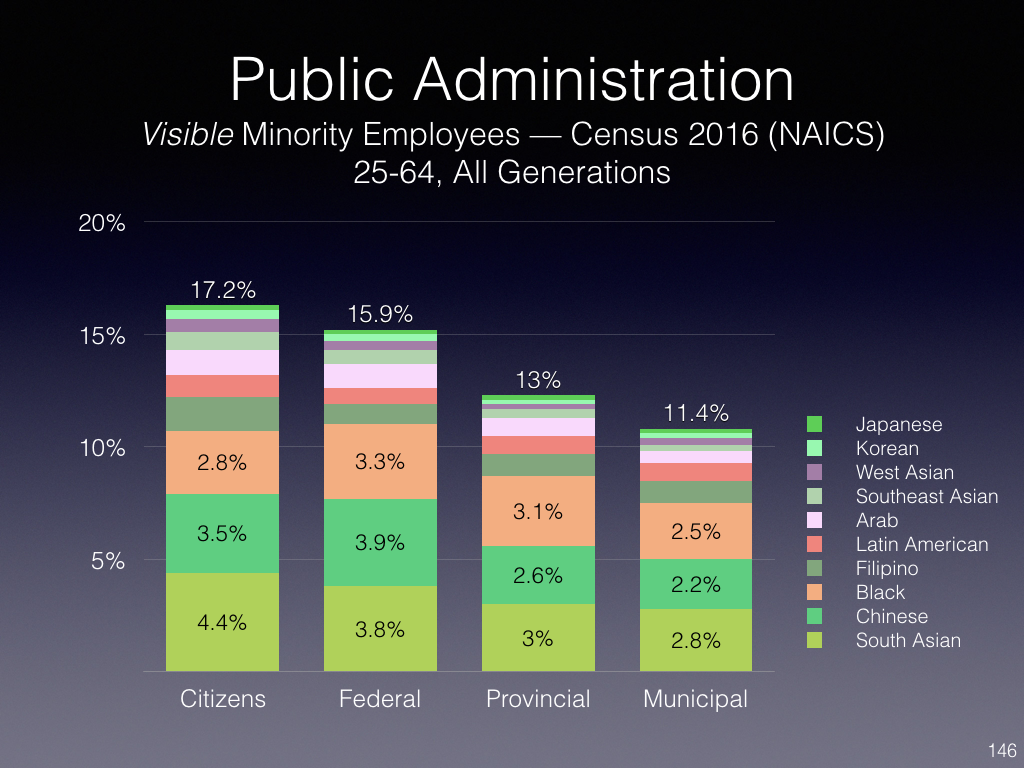
Census data for public servants, broken down by visible minority group, can be seen in the above chart. Compared to the population, Black Canadians are slightly over-represented at the federal and provincial levels.

However, median income data indicates that these tend to occupy lower-paid positions than other visible minority groups.

Part of this may be explained by the overall lower university graduation rates of Black Canadians compared to other groups in addition to the factors mention by MP Celina Caesar-Chavannes.

I haven’t recently done a recent breakdown of EX positions (ADMS EX4-5, DGs and Directors, EX1-3), so hard to comment on her statement regarding any “thinning out” at the ADM level:

Qualified black Canadians are being passed over for promotions to senior positions in the federal government due to systemic racial barriers, says Independent MP Celina Caesar-Chavannes.

Caesar-Chavannes, who is not running for re-election in October, used her final act in the House of Commons last week to shine a light on what she says is discrimination in the civil service.

She says in all of Canada’s history, no black person has been appointed as a federal deputy minister, the bureaucratic head of a department. There has also been a “thinning out” of visible minorities at the assistant-deputy-minister level, she said.

That’s why she tabled a private member’s bill that would require the Canadian Human Rights Commission to more specifically report annually on the progress — or lack thereof — of government’s efforts to promote black Canadians and other visible minorities to more senior positions within the federal ranks.

“It saddens me to know that this is the current state of our federal system,” she said in an interview.

She has heard from current and former civil servants who say they have the qualifications to be promoted, but report being passed over for more senior jobs in favour of candidates they say were sometimes less qualified.

One man she spoke with had a master’s degree, a chartered professional accountant certification and spoke French, English and German — and yet he couldn’t get promoted to a managerial position.

“They present their credentials to me and they’re frustrated,” Caesar-Chavannes said.

“A lot of others have multiple degrees, speak French and English, are dedicated public servants and they’re not able to get ahead. And I think there’s a general sense of frustration.”

Caesar-Chavannes had previously tried to get the House of Commons to unanimously adopt a motion asking the government to study barriers facing black federal employees and to seek to understand their lived experiences. The motion also called on the government to consider implementing equity and anti-racism training for all federal employees.

The motion did not receive the necessary support and it was not adopted.

Her subsequent private member’s bill, which was seconded by Independent MP Jody Wilson-Raybould — like Caesar-Chavannes, a former Liberal — streamlined the request to simply call for the Human Rights Commission to provide an annual report to the minister on the progress made in “dismantling systemic barriers that prevent members of visible minorities from being promoted within the federal government.”

The bill will die on the order paper once the election writ is dropped, as will any other bills left unpassed. But she hopes another MP will take up the cause and reintroduce it when Parliament convenes after the election.

“Let’s ensure that the largest employer in the country leads by example and sets the tone for other organizations to follow suit,” she said.

“Let’s establish some metrics, some criteria by which we can measure ourselves such that our federal public system is reflected, at all levels of management, of the population we serve.”

The Human Rights Commission is mandated to look broadly at the representation of visible minorities in federally regulated workplaces, but said in its recent annual report it finds this term in the Employment Equity Act antiquated.

It has recently employed new auditing tools to better understand why women, Indigenous people, people with disabilities and racialized groups still face barriers to achieving equal representation in the federal workforce. Caesar-Chavannes says more data should be gathered to get a clearer picture of the different experiences of marginalized groups.

Farees Nathoo, a spokesperson for Treasury Board President Joyce Murray, said the government believes Canadians are best served by a public service that reflects the country’s diversity, which is why a “centre for diversity and inclusion” within the public service was created, as was a joint union-management task force on diversity and inclusion. The Treasury Board oversees the federal public service as a workforce.

“As Minister Murray noted in her recent meeting with the federal black employees caucus, more work needs to be done to have a public service that looks like Canada,” Nathoo said.

Canadian Heritage and Multiculturalism Minister Pablo Rodriguez’s spokesman Simon Ross acknowledged that many Canadians still face racism and discrimination, including anti-black racism.

Rodriguez is to launch a new national anti-racism strategy on Tuesday “because we refuse to turn a blind eye and pretend that racism and discrimination do not exist in Canada,” Ross said.

Source: Black civil servants passed over for promotions, says Independent MP

Ravary: Bill 21 a lucid choice by a mature society after long debate


Including this piece by Ravary as the title and thinking reveal a deep misunderstanding of multiculturalism and integration, the former being a means to the latter.

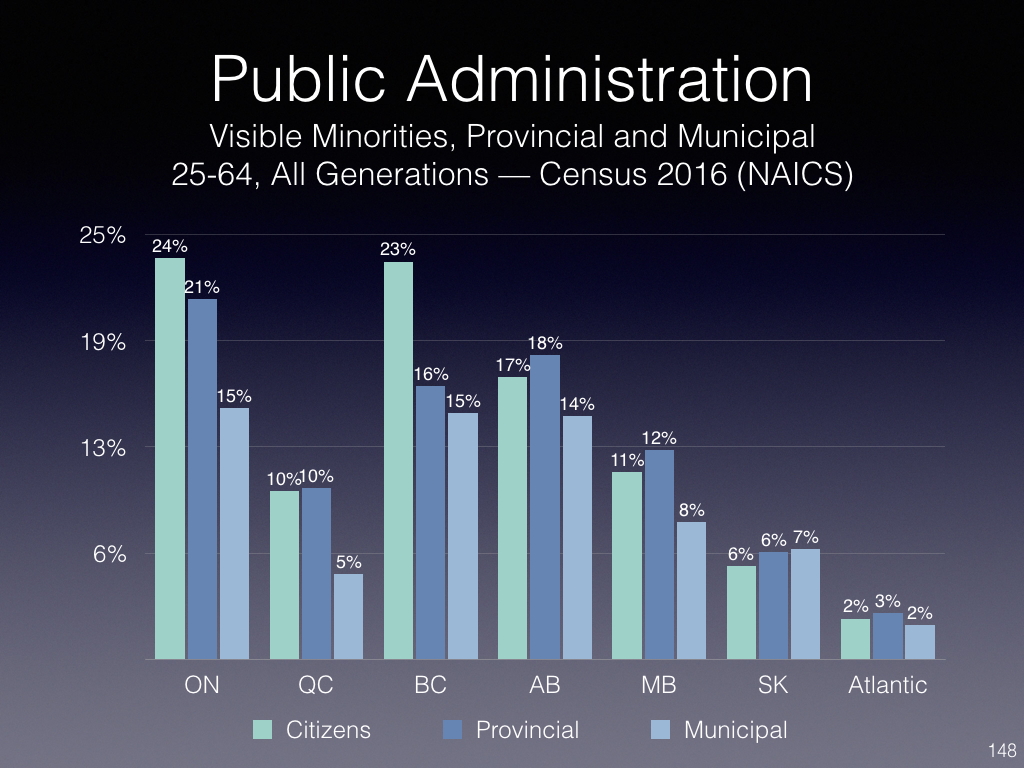
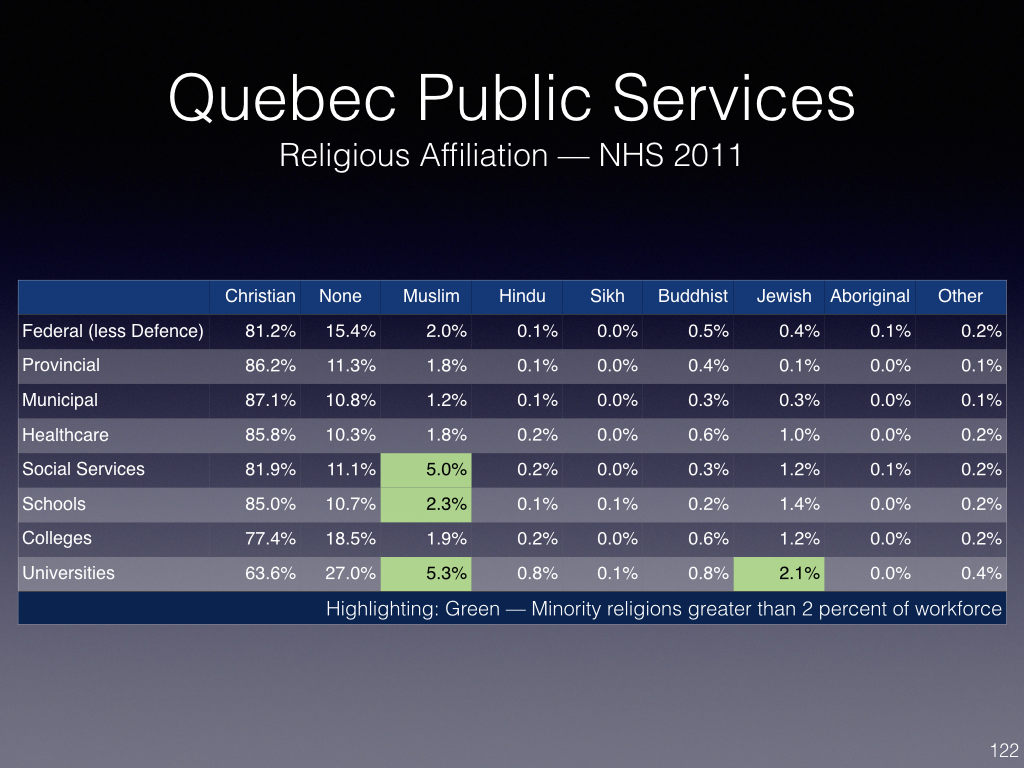
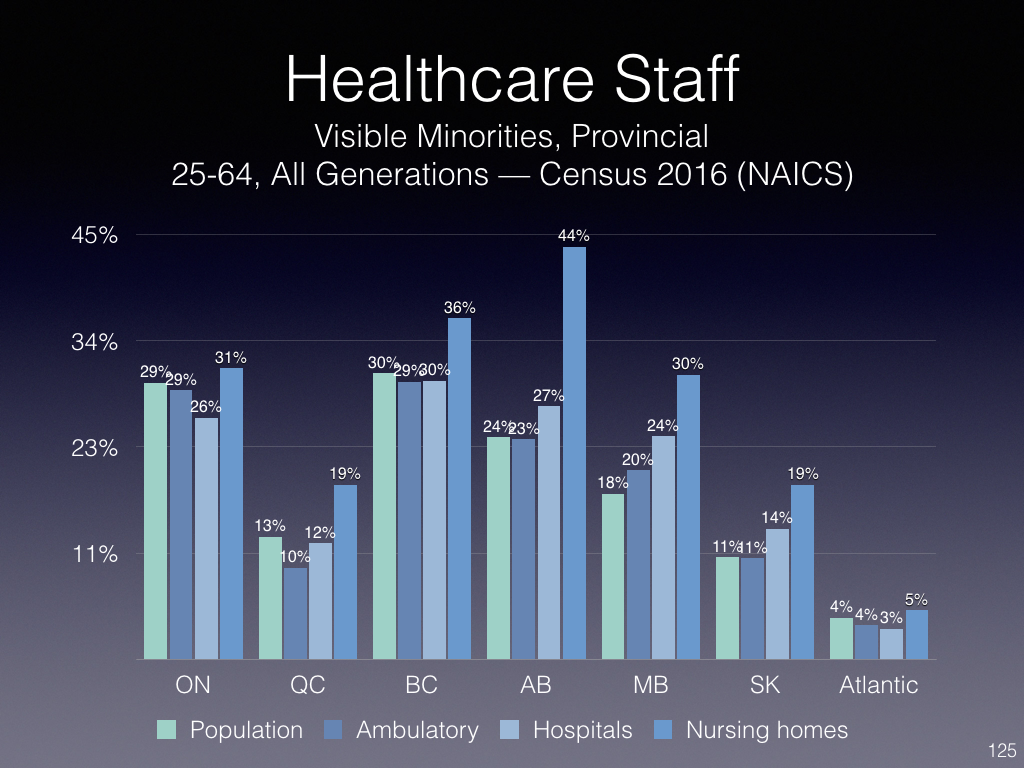
Quebec public services (healthcare, education and public administration are reasonably representative of visible minorities but as 2011 NHS data shows, religious minority representation is relatively small for most groups (Muslims formed 2.6 percent of the population in 2011)

And of course, while it may be a minority of Quebec public servants affected, it will further accentuate the overall under-representation of religious minorities. “sanctions-light” will not be light to those affected:

Flags and floats have been put away until next year’s Fête nationale. I was never a great partaker — I dislike the combination of big crowds and flag waving — but I have lovely memories of my childhood’s innocent Saint-Jean-Baptiste celebrations in Hochelaga-Maisonneuve.

The June French-Canadian liturgical calendar included two big street parties, each with its own procession: the Saint-Jean parade along Sherbrooke Street with its closing tableau of a curly-haired blond boy, dressed up as Jewish preacher John the Baptist, with a lamb at his side. (Children loved it. Beats the more recent puppets.)

The other street party, la Fête-Dieu, held on June 20, also known as the Corpus Christi procession, no longer draws crowds to the streets of Quebec, but 50 years ago, as man was about to conquer the moon, la Fête-Dieu was a still a big deal in Quebec — though it wouldn’t be for much longer.

I am writing this ahead of the Fête nationale, but I suspect the passage of Bill 21 will add pep to the steps of many revellers. I know the new law is not popular with many Montreal Gazette readers, but let’s never forget that many secular Muslims support it.

This having been said, now is not the time for supporters of Bill 21 to gloat. It is also wrong to call for civil disobedience, especially if you are a public official.

The rule of law is the bedrock of democracy.

Many feel that the “moderate way” chosen by the government to signify the separation of church and state in Quebec is a grave attack on individual liberties, but the majority of Quebecers do not share that sentiment, and they cannot be ignored. Unless we want populist leaders à la Orban or Salvini to come along.

Bill 21 is a lucid choice made by a mature society after a 10-year-plus debate, a balancing act between individual rights and the legitimate aspirations of a distinct people to choose how they want to live in their historical homeland.

Francophone Quebecers’ only home on Earth is a piece of land, most of it barren, in the northeast corner of North America. Full-blown multiculturalism, which encourages newcomers to keep their own cultures and does too little to promote integration, would mean the end of an extraordinary experiment that started in 1608, when Samuel de Champlain founded a settlement that would become Quebec City.

In these times of renewed enthusiasm for fundamentalist religious beliefs that go against the grain of Canadian and Québécois values, including those about women and LGBTQ folks held by fundamentalist Christians, Jews and Muslims, Bill 21 aims to formally limit the influence of religion to the private sphere. This is a society that has been working hard to keep all organized religions at bay for more than 50 years.

Even if it meant getting rid of the beloved petit Saint-Jean-Baptiste and his pet lamb.

Bill 21 is the third stage of The Quiet Revolution. In the 1960s, Quebec Catholic priests and nuns stopped wearing traditional religious garb meant to signify penitence and humility, to continue working as teachers or nurses in modernized public education and hospital systems. The second phase was the laicization of Quebec’s school system in 1998 when religious school boards were replaced by linguistic ones. Bill 21 is the third phase of this transformation.

Can it be called unfair? Of course. Only a fool would deny the reality on the ground: some people feel discriminated against. Hence the “no gloating” advice. But let’s also beware of those who will use Bill 21 to further hidden politico-religious agendas.

Many like to cite French political philosopher Alexis de Tocqueville, who described in his 1835 opus Democracy in America the main danger posed by democracy, something he called the “tyranny of the majority.”

But to describe as tyrannical a sanctions-light piece of legislation that restricts the wearing of religious symbols at work by a minority of state representatives seems to me to be at best disingenuous.

Source: Ravary: Bill 21 a lucid choice by a mature society after long debate

Quebec religious symbols law ‘dangerous and un-Canadian,’ says Manitoba premier

Can’t get much stronger than that:

Manitoba Premier Brian Pallister says he will be seeking a joint response to Quebec’s new religious symbols law when western and northern premiers meet on Thursday in Edmonton.

“That is, certainly to my mind, dangerous and un-Canadian and deserves to be opposed,” Pallister said in an interview with The Canadian Press.

“We are not a two-tier-rights country.

“We’re not a country that celebrates sameness. We celebrate diversity, and we need to make sure that we don’t restrict people’s freedoms, whether it’s speech or movement or religion.”

The Quebec law prohibits teachers, police officers and other public servants in positions of authority from wearing religious symbols, and critics say it unfairly targets Muslims, Sikhs and other religious minorities.

Last week, Prime Minister Justin Trudeau said it’s not government’s responsibility, or in its interest, to legislate on what people should be wearing. But he did not specify what action his government would take to protect minority rights.

Pallister said response from federal politicians has probably been muted in part because of the looming national election in October.

“They don’t wish to irritate the province of Quebec, but Quebec is one province in a beautiful country,” he said.

“Canada is a beacon around the world for supporting freedoms, not suppressing them.”

Source: Quebec religious symbols law ‘dangerous and un-Canadian,’ says Manitoba premier

And Jack Jedwab’s called for stronger messaging from federal leaders:

Prime Minister Justin Trudeau and the leaders of the federal opposition parties were cautious in their reaction to Quebec’s legislative ban on religious symbols, Bill 21. That’s probably because of the popularity of the ban amongst Quebec francophone voters who may have an important impact on each party’s political fortunes.

With the exception of the Bloc Québécois, it seems that the preferred approach of the federal party leaders is to reaffirm their respective disagreement with the ban while staying silent about taking action. This stand will not work as we near the start of the federal election campaign in September.

Some party leaders will be tempted to voice their disapproval of the ban while allowing their candidates in Quebec to insist that the provincial government was perfectly within its rights to adopt the legislation. But many Canadians will see this ambiguous line of reasoning for what it is: a cynical excuse for inaction. Voters in Quebec and elsewhere in Canada deserve to know what, if anything, the political parties plan to do about Bill 21. Whatever choice(s) the parties make will certainly have political ramifications both within and outside Quebec.

What should the parties do? It is safe to assume that none of the party leaders will consider recourse to the federal power to disallow the legislation. They would be wise to hold back, as disallowance would delegitimize the democratically elected government of Quebec. The much better alternative is to support court challenge(s) to the law. All federalist parties should take this position regardless of the electoral cost for them in Quebec. Thus far, the Canadian Council of Muslims and the Canadian Civil Liberties Association have launched a judicial challenge to Bill 21. They deserve support from the federal government.

Despite considerable support for the bill amongst Quebec francophones, a May Leger Marketing survey revealed that a majority of Quebecers weren’t automatically opposed to the idea of submitting it to the courts for an opinion (specifically, 46 per cent of Quebecers didn’t approve of a court reference; 41 per cent were in favour of securing an opinion; and the rest didn’t know or refused to respond). The same survey revealed that important majorities in Quebec and Canada greatly valued the Charter of Rights – which is the basis on which the bill would be challenged.

Quebec Immigration Minister Simon Jolin-Barrette will likely describe federal intervention as an unacceptable encroachment on an exclusively Quebec matter. But Bill 21 states that the ban on religious symbols applies “despite certain provisions of the (Canadian) Charter of human rights and freedoms and the Constitution Act, 1982.” This provision justifies intervention on the part of the federal government so as to ensure that constitutional commitments enshrined in the Charter are upheld, regardless of the province in which a citizen resides. To act otherwise would not only weaken freedom of religion but also commitments to other key freedoms in the Charter. If a provincial government outside of Quebec decided to suspend certain rights and freedoms for minority francophones, there would rightly be multiple calls on the federal government to act. The same principle should apply to Bill 21.

Quebecers have been given the impression that the use of the “notwithstanding clause” in Bill 21 means that the issue of fundamental rights is no longer in question. But the clause seeks to dismiss recourse to rights protection, and in no way dismisses the idea that rights are being violated. Minister Jolin-Barrette and Premier François Legault have insisted that the bill does not violate the Quebec or Canadian Charter of Rights. There is good reason to be skeptical. But if they truly believe that, they should have nothing to fear from a court challenge.

Who knows? Maybe the court decision will vindicate them. Either way, the government of Canada and the opposition should give Quebecers and other Canadians an opportunity to find out and make clear their intention to support a court challenge sooner rather than later.

Source: Jedwab: Canadians deserve to know what federal parties will do about Quebec’s Bill 21

Australia: Labor should let hope prevail on refugees, shadow minister Andrew Giles says

Post-election positioning. Even the government seems to have turned down its pre-election rhetoric as seen in its apparent abandoning some of its citizenship proposals (Whatever happened to the ‘Australian values’ citizenship bill?):

Public sentiment on asylum seekers has shifted, and Labor must use the looming parliamentary term to “give Australia’s hopeful side a fair chance to prevail over the politics of fear, and division” according to the shadow minister for multicultural affairs, Andrew Giles.

Giles will use a speech to Australian Fabians on Wednesday to argue the recent community debate around the medical evacuations bill, and the tone of the federal election, suggests Australians are over the toxic politics of border protection, and are fatigued by the “false binaries and unnecessary aggression” from the home affairs minister, Peter Dutton.

The Victorian leftwinger will say it was notable that border protection, and the “demonisation of asylum seekers” did not feature front and centre in the 2019 federal election, which is unusual compared with previous federal contests. “I’m not sure if we can quite characterise this as something to celebrate, but it is a significant development – something to build upon.”

Giles says the “noise” of the hyper-partisan conflict over border protection policy that has raged in Australia since the Tampa standoff “has crowded out both a reasoned and reasonable exchange of ideas, and the voices of those whose lives are directly affected by the policy choices we make”.

Source: Labor should let hope prevail on refugees, shadow minister Andrew Giles says

Editorial: Estonia needs to tackle anti-Semitism before it’s too late

Generally, not much coverage of Estonia:

For the small Estonian Jewish community, times have been peaceful – but recent anti-Semitic acts are a reason for concern.

Over the weekend of 22-23 June, several headstones at the 110-year old Rahumäe Jewish cemetery in the Estonian capital, Tallinn, were knocked over. On 23 June, swastikas were spray-painted on large stones by the Lille bus stop in Tallinn’s Kristiine district.

“On 23 June, when all of Estonia celebrated the 100th anniversary of the victory of Estonian troops over the Baltic Landeswehr (Baltic German troops during the Estonian War of Independence – editor) near Võnnu, there were two extremely outrageous incidents in Tallinn,” the Jewish Community of Estonia wrote on its Facebook page on 24 June.

“This monstrous act of vandalism at a place where our ancestors rest in peace, where every human being thinks about spirituality, their connection to past generations and human values, is offensive, frightening and unacceptable in our society,” the Estonian Jewish Community and the Estonian Jewish Congregation said in a statement.

The community added that the act of vandalism was the first at the Jewish cemetery – it was not defiled even during the Nazi occupation of Estonia (from 1941-1944 – editor).

According to Alla Jakobson, the chairwoman of the Estonian Jewish Community, it is hard to believe that these malicious actions were organised specifically during the holidays in Estonia (when the country celebrates Victory Day, Midsummer Eve and Midsummer Day – or St John’s Day). “It is hoped that it was just a very unfortunate coincidence,” she said in a statement.

“We honour the memory of the deceased and would like society to show understanding and mutual respect for the memory of the people who lost their ancestors in that country. I am convinced the [police] investigation will identify those whose behaviour caused sorrow and pain,” Jakobson added.

The Jewish Community of Estonia added that “such acts of vandalism and the spray-painted swastikas in public places are a direct reference to the tragic [historical] events. We hope [these events] will never happen again. Not in Estonia, or in any other country.”

Several incidents in a row causing a concern

The latest anti-Semitic acts follow the incident in March, when a 27-year-old Estonian man aggressively shouted at the country’s Chief Rabbi, Shmuel Kot, on the street: “What are you staring at, Jew? You’re going into the oven.” The man also shouted “Sieg Heil” and “Heil Hitler” at Kot while the rabbi was walking to Tallinn’s synagogue with two of his children, aged seven and 12. The police later identified the abuser, arrested him – and he was sentenced to eight days in prison.

According to Kot, this kind of an incident was the first time two of his children had witnessed any such harassment.

In August 2018, unidentified individuals vandalised the Holocaust memorials at Kalevi-Liiva in Estonia’s Harju County. Thousands of Jews perished there during the Nazi occupation of Estonia, from 1941-1944. The memorials were spray-painted with swastikas, anti-Semitic and Nazi messages.

6, when Estonian World spoke to Rabbi Kot, he told us Estonia was a very peaceful, calm and good country for Jews. Therefore, the latest developments cause a serious concern – and in the light of far-right gains in the last parliamentary election in March, beg the question whether an anti-Semitic sentiment is on the rise in Estonia.

A troubled history, but mostly tolerant country for Jews

Like many European countries, Estonia may have had a fair bit of troubled history with anti-Semitism, but for the most part of its existence, it has been regarded as a tolerant country for Jews.

From the very first days of its existence as a state in 1918, Estonia showed tolerance towards all the peoples inhabiting her territories. In 1925, the Act of Cultural Autonomy for Ethnic Minorities was enacted in Estonia, giving minority groups consisting of at least 3,000 individuals the right of self-determination in cultural matters. Thus, in 1926, the Jewish cultural autonomy was declared – first of its kind in the world. For its tolerant policy towards Jews, even a page was dedicated to the Republic of Estonia in the Golden Book of the Jewish National Fund in 1927.

Sadly, the history took a wrong turn. With the Soviet occupation of Estonia in 1940, Jewish cultural autonomy, in addition to the activities of Jewish organisations, was terminated. All Jewish schools were closed and 414 Estonian Jews (10 per cent of the Jewish community) were deported to Siberia in the course of the mass deportations of June 1941.

Worse was to come. During the German occupation, the Nazis murdered approximately 1,000 Jews who had failed to flee Estonia (most had escaped to the Soviet Union before the Nazi occupation). In addition, about 10,000 Jews were transported to Nazi concentration camps in Estonia from other parts of Europe. Only a handful of them survived.

During the second Soviet occupation (1944–1991), many Jews migrated to Estonia again to escape the anti-Semitism prevalent in many parts of the Soviet Union. After the restoration of Estonia’s independence in 1991, the local Jewish cultural life was reinvigorated again and the community of about 2,500 people has generally thrived since. In 2007, a new synagogue was opened in Tallinn – the first synagogue to open in Estonia since the Second World War.

Let’s keep Estonia an educated and tolerant country

This publication calls the Estonian society and institutions to take the anti-Semitic incidents seriously – it’s important to tackle the hatred and prejudice and cut it at its roots. More education is needed about the Holocaust – there is sadly still too much ignorance and denial about the genocide that also took place in Estonia, among many European countries.

The local media – and especially the country’s public broadcasting, ERR – could also highlight the positive contribution of thousands of Estonian Jews throughout the history, which has benefitted not just Estonia, but also the world. From Louis Kahn to Eri Klas, from Yuri Lotman to Eino Baskin, many Estonian Jews have made Estonia and the world a better place.

Until recently, Estonia stood out positively as a place where Jews could live in peace and thrive – let’s keep it that way.

Source: Editorial: Estonia needs to tackle anti-Semitism before it’s too late

Egypt considers pros, cons of foreign citizenship changes

Another citizenship-by-investment approach with explicit political involvement :

The topic of granting foreigners Egyptian citizenship has long been controversial, and proposed amendments to the Egyptian Nationality Law are no exception.

The recent proposals have stirred up many questions since the Egyptian government submitted them to parliament in April. They received initial approval June 9 of the parliamentary Defense and National Security Committee, which will discuss them further and then submit them to parliament’s general assembly for final voting.

Article 2 of the amendment bill would entitle the prime minister to grant nationality to foreigners who buy real estate owned by the Egyptian state or other public entities; it also establishes an investment project in Egypt in accordance with the investment law or deposits a sum of money in foreign currency in Egyptian banks.

Article 3 stipulates forming a Council of Ministers unit to examine naturalization applications. This unit will comprise security authorities and representatives of the ministries of Foreign Affairs, Interior, Investment and International Cooperation. The same article states foreigners would submit naturalization applications after paying $10,000. The unit would examine applications within three months while considering national security. If the prime minister grants initial approval, an applicant would be granted residence in Egypt for six months to complete the required procedures.

Opinions on the amendments vary among parliament members, political and economic observers, and citizens.

The Egyptian Businessmen’s Association (EBA) praised the amendments to the Egyptian Nationality Law, also known as Law No. 26 of 1975.

EBA vice chairman Fathallah Fawzi said in a June 17 press statement the proposed amendments to that law and a bundle of others — most notably the unified Investment Law — will help grow the real estate sector in Egypt and create a more attractive business climate for foreign investors.

But speculation abounds. Some critics see the proposed amendments as a move to pave the way for the US plan for peace between Israelis and Palestinians, dubbed by US President Donald Trump the “deal of the century.” That deal is being discussed this week at an economic summit in Bahrain.

Many Egyptians were concerned the US plan will include an offer to establish a place for Palestinians in parts of the Sinai. But US officials denied this, and Yahya al-Kadwani, a member of Egypt’s parliamentary Defense and National Security Committee, told Al-Monitor that’s not likely to happen.

He noted that in 1959, Egypt ratified an Arab League recommendation exhorting Arab countries not to grant nationality to Palestinians so as not to weaken the Palestinian movement to establish a homeland.

Talaat Khalil, a member of the parliamentary Planning and Budget Committee, said some Egyptians, himself included, also fear amendments to the Egyptian Nationality Law would be used as leverage to get Palestinians to cooperate with the US peace plan by offering them Egyptian citizenship.

He said amendments aren’t necessarily even needed, as not having Egyptian nationality is unlikely to prevent foreign investors from establishing projects in Egypt. In a June 11 statement to BBC, Khalil said the current unified Investment Law already gives foreign investors many advantages and opportunities equal to those of Egyptian investors, in addition to almost open-ended residency permits.

Other critics claim the amendments aim to pressure refugees, especially Syrians, to invest more in exchange for citizenship. Reports by the Istanbul-based Arabic Post and Qatari Al-Jazeera news websites, which oppose the Egyptian regime, potentially linked the nationality law amendments to a campaign launched by Samir Sabri, an Egyptian lawyer close to the regime.

On June 9, Sabri filed a complaint asking the government to examine the funds of Syrian refugees to ensure they’re not used for money laundering or terrorist financing. The news reports said Sabri’s complaint might aim to pressure Syrians in Egypt to invest more in real estate or make greater bank and investment savings to obtain Egyptian citizenship.

Yet, Bahaa al-Ghamri, a political science professor at Suez Canal University, questioned the Arabic Post and Al-Jazeera articles. He told Al-Monitor the Egyptian state has always welcomed Syrian and other Arab refugees fleeing civil wars and security unrest in their country.

“The amendments to the Nationality Law will favor affluent Arab and Syrian refugees. Refugees in Egypt are prohibited from engaging in many business activities such as establishing pharmacies, newspapers and some other types of companies. Once the amendments are effective, many Syrians who wish to invest in these fields will be able to do so and get Egyptian citizenship in return,” Ghamri said.

Osama Rushdy, a lawyer specializing in the incorporation of companies and representing many foreign investors, denounced attempts to link the amendments to the “deal of the century” or the Syrian crisis. He argued that the amendments aim to promote the Egyptian investment climate and make investing easier.

“Many refugees in Egypt are unable to invest because of their status as refugees, since they don’t have permanent residency. Giving them Egyptian citizenship is the best way to secure permanent residency,” Rushdy told Al-Monitor.

“The old and current investment laws don’t allow foreign investors to incorporate specific types of companies except in cases of Egyptian partnerships such as those with limited shares, with 49% of the shares held by Egyptians. This [high] percentage of shares could force the foreign investor to accept interventions by one or more unwanted Egyptian partners,” he said.

Rushdy added, “It’s better for foreign investors to obtain Egyptian citizenship to facilitate investment and business procedures.”

Source: Egypt considers pros, cons of foreign citizenship changes

Canada adopts universal definition of anti-Semitism

Another pre-election announcement. The sensitive part of the non-legally binding working definition concerns criticism of Israel.

Comparable issues arise in any definition of Islamophobia or anti-Muslim hate between the relatively easy definitions of discriminatory behaviour or hate against Muslims and criticism of Islam itself:

Canada’s government announced on Tuesday that it will formally adopt the widely accepted definition of anti-Semitism by the International Holocaust Remembrance Alliance as part of the country’s anti-racism initiative.

“To help address resurgent anti-Semitism in Canada, we’re adopting the International Holocaust Remembrance Alliance’s working definition of anti-Semitism as part of our strategy,” said Pablo Rodriguez, Minister of Canadian Heritage and Multiculturalism.

Canada joined the IHRA is 2009 and is one of 32 member states.

The IHRA definition says: “Anti-Semitism is a certain perception of Jews, which may be expressed as hatred toward Jews. Rhetorical and physical manifestations of anti-Semitism are directed toward Jewish or non-Jewish individuals and/or their property, toward Jewish community institutions and religious facilities.”

Jewish groups applauded Rodriguez’s announcement.

“Peddlers of anti-Semitism must be held accountable, but this can only happen if authorities can clearly and consistently identify acts of Jew-hatred,” said Joel Reitman, co-chair of the board of directors at the Centre for Israel and Jewish Affairs.

“This is why CIJA has been calling on all three levels of government to use the (IHRA) working definition of anti-Semitism,” he continued. “The IHRA definition, which has been adopted by dozens of democratic countries, is a vital tool in countering the global rise in anti-Semitism.”

“Canada adopting IHRA’s definition of antisemitism is an important symbolic and declaratory move,” said NGO Monitor founder and president Gerald Steinberg. “We hope that the next steps will pertain to its implementation within Canadian policy, including regarding Canadian international aid and support of NGOs.”

B’nai Brith Canada labeled the IHRA standard “the most universally accepted and expertly driven definition of anti-Semitism available today,” and one that “enjoys unprecedented consensus.”

Some 392,000 Jews reside in Canada, or 1 percent of the overall population.

Overall, 2,041 anti-Semitic incidents in Canada were reported in 2018—a 16.5 percent increase from the previous year, according to B’nai Brith Canada.

Incidents of vandalism decreased from 327 to 221, as violent anti-Semitic attacks also dropped, from 16 in 2017 to 11 in 2018.

Source: Canada adopts universal definition of anti-Semitism

New office will tackle racism in federal institutions as part of $45M national plan

Too busy at the International Metropolis this week to take a closer look to see whether or not it has the potential to have more impact than the post Durban conference Canadian Action Plan Against Racism (CAPAR) whose only meaningful result was the collection of hate crimes statistics:

The federal government unveiled its first-ever anti-racism strategy in Toronto today, which will see the creation of an office that will oversee efforts to tackle systemic racism and discrimination in federal institutions.

Speaking at a community centre in the city, Heritage and Multiculturalism Minister Pablo Rodriguez unveiled the $45-million, three-year strategy, called “Building a Foundation for Change.”

The strategy’s centrepiece is a $4.6 million anti-racism secretariat that will lead federal efforts in tackling the issue, reporting annually on the federal government’s process — or lack thereof — in addressing racism and discrimination.

The new office will ultimately lead efforts to get federal institutions to identify gaps and co-ordinate initiatives meant to address systemic discrimination, pushing the bureaucracy to better consider the impacts of policies, services and programs on racialized and Indigenous communities.

As well, $5 million will go to community-led digital and civic literacy programming to address online disinformation and hate speech in response to “heightened concerns around online hate.”

The strategy also provides $30 million worth of grant funding for community-based projects, with a focus on improving employment outcomes, public participation, and supporting at-risk youth. The application process will start on Sept. 3.

Another $3.3 million will also go toward a national public education campaign to increase public awareness of the historical roots of racism in Canada and the impact it has had on racialized and religious minority communities, as well as on Indigenous peoples.

The strategy, announced ahead of October’s vote, is being pitched as a “first step” in a longer-term commitment in addressing racism and discrimination in Canada.

“Our government recognizes that we are in a unique position to address racism in our institutions and society. This national anti-racism strategy is an essential first step in building a more inclusive country,” Rodriguez said in a statement.

BACKGROUNDER: Budget 2019: New anti-racism strategy unveiled in budget

Between October 2018 and March 2019, the Department of Canadian Heritage held 22 closed-door consultations across Canada on the creation of a new strategy, as well as hosting an online questionnaire for all Canadians to provide comments.

The strategy’s release today comes after Independent MP Celina Caesar-Chavannes recently said qualified Black Canadians are being passed over for promotions to senior positions within the public service.

As a final act in the House, she tabled a private members’ bill last week that would require the Canadian Human Rights Commission to specifically report annually on federal efforts to promote Black Canadians and other visible minorities to more senior positions within the public service.

Caesar-Chavannes, who is not running for re-election, told the Canadian Press that there has been a “thinning out” of visible minorities at the assistant-deputy-minister level and no Black person has ever been appointed as a federal deputy minister.

A recent survey of nine countries also found Canadian visible minorities are 11 per cent more likely to face discrimination in hiring than their American counterparts.

Researchers at Northwestern University looked at more than 200,000 job applications, and broke down the results by race, to see whether minority candidates with similar qualifications to white ones got as many callbacks. Canada was the third-worst country examined in the study, which also looked at the U.K., Sweden, Germany, France and the U.S.

Today’s strategy also provides working definitions for Islamophobia and anti-Semitism, adopting the International Holocaust Remembrance Alliance’s wording for the latter term. The strategy also includes $6.2 million to improve data collection on race and ethnicity.

In 2018, the Liberal government set aside $19 million as a “first step” towards recognizing the challenges faced by Black Canadians and focus on Black youth and enhancing mental health supports for the Black community.

Meanwhile, the 2019 budget acknowledged “ultra-nationalist” movements have emerged across the world and such groups are “unfairly targeting new Canadians, racialized individuals and religious minorities.”

According to Statistics Canada, police-reported hate crimes motivated by religion, race, or ethnicity, increased by 47 per cent in 2017.

Source: New office will tackle racism in federal institutions as part of $45M national plan