HASSAN: UN should press Islamic nations for more inclusive societies

Valid critique of many members of the OIC:

Last year, the United Nations Council on Human Rights passed a resolution acknowledging defamation of religion as a human rights violation. Pakistan led the delegation representing the 56-nation Organization of Islamic Conference and proclaimed that “Islam is frequently and wrongly associated with human rights violations and terrorism.” Pakistan asserted that nations must “deny impunity” to those showing intolerance and ensure respect for religion.

But which religion, how and by whom?

Last Tuesday, the editor of a moderate Islamic website criticized the UN measure, citing freedom of speech issues. More important, he accused Muslim nations of expressing most of this so-called defamation of religion. He said reports from Muslim countries, such as Pakistan, not only tell horrific tales of local misogyny and terror but also reveal ways the rights of non-Muslim minorities are constantly violated. He cited many examples of this, including the publication of jihadi literature and laws that marginalize religious minorities and discriminate against women. In Pakistan, for example, Hindu girls continue to be forcibly converted to Islam and sold into marriage. This is the worst kind of intolerance based on faith.

New Age Islam editor Sultan Shaheen has tried hard in the past decade to salvage Islam from its darker manifestations and to encourage a more humane version of the faith. Like other South Asian moderates, such as Javed Ahmed Ghamidi, he has offered newer interpretations of religious precepts in an attempt to rid Islam of bigotry, violence and fundamentalism.

In drawing attention to these heinous practices in the Muslim world, Shaheen has identified the valid reasons for the bad reputation Islamic countries have earned. In a letter to the UN, he stated that, while this resolution seeks to protect Islam from defamation through any association with terrorism, other religions are routinely defamed in Muslim countries by radical Muslims. For example, propaganda is often published justifying violence against non-Muslim civilians. He cited a long essay in the Taliban mouthpiece Nawa-e-Afghan Jihad entitled Circumstances in which the Killing of Innocent People among Infidels is Justified.

Shaheen’s novelty is to interpret intolerance by Muslim extremists as defaming not only other religions but primarily distorting the essence of Islam itself. He urges the Council to “ask the Muslim countries to treat intolerance of minorities and jihadi literature too as defaming the religion of Islam.”

Shaheen quoted some jihadi literature in his letter, such as by radical Islamic scholar Sheikh Yusuf Al Abeeri, who has openly justified destroying American cities and killing enemy civilians. Shaheen characterized such literature as a tirade against Islam. He also highlighted the anti-Semitism of many of these radical scholars.

Sultan Shaheen has rightly identified the main reason for the negative image of Islam. It is the actions of radical Muslims more than anything else, coupled with the fact that moderates do not actively challenge them or distance themselves from their parochial ideas, that defame Islam the most.

The UN Council on Human Rights must look beyond its own naive resolution and urge Islamic nations to enact laws that enable freer and more inclusive societies. Instead of Pakistan urging consequences for those who supposedly defame its state religion, it should seek real consequences for those who openly and aggressively promote violence against women and non-Muslims.

Source: HASSAN: UN should press Islamic nations for more inclusive societies

In killing citizenship question, Trump adopts Census Bureau’s preferred solution to a thorny problem

After all the sound and fury, after all the lies and pretence:

President Donald Trump’s decision this afternoon to abandon plans to add a citizenship question to the 2020 census and instead rely on existing government records to generate citizenship statistics matches the Census Bureau’s preferred option for dealing with the politically explosive issue. It’s also a win for those who have wanted to keep such a charged question off the decennial headcount.

“This is Option C,” says former Census Director John Thompson, referring to a March 2018 memo in which Commerce Secretary Wilbur Ross spelled out several options for developing a citizenship tally, and gave his rationale for deciding to include the question on the count that will begin on 1 April. Option C “is what the Census Bureau proposed to Secretary Ross,” adds Thompson, who stepped down in June 2017, a few months after Ross began his clandestine efforts to get the Department of Justice to request the question. Ross eventually chose what he called Option D, a combination of using information already in government agency files, known as administrative records, along with a yes/no question about citizenship on the census questionnaire sent to U.S. households.

The Supreme Court, however, blocked Ross’s decision, saying he had violated administrative law by providing a “contrived” rather than a “genuine” explanation for why he wanted to add the question. Critics of the question say it would have prompted many people living in the United States to decline to answer the census, leading to an undercount of the population, and was motivated by a desire to reduce the political power of regions that tend to support Democratic candidates.

Today, speaking at a hastily arranged one-way press conference in which he took no questions, Trump said he will issue an executive order telling every federal agency to “immediately” provide the Commerce Department with “all requested records regarding the number of citizens and non-citizens in our country.” He said the goal is to generate “an accurate count of how many citizens, non-citizens, and illegal aliens are in the United States of America. Not too much to ask.”

Census experts say that the agency should be able to satisfy the president’s request to develop data on the first two categories – citizens and non-citizens. And the Census Bureau already has agreements with a number of federal and state agencies that allow it to access administrative records that include some citizenship information, according to this 2018 analysis by bureau researchers. But using administrative records to determine the number of undocumented immigrants living in the U.S. is not possible, the experts say. And that’s a good thing, believes Robert Santos, vice president and chief methodologist at the Urban Institute in Washington, D.C.

“What this administration really wanted was a tally of those who are undocumented,” says Santos, who is also president-elect of the American Statistical Association. “But that’s not going to happen. They will fly under the radar.” As a result, he says, “now they can participate in the census without fear” of political repercussions.

It’s also good news for Census Bureau, he adds. Extracting the agency from the bitterly partisan national debate over immigration should allow it to do its job of carrying out a complete and accurate census, he says.

Civil rights groups opposing the question also hailed the president’s decision as a victory but said they hadn’t given up their fight against the administration’s policies. “This is a welcome reprieve of his partisan agenda, and a win for all communities,” says Vanita Gupta, president of the Leadership Conference Education Fund in Washington, D.C. “[But] we remain on guard to combat any attempts to sabotage a fair and accurate count.”

Source: In killing citizenship question, Trump adopts Census Bureau’s preferred solution to a thorny problem

And further commentary:

Donald Trump pretended he was doing something meaningful on Thursday after he was forced to cave in on adding a citizenship question to the 2020 census.

But his post-cave bait-and-switch to push an executive order is also going up in flames almost immediately after it was issued.

Page said:

“So just saying it’s not a cave does not make it not a cave. Just the attorney general saying congratulations, Mr. President, does not make it a congratulatory moment. And the executive order, it is not at all clear that it’s necessary to have a new executive order to give publicly available data from federal agencies to the Commerce Department. That would seem to be something that would be easy to do. And in fact, as you noted, the government already calculates the number of illegal immigrants and the number of non-citizens who live in this country, and they’ve done that for some time.”

Trump is pulling out all the distractions after his census cave-in

Donald Trump’s executive order stunt that he announced on Thursday isn’t the only distraction he’s pulling out following his census loss.

It was also reported today that the administration would move forward with its raids on thousands of undocumented migrant families. According to The New York Times, “Nationwide raids to arrest thousands of members of undocumented families have been scheduled to begin Sunday, according to two current and one former homeland security officials.”

The raids, which had been delayed last month due to widespread backlash, will likely separate more families. Even the president’s acting DHS secretary has admitted as much.

Of course, none of these steps are being taken because they are sound policy solutions. They are just the latest in a two-year string of distractions meant to paper over an endless string of policy and political failures from this White House.

Source: Trump’s Citizenship Executive Order Is Already Going Up In Flames

Is ‘Race Science’ Making A Comeback? . News

Interesting and relevant interview:

When Angela Saini was 10 years old, her family moved from what she called “a very multicultural area” in East London to the almost exclusively white Southeast London. Suddenly her brown skin stood out, making her a target. She couldn’t avoid the harassment coming from two boys who lived around the corner. One day, they pelted her and her sister with rocks. She remembers one hit her on the head. She remembers bleeding.

There had been racist comments before that, she says, “but that was the first time that someone around my own age had decided to physically hurt me. And it was tough.”

It was also one of the first stories she reported, writing about the incident and reading it out for class. She says that’s what made her a journalist.

Saini is now an award-winning science journalist, often reporting on the intersection of science, race and gender. Her latest book, Superior: The Return of Race Science tracks the history and ideology of race science up to its current resurgence.

We talked to her about how race isn’t real (but you know…still is), why DNA tests are misleading and how race science crept its way into the 21st century. It’s a lot to get your head around.

This is an excerpt from our interview with her. It has been edited and condensed for clarity.

Code Switch: I guess we should start with the obvious question. What is race science?

Angela Saini: Once upon a time, in the 19th and early 20th century, race science was just science. It was very widely accepted that races exist biologically, that possibly we are different species or different breeds as human beings, and that there might be a racial hierarchy between us.

After the Second World War, when we saw eugenics play out — saw the consequences of Nazi racial hygiene in the Holocaust, the world kind of took a collective intake of breath and tried to put its house in order. So scientists, policy makers, the United Nations all came together and decided, race has no place in biology anymore. It’s not scientifically accurate. Race is not how difference plays out in the real world.

But there were two problems with this. Number one was the hardcore scientific racists. This includes Nazi race scientists. So the ones who believed that whites were superior, that slavery was justified, that segregation was justified. They kept scientific racism alive within a small, but very active global network.

The other aspect is mainstream science. Did everyday scientists really abandon these ideas completely? My argument is, no. They clung on to them, partly because, of course, racism was still there in society. We still had racism all around the world, discrimination embedded in the structures of institutions. And that means even to this day, there are still scientists who, despite knowing better, and despite being mainstream, good-hearted, well-intentioned scientists, still sometimes invoke race in scientific research, particularly medical research, when it’s inappropriate.

Should we even be talking about race anymore?

I’ve read genetics textbooks on race that say race is all silly, we should all let it go and live in this kind of colorblind world. Well, no, because that’s not the world that we live in. These things matter, because that boy when I was 10 years old did not throw rocks at me because of genetics. He threw rocks at me because I looked brown, and that he took exception to that. And that’s not going to stop.

…

The thing is, race is real in society. It’s real in politics, it’s real in the ways that we treat each other. It’s visceral because we have made it visceral in our everyday lives, and it has a biological impact because of that. Racism impacts people’s bodies. It impacts people’s minds. It affects how they live and how they grow.

So I think all researchers, if they’re going to invoke race, have to be really knowledgeable about where these ideas come from, and how they are using race. Are they using it because they’re studying the effects of racism and discrimination, or are they using it as a biological entity in itself? And if they’re using it as a biological entity in itself, then they had better be sure exactly how they define it.

In the U.S., race is defined differently from South Africa, Australia, the U.K., India. We can’t biologize blanket ideas about who people are, because these are socially constructed ideas. I think it’s deeply dangerous, because it falls into the same trap that the people who invented race in the first place wanted us to fall into. The people who hardened these categories wanted us to believe that we are fundamentally different. We are not fundamentally different.

We did an episode not so long ago about how people from certain populations in North and West Africa were more likely to have a trait that makes them predisposed to sickle cell anemia. Is it possible that we risk missing out on important scientific realities if we are skittish about getting into genetics and race?

I think we need to be careful about what we mean when we say race. We know that the sickle cell trait exists in those regions of the world where cases of malaria are high, and that is because, as devastating as it is to have sickle cell anemia, having the trait provides some resistance to malaria. So in the regions where it exists, it is beneficial to the people who have it, because one risk outweighs the other. And this means it’s geographical, it’s not racial. It exists in certain parts of Africa and not all, and it exists in other parts of the world outside Africa, where people don’t have black skin.

The reason it looks racialized in the U.S. is because in the U.S., many white people are of European ancestry, and many black people, because of the history of slavery, are of West African ancestry. That means that in the U.S., you see far higher rates of sickle cell in the black population than the white population.

But globally, it doesn’t look racialized. Globally, it looks as though people in certain regions of the world have it. So in the U.S., when people talk about sickle cell being a black disease or a black illness, they’re really using race as a proxy for geography.

And that goes for many illnesses or diseases that we think about as being racialized. Black Americans are more likely to die of almost everything than white Americans. The life expectancy of a black American is lower than a white American. It is perverse to assume that this must be genetic. Are black Americans so genetically disadvantage that even infant mortality would be higher in black Americans? It just doesn’t make any sense. In the U.K., where I live, we see this life expectancy gap between the rich and the poor. It is exactly the same in America, but in America, it is treated as racial because socioeconomic circumstances run along racial lines.

The inscription in your book reads, “For my parents, the only ancestors I need to know.” What does that mean?

Well, that kind of is a joke at ancestry testing companies. When they tell us that you can find out who you are descended from, thousands of generations back, to your “actual ancestors.” One, you can’t tell me who my actual ancestors are, because DNA testing cannot tell you that.

But secondly, why does it matter? Why is it so important to us to know who our distant ancestors were when we have people alive with us right now who can give us our culture, who give us our frameworks, who give us our sense of who we are, our sense of right and wrong, our place in the world?

…

[Race scientists] play on your sense of ethnicity or sense of origin story. They build up this image of you as being a biologically essential person, and that this ties you to this identity, and it becomes embedded in who you are.

And this is what ethnic nationalists do. They play on these assumptions and stereotypes and the lack of education that we have around these issues, and they make us believe that identity is biological, when identity is cultural.
Source: Is ‘Race Science’ Making A Comeback? . News

Immigrants are moving to smaller U.S. cities

Also happening in Canada to a certain extent:

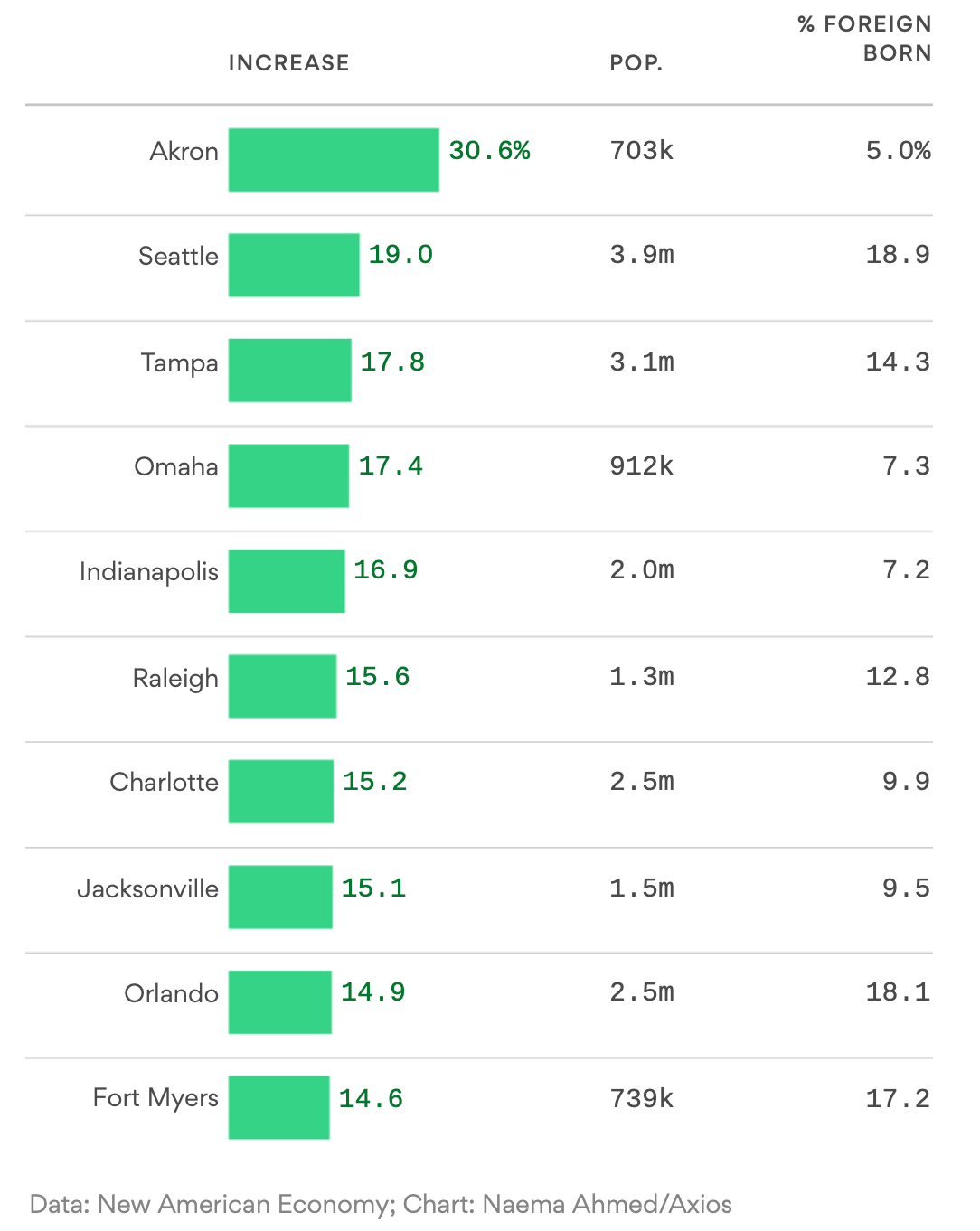
As young Americans stream to coastal cities, immigrants are seizing opportunities in the midwest and south where mid-sized cities are struggling to maintain a younger, working-age population.

Why it matters: From 2014-2017, immigrants contributed nearly 33% of the total population growth in the top 100 U.S. metro areas — and they’re settling in smaller cities that aren’t typically considered immigration hubs, according to new research from New American Economy.

“Immigrants — very similar to other Americans — are looking for less crowded, more affordable cities that have dynamic job markets,” said Andrew Lim, research director at the bipartisan research and advocacy organization.

Details: Foreign-born migration helped reverse population decline in several metros, such as Detroit, Memphis, Dayton and St. Louis.

  • In 2017, immigrants were responsible for 98% of the population growth in metro Cincinnati, 88% of the growth in metro Birmingham, and 87% of growth in metro Miami.
  • Four of the top 10 cities seeing the most population growth from immigrants are in Florida — a state seeing a disproportionate growth of aging residents.

What’s happening: Many of the top destinations are grappling with a demographic double whammy: a growing aging population on one hand, and a dwindling young population on the other.

  • Immigrants to the U.S. are more likely to be of working age — between 25 and 64 — than the native-born population. Meanwhile, 98 of the top 100 metros saw an increase in population above the age of 65 between 2014 and 2017.
  • Healthcare is a popular job area as demands grow in caring for aging residents. In El Paso, for example, immigrants made up a third of healthcare workers in 2017. In the Minneapolis-St. Paul area, that number was 20%.

The big picture: Immigration is a national flashpoint right now, with controversies around poor conditions in detention centers along the Mexico border and political fights over whether the 2020 Census will include a citizenship question.

The research highlights the economic upsides of immigration.

  • Immigrant entrepreneurs grew by 7.7% in the top 100 metro areas between 2014 and 2017. The number more than doubled in Baton Rouge, and grew by more than 60% in Tulsa.
  • Immigrant homeownership increased by 9.5%, with Nashville, Oklahoma City and Charlotte seeing the fastest growth.
  • Despite growth in smaller cities, the more traditional metros (New York, Los Angeles, San Francisco) still saw the highest levels of spending power and taxes paid by immigrants.

Go deeper:

Source: Immigrants are moving to smaller U.S. cities

Is Australia headed for another citizenship saga?

Appears not, despite the heade questionr:

Bill Shorten, Jacqui Lambie and Chris Bowen are among a list of more than two dozen politicians who may not be eligible to sit in the Australian parliament.

Legal academics in Western Australia have put the constitution under the microscope and concluded that 26 MPs and senators may fall foul of the nightmarish Section 44(i).

The section disqualifies anyone who holds allegiance to a foreign country from sitting in the federal parliament.

While much of the attention during the 2017-2018 political crisis that claimed 15 scalps centred on the section’s second criteria -which covers the issue of dual citizenship – the third criteria went largely unnoticed.

‘Right of abode’ in UK

This disqualifies anyone from sitting in parliament if they are entitled to the rights and privileges of citizens of a foreign power.

This means that Australians born before January 1, 1983, to a British parent, probably still hold a ‘right of abode’ in the United Kingdom – which confers almost all the rights and privileges of a full British citizen.

‘We seem to have only scratched the surface.’

“While many Australians perhaps hoped that multiple High Court decisions and resulting by-elections would mean that the country could put the parliamentary eligibility crisis behind it, instead we seem to have only scratched the surface,” says legal academic Lorraine Finlay.

Finlay is co-author of the paper But Wait…There’s More: The Ongoing Complexities of Section 44(I), published in the University of Western Australia Law Review.

At the very least, says Finlay, the third criteria is “significantly more ambiguous” than the second.

Allegiance

And she says it would be up to the High Court to determine if the rights conferred on an Australian holding a right of abode in the UK are significant enough to create an “imputed sense of allegiance”.

Any member of a Commonwealth nation, who holds the right of abode in the UK, is free to enter and exit the UK “without hindrance”, as well as to work, study, apply for welfare, vote and stand for public office in the country.

Finlay says it is interesting to note that the rights afforded to European Union citizens in the UK are “distinct” and lesser than those afforded to Commonwealth Citizens with the right of abode in the UK.

After examining the parliamentary citizenship register, Finlay concludes there are at least 26 current parliamentarians who potentially could have the right of abode in the UK, based on the information they have provided on their British family history.

Australian politicians dual citizenship list

LABOR (14)

  • Bill Shorten (Vic), Chris Bowen (NSW), Mark Butler (SA), Nick Champion (SA), Lisa Chesters (Vic), Pat Conroy (NSW), Alexander Gallacher (SA), Katy Gallagher (ACT), Andrew Giles (Vic), Madeleine King (WA), Susan Lines (WA), Brian Mitchell (Tas), Louise Pratt (WA) and Glenn Sterle (WA).

LIBERAL (5)

  • John Alexander (NSW), Angie Bell (Qld), Ben Morton (WA), Dean Smith (WA) and Alan Tudge (Vic).

NATIONAL (3)

  • George Christensen (Qld), Patrick Conaghan (NSW) and Perin Davey (NSW).

GREENS (2)

  • Adam Bandt (Vic) and Rachel Siewart (WA).

OTHER (2)

  • One Nation’s Malcolm Roberts (Qld) and independent Tasmanian senator Jacqui Lambie.

Challenge unlikely

For any of the above to be ruled ineligible, they would have to be challenged in the parliament and referred to the High Court.

With 14 under a cloud, it’s safe to assume Labor will let sleeping dogs lie.

And while a challenge could be to the coalition’s advantage, the Liberals and Nationals might feel the brunt of a backlash if it forces voters back to the polls for another slew of by-elections.

Finlay concludes that an examination of eligibility in light of the Commonwealth right of abode is therefore unlikely to go any further.

“(But) it demonstrates that there may still be a significant number of current Australian parliamentarians who are not actually eligible to sit in the parliament,” she says.

“Clarifying the scope and reach of section 44(i) is essential to maintain public confidence in the legitimacy of the current Australia Parliament, and also to avoid uncertainty with regards to future elections.”

Source: Is Australia headed for another citizenship saga?

Immigration: les étudiants étrangers diplômés au Québec expulsés de la voie rapide

Not a great way to communicate the change, nor explain it:

Sans faire de bruit, le gouvernement de François Legault vient de suspendre un programme qui permettait aux étudiants étrangers diplômés d’une université québécoise d’immigrer par la voie rapide.

L’annonce a été faite par le truchement de la Gazette officielle du Québec, publiée hier. On apprend dans ce document hautement technique la suspension temporaire immédiate du programme qui permet depuis 2010 aux nouveaux diplômés d’obtenir en quelques semaines seulement un certificat de sélection du Québec, premier pas vers l’obtention de la résidence permanente au pays.

Interrogée par La Presse, l’attachée du ministre de l’Immigration, de la Diversité et de l’Inclusion a expliqué que la suspension se terminera le 1er novembre et fait partie de la refonte du système d’immigration par le gouvernement de la Coalition avenir Québec.

Un autre volet du Programme de l’expérience québécoise (PEQ) – nom donné au processus d’immigration accéléré -, qui vise les travailleurs étrangers occupant un emploi au Québec depuis plus d’un an, est maintenu.

« Étant donné la pénurie de main-d’oeuvre, le gouvernement a décidé de donner la priorité aux travailleurs qui occupent déjà un emploi au Québec. Ils répondent rapidement à nos besoins », affirme Élisabeth Gosselin.

Lorsque La Presse a demandé comment des travailleurs déjà embauchés pouvaient avoir un plus grand impact sur les 120 000 postes à pourvoir au Québec que des étudiants fraîchement diplômés, l’attachée de presse de Simon Jolin-Barrette a affirmé que la pénurie de main-d’oeuvre serait « pire si ces travailleurs [déjà en poste] quittent » le Québec.

Mme Gosselin ajoute que malgré la suspension, ceux qui ont obtenu un diplôme récemment n’ont pas nécessairement à déménager hors du Québec. Ces derniers peuvent demander un permis de travail temporaire, fait-elle valoir.

« En catimini »

L’annonce de la suspension du programme a fait bondir l’opposition officielle à Québec. « Le gouvernement a fait ça en catimini. Il y a eu des annonces la semaine dernière sur l’immigration : pourquoi ne pas avoir parlé de la suspension d’une partie du Programme de l’expérience québécoise, un programme qui fonctionne très bien ? », tonnait hier Dominique Anglade, députée de Saint-Henri-Sainte-Anne et candidate à la direction du Parti libéral. « C’est un gouvernement qui pense à court terme, sans vision. Cette annonce va être dommageable pour l’image du Québec à l’international à long terme », dit celle qui a été présidente et directrice générale de Montréal international avant de faire le saut en politique.

Président de l’Association québécoise des avocats et avocates en droit de l’immigration (AQAADI), Guillaume Cliche-Rivard était incrédule hier. « Tout ça est une conséquence des seuils d’immigration revus à la baisse par le gouvernement. Couper dans le programme destiné aux étudiants étrangers avec un diplôme du Québec et qui parlent français n’a aucun sens, se désolait hier l’avocat. Toutes les sociétés occidentales veulent que les étudiants formés chez eux restent. On envoie vraiment le mauvais message à ceux qui veulent venir étudier au Québec. »

Selon lui, la suspension du programme rendra les universités québécoises – qui recherchent sans cesse de nouveaux étudiants étrangers – moins attrayantes.

À Montréal international, l’une des organisations mises à profit par le gouvernement précédent pour convaincre un plus grand nombre d’étudiants étrangers de rester et de travailler au Québec après leurs études, on disait ne pas s’inquiéter de l’annonce gouvernementale. « Ce qui a été annoncé nous réjouit. Les étudiants étrangers peuvent toujours obtenir un visa de travail. Ce qui est important pour nous, c’est que les travailleurs et les étudiants étrangers qui viennent au Québec ne soient pas freinés lorsqu’il est temps d’obtenir un permis temporaire », a dit hier Christian Bernard, vice-président aux affaires économiques et aux communications.

Un programme populaire

C’est le gouvernement de Jean Charest qui avait mis sur pied le Programme de l’expérience québécoise en 2010 afin de donner rapidement un statut d’immigration permanent aux travailleurs qualifiés temporaires et aux étudiants étrangers qui ont terminé leurs études dans la province. Pour y être admissibles, les demandeurs doivent avoir une bonne connaissance du français.

Depuis 2015, le gouvernement du Québec a déployé des programmes spéciaux pour convaincre davantage d’étudiants étrangers de s’installer au Québec après leurs études, notant un retard important sur la rétention des diplômés par rapport à d’autres provinces, dont l’Ontario, ou encore en se comparant à d’autres pays d’immigration, dont l’Australie et les États-Unis.

En 2018, 10 711 personnes ont été sélectionnées pour l’immigration par le Québec grâce au PEQ, soit près du cinquième des 55 000 immigrants reçus dans la province l’an dernier. De ce nombre, la moitié – soit 5146 – était composée de récents diplômés. En 2019, 8052 personnes ont déjà reçu le feu vert du Québec par le truchement du PEQ, dont 3226 diplômés. Or, le gouvernement de la CAQ a abaissé à 40 000 le seuil d’immigration du Québec pour 2019.

***

Deux fois plus d’étudiants étrangers

De 2009 à 2018, le nombre de permis d’études délivrés à des étrangers a doublé au Québec. En 2018, ils étaient 70 060. De ce nombre, 5146 ont fait une demande d’immigration auprès du gouvernement du Québec. En général, le Québec retient environ 20 % des étudiants étrangers après l’obtention d’un diplôme. Le gouvernement libéral voulait doubler ce pourcentage.

« Par leur expérience préalable au Québec, [les diplômés et les travailleurs qualifiés temporaires] ont déjà amorcé leur processus d’intégration au marché du travail et à la société québécoise, ce qui en fait des candidats de choix à l’immigration permanente. »

– Extrait du document Planification de l’immigration au Québec pour la période 2020-2022 produit en 2019 par le ministère de l’Immigration, de la Diversité et de l’Inclusion

UK’s Labour Party spars with BBC over charges of anti-Semitism

Ongoing train wreck (the Conservatives have the same problem with anti-Muslim attitudes):

British opposition leader Jeremy Corbyn’s office interfered in independent party discipline processes aimed at rooting out anti-Semitism, the BBC said on Wednesday, a claim that the Labour Party sharply rejected.

A BBC investigation spoke to former Labour officials who said top party figures, including Corbyn’s communications director Seumas Milne and general secretary Jennie Formby, had minimized complaints of anti-Semitism against party members.

Labour said the accusations were “deliberate and malicious misrepresentations designed to mislead the public”.

Labour has battled accusations of anti-Semitism since 2016 and Corbyn – a veteran campaigner for Palestinian rights – as well as other senior party officials have been criticized for failing to take decisive action to deal with it.

British Jewish groups have accused Labour of becoming institutionally anti-Semitic, and the issue has played a part in Labour’s failure to take electoral advantage of the Conservative government’s turmoil over Brexit.

The BBC quoted an email from Milne telling Labour’s internal complaints team that “something’s going wrong, and we’re muddling up political disputes with racism”.

Labour said this misrepresented Milne’s email, which referred to a dispute between Jewish Labour members with Zionist and anti-Zionist views. A fuller extract of the email read: “If we’re more than very occasionally using disciplinary action against Jewish members for anti-Semitism, something’s going wrong, and we’re muddling up political disputes with racism.”

The BBC investigation also quoted former party members who felt a hostile atmosphere toward Jews within the party in recent years, who were sometimes challenged over Israeli government actions by other party members.

Nine lawmakers quit the party this year, citing the leadership’s handling of anti-Semitism as well as its stance on Brexit as reasons for leaving.

British foreign secretary Jeremy Hunt said the BBC investigation showed that Corbyn was either “wilfully blind to anti-Semitism or anti-Semitic himself”.

Labour’s deputy leader, Tom Watson, who is frequently critical of Corbyn, said he was “shocked, chilled and appalled” by the allegations in the BBC report.

Labour’s press office said the party was “implacably opposed to anti-Semitism,” and that some of the former officials quoted by the BBC had “personal and political axes to grind” against Corbyn.

Britain’s Conservatives face regular accusations of hostility toward Muslims. On Monday broadcaster Channel 4 published a survey of 892 Conservative Party members by pollsters YouGov which showed that 56% believed Islam was a general threat to Britain’s way of life.

Source: UK’s Labour Party spars with BBC over charges of anti-Semitism

Facial Expression Analysis Can Help Overcome Racial Bias In The Assessment Of Advertising Effectiveness

Interesting. The advertisers are always ahead of the rest of us….:

There has been significant coverage of bias problems in the use of machine learning in the analysis of people. There has also been pushback against the use of facial recognition because of both bias and inaccuracy. However, a more narrow approach to recognition, one focused on recognition emotions rather than identification, can address marketing challenges. Sentiment analysis by survey is one thing, but tracking human facial responses can significantly improve accuracy of the analysis.

The Brookings Institute points to a projection that the US will become a majority-minority nation by 2045. That means that the non-white population will be over 50% of the population. Even before then, the growing demographic shift means that the non-white population has become a significant part of the consumer market. In this multicultural society, it’s important to know if messages work across those cultures. Today’s marketing needs are much more detailed and subtle than the famous example of the Chevy Nova not selling in Latin America because “no va” means “no go” in Spanish.

It’s also important to understand not only the growth of the multicultural markets, but also what they mean in pure dollars. The following chart from the Collage Group shows that the 2017 revenues from the three largest minority segments are similar to the revenues of entire nations.

It would be foolish for companies to ignore these already large and continually growing segments. While there’s the obvious need to be more inclusive in the images, in particular the people, appearing in ads, the picture is only part of the equation. The right words must also be used to interest different demographics. Of course, that a marketing team thinks it has been more inclusive doesn’t make it so. Just as with other aspects of marketing, these messages must be tested.

Companies have begun to look at vision AI for more than the much reported on facial recognition, that of identifying people. While social media and surveys can catch some sentiment, analysis of facial features is even more detailed. That identification is also an easier AI problem than that of full facial identification. Identifying basic facial features such as the mouth and the eyes, then tracking changes based on watching or reading an advertisement can catch not only a smile, but the “strength” of that smile. Other types of sentiment capture can also be scaled.

Then, without having to identify the individual people, information about their demographics can build a picture of how sentiment varies between groups of people. For instance, the same ad can easily get a different typical reaction from white, middle aged women, then from older black men, and from that of East Asian teenagers. With social media polarizing and fragmenting many attitudes, it’s important to understand how marketing messages are received through the target audiences.

The use of AI to rapidly provide feedback on sentiment analysis will help advertisers to better tune messages, whether aiming at a general message that attracts an audience across the US marketing landscape, or finding appropriate focused messages to attract specific demographics. One example of marketers leveraging AI in this arena is Collage Group. They are a market research firm which has helped companies to better understand and improve messaging to minority communities. Collage Group has recently rolled out AdRate, a process for evaluating ads that integrates AI vision to analysis sentiment of the viewers.

“Companies have come to understand the growing multicultural nature of the US consumer market,” said David Wellisch, CEO, Collage Group. “Artificial intelligence is improving Collage Group’s ability to help B2C companies understand the different reactions in varied communities and then adapt their to the best effect.”

While questions of accuracy and ethics in the use of facial recognition will continue in many areas of business, the opportunity to better message to the diversity of the market is a clear benefit. Visual AI to enhance the accuracy of sentiment analysis is clearly a segment that will grow.

Source: Facial Expression Analysis Can Help Overcome Racial Bias In The Assessment Of Advertising Effectiveness

Open letter from Chinese-Canadian groups boosts Hong Kong government, blasts protesters

Expect we will see more of these debates emerge, some legitimate, some bots, some home-grown, some planted:

As protesters in Hong Kong continue to rally against Beijing’s tightening grip on the city, dozens of Chinese-Canadian groups have delivered a different message, voicing support for the enclave’s China-backed government and singling out violent “extremists” among the demonstrators.

The open letter published recently in Vancouver and Toronto Chinese-language newspapers is raising questions about who was behind the statement, with some fingers pointing at the Chinese government and its influence machine.

The authors of the message deny any outside involvement.

The advertisement, signed by over 200 organizations across the country, complained about radicals causing violence, defended China’s “inalienable” right to control Hong Kong, and appealed to Chinese Canadians’ ethnic identity.

“We support the rule of law and stability in Hong Kong, oppose the violent acts of a small number of extremists, oppose any Hong Kong independence movement … and support the Hong Kong government maintaining law and order,” the letter in Ming Pao newspaper said. “Hong Kong is China’s inalienable sovereign territory; Hong Kong’s affairs are China’s internal affairs; and we oppose any foreign interference.”

The ad marks a contrast to what happened on the streets of Hong Kong itself, where hundreds of thousands of people demonstrated against a law that would have allowed extradition of alleged criminals to mainland China. Critics feared the legislation could be used to dispatch enemies of Beijing to a legal system controlled by the Communist Party. Some observers view the mass protests also as a general pushback against China’s growing control of the city since the U.K. gave up control of it in 1997.

The movement shows little sign of ending soon. Even as Carry Lam, the Beijing-backed chief executive of the Hong Kong government, announced Tuesday the extradition law is now is dead and work on it was a “total failure,” critics expressed skepticism about the government’s intentions.

Why would groups purporting to represent the Chinese diaspora in democratic Canada take sides against such demonstrators?

Many of those signatories are shell groups beholden to Beijing, and the message was likely dictated by China’s representatives here, charges Cheuk Kwan of the Toronto Association for Democracy in China.

“These are basically fake organizations … They are what I call the mouthpieces of the Chinese consulate,” he said. “This is a very clearly United Front effort by the Chinese government … If it’s not instituted directly, then indirectly.”

Kwan was referring to the United Front Work Department, the Chinese Communist Party offshoot that works to influence ethnic Chinese and political and economic elites in other countries. Its role has expanded greatly under current Chinese leader Xi Jinping.

Still, he admitted that Chinese Canadians are divided on the Hong Kong protests, with some supporting the demonstrators, and others wishing for a return to civil order.

Fenella Sung, spokesman for Vancouver’s Friends of Hong Kong, agreed that the “linguistic craftiness” of the letter seems typical of the United Front. She pointed especially to its appeal to ethnic nationalism, with statements that Chinese Canadians are “all sons of China and members of the Chinese people,” and “blood is thicker than water.”

There is “not a word about being Canadians, as if they have nothing to do with Canada,” said Sung. “The text of the ad could be used anywhere in the world.”

She also said it blatantly distorted the facts, suggesting protesters caused scores of injuries one day early in the event, when independent human rights groups blamed police action.

Yu Zhuowen of the Chinese Freemasons group in Toronto and one of the organizers of the statement, denied any government was involved, calling the letter a heartfelt appeal to restore peace in Hong Kong, his own hometown.

Yu said protesters misunderstand the extradition legislation — which he argued would protect the city from mainland-based criminals — and faced the same kind of police response they would have in Canada.

“We don’t want to see Hong Kong like this. I have my family in Hong Kong, too, I don’t want them to get hurt,” he said about the demonstrations. “In Canada or America, when the protesters come out, the police get them away right away, they use a lot of violence, too.”

Ethnic diversity makes Britain’s culture great. It would be a disaster if we lost it

A reminder and a more positive picture:

A couple of weeks ago, a young black man from south London stood up in front of tens of thousands of people and delivered one of the most celebrated performances in the history of Glastonbury. A few days later, an England cricket squad – almost half of whom were born abroad or are from an ethnic minority background – made it into the semi-finals of the World Cup. Meanwhile over at Tate Modern, a British artist of Nigerian origin is displaying an artwork made up of thousands of booksimprinted with the names of migrants who have made significant contributions to British culture.

Today, some of our most brilliant prospects in art and culture are from minority ethnic or migrant backgrounds. We present a gloriously multicultural face to the world. And that is important not just for the story we tell to others, but for the stories we tell ourselves. Think of the cultural power of the first Asian families on EastEnders, the breakthrough of Soul II Soul in the 1980s, or the nation-defining literary output of Zadie Smith.

The British actor Riz Ahmed refers to this as “stretching the flag, so it’s big enough to embrace all of us”. He is talking about how art can remould how we see ourselves and the country that we live in. The Pakistani-British heritage of his youth is just as much a part of our modern national story as the playing fields of Eton, remote Shetland communities or the multi-ethnic melting pots of Leicester, Birmingham and London. But it is only through the representation of that experience in our national culture that those truths are cemented across the whole country.

Source: Ethnic diversity makes Britain’s culture great. It would be a disaster if we lost it