The unknowns of US immigration policy are increasing anxiety among first-generation Latinx teens

Not surprising:

Despite the fast-moving news cycle nowadays, shifting immigration policies and policy guidelines make headlines every week. At the end of one dizzying week that included a serious discussion on the decriminalization of border crossings and a Supreme Court ruling againstadding a citizenship question on the 2020 U.S. Census, the Supreme Court announced it would hear the Trump administration’s appeal to end Deferred Action for Childhood Arrivals (DACA) next fall, just in time to issue their ruling the summer before the election. And that was just one week in June.

Dreamers have faced uncertainty about their immigration status since September 2017 when the Trump administration moved to terminate the program and the federal courts took up several lawsuits challenging these actions. Now, new research shows that immigration policy concerns are taking mental tolls on first-generation Latinx (Latino/Latina) adolescents.

Using data from a long-term study of primarily Mexican families living in California’s Salinas Valley region, researchers surveyed 397 sixteen-year-olds with at least one immigrant parent. In the year following the 2016 presidential election, nearly half of the teens reported that they worried about how immigration policies could affect themselves and their families. Compared to before the 2016 election, the teens who worried more about immigration policy also reported an increase in symptoms of anxiety. Particularly among teenage boys, higher anxiety was correlated with poor sleep quality.

As we debate changes to U.S. immigration policy, many immigrant families are having difficult conversations about planning for the worst-case scenario. This research shows that the uncertainty regarding immigration status has effects on mental health in children as well as adults. More studies need to be done to address the long-term health consequences of these policies on immigrant families, both directly and indirectly through their access to healthcare services.

Source: The unknowns of US immigration policy are increasing anxiety among first-generation Latinx teens

Trump’s immigration policy is caging indigenous children. This is the America Native people know.

Although intemperate in language and tone, does not diminish some uncomfortable parallels within both the Canadian (e.g., residential schools, 60s scoop) and US context:

Donald Trump and his nasty administration are anything but unique. In fact, whether they know it or not, they are repeating U.S. history in more ways than one.

Here, in McAllen, Texas, indigenous people fleeing violence and seeking asylum are, right now, locked in chain-link cages and lying on concrete floors, where the sound of frightened, crying kids and mothers and fathers fearing for their children is eerily audible if you just listen closely.

I know because, on Saturday, I joined a caravan of fellow Native Americans who traveled to McAllen from as far away as Los Angeles and Denver and New York City to protest and call for the immediate end to these camps of loss and anguish.

As Native Americans, we have a unique perspective on such cruel American government policies that rip brown babies from their mothers’ arms and, in some cases, turn them over to white families to raise in the white way.

That has already happened to at least one woman locked in the fangs of this immigration crisis, Encarnacion Bail Romero. A judge gave her baby to a white family, and they immediately changed his name to Jamison. But the boy already had a name; his name is Carlitos.

Even the Trump administration’s former director of the Office of Refugee Resettlement, Scott Lloyd, admitted in a deposition to trying to connect a pregnant minor in his agency’s care — who wanted an abortion — with a couple that had written the agency interested in adopting babies to which the American government might have access, as though they were some child repository for white folks.

This is a frightening thing for these brown, immigrant families because only after their child is taken from them do they learn U.S. law allows the government to terminate parental rights of any child in foster care for 15 of the last 22 months — and the same groups handling many of the foster care arrangements for separated children are well known in the mostly-discredited international adoption community.

But this type of evil behavior — separating families and stealing children — is nothing new, says Juan Mancias, the tribal chairman of the Carrizo Comecrudo Tribe of Texas. “They’ve been doing [this] for 500 years,” he said. McAllen is on Mancias’s ancestral territory.

“When [the white people] came we didn’t consider any of them illegal,” he said. “We were open to them. They were two-legged; we knew they were relatives.” But it didn’t take long, he said, before “they began taking our women and children and killing our men. Then we got an idea of who they really were.”

Chrissie Castro, the organizer of the protest and chair person of the Los Angeles City and County Native American Indian Commission, said Native peoples have migrated freely across this continent since time immemorial, and now they’re being demonized for crossing an imaginary border. “The false narrative that our relatives are somehow foreign to these lands is inaccurate and hateful,” she said. “We’re not going to sit by and let this cruelty and injustice happen again.”

At the demonstration, indigenous folks lined the street holding banners reading, “We didn’t cross the border, the border crossed us!” and “Ban ICE” and “Can’t call my folks illegal if yours crossed the sea!” and “No ban on stolen land!”

At one point, an elder, Emma Ortega, of San Antonio, Texas, who is of the Carrizo Comecrudo and Lipan Apache tribes, took the microphone and denounced a colonial government who’d dare call this “their land.” “This is free land. This is our land!” she bellowed. “And it will always be our land, no matter what they say!”

This is all part of a larger movement: All across the nation, people of all stripes and creeds are protesting America’s latest concentration camps. Catholic priests and Jewish rabbis, peace activists and parents who have never even carried a sign are turning out and even getting arrested in protest of the Trump administration’s family separations, the cruelty of ICE, the foul treatment of children in their care and the ongoing, forcible separation of brown families seeking safety.

But this is America being what America has always been — racist, vicious and vile to indigenous people, whilst standing on a soapbox of morality as a beacon for the world. There’s no decency in this country because there never was any, not from day one when Columbus and the rapists he towed with him blundered onto our shores.

And that’s what we saw at McAllen on Saturday — the same racism with a different name in a different century, and many of the descendants of the very same people brutalized by Columbus and those who followed in his footsteps locked in new chains.

We’ve seen this type of raw racism when Native babies were ripped from the loving embrace of moms and dads, stolen away to Christian boarding schools in the east where they were flogged with Bible passages and pierced with sewing needles through the tongue if they dared speak their language.

For more than 500 years, this country has viewed the original inhabitants as nothing more than animals. They’ve called us “savages” and “uncivilized,” and in places like North Dakota and Washington, D.C., they still do. Even prison inmates and dogs are treated more humanely than the indigenous peoples in these concentration camps, one congresswoman said.

“Prisoners in the United States in my estimation are treated better than migrants,” House Representative Jackie Speier, Democratic representative from California’s 14th Congressional District, wroteafter visiting the McAllen. “If dogs were kenneled in the overcrowded, unhealthy conditions we observed at the Border Patrol Station, the Humane Society would immediately shut it down,” she added.

And this is just one of many of the new concentration camps sprawled across this morally bankrupt nation. But it’s nearly as old a concept as separating indigenous babies from indigenous parents.

Today, the president is resurrecting that kind of good ol’ American racist fear with his wretched propaganda, and he has convinced millions of Americans that caging these children is part of making American great again. But this is a lie. This country was never great; it was always the opposite of great, because it has always had this capacity for cruelty, and it has, more often than not, acted on that capacity with the flag in one hand and the Bible in the other.

If this capacity for cruelty is what we deem great, it’s a great testament to our depravity as a nation, and as humans, because there’s nothing as perverse and disturbing as a country that voluntarily separates families and tortures and traumatizes innocent children.

There were no walls or borders or prison camps until the white man came. Now they’re everywhere — and that’s not patriotism, that’s hate.

Source: Trump’s immigration policy is caging indigenous children. This is the America Native people know.

Douglas Todd: Dramatic jump in guest workers hurts Canadians on low wages

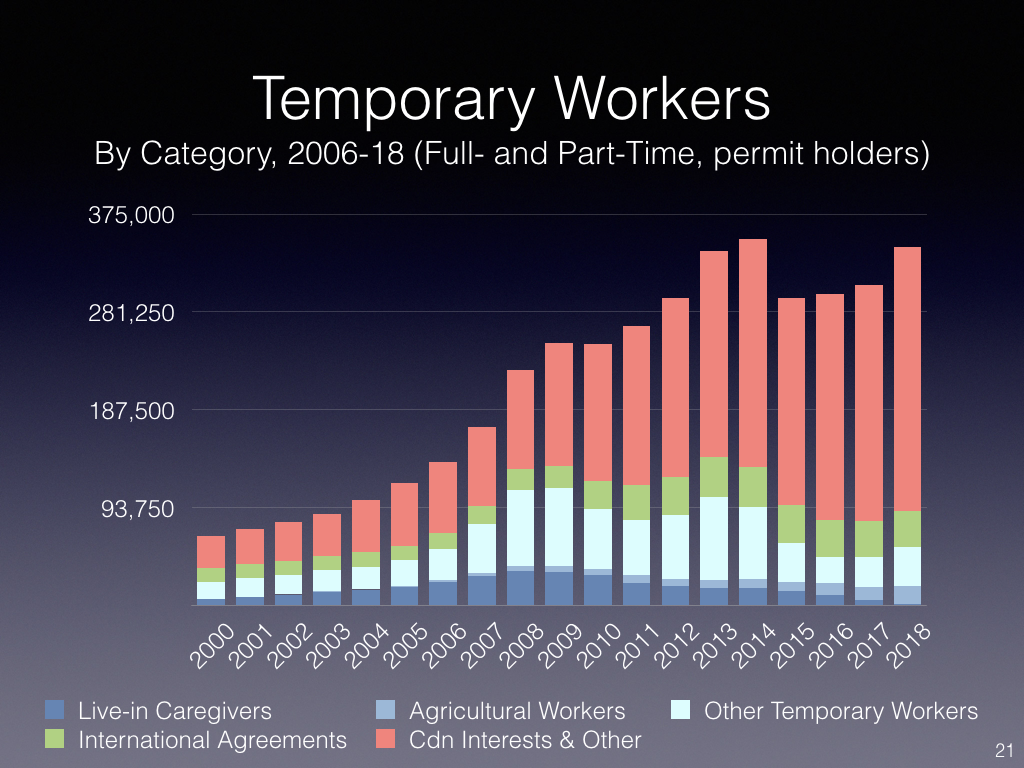
Not sure where Todd is getting the numbers to state his case. The largest part of the increase actually happened under the Conservatives, 2007-15: from 92,000 to 234,000 (IMP), with only Temporary Foreign Workers showing a decline following the reversal of their facilitating their entry in response to business pressures (from 78,000 in 2007, rising to a peak of 104,000 in 2013 before declining to 60,000 in 2015).

The bulk of the Temporary Foreign Workers increase under the Liberal government has been with respect to agriculture workers (a doubling to 52,000, 2016-18), not fast food workers.

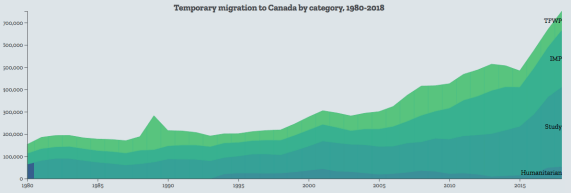
And while there are linkages with international students, better to focus on IMP and Temporary Foreign Workers in this kind of analysis:

A big jump in the number of guest workers is hurting low-wage employees and others across Canada, according to economists.

The number of non-permanent foreign workers arriving in Canada each year has doubled in the past decade, escalating particularly after the federal Liberal government was elected in 2015.

Partly as a result of the increasing flow of guest workers, UBC economist David Green and Carleton University’s Christopher Worswick say in a paper that new immigrants are doing “worse and worse” in regards to earned incomes. And it’s Canada’s low-wage workers who are suffering the most.

Even though businesses frequently lobby politicians to allow more guest employees, Green says the latest hikes are putting downward pressure on wages and threatening respect for workers. They’re exacerbating the kind of scenario, he said, that lead to the rise of Donald Trump and Britain’s Brexit movement.

Saying it’s “truly dumb” for the federal government to continue boosting low-skilled guest workers in the country, Green emphasized the vast majority of Canadians don’t appear to be aware of the labour-market shift. “It’s totally under the radar.”

While temporary workers were initially billed as a way to rescue businesses that needed to make up short-term skill shortages in certain sectors, low-skill guest workers from overseas are now increasingly being brought in to staff fast-food restaurants, fill shelves at supermarkets and perform basic kitchen duties.

In the face of a 2013 backlash against the increased volume of foreign workers in Canada, former Conservative immigration minister Jason Kenney drastically cut their numbers. But Prime Minister Justin Trudeau has jacked up the totals much higher.

The new river of guest workers in Canada “releases the pressure on firms to provide better jobs, jobs where you have control over your time, where the pay is decent. It lets the steam off. And that pushes us toward a society that doesn’t respect workers so much,” said Green, a professor in the Vancouver school of economics and a fellow at the Institute for Fiscal Studies in London.

It’s difficult for the public to recognize that guest worker numbers have grown at a much faster pace than more-often discussed immigration levels, which have expanded by 30 per cent since 2015, with about 320,000 now being approved annually.

The official temporary foreign worker program, which attracted such controversy in the Conservatives’ era, has not greatly expanded. But other guest-worker efforts have.

One jump has come through the doubling of international students. In 2015 about 200,000 foreign students were arriving each year. By last year the number arriving annually on study visas had ballooned to more than 400,000. Most foreign students are allowed to work 20 hours a week, plus full-time during their summer or other breaks.

The least-known migration policy change, however, has arguably been the biggest one for the labour market. That is the fourfold expansion of the so-called “international mobility” program, about which few Canadians have heard.

In 2005 about 70,000 guest workers arrived under the “international mobility” category. But by 2018 Canada was accepting more than 250,000 in this category, which is typically made up of people on two-year visas, many of whom find jobs in the service sector.

Informally known as travellers on “holiday worker” visas, such employees are often associated with young Australians working at ski resorts like Whistler, or with British globe trotters serving beer in pubs in Vancouver or Toronto.

A UBC-backed website called Superdiversity, which has created interactive graphics based on immigration department data, shows the largest group of the more than 250,000 “international mobility” workers who arrived in Canada last year were from India, followed by those from the U.S., China, France and South Korea. Toronto took in about 70,000 international mobility workers in 2018, while Vancouver absorbed 30,000.

In line with the research of American economist Giovanni Peri and the University of Ottawa’s Pierre Brochu, Green described how owners of a Tim Horton’s franchise, a café or a supermarket often try to justify bringing in more guest workers by saying they can’t find anyone to fill the low-skill slot.

“So they go to their local MP and say, ‘I’m in trouble here. I can’t get enough workers for my front counter.’ The real response to them should be, ‘Well, pay them more.’ But it’s not the answer they want to hear, because they want to make more profit,” Green said.

Economists don’t really think it’s a problem that a fast-food restaurant owner or other service sector employer can’t hire workers at low wages, said Green. “When something is scarce, the price for it goes up and people and companies adjust. That’s the whole wonder of the capitalist system.”

The low-wage problem is exacerbated in places like Metro Vancouver, where the cost of renting or owning homes is extreme. Instead of offering decent living wages to the people who live here, Green said many bosses are inclined to hire “people who live in housing with five other foreign workers.”

A second trouble with Canadian companies increasingly relying on low-wage guest workers, Green said, is it leads to a more fearful workforce, incapable of demanding adherence to local labour standards or of forming a union.

“Everyone knows these guest workers have no rights. If they lose their jobs they’re gone. They’re not about to complain. Canadian firms are now not only getting just lower-wage workers these days, they’re getting very compliant workers,” said Green.

Even though a lot of commentators write off the supporters of Trump and Brexit as just “stupid people,” Green said, many have been workers who have felt that the promise of globalization, the transnational movement of capital and labour, has not benefited them.

“These are people who feel there was a deal promised to them, where everyone would share in the benefits of deregulation and a more flexible labour market,” said Green.

“But then governments did things like bring in more temporary foreign workers and those people are feeling like, ‘What the hell just happened?’ If you want people to feel like they have a share, don’t bring in somebody to replace them every time their wages start looking like they’re going to go up.”

Source: Douglas Todd: Dramatic jump in guest workers hurts Canadians on low wages

Stephens: The New Conservative Pyrite “National conservatism” is another road to serfdom

Good post by Stephens on the bankruptcy of contemporary American conservatives:

Friedrich Hayek, whose thoughts used to count for something among well-educated conservatives, made short work of nationalism as a guiding principle in politics. “It is this nationalistic bias which frequently provides the bridge from conservatism to collectivism,” he wrote in “The Constitution of Liberty.”

That point alone ought to have been enough to dim the right’s new enthusiasm for old-style nationalism. It hasn’t.

A three-day public conference this month on “national conservatism” featured some bold-faced right-wing names, including John Bolton, Tucker Carlson and Peter Thiel. The Wall Street Journal’s editorial page published a piece from Christopher DeMuth, a former president of the American Enterprise Institute, on the “nationalist awakening.” Yoram Hazony, an Israeli political theorist, has gained wide attention among U.S. conservatives with his book, “The Virtue of Nationalism.”

And, of course, Donald Trump: “You know, they have a word, it sort of became old-fashioned, it’s called a nationalist,” the president said last October. “And I say, really, we’re not supposed to use that word. You know what I am, I’m a nationalist.”

FATAH: Bernier’s problems with multiculturalism cannot be dismissed

As usual, Fatah conflates populist discourse on multiculturalism with what the original policy, the subsequent act and the related policy instruments (e.g., employment equity) actually mean both in policy and practice.

The policy is all about integration through:

  • Assisting cultural groups to retain and foster their identity;
  • Assisting cultural groups to overcome barriers to their full participation in Canadian society;
  • Promoting creative exchanges among all Canadian cultural groups; and,
  • Assisting immigrants in acquiring at least one of the official languages.

And while identity politics is overly played, this is not new. After all, part of the historical playing out of French and British relations often involved identity politics and many critics of multiculturalism are playing on “white” identity.

Moreover, while there are pockets, analysis of Census level data by people such as Hiebert and Hulchanski confirm that fear of enclaves is exaggerated:

On Wednesday, Maxime Bernier, leader of the People’s Party of Canada, announced his party’s platform on immigration, calling for a 50% cut in the annual number of immigrants admitted.

Justifying this massive cut, Bernier cited figures from a 2011 study by the Fraser Institute that said the net “cost” to Canada per immigrant was $6,051, estimating an annual burden of about $24 billion. He told the cheering audience, that “is a lot of money.”

He then opined that “one reason for this is that immigrants generally have lower wages than non-immigrants” and thus pay less tax.

In arriving at his figure of $24 billion, Bernier did not take into account the fact that immigration is a way of importing consumers without paying a penny to the society that manufactured us. We are the only goods that arrive duty free with no price tag.

When I arrived as an immigrant, Canada paid zero for my degree in biochemistry and 20 years of experience as a journalist and advertising copywriter. Neither did my wife’s postgraduate degree in English Literature cost a penny to the Canadian taxpayer, yet we were both contributing to the economy of Canada as taxpaying consumers and renters from day one.

Having said that, it would be foolish to outright dismiss Bernier’s very sincere fears about the integration of immigrants like me into Canadian society. It is true that most of us who come to Canada from developing countries in Asia and Africa arrive with religious-cultural baggage that includes archaic values bordering on racism, tribalism, casteism and superstitions that have little to do with the values that shaped Canada in the last 400 years of Western civilization.

Bernier said, “in the past, immigrants who came here gradually integrated into our society. They kept some aspects of the culture of their country of origin, of course. And that influenced and changed our society. They became Canadian, but with a distinct flavour.”

“This is a type of multiculturalism that enriches our society. And it is perfectly fine,” he added.

However, Bernier expressed a problem with immigrants “living permanently in an enclave apart from the larger Canadian society,” a problem he said that gets exasperated by “being officially encouraged by the government to continue to do so rather than to integrate into Canadian society and adopt Canadian culture and values.”

A nation must be based on a sense of belonging, of participating in a common national project, sharing the same values, being different from the rest of the world.

As an example, Bernier cited the way ‘ethnic politics’ has become the norm among Canada’s political parties. “They don’t talk to Canadians. They address themselves to ethnic voting blocs. To Ukrainian Canadians, Italian Canadians, Chinese Canadians, Muslim Canadians, Sikh Canadians.”

Bernier is right to point out this slow disintegration of Canadian society into vote banks. As he said, “even our foreign policy now depends on appealing to these ethnic political clienteles, instead of being based on the interests of Canada as a whole.”

The Multiculturalism Act must be revoked for the simple reason that not all cultures are equal. The culture that treats my autistic daughter with the utmost respect, love and care is not equal to the culture that treats autistic children as a punishment by God for sins committed by others.

The culture that calls for slaying gays, permits polygamy, and imprisons women in black burkas is medieval and misogynist and is certainly not equal to the culture of gender equity and LGBTQ rights.

Bernier is right when he told his party faithful: “Among the threats to our values and way of life is political Islam, or Islamism, the fastest-growing and most dangerous radical ideology in the world today.”

Canadians dismiss Bernier’s fears at their own peril.

Source: FATAH: Bernier’s problems with multiculturalism cannot be dismissed

From immigration limbo to liberty: Canada sees surge of non-American migrants

Interesting shift but not surprising given the impact of the Trump administration on US immigration policy and practices:

After spending almost all her life in immigration limbo in the United States, Paras Pizada can finally set down roots and plan for a future … in Canada.

The 27-year-old woman is part of a surge of non-American citizens arriving here legally from south of the border where they’ve faced an increasingly hostile environment since President Donald Trump was elected in 2016.

Canada’s new biometrics visa requirements, however, could prove a deterrent for undocumented migrants in the U.S. who, like Pizada, try to come here legally.

Since January, applicants worldwide must provide fingerprints and have their photos taken at facilities designated by Canadian immigration.

In the U.S., almost all facilities are operated by American immigration officials. Undocumented migrants fear this will put them at risk of arrest and deportation. Indeed, the Canadian immigration website warns biometric applicants that they must be legally in the U.S. to go to a centre.

These biometrics requirements could potentially drive up irregular migration into Canada which has dropped by half to 5,140, between January and May, compared to the same period last year.

“Since these people can’t get fingerprinted to apply for Canadian work permits and study permits legally, they will all just walk across the border. Ottawa has made it impossible for the majority of undocumented U.S. residents who want to apply legally for Canada to do so,” said Winnipeg-based immigration lawyer Vanessa Routley.

According to Canadian immigration data revealed for the first time, in 2018, non-Americans in the U.S. accounted for 85 per cent or 13,754 of the 16,158 permanent residence applicants from south of the border, up from just 48 per cent or 1,477 of the total 3,077 applicants in 2015, with India (10,556), China (768) and Nigeria (337) being the top three source countries in 2018.

In 2015, non-Americans made up just 14 per cent or 4,664 of 33,062 applicants in the U.S. for Canadian work permits and student visas.

In 2018, the number almost doubled to 26 per cent or 11,840 of all 45,202 applicants.

It is not known how many of these applicants were actually undocumented in the U.S., because that data is not collected.

Pizada was two when her family arrived as visitors to the United States from Pakistan in 1994. They never left, moving from place to place to evade detection by immigration enforcement officials. Though both Pizada and her sister later qualified to remain temporarily in the U.S. under a special program for undocumented children launched under then-President Barack Obama, they had had no access to permanent residence and citizenship.

When Trump was elected in 2016 and stepped up the removal of undocumented migrants, the sisters started looking for places to go outside the U.S. In June, Pizada, who has a master’s degree in media studies from Pratt Institute in New York, came to Canada as a permanent resident under the federal skilled workers program, following in the steps of her sibling, Mahaik, who had arrived here the year before.

“We are so relieved,” said Pizada, who now lives in Niagara Falls. “I can finally put down roots and have a place to call home. I’m allowed here and no one can kick me out.”

Pizada was lucky she could avoid the biometrics dilemma presented by Canadian immigration because she had already been known to American homeland security officials by having registered with the Obama administration’s program that offered her a renewable temporary residence in the U.S. every two years. Most undocumented migrants didn’t meet that program’s criteria and are off the enforcement officials’ radar.

Of the 133 facilities in the U.S., only two, one in Los Angeles and the other in New York City, are run by private contractors, which means most undocumented applicants must either travel long distances to those two offices or take the risk of going to their local centres and potentially be intercepted by American immigration authorities.

Sharma, who asked that her full name not be used because she is undocumented in the U.S., has been accepted by four Canadian universities — these are Waterloo, Concordia, New Brunswick and Dalhousie — in their graduate programs, but is afraid of setting foot in her local centre run by the U.S. Department of Homeland Security as it collects fingerprints.

“There is definitely a heightened fear of getting arrested with all these government raids against migrants,” said Sharma, 21, who arrived in the U.S. from Indian with her family 12 years ago.

She graduated in May with an undergrad degree in biomedical engineering.

“This biometrics requirement is hindering our ability to regularize our status in Canada. We just want to make a better life.”

Canada is doing everything it can to make the biometrics collection process as smooth as possible for all applicants, according to Canadian immigration department spokesperson Nancy Caron.

“In a situation where an applicant is unable to comply with the biometric requirement, these individuals can self-identify themselves by contacting the department and provide a supporting rationale for their situation. Canadian migration officers have the discretion, in specific circumstances, to exempt an applicant from providing biometric information,” Caron told the Star in an email.

“It is important (for us) to be aware of an applicant’s previous immigration history and their compliance with immigration laws, including their current immigration status. This helps in determining whether an applicant is admissible to Canada and whether they are likely to respect the conditions of their visa.”

Officials said the data on biometrics exemptions requested and granted is unavailable.

Source: From immigration limbo to liberty: Canada sees surge of non-American migrants

New immigration program opens door to undocumented construction workers in GTA

Interesting. Seeing more and more pilot programs. Good way to test ideas but of course, they also generate constituencies that make them harder to change or cancel:

Ottawa has unveiled a new program that will offer both an immigration pathway for undocumented construction workers in Greater Toronto and help to address a labour shortage in the city.

The pilot has spots for 500 workers — plus their family members — and will open for application on September 3 through the Canadian Labour Congress, which will pre-screen and refer qualified candidates for final assessment by the immigration department.

“It’s a very small project for us but a very important project to initiate,” said Hassan Yussuff, president of the labour congress, who believes the number of non-status construction workers in the country is in the thousands. “Some of these workers have been here for five years plus and their families have set down roots in this country. We need to find a way to resolve their status.”

According to the latest forecast by Build Force Canada, a national industry-led workforce management research group, Ontario needs an additional 26,100 construction workers in the next 10 years as 91,100 people currently working in the sector will reach retirement age.

“Toronto is very busy right now with all the condo, infrastructure and transit projects. It’s tough to build projects when you don’t have the labour. It causes delays and increases costs. That’s not going to be of benefit to anyone,” said Andrew Pariser, vice-president of RESCON, a leading association of residential builders in Ontario.

“The history of the construction industry is built on immigration from Italy, Portugal, Eastern Europe, Scotland and Ireland. They all find a home in construction. We reward workers with skills and performance, and not where they come from.”

The labour congress has been working with immigration officials for almost two years to iron out the details of the pilot unveiled Friday. Only undocumented construction workers who live in Toronto, Durham, Halton, Peel and York regions qualify.

To be eligible, an applicant must have:

  • Entered legally initially as a temporary resident and lived in Canada for at least five years;
  • Proof of paying Canadian income tax;
  • Language ability for day-to-day conversation in English or French;
  • A family member living in Canada who is a Canadian citizen or permanent resident, or a spouse or child in Canada;
  • No previous offences that would make them inadmissible to Canada other than a breach of the immigration law for overstaying in the country.

The job categories that qualify for the program include: trades and skilled transport and equipment operators; maintenance and equipment operation trades; residential and commercial installers and servicers; heavy equipment operators (except crane); and construction trades helpers and labourers.

The labour congress’ Yussuff said applications will be processed on a first-come, first-serve basis and the first 500 qualified principal applicants will be provided a referral letter for the final assessment of the Immigration Department.

Immigration officials said many of the undocumented workers came to Canada with valid temporary resident status to fill labour shortages in the construction industry but have fallen out of status due to the now rescinded “four-in-four-out” rules introduced by the former Conservative government. That policy, in place between 2011 and 2015, required temporary foreign workers to leave Canada after working here for four years and banned them from returning for four years, but many chose to stay illegally.

“Without valid immigration status, these workers and their families have lived in fear and been left feeling very vulnerable. The presence of out-of-status workers in a significant industry leads to depressed wages for Canadians and makes workers vulnerable to employer exploitation and abuse,” the Immigration Department said in a statement.

“This temporary initiative is a step forward to increase the protection of some of these construction workers and their families, while safeguarding Canada’s labour market and ensuring that Canada can retain the workers it needs to grow the economy and build communities.”

Yussuff said personal information submitted by applicants to the congress will be kept confidential and priorities are given to those with spouses and children in Canada. Application to the labour congress pre-screening and referral is free, but qualified applicants must still pay for all applicable permanent residence processing fees.

Source: New immigration program opens door to undocumented construction workers in GTA

Former PPC candidate ‘no longer confident’ in Bernier after being replaced

Of note (the riding profile can be found London North Centre).

A former candidate of the People’s Party of Canada (PPC) says he’s lost confidence in the party’s leadership after being replaced by a Muslim candidate, who he claims Maxime Bernier told him would be better suited to address the “topic of radical Islam.”

Braeden Beller says he learned he was being replaced as the PPC candidate for the riding of London North Centre by political science professor Salim Mansur less than two weeks before the party held one of its largest events to date in downtown London.

Beller spoke with PPC Leader Maxime Bernier and PPC executive director Johanne Mennie about the party’s decision to substitute Mansur in as the candidate in the riding.

He says Bernier told him that “it was very valuable to have a Muslim giving the message that would speak more adequately to other Muslims on the topic of radical Islam.”

Bernier also said that Mansur would be a higher profile candidate with a larger local following in London than Beller, who said he had no political experience prior to being involved with the PPC.

Mennie said Bernier “absolutely (did) not” tell Beller that Mansur’s perspective on Islam as a Muslim would be valuable, instead pointing to Mansur’s local notoriety as the reason for the party’s choice.

“(Mansur) is well known through his work as a columnist, his work as a professor, in terms of his professional career, and that was the extent of (Bernier’s) discussion with Braeden,” Mennie said.

Mennie and Beller both said there was one conversation that he and Bernier had that she was not a part of.

When Bernier announced that the PPC had begun its cross-country candidate search, he said the party wouldn’t do “anything special” to attract a diverse range of candidates.

“I hope that our candidates will represent our country, but … we won’t do anything to attract people with different backgrounds. I think these people are coming right now,” Bernier told reporters in March.

On Wednesday, Bernier praised Mansur as a “star candidate” shortly after introducing him as “one of the main critics of Islamism in Canada,” in a speech about the PPC’s immigration platform.

Mennie says that all potential PPC candidates were told during the selection process that the party could replace them with someone else, under “exceptional circumstances.”

Mansur’s appointment has been the only case the party has invoked that policy, according to Mennie.

Mansur had first tried to run for the Conservatives. While Beller had been presented by the PPC as its candidate, both on Facebook and on the party’s website, Mansur had been vying for the candidacy of the Conservative party in London North Centre. In a statement on his website, Mansur says he was told on June 10 that he had been “disallowed” to run for the Conservatives for unspecified reasons. Five days later, he appealed the party’s decision but was rejected because he had waited too long. The Conservatives haven’t announced their candidate for the riding yet.

Beller said only running for the PPC after failing to run for the Conservatives means Mansur’s choice was “out of self-interest.”

Beller had been the lone applicant for the PPC candidacy in London North Centre and had been acclaimed before Mansur replaced him. When Beller was replaced in the riding he was offered the candidacy in the bordering riding of London Fanshawe, and according to Mennie, was told by Bernier that the leader would help his campaign by personally canvassing for him. Beller said he declined the offer because he was no longer confident in Bernier.

“What made me lose faith in Bernier is because he decided to ignore his principles when it benefited him,” Beller said.

“It’s disappointing but unsurprising,” Beller said about his short-lived experience as a federal candidate.

“I won’t be voting for the PPC, let’s put it that way,” Beller added.

Source: Former PPC candidate ‘no longer confident’ in Bernier after being replaced

Tech Companies Say it’s Too Hard to Hire High-Skilled Immigrants in the U.S. — So They’re Growing in Canada Instead

The latest in a series of articles. Perhaps the only upside for Canada of the Trump presidency:

On a recent Tuesday, Neal Fachan walked down a dock in Seattle’s Lake Union and boarded a blue and yellow Harbour Air seaplane, alongside six other tech executives. He was bound for Vancouver to check on the Canadian office of Qumulo, the Seattle-based cloud storage company he co-founded in 2012. With no security lines, it was an easy 50-minute flight past snow-capped peaks. Later that day, Fachan caught a return flight back to Seattle.

Fachan began making his monthly Instagram-worthy commute when Qumulo opened its Vancouver office in January. Other passengers on the seaplanes go back and forth multiple times a week. Fachan says his company expanded across the border because Canada’s immigration policies have made it far easier to hire skilled foreign workers there compared to the United States. “We require a very specific subset of skills, and it’s hard to find the people with the right skills,” Fachan says as he gets off the plane. “Having access to a global employment market is useful.”

In the fractious battle over immigration policy, most of the attention has been directed at apprehending migrants at the southern border. Some tech executives and economists, however, believe that growing delays and backlogs for permits for skilled workers at America’s other borders pose a more significant challenge to the U.S.’s standing as a wealth-creating start-up mecca. The risk of losing out on the fruits of innovation to Canada and other countries that are more welcoming to immigrants might be a bigger problem for our economic future than a flood of refugees. Half of America’s annual GDP growth is attributed to rising innovation.

“Increasingly, talented international professionals choose destinations other than the United States to avoid the uncertain working environment that has resulted directly from the agency’s processing delays and inconsistent adjudications,” testified Marketa Lindt, president of the American Immigration Lawyers Association, at a House hearing last week about processing delays at U.S. Citizenship and Immigration Services (USCIS). Lindt’s organization finds that USCIS processing time for some work permits has doubled since 2014, a fact cited in a May letter signed by 38 U.S. Senators on both sides of the aisle asking USCIS to explain the processing delays.

The backlogs in processing have particularly benefited our neighbor to the north. Canada has adopted an open-armed embrace of skilled programmers, engineers and entrepreneurs at the same time the U.S. is tightening its stance. Research shows that high-skilled foreign workers are highly productive and innovative, and tend to create more new businesses, generating jobs for locals. So each one who winds up in Canada instead of America is a win for the former, and a loss for the latter. “Really smart people can drive economic growth,” says Robert Atkinson, president of the Information Technology and Innovation Foundation, a think tank in Washington, D.C. funded in part by cable, pharmaceutical, television, and tech companies. “There are not that many people in the world with an IQ of 130, and to the extent that we’re attracting those people rather than the Canadians doing so, we’re better off.”

With the unemployment rate hovering below at or below four percent for the past 18 months, tech companies are long used to battling for talent by offering $100,000-plus starting salaries and perks like onsite gyms and all the kombucha you can drink. Recruiting foreign talent is one way for them to find new hires. There are a number of ways companies can hire skilled workers from India, China, and other countries, including applying for L-1 and H-1B visas, which allow foreigners to temporarily work in the United States. Demand for these visas, which are awarded by lottery, is intense. Since 2004, 65,000 H-1B visas are issued annually: this year’s ceiling was hit in only four days. (The government allows 20,000 additional visas for workers who have a master’s degree or PhD from a U.S. university.)

Amid the wider crackdown on immigration under the Trump Administration, the application process for employment-based visas appears to have gotten even tougher. The government denied 24% of all initial H-1B applications in 2018, up from six percent in 2015, according to an analysis of data from the National Foundation for American Policy, a pro-immigration think tank. It’s not just H-1B applicants who are experiencing delays. Applicants for all employment-based green cards now have to appear in person at a field office, a new policy that has created long delays, according to the American Immigration Lawyers Association, which says immigration officials under Trump are focusing more on enforcement than on processing legal applications for benefits. And despite a backlog of 5.7 million cases in 2018, USCIS has been providing surge resources to Immigration and Customs Enforcement field offices across the country, diverting more staff away from processing visa applications.

Canada’s policies, in contrast, offer an alluring alternative. Canada permits companies with offices in the country to hire skilled foreign workers in positions such as computer engineers, software designers, and mathematicians, and have their visas processed within two weeks. These workers can soon after apply to be permanent residents and, within three years, become full-fledged citizens. (The path to permanent residency for foreign workers in the U.S., by contrast, can take decades.) Officials at the Canadian consulate in Seattle work with two to three companies a week trying to set up offices in Canada.

“The visa process is just completely unpredictable for us, and we were wrestling with it for so long, we decided we needed to have some certainty,” says Thor Kallestad, the CEO of DataCloud, which uses technology to help mining companies better assess land potential. He already had offices in Silicon Valley and Seattle, but decided to open up shop in Vancouver and close his Silicon Valley office so he could more easily hire foreign workers. “In the U.S., we just couldn’t get clear answers about what the process looked like, what we as a company needed to do to rectify it.”

The Canadian option offers workers more certainty — and a near-guaranteed path to citizenship — while many U.S. skilled workers have no idea when and if they will get approved to stay in the United States. Given the choice, talented entrepreneurs with cutting-edge companies are choosing Canada. “They really make it easy to come in and start a business,” said Nat Cartwright, one of the founders of Finn.AI, an artificial intelligence company that powers virtual assistants for banks around the world. Cartwright and her two business partners, who are from Australia and India, met in business school in Spain. When they graduated, they considered locating their new company in Silicon Valley, but ultimately chose Vancouver because they knew they would qualify for a start-up visa there, and that they would be able to quickly hire AI experts from around the world. Of the company’s 60 workers, 60% were born outside Canada. Seven of Cartwright’s business school classmates from Spain have since relocated to Canada.

Canadian officials have deftly responded to the changing climate in the U.S. In 2017, the Trudeau government announced Global Skills Strategy, the program that allows companies to get work permits for foreign talent in less than two weeks. Their spouses can also receive work permits; the U.S. Department of Homeland Security this year proposed revoking work permits of the spouses of skilled foreign workers in the U.S. In 2018, the Trudeau government also made permanent the Start-Up Visa program, which allows immigrant entrepreneurs to live and work in the country provided their start-up has secured funding from venture capitalists or angel investors. A similar start-up visa program in the United States was approved in the last days of the Obama administration, but the Trump administration is in the process of ending it. “By helping Canadian companies grow, this strategy is creating more jobs for Canada’s middle class and a stronger Canadian economy,” said Ahmed Hussen, Canada’s Somali-born Minister of Immigration, earlier this year.

Even the biggest American tech companies are expanding their Canadian operations in a quest for high-skilled labor. Software engineer Janko Jerinic moved to Canada after attending an Amazon recruiting fair in his home country of Serbia. He wanted a job in New York or Seattle, but his wife hoped to work as well, and an Amazon recruiter said it would be hard for her to get a visa. The recruiter steered the couple to Vancouver, where Jerinic has worked for Amazon since 2015. The office, which opened in 2013, rapidly grew from about 500 people when he started to triple that now. A map in Jerinic’s Vancouver office shows employees’ places of birth. There are hundreds of pins from places like India, Russia, Brazil, and Belgium. But “you have to use a flashlight to find people from Canada,” he jokes. Amazon said in April 2018 that it was building a 416,000 square foot office in downtown Vancouver that will open in 2022; it plans to hire 3,000 more people there.

That technology companies are growing across America’s border has big implications for the U.S. economy. Since World War II, the U.S. has been the epicenter of the entrepreneurial universe. But America’s entrepreneurial dominance is waning. While 95% of global start-up and venture capital activity took place in the United States in the mid-1990s, today it’s about half, according to a report from the Center for American Entrepreneurship (CAE), a nonprofit that advocates for start-ups and is funded by banks and financial institutions. And the number of start-ups still paying employees a year after their founding fell 42% between 2005 and 2015, the most recent year for which there is data available.

The innovation economy creates jobs outside of tech, too. Research by the Berkeley economist Enrico Moretti suggests that every high-paying tech job created in an economy results in five more openings, including positions like lawyers, nurses, and hairdressers. The United States allows about 140,000 immigrant skilled workers to become permanent residents annually; Canada, a company with one-tenth of the population, welcomed 160,000 skilled workers on the track to permanent residency in 2017 and hopes to get that number to nearly 200,000 by 2021. Its goal of making immigrants 1% of its population by 2021 would increase annual GDP growth by 0.6%, with immigrants driving one-third of that expansion, according to a report by the Conference Board of Canada.

Making it easier for high-skilled immigrants in the United States could help jump-start America’s innovation economy, said Ian Hathaway, a Brookings Institution fellow who studies entrepreneurialism and technology. Immigrants are twice as likely as native-born Americans to start businesses. Immigrants or children of immigrants founded almost half of America’s Fortune 500 companies. More immigration could also bring benefits beyond the country’s traditional tech hubs, boosting businesses in the countryside and suburbia that are short on skilled tech talent. Most of the start-up activity that has occurred since the Great Recession has been concentrated in only 20 counties, a startling contrast to the economic recovery of the 1990s, when new businesses were sprinkled across the country.

VannTech, a recruiting platform, recently brought 126 Brazilian workers to a company in the Canadian prairies whose native workers kept moving to Toronto and Vancouver. The platform has 70,000 skilled tech workers looking to relocate to Canada and Europe; it does not help these people go to the United States because the process is too difficult, said Ilya Brotzky, VannHack’s CEO. “If U.S. companies are putting 5,000 tech jobs in Canada, when they could be putting them in places like St. Louis or Indianapolis, that’s a huge deal to those local economies,” says Atkinson.

At the same time, Trump himself has advocated for rethinking the system. In 2017, he backed the Raise Act, a bill introduced by Senate Republicans that would have cut legal immigration in half, while also establishing a points system designed to give priority to skilled workers and investors. While the bill would not have dramatically increased the number of visas available to in-demand workers, it did signal a preference for skilled workers over other migrants. The bill stalled out after opposition from politicians whose constituencies include agriculture and tourism companies, which rely heavily on unskilled immigrants. Trump reintroduced the merit-based immigration idea this year in a Rose Garden speech, and his staff is considering a new immigration plan that would revamp the current system to prioritize skills over family ties. “We want immigrants coming in,” he said in May. “We cherish the open door that we want to create for our country, but a big proportion of those immigrants must come in through merit and skill.”

Harbour Air, the seaplane company, used to fly buyers in and out of remote log booms across the Pacific Northwest. As that business waned, the company pivoted to tourism. Now, pilot Reggie Morisset says that tech industry demand is filling up planes once again. When the Vancouver-Seattle route launched last year, tech companies bought tickets in bulk so their employees could easily go back and forth between Canada and the United States, he said. “It’s catching fire,” he said. “If anything, it is just going to get busier.”
Source: Tech Companies Say it’s Too Hard to Hire High-Skilled Immigrants in the U.S. — So They’re Growing in Canada Instead

Political incivility is a losing strategy

Although I wish it were not so, I am not convinced, based on discourse to date:

With a federal election approaching, Canadians seeking elected office might be wondering about messaging strategies and whether the rules of engagement have changed. After all, Donald Trump, who has insulted 598 people, places and thingson Twitter alone (as of May 24), is president of the United States. Crowds at his political rallies go wild when he calls his opponents names or insults their character, “feeding red meat to his base.” Michelle Obama responded to Trump’s incivility with the slogan “When they go low, we go high” — but her preferred candidate lost. Canadian candidates for office may now be wondering if there is a lesson to be learned from south of the border. If insulting people worked for Trump, might it work for Canadian politicians?

As an experimental social psychologist, I have spent the past few years systematically testing this idea. The results from my experiments surprised me: insulting people remains a losing strategy in 2019. Even a politician’s most diehard and adoring followers do not react positively to uncivil political attacks. My advice to those aspiring to public office is to remain civil and win votes the old-fashioned way: on their merits.

It might seem obvious that onlookers would disapprove of someone personally attacking a political opponent. However, when people are grouped together into teams, the normal rules of engagement don’t always apply. For instance, body checking is usually not an acceptable thing to do, but it is sure to draw cheers at a hockey game (when the visiting team is on the receiving end, that is.) Like hockey, politics can be deeply personal for some people; it can set up a sense of “us” and “them.” At times, political opponents can seem threatening. Their policies can look callous and harmful. This sort of intergroup conflict can alter the rules of engagement by giving group leaders (politicians) a social licence to attack the other side as a means of thwarting the perceived threat. Whether this licence applies to insulting political opponents in the Information Age remained to be seen until we conducted our experiments.

Yes, Donald Trump insults people. And yes, he is President of the United States. But those two facts do not necessarily mean that Trump’s insults in some way helped him win the election. His insults and electoral victory appear to be correlated, but correlation does not imply causation. To get to the bottom of this question, my collaborator at the University of Illinois, Chicago, Linda Skitka, and I conducted a series of experiments. In each one, we randomly assigned about 1,000 Americans (from an internet panel) of varying political stripes to read either a real and insulting tweet by President Trump or a more civil version of the same. They then indicated how they felt about the President. Americans across the political spectrum approved of Trump more after reading a civil tweet than after reading an uncivil tweet, meaning that incivility uniformly backfired.

Even people who self-identified as “diehard Trump supporters” either reacted negatively to Trump’s incivility or were unmoved by it. It didn’t matter if Trump’s opponent insulted him first and his incivility was a means of restoring his honour; Americans still preferred civility. An analysis of the pattern of Trump’s uncivil tweets over time confirmed that they have a subsequent depressing effect on his public opinion polls, meaning that the results from our experiments and evidence from the real world converged. Simply put, Donald Trump probably won the US presidency not because of his incivility, but in spite of it. With the US economy humming along, just imagine what his approval ratings would be if he were to be civil more often. If insulting opponents backfires for Trump, it surely would backfire for Canadian politicians.

Why do insults backfire? Psychologists have worked out that people’s impressions, favourable or otherwise, tend to be rooted in two general categories: warmth and dominance. It is generally better to be seen as warm than as cold. And it is generally better to be seen as dominant than as submissive. We suspected that insulting an opponent would make a politician seem more dominant (a positive impression) but perhaps less warm (a negative impression). For diehard supporters of the politician, we wondered if the dominance boost might be larger than the warmth deficit, leading to a net boost in approval. However, we found no evidence that insults make a politician seem more dominant in the first place. Rather, insults only made a politician come across as cold. This perception of coldness explained why insults were universally frowned upon.

Along with its strategic shortcomings, political incivility can have larger, more ominous consequences. In their book How Democracies Die, Steven Levitsky and Daniel Ziblatt make the case that a formal system of checks and balances is necessary but not sufficient to prevent the collapse of a democracy into one-party totalitarianism. It is also necessary for members of different political parties to remain civil with and tolerant of one another (while still disagreeing about policy matters). Incivility can create a sense that subjugating the rights of a political party is both justified and necessary, and thus leads to democratic collapse. When it comes to civility, the interests of politicians and of our democracy are aligned.

Based on what I’ve learned so far from the science of persuasion, Canadians aspiring to public office would be wise to mind their manners and focus their attention on remedying the most important issues facing our nation, such as climate change, the economy (including affordable housing, the cost of living, the wealth gap between the rich and poor) and health care (including the opioid crisis). Insulting political opponents hasn’t helped Trump and it probably won’t help Canadian politicians either.

Source: Political incivility is a losing strategy