Barr Packs Board of Immigration Appeals with Judges Who Denied Asylum Claims at ‘High Rates’

The power of appointments (in Canada, Sean Rehaag has done comparable analysis of IRB board members Refugee approval rates reflect subjectivity of decision-makers, prof says – Montreal – CBC News):

The Trump Administration is making significant moves in an apparent effort to reduce the number of successful migrant applications for asylum at the border. Rather than a ban, which the Trump Administration has explored, U.S. Attorney General William Barr has promoted six immigrations judges to the Department of Justice’s Board of Immigration Appeals (BIA) — all of whom have “high rates” of denying asylum claims, the San Francisco Chronicle reported on Friday.

According to the report, the six appointees who were sworn in on Friday will comprise more than 25-percent of the 21-member BIA. In case you are unfamiliar with what this board is for and how powerful it is, don’t worry, the Department of Justice has got you covered [all emphases ours]: 

“The Board of Immigration Appeals (BIA) is the highest administrative body for interpreting and applying immigration laws. It is authorized up to 21 Board Members, including the Chairman and Vice Chairman who share responsibility for BIA management. The BIA is located at EOIR headquarters in Falls Church, Virginia. Generally, the BIA does not conduct courtroom proceedings – it decides appeals by conducting a “paper review” of cases. On rare occasions, however, the BIA hears oral arguments of appealed cases, predominately at headquarters.

The BIA has been given nationwide jurisdiction to hear appeals from certain decisions rendered by immigration judges and by district directors of the Department of Homeland Security (DHS) in a wide variety of proceedings in which the Government of the United States is one party and the other party is an alien, a citizen, or a business firm.

BIA decisions are binding on all DHS officers and immigration judges unless modified or overruled by the Attorney General or a federal court. Most BIA decisions are subject to judicial review in the federal courts. The majority of appeals reaching the BIA involve orders of removal and applications for relief from removal. Other cases before the BIA include the exclusion of aliens applying for admission to the United States, petitions to classify the status of alien relatives for the issuance of preference immigrant visas, fines imposed upon carriers for the violation of immigration laws, and motions for reopening and reconsideration of decisions previously rendered.”

“Prior to the new rule, the Attorney General’s own decisions were binding on all of DHS, but the BIA’s decisions weren’t binding on the entire system unless a majority of Board members voted to publish them. Currently, this happens about 30 times a year. By giving the Attorney General unilateral power to designate BIA decisions as precedent with the stroke of a pen, the regulation destabilizes the fair checks and balances in the court process.”

The names of the promoted judges: William Cassidy, Earle Wilson, Keith Hunsucker, Deborah Goodwin, Stephanie Gorman, Stuart Couch.

Cassidy and Wilson respectively rejected 95.8-percent and and 98.1-percent of asylum claims between 2013 and 2018; the national denial average was 57.6 percent, the Chronicle reported. (Both of them have inspired complaints of unfairness.) With the national average in mind, consider the other rejection rates added to the board: Hunsucker, 81.6-percent; Goodwin, 89.4-percent; Gorman, 86.9-percent; Couch, 92.1%. These percentages came from data tracked by Syracuse University — data the DOJ claimed it doesn’t track and can’t verify when responding to the Chronicle story.

“DOJ doesn’t track asylum approval and denial rates for individual immigration judges, and (Syracuse) uses its own methodologies in interpreting the data it receives, resulting in conclusions that we cannot verify,” a DOJ spokesperson said. “Collectively these judges … have nearly 120 years of immigration law (experience) through multiple administrations. Advocates that attack their integrity and professionalism only undermine the entire system.”

Source: Barr Packs Board of Immigration Appeals with Judges Who Denied Asylum Claims at ‘High Rates’

Bernier picks ridings where PPC has best chance to win in bid to join leaders’ debate

Looking at the choices by percentage of immigrants and visible minorities, quite a range. Appears selection criteria weighted towards candidate name recognition and profile (for full riding detail, see diversityvotes.ca):

  • Beauce: 1.4 percent immigrants, 1.1 percent visible minorities
  • Etobicoke North: 58 percent immigrants, 75.7 percent visible minorities
  • Nipissing-Timiskaming: 4.6 percent immigrants, 2.4 percent visible minorities
  • Charleswood-St. James-Assiniboia-Headingley: 13.1 percent immigrants, 10.2 percent visible minorities
  • Pickering-Uxbridge: 30.2 percent immigrants, 36 percent visible minorities

People’s Party Leader Maxime Bernier has provided five ridings to the federal commission organizing the election leaders’ debate in a last-minute effort to enter the highly anticipated event.

In a letter sent to the Leaders’ Debate Commission, Bernier picks five ridings based on “candidates who are better known in their riding as public figures, and therefore will start this campaign with an advantage that others don’t have.”

It includes his Quebec riding of Beauce and the Toronto riding of Etobicoke North, where Renata Ford, the wife of late former mayor Rob Ford and sister-in-law of Ontario premier Doug Ford, is running.

The commission had asked Bernier to provide it with three to five ridings where he thought People’s Party candidates had the best chance of winning, after saying on Aug. 12 that Bernier did not meet the criteria needed to qualify for the leaders’ debates slated for early October.

Commissioner David Johnston had preliminarily ruled that the People’s Party, as it stood, did not have a “legitimate chance” of electing more than one candidate in the upcoming election.

That determination is based on recent political context, polling and previous general election results. A final list of invited parties will be published on Sept. 16.

The three other ridings are Nipissing-Timiskaming, where local councillor Mark King is representing the People’s Party; Charleswood-St. James-Assiniboia-Headingley, where former Conservative cabinet minister Steven Fletcher is running; and Pickering-Uxbridge, where former Tory MP Corneliu Chisu carries the party banner.

Bernier states in the letter that his understanding of the criteria is that “it simply states that our candidates must have a legitimate chance to be elected in the general election, and not at this time in the election cycle.”

“The election campaign could have a huge impact on this legitimate chance. More so for the other reasons I explained regarding the recent political context, including the high level of volatility and disaffection of the electorate, and the fact that populist parties similar to the PPC have experienced very rapid growth in other Western countries,” Bernier wrote.

He said as the People’s Party is very young, it had little information about the regional distribution of its support across Canada and its concentration in specific ridings. Nor did the party have the money to conduct polls in 338 ridings.

Bernier also included data obtained from Meltwater, a media monitoring company, on how often his name popped up in online and print sources over the last year compared to other party leaders.

The numbers state his name popped up 23,518 times, more than Green Party Leader Elizabeth May and Bloc Québécois Leader Yves-Francois Blanchet.

As well, data included in the letter shows his name popped up on social media 1.67 million times, more than NDP Leader Jagmeet Singh, May and Blanchet.
Bernier also included in his letter columns in publications such as the Toronto Star, National Post and The Post Millennial arguing in favour of his entry into the debate.

Among candidates, Renata Ford, though a political novice, carries name recognition through her politically involved family members.

Meanwhile, King is a council member in North Bay. He was supposed to run for the Tories, but the party removed him as a candidate last month for allegedly using a corporate credit card to purchase party memberships for himself and close family members. He then joined the People’s Party.

Fletcher was a Conservative MP from 2004 to 2015 and had served as ministers of state for democratic reform and transport. Chisu was a Tory MP from 2011 to 2015.

An Aug. 5 Mainstreet Research poll for iPolitics found Bernier to be running neck-and-neck with the Conservatives in his southeastern Quebec riding.

According to the commission’s letter sent to Bernier, the information he provided will now be relayed to an independent pollster before returning to the party for a final comment.

Source: Bernier picks ridings where PPC has best chance to win in bid to join leaders’ debate

New Canadians take Oath of Citizenship at ceremony tied to Capital Pride

Noteworthy:

As about 50 people became Canadians at a special citizenship ceremony held at the Horticultural Building at Lansdowne Park Thursday morning, 25-year-old Roksana Hajrizi and her mother, Celina Urbanowicz, looked on from the just outside the area cordoned off for officials, volunteers, celebrants and their friends and families.

They watched as Bibiane Wanbji, who six years ago left her husband in Cameroon and brought her four children to Canada to find a better life, smiled at the vastness of the world that had just opened up to her. Having a Canadian passport, Wanbji explained, means she can travel just about anywhere. She hasn’t seen her extended family and friends back in Cameroon since coming to Canada, so that’s a definite destination. So, too, are the U.S. and Cuba, and “the city of love” that she’s always wanted to visit: Venice. “It’s like a passport for the world.”

And although she’s been in Canada for six years already, Thursday’s ceremony left Wanbji feeling a bit different, she said, that she has “more to give in this country, to contribute to build the country.”

Hajrizi and her mother watched, too, as 50 new Canadians, including Haguer Abdelmoneim and her children, Mahmoud, 10, and Youssef, 5, sang their new national anthem. They and Abdelmoneim’s husband came from Egypt in 2014 “for a better education for the kids” and “for a better community to grow in.”

They didn’t just choose somewhere other than Egypt, she added; they specifically chose Canada. “We like the values. It’s a very inclusive country, very welcoming to newcomers.”

Another “new” Canadian, Saiful Azad, who arrived on Canada’s shores from Bangladesh 21 years ago, agrees. “A lot of people don’t understand how important it is to be a Canadian citizen and the opportunities that are given to you here,” he said. “I don’t believe the U.S. is the land of opportunity; I believe Canada is.”

Like Wanbji, Azad, who operates a Greek on Wheels franchise in Hunt Club, cherishes his new-found ability to travel as much as his right to vote. “When you’re a Canadian citizen, people look at you differently and treat you differently. Everyone thinks that Canada is a great country, and I think they’re right.

“People who live here and want to be Canadian citizens should pursue that.”

Thursday’s event was unlike most citizenship ceremonies in that it was one of about 75 sponsored each year by the Institute for Canadian Citizenship, a national not-for-profit charity that promotes active and inclusive citizenship.  As at other ICC-hosted citizenship ceremonies, this one opened with intimate roundtable discussions at which soon-to-be Canadians were engaged in conversations with other community members.

A lot of our soon-to-be Canadians have had long journeys and long stories in getting here,” said ICC chief executive and former Ottawa-Centre Liberal MPP Yasir Naqvi just prior to the start of the ceremony, “so we want to talk a little about that. But most importantly we want to talk about what the journey is going to be like after they become Canadian citizens. How are they now going to contribute to the building of Canada? We want to promote active citizenship.”

Thursday’s ceremony was also co-hosted by Capital Pride, a first for both organizations.

“It’s an opportunity for our community and the candidates for citizenship to engage in dialogue about what our community is about and what the experience of being 2SLGBTQ is,” said Capital Pride founding director Sarah Evans. “A lot of newcomers, and even established immigrants, don’t always know a lot about the 2SLGBTQ community, so it’s a good opportunity to build that awareness.”

As she watched from the sidelines, Roksana Hajrizi was keenly aware. Describing herself as a “proud lesbian,” she attended Thursday’s ceremony partly in support of Capital Pride, and also to congratulate those being sworn in as new Canadians. “I am proud and happy for those who are Canadians today,” she said, “and I hope that one day my family and I could be citizens of this great country.”

Truth be told, Hajrizi already feels very much Canadian. She was just three years old when she and her family — her mother, father, Ismet Hajrizi, and younger sister, Camila, arrived in British Columbia from war-torn former Yugoslavia almost 23 years ago. She even has two brothers born in Canada: Sebastrijana, 22, and Daniel, 19.

But she, her mother and sister are living in Canada without official status, in constant anxiety that they will be deported. They are Roma — her mother a Polish Catholic Roma, her father a Yugoslavian Muslim one. Romas are not welcome in most places, she says, and gay ones even less so.

The United Nations’ Office of the High Commissioner for Human Rights has noted the discrimination that Roma people face worldwide, an Anti-Gypsyism expressed by “violence, hate speech, exploitation, stigmatization and the most blatant kind of discrimination.”

Hajrizi’s family was denied refugee status, and now she fears for her life and the lives of her sister and mother if they’re forced to leave the country. In 2008, her family, except for her brothers, was scheduled for deportation but was given a reprieve.

Still, Hajrizi’s father, she says, despite being a Serbian citizen, was deported in June to Kosovo, where he lives in a garage with no papers. She, with no birth documents herself, worries that it’s just a matter of time before she and her mother and sister will suffer similar fates, that she will never get to be on the other side of Thursday’s ceremony, that despite living in Canada for very nearly her whole life, she will never know what citizenship is like.

“I believe in my heart that I’m Canadian. I believe in my heart that my sister is Canadian. I believe my mother and farther are also Canadian. We’ve been here for 23 years and our roots have spread through Canadian soils. We have given our time, our compassion, our love, our kindness to our community, to our city. People who know us know that we are a good family.

“My family is being ripped apart,” she said. “My father was taken from us, and now my mother is next. But we will fight to stay in Canada.”

Source: New Canadians take Oath of Citizenship at ceremony tied to Capital Pride

Polish Ontario newspaper accused of anti-Semitism

To watch:

Police in Peel Region have confirmed they are investigating a local Polish-language news outlet following a complaint from B’nai Brith Canada about anti-Semitic content.

The force’s Equity and Inclusion Bureau is “also aware” of the complaint, said spokesperson Const. Heather Cannon.

B’nai Brith laid the complaint after discovering “frequent anti-Semitic and hateful material” in Goniec, a news outlet based in Mississauga, Ont., that publishes a weekly newspaper with a circulation of about 1,000, and maintains a website and YouTube channel.

According to B’nai Brith, the paper has accused “Jews and Zionists” of having “terrorism in their blood,” and has urged readers to “stand up to the Jews,” in response to their attempts to “destroy” Poland.

In a series of “incendiary” articles, the outlet “warns repeatedly of Jewish control over the Polish government through ‘puppet politicians’ in the United States who favour ‘rewriting history’ in the interest of the Israeli government,” B’nai Brith said in an Aug. 15 statement.

Authors on the website have also stated that Jews are “playing their old game” of trying to interfere in various governments, while calling the actions of Jewish organizations “racist” and “satanic,” the Jewish advocacy group alleged.

“We are appalled by the blatant Jew-hatred peddled by this publication,” said Michael Mostyn, B’nai Brith’s CEO. “While there is room for disagreement over policies in modern Polish-Jewish relations, the anti-Semitic content that we are seeing is truly beyond the pale.”

Among other examples B’nai Brith cited was a photograph of Hasidic Jews juxtaposed with the U.S. Capitol building, followed by allegations that Congress is controlled by Jewish forces, as well as a headline saying, You Use WhatsApp – Jews Are Spying on You.

Goniec has also described a film documenting the 1941 anti-Jewish massacre in the Polish town of Jedwabne as “false propaganda of the ‘Holocaust enterprise’ in a plot to initiate reparations for Jewish property that was lost or stolen during the Second World War,” B’nai Brith charged.

Andrzej Kumor, the paper’s editor-in-chief and sole employee, called B’nai Brith’s accusations “unfounded” and said he will co-operate with police.

“I have nothing to hide,” Kumor told The CJN via email. “I was never hateful towards Jews or any other community. I see politics as a power play of different interests. I love the debate and I think that the debate is a cornerstone of (a) free, democratic society.”

He defended the material cited by B’nai Brith.

The headline about Jews spying, for example, “is about the security hole found in WhatsApp, which was exploited by (an) Israeli group with connections to … state security services,” Kumor explained, asking, “Is the headline, ‘The Russians are spying on us’ anti-Russian?”

He said the commentary titled Zionists Have Terrorism in Their Blood (not “Jews,” he noted) is about paramilitary groups in pre-state Israel – the Irgun, Haganah and the so-called Stern Gang – and “the smart political use of terrorism by Jews fighting for their country after the Second World War.”

As for the July 1941 pogrom in Jedwabne, “this crime should be investigated to the very end … to find out how many people died, and other circumstances,” Kumor said.

Several sources agree that at least 340 Jews were murdered in the pogrom, 300 of whom were locked in a barn that was set on fire.

Peter Jassem, past chair of the Polish-Jewish Heritage Foundation of Canada’s Toronto chapter, said it was brought to his attention “on numerous occasions” that Kumor was publishing “anti-Semitic content for years, sometimes explicitly, sometimes as innuendo regularly present in numerous articles written by him and his contributors.”

As for B’nai Brith’s translations, “everything seems to be accurate,” said Jassem. However, the title of one video cited by B’nai Brith “does not mean that Zionists have terrorism in their blood, but rather that they are guilty of terrorism,” Jassem explained. “But when you listen to the video, (Kumor) does say this: ‘Jews or Zionists have terrorism in their blood.’ ” Later in the same video, Kumor says, “It is said that Jews simply invented modern terrorism,” according to Jassem.

He added that both in this article and in an interview Kumor gave to an online Polish television station that Jassem views as anti-Semitic,” Kumor “seems to show  himself as a martyr and a freedom fighter whose mission is to uncover the truth and to defend freedom of speech. He blames Jewish conspiracy for this action against him.” 

Source: Polish Ontario newspaper accused of anti-Semitism

Boris Johnson’s dramatic immigration u-turn leaves 2.5m uncertain of their future

Ongoing train wreck:

Less than a month after Boris Johnson officially became the UK’s prime minister, his government has announced changes to the status of EU citizens after the current deadline for UK withdrawal from the EU – October 31, 2019.

The new home secretary, Priti Patel, has said that if the UK leaves the EU without a deal on that day, then free movement will end immediately for all EU citizens in the UK.

This has caused much anxiety and confusion among the almost 3.5m EU citizens in the UK – 2.5m of whom have not yet registered for settled status, having been given a deadline of 2020 to get it done.

The previous government, led by Theresa May, made very different promises to these people. They were told that the UK wanted to “guarantee the rights of EU citizens who are already living in Britain … as early as we can.”. It appears that the new government has gone back on this promise.

EU citizens are still welcome to visit the UK for short trips without a visa. However, anyone planning to stay long-term after October 31 will be subject to proposed new rules if the UK leaves without a deal. So what is being planned by the new government in case of a no-deal for EU citizens?

Change of plan

Ending free movement on October 31 means that there would be no grace period for anyone who arrived after this date. A previous transition period was set to last until December 31, 2020. During this time, EU citizens arriving after Brexit day would enjoy the same rights as those who were there before.

Now, EU citizens would be subject to the planned new immigration system immediately.

The Department of Health has also said that after October 31, 2019, without a deal, NHS trusts will have to start to charge EU citizens for previously free treatment. This would mean NHS trusts would need to check the immigration status of EU citizens seeking treatment. This proposal has already been criticised by the British Medical Association. It would add more work to an NHS already under great strain.

Aside from anything else, the plan has been criticised for being impractical. The previous government admitted in January 2019 there needed to be some time between the end of freedom of movement and a new immigration system coming into force. This is because it would be difficult for employers, universities, landlords and others to distinguish between pre-exit residents and post-withdrawal arrivals. In particular, businesses have said it will make it difficult for them to recruit workers.

What do EU citizens need to do now?

The advice from the Home Office to EU citizens wanting to stay in the UK beyond October 31 is to apply for settled or pre-settled status under its EU Settlement Scheme. This has been officially open since March 30, 2019. However, there are some concerns about this, too.

Just over 1m applicants have already been granted settlement under this scheme. That’s approximately 30% of the eligible population.

For those who have already applied or who are in the UK before October 31, there should be no problem. However, there will probably be disruption for those who arrive after November 1. They will not be eligible to apply for settlement.

There will also be disruption for those who do not apply for EU settlement in time (and there is not much time left) and want to change jobs or move house after Brexit. Employers and landlords would be required to check these individuals’ immigration statuses, and it could be difficult to distinguish if they arrived before or after withdrawal.

There are serious concerns around certain groups of vulnerable individuals who will have most difficulty applying successfully for EU settlement, such as children without a passport, women in abusive relationships or those who simply cannot read English.

Of the approximately 3.5m EU citizens in the UK, there are still 2.5 million who have yet to apply for EU Settlement. It is unclear how many of them are vulnerable. I have previously highlighted that if large numbers of individuals become illegally resident after a certain cut-off date (for example, if free movement ends on October 31) anyone who does not have settled status but is still in the UK then could be illegal, and expelled automatically.

Furthermore, this could affect British citizens in the EU. The current arrangement for this group of approximately 1.3m people is based on reciprocity. But ending free movement on October 31 would mean British citizens in the EU would also lose their rights to stay in the EU. In the rush to end free movement as soon as possible, rights of British citizens in the EU seem to have been forgotten.

Another Windrush?

A leaked Home Office discussion document has already noted that it would be practically difficult to enforce an immediate end to free movement because of various complexities in establishing the system. In particular, it warned of a repeat of the Windrush scandal.

While the end to free movement will only become reality if the UK leaves the EU without a deal on the newest deadline of October 31, the deadlock between the EU and the UK suggests a growing likelihood of no-deal – especially under Boris Johnson’s new government. It is cold comfort for EU citizens in the UK and British citizens in the EU that once again citizens appear to be the bargaining chips for negotiations between the EU and the UK.

Source: Boris Johnson’s dramatic immigration u-turn leaves 2.5m uncertain of their future

Liberal party membership forms distributed at pro-Beijing rally against Hong Kong protests

Look forward to more details emerging:

As speaker after speaker criticized the mass protests in Hong Kong and defended the Chinese government at a Toronto-area rally recently, a different kind of politicking was quietly unfolding.

Several members of the crowd of about 200 passed around and appeared to fill in Liberal membership forms, a striking juxtaposition between Canada’s governing party and backers of China’s Communist regime.

A Liberal spokesman said Thursday the forms looked to be ones that haven’t been used for three years — since the party ended paid memberships — and which would not be accepted today as valid registrations.

And the party had nothing at all to do with the rally, he added.

But critics of the Chinese government say they’re troubled that any kind of Liberal recruiting efforts might have taken place at a pro-Beijing event, calling it more evidence of China’s sway within Canadian politics generally.

“You can see the close connection between the pro-Beijing camp and the Liberal party,” said Gloria Fung of the group Canada-Hong Kong Link. “But … the pro-Beijing camp actually has their people in different federal parties. It’s not only confined to the Liberal party. I can easily name people in the Conservative party who are advocates of the Chinese government’s interests.”

The Aug. 11 rally at King Square shopping centre in Markham featured a number of speakers who portrayed the massive demonstrations in Hong Kong as a dangerous threat to the city’s peace, stability and economy.

The protests have brought as many as a million or more people to the streets for the past 11 weeks, decrying a law that would have allowed extradition to mainland China, calling for the investigation of alleged police brutality and demanding democratic reforms. Some have become violent.

Speakers at the Markham event included Michael Chan, who until last year was an Ontario Liberal cabinet minister.

Chinese-language media reports had said Han Dong, another former MPP who is now running for the federal Liberal nomination in Toronto’s Don Valley North riding, would also attend. One of the event’s moderators mentioned his name, too. But Dong issued a statement latersaying neither he nor any of his campaign team were at the rally. He could not be reached for comment.

Recruiting new members is a timeworn way for would-be candidates to win party nominations.

John Yuen, a Toronto-based supporter of the Hong Kong democracy movement attended the Markham rally to observe, and said he videotaped people passing around forms bearing the Liberal logo.

In the video, posted on Facebook, some of the audience members begin filling out the papers.

Photographs taken by another observer at the rally, who asked to be identified only by his first name, Wilfred, provide a closer look at the form. It appears to be the same as one that was available for download from the Liberal website as recently as Wednesday evening. The National Post asked about the incident Thursday morning, and the download page had been disabled by the afternoon.

The form, which includes payment options, has not been used since 2016, when the federal Liberals decided to make membership in the party free, said spokesman Braeden Caley.

“Those images do not appear to be authentic Liberal registration forms, and they would not be accepted as valid by the party,” he said. “The Liberal Party of Canada was not involved in the event … in any respect.”

Canadians can now join the party without charge by registering online.

Regardless, the presence of partisan political activity at the event raised eyebrows within the Chinese-Canadian community.

“I was very alarmed,” said Fenella Sung of the group Canadian Friends of Hong Kong, who suggested the Liberal party investigate how it happened.

Fung of Canada-Hong Kong Link said she sees the incident as more evidence of Beijing’s attempts to involve itself in Canadian politics, an important issue with an election looming.

“I consider this to be a major threat to our democracy,” she said

Source: Liberal party membership forms distributed at pro-Beijing rally against Hong Kong protests

The Trump Administration’s Sustained Attack on the Rights of Immigrant Children

Good critique:

In 1985, two Salvadoran children, ages twelve and fifteen, were held in a squalid, overcrowded room in a rundown motel in Pasadena, California. For weeks, the government denied them food and kept them from seeing doctors or family members. The circumstances, one of the girls later told the Times, were “too painful to remember, to discuss.” A team of lawyers who went on to represent them and two other girls sued the government, in a case that dragged on for more than a decade, well after the initial plaintiffs were released. By 1997, two Presidential Administrations later, the government decided to settle. Doris Meissner, who was then the head of the Immigration and Naturalization Service, said, “If there are real issues surrounding the detention of minors, and the government is being held responsible for poor conditions, why are we litigating in favor of what we are doing wrong?”

For the past twenty-two years, the terms of this legal settlement, known as the Flores Agreement, have been a central tenet of U.S. immigration policy. When dealing with children, the most vulnerable immigrants to enter federal custody, the government must provide certain, baseline protections, including access to food and medical care; it must also promise to detain them for the shortest possible amount of time, in the “least restrictive” settings.

On Wednesday, the Trump Administration announced a sweeping new set of regulations to gut the Flores Agreement. “It is a wholesale attack on kids in custody,” Jennifer Podkul, the policy director of Kids in Need of Defense (kind), told me. The Administration’s immediate target is an outgrowth of the agreement, shored up by a judge a few years ago, which prevents children from being held in the custody of the Department of Homeland Security for more than twenty days. The agreement applies not just to children who came to the U.S. alone but also to those who crossed the border with their parents. This has meant, in effect, that thousands of asylum-seeking families have been released from detention while their cases have moved through the immigration courts. Now, according to Kevin McAleenan, the acting Secretary of Homeland Security, the government will detain families together for as long as it takes to resolve their immigration claims. For tens of thousands of families, that could easily amount to months in custody—an especially alarming prospect considering that another critical component of Flores, a requirement that the government keep children in licensed facilities overseen by independent monitors, would also fall away under the Administration’s plan.

In his announcement on Wednesday, McAleenan claimed that “all children in U.S. government custody” would be “treated with dignity, respect, and special concern for their particular vulnerability.” But his reassurances sound especially hollow at the present moment. In the past year and a half, seven children have died in immigration custody, and there have been widespread complaints about the conditions in which children are being held. Earlier this summer, at a Border Patrol facility in Clint, Texas, two hundred and fifty infants, children, and teen-agers spent weeks without adequate food and water, and were denied soap and toothbrushes; despite lice and flu outbreaks, authorities skimped on providing medical care. “The Flores monitors are the reason we knew about what was happening at Clint,” Podkul said.

On Monday, a lawyer known as a “special master,” who was appointed last year to investigate potential violations of Flores in facilities run by D.H.S. and the Department of Health and Human Services, filed a report with further details. In Customs and Border Protection facilities, in the Rio Grande Valley of Texas, “allegations of severe overcrowding and excessive length of custody, lack of appropriate food for minors, inability of detainees to sleep, ambient temperatures outside a reasonably comfortable range, and lack of access to medical treatment remain unresolved,” the special master wrote. At H.H.S. shelters across the country, the average time that children spent in government custody, between January of 2018 and May of 2019, was sixty-seven days. Nearly three thousand children who turned eighteen while in detention were transferred to Immigration and Customs Enforcement because they “aged out” and were no longer treated as minors.

The Trump Administration has, from the start, attacked Flores as a “loophole” that immigrant families have continually sought to exploit; closing it was part of a broader mission to deter other families from coming to the U.S. to seek asylum in the first place. In August, 2017, a group of Administration officials met at D.H.S. headquarters, in Washington, to devise a series of policies to restrict the number of asylum seekers entering the country. Among the proposals was separating families at the border and a move to end the Flores agreement. Attendees were also tasked with writing ten separate memos with blueprints for how the Administration could implement each policy goal. “I recall being stumped about what we could do by decree or executive action to get around Flores,” one former official, who was present at the meeting, told me. “It was one of the memos that floundered,” the former official added, because of its “questionable legality.”

The White House decided to work around Flores instead. When the Trump Administration began separating families at the border, in the summer of 2017, part of its rationalization was that, by criminally charging parents for entering the country illegally, the government could detain the adults, and their children would be treated as unaccompanied minors and transferred to the Department of Health and Human Services. The government could thus hold the parents indefinitely and penalize the entire family, as the children were kept in conditions that were notionally consistent with the terms of Flores. By late June, 2018, amid a national outcry, Trump promised to stop separating families at the border. But, in the same breath, he announced that the Administration would hold families together instead. Almost immediately, a federal judge in California named Dolly Gee, who is in charge of supervising the government’s compliance with Flores, blocked the Administration. There was a clear precedent for her decision, which the Trump Administration willfully ignored: in 2015, when President Obama responded to a sudden spike in Central American families seeking asylum by trying to detain families in ice facilities, Gee blocked him, too.

In September, 2018, the Trump Administration released a two-hundred-page document outlining proposed regulations that would end Flores altogether. Immigration advocates immediately appealed to Gee, in California, who took the challenge under advisement but withheld final judgment until after the Administration’s regulations were entered in the federal register, which is slated for Friday. “The President is telling [D.H.S.] they must terminate the settlement,” Peter Schey, one of the lead attorneys in the initial Flores class-action suit, told the Washington Post at the time. “They tried it in court, and now they’re trying it through regulations. But they’re in a bind, because the only way the regulations will be valid is if they’re consistent with the settlement, and if they’re consistent with the settlement then they won’t achieve the changes the President has demanded.” Now the Flores plaintiffs will have a week to amend their suit. Jennifer Nagda, an attorney at the Young Center for Immigrant Children’s Rights, told me, “We’ll have to do a line-by-line comparison between the new regulations and the proposed version from last September to decide how to direct our energy in the next seven days.”

The broader consequences of the Administration’s rollback could extend well beyond detention conditions. When minors travel to the U.S. alone, for instance, they’re categorized as unaccompanied, a designation that affords them additional rights such as the ability to apply for asylum through an asylum officer, as opposed to a judge in the more adversarial setting of an immigration court. “This isn’t just about being detained,” Podkul said. “It’s about the next two to three years an immigrant child spends going through the judicial system.” Earlier this summer, an official at H.H.S.—who at the time suspected that the President’s senior adviser, Stephen Miller, was behind an unprecedented push to reclassify unaccompanied children—told me, “The expectation is that the Administration will change the policy regarding the definition of an unaccompanied child. . . . A child arriving at the border alone will not be declared unaccompanied if they have a parent ‘available’ in the U.S. to care for them. That means the child will be subject to expedited removal.” The idea, the official added, was to skirt Congress by instituting the change in the form of a regulation, while creating yet another pretext for assailing lawmakers for their failure to take some radical action of their own. And that is exactly what has happened: the regulations announced this week will further whittle away the legal rights of immigrant children. “The change will end up in court immediately,” the official had told me. But the Administration wanted to send a message anyway.

Source: The Trump Administration’s Sustained Attack on the Rights of Immigrant Children

Unrest in Hong Kong fuels speculation of spike in ‘re-return migration’ to Canada

Largely anecdotal at this point in time but credible:

As riot police clashed with protesters in Hong Kong in recent days, it focused attention on the estimated 300,000 Canadian passport holders — most of them Hong Kong-born — who live in the port city and fuelled speculation of a surge in “re-return migration” back to Canada.

Hong Kong observers say they had already begun to see an uptick in the phenomenon of so-called “re-returnees” — those who moved from Hong Kong to Canada in the 1980s or 90s, returned to Hong Kong and are now back in Canada — beginning around 2014 and expect the recent political turmoil will accelerate it.

“Back in the 1990s, their parents moved to Canada because they worried Hong Kong one day would be a city of China. Right now, their worries have been actualized. … China has undermined the autonomy of Hong Kong. The next generation are making the same decision as their parents did,” said Kennedy Wong, co-investigator of an unpublished UBC study on re-returnees.

Hong Kong serves as a key trading hub in Asia for Canadian products and ranks third as a destination for Canada’s export of financial, engineering and other professional services.

In addition to shared business interests, Canada also has deep-rooted historical ties with Hong Kong. During the Second World War, the then-British colony was the first place Canadian troops fought a land battle. They suffered great casualties against the Japanese — 290 died in combat, nearly 500 were wounded and another 264 died as prisoners of war.

“There has been a long and strong ties between Canada and Hong Kong,” said Leo Shin, a professor of Chinese history at UBC.

While there was some migration from Hong Kong to Canada in the 1950s and 60s, the numbers swelled to about 380,000 from the mid-1980s to mid-1990s in advance of the handover of Hong Kong from British rule back to China. Many families did not, however, completely cut off ties to their homeland as evidenced by the “astronaut family” phenomenon, in which the breadwinner — typically the father — spent the bulk of his time overseas.

In the handover’s aftermath, fears subsided as China established a “one country, two systems” model of governing that allowed Hong Kong to maintain its economic and political autonomy. As a result, there was an outflow of migration of these now-naturalized Canadian citizens back to Hong Kong in the 1990s through the mid-2000s.

Many of those returning to Hong Kong had Canadian university degrees, weren’t married yet, and had the luxury of mobility. From their point of view, going back to Hong Kong was a no-brainer — the economy was booming, opportunities for climbing the corporate ladder were plentiful, and their Canadian schooling and English skills meant higher salaries. Many Canadian-born citizens of Chinese descent joined this outflow to Hong Kong — driven not only by job prospects but also a desire to connect with their ancestral homeland.

The fact they all carried Canadian passports offered peace of mind, Wong said. If things went sideways in Hong Kong, they could always come back to Canada.

“You can pick Canada or Hong Kong,” he said.

In 2011, the Asia-Pacific Foundation released a study that estimated the number of Canadian citizens in Hong Kong to be around 300,000 but possibly as high as 500,000 — making the Canadian diaspora in Hong Kong the largest outside of the United States. Most were naturalized Canadians; only 16 per cent were thought to be Canadian-born.

The study was based on the results of a phone survey of more than 500 Canadian citizens in Hong Kong.

Forty-six per cent of respondents said they considered Canada home “sometimes” or “all the time,” while 37 per cent said they “never” consider Canada home. Reflecting the push-pull dilemma facing many of these residents, about one-third said they would most likely return to Canada within five years.

And that’s what started to happen, experts say, citing a number of triggers.

In 2012, an idea was floated to introduce in Hong Kong’s public school curriculum civics courses intended to promote greater patriotism and identification with mainland China. The idea was panned by critics who worried about “brainwashing” and was ultimately scrapped.

But it sowed fear, observers say, about growing influence of Chinese politics in education, the economy and other sectors.

“They started to be more sensitive and aware of these things,” Wong said.

As part of his study on re-return migration to Canada, Wong interviewed about 20 people who had decided to settle in Vancouver and Toronto. One interviewee said the decision was tactical. “After 2008, the whole political situation has been getting worse. … And you can see how they (the government) wanted our children to be raised … to learn about something that is nonsense, or to learn to be a robot.”

That sort of fear intensified in 2014 when Beijing was accused of trying to interfere with the electoral process in Hong Kong, sparking protests that came to be known as the “Umbrella Movement.”

On top of the changing political climate, many in Hong Kong have been returning to Canada for personal reasons. Some are raising young families or nearing retirement age and prefer the quieter Canadian lifestyle over the chaos of Hong Kong, which has become notorious in recent years for overcrowding in hospitals and kindergarten classes. Some also have aging parents living in Canada.

“I told myself clearly that (if I make this decision), I am at a point of no return. Because I want to get settled in a place,” said another interviewee in the study.

While there is no hard data to show the number of re-returnees, there is anecdotal evidence to suggest it is on the rise. When the UBC alumni association in Hong Kong held a paid seminar at the start of this year titled “Thinking of Moving Back to B.C.?” more than 70 people showed up, higher than expected.

In June, the South China Morning Post cited census data to show that the number of Hong Kong-born people in Canada had been steadily declining since 1996 but then increased from 209,775 in the 2011 census to 215,750 in the 2016 census. The newspaper attributed the increase to the new phenomenon of “double reverse migration.”

In recent weeks, as violent clashes between police and pro-democracy demonstrators — upset over a proposed bill that would’ve allowed for the extradition of Hong Kongers to face trial in China — have intensified, observers have speculated that the turmoil is likely to fuel more departures.

“We can tell obviously people are not just worrying about democracy. They’re worrying about the freedoms that Hong Kong people have been enjoying,” said Miu Chung Yan, a UBC professor of social work who worked with Wong on the re-return migration study.

Wong said he has friends who have lived in Hong Kong all their lives but who have recently expressed interest in having a “working holiday” in Canada. “The push factor is much higher,” he said.

Migration consultants in Hong Kong have similarly been reporting sharp increases in young people inquiring about emigrating to other parts of Asia, Australia, the United States and Canada.

One of them, John Hu, told Global News this week the number of inquiries he’s received has doubled.

“Before June, when we answered calls, they were thinking about immigration,” he said. “But now, we are taking calls from people who are already determined to migrate.”

Source: Unrest in Hong Kong fuels speculation of spike in ‘re-return migration’ to Canada

Trump Again Says He’d End Birthright Citizenship

More identity politics:

President Donald Trump said Wednesday he was looking “very seriously” at ending the right to citizenship for babies born to non-U.S. citizens on American soil.

Trump spoke to reporters as he departed the White House for a speech in Louisville, Kentucky. He said birthright citizenship was “frankly ridiculous.”

“We’re looking at it very, very seriously,” he said.

This isn’t the first time Trump has claimed he’d do away with it — he said something similar in October.

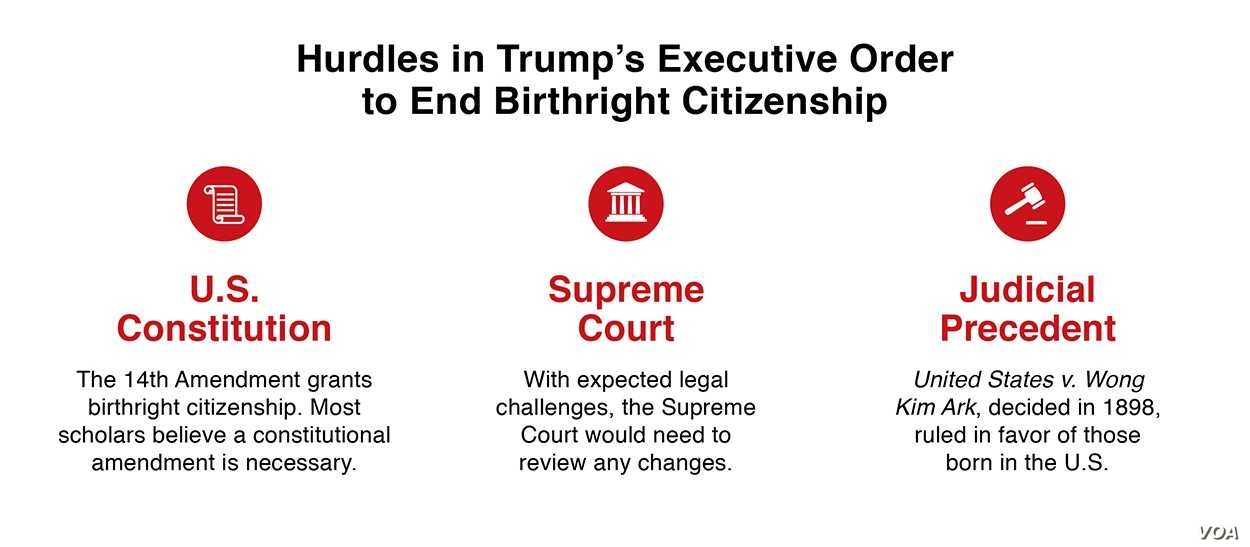
But the citizenship proposal would inevitably spark a long-shot legal battle over whether the president can alter the long accepted understanding that the 14th Amendment grants citizenship to any child born on U.S. soil, regardless of a parent’s immigration status.

Hurdles in President Trump's executive order to end birthright citizenship
Hurdles in President Trump’s executive order to end birthright citizenship

Executive order

James Ho, a conservative Trump-appointed federal appeals court judge, wrote in 2006, before his appointment, that birthright citizenship “is protected no less for children of undocumented persons than for descendants of Mayflower passengers.”

But Trump has said he was assured by his lawyers that the change could be made “just with an executive order” — an argument he has been making since his early days as a candidate, when he dubbed birthright citizenship a “magnet for illegal immigration” and pledged to end it.

There are no figures on how many foreign women travel to the U.S. specifically to give birth. The Center for Immigration Studies, a group that advocates for stricter immigration laws, estimated that in 2012 about 36,000 foreign-born women gave birth in the U.S., then left the country.

Places like Florida have seen in a boom in so-called “birth tourism.” Every year, hundreds of pregnant Russian women travel to the United States to give birth, paying from $20,000 to more than $50,000 to brokers who arrange their travel documents, accommodations and hospital stays. Sizable numbers of women from China and Nigeria also come to the U.S. for the same reason.

Immigrant detention

Trump’s comments Wednesday came as the administration continued to make immigration changes pushed by his hard-line advisers that have been in the works for months. On Wednesday, the Department of Homeland Security announced it had moved to end a longstanding federal agreement that limits how long immigrant children can be kept in detention. The decision will almost certainly lead to a legal battle over the government’s desire to hold migrant families until their cases are decided.

The rule also follows moves last week to broaden the definition of a “public charge” — a burden to the U.S. — to include immigrants on public assistance, potentially denying green cards to more immigrants. There was also a recent effort to effectively end asylum altogether at the southern border.

Source: Trump Again Says He’d End Birthright Citizenship

Ukip Might Not Get Votes – But Its Anti-Islamic Voices Have a Platform

On anti-Muslim attitudes in the UK and UKIP:

It seems tempting to ignore the election of Richard Braine, the new leader of the UK Independence Party. After all, its former leader Nigel Farage moved on to found the Brexit Party and much of Ukip’s support seems to have migrated there with him.

But it would be a mistake to disregard Ukip. Its strongest impact was never in the parliamentary seats it failed to get, either in the House of Commons or the European Parliament. Rather, it made its mark by moving the conversation dangerously further to the right than was previously acceptable. Take, for example, the first controversy to emerge involving Mr Braine. Footage of a hustings for the leadership race showed him complaining some British towns and cities were effectively no-go areas for non-Muslims and calling for it to be a crime to hand out copies of the Quran under laws connected to violence.

Such virulent anti-Muslim sentiment underpins Ukip and has only become more intense over the years, despite claims that it wants to distance itself from the anti-Islamic views that shaped the leadership of Mr Braine’s predecessor, Gerard Batten. Mr Farage quit the party over the issue of Islamophobia and Mr Batten’s links to far-right activist Tommy Robinson. The footage of Mr Braine seems to indicate it’s a different face at the helm but the same message.

For a party that is arguably on the far-right of British politics, Ukip enjoys an outsized presence in terms of press coverage. The boisterous antics of the likes of Mr Farage boosted his popularity and was handsomely rewarded by a disproportionate amount of airtime on television, a radio show on a mainstream network and a platform with various media outlets.

But as oxygen has been given to such right-wing views in so much of the mainstream media, such voices and their radical views have become normalised.

Ukip began as a Eurosceptic party and leaving the EU was the issue that defined its purpose. It never found a critical mass to vote for it as a party – but it did manage to get a critical mass to take up its one issue. As a result, the Brexit referendum of 2016 happened. The turmoil that has unfolded since is significantly down to mainstream political parties not taking seriously how to provide leadership in an age where Ukip-style populist politics can make a difference.

Mr Farage has now moved on to another political force, one which yielded considerably more success in the recent European elections. But the Brexit Party could never have done so if Ukip had not existed in the first place. Ukip continues to tap into a minority of the British public’s sentiments – an unruly minority that seeks division in order to promote its agenda.

That agenda is increasingly not about leaving the EU, an issue that has been taken up by the Brexit Party, large parts of the Conservative party, and even significant pats of the Labour party. Ukip might deny it is an anti-Islamic party – but the issue of Islamophobia is increasingly shaping conversations both within its ranks and about it.

Since the Brexit referendum took place, it is the issue that has energised the remaining Ukip base like no other. Robinson, currently serving nine months in prison, was until recently serving as a political adviser to Mr Batten. Others, including Ukip candidates Mark Meechan and Carl Benjamin and Paul Joseph Watson, have been accused of racist, threatening language. Mr Watson founded the far-right conspiracy website Infowars which is known for promoting absurd conspiracy theories; he himself declared “Islam control” was needed rather than gun control.

The anti-Islam animus has been present within Ukip since its early days – but it now seems to have overtaken nearly all other considerations within the party today. Anti-Muslim sentiment is a problem that infests many parts of the political spectrum already, including within the ranks of the Conservative party, to the point where even the term Islamophobia is challenged.

Ukip is currently polling badly in the UK. But with anti-Muslim bigotry across Europe on the rise, history reminds us that insignificance at the ballot box doesn’t mean irrelevance elsewhere.

Source: Ukip Might Not Get Votes – But Its Anti-Islamic Voices Have a Platform