Bloc Québécois Leader Yves-François Blanchet apologized Thursday after media outlets uncovered a number of Islamophobic and racist social media posts by candidates running for the sovereigntist party.
“They all regret having shared in the past videos or messages containing inappropriate comments,” Blanchet said in an emailed statement.
“They apologized. As leader of the Bloc Québécois, I add my apologies on their behalf to the entire population of Quebec.”
Blanchet’s statement does not name any of the candidates, though it indicates he has spoken to five individuals — four women and one man.
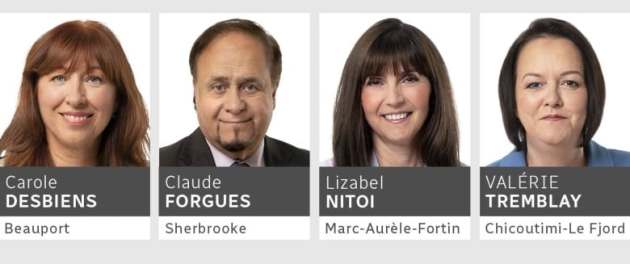
The apology is almost certainly in response to articles published Wednesday in the Globe and Mail and Thursday in the Journal de Montréal that documented numerous posts, tweets and shared links on Facebook and Twitter by: Caroline Desbiens, a candidate in the Beauport riding; Lizabel Nitoi, running in Marc-Aurèle-Fortin; Valérie Tremblay in Chicoutimi–Le Fjord; and Claude Forgues in Sherbrooke.
The four candidates named in the Globe and Mail and Journal de Montreal articles. (Radio-Canada)
The fifth candidate is likely Nicole Morin, a Bloc candidate in Saint-Maurice–Champlain who was found to have shared a video by the far-right group La Meute.
The four Bloc candidates cited in the Journal article issued identical statements of apology on social media Thursday. The apologies note that Le Journal “considers” the messages Islamophobic, but the authors don’t state whether they agree with the assessment.
Desbiens’ remarks were in a publication promoting a law on secularism in 2013. She said she worried that women would soon be forced to either wear a veil to go grocery shopping or be thrown in jail. She also praised France’s far-right leader Marine Le Pen.
Nitoi shared a groundless article about the intelligence of Muslims. Tremblay has shared several anti-Islam messages and conspiracy theories on Twitter since 2016, the Journal de Montreal reported.
Forgues shared a video on Facebook that states “Islam is a disease” and contained other intolerant remarks about Muslims, according to the Journal.
The boilerplate apologies, written in the first person, all say that the candidates did not mean to offend.
The four candidates go on to affirm in their statements their “total and complete support for the values and program of the Bloc Québécois … which in no way advocates measures that go against some communities, whether cultural or religious.”
The controversy lands ahead of the second French-language debate, set for Thursday.
The Bloc Québécois has been building momentum ever since the first French-language debate last week. Polls suggest Blanchet was the big winner of that contest and that the Bloc’s support levels have increased as a result.
Rima Elkhouri argues that while Bill 21 is discriminatory, it is not racist and that all who support it are not racist or xenophobes. However, in its effects, it primarily targets Muslims and Sikhs, and thus has racist and xenophobic effects:
À entendre les hauts cris suscités par la question de la journaliste Althia Raj lors du débat des chefs diffusé par la CBC, il semblerait que oui. Certains réclament des excuses publiques et dénoncent ce qu’ils perçoivent comme du « militantisme » de la part de la cheffe du bureau parlementaire d’Ottawa pour le HuffPost Canada. Comme s’il fallait désormais s’excuser de mettre les politiciens devant leurs contradictions en posant des questions qui s’appuient sur des faits.
Rappelons d’abord quelques-uns de ces faits… Dans un segment du débat en anglais portant sur la polarisation, les droits de la personne et l’immigration, Althia Raj, qui était l’une des modératrices, a posé une question sur la loi 21 au chef du Nouveau Parti démocratique, Jagmeet Singh.
« Votre campagne est axée sur le courage, mais vous n’avez pas eu le courage de combattre la loi discriminatoire du Québec. [Cette loi] interdit aux personnes qui, comme vous, portent des symboles religieux d’occuper certains emplois dans la province. Si vous étiez premier ministre, resteriez-vous en retrait et laisseriez-vous une autre province pratiquer la discrimination à l’endroit de ses citoyens ? Ne faites-vous pas passer les intérêts de votre parti au Québec avant vos principes et les droits à l’égalité de tous les citoyens – vous et, franchement, tous les autres chefs sur la scène ? »
La question a suscité une levée de boucliers au Québec. On a accusé la journaliste d’avoir fait preuve de mépris et de laisser entendre que la majorité des Québécois qui appuient la Loi sur la laïcité sont « racistes » – alors qu’elle n’a jamais dit une telle chose. On l’a accusée d’être une vilaine anglo qui ne comprend pas le français et ne connaît rien à l’histoire du Québec – alors que le français est la langue maternelle d’Althia Raj et que sa mère est originaire de Victoriaville… (Ça peut encore paraître déroutant pour certains, mais ce n’est pas parce qu’on s’appelle Althia et qu’on a la peau foncée qu’on est nécessairement une étrangère allophone fraîchement débarquée du bateau.)
En qualifiant la Loi sur la laïcité de « discriminatoire », Althia Raj, qui a répondu à ses détracteurs sur Twitter, n’a pas tordu les faits. Elle énonce une évidence qui fait consensus dans la communauté juridique.
Que ceux qui en doutent ouvrent d’abord leur dictionnaire. Est discriminatoire ce qui « tend à opérer une discrimination entre des personnes, des groupes humains », nous dit le Larousse. Quant au mot « discrimination », c’est le « fait de distinguer et de traiter différemment (le plus souvent mal) quelqu’un ou un groupe par rapport au reste de la collectivité ou par rapport à une autre personne ».
La Loi sur la laïcité de l’État, qui interdit le port de signes religieux au travail à des employés de l’État en situation d’autorité, est discriminatoire dès lors qu’elle distingue et traite différemment des croyants qui portent un signe religieux et ceux qui n’en portent pas. La démonstration n’est pas très difficile à faire. Un Jagmeet Singh qui tient à garder son turban ne pourrait pas décrocher un emploi d’enseignant au Québec en vertu de cette loi, même s’il réussit brillamment son baccalauréat en éducation. Même chose pour une femme musulmane qui tient à porter le voile.
Par contre, le mari de cette enseignante, qui partage les mêmes convictions religieuses mais ne porte aucun signe religieux, peut enseigner sans problème. Tout comme l’enseignant ultra-catholique qui, sans porter une grande croix sur son torse, ne fait pas toujours preuve de neutralité dans son enseignement.
On peut considérer que la laïcité de l’État rend tout à fait justifiable cette discrimination pour les fonctionnaires en situation d’autorité. Mais on ne peut nier que la loi a des effets discriminatoires. Si ce n’était pas le cas, on n’aurait pas eu besoin de faire appel à la clause de dérogation, qui permet de la soustraire à l’application des chartes canadienne et québécoise des droits de la personne.
Autre précision importante : dire que la loi 21 est discriminatoire, ce n’est pas la même chose que de dire qu’elle est raciste ou que tous ceux qui l’appuient sont racistes. Je l’ai déjà dit et je le répète. Contrairement à certains commentateurs anglo-canadiens, je ne crois pas qu’il soit juste de dire que la Loi sur la laïcité est raciste ou xénophobe ou que ceux qui l’appuient le sont.
Et contrairement à certains défenseurs de la loi 21 au Québec, je ne crois pas qu’il soit juste non plus de dire que les opposants à cette loi sont contre la laïcité. En fait, c’est aussi injuste que de dire que la loi est raciste… La CAQ n’a pas le brevet de « LA » laïcité. D’autres conceptions existent. Et en passant, le Québec était déjà laïque avant l’adoption du projet de loi 21.
Bien sûr qu’il se trouve des xénophobes pour applaudir cette loi. Tout comme il se trouve des extrémistes religieux pour la décrier. Mais réduire le débat à une opposition entre racistes et non-racistes ou entre vertueux défenseurs de « LA » laïcité et vilains pourfendeurs des Lumières complices des extrémistes, c’est en faire une lecture pour le moins simpliste.
The resurgent Bloc Quebecois is poised to perform well in the election under its articulate and pragmatic leader, Yves-Francois Blanchet. It has successfully pitched itself to younger voters by turning away from ageing entrenched separatists. Recent polls in Quebec put it behind only the Liberals, and first among Francophones.
Its broad mix of conservative and progressive policies makes it hard to pin down with standard left/right labels – which may be a virtue on polling day. Supporting climate change reform is very global and twenty-first century, but its demand for Quebec to have more say on immigration may be seen as traditional and isolationist. The same can be said for its support for the contentious Bill 21, the secularist ban on religious symbols for people in public office.
This bill is anathema to Liberals in Ottawa, but it is popular in Quebec. This is unsurprising, because France has a long history of encouraging private piety but public secularism. Provincial premier Francois Legault’s warning for outsiders not to tamper with the provincial bill is having some effect. Justin Trudeau is treading lightly in his opposition for fear of alienating voters there, though he has admitted the federal government “is not going to close the door on intervening at a later date.”
Of course, that means after the election, assuming a Liberal victory. Conservative leader Andrew Scheer has also been delicately non-committal, expressing support for provinces to have the right to determine some of their own policies.
Bill 21 would prevent public employees from wearing any religious regalia such as yarmulkas, hijabs or turbans during working hours. It is likely to apply to public servants such as police officers, prison guards and public school teachers. It has taken plenty of criticism. For example, Calgary’s mayor Naheed Nenshi – who is Muslim – made no attempt to conceal his outrage. He said, “It’s terrifying. It is flagrantly unconstitutional. It’s violating the Charter of Rights and Freedoms in a really, really transparent way.” His city council concurred: it voted unanimously to back a motion condemning Quebec’s law.
Mayor Nenshi is partly right. I have expressed my abhorrence for certain kinds of religious garb in these pages many times. However, the only religious garments that should be banned are specifically those covering the face. In effect, these are just the niqab and burka, primarily for security reasons.
I am no fan of other religious regalia, because I would rather we proclaim ourselves simply to be human beings rather than Muslims or Jews or Sikhs, but this is surely a matter for individual preference rather than government interference – either from Ottawa or Montreal.
This bill could never be implemented in any equitable way, partly because of perceptions and definitions. Imagine that two government workers wear identical pendants. The first says she wears it because she likes the design, but the second wears it because it confirms her identity as a follower of the obscure faith the design symbolizes. Will only the second face a ban?
In any case, the bill’s future looks less than rosy. It is likely to be legal rather than legislative snags that prevent it from gaining traction any time soon. Quebec’s Court of Appeal is already hearing a challenge which claims the bill is unconstitutional, and others have been lodged. It seems nothing will come of Bill 21.
Facing backlash in February over a sweater that looked like blackface, Gucci followed a now predictable course. Company officials apologized for appearing to mine demeaning imagery from the past; hired a global diversity czar, who is African American; and vowed to create multicultural scholarships and a more diverse workforce. Burberry announced similar efforts after it showed a hoodie that looked like a noose the same month, and Prada did the same in 2018 after it had unveiled a line of figurines that also resembled blackface.
This is not just the playbook of the fashion industry. Dozens of companies and institutions have sought to deflect controversy over embarrassing missteps or revelations of homogeneous boards and workplaces by launching high-profile initiatives or enlisting a person of color for a prominent post.
In 2003, MIT professor Thomas Kochan noted that companies were spending an estimated $8 billion a year on diversity efforts. But since Trump’s election, and with the emergence of movements like #MeToo and Black Lives Matter, the industry has exploded. A 2019 survey of 234 companies in the S&P 500 found that 63% of the diversity professionals had been appointed or promoted to their roles during the past three years. In March 2018, the job site Indeed reported that postings for diversity and inclusion professionals had risen 35% in the previous two years.
The lucrative industry shows few signs of waning–from the spike in well-compensated diversity consultants and czars; to online courses and degree programs at prestigious schools; to professional organizations and conferences; to the commissioning of ever more studies, task forces and climate surveys. The buzzword is emblazoned on blogs and books and boot camps, and Thomson Reuters, a multinational mass-media and information firm, even created a Diversity and Inclusion Index to assess the practices of more than 5,000 publicly traded companies globally.
But while business targeting diversity is flourishing, diversity is not.
People of color–who make up nearly 40% of the U.S. population–remain acutely underrepresented in most influential fields. From 2009 to 2018 the percentage of black law partners inched up from 1.7% to 1.8%. From 1985 to 2016, the proportion of black men in management at U.S. companies with 100 or more employees barely budged–from 3% to 3.2%. People of color held about 16% of Fortune 500 board seats in 2018. A 2018 survey of the 15 largest public fashion and apparel companies found that nonwhites held only 11% of board seats and that nearly three-quarters of company CEOs were white men. And in the top 200 film releases of 2017, minorities accounted for 7.8% of writers, 12.6% of directors and 19.8% of lead roles.
A look at higher education–where, in fall 2017, 81% of full-time professors at degree-granting postsecondary schools were white while just 3% were Hispanic and 4% were black–is helpful in understanding the forces that allow these disparities to persist. Though the 1960s saw the introduction of affirmative-action policies intended to address the history of slavery followed by centuries of discrimination against people of color, decades of legal challenges have undermined these measures. Since 1978, for example, Regents of the University of California v. Bakke has prohibited institutions from using racial quotas or other remedies to address past discrimination.
Because of this decision, says Columbia University president Lee Bollinger, who as president of the University of Michigan was named in two lawsuits in which white students who’d been denied admission claimed reverse discrimination, “we’re deprived of the context that gave it a sense of mission. Every college leader is told, ‘Do not refer to history.’”
In recent years, “diversity” has been touted as a feel-good exercise that includes everything from gender to sexual orientation to body size. But while we should be concerned about discrimination against any group, the term has become such a catchall that we’ve lost focus on the original intent of antidiscrimination efforts. “There hasn’t been enough pushback on the abstraction of diversity,” Bollinger says.
What’s more, many whites now claim they are being disenfranchised as others are afforded undue advantage. A 2017 NPR poll found that 55% of white Americans believe that white people are discriminated against, while, tellingly, a lower percentage said they had actually experienced discrimination. Moreover, renewed calls for diversity are playing out against resurgent white nationalism; a rise in bias crimes; and a President who has denigrated Mexicans, Muslims and blacks, among other groups.
Although the worsening racial climate appears to power the diversity industry, a number of studies suggest that these initiatives can actually make matters worse by triggering racial resentment. Think of the Google engineer who was fired for writing a memo deriding the company’s diversity efforts. He went on to file a class action claiming Google discriminates against conservative white men before ultimately moving to arbitration.
For diversity to become a reality in the nation’s workplaces, companies and institutions need to do more than recycle costly and ineffectual initiatives. Cyrus Mehri, a civil rights lawyer who successfully litigated discrimination lawsuits against major corporations including Coca-Cola and Texaco, says companies need to analyze metrics related to hiring, pay, promotions and bonuses along racial and gender lines to detect and disrupt patterns of bias.
“Everybody is quick to do unconscious-bias training and not interventions,” says Mehri, who, with the late civil rights lawyer Johnnie Cochran, is credited with devising the NFL’s Rooney Rule, which requires a diverse slate of candidates for coaching and front-office jobs. “When you keep choosing the options on the menu that don’t create change, you’re purposely not creating change,” he says.
To wit, A Leader’s Guide: Finding and Keeping Your Next Chief Diversity Officer, a report published this year by the consulting firm Russell Reynolds Associates, stated that more than half of diversity professionals do not have the resources or support needed to execute programs and strategies. Only 35% had access to company demographic metrics, and a survey of 1,800-plus company executives found that diversity ranked last on a list of eight potential business priorities.
But persistent failure appears not to have prompted many institutions to change course. Although Google reportedly spent $114 million on its diversity program in 2014, its diversity report this year showed that blacks made up just 3.3% of the workforce and held 2.1% of tech and 2.6% of leadership roles.
Why do companies spend so much to achieve so little? Lauren B. Edelman, a professor of law and sociology at the University of California, Berkeley, and the author of Working Law: Courts, Corporations and Symbolic Civil Rights, found that courts tend to look for symbolic structures of diversity rather than their efficacy. In other words, the diversity apparatus doesn’t have to work–it just has to exist–and it can help shield a company against successful bias lawsuits, which are already difficult to win.
Misan Sagay, a black filmmaker and member of the Academy of Motion Picture Arts and Sciences, says more attention also must be paid to what happens once people of color are hired. “A lot of the times they want our physical presence but not our voice,” she says, explaining that real change begins with the composition of the studio executives who greenlight projects. “There should be some brown faces when I’m pitching,” she says. “Until there’s diversity at every level, I doubt filmmakers of color will be on a level playing field.”
True progress won’t come without discomfort, says Darren Walker, president of the Ford Foundation, which allocates hundreds of millions of dollars annually to efforts promoting equality. “It requires incumbent leaders and managers to change their behavior and practices,” he says. “It means that institutions have to change incentive structures and to fundamentally interrogate their own behavior.” Walker adds that this is not just a conservative problem, as many purportedly progressive fields, like fashion and entertainment, also lack diversity.
In the end, racial diversity will not be ushered in by pledges, slogans or czars. It will be achieved only once white America is weaned off a prevailing narrative of racial pre-eminence, which can still be glimpsed in historical narratives, film and literature, and in racially offensive iconography like blackface. The seeds of this corrosive ideology are planted early, and a paradigm shift will require courageous leadership. Yes, change will require resources and resolve, but no amount of money will succeed alongside a willful negation of our shared humanity.
More political positioning than realistic options for many of the reasons listed:
Conservative Party Leader Andrew Scheer says that, if elected, he would close the loophole in the Safe Third Country Agreement (STCA) that allows people to make refugee claims in Canada even if they enter the country at an unofficial border crossing.
The Conservatives also aren’t ruling out creating detention camps at the border to house irregular migrants while their claims are being processed.
Asked directly if detention camps were something a Conservative government would create at the border, the Conservatives said the Immigration and Refugee Protection Act provides criteria for detaining asylum seekers. This leaves the option of creating detention camps at the border open.
Scheer’s pledge, made Wednesday at Roxham Road in Quebec, came with few details on exactly how he would close the loophole.
Scheer said his “preferred option” would be to renegotiate the STCA with the U.S., but when pressed on what he would do if U.S. President Donald Trump refused to make a deal, Scheer was light on details.
“There are other options. There are other tools available to the government that we will also be exploring,” Scheer said.
The rising rhetoric around refugees is fuelling many falsehoods about whether these new arrivals pose a threat
One of these options is to declare the entire Canada-U.S. border an official port of entry. This way, people entering the country would be covered by the STCA and — if they do not qualify for an exemption under the agreement — would be sent back to the U.S.
Scheer suggested this is one of the options he’s looking at when he said “we can apply the principles of the Safe Third Country Agreement at other points along the border.”
But migration experts, border security officials and the government have questioned whether this is possible.
Sharry Aiken, a Queen’s University law professor, says any plan to scrap the loophole in the STCA without agreement from the U.S. is “doomed to failure.”
Meanwhile, she says expanding the agreement to cover the entire border is nonsensical because Canada does not have the resources to enforce this type of mass “securitization” of the border, nor is this type of strategy effective.
Aiken points to the U.S.-Mexico border as an example of why increased security does not mean fewer irregular migrants.
“As we can see in relation to what’s going on with respect to America’s efforts in relation to Mexico, they’re an abysmal failure,” she said. “People are still crossing, just at higher costs and at peril to their lives. People are dying all the time.”
A Conservative spokesperson later clarified Scheer’s comments on this issue. The Conservatives said it’s not their policy to expand official port of entry status to the entire border. Instead, they would “pursue a regulatory approach to ensure that the principles of the Safe Third Country Agreement are applied and people are not able to jump the queue.”
Promise would require new legislation
Since spring 2017, there has been a significant influx of asylum seekers in Canada, many of whom entered the country irregularly at unofficial border crossings.
The total number of asylum claims made in Canada in 2018 was 55,000, of which about one-third crossed the border irregularly. This was up from 23,500 total claims two years earlier.
In addition to pledging to close the loophole in the STCA, Scheer said he would move existing judges from the Immigration and Refugee Board (IRB) closer to the border and widely used unofficial crossings to speed up the processing time for claims and make crossing “illegally” less attractive.
But Aiken and others say Scheer could not do this without first introducing new legislation to change the IRB’s mandate. That’s because the IRB operates independently of the government, and administrative decisions are strictly the authority of the IRB’s chairperson, she said.
Raoul Boulakia, a Toronto-based immigration lawyer, says moving refugee judges to the border would also make it a lot harder for asylum seekers to access a lawyer — a right they are guaranteed under Canada’s Constitution.
Meanwhile, Craig Damian Smith, director of the Global Migration Lab at the Munk School of Global Affairs and Public Policy, said Scheer’s pledge lacks vital details.
For example, he wonders if Scheer would create detention camps at the border for asylum seekers who enter the country irregularly to be held while their claims are processed.
Scheer claims asylum seekers are ‘skipping the line’
Smith also questions the logistics of the move. The IRB isn’t just made up of judges, he said. There are translators, administrative staff, offices and other things needed in order for claims to be heard and judges to be able to do their jobs.
Smith says holding asylum seekers at the border while their claims are processed — no matter how quickly this is done — presents other problems, such as limiting their ability to work, pay taxes and receive health care.
The Conservative Party, meanwhile, says that if elected, it will amend existing immigration legislation and regulations to make sure IRB judges can be deployed to irregular crossing “hot spots.”
The money needed to relocate IRB judges will come from existing budgets, Conservatives say, adding that there are no plans to change current work-permit rules for people whose asylum claims are allowed to go forward.
Ex-minister under Hussein made refugee claim in Canada
Conservatives point out that immigration detention already takes place in Canada. However, there are currently no immigration detention centres at the border. Instead, would-be refugees who cannot prove their identity, are a flight risk or who could pose a security risk are detained at facilities in Montreal, Toronto and Vancouver.
Some asylum seekers are also held in long-term detention in provincial jails. According statistics from the Canada Border Services Agency, the average stay in immigration detention in 2017-18 was 14 days.
Under current rules, asylum seekers are allowed to move freely within Canada once their claims are made and so long as they are not detained. Unless laws are changed, Smith said, moving IRB judges to the border would not change this and likely will not speed up the hearing process.
Scheer has repeatedly said closing the STCA loophole would make Canada’s immigration system fairer, more orderly and more compassionate.
Chinese Canadians were among the most opposed to cannabis legalization which continues to be covered in Chinese language media. This fake news exploits this opposition:
The close-up image of lines of white powder, a razor blade and thick, white fingers is startling enough for most Facebook users. But it’s the words in the Conservative Party of Canada’s Facebook ad — in Chinese characters — that are more attention grabbing.
“(Liberal Leader Justin) Trudeau has already legalized marijuana, he now plans to legalize hard drugs! If you want to get the latest in Chinese, please press Like in our Facebook page.”
Alarming? Yes, it is. It’s also not true.
The message is repeated in a bilingual (Chinese/English) post dated Oct. 5 on the Conservative Party’s Chinese-language Facebook page. “Do you want Justin Trudeau to legalize hard drugs in your community?” reads the headline. “Justin Trudeau has a plan to legalize hard drugs!”
No similar posting was made on the party’s main English-language Facebook page.
The Conservatives base the fake claim on an exchange between Conservative leader Andrew Scheer and Trudeau during a recent leaders’ debate. In French, Scheer accuses the Liberals of having a “secret agenda to legalize or decriminalize hard drugs.”
But Liberal spokesman Guy Gallant said Wednesday, “That (legalization) is not in our plans.”
What the Liberals’ platform says is that the “default option for first-time, non-violent offenders” would require going to drug court where they would get “quick access to treatment,” which in turn would “prevent more serious crimes.”
To make it work, the Liberals promise more community-based services, more residential treatment beds as well as a scaling up of the most effective harm-reduction services such as supervised consumption sites.
Although it lacks many details, it sounds similar to what Portugal did in 2001 in response to its opioid addiction crisis.
There, all street drugs (including marijuana) are illegal. But anyone found with drugs within the set limits for personal use is sent to the Commission for the Dissuasion of Drug Addiction, where counsellors and therapists come up with a plan to direct the user to whatever services are needed to help them quit taking drugs.
Anyone found with larger amounts is charged with trafficking, goes through the criminal justice system, and can be sent to jail for up to 12 years.
Drug use in Portugal, once the highest in Europe, is now amongst the lowest, especially among youth, according to the European Monitoring Centre for Drugs and Drug Addiction’s 2019 report.
While Portugal had only 30 overdose deaths in 2016, the year quoted in the report, 4,588 Canadians died from overdoses in 2018, and another 1,082 died in the first three months this year.
“If Justin Trudeau tells us precisely when he is going to legalize dangerous drugs, we will amend our ads to reflect the new information,” Conservative spokesman Simon Jefferies said Wednesday in an email.
All but one of the links provided by Conservatives to “prove” that Liberals would legalize illicit drugs — the French-language debate clip, a Trudeau interview with Global TV, news stories about individual Liberal candidates, and a YouTube videofrom the 2018 Liberal convention — all refer not to legalization, but to decriminalization. Some even include specific references to the Portuguese model.
The exception was a 2014 tweet from Michael Den Tandt, the Liberal candidate in the Ontario riding of Bruce-Grey-Owen Sound. At the time, he was a National Post reporter and his tweet urged legalization and control of recreational drugs and prostitution, along with an end to supply management and lower taxes. None of those are Liberal party policies.
Conservatives deny a deliberate attempt to confuse voters by using “decriminalization” and “legalization” interchangeably.
The Conservatives have yet to release their full platform, but last week Scheer promised to “tackle drug addiction” in an announcement that focused on guns, gangs and sentencing.
A background paper released at the same time said Conservatives would invest in treatment and recovery centres, including recovery high schools, have a national campaign warning children and youth about the dangers of drug use, and partner with municipalities and schools to clean up used needles.
Illicit drugs are anathema for many new Canadians from Asia and for those who recall China’s opium wars. In Hong Kong, for example, penalties for possession of illicit drugs can be up to seven years in jail and a fine of C$170,000. In China, drug trafficking can bring the death penalty, as two Canadians found out earlier this year. Vietnam, Malaysia, Singapore and Thailand also have a death penalty for trafficking.
As was apparent when Trudeau’s government legalized marijuana, changing drug laws is much less acceptable to many Asian voters than to other Canadians. And it just so happens that Chinese-speaking voters account for a significant percentage in some of the most heavily contested ridings — including Richmond Centre, Steveston-Richmond East, and Vancouver Kingsway.
Deliberately creating confusion and misunderstanding has, unfortunately, proven to be a far too effective strategy south of the border, and it seems to have made its way north.
Bad at any time, it’s worse when it targets voters whose first language isn’t English, and especially confuses an issue that affects thousands of Canadians with addictions whose lives are at stake every day.
Yet, that’s what Conservatives are willing to risk in this ugly, too-close-to-call election.
Good investigative reporting. How a good initiative appears to have been undermined and exploited.
Amusing, however, to see Alberta Premier and former federal immigration minister Jason Kenney’s office state that” he is fully focused on Alberta now” just after his weekend campaigning for the federal conservatives in the 905:
Vo Van Dung gave the television cameras a thumbs-up as he walked through Toronto’s Pearson International Airport.
Along with more than 100 Vietnamese “boat people” who arrived in Canada between 2014 and 2017, he was landing in the country after seemingly living in the shadows of society for the previous 20 years.
Rather than live under Communist rule in Vietnam, many who fled their homeland after the Vietnam War sought refuge in neighbouring Thailand in the 1970s and ’80s.
But refuge came with a price. For decades, they were living “without status” or as “stateless” people. They could not work without the threat of being arrested or fined. They had no access to health care. Some relied on donations to make ends meet.
They had few to no options until Canada accepted them under a special program designed to resettle boat people who had been living under desperate circumstances.
A business card identifies Vo as director of Saigon Red Travel, which has its headquarters in Vietnam.(Submitted)
But CBC News has learned that Vo was apparently living a more privileged life prior to coming to Canada.
The 57-year-old had been running a tour guide business. Headquartered in Ho Chi Minh City, Vietnam, Saigon Red Travel Company Limited offered tours between Vietnam and Thailand. And Vo wasn’t shy about his business and travel ventures, posing for photos with employees that were posted to social media.
Records obtained by CBC show the business began operating in 2014, two years before Vo arrived in Canada.(CBC)
A CBC investigation into the program has found at least five people, including Vo, ended up in Canada even though they do not appear to be those the government wanted to help, raising questions about the checks and balances meant to protect the country’s immigration system.
“Canada is known for being an international example for humanitarian endeavours, for people who are displaced, for people who are in trouble somehow,” said Guiddy Mamann, a refugee lawyer in Toronto.
“If people took the place of a more deserving candidate, then that would trouble me a lot.”
Vo did not respond to CBC’s requests for comment. But when CBC News asked an acquaintance of his about his business and lifestyle, he said Vo goes back and forth between Vietnam, Thailand and greater Vancouver and “thinks he’s doing very well.”
Who are the stateless?
A humanitarian crisis ensued following the fall of Saigon in 1975. Close to one million people fled from Vietnam — many by boat. Their journeys were perilous. The United Nations estimates up to 250,000 boat people died at sea.
Many of the boat people who did make it landed in neighbouring countries such as Malaysia, Hong Kong, the Philippines and Thailand.
Canada alone took in more than 100,000 refugees after the war.
In 1996, Vietnam repatriated tens of thousands of boat people from abroad. Those who did not want to go back because of fear of persecution back home escaped from refugee camps, living stateless in places like Thailand.
In 2006, the Vietnamese Canadian Federation (VCF), along with a U.S.-based group called the Vietnamese Overseas Initiative for Conscience Empowerment (VOICE), appealed to the Canadian government to bring over a number of stranded people from Thailand.
Current Alberta Premier Jason Kenney, who was federal immigration minister at the time, met discreetly with Thai government officials to ensure they would be provided exit permits to leave the country.
A Canadian government official says Thai officials did not want to raise awareness about the program for fear that thousands of people would enter the country illegally and turn their country into an immigration hub.
“I actually went to Bangkok … and we had a lot of negotiations,” Kenney told a room full of recently arrived stranded people in Vancouver, according to a YouTube video of the 2014 session. “We promised to do this negotiation in a discreet way.”
According to a senior government official and another person consulted in developing the resettlement program, the conditions for the more than 100 people who were eventually let in were narrow and specific: those who were selected had to have remained in Thailand after leaving Vietnam between 1984 and 1991. This meant anyone who had been repatriated back to Vietnam or lived elsewhere would not qualify.
But Mamann, the Toronto immigration lawyer, said there were major shortcomings in program’s written policy, which was called a “Memorandum Of Understanding Relating To A Temporary Public Policy Concerning Certain Vietnamese Persons In Thailand.”
The MOU said that applicants had to have arrived from Vietnam between 1984 and 1991 and be residing in Thailand — but it never specifically said that they had to have lived continuously in Thailand the entire time.
“This is an obvious error…. The whole underpinning of this thing was we believe that you can’t go back to your country [and] that you’re stuck here. You’re like on an island in the middle of the ocean and we have to come and rescue you,” said Mamann. “The language was sloppy and not precise.”
The first wave of people arrived in Canada in 2014, with the last family arriving in 2017.
But towards the end of the program, the Vietnamese community in North America and overseas began criticizing some of those who were chosen for it.
‘Please help us’
Nguyen Tu, a former boat person who runs a cyber security company in Houston, began investigating the concerns in 2016 after receiving tips about the program from people stranded in Thailand.
He travelled to Vietnam and Thailand and heard allegations that a number of vulnerable people who believe they should have been accepted into the program had been overlooked.
“Several boat people from Thailand contacted me … [saying]: ‘Please help us, help us,’ ” said Nguyen.
The claims and the numbers of incidents prompted him to arrange meetings with officials from the Thailand Immigration Bureau, the Canada Border Services Agency and the RCMP in Thailand. He said he provided them with material he had uncovered.
Then in May 2019, Father Nguyen Thien, a U.S.-based priest, along with Dau Vu Bac, a former boat person living in the U.S., hosted a Facebook video live from Bangkok in a room of stateless Vietnamese making more allegations.
The video, viewed close 50,000 times, accused groups such as VOICE of selecting people such as Vo Van Dung, who had gone back to Vietnam, over them.
“It’s my understanding that some of those people didn’t deserve to go as boat people,” Dau said in Vietnamese. “So those people shouldn’t have gone, but were sponsored by VOICE anyway.”
CBC spoke to two people who had been living on the margins in Thailand and say they were left off the list.
Pham Ty said he arrived in Thailand in 1991 and lived at a number of refugee camps over a period of years. Almost 30 years later, he said he still lives in a town near the Thailand-Cambodian border.
He said he applied for the Canadian resettlement program but wasn’t selected and wasn’t given an explanation why.
“I believe in fairness. I believe that God and Buddha and the heavens will see everything. There’s no point in blaming other people,” he said when asked whether he was upset others got into Canada instead of him. “If I’m allowed [into Canada] I would be grateful.”
The other cases
Through sources, business records, social media accounts, emails and archival footage on Vietnamese television, CBC found at least five questionable candidates for the program.
One of those people is Truong Lan Anh, who according to her social media account, lives in Ottawa. She arrived in 2016 but business records for a travel company based in Vietnam, showed Truong Thi Lan Anh as the owner since 2012.
Facebook photos showed her taking photos at the business in 2013. An employee at the travel agency, according to a video obtained by CBC, confirmed Truong was her employer.
Truong did not respond to CBC’s requests for comment.
Another case involved Sabay Kieng. In 2014, he was welcomed to a gallery of media and supporters as he arrived in Toronto. Kieng said he had been struggling for years trying to support his family.
“I [wanted] to find a job. It’s not easy so I sell some fruit on the street [in Thailand] … to feed my son and my wife,” he told CBC in a telephone interview.
He’s said he’s working in automotive manufacturing in the Greater Toronto Area.
But CBC obtained records, photos and videos that showed he had been running a jewelry and crafts business in Cambodia called Craftworks Cambodia since at least 2008. He travelled at one point to Manilla to give a talk about his business experience at a conference.
Kieng confirmed to CBC that he had businesses in Cambodia but said he did not live there, only near the border.
But according to a former business associate, he lived in a house in Cambodia’s capital, Phnom Penh, before coming to Canada.
“I think compared to a lot of people in Cambodia, he was living quite well,” the business associate told CBC. “He went straight to Canada. I mean, he had to go immediately when he got the approval.”
CBC tried reaching Kieng on the phone again but he said he was “busy” before hanging up.
CBC made further attempts to get a comment about these inconsistencies but did not get a response.
‘A very ominous cloud’
Nguyen Dinh Thang, chief executive officer for Boat People S.O.S, an American non-profit organization that provides legal assistance for Vietnamese refugees abroad, had serious questions about the program as well after CBC showed him examples it had found, including the case involving Vo.
“They cannot even work legally in Thailand let alone [run] a business in Thailand or in other countries,” said Nguyen, who was in discussions with the Vietnamese Canadian Foundation during the negotiations on the agreement. “If they are truly stranded, they may not.”
While the MOU is vague and never specifically said that applicants had to be residing in Thailand the entire time, after reviewing CBC’s examples, Nguyen does not think these are the types of people the Canadian government intended on helping based on the intent of the policy.
“None of those cases would be eligible, under this temporary special program,” he said.
The process of selecting people went like this: the VCF was responsible for identifying potential candidates, but looked to VOICE to help stranded people in Thailand complete and submit applications to Citizenship and Immigration Canada (now Immigration, Refugees and Citizenship Canada).
Once the list of potential applicants was passed on to Canadian immigration officials, the federal government would be responsible for interviewing people and to ultimately ensure their eligibility for entry into Canada.
Nguyen, who provides legal assistance for Vietnamese refugees in Thailand, said he is “perplexed by the lack of internal control” by the Canadian government because if there is any suspicious activity, that would “clearly cast a very ominous cloud” on all refugee programs.
“It is the responsibility of immigration to screen and serve as the first line of defence to protect the integrity of the country’s immigration program,” said Nguyen.
The VCF said it was not aware of any questionable candidates coming into Canada and that the final decision to let anyone into Canada rested with Canadian immigration.
A senior government official involved in helping create the program told CBC the government would not have agreed to this program if it was aware of people coming from Vietnam to Thailand after repatriation or elsewhere.
He said that it would “undermine the claim they had no alternative option available to them.”
‘It’s unfair’
CBC showed VOICE co-founder Trinh Hoi examples of people who critics say did not deserve to come, including Vo.
“Just because someone got resettled here doesn’t mean that the person cannot go back to Vietnam and visit his homeland,” said Trinh.
“You cannot use one story of someone who has been able to do well or relatively well … to illustrate and say that the refugees were not stateless and were not desperate — it’s unfair,” he said.
“When one person took advantage, and I’m not even saying [Vo] took advantage of the system, if he’s eligible under the law … he should be considered if he meets [the] criteria,” he said.
Trinh said the names submitted to the Canadian government were “eligible to the best of my knowledge” and that his job was to “refer those cases for consideration” with the federal government.
He denied he or his group did anything untoward, refuting the assertions in the video.
‘We take those concerns very seriously’
A government source confirmed to CBC that the Canada Border Services Agency (CBSA) is investigating potential violations under the Immigration, Refugee Protection Act but would not indicate who, if any, specific individuals are being investigated.
Immigration, Refugees and Citizenship Canada Minister Ahmed Hussen would not comment on any of these allegations but did say that confidence in Canada’s immigration system is of utmost importance.
“I think it’s important for us to continue to maintain the integrity of our system. We take any allegation of fraud or anything that threatens the integrity of our refugee system very very seriously,” said Hussen.
Hussen said he couldn’t comment on the considerations that were made at the time the program was established because it was set up by the previous government.
Kenney’s office declined to comment on the matter and told CBC “it’s been a long time since he was immigration minister and he is fully focused on Alberta now.”
Doing business in China comes with major strings attached. This week it became evident that a few provocative words can cause those strings to tighten.
A single tweet by Houston Rockets General Manager Daryl Morey in support of pro-democracy protesters in Hong Kong unleashed massive retaliation from China that put the team and the entire NBA on notice. China’s state TV cut off preseason games and ominously announced it would “immediately investigate all co-operation and exchanges involving the NBA.” Tencent, a major Chinese social media company with a reported $1.5 billion streaming deal with the NBA, said it will no longer stream Rockets games, even though the team is immensely popular in China.
China’s message to foreign companies and their employees is clear: Watch what you say on matters sensitive to our country if you want to do business here. This hardball response to Morey and the NBA fits a pattern of threats and reprisals against foreign organizations wading (even unintentionally) into the country’s sensitive internal politics.
Facing boycott threats this summer, Western fashion brands apologized for T-shirts that suggested that Taiwan and Hong Kong were independent countries rather than territories that are part of China. It isn’t just top executives who have paid a price for speech that offends China’s sensibilities. Last year, a Marriott employee earning $14 an hour used a company account to like a post on Twitter from a Tibetan separatist group. A Chinese tourism organization demanded an apology and urged Marriott to “seriously deal with the people responsible.” The employee was fired. When China threatens a foreign business, compliance typically prevails over resistance.
China’s efforts to impose speech controls on international companies and their workers have largely succeeded. Morey deleted his tweet. The NBA put out a statement saying the tweet doesn’t represent NBA or the Rockets, which led to an uproar in the U.S. and another statement from the NBA.
The league’s initial response provoked a torrent of criticism in the United States; in a rare show of unity, leading Democrats and Republicans rebuked the NBA for caving to China and failing to stand up for Morey’s free speech rights.
American companies have grudgingly accepted all kinds of Chinese rules for years. They may bristle about how they are forced to transfer technology in exchange for access to China’s market and about Chinese cyber spies who threaten their intellectual property. But the potential rewards — all those consumers, a middle class that’s expected to reach 550 million by 2022 — are just too great to spurn. And that means playing by China’s rules.
One notable recent exception: South Park, the sardonic, boundary busting Comedy Central cartoon. Last week’s episode, “Band in China,” appeared to offend authorities so much that all traces of the show — episodes, clips, discussion groups and social media posts — vanished from major platforms in China.
South Park‘s creators, Trey Parker and Matt Stone, seized on the moment to issue a fake apology mocking China’s President Xi Jinping and the NBA:
OFFICIAL APOLOGY TO CHINA FROM TREY PARKER AND MATT STONE.
“Like the NBA, we welcome the Chinese censors into our homes and into our hearts. We too love money more than freedom and democracy. Xi doesn’t look just like Winnie the Pooh at all. Tune into our 300th episode Wednesday at 10! Long live the Great Communist Party of China! May this autumn’s sorghum harvest be bountiful! We good now China?”
In fairness to the NBA, South Park thrives on political agitation. The basketball league has painstakingly built a thriving connection with hundreds of millions of Chinese fans.
The NBA has notably supported players and coaches who express their political views on subjects ranging from police violence to guns and President Trump. But Daryl Morey’s seven-word tweet “Fight For Freedom Stand With Hong Kong” puts the league’s progressive image to its sternest test. On Tuesday, the well-regarded NBA Commissioner Adam Silver sought to clarify the league’s position, saying it would “protect its employees’ freedom of speech,” while at the same time apologizing to the league’s fans in China.
The apology failed to defuse the league’s crisis. China’s state-run television network said it was “strongly dissatisfied” with Silver’s remarks. And it bluntly declared that any speech challenging China’s “social stability” doesn’t fall within the realm of freedom of speech.
The Chinese message is loud and clear: Your free speech ends at the water’s edge.
So unfortunate and a reminder that Canada is hardly immune from this kind of behaviour and social media stirred up hate:
Eleven days ago, Alaa Alsoufi attended a political protest in Hamilton wearing a face mask. Less than 24 hours later, a Twitter user in Ottawa identified the young man as a Syrian “terrorist” who reportedly harassed an elderly woman as she approached Mohawk College to hear the People’s Party of Canada Leader Maxime Bernier speak at a fundraiser.
Social media users across North America and Europe ran with the narrative, launching death threats against the Toronto man, his parents and their business.
And so a downtown Toronto restaurant founded by Alsoufi’s family, which had been widely lauded as a success story of Canada’s refugee resettlement program, abruptly closed on Tuesday in the wake of escalating online attacks.
“We could not put our family members, staff and patrons in danger,” the Alsoufis said in a public statement on Tuesday night that defended their son as a humanitarian and the victim of a vicious, politically motivated smear campaign by alt-right crusaders.
The family of Dorothy Marston, 81, the woman at the centre of the viral video, came to the Alsoufis’ defence and condemned the vigilantism by “social justice warriors on both sides.” The video shows Marston using her walker on Sept. 29 when she is confronted by a wall of masked protesters blocking her way, some calling her “Nazi scum.”
David Turkoski, Marston’s son, said he was heartbroken and disgusted by the attacks on the Alsoufi family.
“I’m absolutely ashamed of anybody who called and threatened them. That’s how polarized Canada is becoming. We have lost our ability to see reason,” Turkoski said on behalf of his mother. “We don’t like war and persecution of anybody.”
The Alsoufis, who opened Soufi’s on Queen Street West in 2017, said Alaa “did not in any way verbally or physically assault the elderly woman” and “offered to apologize personally for not doing more” to stop other protesters from harassing Marston.
They said Alaa was physically assaulted on Friday, several days after the event, and doxed, an Internet-based practice in which social media users unite to expose a person’s private records and launch threats.
While the family expressed “deep gratitude” toward the “loving, welcoming people” of Toronto, they said “the magnitude of hate we are facing is overwhelming.”
In addition to physical violence, a torrent of death threats prompted their decision to close the popular restaurant.
Messages on Facebook and Twitter illustrated the attacks on the Alsoufis over the course of a week.
On Oct. 1, a Facebook user in Philadelphia, who describes himself as a former U.S. Navy Submarine Service employee, posted photos of Alaa to his personal page with a message inviting his friends to “Meet Alaa Soufi Dalua (sic), one of the antifa scumbags that harassed an elderly couple while they tried to cross a street. … We have everything on him. Everything!”
A user in New York commented on the post, writing: “Pay his parents a visit, make an example of them!”
From British Columbia: “Your (sic) going back in a box or not your going back.”
From Belgrade, Serbia: “Hey little muslim b—-h. You know you’re gonna get f—–d right.”
In an email to the Alsoufis’ restaurant, an anonymous sender writes: “Keep it up and your family, and those who defend your family’s terrorist actions will suffer immensely.”
Hamilton police told the Toronto Star its investigation of the Sept. 29 protest “remains ongoing” and stated in an email: “There is no information to support that the conduct of the protesters was in violation of Section 318 (1) of the Criminal Code of Canada — Hate Propaganda.”
Toronto police would not confirm whether they were investigating or if the Alsoufis had notified them of the death threats.
Videos posted online show Alaa attending a variety of rallies in support of LGBTQ rights and protesting racism against migrants.
He was described in his family’s statement as “standing up for the rights of oppressed communities in Canada and worldwide.”
Husam and Shahnaz Alsoufi came to Canada after they and their three children were sponsored by a community group in 2015. The family opened the restaurant two years later, touting its Middle Eastern food as a culinary offering “from Syria with love.”
Soufi’s was among the restaurants profiled in a New York Times story last year showcasing the budding Syrian culinary scene in Greater Toronto. It has also been featured in Toronto Life, Now Magazine and the Star.
On Tuesday, staff at Soufi’s blocked the restaurant’s storefront window with printouts of the closing notice and the company’s signature yellow T-shirt while they were cleaning and clearing the premises as reporters gathered outside trying unsuccessfully to talk to the owners.
Members of the Queen West business community said they were shocked by the abrupt closing of the restaurant.
“Soufi’s has become a local staple. As a young business, it’s been growing and has a consistent following. It’s a success story,” said Zane Aburaneh, who runs a fashion and accessory boutique across the street and has hired the restaurant for catering. “It’s so unfortunate that someone has to close down their business because of threats.”
Julie Skirving, who operates Logan & Finley, a nearby eco-conscious general store, said she was a regular of the restaurant.
“They (the Alsoufis) are lovely people and must be devastated,” said Skirving. “It’s such a loss to the community.”
“This is horrifying and appalling. This is not Canada. There are rules of law. There are procedures to deal with situations like this,” added Jon Spencer, a patron of the restaurant, after leaving a heart-shaped note of support for the family that said “I’m so sorry to hear the awful news.”
The Canadian government said any employer found to break the rules of a temporary worker program would face “serious consequences” after an investigation by The Globe and Mailexposed a scheme that saw trucking companies with poor safety records luring inexperienced foreign workers into driver careers.
Canada’s second-largest newspaper found that some trucking companies and immigration consultants were exploiting job-seekers through Canada’s Temporary Foreign Worker Program, which allows companies to temporarily fill vacancies from outside the country when the jobs can’t be filled. The investigation revealed an array of allegations such as payments for jobs.
“Any employer found to have violated the rules of the Temporary Foreign Worker Program will face serious consequences,” Isabelle Maheu, a spokesperson for the program’s administrator, Employment and Social Development Canada, wrote in an email on October 8.
Maheu would not say whether Employment and Social Development Canada was investigating any employers mentioned in The Globe and Mail’s report. But she wrote that allegations of misuse are being investigated.
“The Government of Canada takes very seriously its responsibility to protect the integrity of the Temporary Foreign Worker Program, as well as the safety and welfare of temporary foreign workers, and does not tolerate any abuse or misuse of workers,” Maheu wrote.
Trucking companies across Canada frequently struggle to fill driver positions. Statistics Canada reported more than 20,000 vacancies in trucking during the second quarter of 2019, a number that has been increasing in recent years.
But within the industry, there is growing anger about employers who cut corners to fill trucks and improve their operating margins.
“The article put the final piece of the puzzle together,” said Wendell Erb, CEO of Erb Group, an Ontario-based trucking company that specializes in refrigerated transport.
The Canadian Trucking Alliance responded to the Globe’s report, saying it was “embarrassed by the actions of a small element of our sector.”
The organization, which represents carriers across Canada, called on improved oversight by federal and provincial authorities and also singled out a practice known as “Driver Inc.” where drivers are intentionally misclassified as independent contractors to avoid tax withholding.
The organization also stressed the importance of immigration programs that help fill trucks and other positions in the industry.
“It’s imperative our valued new immigrants end up with the majority of compliant, responsible fleets operating in Canada,” the organization wrote in a statement.