Breaking the law: How the state weaponizes an unjust criminal justice system

Good column by prominent criminal lawyer Marie Henein on systemic barriers within the justice system:

On June 6, Prime Minister Justin Trudeau took a knee during the Black Lives Matter demonstration on Parliament Hill. It was the correct show of support required of a political leader, acknowledging undeniable facts: a history, a present and – without change – a future of racism.

But if the Prime Minister is going to stop at a bended knee, then that is as ineffectual as sending out a “thoughts and prayers” tweet. To quote Shakespeare, it is sound and fury signifying nothing. A bended-knee photo-op is not enough. Not even close.

The history of racism, in the United States and Canada, manifests in an endless list of ways. I want to talk about the one I’ve known intimately: the criminal justice system. Its history and present is central to our understanding of how criminal justice, from police powers to sentencing, is part of the web that directly oppresses Black and Indigenous lives. Knowing this reveals the hollowness of Mr. Trudeau’s camera-ready genuflection.

Let’s start here. There is a rational reason that Black Lives Matter marches have been accompanied by demands to defund police, enforce police oversight and decrease the epidemic of mass incarceration. It is because the state’s weaponization of the criminal justice system for the purpose of racial marginalization has a long, well-documented history. Using the criminal law is a dependable and effective method to double down on marginalizing the marginalized and sidelining the racialized. Historically, criminalizing others, locking them up, is a weapon deployed to maintain social dominance. Drug laws, three-strikes rules, minimum sentences – much of it has been born from racism masquerading as law and order. That is just a plain, undeniable fact. It is and always has been the case.

Let me give you just one example of how this political three-card monte is played. One of the most notorious was U.S. president Richard Nixon’s declaration of a War on Drugs. While entrenched by president Ronald Reagan, it was in fact Mr. Nixon who first inspired it when, in 1971, he announced at a press conference that drug abuse was “public enemy number one in the United States.” But the declaration of war wasn’t really on drugs at all. John Ehrlichman, counsel and assistant to Mr. Nixon and a Watergate co-conspirator, later revealed the truth: “The Nixon campaign in 1968, and the Nixon White House after that, had two enemies: the anti-war left and Black people. … We knew we couldn’t make it illegal to be either against the war or Blacks, but by getting the public to associate the hippies with marijuana and Blacks with heroin, and then criminalizing both heavily, we could disrupt those communities. We could arrest their leaders, raid their homes, break up their meetings and vilify them night after night on the evening news. Did we know we were lying about the drugs? Of course, we did.”

Mr. Reagan was masterful in his use of the “war on drugs” mantra to whip up mass hysteria and fear with the nightly news showing crack dens and the arrests of Black men. Now the enemy was not only identified, it was real, palpable and there for everyone to see. President Bill Clinton later piled on with his three-strikes rule, proof that cracking down on crime, whether in Canada or the U.S., is something that has always found bipartisan support. You see, the marginalized are not a particularly important voting bloc for most politicians. The criminalization of drugs throughout U.S. history was and continues to be linked to race in the United States. The war on drugs led to the incarceration rate in the U.S. doubling and then tripling. The same patterns are true in Canada’s history of deploying criminal law to control Indigenous and Black communities as far back as colonial times; the incarceration trends of minorities in Canada mimic those of the U.S.

Criminalization and incarceration are the ultimate weapons in marginalization. Arresting someone, restricting their movements through a bail order, and handing out a conviction and hence a criminal record – incarcerating is a surefire way to push down and keep down a population. It guarantees a life of struggle and a burden that the majority of the white population does not suffer.

And it is not just the creation of criminal offences or the expansion of minimum jail sentences that serve this ulterior purpose. Police powers are often also mobilized by the state. Stop-and-frisks, carding and unlawful searches are all police tactics that are disproportionately visited on racial minorities. If you are Black or Indigenous, you are more likely to be forced to interact with the police.

If you practise criminal law, then you know that the majority of times that individuals are stopped by the police that they describe being harassed, the extent to which their privacy is intruded far exceeds the number of cases that ever make it to court. If a police officer improperly stops you, searches your car, degrades and humiliates you and finds nothing, your case and your experience often disappears from public view and into the ether. The vast majority of police interactions do not result in criminal charges. The police officer is often not sanctioned or dissuaded from doing this again. Nobody knows just how many law-abiding citizens are harassed by the state daily. So while the numbers we do have show that Indigenous and Black members of the community are disproportionately stopped and interfered with by the police, their experiences occur in the shadows. Unless there is a death that happens to be caught on video, or a crime alleged, nobody hears about it. But while it is hidden from view, those experiences are lodged in the collective and individual psyche.

The disproportionate impact on Black and Indigenous communities is staggering. Commentators frequently respond that more white men are killed by the police yearly than Black men. That claim is a complete distortion. A myriad of statistics demonstrate that both in Canada and in the U.S., a disproportionate percentage of the Black and Indigenous population is subjected to police violence. It is no answer to say more white people are killed or quote silly statistics about “white-on-white violence” compared to “Black-on-Black violence.” These are distracting, insidious talking points. They don’t tell you the one fact you need to know: If you are a Black or Indigenous man, you are more likely than a white man to be harassed by the police, stopped and searched by the police, arrested, held for bail and incarcerated. That is what matters. If you are Black or Indigenous, you do not drive, walk, live without the fear of state harassment or interference.

The disproportionate incarceration of racialized members of the community tells the story as well. In January, Canada’s Correctional Investigator Ivan Zinger confirmed that Indigenous people comprise more than 30 per cent of the federal inmate population; Indigenous women make up 42 per cent. This is a stunning overrepresentation within the prison population. “Over the longer term, and for the better part of three decades now, despite findings of Royal Commissions and National Inquiries, intervention of the courts, promises and commitments of previous and current political leaders, no government of any stripe has managed to reverse the trend of Indigenous overrepresentation in Canadian jails and prisons,” Dr. Zinger said. “The Indigenization of Canada’s prison population is nothing short of a national travesty.” Black Canadians are similarly overrepresented.

The overpolicing and overincarceration of racial communities is a critical point. It is the state that is “othering” a segment of the population. The criminal justice system provides an official government imprimatur that this group of people – “they,” the “accused” – are not like you. The message that is being sent is that they deserve less, are not to be trusted, must be corralled, segregated, stopped and removed from “civil” society. How else are we to be safe?

One of the most troubling aspects is that the police conduct that is inspiring demonstrations across not only this continent but the world is state conduct. Let me say that again because it is a significant point that must be understood: The conduct, the abuse, is visited upon members of our community by our own governments. It is sanctioned and financed by the state. The police officers are state actors and state funded. The criminal justice system is comprised largely of state actors paid for by the government. The jails are manned, funded, controlled by state actors. The offence, the outrage stems in no small part from our government’s role in the abuse of its own citizens. This travesty lays squarely at the feet of our government and the gross inaction of politicians, no matter what their political stripe.

So when the person who is the head of the state takes a knee conveniently in front of the cameras and has not and does not do anything to address the problem, well, what can I say? The person with power and privilege has failed to make the change that is in his hands to make. The state needs to do more than take the knee.

While it has sent well-wishing tweets every which way, the Canadian government has not taken any decisive action on criminal justice reform. The Harper government’s flourish of mandatory minimum sentences, which should have been abolished long ago, continues to thrive under the watch of the Liberals, notwithstanding their 2015 election promise to abolish them. More offences have found their way into the Criminal Code, not fewer. No serious attempt has been made to decriminalize, to improve the condition of jails, to look at restorative justice models – or, indeed, any evidence-based justice reform. Maybe that is because a tweet is easier to read than an expert report.

Even now, as every province and territory struggles to deal with the catastrophe that COVID-19 has visited on the criminal justice system, help from the federal government is non-existent. Today, incarcerated accused people cannot have a trial. Most cannot speak to their lawyers; many don’t even have lawyers. Legal aid – which provides the most marginalized, isolated and disenfranchised with the dignity of having a lawyer help them to have their voice heard in court – are in crisis and grossly underfunded across the country. And courthouses fill up more and more every day with the unrepresented, the underprivileged, and those with addiction and mental-health struggles. In Northern communities, Indigenous people who are accused of crimes and granted bail often choose to stay in jail because they cannot afford the transportation needed to return to their communities. And despite this catastrophic Hobson’s choice, not a single penny has been offered up by the Prime Minister in his doorstep news conferences.

It is not as though smart people haven’t been offering thoughtful policy options for our governments to consider for years. In Ontario alone, two reports were commissioned by the previous government to address carding and the investigation of police. The Independent Street Checks Review and the Independent Police Oversight Review were penned by the Honourable Justice Michael Tulloch, the first Black member of the Ontario Court of Appeal, who made practical, entirely achievable recommendations centred around the belief that, in order to gain any legitimacy, police need to have a vested interested in the communities they serve. His recommendations included investing more in community policing and less on use-of-force tactics and training; investing in community situational hubs where mental-health experts work in tandem with police to address mental-health issues; the creation of a central college of policing that would operate as an independent regulatory body to professionalize and demilitarize policing; changing the way that oversight boards are appointed; and mandating governance training. Very few of these pragmatic suggestions were ever taken up. And so the report sits, among all the others, waiting for someone, anyone, to take a look.

There are real things in policing and in the criminal justice system as a whole that can change immediately and begin to end its disproportionate burden on racialized communities. Wholehearted, reflective, meaningful changes – not incremental tweaks – are needed to tear down the foundations of institutions that have been built and thrived on a racist history, and replace them with approaches that protect all community members.

Criminal justice reform is a good place to start now. It is a good way to show marginalized communities that the state will refuse to use its power to abuse its own citizens. To show that the state will not put its knee on the neck of George Floyd until the breath is taken out of him. To show that the state will not choke Eric Garner for selling cigarettes on the street. To show that it will not shoot 12-year-old Tamir Rice for playing with a toy gun. To show that it will not take Indigenous people, such as Rodney Naistus or Neil Stonechild in Saskatchewan, and abandon them at the outskirts of the city with no clothes and leave them to freeze to death. To show that the state, when called to help people in a mental-health crisis, will not shoot Andrew Loku.

So the Prime Minister isn’t just anybody taking a knee. He is the representative of the state, a white man with all the power and privilege that is an unreachable fairytale to most, who has the ability and authority to change things. This is not a time for salutary gestures, carefully measured words and photo-ops, or inconsequential small tweaks. The time for gradual change has long passed. The Prime Minister’s chasm between gleefully putting on blackface and taking a knee can be readily filled with action. So instead of bending the knee, how about standing up? The Prime Minister needs to put his money where his march is.

Source: Breaking the law: How the state weaponizes an unjust criminal justice system: Marie Henein
‘We’re Not Racist’: French Police Say They’re Being Unfairly Criticized

Generally, people and organizations are reluctant to state they are racist or that systemic racism exists, France being no exception:

French police say they are being stigmatized during protests in France against police violence in the wake of George Floyd’s death.

On Thursday, police gathered in front of precincts across the country and threw down their handcuffs in a symbolic gesture against what they say is unfair criticism.

“The police in France have nothing to do with the police in the U.S., and we’re not racist,” said Fabien Vanhemelryck, the head of the main police union in France, as he joined dozens of police officers demonstrating Friday morning along the Champs-Élysées.

Just days after Floyd was killed while in police custody in Minneapolis, more than 20,000 Parisians defied a ban on gatherings during the pandemic to demand the truth about the death of a black Frenchman named Adama Traoré while in police custody in 2016.

The protesters said the French police, like their American counterparts, are endemically racist, a charge denied by many top officials in a country that likes to consider itself colorblind.

Mathieu Zagrodzki is a specialist on law enforcement and a lecturer at the University of Versailles. He says police violence in France cannot really be compared to the levels of violence in the U.S.

“French police kill from 10 to 15 people a year,” he says. “American police kill more than 1000.”

But Zagrodzki says both forces disproportionately target minorities.

A 2017 report by the French state civil liberties guardian, the Défenseur des Droits, says people perceived as black or Arab are 20 times more likely to be stopped by police than the general population.

“The difference with the U.S. and France is that in France I don’t fear for my life,” says Thierry Picaut, a black actor who participated in a rally this week.

Earlier this week, Interior Minister Christophe Castaner announced a ban on police use of chokeholds and said there would be zero tolerance for racism in law enforcement.

The police say they need the chokehold to restrain violent individuals and keep dangerous situations from escalating. Officers say Castaner has betrayed them.

Zagrodzki says strong police unions makes reform difficult to achieve – and he say French law-enforcement is in a state of crisis.

“The police paid a high toll in the terrorist attacks,” he says, referring to a series of bloody incidents in 2015. That was followed by the long and frequently violent “yellow vest” protests that all but paralyzed France for much of last year.

The strain on officers has been intense “They have worked more than 25 million hours of overtime in the past few years,” Zagrodzki says, “and the the number of suicides is very high.”

Source: ‘We’re Not Racist’: French Police Say They’re Being Unfairly Criticized

As Donald Trump tightens immigration rules, Indian tech students ditch the American Dream for Canada

Yet another article of the shift with some interesting data:

Indian students are slowly getting over their fascination with the US.

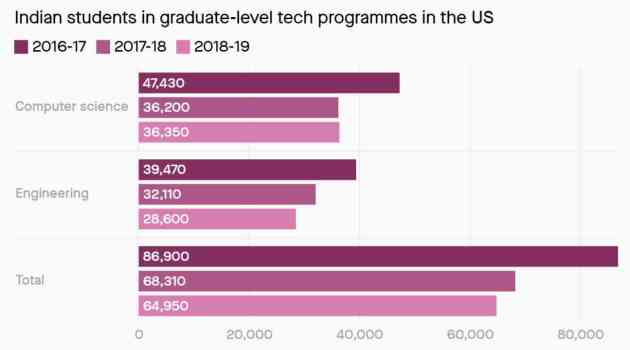
The number of Indians enrolled in graduate-level computer science and engineering courses at American universities declined by more than 25% between 2016-’17 and 2018-’19, according to an analysis of government data by the National Foundation for American Policy.

The key factors for this decline are “more restrictive immigrationand international student policies under the [Donald] Trump administration and the difficulty of obtaining green cards in the United States,” the think tank focused on public policy research on trade and immigration said in a report published on June 8.

Data: National Foundation for American Policy, US Department of Homeland Security, US Immigration and Customs Enforcement, special tabulations (2018) of the Student and Exchange Visitor Information System (SEVIS) database via Quartz

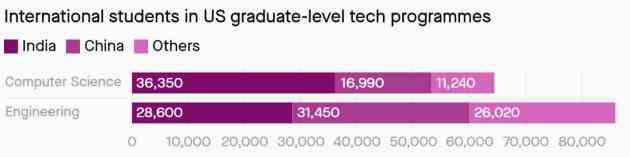
This decline is a massive hit to the entire international tech student population in the US, as Indians form an outsized proportion of the group.

Data: National Foundation for American Policy, US Department of Homeland Security, US Immigration and Customs Enforcement, special tabulations (2018) of the Student and Exchange Visitor Information System (SEVIS) database via Quartz

America’s loss

In a letter dated June 2, 21 members of the US Congress highlighted that international students and their families contributed approximately $41 billion to the US economy in 2018-’19 alone, despite making up just 5.5% of overall US college enrollments. This cohort subsidises tuition for many domestic students.

Moreover, “as a source of research assistants, graduate students help professors conduct research and retain top faculty,” the National Foundation for American Policy report said. “Without the ability to perform high-level research, many leading professors would move on to other careers, which would weaken American universities as a global centre for science.”

While the US is losing out on Indian talent, its neighbour is making strides.

Canada’s gain

National Foundation for American Policy’s research shows that the share of Indian students in Canada more than doubled between the academic years 2016-’17 and 2018-’19.

Data: Canadian Bureau for International Education, National Foundation for American Policy via Quartz

Unlike America’s hardline approach, Canada’s policies have been incentivising students. In June 2018, Immigration, Refugees and Citizenship Canada announced the Student Direct Stream for China, India, Vietnam, and the Philippines. Students from these four countries enrolled in any of the 1,400-plus designated learning institutes in Canada can fast-track their applications, as long as they pass English-language tests and prove they are financially stable.

While the US has suspended immigration due to coronavirus outbreak and is reconsidering the post-graduate work programme Optional Practical Training, Canada isn’t letting Covid-19 get in its way.

As of May 14, international students with valid study permits in Canada from before March 18 have been exempted from the travel restrictions contingent on passing health checks and following isolation protocols.

Not just students but even Indian working professionals have been flocking to Canada as Trump’s anti-immigration rhetoric builds up. Several Indian techies have been swapping Silicon Valley for the more immigrant-friendly neighbour.

“Canada is benefiting from a diversion of young Indian tech workers from US destinations, largely because of the challenges of obtaining and renewing H-1B visas and finding a reliable route to US permanent residence,” said Peter Rekai, founder of the Toronto-based immigration law firm Rekai LLP. The country even offers express entry for skilled immigrants.

Moreover, Canada allows permanent residents to apply for citizenship after six years. Indian permanent residents admitted into the country jumped up over 117% between fiscal years 2016 and 2019, National Foundation for American Policy found.

Source: As Donald Trump tightens immigration rules, Indian tech students ditch the American Dream for Canada

Immigration application system set for massive revamp after COVID-19

Looking forward to the details. Hopefully implementation will be closer to CERB than Phoenix:

A complete overhaul of how Canada processes immigration applications is in the works as the government braces for post-pandemic demand for migration to Canada.

Aging computer systems, paper applications and in-person interviews are among the things that must be adapted for the “new normal” after COVID-19, Immigration, Refugees and Citizenship Canada said in a tender posted to the government’s procurement website and marked “urgent.”

“When travel restrictions begin to ease, a significant surge of applications and support requirements is anticipated, putting tremendous demand on our global operations and supporting branches,” the tender request says.

“IRCC needs to act quickly to develop (i) updated and new strategies, and (ii) processes and digital systems to cope with the rapid change it is undergoing.”

Immigration to Canada came to a near-halt in March when borders around the world slammed shut to slow the spread of COVID-19.

Though some already authorized to enter Canada before the pandemic – temporary foreign workers and students – have still been able to arrive, thousands of others, including refugees, remain abroad, waiting for travel restrictions to lift.

Meanwhile, the government has closed or significantly scaled back many of its immigration operations, including all in-person interviews and the collection of biometrics, while many private visa centres around the globe that have contracts with Canada are also shuttered.

It’s effectively put the kibosh on new applications, and the uncertainty means the government has now abandoned even estimates on how long it will take to process them.

The department is trying to get through some of the applications, said spokesperson Nancy Caron.

“In the face of so many challenges, IRCC has made great efforts to adapt, for instance, by prioritizing applications from Canadians returning to Canada, vulnerable people and people who perform or support essential services,” she said in an email.

“We are processing those as quickly as possible.”

In its request, the department notes that among its challenges is operating while respecting physical-distancing protocols. The requirements make it harder to do everything from in-person interviews to citizenship ceremonies.

At least one virtual citizenship ceremony has already been held, for a researcher awarded a major grant to study the impact of the pandemic on supply chains, but the tender seeks guidance on more digital solutions for those and for traditional in-person interviews.

The Liberal government had intended to welcome as many as 371,000 new permanent residents in 2020, a number that will fall dramatically due to COVID-19.

A recent report from RBC Economics suggested the slowdown will have knock-on effects on the economy, noting among other things the $6 billion in tuition alone that international students contribute to the economy each year.

Source: Immigration application system set for massive revamp after COVID-19

Five years on, Trudeau’s vow to build a diverse public service still unfulfilled

I find this report unbalanced and does not reflect that the government largely met its commitment to increase diversity in appointments as I wrote in 2019 (Taking stock of Ottawa’s diversity promises) while public service diversity continues to increase for women and visible minorities for both employees and executives albeit at a slow but steady pace.

The main issue is with respect to Black Canadians at senior levels and I will be looking at data to take this concern from the anecdotal and symbolic (only one Black DM) to quantify the occupational groups and levels where this is most prevalent, as well as looking at other relatively under-represented particular visible minority groups.

I agree with Michael Wernick that while the employment equity act is ripe for a review, opening it up would indeed be a hornet’s nest. And looking back over the over 30 years of EE data, hard to argue that it has not been a success in improving representation given its focus on representation:

When they took power in 2015, the Trudeau Liberals promised to “build a government that looks like Canada.”

But their government, now in its second mandate, still hasn’t hired enough minority senior staff members to truly reflect the country’s diverse makeup.

Only four chiefs of staff to 37 ministers are people of colour — roughly 11 per cent of the total — while they constitute more than 22 per cent of the national population, according to the last census in 2016.

As protests against anti-black racism — triggered by George Floyd’s police custody killing in Minneapolis — have grown in size and spread around the globe, Prime Minister Justin Trudeau has been talking more about “systemic” racism in Canadian institutions. The prime minister also kneeled in a crowd of anti-racism protesters in Ottawa last Friday as a symbolic gesture of support for their calls for change.

“Systemic racism is an issue right across the country, in all our institutions, including in all our police forces, including in the RCMP. That’s what systemic racism is,” Trudeau said Thursday morning.

“Here are the facts in Canada. Anti-black racism is real, unconscious bias is real, systemic discrimination is real,” the prime minister said in a speech in the House of Commons last week, vowing that his government is committed to breaking down barriers and providing opportunities for marginalized communities.

The lack of diversity among Liberal staffers was keenly felt by Omer Aziz, who worked briefly as an adviser to Chrystia Freeland when she was foreign affairs minister.

“I would go into meetings and I’m the only non-white person there. I felt that when I would raise my voice and give my advice, that it wasn’t taken seriously,” Aziz told CBC.

“That is eventually why I left what was my dream job.”

Getting better … slowly

Other senior staffers told CBC that while being one of just a few people of colour around the table may not be an ideal job situation, diversity in the higher ranks of the federal public service has come a long way in the past decade.

The government is also responsible for appointing people to hundreds of bodies outside the core public service, such as agency boards, foreign missions and Crown corporations.

The Trudeau Liberals reformed that hiring process early in its first mandate to serve its goal of attracting diverse applicants. The result: a dramatically improved ratio of people of colour to other hires, from 4.3 per cent when the Liberals were elected in 2015 to 8.2 per cent as of June 2020.

As for the most senior civil servants (deputy and associate deputy ministers), the number coming from diverse backgrounds is still less than 10 per cent of the total — so low that the Privy Council Office won’t release the figure, arguing it would compromise privacy rights because it would be easy to work out who these senior civil servants are.

‘You have to represent’

“We are in 2020. How come it took so long? It shouldn’t have,” said Caroline Xavier, the only Black person serving as an associate deputy minister in the federal government. She was appointed to the post at Immigration, Refugees and Citizenship Canada back in February.

“Sometimes the burden is heavy because you have to represent. It’s a burden I’m prepared to take on because it’s my job to open more doors for others.”

Xavier said there’s no easy solution, but conversations about breaking down barriers “are happening” within government.”There is a recognition at the most senior levels that this has got to be rectified.”The federal government fares far better when it comes to appointing women; the ranks of deputy ministers and other high-level positions are close to gender parity now.

The Trudeau government isn’t the first to pursue greater diversity in the upper ranks of the public service.

In 2000, a task force struck to look into the participation of people of colour in the federal public service cited an “urgent imperative to shape a federal public service that is representative of its citizenry.”

Seven years later, the Senate published a report on employment equity in the public service with the title: “Not There Yet.” Ten years after that, in 2017, a Treasury Board of Canada Secretariat task force reported that “many gaps in representation persist in the executive category … the very leaders who shape and influence the culture of federal organizations are not sufficiently diverse.”

‘People don’t want to admit that’s going on’

Since 2000, there has been a slow but steady increase in the number of Canadians of colour in the public service — from just under six per cent of the total then, to more than 16 per cent today.

But annual employment equity reports and the census show that Black civil servants, along with Filipinos and Latinos, are still grouped at the lower end of the salary ladder.

Liberal MP Greg Fergus, chair of the parliamentary Black caucus, told CBC News this week that he wants to see the government address that disparity.

“It doesn’t make sense that there’s been no Black deputy ministers — you can’t convince me that there aren’t Black people who are competent,” he said. “But there’s something that went into the calculation over time, that that person didn’t make the right fit, or didn’t get that promotion. We can justify any individual decision, but when you aggregate all these decisions, you end up with a biased result.

“Those are the things that we’ve got to take a look at. But it’s hard to do the things which are hard to do. And it’s hard to see bias. People don’t want to admit that’s going on.”

Trudeau has tasked his parliamentary secretary, Ontario MP Omar Alghabra, with looking at public service renewal. While the Black Lives Matter protests have given the file more urgency, the government has no clear plan yet.

Sharon DeSousa has suggestions. A regional executive vice president with the Public Service Alliance of Canada, she served on the 2017 task force on diversity in the public service. She points out that only one recommendation out of 43 was implemented.”We keep having committees and reports and, to be honest, we’re coming up with the same data,” DeSousa said.”We’ve got systemic barriers and we need to address them,” she said, adding that if the Liberals were serious about going after unconscious bias, they would take a hard look at how data on hiring are being collected, and the problems baked into legislation like the Employment Equity Act.

A ‘hornet’s nest’

The Employment Equity Act hasn’t been updated in nearly two decades and still uses the broad term “visible minorities” — a phrase the United Nations has called discriminatory because it lacks nuance and assumes the experience of a Black employee is the same as that of a South Asian one.

Former head of the privy council Michael Wernick said he believes now is the time to look at changing legislation.

“I think to get at issues in the 2020s, you’re going to want to dig down into each of those communities and have more precise strategies for them,” Wernick said, adding that employment equity laws are still an important tool for promoting diversity.

Still, he said, opening the act up for debate could be like turning over a “hornet’s nest” and coming to a consensus won’t be easy.The Liberals also have flirted with the concept of “name blind” recruitment for the public service — the practice of concealing a candidate’s name to protect those with more ethnic-sounding names from conscious or unconscious bias in the hiring process.A pilot project in 2017 produced a report suggesting name blind recruitment made no difference to outcomes, which prompted former Treasury Board president Scott Brison to declare that “the project did not uncover bias.”

But it turned out the methodology was flawed. Departments had volunteered to take part in the pilot and knew their hiring decisions would be evaluated.

The Public Service Commission is still examining other random recruitment processes.

Some factors that serve to prevent people of colour from being hired by the federal government — the country’s largest single employer — are harder to work around, said Andrew Griffith, a former director-general with Citizenship and Immigration Canada who has written extensively about the issue.

“There’s a preference in the public service to hire Canadian citizens and not all visible minorities have become citizens yet,” Griffith said. He said he believes that factor narrows the gap between the diversity of the general population and that of the federal public service.

Other factors that could be frustrating the push for a more diverse public service, he said, are language requirements and a need for regional representation in parts of Canada that are not so diverse.

That second factor could be less of a problem in the longer term, with a pandemic crisis forcing many civil servants to work from home. But Griffith said getting into government work is “just a long convoluted process.”

Source: Five years on, Trudeau’s vow to build a diverse public service still unfulfilled

Economics, Dominated by White Men, Is Roiled by Black Lives Matter

Tone deaf and blindness about socioeconomic realities:

The national protests seeking an end to systemic discrimination against black Americans have given new fuel to a racial reckoning in economics, a discipline dominated by white men despite decades of efforts to open greater opportunity for women and nonwhite men.

A growing chorus of economists is seeking to dislodge the editor of a top academic publication, the University of Chicago economist Harald Uhlig, after he criticized the Black Lives Matter organization on Twitter and equated its members with “flat earthers” over their embrace of calls to defund police departments.

Days earlier, the profession’s de facto governing body, the American Economic Association, sent a letter to its members supporting protesters and saying that “we have only begun to understand racism and its impact on our profession and our discipline.” A group of economists, mostly from outside academia, last week hosted an online fund-raising effort for the Sadie Collective, an organization that aims to bring more black women into the field.

Black economists say the events have brought some progress to a field that has long struggled with discrimination in its ranks — and with a refusal by many of its leaders to acknowledge discrimination in the country at large. But the profession remains nowhere close to a full-scale shift on racial issues: On Wednesday, the director of the White House National Economic Council, Larry Kudlow, told reporters, “I don’t believe there is systemic racism in the U.S.”

Black Americans are vastly underrepresented among economics students and professors, a wide range of data have shown. There are no black editors of the most prestigious economics journals. There are no black professors in the main economics department at Chicago, Mr. Uhlig’s employer, which is one of the most storied departments in the country.

In a survey of economists released by the American Economic Association last year, only 14 percent of black economists agreed with the statement that “people of my race/ethnicity are respected within the field.”

As protests against discrimination have grown in recent days, a conversation has erupted — often led by black economists — over how the lack of diversity has left the profession ill equipped for a moment where policymakers are seeking ideas on how to combat racial inequality in policing, employment and other areas.

“Hopefully, this moment will cause economists to reflect and rethink how we study racial disparities,” the Howard University economist William Spriggs wrote to colleagues in an open letterthat was posted this week on the website of the Federal Reserve Bank of Minneapolis.

“Trapped in the dominant conversation, far too often African American economists find themselves having to prove that African Americans are equal,” he continued. “We find ourselves, as so often happens in these ugly police cases, having to prove that acts of discrimination are exactly that — discrimination.”

Walmart to change policy that saw ‘multicultural’ beauty products in locked display cases

Of note and overdue:

Walmart Inc will stop keeping personal care products designed for people of colour in locked display cases, the retailer said, after the practice drew flak online with many saying it suggested customers for these products cannot be trusted.

“We have made the decision to discontinue placing multicultural hair care and beauty products in locked cases,” the company said in an e-mail statement on Wednesday.

Walmart said the practice was in place in about a dozen of its 4,700 stores in the United States and the cases were in place to deter shoplifters from products such as electronics, automotive, cosmetics and other personal care products.

The criticism of the retailer comes at a time when the United States has been rocked by protests against racial discrimination, following the killing of an unarmed black man, George Floyd, on May 25.

The change in Walmart’s policy was prompted by a June 8 CBS News report that a Walmart customer had complained of the practice being discriminatory against people of colour, while visiting a store in the city of Denver.

“The multicultural hair care is all locked behind the glass. That’s so ridiculous,” Lauren Epps, a Black woman was quoted as saying in the report.

Many companies have issued statements in support of the Black community, in addition to setting up funds to fight systematic racism.

Walmart Chief Executive Doug McMillon has said the company, along with Walmart Foundation, will commit $100-million to create a new centre on racial equity.

Source: Walmart to change policy that saw ‘multicultural’ beauty products in locked display cases

@KonradYakabuski François Legault’s denial of systemic racism reveals Quebec’s great divide

Good commentary on the new “two solitudes” of Quebec::

When Dominique Anglade became the Leader of the Quebec Liberal Party last month, a historic step forward for equality was buried under an avalanche of sad statistics as the province grappled with Canada’s worst COVID-19 outbreak.

Ms. Anglade, who won the job by acclamation after the only other candidate in the race dropped out, is the first woman to lead the party in its 153-year history. She is also Black and the daughter of Haitian immigrants in a province whose top institutions are still dominated by white men descended from 17th-century French colonists.

Still, Ms. Anglade’s odds of winning next election remain low. The QLP holds no ridings outside of non-francophone Quebec. Recent polls place support for Premier François Legault’s Coalition Avenir Québec at more than 60 per cent among francophone voters. The QLP barely cracks double digits. Although all but two of her 15 predecessors as leader went on to serve as premier, Ms. Anglade faces a steep challenge if she is to avoid becoming the third.

Such is the extent to which Mr. Legault has come to dominate Quebec politics since the party he founded in 2011 won power 20 months ago. His approval rating was slightly dented as the coronavirus death toll mounted in long-term care homes, but it remains through the roof. Not since René Lévesque have Quebeckers seemed to like their premier this much.

This explains why Mr. Legault was in no hurry last week to concede that systemic racism exists within Quebec society. Unlike Ontario Premier Doug Ford, who quickly changed his tune after initially denying the existence of systemic racism in Canada, Mr. Legault has continued to insist there is no “system of discrimination” against visible minorities in Quebec.

Although thousands of people marched in Montreal on Sunday to argue otherwise, Mr. Legault’s own political base is with him on this one. While his refusal to state the obvious drew guffaws among many Montreal-based media commentators, others defended the Premier.

“This murky concept [of systemic racism] has no scientific value. Its principal function is to associate all forms of resistance toward multiculturalism with racism,” prominent Quebecor Media columnist Mathieu Bock-Côté wrote last week. “When you search pseudo-scientific literature on systemic racism, you find that the main proof [offered for] its existence lies in the fact of [others] not recognizing it.”

Quebec nationalists have always dismissed Ottawa’s official policy of multiculturalism as a political strategy aimed at winning votes among ethnic Canadians. So, it should hardly come as a surprise that the concept of systemic racism so eagerly embraced by Prime Minster Justin Trudeau would be a harder sell in Quebec than the rest of Canada.

This was clear in debate over Bill 21, the law Mr. Legault’s government passed last year to ban public-sector employees in positions of authority from wearing religious symbols. The law might easily be held up as an example of systemic discrimination, since it institutionalizes barriers faced by certain Muslim women. But it remains extremely popular among francophone Quebeckers, most of whom live outside Montreal.

The political divide between Montreal, long the home of the province’s anglophone elite, and the rest of Quebec has always been a large one. But it has grown in recent years as the city became the destination for thousands of immigrants from North Africa and Haiti. White francophones who live in Montreal’s hip Plateau Mont-Royal or Rosemont neighbourhoods tend to be far more progressive in their politics than their relatives in the suburbs.

This clash in values between Montrealers and other Quebeckers risks putting the province on a path toward the extreme political polarization that has destabilized the United States and many European countries. Mr. Legault may not need to win over voters in Montreal to keep his job in 2022. But unless he wants his province to descend into civil war, he will need to make greater efforts to bridge the political gap between Montreal and the rest of Quebec.

He took a tentative step in that direction this week by promising to soon release an action plan for combating racism that could include police reforms. But in calling for “quiet evolution” of Quebec society, in contrast to the province’s Quiet Revolution of the 1960s, Mr. Legault appeared to minimize the importance of the issue. He will need to do much better than that.

Source: François Legault’s denial of systemic racism reveals Quebec’s great divide

As Protests Grow, Belgium Faces Its Racist Colonial Past

Of note:

When it comes to ruthless colonialism and racism, few historical figures are more notorious than Leopold II, the king of the Belgians who held Congo as his personal property and may have been responsible for the deaths of millions of Congolese more than a century ago.

Yet across Belgium, the monarch’s name is still found on streets and tunnels. Cities are dotted with his statues and busts, even as evidence of his misdeeds has piled up over the decades.

Now a reckoning seems to be at hand.

The protests sweeping the world after George Floyd’s death in the U.S. have added fuel to a movement to confront Europe’s role in the slave trade and its colonial past. Leopold is increasingly seen as a stain on the nation where he reigned from 1865 to 1909. Demonstrators want him removed from public view.

In just the last week, a long-running trickle of dissent that resulted in little more than occasional vandalism has turned into a torrent, with statues of Leopold defaced in a half-dozen cities. In the port town of Antwerp, where much of the Congolese rubber, minerals and other natural riches entered the nation, one statue was burned and had to be removed for repairs. It is unclear whether it will ever come back.

“When you erect a statue, it lauds the actions of who is represented. The Germans would not get it into their head to erect statues of Hitler and cheer them,” said Mireille-Tsheusi Robert, president of the Congolese action group Bamko-Cran, which wants all Leopold statues removed from Belgian cities. “For us, Leopold has committed a genocide.”

On Wednesday, an internet petition to rid the capital, Brussels, of any Leopold statue swept past 70,000 signatures. Also this week, regional education authorities promised history course reforms to better explain the true character of colonialism. And at the University of Mons in southern Belgium, academic authorities removed a bust of the king, saying they wanted to make sure “nobody could be offended by its presence.”

Similar efforts are unfolding in Britain, where at least two statues of prominent figures connected to the slave trade have been taken down by protesters or city officials. London’s mayor has promised a review of all monuments.

Leopold ruled Congo as a fiefdom, forcing many of its people into slavery to extract resources for his personal profit. His early rule, starting in 1885, was famous for its brutality, which some experts say left as many as 10 million dead.

After his ownership of Congo ended in 1908, he handed the central African country over to the Belgian state, which continued to hold sway over an area 75 times its size until the nation became independent in 1960.

Leopold has come to symbolize the racism and inequality citizens of Congolese descent have had to endure. Next to the royal palace stands an equestrian statue with Leopold gazing solemnly toward the horizon. On Wednesday, his hands and eyes were covered with red paint, and expletives were spray-painted on the side of the monument.

Maximilian Christiaens, an architect with a Congolese mother and Belgian father, who came to see the statue after the defacing, realizes the issue is part of his identity. Since Congo achieved independence, Belgium’s Congolese population has swelled to about 230,000 in a nation of 11 million.

“You know, we feel at home here, but seeing symbols like this in the city and all over the country gives us the opposite signal,” Christiaens said. He would like to see them torn down.

A similar struggle is playing out in the majestic woods east of Brussels in Tervuren, where the palatial Royal Museum for Central Africa stands. It was built over a century ago to glorify Leopold’s colonial exploits and to convince Belgium citizens that their country was delivering civilization to the heart of wild Africa.

Museum Director Guido Gryseels fully understands the challenges and the sensitivities, especially after a Leopold statue was defaced in the gardens outside the museum last week. He has sought to shift the museum’s views on colonialism into a contemporary reassessment of a flawed past. This week, the Black Lives Matter logo was displayed on digital screens at the museum entrance.

As part of a major renovation he oversaw, Gryseels consigned the racist statues of Congolese and the glorifying busts of the Belgian military to the “depot” of outdated sculptures in the museum’s cellars.

“We wanted to keep them somewhere so that the visitors could still see, so that we could explain: ‘This is how we looked at Africa before,’” Gryseels said.

Upstairs, in the grand rooms, the only bust of Leopold on display is made of ivory and aims to explain how the plunder of the country extended to the wholesale slaughter of elephants.

As a listed architectural treasure, Leopold’s royal double L monogram is still plastered all over the building. But Congolese artists have been asked to make a counterpoint, and in the main hall now stands a sculpture of a skull of a Congolese chief who was beheaded by a Belgian. In front of statues that could not be moved because they were protected, there are now transparent drapes with images criticizing Belgian actions in Congo.

“It would have been impossible 30 years ago, but there is a step forward,” Robert said. Still, she said the changes do not go far enough and the museum needs to better embrace Congolese in its management structure.

Just about everybody acknowledges that Belgian society needs to take a hard look at its past. The Catholic church, the dominant force in education during much of Belgium’s existence, was at worst an active participant in colonialism, at best a passive bystander. And since many Belgians had family members who went to Congo to seek their fortunes, there is a sense of unease in confronting the history of racism and exploitation.

“The amnesia is linked to the money the Belgians made in Congo,” Robert said.

For many years, Belgian colonial authorities peddled the idea that the king went to Congo to stop the slave trade, Gryseels said, when it was really “a pretext to make big economic gains.”

Source: As Protests Grow, Belgium Faces Its Racist Colonial Past

@TrueNorthCentre 76% of Canadians want a total pause on immigration: Fake poll or fake news?

With her usual sensationalist style, Candice Malcom reports on the findings of a poll commissioned by the True North Centre.

However, first of all, the company “ONE” does not appear to have a website according to a Google search and is not known by industry professionals I consulted.

So is the company named “ONE” just one person and if so, who?

Secondly, the poll question was with respect to a temporary pause not a total pause, two very different questions. For Malcolm to mischaracterize as a total pause is irresponsible and unethical at best.

Hard not to think of this as just clickbait to solicit donations to True North ongoing overly simplistic conservative commentary on immigration and related issues:

The majority of Canadians want to close the borders and pause immigration into the country until the coronavirus threat has passed and until Canada’s economy has fully recovered, according to a recent scientific poll commissioned by True North.

Three quarters (76%) of Canadians polled by ONE, a research company based out of Toronto, strongly agree or moderately agree with the statement: Canada should temporarily pause immigration until a vaccine is developed for coronavirus and the unemployment rate drops down to pre-coronavirus levels.

The survey shows a vast consensus to the immigration pause among all regions, age groups, education levels, income levels, political party preference and in both official languages.

Two-thirds of Canadians who voted Liberal (67%) in the 2019 federal election support the statement, as do two-thirds of NDP voters (66%). The consensus is even stronger among Conservative voters, as 67% strongly agree and another 22% moderately agree. Likewise, 48% of Bloc voters strongly agree and 39% moderately agree with the immigration pause.

Canadians similarly agree that Canada’s temporary immigration programs should also be suspended during this time.

Nearly two-thirds (61%) of Canadians surveyed agree that “Canada should temporarily pause the Temporary Foreign Workers program until a vaccine is developed for coronavirus and the unemployment rate drops down to pre-coronavirus levels.”

Back in April, Prime Minister Justin Trudeau hinted that life in Canada will not go back to normal until a vaccine is developed. “Normality as it was before will not come back full-on until we get a vaccine for this… that will be a very long way off,” said the prime minister during his daily COVID-19 media performance. “We will have to remain vigilant for at least a year.”

While a vaccine may be years away, Canada’s economy may need even more time to recover. The unemployment rate in February 2020, prior to the coronavirus pandemic and resulting lockdowns, was 5.6%. According to the May 2020 jobs report, Canada’s unemployment rate is at an all-time high of 13.7%.

With millions of Canadians out of work and looking for jobs, the rationale for bringing in temporary foreign workers to fill gaps in the labour market is wearing thin for Canadians. Rather than importing cheap labour from developing countries and risking that those travellers may bring coronavirus with them, this survey shows Canadians would broadly prefer hiring domestically.

There is also confusion around the state of Canada’s immigration system and the policies introduced during the coronavirus lockdown.

Many Canadians wrongly believe that our borders are currently closed and that Canada’s immigration system has been shut down. Trudeau announced border and airport closures and travel restrictions in mid-March, and the mainstream media largely reported that the borders were closed.

Official numbers from the Canadian Border Security Agency (CBSA), however, paint a different picture.

According to the most recent CBSA Traveller Statistics released on June 3, more than one million travellers entered Canada at land border crossings between the period of March 21 and June 2. An additional 763,000 travellers arrived at our international airport during that same week.

CBSA does not release the immigration status of land travellers, but it does for air travellers. Of the 763,000 people who landed at Canadian international airports since Trudeau’s March announcement, only 283,000 were Canadian citizens and 21,000 were Permanent Residents. More than half of the people arriving in Canada — 459,000 — were new immigrants.

This is because the Trudeau government’s travel ban includes wide exemptions for new immigrants, including students, agricultural workers and others who come to Canada through the Temporary Foreign Workers Program.

A recent employment report compiled by the federal government likewise revealed that 13,000 foreign workers were approved to come to Canada between March 15 to May 8, or approximately 1,625 per week.

According to ONE’s research, most Canadians would prefer no immigration for the time being.

ONE surveyed 1,000 Canadians using a national representative sample between June 3 and June 6 in both official languages. The survey was commissioned by True North Centre for Public Policy and the margin of error is +/- 4.3%.

Source: READ MORE