Drover: Parliament should invoke Notwithstanding Clause to reverse judicial overreach

To date, haven’t seen any commentary in the mainstream right of centre press (Postmedia). Further to the right, True North published this piece by Devin Drover, a member of NL Strong (affiliated with Ontario Proud) and former NL Conservative staffer, with minimal legal understanding and the realities of current US immigration and asylum policies under the Trump administration:

Judicial activism in Canada has continued to be on the rise in the last decade.

Our unelected judiciary appear to be favouring their own interpretations of the Canadian Constitution rather than a firm commitment to historical precedent and the text of the document itself.

The latest example of this comes from the Federal Court.

Last week, a federal court ruled that the law underpinning the Safe Third Country Act is a violation of our Charter-protected guarantee of life, liberty and security of the person. This interferes with Parliament to make their own foreign policy decisions.

The Safe Third Country Agreement, which took effect in 2004, is an agreement between the United States and Canada which recognizes that both countries are safe places for refugees to seek protection. The Agreement requires that Canada refuse the claim of an asylum claimant who arrives at the land ports of entry along the Canada-US border by requiring them to pursue their claim in the US instead – the country they first arrived in.

Through this decision, the Federal Court has attacked parliament’s ability to make decisions on Canada’s foreign affairs.  Appealing to what they deem the “spirit” of the legislation, they have ruled that the United States is a country which is now unsafe for refugees to return to – a dangerous precedent to set which can have negative consequences for our relations with our greatest foreign ally.

Trying to apply the Canadian Charter to asylum claimants upon return to another country – yet alone an allied country – is a massive overreach that goes far beyond the intention of who the Charter was intended to protect. It is not up to the courts to consider how non-citizens are to be treated in a different state – specifically a democratic one with their own firm commitment to the rule of law. It is certainly not the role of courts to determine they do not enjoy how the United States treats refugees upon return.

That is not to say one must endorse the United States treatment of refugees in opposing this decision. But we must endorse a commitment to an interpretation of the Charter which focuses more on protecting the ability for democratic lawmakers to exercise their rights, rather than judicial overreach and activism.

In the wake of this interference of Canadian foreign policy by the Federal Court, some legal commentators have gently shrugged and suggested Canadians should just wait for the Federal Court of Appeal to weigh in – if they choose to at all.

Nonsense.

The Charter does not exist to allow the courts to slide into areas of governance where they do not belong.

Parliament should assert itself as the guardian of separation of powers by invoking section 33 of the Charter – the aptly named Notwithstanding Clause – immediately to enable legislation to correct this judicial overreach.

In doing so, Parliament can tell the judiciary to stay in their lane, while ensuring that important lawmaking is done by those elected to do it.

Source: DROVER: Parliament should invoke Notwithstanding Clause to reverse judicial overreach
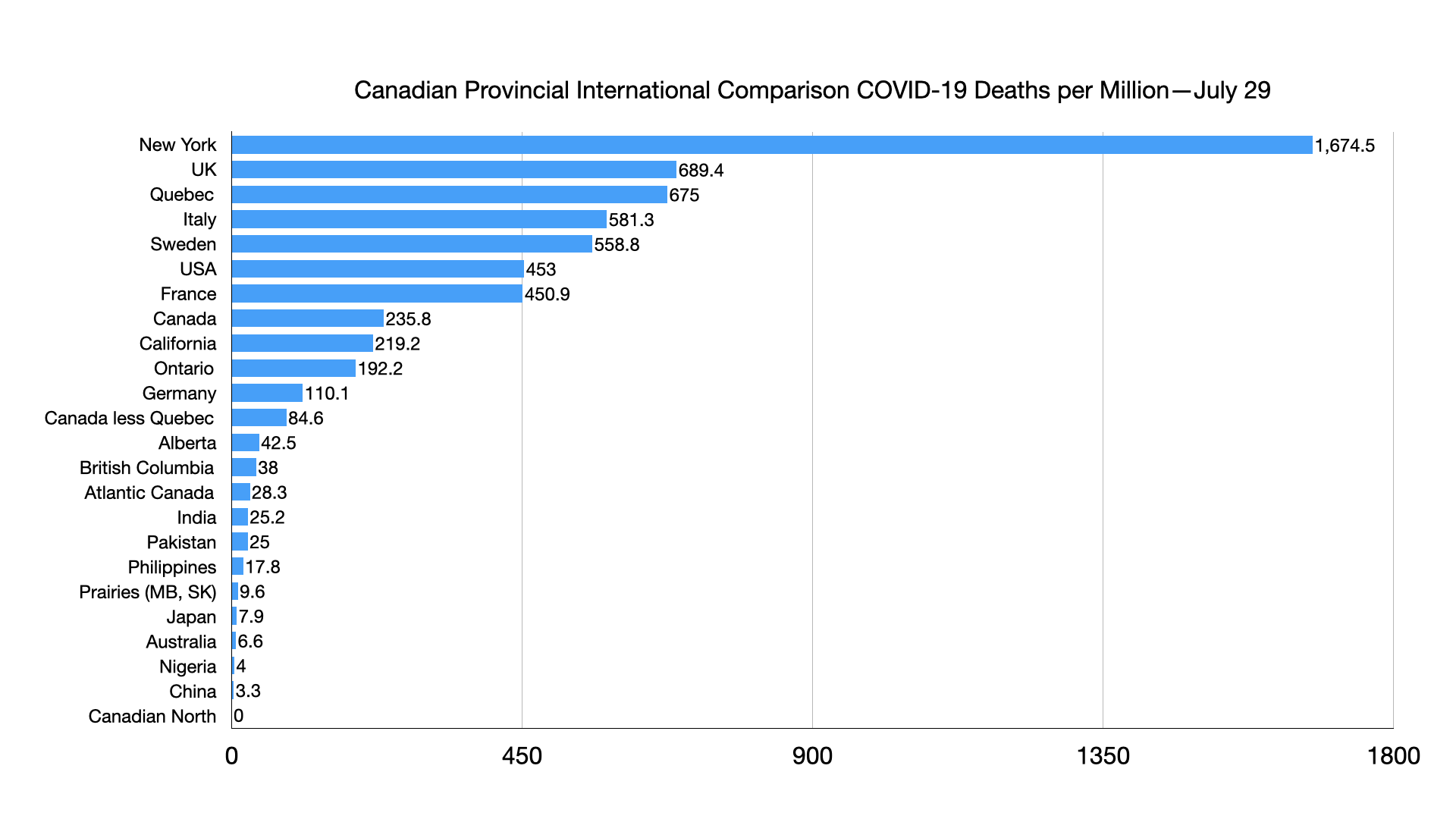
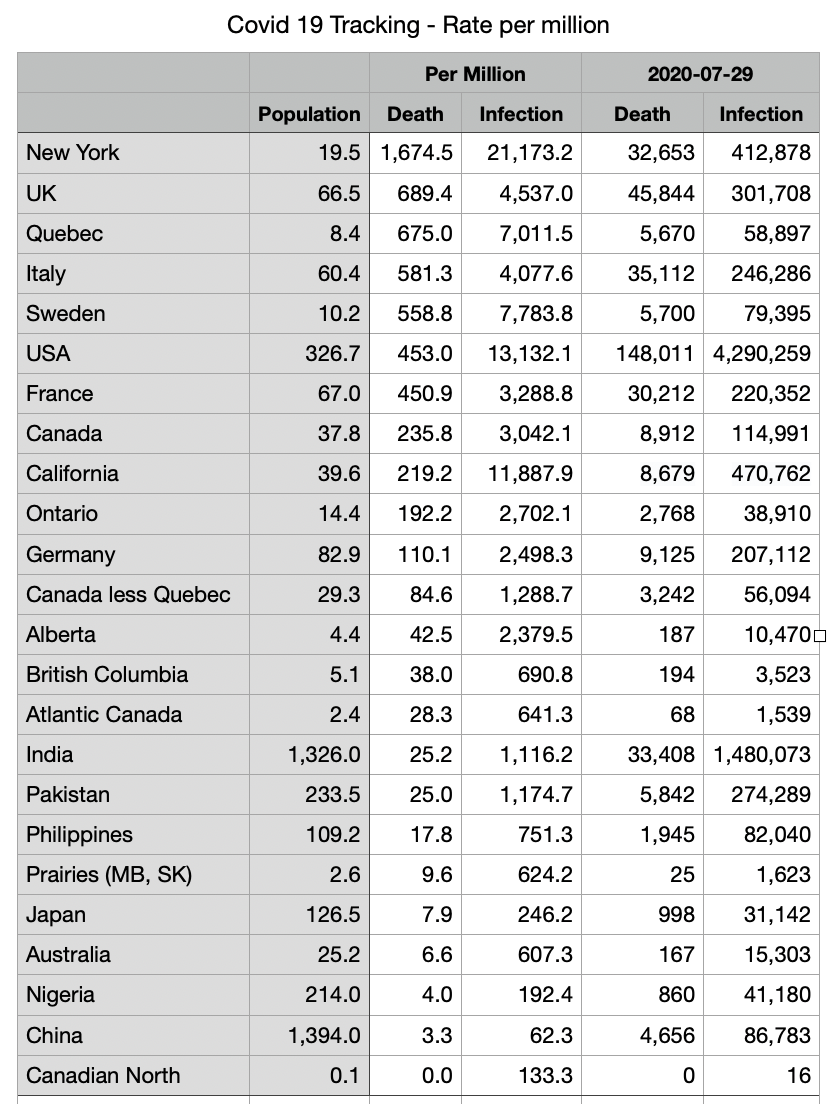
#COVID-19: Comparing provinces with other countries 22 July Update

USA has moved ahead of France in terms of deaths per million. India has moved ahead of Pakistan. No major change in order of Canadian provinces.

Terry Glavin: Will Canada stand with Uyghurs—and against ‘modern slavery?’

Valid questions:

While the Trudeau government is coming under increasing pressure to extricate Canada from commercial supply chains compromised by slave labour in China, a frustrated senior Liberal MP says the Prime Minister’s Office appears to be ignoring mounting evidence that China’s persecuted Uyghur minority, after being rounded up into re-education camps in the northwestern province if Xinjiang, is now being corralled into industrial gulags to satisfy the needs of global corporations.

“We simply cannot be a nation that professes what we purport to profess and continue to turn a wilful or negligent blind eye to the evidence of what is clear is going on,” says John McKay, chair of the House of Commons Standing Committee on Public Safety and National Security. “But sometimes, governments don’t see what’s blindingly obvious.”

For two years, McKay has been attempting to push Parliament to adopt a new law, the Modern Slavery Act, which would require corporations doing business in Canada to ensure their supply chains are uncontaminated by forced labour and child labour. The law would provide for fines of up to $250,000 for violators and amend the Customs Tariff to allow the Canadian Border Services Agency to ban slave-labour goods from entering Canada.

McKay first introduced a private members’ bill proposing the law in 2018. Last year, before Parliament was dissolved for the October election, the Standing Committee on Foreign Affairs and International Development proposed such a law, and Marie-Claude Bibeau, who was International Development minister at the time, agreed to stakeholder consultations. That effort has now been passed on to Anthony Housefather, parliamentary secretary to Labour Minister Filomena Tassi. In an effort to move things along, earlier this year, Senator Julie Miville-Dechêne introduced McKay’s bill in the Senate.

And there it sits.

“If I were looking at royal assent by this time next year, I’d be dancing in the streets, presuming the government survives,” McKay told me. “It’s tough.”

The absence of an effective anti-slavery law in Canada was brought into dramatic relief last week when Bill Matthews, the deputy minister of public works, told the Commons government operations committee that Ottawa has no way of knowingwhether suppliers relying on Uyghur slave labour are benefitting from the $2 billion in new spending on personal protective equipment required to cope with the COVID-19 crisis. Most of new money is being spent in China. Liberal and Conservative MPs said they were shocked to learn that Ottawa expects Chinese suppliers to “self-certify” that no forced labour is involved in PPE production.

“It is distressing that the Government of Canada can’t assure a committee that there’s no element of slavery in the products that it purchases from its various suppliers,” McKay told me. “That, it seems to me, is something the Government of Canada should lead in, rather than relying on the blandishments of Chinese suppliers.”

But the slavery issue doesn’t arise only in government purchases of PPEs, McKay said. It arises across the board in trade with China. “We are in effect cutting our own throats,” McKay said. “There’s not a snowball’s chance in hell that we can manufacture products at a price point that is competitive with the price point that China has to offer. We’re actually working against our own economy. It is ultimately not in Canada’s best interests, our moral best interests, or our interests writ large, or from a national security standpoint, an economic standpoint, or from a health standpoint, or an overall societal standpoint.”

Last week, nearly 200 human rights and labour organizations from 36 countries launched a campaign to secure formal commitments from the world’s major clothing brands to sever contracts with suppliers implicated in Uyghur slave labour. Beijing’s archipelago of “labour transfer” operations arise from the detention centres and re-education camps where the Chinese Communist Party has interned more than a million Uyghurs and other Muslim minorities in their homelands in Xinjiang, purportedly to suppress religious and separatist militancy.

Campaigners estimate that 90 per cent of China’s cotton comes from Xinjiang, and one fifth of all cotton garments sold worldwide contain cotton or yarn from Xinjiang. But the corporations implicated in Uyghur forced labour are not just major garment brands and retailers like Adidas, Abercrombie & Fitch, Ralph Lauren, Tommy Hilfiger and Calvin Klein. Earlier this year, in a major investigative report titled “Uyghurs for Sale,” the Australian Strategic Policy Institute (ASPI) found that at least 80,000 Uyghurs have been forced from Xinjiang and conscripted into factories across China where they are made to work in production for 83 international corporations, including Samsung, Apple, BMW, Sony, and Volkswagen.

Mehmet Tohti, the Canadian representative for the World Uyghur Congress, said he appreciates McKay’s efforts to bring Canada in line with modern anti-slavery laws already in force in the United Kingdom, the United States, France, Germany, Italy and Brazil. McKay is not like most Liberals, Tohti said: “Their response is standard. They all stick to talking points. They repeat like parrots whatever the government says. It’s really difficult to understand those people.”

Here’s where Tohti differs with McKay.

The Uyghur crisis has to be addressed specifically, and fast, Tohti said. The World Uyghur Congress is hoping Canada will replicate a bipartisan initiative in the U.S. Congress, the Uyghur Forced Labour Prevention Act, spearheaded by Massachusetts Democrat James McGovern and the Republicans’ Marco Rubio. Their proposed law would declare all goods relying on materials originating in Xinjiang to be the product of slave labour unless otherwise proven, shifting the burden of proof in the existing rules under the 1930 Tariff Act.

“It is shocking that we have not seen any steps taken in Canada to ban products that have entered Canadian markets through supply chains that use Uyghur forced labour,” Tohti said. “Canadian consumers continue to buy these products, unknowingly.”

And here’s where McKay sides with Tohti.

“If COVID has exposed anything it has exposed our unhealthy dependency upon products made in China, and I think it’s exposed vulnerabilities not only in PPEs but in vaccines and various other health supply chains that leave us hugely vulnerable as a nation to the political whims of the Communist Party of China. And I just don’t think that’s a viable position for Canada to be in, and that’s aside from the slavery issue.”

Source: Will Canada stand with Uyghurs—and against ‘modern slavery?’

Racist stereotyping of Asians as good at math masks inequities and harms students

Some good analysis of the diversity within and between different Asian groups, as is the case with all groups and the risks of all stereotypes, along with the importance of socio-economic status:

Some people stereotype Asian students as the “model minority” in math achievement: they generalize attributes of a so-called “minority” (racialized) community in a way that just perpetuates racism disguised as a compliment.

It is clear, however, that not all students identified as Asian are good at math. The word “Asian” is a category used to represent human beings who are, in fact, diverse and their differences are lost by their inclusion in the term. “Asian” includes 50 or so ethnic groups in a huge diversity of linguistic, socio-economic, political and cultural settings. Making judgments based on categories often leads to faulty or erroneous implications.

Both scholars and cultural commentators have highlighted the problem that the “model minority” label is sometimes used politically to divide those who are held up as so-called “model” groups and those who are not. Reporter Kat Chow notes that some white people have talked about Asians in North America in ways that positions Asians’ so-called “success” as a “racial wedge” that separates Asians from Black people or other racialized groups. Such framing distracts from necessary conversations about racism and structural inequalities.

We are involved in a study launched in 2018, “Behind the Model Minority Mask,” that seeks to understand divergent literacy and academic trajectories of Cantonese- and Mandarin-speaking children in Canada. We wanted to explore how early factors such as home and classroom environments and larger cultural myths surrounding “Asian academic achievement” may be affecting children’s academic results.

Our research has found that holding up a “model minority” stereotype leads to destructive emotional stress for students. The “model minority” myth both encourages blaming students for failure, obscures the socio-economic factors that influence student academic achievement and also imposes significant psychosocial pressure on high-achieving students.

Breaking down the meaning of ‘ESL’

Our research into Asian students in Vancouver schools also revealed that there are also problems with the generalized use of terms such as “English as a Second Language” (ESL) learners and “English Language Learners” (ELL).

For example, we learned through a series of studies of about 25,000 immigrant students aged six to 19 who were categorized as “ESL” that a small number were in fact non-ESL. They were raised in families where they learned another language in addition to English from birth.

Of the students who did learn English after another language, there was a wide range of English-language skills, from those who spoke only a little bit of English to those who were fluently bilingual. The group included immigrants and refugees and those who were from low to high socio-economic backgrounds, and included speakers of 150 first languages and dialects.

The “ESL” or “ELL” labels, like the “Asian” label, however, are sometimes also used in ways that can misrepresent achievement, influence or realities of individuals. Some right-wing media commentators use the “ESL” label, for example, to argue that ESL students are responsible for a “strain on the system,” and “lowering” education.

Such reprehensible commentary is facilitated by studies or news reports that rely on generalized categories and pay insufficient attention to variables.

Roots of achievement patterns

In part of our study, Lee Gunderson recorded science, math, English and social studies academic achievement of 5,000 randomly selected students from grades 8 to 12 in 18 Vancouver secondary schools including Asian students. ESL students scored significantly higher than native English speakers in all academic areas except English and social studies in Grade 12. Mandarin speakers’ academic achievement was also significantly higher than that of Cantonese, Korean, Spanish, Tagalog, Vietnamese and other language groups.

While there were high achievers among this diverse group of Asians, many Asian students (even among the Chinese subgroups) also reported struggling academically and socio-emotionally in school.

Socio-economic status was also found to be an important variable: Mandarin-speaking immigrants were from more affluent families than the other ethno-linguistic groups. Mandarin-speaking families employed more tutors to bolster their children’s academic work than other groups. Indeed, among this group, some Mandarin-speaking university students worked as academic tutors.

The sample of native-English speaking students included a wide-range of families from a range of socio-economic backgrounds. By contrast, the Mandarin sample, as a result of immigration patterns, included more high economic status families than other groups.

When high economic status native English speakers were selected they scored significantly higher in all academic areas than Mandarin speakers at all grades. Socio-economic status is related to school success.

Early beginnings

With this same set of students, initial assessment results in the early grades revealed no significant differences in achievement between young Cantonese and Mandarin speakers. However, by Grade 12 there were differences with Mandarin speakers having significantly higher grades.

Mandarin-speaking girls were four times more like to be eligible for university than Cantonese-speaking boys. About two-thirds of the Cantonese boys did not have grades sufficient for admission to university. Cantonese boys were at-risk students. The other Asian groups scored lower than Mandarin speakers in all academic areas.

Understanding differences

The two largest groups of Asian immigrants, the Cantonese and Mandarin speakers, were from Hong Kong, Taiwan and China. The language of instruction in their communities was not English, so we expected these children’s English skills would be nascent when they immigrated to Canada.

As researchers, we did not expect that these students’ achievement would differ at the end of their public school careers. We also didn’t expect to see gender differences in academic achievement when this difference wasn’t present when these children first entered Canada. Nor did we expect to see differences among the Cantonese and Mandarin speakers.

As our research continues, we predict the findings will provide critical knowledge that educators need to improve the learning of Cantonese-speaking boys or others who we find to be at risk academically or socio-emotionally in Canadian schools.

We also hope we will identify characteristics of supportive ESL environments and inform early intervention through effective ESL program design and teacher professional development. Our hope is to provide information that informs parents about how to effectively support their children in school and at home in their early years.

Canada provides exception for U.S. students planning to study north of border

That was fast (a few days after this article Canada’s travel rules unfair to first-year foreign students, U.S. parents say:

The federal government appears to have relaxed restrictions at the Canada-U.S. border that would have made it impossible for first-year university students from the United States to enter the country.

An update to the government’s guidance for international students, posted Friday, now says a student coming from the U.S. may no longer need a study permit that was issued on or before March 18, the day the border restrictions were first announced.

New York resident Anna Marti, whose daughter is planning to attend McGill University in Montreal this fall, said she was part of a “group effort” by parents across the U.S. who lobbied their senators, members of Congress and Richard Mills, the acting U.S. ambassador to Canada, to get the restrictions eased.

The rule would have made it all but impossible for U.S. freshmen to get into Canada, while other later-year students with pre-existing student permits could cross the border easily — even after having spent the summer south of the border, where the COVID-19 pandemic has been growing in severity for months.

Marti said she was told by Mills that the issue came up during ongoing discussions in Washington about the Canada-U.S. border restrictions — and that her entreaties, as well as media coverage of the plight of U.S. parents, “helped to put a ‘face’ to the issue.”

Citizenship, Refugees and Immigration Canada now says border officers will accept a “port of entry letter of introduction” that shows the student was approved for a study permit, in lieu of a permit approved before March 18. The exception, however, only applies to students from the United States.

“We celebrated, although we won’t fully celebrate until she is in Montreal,” Marti said, noting that the family — and many others — must now wait for those letters of introduction and study permits to come through.

She’s also well aware of the fact that students hoping to travel to Canada from countries outside the U.S. are still bound by the March 18 restriction.

“I just hope someone continues addressing the issue for all international freshmen,” she said. “International students who quarantine are not the real danger.”

Other parents in the U.S. remain wary of the border, since the rules require anyone seeking entry to Canada to be travelling for a “non-discretionary or non-optional purpose” — a description that could exclude students whose courses are being held entirely online.

The total number of COVID-19 cases in the U.S., growing by tens of thousands of cases a day, reached the 4.4 million mark Monday, with more than 150,000 deaths to date. Premature reopenings, an uneven and cavalier approach to physical distancing in parts of the country and a partisan divide over mask requirements have helped to fuel a surge in cases.

Canada, by comparison, has reported 114,000 total cases and nearly 8,900 fatalities so far.

“There are no measures in place to provide for expedited processing of study permit applications,” Canada’s immigration department said in an update earlier this month.

“Foreign nationals who had a study permit application approved after March 18, 2020 … may not be exempt from the travel restrictions (and) they should not make any plans to travel to Canada until the travel restrictions are lifted, as they will not be allowed to travel to or enter Canada.”

Immigration Minister Marco Mendicino announced last week the government would prioritize study permits for students who have submitted complete applications online. Students will also be able to apply time spent studying online toward their eligibility for work permits in Canada, provided at least 50 per cent of the program is completed in Canada.

Ottawa has also introduced a priority processing system and a two-stage process for students who are unable to obtain all the necessary documentation.

A spokesman for Mendicino did not respond to media inquiries Monday.

Source: Canada provides exception for U.S. students planning to study north of border

Be in Canada, bring scissors; instructions for online citizenship ceremonies Canada is now holding citizenship ceremonies online, so some new guidelines have been put in place.

Further to my earlier post, contrasting Australia’s 60,000 to Canada’s 1,000 new citizens over the past 3 months or so, @canadavisa_com flagged the new guidelines for online ceremonies:

Canada is not letting the coronavirus pandemic rob immigrants of their special day, but since citizenship ceremonies now take place over Zoom, a few changes have been made.

Canadian citizenship ceremonies are meaningful, important events in people’s lives, so Immigration, Refugees and Citizenship Canada (IRCC) created new instructions for soon-to-be citizens who are taking their oath online.

IRCC will provide all the details of the citizenship ceremony in an invitation letter. It will include the date, time, Zoom link and log-in instructions.

Even though everything is being done online, you have to be physically in Canada in order to take the Oath of Citizenship. IRCC will ask you to confirm your location before you can participate in the ceremony. If you are not physically in Canada, you may have to do the citizenship ceremony once you are back in the country.

Though there’s no strict dress code IRCC says to dress “respectfully.” Wearing religious or traditional clothing is acceptable, though face coverings may be requested to be removed temporarily for identification purposes. Casual hats are discouraged.

You can sit for the entirety of the ceremony, even when saying the oath, but IRCC asks to choose a quiet room for the Zoom call. They recommend a room free of noise and distractions, and to have a plain background.

Your head and shoulders should be visible, and your hand-held device should be stable.

You’ll need a number of documents such as your permanent residence card, whether it’s expired or not, or your Confirmation of Permanent Residence (COPR). You will also need two pieces of ID, unless you’re under the age 18. Some people will need their record of landing if they came to Canada before June 28, 2002. IRCC will also send you a form to sign after you have taken the oath.

And of course, you’ll need scissors to cut up your permanent residence card on-screen, since you won’t be needing it anymore.

You also have the option to bring a holy book if you want to use it to swear the Oath of Citizenship.

Canada postponed citizenship ceremonies scheduled for the last two weeks of March following coronavirus closures and switched to holding the events online by April. On Canada Day, July 1, IRCC reported over 1,000 citizenship ceremonies had taken place online since the start of the pandemic.

They even held their annual Canada Day citizenship ceremony online. For the first time ever, 19 participants took the oath at the same time from all over Canada.

Source: cicnews.com/2020/07/be-in-…

Griffith: What individual Canadians and organizations should do about China

My latest:

How should Canadians react to Chinese government actions?

With justified criticism regarding Chinese government repression of its Uighur minority, imposition of the Hong Kong security law, the hostage-taking of Michael Kovrig and Michael Spavor in retaliation for the U.S. extradition request regarding Huawei executive Meng Wanzhou and escalation with Taiwan and the Indian border dispute, the focus has understandably been on protesting these belligerent actions.

To provide pressure for change, consumers should ask whether there are viable non-Chinese substitutes available for the products they seek, and consider shifting their purchasing accordingly. Given the pervasiveness of Chinese-made goods, consumers should distinguish between those assembled in China and those branded as Chinese. For example, should consumers purchase Huawei devices given that the detention of the two Michaels is directly related to the detention of Meng Wanzhou?  Foodstuffs provide another opportunity to switch to non-Chinese suppliers, given Chinese government targeting of Canadian agriculture exports.

Users of Chinese social media sites such as WeChat, Weibo and TikTok, or sites with China-based servers, may also wish to reconsider their use.

Individuals need to reconsider attendance at events hosted by the Chinese Embassy and consulates, or where Chinese diplomats are key speakers without another speaker invited to counter their aggressive talking points. This applies also to elected officials, given the business-as-usual signals that their presence at such events sends. If attendance is required, any speaking notes should include Canadian concerns regarding Chinese government actions: bilateral (the two Michaels) and general (Hong Kong, Uighurs).

Alternately, individuals should consider showing visible signs of protest at such events, such as turning their backs, carrying protest signs, or asking pointed questions.

Similarly, should Canadian non-governmental organizations invite Chinese diplomats to speak at events, given the questionable value of hearing belligerent talking points and the unlikelihood of open and free dialogue? And if so, can organizations structure events that include critical voices regarding Chinese government actions as a requirement of participation?

Should Canadian media run Chinese diplomat opinion pieces without corresponding rebuttals or commentary?

Organizations — academic, think-tanks or business — need to ask themselves harder questions regarding the objectives of their collaboration, and the nature of the organization they are collaborating with. Is Chinese government funding involved, or gifts? Will collaboration be portrayed as endorsement, and will be an open exchange of perspectives? In particular, organizations should be cautious of collaboration with entities that are part of the United Front, the Chinese Communist Party’s foreign influence arm.

Educational institutions and academics that have agreements with Confucius Institutes or other Chinese government organizations have to ask whether these undermine the values of the educational institution. Institutions may need to review their conflict-of-interest codes regarding academics accepting Chinese government funding. All should recognize that gifts often play a political role and thus should be treated with caution.

And to reiterate, any such action needs to be carefully focused on the Chinese government, not Chinese-Canadians or Chinese people. Unfortunately, Chinese-Canadians have been subject to racist attacks during the pandemic; proposing the actions I suggest places the focus where it should be: on the actions of the Chinese regime.

At the same time, we also need to recognize that some Chinese-Canadians have attachment to the People’s Republic of China, related both to their home culture as well as pride in China’s increased importance. The former is not at issue, the latter, combined with the Chinese regime’s diaspora and geo-political strategies, is – and that makes targeted messaging even more important.

While many of these actions I propose may appear as “virtue signalling,” given the power imbalance between Canada and China, not acting would be a missed opportunity to send a message to Chinese government officials that their public diplomacy, as pointed out by Canadian Ambassador Dominic Barton, is counterproductive and not supported by most Canadians.

Source: https://ottawacitizen.com/opinion/griffith-what-individual-canadians-and-organizations-should-do-about-china/wcm/828b05d2-dd81-461c-9590-66147a82ca19/

Want a more diverse work force? Move beyond inclusion to belonging

A private sector view from Jaqui Parchment, CEO of Mercer Canada and a director of the BlackNorth Initiative:

In recent weeks, individuals and organizations across North America and beyond have engaged in important conversations about systemic racism and how it is embedded in our institutions, workplaces and daily lives. It’s been heartening to hear from people from diverse backgrounds expressing a desire to learn, to reflect and to consider the roles they can play in addressing these issues. These conversations, while difficult and stemming from recent instances of horrific violence, are necessary if we want to create lasting change.

In order to do so, however, we need to think beyond short-term solutions. Instead, from a business perspective, we need to focus on improving the employee experience for a more diverse Canadian work force. We need to shift our thinking to move from a focus on diversity and inclusion alone, and start cultivating a more deeply-rooted sense of belonging in our workplaces.

This requires a fundamental shift in the way we do business. Leaders must encourage open communication and really listening to their staff, be willing to make the necessary changes, conduct themselves with compassion and put their people first. It’s not just the right thing to do; it’s also the smart thing to do: A workplace where employees can bring their full selves is one where they will be engaged, productive and want to stay.

The focus on belonging at work is deeply personal to me. As one of the few Black chief executives in Canada, and as a woman in the corporate world, I came up through the ranks at a time when diversity was neither prized nor a focus. I sat in meetings, attended networking events and activities and started to notice and think about the thousand seemingly small things that happen at work every day that might make an employee feel like they don’t belong. This could be the food that’s served, the music that plays at an event, the kind of networking activities that are hosted, and who is represented at conferences, speaking engagements, town halls, as co-authors of research, and in a company’s branding.

In addition to ensuring a diverse group of voices are heard, there is also tremendous power in people feeling seen, represented, reflected and promoted at work, both within the organization and externally. These things might seem small or innocuous individually, but in aggregate they send important messages, showing employees of colour what is possible for them to accomplish and letting them know that they are seen and valued by their companies. These actions signal to employees and clients who belongs, and who does not, who the corporate world is designed for, and who is excluded from consideration.

I carried these ideas with me as I advanced to my current position as CEO of Mercer Canada, where I now have the opportunity to build a workplace where everyone feels like they belong. With colleagues whose families come from more than 78 different countries in our Toronto office alone, we recognize that we need to ensure we reflect this diversity whenever possible. We started in our Toronto office by reviewing our client entertainment practices. Where hockey games and golf tournaments were previously the biggest client events, we’ve now looked for more representative ways of engaging all our clients and finding opportunities for all our colleagues. Instead of hosting events with food, music and images representing little to no racial diversity, we’ll serve food and play music from various cultures, and ensure our images are representative of a diverse work force.

In terms of charitable efforts, we have chosen to support local initiatives in our community that better reflect the needs of a diverse society, recognizing that people are more likely to feel they belong if their companies are prepared to align with the social justice issues and philanthropy initiatives relevant to their communities.

It’s time for the difficult and necessary work of looking inward and making fundamental changes to our workplaces. This work can and must begin right now if we are going to capitalize on a time when, finally, real change seems possible.

Source: Want a more diverse work force? Move beyond inclusion to belonging

Canadian court correctly finds the U.S. is unsafe for refugees

Sean Rehaag and Sharry Aiken on the court decision. To date, haven’t seen any media commentary from those more to the right on the court decision and the CPC Immigration Critic Peter Kent has also been silent. Sharp contrast to all the earlier commentary and criticism:

This week, Canada’s Federal Court ruled that the Canada-U.S. Safe Third Country Agreement (STCA) is unconstitutional.

Under the agreement, refugee claimants entering Canada at land ports-of-entry can be returned directly to the United States without being allowed to make a refugee claim in Canada. The agreement was a quid pro quo for concessions offered to the U.S. after 9/11, including a “smart border” accord, enhanced information-sharing and joint border enforcement.

Advocates for refugees have long argued that the STCA violates international refugee law and Canadian constitutional law. Differences between the refugee determination systems in Canada and the U.S., as well as differences in the rights enjoyed by refugee claimants in both countries, mean that some people who would be recognized as refugees in Canada would be denied protection south of the border.

In other words, the U.S. is not “safe” for at least some refugees.

Trump’s election worsened situation

These arguments took on an especially urgent tone after Donald Trump’s election as American president in November 2016.

The Trump administration has implemented many racist, xenophobic and anti-refugee policies to dissuade people from seeking asylum in the U.S. For example: Harsh detention practices (including detention of young children), family separation, restrictions on the refugee definition (such as excluding people facing gender-based violence), militarization of the border and of course attempting to build a wall along the U.S.-Mexico border.

This prompted a growing chorus of voices — from law professors to human rights organizations and political parties — to call on Canada to suspend or withdraw from the STCA.

Their arguments are persuasive. How can a country be considered safe for refugees if it locks up refugee kids in cages or refuses refugee protection to women facing gender-based violence?

Closing the loophole

Unfortunately, these voices have been ignored. Instead, worried about critiques from the right about weakness on border control, the federal government under Prime Minister Justin Trudeau contemplated trying to get the U.S. to extend the agreement to the entire border — not just official land ports of entry.

The U.S., however, has little incentive to expand the agreement, which would block even more asylum-seekers from leaving the United States for Canada, and there has been little movement on this front.

This inaction left the matter to the courts. Lawyers for refugee and human rights organizations, as well as refugee claimants, went to Federal Court, arguing that the STCA is unconstitutional.

Federal Court Justice Ann Marie McDonald agreed with them.

Her decision focused narrowly on what happens to refugee claimants who are turned away under the STCA.

And what happens is atrocious. Refugee claimants are handed over to American officials who detain them for weeks. Conditions of detention are inhumane. Solitary confinement is common. Access to lawyers is restricted, which makes it harder to secure refugee protection.

Worse still, these are intentional policies aimed at making the experience of seeking asylum in the U.S. so traumatic that others will be discouraged from making the same journey.

As Justice McDonald held:

“The evidence clearly demonstrates that those returned to the U.S. by Canadian officials are detained as a penalty …. penalization of the simple act of making a refugee claim is not in keeping with the spirit or the intention of the STCA or the foundational conventions upon which it was built.”

No safety for refugees

In other words, U.S. immigration detention practices violate international refugee law and undermine the basic premise of the STCA that both countries are safe for refugees.

So there we have it. A Canadian court has determined that American detention practices are “grossly disproportionate” and “shock the conscience,” and that Canada cannot be complicit by sending refugee claimants to the U.S. to face these practices without violating constitutional rights to life, liberty and security of the person.

The question now is what comes next.

The Federal Court suspended its declaration of constitutional invalidity for six months to allow Canadian Parliament to respond.

The government could appeal the decision. If that happens, the STCA will be tangled up in the courts for years — during which time more asylum-seekers like Nedira Mustefa, one of the applicants in the case, will find themselves in solitary confinement in U.S. detention centres. Mustefa told the court she felt “scared, alone and confused,” with no sense of when she would be released, during her time in American detention.

Alternatively, the Canadian government can send a clear signal that it cares about constitutional and international law, heed Justice McDonald’s findings and take steps to immediately suspend the STCA.

The detention practices that she focuses on in her decision are only one among many ways in which the U.S. has attacked refugee rights. These attacks are mounting. The Trump administration recently proposed reforms that would gut what remains of the American asylum system. Every day that the STCA remains in effect, Canada continues to be complicit in these attacks.

Enough is enough. The STCA must be suspended.

Source: Canadian court correctly finds the U.S. is unsafe for refugees

ICYMI: No New International Students At Harvard Due To Immigration Rules No New International Students At Harvard Due To Immigration Rules

Of note:

In a stunning announcement, a Dean of Harvard told first-year international students they could not come to Harvard this fall because the Trump administration has not changed immigration rules on online instruction. The setback for students came only a week after a Harvard and MIT lawsuit persuaded the administration to withdraw guidance that would have forced out returning international students whose universities do not hold in-person classes for health reasons.

On July 21, 2020, Harvard Dean Rakesh Khurana wrote to all Harvard students to share a message sent to first-year international students. “I am writing today to share the difficult news that our first-year international students will not be able to come to campus this fall,” wrote Dean Khurana. “Despite the Immigration and Customs Enforcement [ICE] division’s decision to withdraw the directive that would have prohibited currently enrolled international students in the United States from taking an all-online course load this fall, this reversal does not apply to our newly admitted international students who require F-1 sponsorship. At present, any incoming student who received a Form I-20 to begin their studies this fall will be unable to enter the U.S. in F-1 status as course instruction is fully remote.”

Under ICE regulations, “For F-1 students enrolled in classes for credit or classroom hours, no more than the equivalent of one class or three credits per session, term, semester, trimester, or quarter may be counted toward the full course of study requirement if the class is taken online or through distance education and does not require the student’s physical attendance for classes, examination or other purposes integral to completion of the class.” (Emphasis added.)

When ICE issued guidance on March 9, 2020, that allowed currently enrolled international students to continue online because of the health crisis, it did not change the regulation nor address new students (it was the middle of the semester). The July 6, 2020, guidance required at least some in-person classes and included both new and returning international students. When ICE withdrew that July 6, 2020, guidance, the status quo became the guidance in place before March 9, 2020, as interpreted by universities, which means that the long-standing regulation (an incoming international student is not permitted a visa if more than 3 credit hours are remote) remains in effect for new international students. That will be the case unless the Department of Homeland Security makes clear another policy is in effect.

“We are deeply disappointed with the Department of Homeland Security’s  failure to provide updated and responsive guidance to colleges and universities as we requested they do on July 17,” said Miriam Feldblum, executive director of the Presidents’ Alliance on Higher Education and Immigration, in an interview. “New international students should be allowed to enter the United States to pursue their education. Many of these students have spent months – and more likely years – of preparation to start their education at our institutions. Their absence from the U.S. hurts all students and will have lasting effects. It undermines our nation’s standing as the destination of choice for international students. We will be looking to see what actions can be taken.”

Harvard is also pursuing additional options. “The University is working closely with members of the Massachusetts congressional delegation to extend the online exemption to newly admitted students and ensure that this flexibility remains in place for the duration of the public health emergency,” wrote Dean Khurana. “Unfortunately, we don’t anticipate any change to the policy in time for the fall semester.”

Dean Khurana said in his message that while the university explored options that allowed for “some in-person instruction as a way to enable first-year international students to obtain an F-1 Visa and join us on campus,” it was rejected “given the unpredictability of current government policies and the uncertainty of the Covid-19 crisis.” In addition to the health issues that prompted Harvard to go online in the fall, the university was concerned about putting new international students in a situation where they entered the U.S. but were forced to leave and could not return to their home country.

“Given this development, our first-year international students should consider the following two options: You can start your Harvard experience from home, taking courses remotely,” wrote Dean Khurana. “We have worked hard to create a robust program for all of our students to learn online, and we hope you will consider this option. Alternatively, you may defer the start of your time at Harvard.”

The 2020-2021 academic year may be a historically low year for international students coming to the United States. “The enrollment of new international students at U.S. universities in the Fall 2020-21 academic year is projected to decline 63% to 98% from the 2018-19 level, with between 6,000 to 12,000 new international students at the low range, and 87,000 to 100,000 at the high range,” according to an analysis by the National Foundation for American Policy.

“The decline of as many as 263,000 students from the 2018-19 academic year total of approximately 269,000 new international students would be the lowest level of new international students since after World War II when the numbers started to be tracked,” notes the analysis. “The 12,000 level represents new international students if only new students from Mexico and Canada enrolled. Given uncertainties surrounding even Mexican and Canadian students, the most pessimistic forecast would put the number of new enrolled international students at only half the 12,000 level.”

At present, the administration has not responded to university requests to issue clear guidance on the admission of first-time international students. If the Trump administration expressed a keen interest in facilitating the entry of international students, analysts note, it could have put forward more flexible policies and worked closely with universities and international students. That has not been the case. As a result, new international students will not be coming to Harvard or, it appears, many other U.S. universities this fall

Source: No New International Students At Harvard Due To Immigration Rules