It is not only the twin towers and rose window that have their origins in the Middle East, she pointed out, but also the ribbed vaults, pointed arches and even the recipe for stained glass windows. Gothic architecture as we know it owes much more to Arab and Islamic heritage than it does to the rampaging Goths. “I was astonished at the reaction,” says Darke. “I thought more people knew, but there seems to be this great gulf of ignorance about the history of cultural appropriation. Against a backdrop of rising Islamophobia, I thought it was about time someone straightened out the narrative.”
And so she has, with Stealing from the Saracens, an exhilarating, meticulously researched book that sheds light on centuries of borrowing, tracing the roots of Europe’s major buildings – from the Houses of Parliament and Westminster Abbey to Chartres cathedral and St Mark’s basilica in Venice – back to their Middle Eastern precedents. It is as much a story of political power, wealth and fashion as it is of religious belief, with tales of looting Crusaders, fashion-conscious bishops and globe-trotting merchants discovering new styles and techniques and bringing them home.
“Now we have this notion of east and west,” says Darke. “But back then, it wasn’t like that. There were huge cultural exchanges – and most came from the east to the west. Very little went the other way.”
Masterpiece of geometry … the exquisite interior of Córdoba’s mosque-cathedral. Photograph: Ingo Mehling
Given their prevalence in the great cathedrals of Europe, it is easy to imagine that pointed stone arches and soaring ribbed vaults are Christian in origin. But the former dates back to a seventh-century Islamic shrine in Jerusalem, while the latter began in a 10th-century mosque in Andalucia, Spain. In fact, that first known example of ribbed vaulting is still standing. Visitors to the Cordoba Mezquita can marvel at its multiple arches intersecting in a masterpiece of practical geometry and decorative structure, never needing a repair in its thousand-year existence. The vaulted maqsura – the part of the mosque reserved for the ruling caliph – was designed to cast a sacred glow across the leader. However, the official leaflet will tell you little of the building’s Islamic origin, perhaps because it has been a Catholic church since 1236.
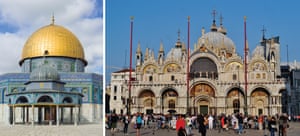
The pointed arch, meanwhile, was a pragmatic solution to a problem encountered by masons working on the Dome of the Rock in Jerusalem. One of the holiest sites in the Muslim world, it was built in 691 by the ruler of Islam’s first empire. The challenge was how to line up an outer arcade of rounded arches with a smaller inner arcade, while maintaining a horizontal ceiling between them. For the openings to align, the masons had to give the inner arcade tighter arches, forcing them to become pointed. Another world first can be spotted higher up in the shrine, where encircling the dome is an arcade of trefoil arches, the three-lobed style of arch that went on to encrust practically every European cathedral, voraciously adopted as a symbol of the Holy Trinity.
“Again and again,” says Darke, “I am so struck by how much of this stuff that we think of as essentially Christian and European was based on ignorance and misinterpretation of much earlier Islamic forms.” She points out that the enormous influence of the Dome of the Rock was down to the Crusaders of the Middle Ages mistakenly thinking the building was the Temple of Solomon.
Looks familiar? … from left, the interior of Jerusalem’s Dome of the Rock, and Temple Church in London. Composite: Virtutepetens/Getty Images/iStockphoto
They used the domed, circular layout of this supposedly Christian shrine as the model for their Templar churches (like the City of London’s round Temple church), even copying the decorative Arabic inscription, which openly chastises Christians for believing in the Trinity rather than in the oneness of God. Their pseudo-Kufic calligraphic patterns went on to adorn French cathedral stonework and the borders of richly woven textiles, with no one aware of what they actually meant.
The confusion was spread further by the first printed map of Jerusalem, published in Mainz, Germany, in 1486. It not only mislabels the Dome of the Rock as the Temple of Solomon, but depicts the building with a fine onion dome – a pure orientalist fantasy from the mind of a Dutch woodcut artist named Erhard Reeuwich. The book containing the map became a bestseller, reprinted 13 times and translated into multiple languages, influencing the spread of onion-domed churches across Europe in the 16th century. It is a tale of mistaken identity and unintended consequence worthy of a Monty Python sketch.
The transfer of Islamic motifs to the west wasn’t always so simple, though. The pointed arch took a more circuitous route. Darke traces how the arches first spread to Cairo, becoming sharper and more pointed under the Abbasid empire, and were in turn admired by visiting merchants from the wealthy Italian port of Amalfi, who channelled discoveries from their travels into their eclectic 10th-century basilica. This exotic building caught the eye of Abbot Desiderius, who visited Amalfi in 1065 on a shopping trip for rare luxury merchandise, and decided to take the pointed window design for his monastery at Monte Cassino.
More Arab than European … Jerusalem’s Dome of the Rock, left, and St Mark’s basilica in Venice. Composite: Godot13/Zairon
Those windows were then copied for the Benedictine abbey at Cluny in France, the largest church in the world at the time. Abbot Suger, an adviser to kings Louis VI and VII, liked how the windows let in more light, and immediately applied the same design to his Saint-Denis basilica in Paris. Regarded as the earliest fully gothic structure, the basilica was completed in 1144 and its architect went on to work at Notre-Dame. “They all just copied it,” says Darke. “These were the most powerful churches in Europe, so the style completely took off, as all fashions do. When powerful people adopt something, everyone wants one.”
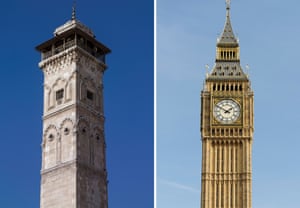
The list goes on. There are the early square minarets, found on such buildings as the Great Mosque of Damascus, that taper thinner and are crowned with a bulbous finial dome. These inspired such great Italian towers as those of Florence’s town hall and St Mark’s Campanile in Venice, prefiguring centuries of church bell-towers.
Drawing on architectural historian Deborah Howard’s research, Darke shows Venice to be more Arab than European, from its narrow winding passageways and courtyard homes with rooftop terraces, to the Islamic ornamentation of the Doge’s Palace (modelled on Al-Aqsa Mosque in Jerusalem) and the onion domes of St Mark’s. All are the fruit of trips made by Venetian merchants to Egypt, Syria, Palestine and Persia, fostering a level of influence that extended even to fashion: women in Venice were veiled in public and dressed in black from head to toe. “One cannot see their faces for all the world,” a 15th-century source commented. “They go about so completely covered up, that I do not know how they can see to go along the street.”
The book comes at a charged time, when supposedly western architecture is being mobilised by right-wing nationalist groups to bolster their idealised vision of a “pure” European identity. There are now countless social media accounts promoting messages of white supremacy disguised as heritage appreciation, while recent government edicts about tradition and beautycarry similar overtones. Darke’s work takes an eloquent sledgehammer to such ignorant, dog-whistle propaganda, revealing how the monuments idealised by the alt-right have their roots in the very culture of which they are so suspicious.
Borrowed time … from left, the now destroyed minaret of the Great Mosque in Aleppo, Syria; and Big Ben in London. Composite: Alamy/Getty Images/Dorling Kindersley
The ignorance is widespread, and perhaps the most surprising thing in Stealing from the Saracens is how much of this should not come as a surprise to the modern reader. After all, throughout the book, Darke summons the words of Christopher Wren, who was well aware of the Middle Eastern origins of gothic architecture, and of the structural techniques he was using for St Paul’s Cathedral.
“Modern gothic,” he wrote in the 1700s, “is distinguished by the lightness of its work, by the excessive boldness of its elevations … by the delicacy, profusion and extravagant fancy of its ornaments … Such productions, so airy, cannot admit the heavy Goths for their author.” Instead, he concluded, “from all the marks of the new architecture, it can only be attributed to the Moors; or what is the same thing, to the Arabians or Saracens”.
The irony is in the name itself: in Wren’s day, Saracen was a pejorative term for the Arab Muslims, against whom the Crusaders had fought their “holy war”. It originated from the Arabic word “saraqa”, meaning “to steal”, as Saracens were seen as looters and thieves. Never mind the fact that the Crusaders plundered their way across Europe, Jerusalem and Constantinople – pilfering the wonders of Islamic architecture as they went, and airbrushing the origins of their booty in the process.
An official survey shows the tumult created in B.C. by the novel coronavirus has hurt racialized people the most, with more than one in five Latin American, West Asian and Black respondents reporting job losses due to the pandemic.
Provincial Health Officer Bonnie Henry said at Thursday’s daily COVID-19 briefing that the results of a recent online survey of 394,000 people confirmed a trend seen in many other places: The virus and the measures taken to slow its growth have disproportionately affected non-white people. The results did not touch on who has been infected, but charted how people of different ethnicities have fared with regards to unemployment, financial stress, and access to health care and food.
“The challenge has not been shared equally,” she said as she revealed the results of the survey done by the BC Centre for Disease Control, a government agency.
The information comes as British Columbia logs an additional 78 confirmed cases of the virus. The numbers have been creeping up all summer, leading to a recent spike that Dr. Henry says is driven by younger people socializing.
The provincial average for losing a job due to the pandemic was 15.5 per cent, according to the survey. Only white respondents reported recent unemployment at below that rate, 14 per cent. People of every other ethnicity reported rates above the provincial average, with the highest affecting Latin American people at 22.6 per cent, West Asian or Arabic people (21.5 per cent), and Black people (21.1 per cent).
That same inequality was seen when respondents were asked about whether they had more money troubles. The provincial average was 32 per cent of respondents saying they had increased financial problems, with 29 per cent of white people reporting these issues.
Neither Dr. Henry nor the provincial health ministry explained why Indigenous respondents were not represented in the survey results released on Thursday.
Japanese, multi-ethnic and Korean respondents were the most likely to report difficulty accessing health care. On the other hand, Latin American, Southeast Asian and Black respondents were the most likely to report feeling more connected to family since the province began its state of emergency in March.
The survey also showed people at the income level of less than $60,000 reported having a harder time meeting their financial needs and putting enough food on the table, and that they were more likely to be out of work.
Among respondents with school-aged children, lower-income households reported more stress on their kids, more barriers to learning and a decreased connection to their friends.
At Thursday’s briefing, Health Minister Adrian Dix and Dr. Henry spent most of their time addressing the increase in cases. Mr. Dix warned anyone ignoring physical distancing at parties this weekend that public-health inspectors will be out enforcing rules at bars and banquet halls.
Since early July, people in their 20s have made up the highest proportion of new cases, according to the Public Health Agency of Canada. From July 29 to Aug. 4, more than 40 per cent of cases nationally for which data were available were reported in people 29 or younger.
In B.C., this group accounts for about 32 per cent of cases since July 1, while people in their 30s make up about 22 per cent. In Alberta, people in their 20s make up the largest proportion of active cases, at 22 per cent, while people in their 30s followed with 19 per cent.
One of the classic definitions of a diplomat is one who lies for his country, whether aware or not:
Any moves by Canada to sanction Chinese officials for human rights violations against the Muslim Uyghur population would be met with a “strong and resolute reaction,” according to China’s ambassador in Ottawa.
A letter to Prime Minister Justin Trudeau signed by 64 Canadian MPs and senators called for sanctions to be levied against officials deemed guilty of abuses in Xinjiang province and Hong Kong.
But Cong Peiwu said such a move would be deemed to be interference in China’s domestic affairs. “It would demonstrate ideological prejudice against China and a disregard for the basic facts,” he said.
“It is the lie of the century to claim China has put one or even two million people into concentration camps.”
Xinjiang faced threats from “separatist terrorists” that claimed innocent lives, he said. The Chinese government responded with “education and training centres” where “students” learn Chinese and labour skills to help them find jobs, he said. When he was asked about footage screened by the BBC of hundreds of detainees lined up at a railway depot, Cong said it was merely a prisoner transfer. “That is normal procedure … a very common practice,” he said. “The focus has been on so-called concentration camps but there are none of them.”
On Hong Kong, global affairs minister Francois-Philippe Champagne has said that Trudeau government is considering “additional measures” on the immigration front, in conjunction with Great Britain and Australia, potentially offering a pathway to citizenship for people who would like to leave the territory. Sources said work is underway and options are being actively considered.
Cong said it is up to the 300,000 or so Canadian passport holders in Hong Kong whether they stay or leave.
But he said China would oppose any country interfering in the “Hong Kong Special Administrative Region.”
In an interview inside the Ottawa embassy compound, Cong said Canada should share with China’s interest in preserving the long-term stability and prosperity of Hong Kong, which was threatened by people “engaged in violent crimes” that had scared off investors.
He said Britain has violated its agreement with China by offering a new home to Hong Kong residents born before the handover in 1997 who hold British National (Overseas) passports.
One suggestion is that Canada and Australia offer resident status to Hongkongers born after 1997 who do not hold BN(O) passports.
Cong said that the Hong Kong national security law is designed to protect the rights of the majority and to deter “the very small number of people engaged in dangerous crimes.”
Cong is a welcome departure from his predecessor, that most undiplomatic of diplomats, Lu Shaye, who accused Canada of “Western egotism” and “white supremacy.”
But while he is more restrained, Cong is no less devoted to the party line. In a wide-ranging interview, he refuted accusations that the embassy co-ordinates influence and intimidation campaigns against its opponents in this country. Witnesses at the Canada-China parliamentary committee this week suggested that Canadians of Hong Kong origin were targeted with “bullying and harassment” by the Chinese government.
Cong said one of the functions of the embassy is to communicate with Canadians, including those of Chinese origin. “This kind of discussion can be defined as influence but there is not much logic to it. We are sitting here but are we trying to infiltrate and influence the National Post? Regular contact is one of our functions. We send out our message and it is up to you to take it up or not. We have every reason to communicate with our people,” he said.
As we approach the 50th anniversary of the establishment of bilateral relations between Canada and China, he recognized relations are at a low ebb. Just 14 per cent of Canadians look favourably on China, according to an Angus Reid poll, down from nearly 50 per cent in 2017.
But he said “important progress” has been made — a pre-COVID-19 trading relationship worth $74 billion, two way travel of 1.5 million people and 230,000 Chinese students studying here.
A chill set into the relationship with the detention of Huawei executive, Meng Wanzhou, in December 2018, after an extradition request by the U.S., in relation to alleged breaches in sanctions against Iran.
“This is the main obstacle, the most outstanding issue,” said Cong.
He said Canada was “taken advantage of by the U.S.”
“The U.S. plotted what we call a very severe political incident as it prepared to bring down Huawei.”
He said China sees political, rather than judicial, motivations in the actions of the Americans and urged Canada to make its own decisions.
(Judging by the recent memoir by former U.S. national security adviser, John Bolton, the White House knew about Meng’s imminent detention long before the Trudeau government — the prime minister is said to have found out after the fact, when he was handed a note at the G20 summit in Buenos Aires).
Cong said that the Meng case is “totally different” to the detention of two Canadians, Michael Kovrig and Michael Spavor. The two men were detained just nine days after Meng’s arrest. “You could call it a coincidence,” said Cong. After 557 days of interrogation, the two Michaels were formally charged with espionage, a crime punishable by life in prison.
Cong said the two are being treated “in strict accordance with the law” and their rights are being protected. That account contrasts starkly with reports the two men were initially interrogated for six to eight hours a day and kept under 24 hour lighting. Consular and legal visits were cut off during the COVID pandemic.
Cong said the two cases are different in nature. “A large number of people have been misled by reports from the U.S. trying to blacken China’s image,” he said.
It is all a far cry from 2017, when the relationship with China was still strong, and the enthusiasm from the Trudeau government to launch free trade negotiations was almost undignified.
During the prime minister’s visit to Beijing, his advances were rebuffed.
“We were very close but they put forward some terms and we said ‘we can be patient.’ But we are happy to continue,” Cong said. “The door is still wide open.”
Yet even that is not true, as canola exporters Richardson International and Viterra Inc. would testify.
Cong said the suspension of canola shipments by the two Canadian suppliers is specific to them, caused by concerns over “quarantined pests.” He said negotiations to recommence canola imports are ongoing and pointed to a doubling of pork imports from Canada in the first half of this year as evidence that the trade relationship can still flourish.
“I believe there is huge potential, if we can remove the main obstacle (Meng’s detention),” he said.
The exclusion of Huawei from the development of Canada’s 5G network might further test that assurance. The government has yet to make a formal decision but the three main carriers — Bell, Telus and Rogers — have all announced partnerships with European suppliers in the development of the multi-billion dollar 5G network.
“My message is for there to be a non-discriminatory business environment for Chinese companies,” Cong said.
When asked to comment on the observation by a Japanese academic that China is making the same mistakes Japan made in the 1930s — an ugly nationalism, supported by the majority of the people and taken advantage of by a military that has no civilian supervision — Cong tried to offer reassurance.
“We are committed to path of peaceful development. It is our national policy and enshrined in our constitution,” he said. “China is focused on its own development and has no intention of dominating the world or overtaking the U.S.
“It is the U.S. that is dragging the world into Cold War Two and is trying to get a lot of countries to oppose China. But I don’t think that intention will succeed. The U.S. is becoming the troublemaker for world peace and is exiting from international organizations like the World Health Organization. In this regard, China and Canada are on the same wavelength, upholding multilateralism and international organizations.”
That is unlikely to induce a warm, fuzzy feeling in the four out of five Canadians who hold an unfavourable view of China.
As long as Canadian citizens are arbitrarily imprisoned and used as human bargaining chips, there is unlikely to be much fondness in the relationship.
Predictable (and hard if not impossible to believe that John Eastman did not do so deliberately, with Newsweek’s defence of the column as not having racist undertones tone- and reality-deaf):
President Trump on Thursday encouraged a racist conspiracy theory that is rampant among some of his followers: that Senator Kamala Harris, the presumptive Democratic vice-presidential nominee born in California, was not eligible for the vice presidency or presidency because her parents were immigrants.
That assertion is false. Ms. Harris is eligible to serve.
Mr. Trump, speaking to reporters on Thursday, nevertheless pushed forward with the attack, reminiscent of the lie he perpetrated for years that President Barack Obama was born in Kenya.
“I heard it today that she doesn’t meet the requirements,” Mr. Trump said of Ms. Harris.
“I have no idea if that’s right,” he added. “I would have thought, I would have assumed, that the Democrats would have checked that out before she gets chosen to run for vice president.”
Mr. Trump appeared to be referring to a widely discredited op-ed article published in Newsweek by John C. Eastman, a conservative lawyer who has long argued that the United States Constitution does not grant birthright citizenship. Ms. Harris, the daughter of Jamaican and Indian immigrants, was born in 1964 in Oakland, Calif., several years after her parents arrived in the United States.
But Mr. Trump was in effect revisiting an old tactic: spreading a race-based and anti-immigrant crusade he began nearly a decade ago, when he began sowing distrust in the background of Mr. Obama, who was born in Hawaii.
This time, Mr. Trump has legions of followers who have been spreading similar theories about Ms. Harris. In the hours after Joseph R. Biden Jr. announced Ms. Harris as his running mate, a new crop of memes and conspiracy website postings began proliferating online, suggesting that Ms. Harris was an “anchor baby,” a disparaging term for a child born in the United States to immigrants.
Mr. Eastman’s column tries to raise questions about the citizenship of Ms. Harris’s parents at the time of her birth, and argues that she may have “owed her allegiance to a foreign power or powers” if her parents were “temporary visitors” and not residents. Ms. Harris’s parents received doctorate degrees from the University of California, Berkeley, in 1963 and were working as academics when Ms. Harris was born in 1964.
But constitutional law scholars say that the immigration status of Ms. Harris’s parents at the time of her birth is irrelevant because under the Constitution, anyone born in the United States automatically acquires citizenship.
The 14th Amendment makes it clear: “All persons born or naturalized in the United States, and subject to the jurisdiction thereof, are citizens of the United States and of the State wherein they reside.”
Nonetheless, Mr. Eastman’s article leapfrogged throughout social media on Thursday. Tom Fitton, the president of the conservative group Judicial Watch — a favorite information source of Mr. Trump’s — shared the article on Twitter. By Thursday afternoon, it had reached some 14.3 million people on Facebook, Reddit and Twitter before it was parroted by the president, according to data reviewed by The New York Times.
Newsweek in the meantime defended Mr. Eastman’s column, asserting that it had “nothing to do with racist birtherism.” Experts in constitutional law were still quick to disparage the article as dangerous.
In an interview on Thursday, Laurence H. Tribe, a professor of constitutional law at Harvard Law School, compared Mr. Eastman’s idea to the “flat earth theory” and called it “total B.S.”
“I hadn’t wanted to comment on this because it’s such an idiotic theory,” Mr. Tribe said, “There is nothing to it.”
Mr. Tribe pointed out that the theory still quickly landed in the hands of a president who has used his pulpit to spread a number of conspiracies against his political enemies, particularly those who do not have white or European backgrounds.
During the 2016 presidential race, Mr. Trump continuously questioned the citizenship of Senator Ted Cruz of Texas, suggesting that his Canadian roots would be a problem should he win the presidency. Mr. Cruz, who was born in Canada to an American mother and a Cuban father, is a United States citizen. Mr. Eastman, for his part, wrote that year that Mr. Cruz was eligible.
But Mr. Trump was relentless about questioning Mr. Obama’s background. In 2011, he began appearing on television to question whether Mr. Obama was born in the United States — spreading the lie he has never fully apologized for.
“Maybe I’m going to do the tax returns when Obama does his birth certificate,” he said in an ABC interview in April 2011. “I’d love to give my tax returns. I may tie my tax returns into Obama’s birth certificate.”
Mr. Obama eventually released his birth certificate. Mr. Trump has never released his tax returns.
At the White House Correspondents Dinner in 2011, Mr. Obama acknowledged that he released his long-form birth certificate, and took aim at Mr. Trump, who was sitting in the audience.
“He can finally get back to focusing on the issues that matter, like, did we fake the moon landing?” Mr. Obama said as a stone-faced Mr. Trump looked on. He also displayed a rendering of the White House, styled as a casino, should Mr. Trump win the presidency.
Mr. Trump, of course, ended up running and winning. In 2016, he finally, and tersely, acknowledged that Mr. Obama was an American citizen.
“President Barack Obama was born in the United States, period,” Mr. Trump said at the time. “Now, we all want to get back to making America strong and great again.”
He then falsely suggested that Hillary Clinton, his former Democratic opponent, had started the rumor.
A further reminder of our dependence of foreign seasonal agriculture workers:
Nineteen-year-old Florence Lachapelle was among hundreds of Quebecers who tried their hand at planting seeds and harvesting produce this summer, replacing migrant workers who were unable to leave their countries because of the COVID-19 pandemic.
And while Lachapelle spent long days working the fields on Francois D’Aoust’s farm in Havelock, Que., too few other Quebecers took up the call to help the province’s struggling agricultural industry.
Despite a recruiting drive by the provincial government in April, the lack of labour this season has forced farmers to cut production or leave food rotting in the fields.
Unfortunately for Lachapelle, she fell ill with mononucleosis after two months and returned home to Montreal. She said the work was very demanding with so few migrant workers available.
“They’re professionals and we’re simply not,” Lachapelle said in a recent interview.
D’Aoust said he hired a handful of people to work alongside Lachapelle, who were out of work in other sectors such as communications, film and the restaurant industry. But once their opportunities returned, he said, they left for their better-paying jobs.
“Not a lot of people are used to (physical) work all day,” D’Aoust said in a recent interview. “It’s just not the kind of work that we do. It’s rare that people are in shape and can (work) all day in the field.
“People that are farmers, themselves, in their country, surely they are at an advantage.”
D’Aoust and his wife, Melina Plante, have hired the same four Guatemalan seasonal workers year after year. But this year the farmhands were stuck at home at the beginning of Quebec’s farming season due to travel restrictions their country imposed to limit the spread of COVID-19.
He said it takes inexperienced Quebecers up to three times as long to do farm work compared to a migrant worker. That meant he had to pay locals to do less work, eating into his profits.
D’Aoust slashed production at his farm, Les Bontes de la Vallee, by 60 per cent this year because he and his wife figured they would only have migrant workers later in the harvest season.
Two Guatemalan workers eventually made it on D’Aoust and Plante’s farm — but the financial damage to the business was done. “What we hope is to pass through this difficult period without too much loss and start again next year,” he said. “We just want to stay alive.”
For Michel Ricard, who owns 60 hectares of farmland in Saint-Alexis-de-Montcalm, about 60 kilometres north of Montreal, he said he’s going to lose a lot money and food this year because migrant workers from Mexico and Guatemala haven’t been able to arrive.
By the end of August, Ricard said he expects to lose approximately $100,000 dollars worth of cucumbers because he has no one to pick them.
Experienced foreign workers are “essential for the future, for me, and for the majority of growers of vegetables,” he said in a recent interview.
“The people from Guatemala are able to work from 6 a.m. to 6 p.m. It’s not a problem. Sometimes I need to stop them because they want to continue, but sometimes I say ‘that’s enough for today.'”
Local workers haven’t been much help to him, he said. Ricard had his daughter post a message on Facebook to reach out to prospective farmhands, but he said only eight came through for him.
“It was impossible,” Ricard said.
The Union des producteurs agricoles, which represents about 42,000 Quebec farmers, says there are close to 2,000 fewer migrant workers on Quebec farms than usual. Despite the UPA’s efforts to lure Quebec workers through a recruiting drive, just under 1,400 were assigned to Quebec farms this year.
“It didn’t replace, really, the foreign workers,” UPA President Marcel Groleau said in a recent interview. “It helped on some issues … but those workers are not trained and can’t really replace the foreign workers that are trained and have experience on farms.”
Farmers such as D’Aoust and Ricard say migrant farmhands are willing to work longer hours, even for minimal pay.
Groleau said the federal government’s emergency response benefit, which offers up to $2,000 a month to many people who have lost jobs, has encouraged Quebecers to stay away from the gruelling field work.
“When you can get two thousand dollars a month sitting at home,” Groleau said, “it’s not really interesting to go on a farm and work a little bit for minimum wage.”
Significant issue and more concrete action warranted:
Foreign Affairs Minister François-Philippe Champagne said Ottawa will not tolerate the intimidation of human rights activists in this country by foreign governments after a democracy activist told a parliamentary committee she and her family have faced threats from Beijing over the past year.
But Amnesty International said Wednesday that Canada’s response to rising complaints about bullying by pro-China forces has been hapless, muddled and ineffective.
Parliamentary hearings on Canada-China relations this week in Ottawa included testimony from Canadians of Hong Kong origin, who described threats they’ve received on Canadian soil during the course of their advocacy for democratic rights in the former British colony.
Cherie Wong, executive director of Alliance Canada Hong Kong, told the Commons committee on Canada-China relations that she has been the target of “death and rape threats,” as well as talk of harming her family, over the past 12 months. At rallies – even on Parliament Hill – pro-Beijing supporters have harassed and threatened those demonstrating in support of Hong Kong. Afterward, the personal information of pro-Hong Kong demonstrators – cellphone numbers, e-mail addresses, photos, class schedules – was published online.
Her experience echoes a May report by Amnesty International Canada and other groups warning that Chinese government officials and supporters of the Communist Party of China are increasingly resorting to “threats, bullying and harassment” to intimidate and silence activists in Canada, including those raising concerns about democracy and civil rights in Hong Kong, and Beijing’s mistreatment of Uyghurs, Tibetans and Falun Gong practitioners.
This intimidation includes threats of sexual violence and other physical violence against targets in Canada, as well as their family members in Hong Kong and China.
Conservative foreign affairs critic Leona Alleslev asked Mr. Champagne on Wednesday in the House of Commons about testimony such as Ms. Wong’s, and whether the government would introduce legislation to fight foreign interference.
“Witnesses at the Canada-China committee stated the People’s Republic of China is actively threatening Canadians on Canadian soil who seek to expose China’s authoritarian agenda. These individuals have been subjected to everything from physical threats, commercial blacklisting and state-backed cyberhacking with no protection from Canada. When will this government introduce legislation to combat foreign influence and protect basic human rights in Canada from aggressive actions of the Chinese Communist Party?” Ms. Alleslev asked.
Mr. Champagne told the Commons that Canada does not allow such intimidation and said Ottawa has been swift to address it.
“Let me be very clear, the safety and protection of Canadians is paramount to this government. We will never allow any form of foreign interference in Canada by state or non-state actors,” the Foreign Affairs Minister said.
He said Canada has acted whenever complaints have arisen. “Every time there have been allegations … we have taken action with the Minister of Public Safety,” he said, and advised Canadians to contact the police if they are being threatened.
“We invite any Canadians who might be subject to any form of such actions that have been described to contact law enforcement authorities and we will always defend the freedom and liberty of Canadians in Canada from foreign interference.”
But Alex Neve, secretary-general at Amnesty International Canada, said the response from Canadian authorities to such complaints has been unco-ordinated and disappointing. He said that in 2017 and again in May this year, Amnesty and other groups in the Canadian Coalition on Human Rights in China published reports on the intimidation and threats, as well as recommendations to address it – but these have received little response.
He said targets of harassment end up discouraged. “Individuals have often found they turn to one agency only to be told to go to another, and yet another, and at the end of the day told, ‘Well, we share the concern, but there’s not really anything that can be done here because it’s not a clear criminal offence,’ or, ‘You don’t have enough evidence.’ ”
The Amnesty-led coalition has recommended establishing a point person and hotline to handle complaints, talking to China about the harassment, and the consideration of a law to counter foreign interference as other countries such as Australia have enacted.
Mr. Neve said the response from the Canadian government, from security agencies and from police “lacks coherence and at the end of the day therefore is entirely ineffective.”
“Individuals experiencing these instances of interference and of threats, including threats of sexual and other physical violence and threats against family members in Hong Kong or in China, are largely left without effective recourse, often unsure where to turn and what to expect,” he said in recommendations provided to the Canada-China committee this week.
“It may be a considerable challenge to counter China’s influence on the world stage, it may be difficult to exert pressure for human rights reform on the ground in China, but there is no excuse for a failure to take robust and decisive steps to counter human rights abuses that may be linked to or backed by Beijing – connected to what is happening in Hong Kong, but taking place here in Canada.”
The Chinese embassy in Ottawa did not immediately respond to a request for comment.
After completely shutting the Canadian citizenship program in late March, June saw a resumption with almost 1,700 new citizens in June (down 92 percent compared to June 2019). Australia had a much smaller decline as this article attests:
The suspension of processing had caused widespread concern among pending applicants, who were worried about their cases being put on hold.
Australian citizenship testing and interviews that were suspended earlier this year due to the coronavirus pandemic are resuming in capital cities across the country.
The federal government says the appointments have started in Brisbane, Sydney, Adelaide and Perth and will also resume in Canberra, Hobart and Darwin later this month.
The suspension of processing had caused widespread concern among pending applicants, who were worried about a growing backlog.
Acting Immigration Minister Alan Tudge said the resumption of testing would allow more migrants to progress towards making the pledge of allegiance.
“The interview and tests are important steps in the process of applying for Australian citizenship, ensuring the integrity of our citizenship decisions,” he said.
A record 204,000 people became Australian citizens last financial year despite the coronavirus disruption, while 73,000 online ceremonies were conducted during the pandemic.
There remains a further 150,00 people who have applications pending, including those awaiting citizenship testing and interviews, according to government figures.
Yash-Sanjiv Rungta, who lives in Sarina in Queensland’s Mackay region, said he and his wife are yet to hear back about the status of their application since applying for citizenship in December last year.
The Indian national migrated to Australia six years ago – a decision motivated by his passion for cricket and the country’s “amazing” weather.
“To get Aussie citizenship is a matter of pride and honour,” he told SBS News.
“We are really excited about the prospect of becoming citizens of this country soon… it might take time but definitely we will become citizens one day.”
The government says citizenship appointments will return in capital cities in line with state and territory health restrictions with the safety of staff and applicants to be made a priority.
More than 1,150 people have attended one of these citizenship appointments since they resumed in July.
Mr Rungta said he remains uncertain about when he will get his opportunity, with interviews and testing yet to become available in his regional area.
“If they ask me to attend an interview or test in Brisbane – I don’t mind,” he said.
“(But) I fail to understand why they can’t start it in regional towns – where there is no instance of coronavirus left now.”
A spokesperson for the Department of Home Affairs said that Services Australia conducts citizenship tests on the department’s behalf for clients in regional Australia.
“The department is working closely with Services Australia to resume citizenship testing arrangements in regional Australia as restrictions ease in states and territories, and in accordance with health advice,” the spokesperson said.
In Melbourne, citizenship tests and interviews are yet to be resumed because of the city’s resurgence in coronavirus cases.
Melbourne-based Amul Jani is among those in the city facing the prospect of their citizenship application being further delayed by the COVID outbreak.
“That’s a big test of patience and it is really disappointing – we would have really loved for this to have happened sooner than what it looks like now,” he told SBS News.
Mr Jani migrated from India with his wife Mosiqi six years ago and along with their seven-year-old son Reyansh made their applications to become citizens in March this year.
He said the government should consider introducing virtual options for citizenship processing where face-to-face appointments can’t resume.
“In all sense we consider ourselves as part of this country … we just hope for the best and wait for it to happen,” he said.
Sydney-based Abhijeet Sen, his wife, and six-year-old son are also waiting to undertake the citizenship test and receive an interview invitation.
Almost 1,600 people signed his petition calling for the government to gradually resume the procedures as coronavirus health concerns ease.
Mr Sen said the resumption of the citizenship interviews and testing is welcome.
“That makes me excited … I am really looking forward to it,” he told SBS News.
But he remains wary of a potential backlog of applications because of the coronavirus disruption.
“COVID is not going away anytime soon so even if test is resumed it will be conducted at fairly low levels,” he said.
Face-to-face citizenship ceremonies returned in June.
There are currently around 35,000 people who have their application approved and are awaiting a ceremony, down from 85,000 in April.
While I think Harris’ biracial background has been well covered, found this commentary of interest given that the writer found it under-covered along with the implications for others with mixed identities:
On Tuesday, Joe Biden, presumptive Democratic nominee for president of the United States, announced he had chosen Senator Kamala Harris as his running mate. The excitement was swift. The backlash was even swifter. President Trump wasted little time calling Harris “nasty” and “disrespectful”—the man is nothing if not predictable. As was the Democratic talking heads’ praise of Biden for picking Kamala as a means of “securing the Black vote,”as if Black people are a monolith and Biden didn’t tell Charlamagne tha God on The Breakfast Club, “If you have a problem figuring out whether you’re for me or Trump, then you ain’t Black.” Many also claimed Harris’ potential vice presidency will change “the way we view and treat women in politics forever,” as if a number of Democrats didn’t consider Harris “too ambitious” to be Biden’s running mate.
But amid the sexist, racist backlash and Democratic congratulator back-slapping, history was made. Not only was Harris the first African American and first woman to serve as California’s Attorney General and the second Black woman to become a sitting U.S. senator, she is now the first Black woman to join a major party ticket (civil rights activist Charlotta Bass became the first Black woman to ever run for office as vice president in 1952, when she joined the Progressive Party ticket). If Biden is elected president, Harris will become the first African American and first woman to hold the office of the vice presidency.
She’ll also become the first South-Asian American to become vice president. Just as she is the first South-Asian American to join a major party ticket, just like she was the first South-Asian American to join the Senate. But Harris’ multiculturalism and South Asian identity is often overlooked by a society that continues to rely on a binary way of thinking. Like former President Barack Obama, Harris’ multiculturalism is, most often, only acknowledged in a racist attempt to invalidate her Blackness. Obama isn’t really Black, Rush Limbaugh argued. He is “half white.” Harris isn’t reallyAfrican American, right-wing talking heads say. She is Jamaican. She is “half” South-Asian. She is “half” Black. She is a half, they say. She is not whole.
For those of us who are bi- or multiracial, watching Harris’ entire identity be whittled away to “this” or “that” is as painful as it is familiar. As a Puerto Rican and Norwegian woman who grew up in Eagle River, Alaska, and now lives in Bed-Stuy, Brooklyn, New York, I know what it’s like for people to assume the entirety of your identity based on how you look. I know how your identity can be white-washed, invalidated, categorized, and in Harris’ case, used to devalue who you are and the community you represent. As Americans, we often lack the ability to establish and maintain nuanced conversations about race and heritage, ethnicity and culture. And in this country, bi- or multiracial people are often described in halves—“half black,” “half white,” “half Puerto Rican,” “half Asian”—as if the rich multiplicities that embody our identity do not make us whole but fractured. It is no wonder that multiracial people often feel both within and without—for me, not Puerto Rican enough but not white enough either.
But to acknowledge Harris’ Black and South Asian identities simultaneously is to give bi- and multiracial kids who feel like they have to be all of one thing or risk being seen as nothing at all a chance to be reminded of their inherent value—that we are not fragments of our ancestries but a dream realized by those who live in a country that didn’t legalize biracial marriage until 1967.
All of Harris’ firsts have given and continue to give us an opportunity to see ourselves not as a collection of halves or a myriad of contradictions or parts to be dissected and criticized and used against us when we ascent to positions of power but as whole people worthy of respect, a seat at the table, and if given the opportunity, a shot at the vice presidency of the United States.
While no fan of the Trump administration, Canada should consider a similar measure:
The Trump administration is increasing scrutiny of a long-established Chinese-government funded programme that’s dedicated to teaching Chinese language and culture in the US and other nations, the latest escalation of tensions with Beijing.
The State Department plans to announce as soon as Thursday (Aug 13) that Confucius Institutes in the US – many of which are based on college campuses – will need to register as “foreign missions,” according to people familiar with the matter who asked not to be identified.
The designation would amount to a conclusion that Confucius Institutes are “substantially owned or effectively controlled” by a foreign government. That would subject them to administrative requirements similar to those for embassies and consulates.
The State Department, which didn’t immediately respond to a request for comment, took similar action toward several Chinese media outlets earlier this year.
The institutes have long been a target of China hawks, with lawmakers including Senator Marco Rubio, a Florida Republican, urging schools in his state to terminate their agreements with them.
He called them “Chinese government-run programmes that use the teaching of Chinese language and culture as a tool to expand the political influence” of the government.
The move is likely to further stoke tensions with Beijing as the two countries clash over everything from the governance of Hong Kong to 5G technology.
This week, Health and Human Services Secretary Alex Azar became the highest-ranking American official to visit Taiwan in more than 40 years, while Secretary of State Michael Pompeo used a speech in Prague to blast the Chinese Communist Party’s “campaigns of coercion and control.”
Of some 550 Confucius Institutes around the world, 80 are based at US colleges, including Stanford University and Savannah State University in Georgia, according to the National Association of Scholars, a non-partisan research group that has studied them.
Although the institutes generally steer clear of history, politics and current affairs, critics say they are vehicles for Chinese influence on campuses, providing the government in Beijing leverage to censor teaching materials and academic events by threatening to withdraw funding for the institutes.
The National Association of Scholars opposes them because it says their funding lacks transparency and topics sensitive to China’s government are off limits.
Elegant birtherism, presented in formal legal reasoning. And his rhetorical question, “how else could we possibly expect the candidates, if elected, to honor their oaths to “faithfully execute the Office of President of the United States, and…to the best of [their] Ability, preserve, protect and defend the Constitution of the United States?” is just that, one designed to raise doubts when none are warranted:
The fact that Senator Kamala Harris has just been named the vice presidential running mate for presumptive Democratic presidential nominee Joe Biden has some questioning her eligibility for the position. The 12th Amendment provides that “no person constitutionally ineligible to the office of President shall be eligible to that of Vice-President of the United States.” And Article II of the Constitution specifies that “[n]o person except a natural born citizen…shall be eligible to the office of President.” Her father was (and is) a Jamaican national, her mother was from India, and neither was a naturalized U.S. citizen at the time of Harris’ birth in 1964. That, according to these commentators, makes her not a “natural born citizen”—and therefore ineligible for the office of the president and, hence, ineligible for the office of the vice president.
“Nonsense,” runs the counter-commentary. Indeed, PolitiFact rated the claim of ineligibility as “Pants on Fire” false, Snopes rated it simply “False,” and from the other side of the political spectrum, Conservative Daily News likewise rated it “False.” All three (and numerous others) simply assert that Harris is eligible because she was born in Oakland—and is therefore a natural-born citizen from location of birth. The 14th Amendment says so, they all claim, and the Supreme Court so held in the 1898 case of U.S. v. Wong Kim Ark.
But those claims are erroneous, at least as the Citizenship Clause of the 14th Amendment was originally understood—an error to which even my good friend, renowned UCLA School of Law professor Eugene Volokh, has fallen prey.
The language of Article II is that one must be a natural-born citizen. The original Constitution did not define citizenship, but the 14th Amendment does—and it provides that “all persons born…in the United States, and subject to the jurisdiction thereof, are citizens.” Those who claim that birth alone is sufficient overlook the second phrase. The person must also be “subject to the jurisdiction” of the United States, and that meant subject to the complete jurisdiction, not merely a partial jurisdiction such as that which applies to anyone temporarily sojourning in the United States (whether lawfully or unlawfully). Such was the view of those who authored the 14th Amendment’s Citizenship Clause; of the Supreme Court of the United States in the 1872 Slaughter-House Cases and the 1884 case of Elk v. Wilkins; of Thomas Cooley, the leading constitutional treatise writer of the day; and of the State Department, which, in the 1880s, issued directives to U.S. embassies to that effect.
The Supreme Court’s subsequent decision in Wong Kim Ark is not to the contrary. At issue there was a child born to Chinese immigrants who had become lawful, permanent residents in the United States—”domiciled” was the legally significant word used by the Court. But that was the extent of the Court’s holding (as opposed to broader language that was dicta, and therefore not binding). Indeed, the Supreme Court has never heldthat anyone born on U.S. soil, no matter the circumstances of the parents, is automatically a U.S. citizen.
Granted, our government’s view of the Constitution’s citizenship mandate has morphed over the decades to what is now an absolute “birth on the soil no matter the circumstances” view—but that morphing does not appear to have begun until the late 1960s, after Kamala Harris’ birth in 1964. The children born on U.S. soil to guest workers from Mexico during the Roaring 1920s were not viewed as citizens, for example, when, in the wake of the Great Depression, their families were repatriated to Mexico. Nor were the children born on U.S. soil to guest workers in the bracero program of the 1950s and early 1960s deemed citizens when that program ended, and their families emigrated back to their home countries.
So before we so cavalierly accept Senator Harris’ eligibility for the office of vice president, we should ask her a few questions about the status of her parents at the time of her birth.
Were Harris’ parents lawful permanent residents at the time of her birth? If so, then under the actual holding of Wong Kim Ark, she should be deemed a citizen at birth—that is, a natural-born citizen—and hence eligible. Or were they instead, as seems to be the case, merely temporary visitors, perhaps on student visas issued pursuant to Section 101(15)(F) of Title I of the 1952 Immigration Act? If the latter were indeed the case, then derivatively from her parents, Harris was not subject to the complete jurisdiction of the United States at birth, but instead owed her allegiance to a foreign power or powers—Jamaica, in the case of her father, and India, in the case of her mother—and was therefore not entitled to birthright citizenship under the 14th Amendment as originally understood.
Interestingly, this recitation of the original meaning of the 14th Amendment Citizenship Clause might also call into question Harris’ eligibility for her current position as a United States senator. Article I, Section 3 of the Constitution specifies that to be eligible for the office of senator, one must have been “nine Years a Citizen of the United States.” If Harris was not a citizen at birth, we would need to know when (if ever) she became a citizen. Her father’s biographical page at Stanford University identifies his citizenship status as follows: “Jamaica (by birth); U.S. (by naturalization).” But there is some dispute over whether he was in fact ever naturalized, and it is also unclear whether Harris’ mother ever became a naturalized citizen. If neither was ever naturalized, or at least not naturalized before Harris’ 16th birthday (which would have allowed her to obtain citizenship derived from their naturalization under the immigration law, at the time), then she would have had to become naturalized herself in order to be a citizen. That does not appear to have ever happened, yet without it, she could not have been “nine Years a Citizen of the United States” before her election to the U.S. Senate.
I have no doubt that this significant challenge to Harris’ constitutional eligibility to the second-highest office in the land will be dismissed out of hand as so much antiquated constitutional tripe. But the concerns about divided allegiance that led our nation’s Founders to include the “natural-born citizen” requirement for the office of president and commander-in-chief remain important; indeed, with persistent threats from Russia, China and others to our sovereignty and electoral process, those concerns are perhaps even more important today. It would be an inauspicious start for any campaign for the highest offices in the land to ignore the Constitution’s eligibility requirements; how else could we possibly expect the candidates, if elected, to honor their oaths to “faithfully execute the Office of President of the United States, and…to the best of [their] Ability, preserve, protect and defend the Constitution of the United States?”
Dr. John C. Eastman is the Henry Salvatori professor of law & community service and former dean at Chapman University’s Fowler School of Law. He is also the 2020-21 visitor scholar in conservative thought and policy at the Benson Center for the Study of Western Civilization, University of Colorado Boulder. Dr. Eastman is also a senior fellow at the Claremont Institute and founding Director of the Institute’s Center for Constitutional Jurisprudence.
U.S. President Donald Trump said he would have to look into claims that Sen. Kamala Harris, who is the 2020 Democratic vice-presidential nominee as Joe Biden’s running mate, may not be eligible to run for office after Newsweek published an opinion article questioning her citizenship.



 Multicultural Meanderings

