Trump administration’s revisions to the naturalization exam could make the test harder for immigrants seeking citizenship

Last gap of a lame-duck administration, still in denial and one easy to overturn. While there is always a case to update and revised citizenship processes, this is not the way to proceed.

Perhaps members of the administration could test themselves on their understanding of the Constitution and democratic principles and practices:

The Trump administration is planning to make the naturalization test, which immigrants must pass to become US citizens, longer, according to a draft memo obtained by CNN, a move that could make it more difficult and marks the latest in a string of actions intended to alter the citizenship process.

Last year, US Citizenship and Immigration Services, which administers the exam,announced that it was making changes to the civics portion of the test. The agency last launched revisions of the naturalization exam in 2009, “which implemented standardized test forms for both the English and civics test requirements,” according to a May 2019 memo. The memo also said the agency was in the process of formalizing a decennial revision process.

The agency appears to be nearing the finish line for its latest slate of changes. According to the memo, revisions include adding more civics test questions and topics, as well as changing the passing score. The exam generally consists of both an English test and civics test.

Over the course of his presidency, Donald Trump has tried to curtail legal immigration and doubled down on citizenship, teasing an end to birthright citizenship and attempting to include a citizenship question on the census. Earlier this year, his administration also moved to increase the cost of online naturalization applications from $640 to $1,160.

The naturalization exam is a crucial step to an immigrant’s path toward US citizenship. The planned revisions would stand to affect hundreds of thousands of immigrants who seek citizenship annually.

Currently, the exam features 100 civics questions. Hopeful American citizens are asked up to 10 of these during an interview and have to answer six correctly to pass. But the changes, according to the memo, include an increase in civics test questions from 10 to 20, and as such, changing the passing score to 12/20 instead of 6/10. The memo also says USCIS officers will ask all 20 questions, rather than stopping when an applicant reaches the passing score.

The updated test, according to the memo, “includes more questions that test applicants’ understanding of U.S. history and civics in line with the statutory standard than the current test.”

The agency says it added more topics touching on specific amendments to the Constitution, the “rationale for the legislative branch structure,” and an item on “American innovations.” It also includes more “why” questions, though it’s unclear what that entails.

It’s unclear when the agency will roll out the changes to the exam. USCIS declined to comment on the planned revisions.

“It’s not unprecedented to change the questions … what stands out to me is once again a desire to slow down the process and require more from immigrants,” said Aaron Reichlin-Melnick, policy counsel at the American Immigration Council, a non-profit group that advocates for the rights of immigrants, in part because it takes more to ask additional questions.

“This administration seems locked into an endless cycle of making the process more difficult and inevitably, discouraging more and more people from seeking citizenship and legal immigration benefits,” Reichlin-Melnick added.

USCIS, a part of the Department of Homeland Security, has been at the center of some of the administration’s most hardline immigration policies, notably policies that have made it exceedingly difficult for migrants to seek asylum in the US and the controversial “public charge” rule, which makes it more difficult for immigrants to obtain legal status if they use public benefits.

Ken Cuccinelli, who now serves as the senior official performing the duties of the Homeland Security deputy secretary, brought the agency into a rare spotlight when he served as the acting USCIS director, working to rebrand it as an vetting agency, rather than a benefits agency.

“Updating, maintaining, and improving a test that is current and relevant is our responsibility as an agency in order to help potential new citizens fully understand the meaning of U.S. citizenship and the values that unite all Americans,” Cuccinelli said in a statement last year when the agency announced it would revise the exam.

USCIS has boasted about the number of people it naturalizes on a yearly basis. In fiscal year 2019, USCIS naturalized 834,000 new citizens, an 11-year high. But during the pandemic, naturalization ceremonies, which occur in person, were halted.

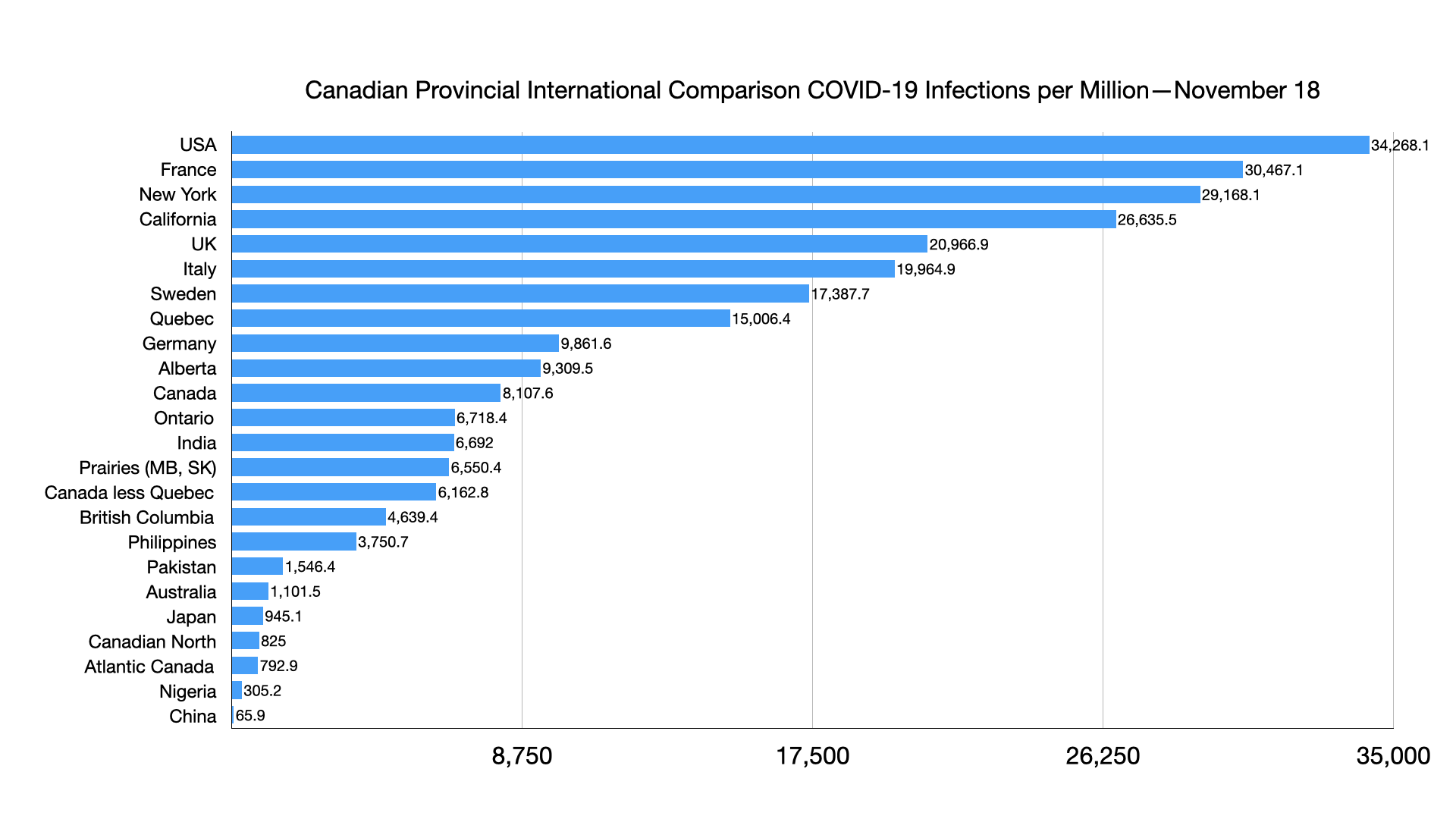
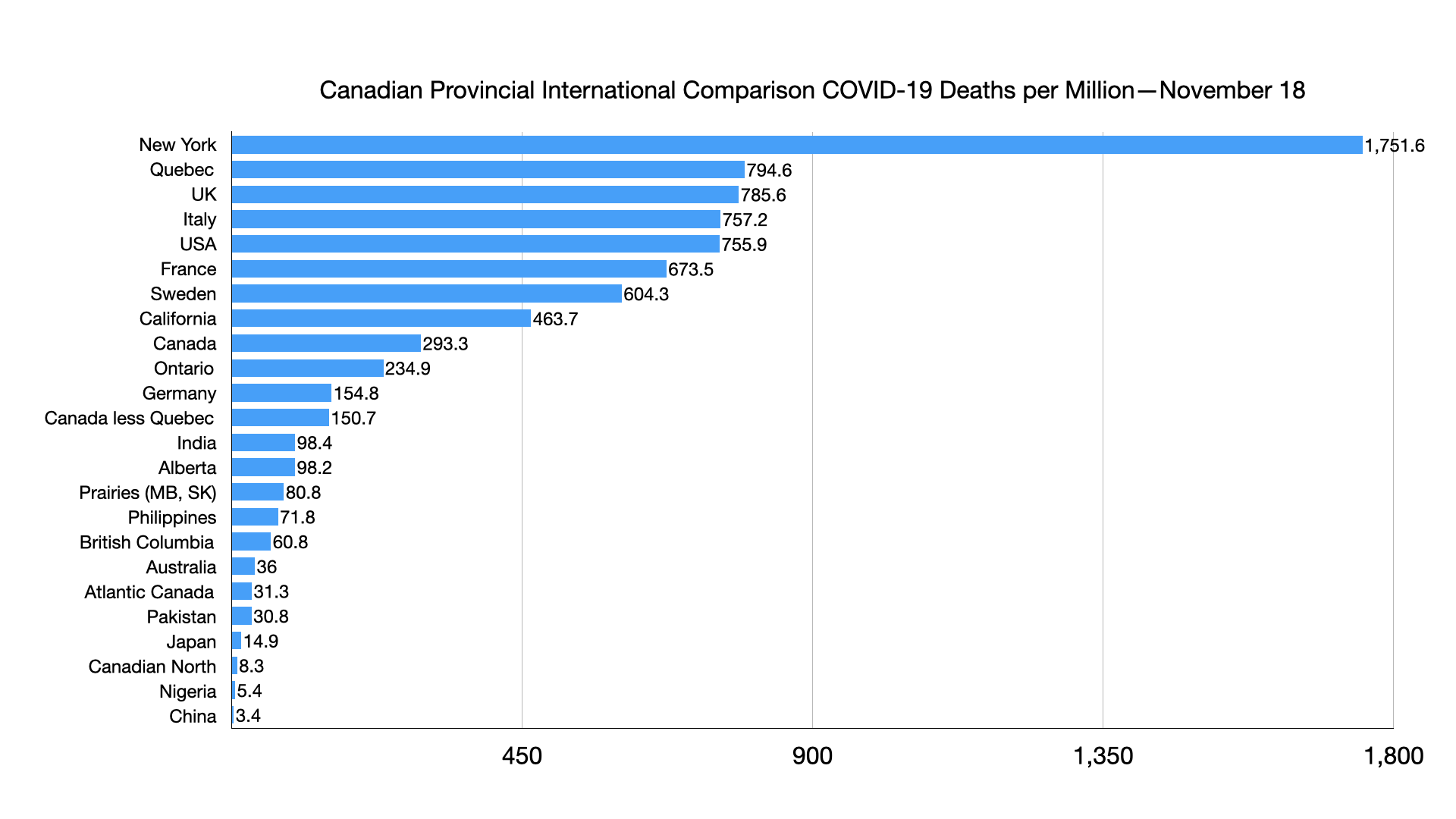
#COVID-19: Comparing provinces with other countries 11 November Update

Main news continues to be with respect to rapid increase in infections in most countries and provinces:
 
Weekly:
 
Infections per million: France ahead of New York, Italy and Sweden ahead of Quebec, British Columbia ahead of Philippines
 
Deaths per millionUK ahead of USA, France ahead of Sweden, Canadian North ahead of Nigeria


Rembrance Day, 2020

In capitals around the world, there is no joy in a Biden win

Authoritarians of a feather, stick together:

In major cities across a divided United States, Americans celebrated this weekend as Joe Biden became their president-elect. A number of liberal democracies joined in congratulating Mr. Biden, hoping for a return to something close to normal after four years of Donald Trump’s chaotic, unpredictable and damaging retreat from the global order.

But not all world leaders are so excited for a change in U.S. administration. For some, Mr. Biden signifies a return to normative Barack Obama-era preaching about human rights, a renewed commitment to multilateralism and to global climate action at the expense of their hyper-nationalist agendas, and a restoration of Chinese appeasement policies in exchange for short-term U.S. trade gains.

Leaders in Israel, Egypt, Saudi and the United Arab Emirates, for instance, have benefited greatly from Mr. Trump’s presidency. His transactional foreign-policy approach, favourable view toward unfettered arms sales, and disregard of their human rights abuses have all resonated positively. A Biden administration, on the other hand, may reverse the sale of advanced F35 warplanes to the UAE, and it will surely be more critical of Saudi bombings using U.S.-made warplanes in Yemen. Despite sending congratulations for the president-elect, Israeli Prime Minister Benjamin Netanyahu and Egypt’s autocratic Abdel Fattah el-Sisi have lost a friend with Mr. Trump’s exit. Perhaps more importantly, Mr. Trump’s unilateral “maximum pressure” strategy against Iran was welcomed by these Middle East leaders; Mr. Biden, meanwhile, has vowed to reopen multilateral negotiations on a nuclear agreement with that country.

Recep Tayyip Erdogan’s government in Turkey, which has purchased Russian-made missile defence systems and whose state-owned Halkbank faces indictment in the U.S. for allegedly funnelling money to a sanctioned Iran, will miss Mr. Trump too. Mr. Biden has unreservedly supported the NATO alliance’s military interoperability, which will comfort European allies frustrated by both Mr. Erdogan and Mr. Trump.

Europe isn’t necessarily unanimous in its celebration of Mr. Biden, however. While Hungary Prime Minister Viktor Orban and Polish President Andrzej Duda found ideological common ground in Mr. Trump’s anti-immigrant, anti-EU, populist-nationalist views, Mr. Biden has referred to those leaders as “thugs.” Meanwhile, U.K. Prime Minister Boris Johnson will have to deal with Mr. Biden’s tough talk against a reinstated customs border between Northern Ireland and the Republic of Ireland – unwelcome complications to Mr. Johnson’s already fraught Brexit negotiations with the EU.

Despite Russia’s Trump-boosting election-interference efforts, President Vladimir Putin may have a mixed response to Mr. Biden’s win. Mr. Trump added more sanctions on Russian officials, approved arms sales to Ukraine and declined to recognize Russia’s annexation of Crimea. But the chaos Mr. Trump brought to the United States did help Mr. Putin quash domestic discourse about the virtues of liberal democracy. Mr. Biden, meanwhile, has already affirmed his support for Russian civil society and democracy advocates, surely triggering memories of Hillary Clinton’s perceived interference in Russia’s 2011 pro-democracy protests.

In Asia, Mr. Biden’s criticism of India’s illiberal turn – with its new citizenship law and lockdown of Kashmir – will not go over well with Indian PM Narendra Modi, even though Mr. Trump hadn’t budged on a U.S.-India trade deal. Both Mr. Modi and the Philippines’ Rodrigo Duterte appreciated Mr. Trump’s supportive tough talk on Chinese military expansionism, both on the disputed Himalayan border with India and throughout the South China Sea. While Mr. Trump may be seen by Asian countries such as Vietnam and Taiwan as a more effective countervailing force to China’s ascent than Mr. Biden, who is likely to pursue re-engagement with Beijing, Seoul and Tokyo are relieved all the same to see Mr. Biden elected, given Mr. Trump’s repeated threats that he would remove U.S. troops from South Korea and Japan.

In the Americas, Brazilian president Jair Bolsonaro has been among the ranks of the world leaders remaining silent in the wake of Mr. Biden’s election win. Mr. Bolsonaro, who has been dubbed the “Trump of the Tropics,” has been criticized by Mr. Biden for Brazil’s deforestation of the Amazon and his government’s failure to control raging wildfires. Similarly, Mexican President Andres Manuel Lopez Obrador, who has struck up an unlikely rapport with Mr. Trump, shared Mr. Trump’s interests in increasing investments into fossil fuels and stemming Central American migration. On both of these issues, a Biden presidency – which is likely to bow to progressive forces within the Democratic Party and change course – could potentially complicate the Mexican-American relationship.

In cities such as London, Paris, and Toronto, people reportedly celebrated Mr. Biden’s win with fireworks, the ringing of church bells, and jubilant noise-making from their balconies. But for the international leaders who might have gotten comfortable with the trajectory of the last four years of discord, a Biden administration might now represent a Trump-sized system shock of its own.

Bessma Momani is a professor of political science at the University of Waterloo and senior fellow at the Centre for International Governance Innovation.

CSIS warns China’s Operation Fox Hunt is targeting Canada’s Chinese community

Risk to Chinese Canadians of note:

The Canadian Security Intelligence Service says Beijing routinely uses undercover state security officials and “trusted agents,” or proxies, to target members of Canada’s Chinese community in an effort to silence critics of President Xi Jinping, including threats of retribution against their families back in China.

The federal spy agency says these illegal activities in Canada are part of a global campaign of intimidation that constitutes a threat to this country’s sovereignty and the safety of Canadians. One of the most high-profile efforts is Operation Fox Hunt, directed by Beijing’s Ministry of Public Security, which has been under way since 2014.

Operation Fox Hunt was ostensibly launched as an anti-corruption campaign by Mr. Xi that targeted wealthy citizens and corrupt Communist Party members, who had fled overseas with large amounts.

However, FBI director Christopher Wray said in July that Operation Fox Hunt’s principal aim now is to suppress dissent among the Chinese diaspora. He called Fox Hunt nothing more than a sweeping bid by Mr. Xi to “target Chinese nationals who he sees as threats and who live outside China, around the world.”

On Oct. 28, the FBI charged eight individuals, including three Chinese citizens, with conspiring to act as “illegal agents of the People’s Republic of China” as part of Operation Fox Hunt. The charges stem from a foiled plot beginning in 2016 to coerce an American resident and Chinese citizen identified only as John Doe to return to China with his family – by threatening his wife and daughter in the United States and other relatives still in China, the U.S. government said.

Now Canada’s spy agency is speaking out on the same issue, publicly acknowledging to The Globe and Mail that China is using threats and intimidation against members of Canada’s Chinese community that are akin to the tactics used in Operation Fox Hunt.

While China may be trying to coerce some fugitive criminals to return home, CSIS said, “these tactics can also be used as cover for silencing dissent, pressuring political opponents and instilling a general fear of state power no matter where a person is located.”

John Townsend, the Canadian spy agency’s head of media relations, was speaking in reply to a question from The Globe about whether CSIS had the same national security concerns about Operation Fox Hunt as Mr. Wray.

“Certain foreign states routinely attempt to threaten and intimidate individuals around the world through various state entities and non-state proxies. These states, such as the People’s Republic of China, may use a combination of their intelligence and security services as well as trusted agents to assist them in conducting various forms of threat activities,” the CSIS spokesman said.

He urged Chinese nationals and Chinese-Canadians to report any threats or intimidation to Canadian authorities.

“Importantly, when foreign states target members of Canadian communities, these individuals, for various reasons, may not have the means to protect themselves or do not know they can report these activities to Canadian authorities. The fear of state-backed or state-linked retribution targeting both them and their loved ones, in Canada and abroad, can force individuals to submit to foreign interference,” Mr. Townsend said.

“When individuals in Canada are subjected to such harassment, manipulation or intimidation by foreign states seeking to gather support for or mute criticism of their policies, these activities constitute a threat to Canada’s sovereignty and to the safety of Canadians,” he added.

Mr. Townsend declined to say how many members of the Chinese community in Canada have been targeted by Fox Hunt. The FBI’s Mr. Wray said hundreds of U.S. residents have been pursued by agents of China.

In a separate statement, the Royal Canadian Mounted Police said they are aware of China’s operations in Canada, adding “at this time, the RCMP has not laid any charges” of foreign-influenced threats covered by the Security of Information Act. Canada Border Service Agency was unable to say how many Chinese citizens had been removed from Canada because it was determined they were in this country to put pressure on or coerce people.

Former CSIS director Richard Fadden, who also served as national security adviser to prime ministers Stephen Harper and Justin Trudeau, said it is noteworthy that CSIS is publicly acknowledging what has been a significant national security concern for many years.

“The Chinese authorities are very active. They are very sophisticated. They have almost unlimited resources and in particular, the Chinese diaspora in Canada is quite large,” he said.

Vancouver-based immigration lawyer Richard Kurland said this intimidation from China on Canadian soil has become “standard operating procedure” now.

He said sisters and brothers are often used to exert pressure on behalf of Beijing. “In British Columbia, siblings are fair targets and they’re not even shy about it. It’s literally in your face.”

“The proxy from China will have a face-to-face conversation … to explain either subtly or not subtly what they expect in terms of the family member’s behaviour in Canada and next steps that will be taken if people don’t co-operate.”

Mr. Kurland said the Chinese state has grown “less reluctant to do this kind of dirty work on Canadian soil to members of the Chinese Canadian community.” Such direct pressure would be virtually unheard of 15 to 20 years ago, he said.

“It’s one thing to receive a telephone or message indirectly. It’s something quite different when you get a knock on the door from a proxy from China right here in Canada.”

A former CSIS official said Chinese government officials have made a habit of booking meetings in Canada with government ministries but arranging these appointments so that there were days or weeks between the meetings. That left the visitors time to pay visits to Chinese citizens living in Canada and intimidate them. The Globe is not identifying the former official because he is not authorized to discuss these matters publicly.

He also pointed to incidents in 2018 where an unidentified individual took out full-page ads in Ming Pao Daily, a Chinese language newspaper with Hong Kong owners, that accused a Chinese citizen living in Canada of being a fugitive from justice in China. The ads listed his birthdate, Chinese passport number, Chinese citizen identification number and alleged he was a Communist Party official guilty of embezzlement and taking bribes. It implored the individual to “give themselves up” and admit their guilt. The sponsor of the ads was not identified in the ads.

Toronto refugee and immigration lawyer Lorne Waldman told The Globe that some of his clients in Canada have received cellphone messages from Chinese security officials threatening them and their families if they don’t return home.

Mr. Waldman said he has has worked several cases where Chinese citizens in Canada were the target of intimidation to force them or their relatives to return to China.

“This is a very serious problem,” Mr. Waldman said.

In some cases, Chinese authorities have dispatched people to Canada to try to put pressure on people to return, he said. In other cases, his clients’ relatives in China were detained to force them to come back.

Mr. Fadden said Chinese Fox Hunt agents come to Canada either under diplomatic cover or covertly on tourist visas, as business people and students to bully expatriates, including some suspected of corruption, to return home.

“They try to do it in such a way where it is not obvious,” he said.

Mr. Fadden said it can be difficult to lay criminal charges in these cases, but CSIS and the RCMP are able to stop the intimidation tactics if people come forward to complain.

“Either CSIS or the RCMP can make a point of making it very clear that we are onto to them and they better stop. I would guess in most cases they would stop and go away,” he said. “It’s difficult to get a grip on unless the people who are being approached, harassed, intimidated complain and very few do.”

In a heavily redacted report issued in March, the National Security and Intelligence Committee of Parliamentarians said the RCMP had co-operated with China’s Fox Hunt, facilitating their requests for police and prosecutors to travel to Canada to interview alleged fugitives. However, the committee said the “RCMP imposed increasingly stringent criteria on PRC investigators as time passed.”

Source: CSIS warns China’s Operation Fox Hunt is targeting Canada’s Chinese community

MacDougall: Let’s dump Trump’s accomplices: social media and cable news

Hard not to agree:

Now that Donald Trump has been fired by (enough of) the American people, it’s time to think about how to bin his accomplices: cable news and social media.

The Trump Era has been exhausting and the lion’s share of that exhaustion stems from our grossly expanded information economy. What used to come to us in dollops of papers and broadcasts is now streamed non-stop across all hours of the day on too many platforms to count. But there can be too much of a good thing. A glass of water quenches your thirst; a firehose knocks you over and leaves you drenched. It’s time to turn off the tap.

Whatever the intention at their points of creation, cable news and social media have flown a long way off course. Watching CNN or Fox News during (and after) the Presidential election was to subject yourself to a marathon of preachy monologues/inquisitions interspersed with furious nine-person panels, in which various partisans were invited to bark at each other, not listen to an argument or concede a point. It was a stark reminder of how far our public sphere has degraded.

But it’s actually worse than that. Cable news has also sought to make stars out of journalists but journalism isn’t meant to be celebrity entertainment. It’s supposed to serve a nobler purpose. It’s the work that’s meant to be important, not the author. What’s more, inviting reporters on to discuss or opine on the news of the day is to make them active participants, not impartial observers. What news value is there, for example, in having CNN’s Anderson Cooper calling the President of the United States of America an “obese turtle”? Is it any wonder that trust in the news is at record lows?

And if that wasn’t bad enough, social media then picks up the baton to make everything worse. Instead of bringing hidden expertise to bear on conversations, social media makes everyone ‘experts’ on everything, no matter what they don’t know about the subject. Even worse, the loudest and most extreme takes get the most attention. As study after study has shown, social media encourages people to indulge their emotions, not to apply logic or reason. These channels encourage us to huddle amongst like-minded people and then helps us radicalize. It makes enemies of citizens instead of encouraging a common understanding.

That’s why the sooner we get our politics and news off 24/7 platforms, the better. If the past four years of Trumpism have taught us anything, it’s that our brains simply cannot handle the volume of information they’ve been receiving. Seeing so much means we retain little of actual value. And it’s not just politics that suffers from this consumption pattern. Our recall with music, for example, was much stronger when we had to buy physical albums than it is now when we can stream literally anything for a few bucks a month. Everything now goes in one ear (or eyeball) and out the other.

It turns out quality content isn’t a gas; it doesn’t expand to fill the available space. If anything, whatever quality exists in our news environment now gets choked by the amateur fumes polluting our screens and feeds. Using quality to compete for attention in the 24/7 information economy is to lose the battle before it starts. Everybody is more interested in the outrage. A better approach would be to evacuate the pitch and find a new place to play, somewhere it has a chance of being noticed.

Pulling news content off social media would be a risk, yes, but it’s less of a risk than hoping the current information environment will improve. The news can either die on its terms or someone else’s, and right now social media companies and cable news programmers are incentivized to virality and outrage, not analysis or introspection. More importantly, their current output is cheap, unlike quality journalism. They do not, as presently constructed, serve a civic good. We wouldn’t miss them when they’re gone.

Of course, we can’t actually bin cable news and social media. For one, the purveyors of cable news and social media make too much money doing it. They won’t stop. But we can make the choice to stop watching and clicking.

It would help if the media outlets took the first step of not seeding the outrage machine with the lifeblood of their content. It would also help if they forbid their reporters from appearing on cable shows. We have enough data now to know that social media and cable news aren’t gateways to serious news consumption; they’re pathways to polarization and misinformation. They are platforms for the already convinced. More pertinently, they’re not serious money makers for news organizations. Media organizations need to make their content scarce, not ubiquitous. It’s time to put up paywalls and demand money for quality.

And now that we’re all properly exhausted, people might be open to a return to the subscription model. I know my mood has improved significantly since I prioritized one paper in the morning to the exclusion of all others. And while I might miss some stories because of it, I trust in the quality of my morning read to know that I won’t be out of too many important loops.

As strange as it seems after years of the firehose, we’ll have to consume less to understand more.

Andrew MacDougall is a director at Trafalgar Strategy, and a former Head of Communications to Prime Minister Stephen Harper

Source: Let’s dump Trump’s accomplices: social media and cable news

Quebec immigration minister skips federal human rights meeting addressing systemic racism (along with Alberta, Saskatchewan)

Sigh:

Quebec’s immigration minister Nadine Girault pulled out of a virtual meeting among provinces about human rights, drawing criticism from federal government officials who say it is because of the province’s refusal to acknowledge systemic racism.

Girault sent a bureaucrat to observe, instead of participate in the meeting, citing scheduling issues. Alberta and Saskatchewan also sent observers, rather than participating.

But Canadian Heritage Minister Steven Guilbeault says he was told by Quebec provincial officials Girault’s absence was because of the meeting’s portion on systemic racism, which Premier François Legault has refused to say exists in Quebec.

Source: Quebec immigration minister skips federal human rights meeting addressing systemic racism

Pandemic risks companies’ diversity efforts, CPPIB CEO Mark Machin says

Of note:

The pandemic is threatening the pipeline of emerging female leaders and risks thwarting the progress Corporate Canada has made in diversity and inclusion efforts, the head of the country’s largest pension fund is warning.

The pace of change, particularly in diversifying executive teams, was already slow, said Mark Machin, president and chief executive officer of the Canada Pension Plan Investment Board, in an exclusive interview with The Globe and Mail. Now, with the COVID-19 pandemic, “you see some particularly alarming trends. … It could leave a permanent scarring and a setback for a lot of the progress that’s been made in the past,” he said.

The pandemic pushed women’s participation in the labour force down to a three-decade low, he noted; though there’s been a partial recovery in recent months, he cited recent surveys showing women are experiencing severe stress and burnout during the pandemic, with many considering quitting or reducing hours.

“It is fragile,” he said of the current situation, ahead of a gender diversity white paper that CPPIB will publish on Monday.

Female directors now account for 30 per cent of the board seats at TSX 60 index-listed companies – and just 15 per cent of the C-suite for the same group of companies, it noted.

To address that dearth, companies should set measurable targets for diversity on both boards and executive positions, Mr. Machin said. “I am a huge believer in targets. As business people, once we know what the target is, then we’ll solve for it.”

Few companies in Canada, however, have publicly stated targets: 29 per cent of companies say they have targets for women on boards, while just 7 per cent have targets for female executive officers, according to a report last month by Osler, Hoskin & Harcourt LLP.

With so few companies setting diversity targets, some say the federal government may have to step in. Last week, Senator Howard Wetston, the former chair of the Ontario Securities Commission, said Ottawa may have to require corporate boards to set targets if the provinces fail to do so. “We haven’t gone far enough and we need to do better,” he said.

Boosting diversity in leadership is also crucial to Canada’s economic recovery, Mr. Machin said, citing studies showing that businesses with diverse work forces came through the previous recession in better shape.

As long-term investors, “it’s something that matters for us,” he said. “If you have companies that have diverse senior managements and diverse boards, they’re more likely to produce better risk-adjusted returns, because they make better decisions over time. It’s not just a belief – we’ve done that analysis multiple different ways.”

CPPIB, which has a $434-billion portfolio, has stepped up efforts to improve board diversity. In 2017, it started voting against the election of the nominating committee chair if the board had zero female directors. Last year, it voted against 13 Canadian public companies with no women on the board, and another 26 companies with only one female director.

This year, it voted against directors at 10 public companies (nine of which on the S&P/TSX Composite Index had only one woman on the board; the other, not listed on the benchmark index, was a company with none). Globally, it voted against 323 companies for failing to have any women on their boards.

“Watch this space,” Mr. Machin said, when asked if the fund is going to further ramp up pressure in the coming year.

The white paper issued several recommendations to accelerate the participation of women at all corporate levels, among them, giving workers more control over their schedules and removing bias by, for example, running job descriptions through software programs to eliminate terms that may appeal more to men.

It also urged more support for child care. Furloughs and reduced hours “may turn into permanent departures if parents who lack child care are forced to put their professional ambitions on hold,” it cautioned. Businesses can address this by creating more on-site daycares, helping employees source child care and accommodating workers who can’t return to the office because their children remain at home, the report said.

The CPPIB is not the only institution urging a greater priority on child care. Bank of Nova Scotia CEO Brian Porter called on the federal government in September to “significantly” enhance supports for parents with kids in daycare, to enable more women to enter the work force. The Ontario Chamber of Commerce also recently called for child-care reforms to improve affordability and accessibility, saying the COVID-19 crisis is having a “disproportionate” economic impact on women.

In an accompanying opinion piece submitted to The Globe, Mr. Machin noted the looming challenges in the coming months, with the economy projected to shrink by 6 per cent. “We expect a recession more than twice as deep as the one following the global financial crisis in 2008,” he said. “Let’s not hobble ourselves by denying our companies the talents and wisdom of half the population.”

Source: https://www.theglobeandmail.com/business/article-cppib-ceo-mark-machin-says-canada-needs-to-accelerate-the/

Even as Trump Cut Immigration, Immigrants Transformed U.S.

Of note, the growth of immigration to non-traditional cities and states:

To grasp the impact of the latest great wave of immigration to the United States, consider the city of Grand Island, Neb.: More than 60 percent of public school students are nonwhite, and their families collectively speak 55 languages. During drop-off at Starr Elementary on a recent morning, parents bid their children goodbye in Spanish, Somali and Vietnamese.

“You wouldn’t expect to see so many languages spoken in a school district of 10,000,” said Tawana Grover, the school superintendent who arrived from Dallas four years ago. “When you hear Nebraska, you don’t think diversity. We’ve got the world right here in rural America.”

The students are the children of foreign-born workers who flocked to this town of 51,000 in the 1990s and 2000s to toil in the area’s meatpacking plants, where speaking English was less necessary than a willingness to do the grueling work.

They came to Nebraska from every corner of the globe: Mexicans, Guatemalans and Hondurans who floated across the Rio Grande on inner tubes, in search of a better life; refugees who fled famine in South Sudan and war in Iraq to find safe haven; Salvadorans and Cambodians who spent years scratching for work in California and heard that jobs in Nebraska were plentiful and the cost of living low.

The story of how millions of immigrants since the 1970s have put down lasting rootsacross the country is by now well-known. What is less understood about President Trump’s four-year-long push to shut the borders and put “America First” is that his quest may prove ultimately a futile one. Even with one of the most severe declines in immigration since the 1920s, the country is on an irreversible course to becoming ever more diverse, and more dependent on immigrants and their children.

The president since the moment he took office issued a torrent of orders that reduced refugee admissions; narrowed who is eligible for asylum; made it more difficult to qualify for permanent residency or citizenship; tightened scrutiny of applicants for high-skilled worker visas and sought to limit the length of stay for international students. His policies slashed the number of migrants arrested and then released into the country from nearly 500,000 in fiscal 2019 to 15,000 in fiscal 2020.

The measures worked: “We are going to end the decade with lower immigration than in any decade since the ’70s,” said William Frey, a senior fellow at the Brookings Institution, who analyzed newly available census data.

The president-elect, Joseph R. Biden Jr. has pledged to reverse many of the measures. He has vowed to reinstate Deferred Action for Childhood Arrivals, known as DACA, an Obama-era program that allowed young adults mainly brought to the United States illegally as children to remain, and to resume accepting refugees and asylum seekers in larger numbers.

He has also said he would introduce legislation to offer a path to citizenship for people in the country illegally.

Boswell: Ten suggestions to help avoid a Trump-like nightmare in Canada

A range of possible measures, some which focus on political culture, others require institutional change, and some more realistic than others. But a good list to discuss and debate (respectfully of course!):

While the CNN hosts expressed shock and disgust, other networks turned their cameras away and Late Show host Stephen Colbert choked back tears, I felt a deep satisfaction when U.S. President Donald Trump spoke directly to the American people (and the world) on Thursday night and launched a scorched-earth attack on his own country’s democratic process — declaring it corrupt and fraudulent because it was failing to recognize his unmatched greatness and divine claim to renewed power.

Had Trump shown an ounce of decency or graciousness in that moment, there might have been an inclination among his Republican allies, certain political observers and even some historians to frame their final judgment of the worst president in U.S. history more forgivingly.

Instead, no one should be able summarize the term in office of the 45th U.S. president as anything but a nightmare, its end — or at least the beginning of its end — suitably incoherent, desperate and terrifying.

But the Trump horror show of the past four years isn’t something Canadians should too swiftly forget. There are many lessons to be learned from what our neighbours to the south have been enduring since 2016 — though this country and the entire world has suffered along with them.

The following is a shortlist of 10 things we Canadians need to be thinking about in charting our own political future in a way that should prevent Trumpism from ever triumphing here.

 We need greater vigilance in calling out and condemning dog-whistling bigotry — not to mention undisguised bigotry — and other strategically divisive speech and actions among fringe political forces and mainstream actors alike;

 We need to demand basic decency in our political discourse and punish corrosive, hyper-partisan rhetoric in which legitimate opponents and other important players in public affairs (such as journalists) are characterized as enemies;

 We must establish a fully trusted electoral system in which the efficiency, transparency, fairness and integrity of the voting process is guaranteed with adequate funding and the best technology and organizational protocols;

 We should move toward an electoral system in which citizens’ voting preferences are more fairly reflected in the composition of our legislative bodies, and where majority power cannot be obtained without majority support at the polls;

 We must extend and expedite efforts to identify, condemn and curb transparently false, incendiary, conspiratorial communication in all digital and other forms;

 We should foster a political culture in which arguments are routinely scrutinized to ensure evidence-based, science-backed, logical thinking prevails over groundless assertions, no matter how colourfully or passionately expressed;

 We must promote greater ethnocultural diversity and gender equity at all levels of our representative democracy to ensure decision-making bodies, the public service and public discourse better reflect the true complexion of our ever-evolving population;

 We have to redouble efforts to improve all Canadians’ understanding of what responsible citizenship requires in a participatory democracy, recognizing the importance of both free speech and tolerance, media literacy, and basic knowledge of civics, history, geography, math and science;

 We need to recognize that achieving and maintaining a stable, constructive democratic culture in this country requires a high degree of social cohesion, political unity and mutual support across the federation’s provincial and territorial jurisdictions;

 We also need to understand that safeguarding democratic cultures in any country requires a sustained, collective commitment to promoting similar values internationally through strong, multilateral, global institutions.

It goes without saying that this really is just a shortlist. Canadians need to do much more to prevent the rise of a demagogue here.

We need to treat the Earth sustainably, we need to respect each other’s human rights and the rule of law, and we need to strive to promote social and economic justice — as well as social and economic freedom — while creating and recreating a healthy political culture.

But in those maddening, pathetic, horrifying moments at the White House presidential podium on Thursday night, Canadians were given a parting gift by Trump the Terrible: an enduring reminder that we can’t ever let politics in this country descend to such dark and dangerous depths.

Randy Boswell is a journalist and Carleton University professor.

Source: https://ottawacitizen.com/opinion/boswell-ten-suggestions-to-help-avoid-a-trump-like-nightmare-in-canada