COVID-19 mortality rate higher in neighbourhoods with more visible minorities: StatsCan

Yet more evidence of correlation between visible minorities, lower income and poorer housing:

Residents of communities home to more visible minorities had a higher likelihood of dying from COVID-19 in Canada’s three largest provinces, according to Statistics Canada, in a trend health experts say underscores the need for provinces such as B.C. and Quebec to improve their data collection on race and mortality.

report issued by StatsCan late last month looking into COVID-19 mortality rates in “ethno-cultural neighbourhoods” found communities in B.C. that were home to more than 25 per cent visible minorities had an age-adjusted COVID-19 mortality rate that was 10 times higher than neighbourhoods that were less than one per cent visible minority.

In Ontario and Quebec, neighbourhoods with large visible minority populations had age-adjusted mortality rates three times higher than the general public.

That COVID-19 deaths in B.C.’s ethno-cultural neighbourhoods are ten times higher than comparable rates for Canada’s broader population could be partially linked to a lower general death rate in the province.

As of Monday, 299 people with the virus had died in B.C., out of more than 11,000 deaths across Canada.

The Statistics Canada analysis was compiled when B.C. had fewer than 200 coronavirus deaths. But the analysis is part of a growing body of literature showing that visible minority communities in Canada have been hit harder by the virus than the general population.

Dr. Andrew Boozary, the executive director of Social Medicine and Population Health at the University Health Network in Toronto, said it’s important to have specific, reliable data so affected populations can be protected.

“We’ve not been a leader on that front and it has been awfully expensive in not allowing our response to be as precise as we hoped, but also not allowing us to galvanize the response as quickly as we should have.”

‘Extremely important to be collecting that data’

Unlike Ontario, Quebec and B.C. are still not collecting the data that would identify which communities are most at risk, or why they are at risk, despite repeated calls to do so.

Source: COVID-19 mortality rate higher in neighbourhoods with more visible minorities: StatsCan

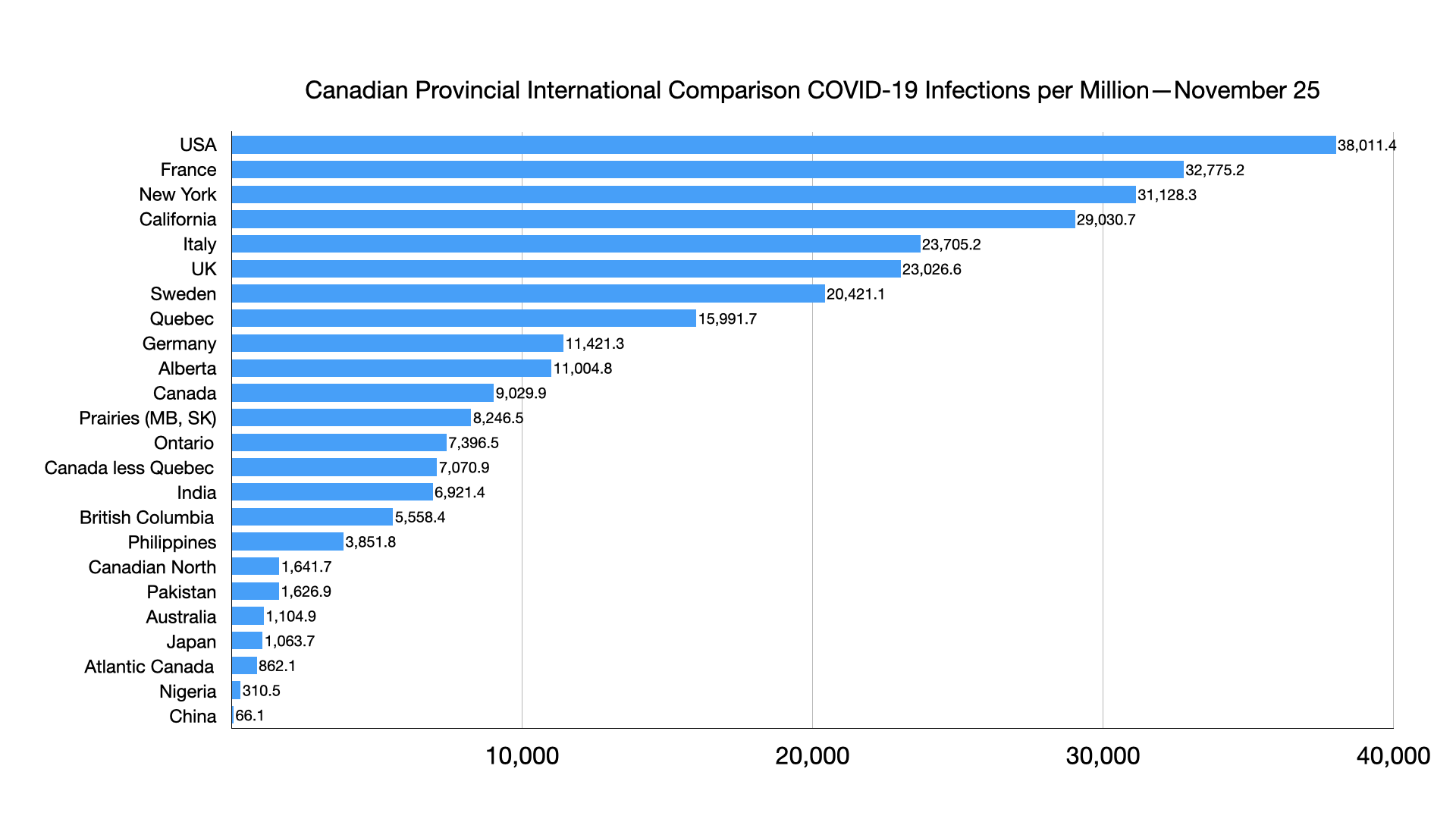
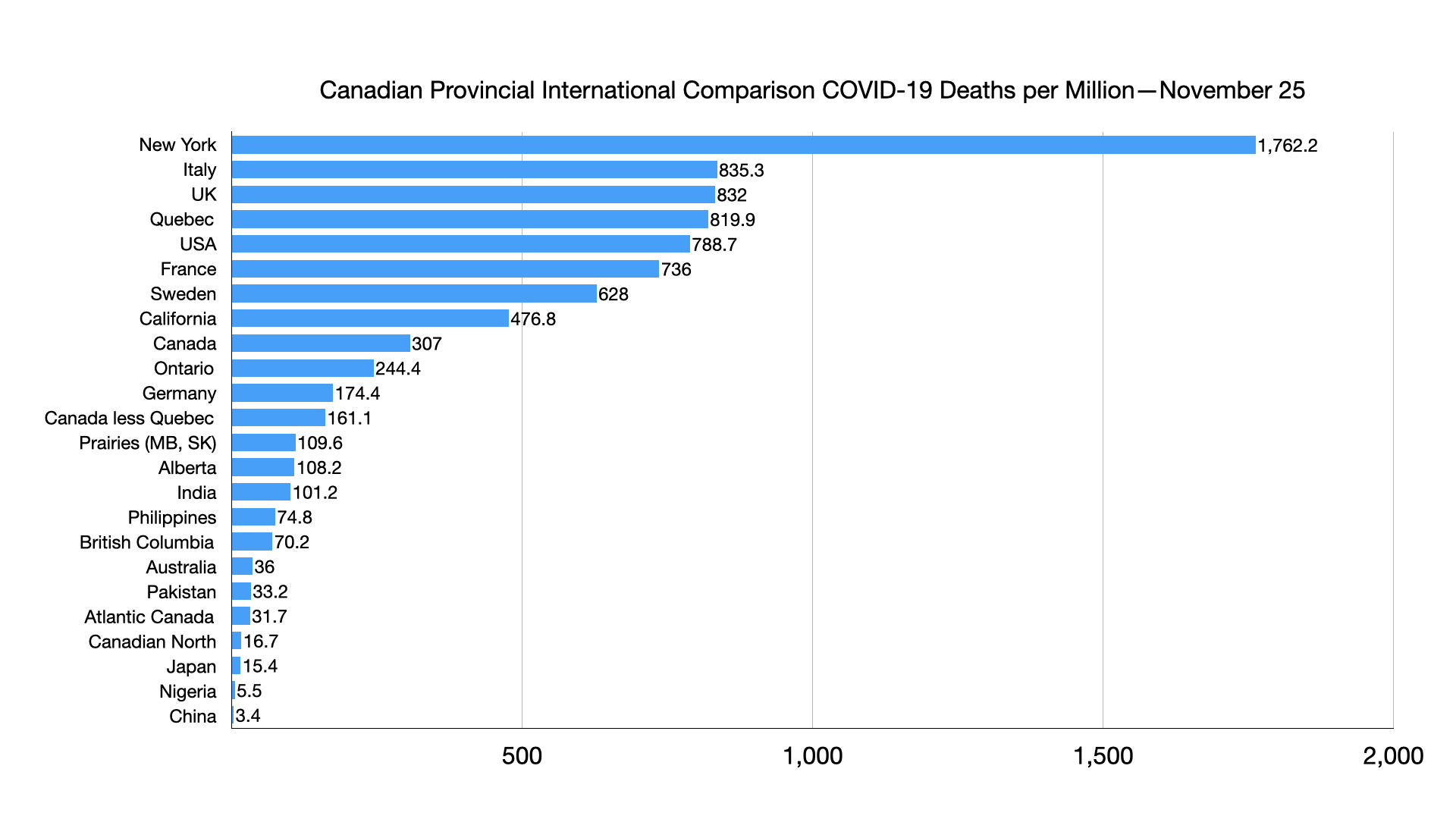
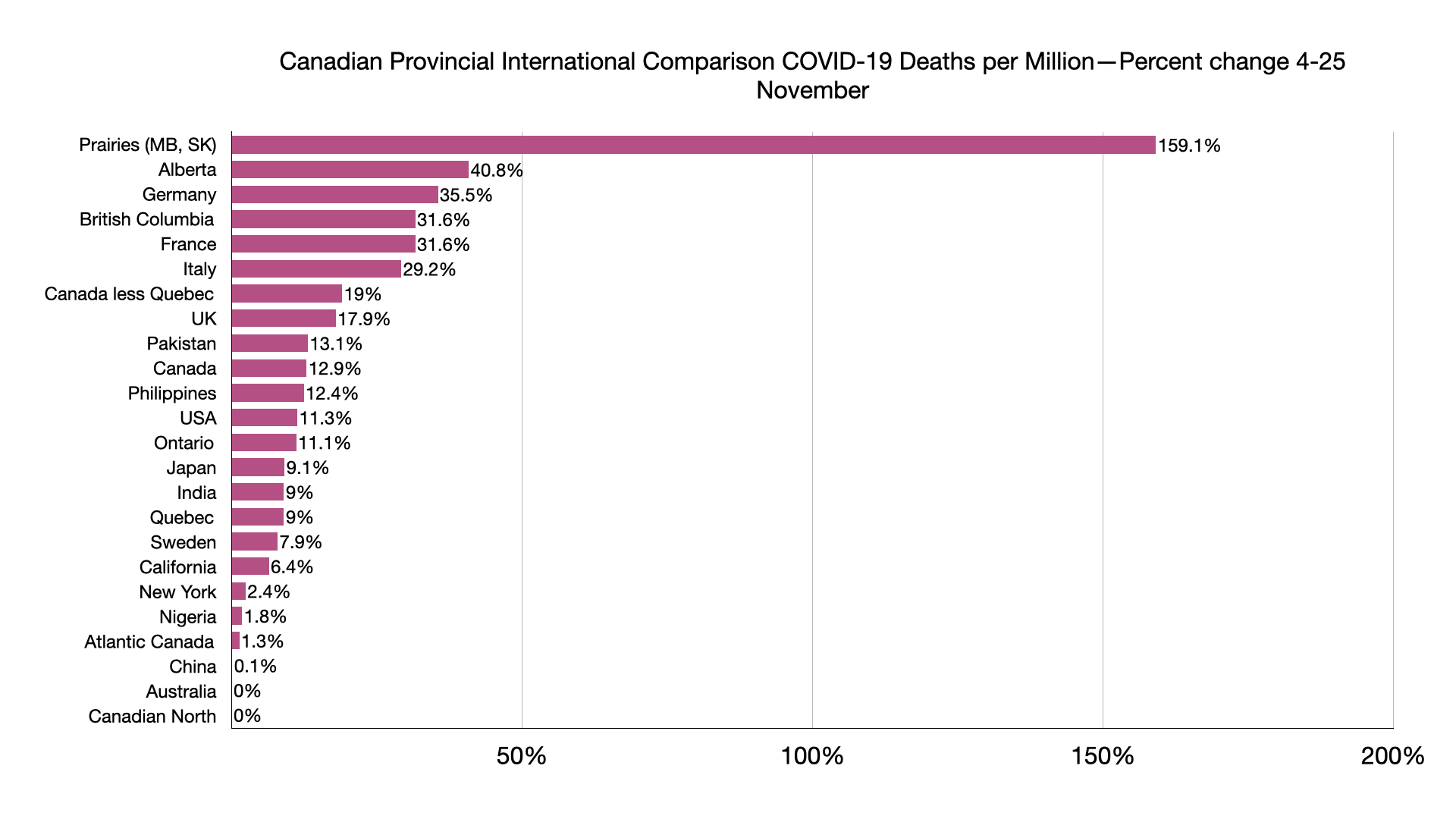
#COVID-19: Comparing provinces with other countries 11 November Update

Overall, infection rates continue to skyrocket with some increase in death rates. Prairies and North numbers particularly noteworthy.
 
Weekly:
 
Infections per million: Ontario ahead of India, Prairies ahead of Canada less Quebec, Canadian North ahead of Atlantic Canada 
 
Deaths per million: Italy ahead of USA, Germany ahead of Canada less Quebec, Prairies ahead of Philippine


South Asians play a part in COVID-19 transmission and we need to acknowledge it

Important and courageous piece by South Asian Canadian doctors:

Canadian society is an interwoven matrix of multiculturalism that contributes to the strength of our nation. The South Asian community comprises a significant part of this rich heterogeneity. Today, we write to you both as physicians, and also members of this vibrant community.

South Asian culture itself is extremely diverse, but there are some themes that are common throughout the vast subcontinent. One such theme is hospitality to others, no matter what background or creed. A guest leaving your house on an empty stomach is considered a travesty, and results in long meals and conversation. 

We grew up with a strong bond with our elderly relatives, and many of us still live in multi-generational families, respecting the traditions of our ancestors before us. Our weddings, cultural holidays, and music nights celebrate not only our unique culture, but embrace the family and friends that enrich our lives. This is the ethos that shaped us as health care providers and human beings. 

COVID-19 has changed the life of everyone on the planet, and South Asians are certainly no exception. The virus that transmits from person to person (especially in close, indoor environments) are the same places we find the most comfort in our community. While we all have been given the same public health advice and messaging, it is increasingly apparent that some groups are being affected harder than others. 

It is time to acknowledge that South Asians are acquiring and dying of COVID-19 at a degree higher than other Canadians, and we need to take immediate action.

The evidence is fairly profound. In Peel Region, one of the hardest hit areas across the country, South Asians account for about a third of the population, but account for almost half the COVID-19 cases. 

COVID-19 has changed the life of everyone on the planet, and South Asians are certainly no exception. The virus that transmits from person to person (especially in close, indoor environments) are the same places we find the most comfort in our community. While we all have been given the same public health advice and messaging, it is increasingly apparent that some groups are being affected harder than others. 

It is time to acknowledge that South Asians are acquiring and dying of COVID-19 at a degree higher than other Canadians, and we need to take immediate action.

The evidence is fairly profound. In Peel Region, one of the hardest hit areas across the country, South Asians account for about a third of the population, but account for almost half the COVID-19 cases. 

In Toronto, despite only being about a tenth of the population, South Asians account for a fifth of total cases. The city of Surrey in British Columbia, where approximately 30 per cent identify as South Asian, there have been three times the number of cases of any other greater Vancouver area. 

Many well publicized COVID-19 outbreaks in Canada have been associated with South Asian events, such as weddings. When these infections are later introduced into a large, multi-generational household, it’s easy to see how the problem can compound quickly. 

What are the consequences of this spread? South Asian populations are at higher risk for dying of COVID-19. Canadian data suggests the rate of death is 25 per cent higher in neighbourhoods with large South Asian communities as compared to those with small communities. 

A large study from the United Kingdom suggested South Asians were more likely to die of COVID-19 than the general population. The high rates of underlying diabetes, hypertension, cardiovascular disease, stroke, and obesity within the South Asian population are the very profile of risk factors that increase the risk of hospitalization, intensive care stay, and death with COVID-19. 

Furthermore, South Asians have a strong presence in public-facing professions in health care, commercial business, and the service/manufacturing industry, creating a higher risk of acquiring COVID-19 outside of home. 

Financial instability, particularly amongst new Canadians, creates disincentives for testing and participating in contact tracing. People afraid of losing income are liable to go to work even if feeling unwell thereby further propagating the spread of infection. 

Family structures, embracing our multi-generational cultures, create situations where young and old mix with prolonged close contact. Stigmatization, particularly of those who need to go into isolation or infect others, creates more hesitancy around testing when symptomatic. 

The next few months pose a difficult journey for COVID-19 cases and deaths, and the time for action is now. Our health care providers, communication experts, cultural and religious leaders, and the community as a whole need to embrace this challenge. 

Our values teach us the ethics of protecting our communities, and in this pandemic, protecting our most vulnerable members is a part of that. We need to examine our day-to-day activities, and provide support for one another, but in a safe way where non-essential contact is minimized. 

Indoor gatherings of individuals outside of our direct household must be temporarily stopped in order to limit spread — particularly with large celebrations, such as Diwali, upcoming. 

We need to be creative with outdoor spaces, trying to allow for some in person interaction while minimizing risk. 

We need to create virtual support networks to provide the stability and welfare of our community. 

We need to reach those suffering mental health and other consequences of the pandemic. 

Finally, we need to create culturally and linguistically appropriate materials to disseminate amongst our hardest to reach, encouraging distancing, hand hygiene, masking, self evaluation for symptoms, how to access testing, and holistic support for those who test positive. 

From a societal standpoint — a recognition of this minority community that has been hit particularly hard is paramount. Partnering with our local public health units and trying to engage our community leaders is essential for creating a position of trust. Understanding the cultural contexts that are unique to our population, such as multi-generational families, public-facing occupations, poor English literacy, and densely populated communities, allow for individualized planning that benefits society as a whole. 

The next few months pose a difficult journey for COVID-19 cases and deaths, and the time for action is now. Our health care providers, communication experts, cultural and religious leaders, and the community as a whole need to embrace this challenge. 

Creating campaigns discouraging large gatherings around festive events, rites of passage, and religious ceremonies, with local cultural leaders will help to prevent scenarios involving sustained indoor spread. Encouraging healthy workplaces, particularly reinforcing indoor masking and avoidance of prolonged close contact is paramount. 

The successes of these campaigns will not only benefit the South Asian population, but given how interwoven we are, the larger community will also prosper. The financial and human resource needs should be prioritized for the greater good of our society.

Many of our community made incredible sacrifices leaving their homes across the globe to reestablish themselves in Canada for the promise of a better life. We are fortunate in Canada to live in a society where our customs and traditions can be practiced freely, and we can contribute to the growth and success of our nation in all sectors. 

The time has come for us to recognize that collaboration with internal and external stakeholders in the South Asian community will lead to more sustainable outcomes for COVID-19 transmission, and the health of our community. 

Dr. Zain Chagla is an infectious diseases physician, St Joseph’s Healthcare in Hamilton and associate professor at McMaster University.Dr. Sumon Chakrabarti is an infectious diseases physician in Mississauga and a lecturer at the University of Toronto.Dr. Tajinder Kaura is an emergency medicine physician at the William Osler Health System and a clinical assistant professor (Adj) at McMaster University.

Source: https://www.thestar.com/opinion/contributors/2020/11/15/south-asians-play-a-part-in-covid-19-transmission-and-we-need-to-acknowledge-it.html?li_source=LI&li_medium=thestar_recommended_for_you

Three times more racialized renters live in overcrowded housing in Toronto than non-racialized renters — and the starkest gap is among those born in Canada, study says

Significant study on inequality and minority groups:

If you look at Toronto renters who spend at least 30 per cent of their income on housing — a traditional marker of unaffordability — you might miss the deep racial divides of the city’s housing crisis.

There’s barely a gulf between racialized and non-racialized renter households that spend that much: 41 per cent versus 43, respectively, census data says. Similarities prevail as fortunes get worse: 19 per cent of racialized renter households spend at least half their income on rent, versus 20 per cent of non-racialized households.

But a new study of census micro data, shared exclusively with the Star, reveals stark inequalities in the housing conditions of Toronto renters — especially in unsuitable housing, an indicator of overcrowding that was found to be nearly three times higher for visible minority renters.

For housing to be reported as unsuitable, it has to lack an adequate number of bedrooms for the size and composition of the household that lives there, according to the national occupancy standard.

University of Calgary researcher Naomi Lightman said looking at overcrowding allowed for a broader understanding of the housing crisis — noting that some renters may choose to squeeze more people into a smaller unit, instead of overspending on enough space.

“People are making choices within constrained conditions,” said Lightman, who co-authored the study with York University associate professor Luann Good Gingrich and Social Planning Toronto analyst Beth Wilson.

The data took on new weight during the COVID-19 pandemic, Lightman noted — neighbourhoods in Toronto with high levels of overcrowding have shown infection rates almost four times higher than in other areas, as stated by Toronto’s public health agency in July.

In York Centre in the city’s hard-hit northwest corner, 22 per cent of non-racialized renter households are considered unsuitable. Among racialized renters, that jumps to 51 per cent. In nearby York South-Weston, the unsuitability rate is 25 per cent and 49 per cent, respectively. Racialized renters in every city ward had higher rates of unsuitable, overcrowded conditions.

And though those gaps persisted among both the newcomer and long-term immigrant populations, the starkest racial divide the study found was among those born in Canada. While 14 per cent of non-racialized Toronto renters born in Canada reported unsuitable housing conditions, that number more than tripled for racialized non-immigrants — to 48 per cent.

Toronto councillor Joe Cressy, chair of the city’s board of health, said that finding illustrates how racism can be systemic — noting longstanding inequalities in access to employment and income.

“People often talk about opportunity like, you know, ‘Everybody gets a fighting chance,’” he said. “The fact of the matter is, in our city, non-racialized people are starting at the 50-yard line. And that’s due to decades of disproportional access and intergenerational wealth.”

Lightman said their data overall highlighted that the housing crisis played out in “different ways than we might have expected,” and had geographic implications within Toronto. “The divides between people translate into divides between places — and an increasingly segregated city.”

The findings are part of a multi-year research project on social exclusion in Canada. It examines micro data from the last census — specifically, data on affordability, unsuitability, housing in need of major repair, and what’s known as “core housing need.” The latter refers to housing that falls below any of those standards, where the household would have to spend 30 per cent or more of its pre-tax income to afford the median rent of alternative, adequate housing nearby.

Core housing need, like overcrowding, saw higher rates among racialized tenants — with 39 per cent of them reporting core housing need versus 27 per cent of non-racialized renters.

But Lightman said their work also underscored a need for more granular data, as it showed that certain groups — like Black, Latin American and Southeast Asian tenants — were reporting especially high rates of core housing need. While racialized and non-racialized renters had similar rates of unaffordable housing, the study found more than half of Korean, West Asian, Arab and Chinese renters reported spending at least 30 per cent of their income on shelter.

Avvy Go, director of the Chinese and Southeast Asian Legal Clinic, said the findings about specific racialized communities underscored a need for more disaggregated, race-based data in the housing sphere, to understand which communities are facing the worst outcomes, followed by more targeted efforts from governments to address the housing crisis within those groups.

While Go said she’d expect racialized communities to struggle more in the rental housing market — noting that racialized people were more likely to live in low-income households in general — the difference in the study between racialized and non-racialized renters, born in Canada and living in unsuitable housing, was more significant than she would have expected.

“Even if you take away immigration status as a factor, there is still a racialized gap. You cannot blame it on the fact they are born outside of Canada, to explain away the racial inequality that exists in Canada,” she said.

Cressy backed calls for more disaggregated data, noting the city’s executive committee will consider a strategy on Wednesday that would collect voluntary data on race from those who use city services or participate in public consultations.

“In the face of data, decision makers have one of two choices,” he said. “They can address it, or they can remain complacent.”

Source: Three times more racialized renters live in overcrowded housing in Toronto than non-racialized renters — and the starkest gap is among those born in Canada, study says

Vaughn Palmer: Failure to recruit female and minority candidates killed Liberal hopes in BC election

One element:

The B.C. Liberal party executive is calling on members and supporters to join “open and honest conversations” and “serious and exciting debates” about the party future.

But two recent statements from Liberals — one a defeated MLA, the other a former candidate — may be more honest and exciting than the current leadership can survive.

Taking direct aim at party leader Andrew Wilkinson was Jane Thornthwaite, beaten in her bid for a fourth term as Liberal MLA for North Vancouver-Seymour.

Source: Vaughn Palmer: Failure to recruit female and minority candidates killed Liberal hopes

Hate crimes in US reach highest level in more than a decade

Of note (still less than the previous high in 2008) so not all attributable to Trump. Canadian police-reported hate crimes 2019 numbers not yet out:

Hate crimes in the U.S. rose to the highest level in more than a decade as federal officials also recorded the highest number of hate-motivated killings since the FBI began collecting that data in the early 1990s, according to an FBI report released Monday.

There were 51 hate crime murders in 2019, which includes 22 people who were killed in a shooting that targeted Mexicans at a Walmart in the border city of El Paso, Texas, the report said. The suspect in that August 2019 shooting, which left two dozen other people injured, was charged with both state and federal crimes in what authorities said was an attempt to scare Hispanics into leaving the United States.

There were 7,314 hate crimes last year, up from 7,120 the year before — and approaching the 7,783 of 2008. The FBI’s annual report defines hate crimes as those motivated by bias based on a person’s race, religion or sexual orientation, among other categories.

Some of the 2019 increases may be the result of better reporting by police departments, but law enforcement officials and advocacy groups don’t doubt that hate crimes are on the rise. The Justice Department has for years been specifically prioritizing hate crime prosecutions.

The data also shows there was a nearly 7% increase in religion-based hate crimes, with 953 reports of crimes targeting Jews and Jewish institutions last year, up from 835 the year before. The FBI said the number of hate crimes against African Americans dropped slightly to 1,930, from 1,943.

Anti-Hispanic hate crimes, however, rose to 527 in 2019, from 485 in 2018. And the total number of hate crimes based on a person’s sexual orientation stayed relatively stable, with one fewer crime reported last year, compared with the year before, though there were 20 more hate crimes against gay men reported.

As the data was made public on Monday, advocacy groups, including the Anti-Defamation League, called on Congress and law enforcement agencies across the U.S. to improve data collection and reporting of hate crimes. Critics have long warned that the data may be incomplete, in part because it is based on voluntary reporting by police agencies across the country.

Last year, only 2,172 law enforcement agencies out of about 15,000 participating agencies across the country reported hate crime data to the FBI, the bureau said. And while the number of agencies reporting hate crimes increased, the number of agencies participating in the program actually dropped from the year before. A large number of police agencies appeared not to submit any hate crime data, which has been a consistent struggle for Justice Department officials.

“The total severity of the impact and damage caused by hate crimes cannot be fully measured without complete participation in the FBI’s data collection process,” the Anti-Defamation League’s president, Jonathan Greenblatt, said in a statement.

An Associated Press investigation in 2016 found that more than 2,700 city police and county sheriff’s departments across the country had not submitted a single hate crime report for the FBI’s annual crime tally during the previous six years.

Greenblatt also said America must “remove the barriers that too often prevent people in marginalized communities – the individuals most likely to suffer hate crimes – from reporting hate-based incidents,” a sentiment shared by other advocates.

“The FBI’s report is another reminder that we have much work to do to address hate in America,” said Margaret Huang, the president of the Southern Poverty Law Center.

Source: Hate crimes in US reach highest level in more than a decade

The Mentality That Explains Trump’s Dead-Enders

Possible cult thesis:

In 1954, social psychologist Leon Festinger embedded himself in a cult called The Seekers, whose leader, Dorothy Martin, preached that a UFO would rescue them before destroying the planet on Dec. 21 of that year. When that didn’t happen, many sect members left. But most of the inner circle remained, inventing all kinds of rationales for why the prophecy didn’t come true (e.g. their faith persuaded the aliens to give Earth a second chance) and redoubled their devotion.

From this research, Festinger developed the theory of cognitive dissonance: that human beings will do just about anything to resolve contradictions between our deeply held beliefs about the world and the reality of the world itself. Cognitive dissonance is so unpleasant, so disordering and catastrophic for the ego, that no amount of absurd, tortured reasoning is worse than reality contradicting a deeply held belief.

Sound familiar?

I first encountered the concept of cognitive dissonance as a grad student in religious studies (I ended up writing my dissertation on a failed messianic movement) but it’s become a cornerstone of contemporary psychology in a variety of contexts. It applies to much more than religion: it is, I think, the best explanation for today’s political and ideological divides, and for the mind-blowing fact that 70 percent of Republicans say they think the election Trump lost was not “free and fair.”

All of us try to resolve cognitive dissonance, but the Trump movement has been a years-long exercise in it. Election denial is its latest manifestation. But before that came COVID denial, science denial, climate denial, ‘alternative facts,’ the inability of Trump’s most devoted fans to see him for the obvious con man that he is, and, at the movement’s very core, denial of the social and demographic changes that are transforming America.

In all of these cases, developments in history are contradicting deeply held beliefs—in fact, not mere “beliefs” but organizing principles of the world that create one’s sense of place within it. If Donald Trump legitimately lost the election, most Americans can put up with Socialism or Black Lives Matter or the Liberal Media or whatever else. If America is really, legitimately changing, then the white-, male-, straight-, and Christian-dominated world is gone and will never come back. If climate change is real, then the way I’ve been living my life has been causing harm, and has to change, even if that means government regulations and restrictions. If the Republicans are just duping me into supporting massive benefits for the ultra-rich, I’m a stupid mark. If Trump really is a con man with a bad weave and even worse makeup, then I’ve been deluded for four years. And so on.

Again, these aren’t mere beliefs; they are how people understand themselves and their communities. That’s what’s challenging about cognitive dissonance. It’s pointless to argue facts with someone in the throes of denial, because no twist of facts is too preposterous to entertain if the alternative is letting go of one’s entire worldview and sense of self.

Cognitive dissonance is also a primary reason that people resort to conspiracy theories, which Trumpworld increasingly resembles, not only in fringe manifestations like QAnon but in the allegation of widespread fraud in the presidential election, which, of course, has no factual basis whatsoever and is, at this point, simply a conspiracy theory writ large.

Conspiracy theories explain phenomena too difficult to simply accept: Plandemic explains how COVID-19 could upend the world, Trutherism explains how 9/11 could upend the world, QAnon explains how Trump has “not yet” uprooted the profound evil among American elites. And for believers, however horrible the conspiracy is—Cannibal pedophiles! Reptilian aliens!—it is less horrible than the possibility that no one is minding the store, that bad things happen to good people, that life is filled with randomness, chance, and change, and that most people actually don’t agree with your ideas, all of which are cognitively dissonant for human animals trying to find security in the world.

“Plandemic explains how COVID-19 could upend the world, Trutherism explains how 9/11 could upend the world, QAnon explains how Trump has “not yet” uprooted the profound evil among American elites.”

In this light, QAnon isn’t some weird, fringe phenomenon with no connection to populist politics. It’s a logical extension of the populist worldview. If “the people” are actually the majority, then a sinister minority—Jews, ‘coastal elites’, the media, the Satanic pedophiles, whoever—is actually in control. It’s a short jump from that to full-blown conspiracy madness. And when the anointed messenger of “the people” turns out to be a buffoon chiefly interested in his own enrichment, well, that must all be a ruse. Or a media conspiracy. Or whatever.

In fact, of course, America is changing not because of manipulation by shadowy elites, be they coastal, Semitic, pedophiliac, or reptilian, but because of demographics and social change on questions like sexuality, gender, race, and religion. The numbers are incontrovertible. But that would mean that the populists are actually wrong about what “America” even is. That would mean they are wrong about who they are; they’re not the “real Americans,” they’re just one subset of real Americans, and a dwindling one at that. That is intolerable.

To be sure, denial as a means of avoiding cognitive dissonance exists across the political spectrum. Plenty of progressives have been 9/11 Truthers, anti-vaxxers, and COVID deniers. Plenty more believe in astrology, pseudo-science, and the quackery of the “wellness industry” despite contrary evidence. In the phenomenon known as “conspirituality,” many have even co-opted right-wing conspiracies like QAnon and grafted them onto a New Age worldview.

Nor is right-wing cognitive dissonance new. Drawing on the McCarthy period, historian Richard Hofstadter coined the term “paranoid style in American politics” to describe the populist worldview, as alive now as then, that sees real America as simultaneously a beacon of strength and a citadel under siege by nefarious outsiders (communists, Jews, Muslims, immigrants, whoever). Someone is always out to destroy America, and it’s always five minutes to midnight.

Likewise today. Trump can’t be defeated fairly—that would mean that America isn’t what the “America First” crowd says it is, and that the identities of tens of millions of Americans are in need of serious revision. So it must be the fault of some ‘Other’: the media, the Democrats, the Jews, the great Satanic conspiracy.

The human aversion to cognitive dissonance is widespread, powerful, and connected to our core conceptions of the meaning of life and how to survive it. It is as primal as it gets. So no, my numerous data-filled articles about Trump’s lawsuits will not persuade a true believer.

Don’t worry, though; cognitive dissonance is so strong a motivator that it will eventually triumph over its current manifestation. When the facts are incontrovertible, all but a small hardcore of Trump’s supporters will simply tweak their meta-theories. God works in mysterious ways, after all. Or maybe Biden’s election was punishment for our sins. Or maybe, for those more secularly inclined, we were getting complacent under Trump, and now we’ll have to wake up.

Whatever it takes, Trump’s devoted base will find a way to preserve their beliefs in the face of his eventual loss. I suppose that’s a good thing: eventually they’ll figure out a way to explain that, too.

Source: The Mentality That Explains Trump’s Dead-Enders

‘A pandemic of grief’: StatCan’s first-ever data on Black victims of homicide prompts calls for targeted trauma services

Important to have this data and the findings to drive home the need for change:

For the first time ever, Statistics Canada has released race-based homicide data that reveals a stark representation of Black Canadians among homicide victims in 2019, prompting calls for targeted mental health programming for members of the Black community.

StatCan’s 2019 homicide data, released on Oct. 29, shows one-third of homicide victims were visible minorities — 44 per cent of whom were identified as Black, yet Black people account for only 3.4 per cent of the Canadian population.

In Toronto, the numbers are more stark: 51 per cent of the city’s population identify as visible minorities, yet visible minorities made up 75 per cent of homicide victims.

The numbers come amid a year marked by more than 425 shootings to-date in Toronto that led to 201 deaths or injuries, many of which occurred in Black Creek and York University Heights, where a large population of African, Caribbean and Black Canadians call home — and where a shooting on Saturday claimed the life of a 12-year-old boy, who succumbed to his injuries Wednesday.

StatCan’s data are the first federal numbers released on the race of homicide victims in Canada specific to Black Canadians — information that has long been readily-available in the United States.

But it affirms what many have known all along, researchers say: there is disproportionate and widespread grief among African, Caribbean and Black communities in Canada that must be addressed.

“This is a pattern of inequity that has created a pandemic of grief, and we have a responsibility to address those structures that are contributing to this,” said Dr. Tanya Sharpe, an associate professor at the University of Toronto and the Factor-Inwentash Chair in Social Work in the Global Community.

Sharpe said the stark homicide rates have had a “devastating impact” on the mental, physical and spiritual well-being of communities of colour who are disproportionately forced to cope with the murder of their loved ones. She estimates that, on average, each homicide leaves behind seven to 10 friends and family members struggling with grief.

“It often presents itself in the form of complicated, elongated grief of emotional numbing, lack of motivation and traumatic stress reactions, depression, hypervigilance, anxiety and insomnia,” Sharpe said.

Research Sharpe has done on African-American communities in the United States found the homicide of a loved one leads to symptoms of post-traumatic stress disorder. It also ignites feelings of shame and guilt, both for the inability to protect the victim and due to stigma and racism Black communities face as a whole.

Sharpe, who is from Baltimore, has dedicated the last two years to researching and studying the impact of homicide on Toronto’s Black population. She said initially, the lack of race-based data collection in Canada astonished her.

“That blew me away,” Sharpe said. “In the U.S., we can only just open our Bureau of Census Statistics and find all kinds of data relevant to homicide victims, where they are and who they are, so we can easily paint a picture and have it inform our research, policy and practise.”

In Canada, she said, the lack of race-based data equals erasure of the experiences of Black Canadians who are disproportionately impacted by homicide. “Race-based collection of data matters,” Sharpe said. “If you’re not counting it, then people feel as if they don’t count.”

For this reason, Sharpe founded The Centre for Research and Innovation for Black Survivors of Homicide Victims, or the CRIB — the first centre of its kind in Canada dedicated to projects researching the traumatic impact of murder on surviving family members and their communities, and how best to address it.

Through a study done by the CRIB alongside the Canadian Mental Health Association (CMHA), Sharpe found there is a lack of understanding by mental health professionals to address the issue of trauma in communities of colour, and that 65 per cent of Ontario service providers, from probation officers to psychologists, don’t feel they have the culturally responsive skills to best serve Black and Indigenous populations.

Informing better policy is one of the reasons Statistics Canada announced its intent to publish homicide data on ethnocultural groups in July, but it also aligned with broader calls for racial equality from the public.

Warren Silver, the national training officer of the Policing Services Program at StatCan, said the federal agency had collected data specific to Indigenous people since 2014 because of the Missing and Murdered Indigenous Women and Girlsmovement.

While StatCan was already working on providing homicide data on other ethnicities, Silver said calls for racial equity in 2020, specifically for Black communities following the death of George Floyd, a Black man killed by Minneapolis police, have “definitely pushed” the needle forward.

Sharpe said the release of the data is a “step in the right direction.” What’s still missing from the numbers, however, is the context behind how African, Caribbean and Black Canadians are impacted by it.

Sharpe said the CRIB hopes to unearth some of that by launching Canada’s first study focusing on the experiences of African, Caribbean and Black Canadians after the homicide of a loved one, called the Invisible Wounds Project. The research project will begin in April 2021.

The data collected, with the help of the Canadian Centre for Addiction and Mental Health and CMHA, Sharpe said, will inform the development of policy and intervention that can help support organizations meet the needs of those families.

The presence of official data from Statistics Canada marks a beginning, Sharpe said.

“But we have got to contextualize the experience of homicide for Black communities to better be able to respond.”

Source: ‘A pandemic of grief’: StatCan’s first-ever data on Black victims of homicide prompts calls for targeted trauma services

Religious Freedom Arguments Give Rise To Executive Order Battle

As in so many policy areas, partisan gridlock:

Key government policies on religious freedom and discrimination, once set through legislation, are increasingly dictated by presidential orders, meaning they shift capriciously from one administration to the next.

In 2014, advocates for LGBTQ rights cheered when President Obama unilaterally issued an executive order prohibiting federal contractors from discriminating in their hiring practices on the basis of sexual orientation or gender identity.

Four years later, the Trump administration weakened that order with another unilateral movedirecting that contractors facing a discrimination claim under Obama’s order should be entitled to a “religious exemption.”

The Labor Department then proposed a rule that would give the directive the force of law and permit faith-based contractors to give hiring preference to individuals with particular religious beliefs, such as an opposition to same sex unions or transgender identities.

That time, it was conservatives who were pleased.

Such back-and-forth executive orders are now set to continue under President-elect Joe Biden, who has promised to reverse President Trump’s hiring directives.

Behind the dueling orders is a deep disagreement over the meaning of the First Amendment guarantee of religious freedom. Conservatives say the right to “free exercise” of religion means people and organizations should be able to act on their religious objections to abortion, same sex marriage, or accommodation policies for transgender individuals.

Others say the First Amendment’s prohibition against the “establishment” of a religion means that religion-based arguments should not be used to justify discrimination or the denial of civil rights or basic human services.

Such conflicts in the past have been resolved through legislative remedies. Congress passed the landmark Civil Rights Act in 1964 and the Religious Freedom Restoration Act in 1993. Both measures had bipartisan support, but that consensus has since broken down.

Health care and nondiscrimination became so partisan,” says Holly Hollman, general counsel at the Baptist Joint Committee for Religious Liberty. “We’ve kind of lost our shared definition and commitment to religious liberty in ways that make it harder to legislate.”

The prospect of a divided government in 2021, with Joe Biden in the White House and possibly a Republican-led Senate, means that consensus around religious freedom issues may continue to be elusive.

“Given the gridlock, we’re going to see more unilateral action from the executive branch, whether it be regulatory action or executive orders,” says Ryan Anderson, a research fellow at the Heritage Foundation who writes often on religious freedom issues.

Following his 2014 order barring discriminatory hiring practices by federal contractors, Obama issued guidance in 2016 that required schools to protect transgender students from harassment and to accommodate their identities with respect to pronouns and bathrooms.

That guidance, however, was rescinded shortly after Trump was inaugurated, when his administration told school districts that the relevant policies were more properly established by state and local authorities.

Three months later, Trump issued a sweeping order “promoting free speech and religious liberty.” The order called for weaker enforcement of the Johnson Amendment, which bars tax-exempt religious groups from endorsing political candidates. It also instructed government agencies to consider new regulations to address “conscience-based objections” to the provision of certain health care services, and it directed the Attorney General to issue guidance to all federal agencies on what religious liberty protections require.

Among the agencies responding quickly to the order was the Department of Health and Human Services (HHS), where a conservative activist, Roger Severino, was put in charge of a “conscience and religious freedom division” under that department’s Office of Civil Rights, which Severino directs.

“Every agency has a civil rights office in the federal government,” Severino noted last month in a video presentation. “Not every agency, until now, had a religious freedom office. And now we do.”

Over the course of his term in office, Trump has taken a variety of unilateral steps to promote a conservative view of religious freedom, many of which a Biden administration might be inclined to reverse.

The American Civil Liberties Union (ACLU) and Americans United for Separation of Church and State (AU) have both issued detailed lists of the executive actions they expect to see Biden take in the area of religious freedom, perhaps beginning with a broad order similar to the one Trump issued.

“We would like to see the Biden administration sign an executive order to restore and protect religious freedom for all Americans,” says Rachel Lazer, the AU president, “and make clear that religious freedom should operate as a shield to protect us and not as a sword to license discrimination.”

Some of Trump’s executive actions will be easier than others to reverse. The directive to weaken enforcement of the Johnson Amendment could be countered simply by mandating strengthened enforcement. Other issues could be settled through the courts.

An HHS-issued “conscience rule” that would allow health care workers to refuse to provide medical services that conflict with their moral and religious beliefs has faced several court challenges and is now on appeal before the U.S. Court of Appeals for the Second Circuit. The AU’s Lazer says a Biden administration could simply decline to defend the rule.

“We would expect that the Biden administration would not carry forward with any type of appeal,” Lazer says. “[That] would cut that off at the knees.”

Some of Trump’s directives would be vigorously defended by outside groups, however, particularly where they concern sexuality and marriage.

“There are a variety of religious traditions that hold viewpoints on this question,” says Ryan Anderson, of the Heritage Foundation. “Orthodox Jews, Roman Catholics, evangelicals, Latter Day Saints, Muslims, and various people who accept the Genesis creation story are going to have strong convictions about male and female.”

Under President-elect Biden, Anderson says, “the government might be asking us to violate those convictions. If we’re going to be pluralistic, how do we navigate those disagreements?”

Even if a Biden administration manages to undo some of the government directives that reflected conservative interpretations of religious freedom principles, other groups could go to court with similar claims, using the same arguments.

“The undoing would give rise to legal challenges,” warns Louise Melling, the deputy legal director at ACLU.

Such challenges are likely to get a more favorable hearing, given the installation of more conservative judges in federal courts across the country and a newly powerful conservative majority on the U.S. Supreme Court.

“The court is clearly in the midst of reconceiving some of our religion statutes and the constitution, I think,” Melling says.

With that prospect, battles over religious freedom are likely to continue, no matter the presidential administration.

Source: Religious Freedom Arguments Give Rise To Executive Order Battle

Canada better fits the definition of a state committing genocide than Xinjiang region, China says

Cultural genocide with respect to Indigenous peoples, but acknowledge, recognition and efforts to address past and present injustice. None of which is happening in China. And legitimate to call for boycott of 2020 Winter Olympics in China:

The Chinese government says Canada better fits the definition of a state committing genocide than the Xinjiang region, pointing to population growth rates – some inaccurate – that it says demonstrate it has not mistreated its Uyghur population.

China’s foreign ministry spokesman Zhao Lijian also scoffed at the “ignorance” of Bob Rae, the Canadian ambassador to the United Nations, who on Sunday said “there’s no question that there’s aspects of what the Chinese are doing” in Xinjiang that “fits into the definition of genocide in the Genocide Convention.”

Mr. Rae’s comments mark the latest escalation from the Canadian government in its condemnation of Chinese policies in Xinjiang, where women have been sterilized, large numbers of people have been forced into political indoctrination camps and mosques have been demolished. Mr. Rae made the comments to the CBC, saying he has called for the United Nations Human Rights Council to mount a genocide investigation in Xinjiang.

On Monday, Mr. Zhao mocked Mr. Rae for his “ridiculous” remarks, pointing to demographic statistics as evidence. In Xinjiang the Uyghur population has increased by 25 per cent between 2010 and 2018, he said, a rate he called “18 times the rate of Canada.” That would suggest that “it is the Canadian people, rather than the Uyghurs, who are being persecuted,” he said, adding: “The ambassador should have done his homework beforehand to avoid making a fool of himself.”

Mr. Zhao, however, cited inaccurate figures. Canada’s population grew by more than 10 per cent between 2010 and 2018, according to Statistics Canada.

And Mr. Zhao did nothing to refute the dramatic changes in Hotan and Kashgar, Uyghur-dominated areas of Xinjiang where birth rates fell more than 60 per cent between 2015 and 2018, the Associated Press has reported. The Xinjiang Health Commission has in public documents called for population growth rates in some areas with large Uyghur communities to be brought considerably below 2016 levels, according to research by Adrian Zenz, a U.S.-based scholar and senior fellow in China studies at the Victims of Communism Memorial Foundation.

“In Guma [Pishan] County, the 2019 family planning budget plan specifically called for 8,064 female sterilizations,” Mr. Zenz wrote in a report this summer.

The United Nations Convention on the Prevention and Punishment of the Crime of Genocide defines genocide as acts that include “imposing measures intended to prevent births within [a] group,” as well as “causing serious bodily or mental harm to members of [a] group.”

Some ethnic Muslims in Xinjiang who went through centres for political indoctrination and skills training have described conditions so oppressive they attempted to kill themselves.

But few have been willing to accuse China of genocide. U.S. Secretary of State Mike Pompeo has said China’s actions in Xinjiang “remind us of what happened in the 1930s in Germany,” while a resolution in the U.S. Senate has said China’s campaign “against Uighurs, ethnic Kazakhs, Kyrgyz and members of other Muslim minority groups … constitutes genocide.”

Chinese authorities have said they have protected human rights in Xinjiang by creating stability and helping to grow the economy. The Chinese government has defended its use of forcible political indoctrination as a necessary redress for radical thought. More recently, it has said that “students” in indoctrination centres have all “graduated.”

The Chinese government has said publicly that it has invited a European Union delegation to see the “real situation” in Xinjiang. That visit has not taken place because the two sides have yet to agree on terms.

Other governments, including in Australia, have declined to use the term “genocide,” saying such a determination is for courts to make.

Scholars, however, argue that the key question is not evidence but national will.

“There is a plethora of evidence in this case, but I think the larger problem will be the political capacity of international institutions to challenge a state as powerful” as China, said Sean Roberts, an international affairs specialist at George Washington University who is the author of The War on the Uyghurs: China’s Internal Campaign against a Muslim Minority.

For Ottawa to lend its voice is important, he said. But it “will take a broad coalition of different states to change Beijing’s behaviour. If this is followed by others, it will indeed be significant, especially if those other states extend beyond the US, EU, and the British commonwealth.”

National leaders should also consider steps outside a genocide case, said Timothy Grose, a scholar who specializes in Xinjiang and Chinese ethnic policy at the Rose-Hulman Institute of Technology.

That could include “a broad boycott of the 2022 Beijing Winter Olympics,” he said.

“”It is now up to world leaders and global corporations to persuade China to halt its state-violence against Uyghurs,” he said.

“A boycott would devastate revenue for the host city Beijing and the negative journalistic attention a boycott would attract – that would occur on a global scale – would almost certainly force leaders’ hands.”

Source: Canada better fits the definition of a state committing genocide than Xinjiang region, China says