Illegal Immigration In America Has Continued To Decline

Useful context:

In a report that could provide context to most immigration news stories, new research reveals that the number of unauthorized immigrants has continued to decline in the United States. The unauthorized immigrant population fell to 10,350,000 in 2019, a decline of 12% since 2010. The approximately 10.4 million unauthorized immigrants represent about 3% of the total U.S. population. A majority have lived in the U.S. for more than a decade.

While Donald Trump railed against illegal immigration from Mexico, it turns out demographics and economic conditions in Mexico had already addressed the issue. “The undocumented population from Mexico declined so much in the past decade that its share dropped to less than half of the total population,” according to new research from Robert Warren, a demographer and senior visiting fellow at the Center for Migration Studies. “From 2010 to 2019, the undocumented population from Mexico declined by about 1.9 million, and the undocumented population from the rest of the world increased by about 500,000.”

Among the key findings in Warren’s report:

–        “The undocumented population continued to decline in 2019, falling by 215,000 compared to 2018; this population has declined by 1.4 million, or 12%, since 2010.”

–        “Return migration of undocumented residents to Mexico was principally responsible for the decline of almost 1.9 million in the total undocumented population from 2010 to 2019.”

–        “The undocumented populations from Central America and Asia increased at the same rate from 2010 to 2016. After 2016, the population from Asia stopped growing, and the population from Central America increased by about 200,000.”

–        “Since 2010, the undocumented population from Mexico has fallen from 6.6 million to 4.8 million, or by 28%.”

–        “In 2019, 42 states and Washington, DC, had fewer undocumented residents from Mexico than they had in 2010. The states with increases in undocumented persons from Mexico had small undocumented populations.” Between 2010 and 2019, the number of unauthorized immigrants from Mexico declined by 35% in California, 13% in Texas, 23% in Arizona, 41% in Illinois, 37% in Georgia and 27% in Florida.

However, news and politics are often dominated by the short-term, including what is happening at any moment on the U.S.-Mexico border.

Ali Noorani, president and CEO of the National Immigration Forum, believes a combination of people today are crossing the U.S.-Mexico border. “My sense is that we are talking about unaccompanied minors (UACs) presenting themselves for protection, families who were in Migrant Protection Protocols (MPP) in Mexico and are re-entering through the UNHCR (United Nations High Commissioner for Refugees) process, families with young children who Mexico will not take back (in particular those in south Texas) and the population of single adults by and large from Mexico who are entering, apprehended, expelled and who then try to enter again,” he said in an interview.

“Nothing at the border right now is a surprise,” said Noorani on Twitter. “Therefore, it should not escalate to a crisis. The Biden administration needs to put in place the infrastructure, logistics and processes to manage the border. A crisis is when Trump expelled thousands of migrant children back to Mexico, strong-armed/bribed unsafe countries to pretend to be safe countries, and forced thousands of families to wait in Mexico while eviscerating the immigration system.”

The current situation at the border could affect bills to legalize Dreamers and others in the United States, although Robert Warren found no evidence that Congress considering legalization affects migrant decisions to come to America.

“An important finding is that the comprehensive immigration reform bill, S. 744, passed by the U.S. Senate in June 2013, did not cause an increase in undocumented immigration from Mexico,” writes Warren. “Instead, return migration fell by about half during the period that the bill was under active consideration. The finding that proposed legalization programs do not increase undocumented migration provides support for legalization proposals forthcoming from the Biden administration.”

A letter (February 2, 2021) from legal, religious and humanitarian organizations urged President Biden to stop using the authority invoked by the Trump administration to expel people at the border without due process. “We write to urge your administration to immediately end the misuse of Title 42 public health authority to illegally and inhumanely expel asylum seekers and migrants at the border,” according to the letter from Human Rights First, America’s Voice, American Immigration Lawyers Association, Anti-Defamation League, Kids in Need of Defense (KIND) and other groups.

“Since March 2020, the Department of Homeland Security (DHS) has blocked and turned away people at the southern border, including asylum seekers and children, without access to the U.S. asylum system or preliminary protection screenings, sending them to persecution, torture and other serious danger in violation of U.S. refugee and anti-trafficking laws and treaty obligations. The Trump administration, for instance, expelled prominent Nicaraguan dissidents who had attempted to seek asylum in the United States, returning them to Nicaragua where authorities had detained and beaten them for their political activism. Your administration continues to block and expel people, including families with children, under the same policy.

“These expulsions are being carried out under orders that Trump Administration officials pressured the Centers for Disease Control and Prevention (CDC) to issue despite objections by senior CDCmedical experts. . . . During the presidential campaign, you committed to end inhumane Trump administration border policies, uphold U.S. laws and treaty obligations to protect refugees and immigrant children, and adopt COVID-19 measures based in science. For your actions to reflect those promises, your administration must end the misuse of Title 42 public health authority at the border, stop blocking and expelling people seeking U.S. humanitarian protections, ensure appropriate infrastructure and support for shelters and other border groups to assist asylum seekers, and allow these families, children and adults to pursue their requests while in safety, inside the United States.”

In addition to addressing humanitarian concerns, the solution to preventing most future illegal entry is to make it possible for individuals to apply to work legally in the United States at the types of jobs many would otherwise fill as unauthorized immigrants.

Fernando Castillo picks “oranges and other crops for Elkhorn Packing, a company that provides labor through H-2A visas . . . He heard about the program through his job back in Tamaulipas, Mexico. It’s a good way to make more money, he says.”

“‘Because here the salary is a bit more than over there, and to help the bosses,’ he says,” according to National Public Radio. “The bosses he’s referring to are his parents. The 29-year-old sends money to them and his siblings. ‘To buy food to buy whatever they need in Mexico. Because in that country the salary is not enough to do certain stuff,’ he says. ‘And the American money over there gives people better benefits.’”

Contrast Fernando Castillo, who had a legal work visa and happily sends money to his family, with the fate of Yesenia Magali Melendrez from Guatemala.

“Yesenia Magali Melendrez Cardona told her father she wanted to follow in his footsteps,” reported the Los Angeles Times. “He had made the trek from Guatemala to the U.S. 15 years earlier in search of a new life. In February, she left a job and her studies behind and headed north. Chiquimulilla, the town where she had spent her 23 years, had been ravaged by the pandemic. Unemployment was rising. The population was desperate. The streets were too dangerous to walk at night.

“On Tuesday, Yesenia found herself in a situation just as perilous as the one she had fled. A maroon Ford Expedition bore a suspected smuggler and 24 people racing toward what they hoped would be safety. Yesenia and her mother, Verlyn Cardona, were wedged in the back when it drove through a breach in the fence separating Mexico from California.

“It was broadsided in the Imperial County town of Holtville by a semi hauling two empty trailers. It came to a stop, windshield shattered, at the intersection of Highway 115 and Norrish Road.

“Seventeen passengers were ejected from the SUV. When Verlyn regained consciousness in the back of the crumpled vehicle, her daughter was sprawled across her legs. Dead.”

Many potential asylum seekers from Central America would welcome the security of a work visa.

“The best solution, as ever, is to reduce the incentive for people to come illegally by creating more ways to work legally in America,” wrote the Wall Street Journal in a December 2018 editorial. “Most migrants come to work, and at the current moment there are plenty of unfilled jobs for them. A guest-worker program would let migrants move back and forth legally, ebbing and flowing based on employer needs, while reducing the ability of gangs and smuggler ‘coyotes’ to exploit vulnerable migrants.”

Research from the National Foundation for American Policy found increasing the legal admission of farmworkers during the 1950s under the Bracero Program significantly reduced unlawful entry to America. Based on apprehensions at the border, illegal entry to the United States fell by 95% between 1953 and 1959, as farmworkers entered legally in larger numbers. Today, a greater ability to work in jobs in other sectors, particularly year-round, would be welcomed by migrants and employers.

Making it easier to work and apply for protection lawfully will save lives and address illegal immigration. The unauthorized immigrant population in the United States has declined by 12% since 2010. It’s a statistic that should crawl across the screen whenever immigration is discussed on TV—or in Congress.

Source: Illegal Immigration In America Has Continued To Decline
Moving for work? No thanks. Foreign talent increasingly chooses remote work over relocating amid COVID-19

Requires some thinking regarding implications for immigration policy with respect to those highly skilled who can largely work remotely. Virtual immigration should not be conflated with immigration and integration. Remote workers are highly unlikely to use Canadian government services or pay Canadian taxes:

With more opportunities emerging to work remotely in these uncertain times, fewer people appear willing to move abroad for work, according to a global survey that also found Canada is overtaking the U.S. as the world’s top destination for foreign workers.

Overall, only 50.4 per cent of the 209,000 respondents from 190 countries said they would move to another country to work, citing the COVID-19 pandemic as a key reason, according to the survey by Boston Consulting Group and The Network.

The report on global workforce trends shows a gradual decline in people’s interest in working abroad, from 57 per cent in 2018 and 64 per cent in 2014, when the surveys were previously conducted.

“These findings reflect several new factors that have penetrated the world’s consciousness and changed the workplace. The factors — the fallout from a difficult-to-control pandemic and a sharp rise in nationalism — have altered people’s thinking,” said the report released this month.

“Businesses and governments must understand these new attitudes and make adjustments of their own in order to ensure they’ll have the future workforce they need.”

Almost a quarter of respondents picked Canada as their first choice to relocate, four percentage point ahead of the United States, which, along with Australia, ranked second.

Canada is the No. 1 destination for many of the types of people that “countries prize,” including those with master’s or PhD degrees, those with digital training or expertise, and those younger than 30, said the report.

Almost all of the countries that moved up in the Top 10 rankings have a relatively low incidence of COVID-19 cases. That includes Canada (up two spots from last survey); Australia (up one place); and Japan (up to No. 6 from 10th place).

Two Asia-Pacific countries that were recognized for their public health response — Singapore and New Zealand — also appear on the Top 10 list for the first time. Many previously popular destinations, such as Germany and France, saw their ranking suffered.

“The travel restrictions that have come and gone during the pandemic have clearly had an impact on people’s attitudes,” said the report. “Relocation willingness has also been affected by the trend toward remote work.”

No physical presence needed

Fifty-seven per cent of respondents said they were willing to work remotely for a foreign employer that doesn’t have a physical presence in their home country. About one-quarter said they aren’t sure but would consider it. Few rejected the idea outright.

The overall openness to virtual work is especially high among people in the information technology and digital fields, with 71 per cent of people with digital or analytics backgrounds saying they would be willing to work for a company with no physical presence in their own country. Among those with postgraduate degrees, 62 per cent would say yes.

“Hiring people from other countries is not a new practice for employers,” said report co-author Pierre Antebi, a co-managing director of The Network, which is a global leader in online recruitment, serving more than 2,000 international corporations.

“But the trend of remote working makes it possible to do it on a broader scale and expand the available talent pool. There’s also an upside for workers, who can advance their careers without uprooting their lives.”

As a destination for international remote employment, the U.S. ranked first and was the choice of 25 per cent of respondents, followed by Canada and Australia, both getting 22 per cent of the votes.

A global and remote talent pool

That virtual mobility allows multinational companies to tap into talent without having to pay to relocate people or set up offices in foreign countries, said the report.

“An embrace of virtual mobility could mean a reversal of some of the skills shortages that countries face,” it noted.

However, the report pointed out, companies and governments must first navigate complex taxes, labour laws and work regulations. There are also other logistical challenges, such as cultural integration of remote employees and time-zone problems that need to be considered.

Seventeen governments in Europe and the Caribbean have already introduced visas that simplify the recruitment of foreign digital workers. Some of the countries offer tax exemptions to the foreign employees they need the most.

“If you’re a company or government that hasn’t previously considered international remote employment as a way to address your skills shortages, it may sound like a very complicated thing to do,” said the report. “In fact, you’re probably more ready than you think.”

Source: Moving for work? No thanks. Foreign talent increasingly chooses remote work over relocating amid COVID-19

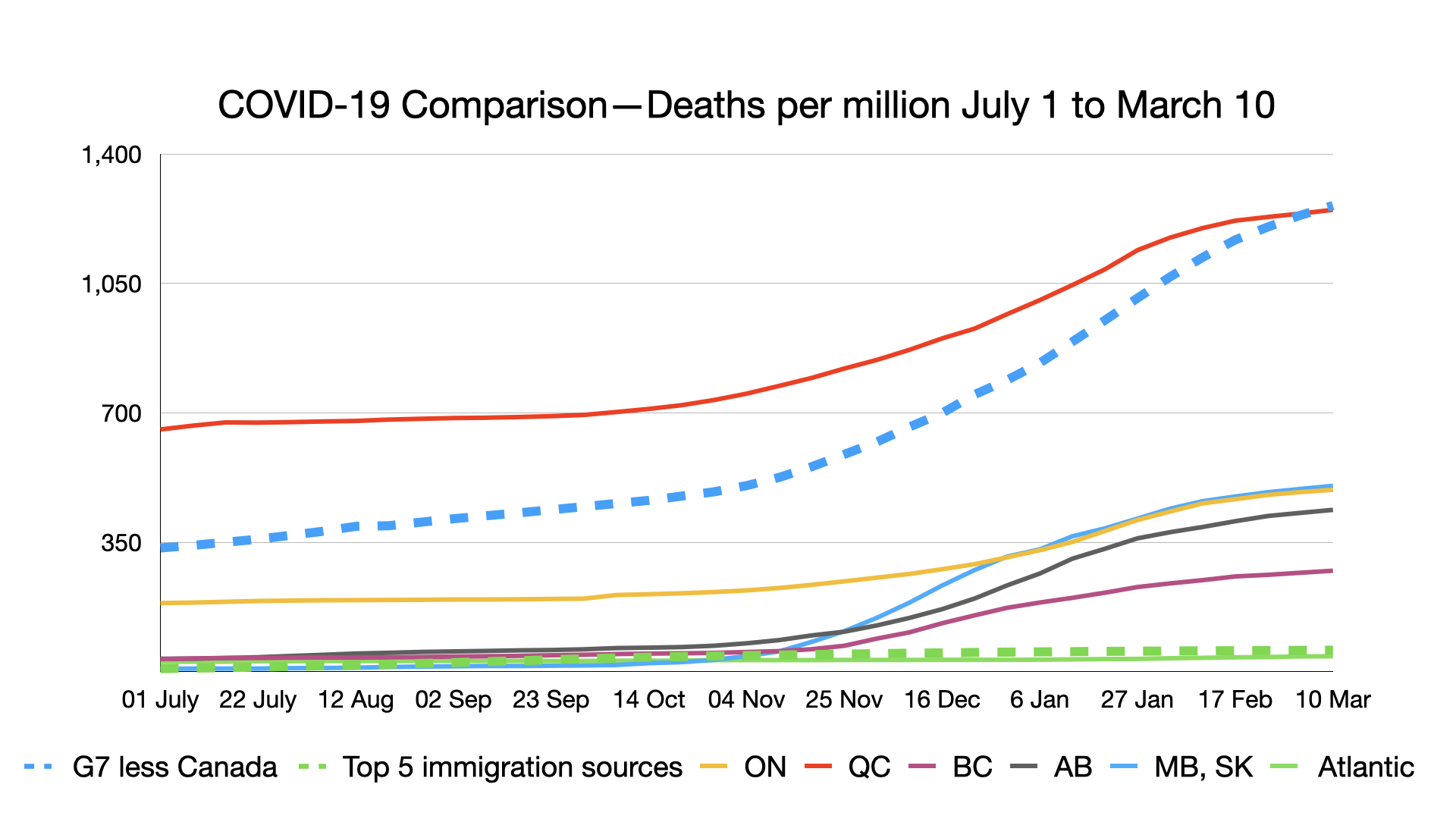
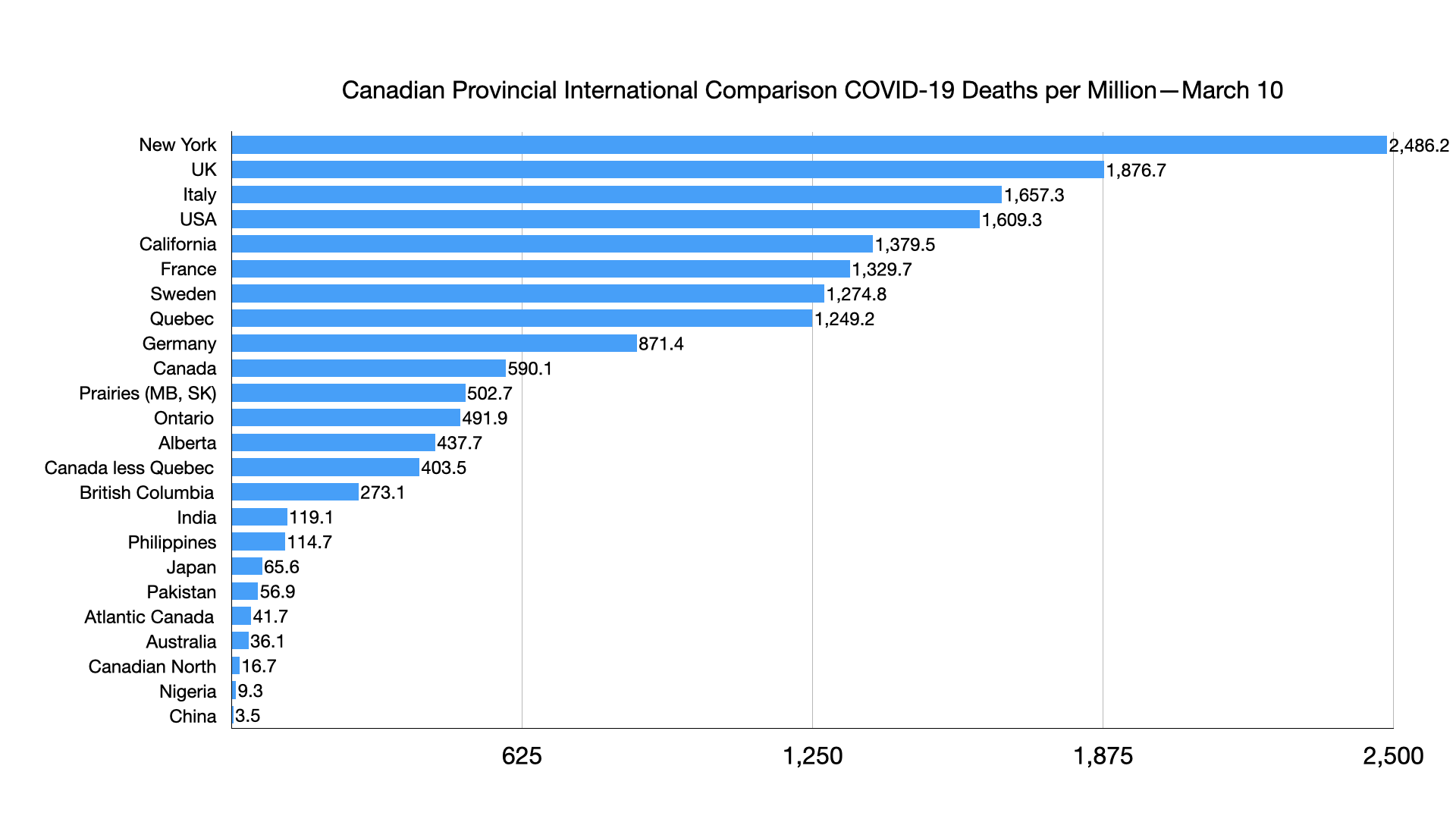
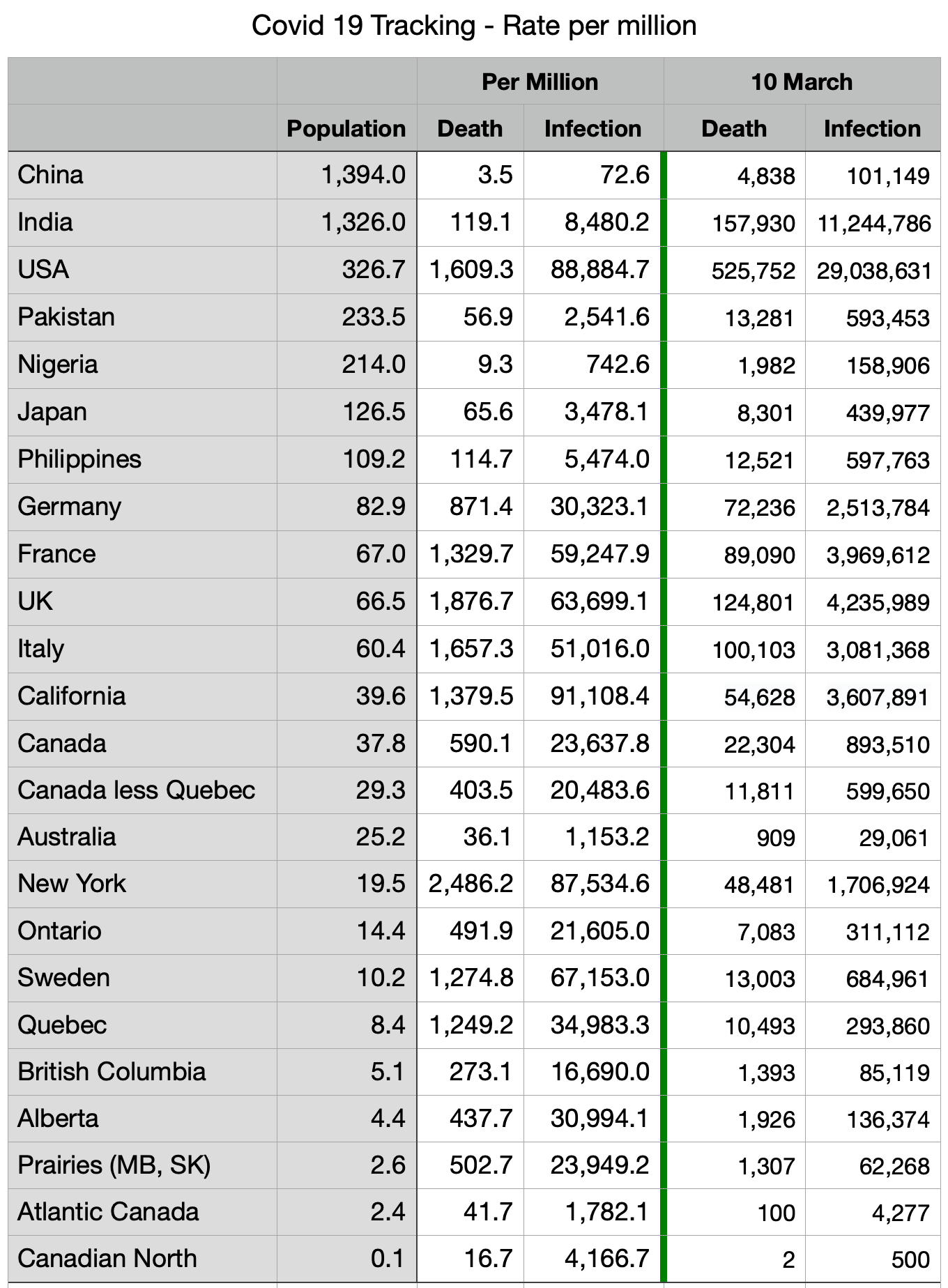
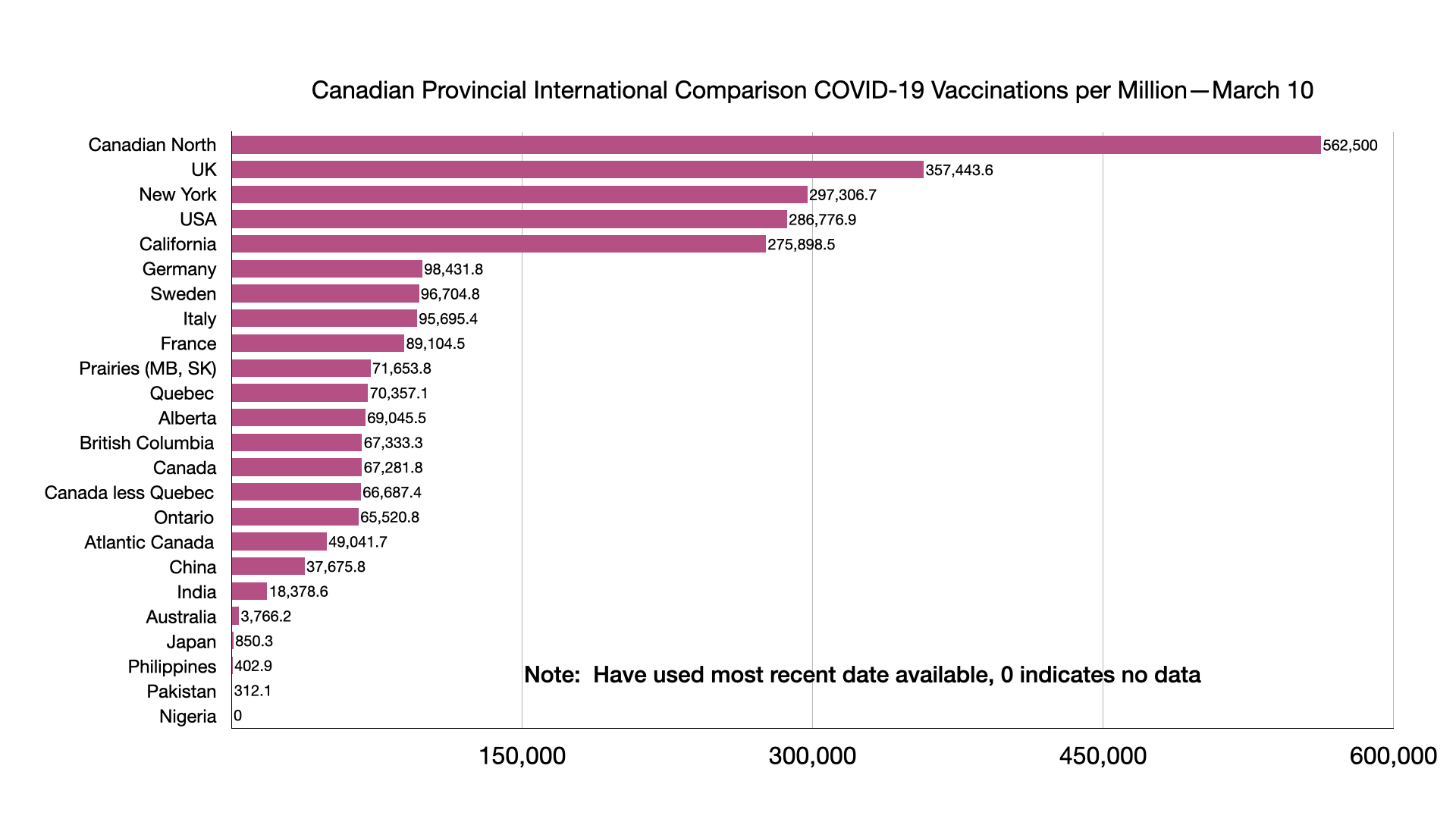
#COVID-19: Comparing provinces with other countries 10 March Update

The latest charts, compiled 10 March (note international vaccination data is latest available). One year after the start of Canadian lockdowns.

Vaccinations: The gap between all G7 countries save Japan continues to grow, all European countries slightly ahead of Canada with no narrowing yet of the gap.

Trendline charts

Infections per million: The overall trend of a flattening curve is seen in G7 countries with limited flattening in Canada.

Deaths per million: Most Canadian provinces continue to flatten the curve, Quebec most dramatically. Overall G7 death rate surpassing Quebec.

Vaccinations per million: Gap between G7 and Canada continues to grow despite the arrival of more vaccines.

Weekly

Infections per million: No relative change.

Deaths per million: No relative change 

Laurentian Bank CEO says diversity targets part of financial package for bank leaders

Money talks:

Laurentian Bank of Canada chief executive Rania Llewellyn says that early in her career, she was told by a manager that he was looking for a man to fill a job she was vying for.

“I remember, there was a vacant job. I was ready to go for it. I was trained,” said Llewellyn at a webcast event on Monday at The Empire Club of Canada, in a celebration of International Women’s Day.

“And he said, ‘I’m looking for a man and I’m looking for someone who’s older.’ And this was going to be my new boss. Right? So, I would say there’s lots of those little stories across along the way.”

Llewellyn’s speech came on the heels of a report from DBRS Morningstar, which found that the six largest Canadian banks score better than the Australian and U.S. bank averages on attracting, retaining and developing women into senior leadership positions.

But DBRS Morningstar also says BMO, Scotiabank, CIBC, National Bank, RBC and TD are on average falling behind the three large Australian banks on the issue of gender pay equity.

Llewellyn, who in October became the first woman to lead a major Canadian bank, said diversity and inclusion targets should be written into the financial packages that go to the board, just as there are financial targets for leaders at the bank.

Llewellyn said companies setting such targets should focus not only on recruiting diverse talent, but also on retaining women as they move up the ranks.

“That’s one thing I introduced at Laurentian. All of my leaders have targets on their scorecards, in terms of diversity targets. But more importantly, I’ve actually included in our financial package that goes to the board,” Llewellyn said.

Linda Seymour, chief executive at HSBC Bank Canada, also said on Monday that International Women’s Day had her “reflecting on what it took to get here.”

“I was recently asked if I had to fight to break through the glass ceiling. It wasn’t that I had to fight harder than my male colleagues,” Seymour wrote in a LinkedIn post. “It was that I had to navigate harder – to make sure I was heard, to constantly network, to demonstrate when I was not only as qualified, but more qualified than my male colleagues.”

Seymour wrote that she sees having a gender-balanced board and executive committee at HSBC Bank Canada as a business advantage, but called on leaders to generally be more open to being challenged by employees on diversity and inclusion progress.

The report from DBRS Morningstar said that the gender wage gap has been consistent for about 20 years for workers between 25 to 54 in finance, insurance, real estate, rental and leasing. But the report said that disruptions to the labour force caused by the COVID-19 pandemic may be behind a slight widening of the gap recently. Indeed, across industries, the female participation rate in Canada’s labour force fell during the pandemic, the report said.

Llewellyn said child-care infrastructure, flexible work arrangements in terms of time and hours, upskilling programs and early childhood financial literacy programs will be key to helping women recover from the effects of the pandemic.

“I think it’s systemic throughout our culture as well. I have a daughter and it starts very early on, in terms of some of these systemic biases in the system,” she said. “Words matter and how people behave and how we model is absolutely important.”

Source: Laurentian Bank CEO says diversity targets part of financial package for bank leaders

Immigrant Minorities in Canada at Higher Risk for PTSD

Of note:

Immigrant minority groups had higher rates of PTSD than both Canada-born minorities and white immigrants. Socioeconomic status, health, and nutrition also played a role according to a study published in Social Psychiatry and Psychiatric Epidemiology.

The researchers used data from the Canadian Longitudinal Study on Aging (CLSA), which includes Canadians age 45-85. A random selection of participants were invited to participate. More than 30,000 adults participated. Researchers assessed PTSD, ethnicity, immigration status, demographic information, health status, and nutrition information.

PTSD prevalence among minority immigrants (7.5%) was more than double that of white immigrants (3.6%, p < 0.001), and about 50% higher than Canada-born whites (5.6%, p = 0.008). Prevalence did not differ significantly between immigrant and Canada-born minority members (4.9%, p = 0.19). Researchers attribute this to the small sample size of the latter.

Looking at demographic and socioeconomic variables, adults age 45-55, those who earned less than C$100,000 per year, and those who were widowed, divorced, or separated had higher odds of PTSD. Participants who reported at least 2 health conditions, who had chronic pain, who smoked, and who had a low waist-to-height ratio had higher odds of PTSD.

Adults who consumed fiber-rich foods less than 3 times a day had lower rates of PTSD than adults who consumed only 1 source of fiber. Adults who ate a lot of pastries and chocolate also had higher rates of PTSD than their non-sweets-eating counterparts.

The study was limited by a sample size restricted to those aged 55 and over and cross-sectional data. Information about traumatic experiences which may have caused PTSD was not available.

“This investigation provides important insights for policy and program development to mitigate PTSD among mid-age and older adults, particularly for marginalized groups such as visible minority immigrants,” the researchers concluded. “Future investigations that use estimate models such as these as well as longitudinal analyses may better inform mental health practice and policies to both prevent and treat PTSD.”

Reference

Davison KM, Hyland CE, West ML, et al. Post-traumatic stress disorder (PTSD) in mid-age and older adults differs by immigrant status and ethnicity, nutrition, and other determinants of health in the Canadian Longitudinal Study on Aging (CLSA). Soc Psychiatry Psychiatr Epidemiol. Published online February 3, 2021. doi:10.1007/s00127-020-02003-7

Source: Immigrant Minorities in Canada at Higher Risk for PTSD

Ryerson School of Journalism leaders step down amid calls to address racism

The “woke brigade” at work. Lasting change takes time:

The heads of a prestigious journalism program at a Toronto university have stepped down amid calls for sweeping changes at the school to address systemic racism and discrimination.

Janice Neil, the chair of the Ryerson School of Journalism, and Lisa Taylor, associate chair and the school’s undergraduate program director, resigned on Sunday.

Both noted in their resignation letters that they had worked to address issues of systemic racism and discrimination at the school during their years as leaders.

On Monday morning, Ryerson journalism students issued a public letter accusing the school of failing to represent and support Black, Indigenous, people of colour and LGBTQ students in the program.

The letter said the school has contributed to an unsafe learning environment rife with discrimination that has left students traumatized.

In an email to The Canadian Press on Monday evening, Neil said that under her leadership, the school had increased diversity of the teaching faculty, introduced new courses about reporting on race, Indigenous issues and the LGBTQ community, and offered mental health supports for students.

But Neil also acknowledged that many students think change has not come fast enough or is broad enough to make an impact,.

“One of the things I’ve learned as a leader is to recognize when It’s time for a major reset and that time is now,” she wrote. “To get to the next level will require different leadership.”

In her resignation letter, Lisa Taylor explained her reason for stepping down.

“Some students don’t believe that I’m in their corner, which means they may not turn to me if they’re in need, and having an undergraduate program director who is a trusted resource for only some students is truly inequitable,” she wrote.

A spokeswoman for Ryerson said the school “continues to acknowledge the work that needs to be done to address systemic racism” and will continue to take concrete steps to address the students’ concerns.

Source: Ryerson School of Journalism leaders step down amid calls to address racism

Are We Ready for a Novel Narrated by a Terrorist? – The Daily Beast

Similar but different to The Reluctant Fundamentalist:

Would you read a book in which the protagonist is a radicalized terrorist?

This is the premise of Khalil, a novel by Algerian-born, France-based author Yasmina Khadra. When it was first published in France in 2018, there was a certain reticence towards the book. “Frankly, what interest is there in finding yourself in the mind of one of the perpetrators of the attacks of November 13, 2015 in Paris?” a cultural critic in French newspaper Libération bluntly queried. “Khadra’s new novel provokes an impulse to retreat: don’t want to read it, don’t want to check it out.”

And yet, the reviewer concluded just as firmly: “Such prejudices show that the author was right to write his book.”

The desire to dismiss rather than deconstruct dangerous figures is, in a way, its own danger. Their unfathomable and unconscionable actions shape our anarchic society; avoidance doesn’t eradicate their presence or power. Nor does an engagement with their narrative validate what they do. Confronting our malaise around these figures helps identify how the past has metastasized into the present moment.

More than 520 plaintiffs now part of Black public servants’ $900-million class-action lawsuit against government, as feds enlist Bay Street law firm

The disaggregated data that we have for the past three years (employment equity reports including hiring and promotion data, public service employee survey) along with PSC analysis of staffing process stages on employment equity results is not supportive of the proposed suit.

The large number of claimants, on the other hand, provides large-scale anecdotal evidence. (For my overall analysis, see Public Service Disaggregated Data for Visible Minorities and Indigenous peoples, Citizenship status):

More than 520 current and former Black federal public servants are now part of a $900-million class-action lawsuit that is alleging decades-long government discrimination, lack of advancement opportunities, and harassment. Three months ago, there were 12 representative plaintiffs.

After three months of waiting to hear from Ottawa, the suit’s leading lawyer says the government has decided to enlist a Bay Street law firm to fight the action despite the fact that Prime Minister Justin Trudeau (Papineau, Que.) has publicly admitted that racism and discrimination exists across public-sector institutions.

Courtney Betty, the lawyer leading the class action, has called his experience over the last three months and the steady influx of new plaintiffs “an incredible journey and nothing that I had expected.”

“I think that every day, we’re having new plaintiffs register and new individuals calling in asking how they can become class members,” said Mr. Betty, a former Crown attorney at the Department of Justice.

The class action started receiving a “flood” of call from elderly individuals who have retired from government departments and agencies, something which Mr. Betty called a “game-changer.”

“When we started getting people that were 74, 78 years old, it was like an atomic explosion, because it really brought to the forefront so many things that we had not been aware of,” said Mr. Betty. “It’s like unearthing this tremendous pool of pain and trauma.”

Filed on Dec. 2, 2020, the class proceeding includes plaintiffs from a wide range of government departments and agencies, including the Canada Revenue Agency, Employment and Social Development Canada, Corrections Canada, the Department of National Defence, and the RCMP.

Many of the experiences of members delineated in the class action centre on their lack of promotions within the federal public service after many years on the job, with the suit alleging that the Employment Equity Act has “failed in its goals and mandate to Black employees,” as it “fails to break down the category of visible minorities and thus ignores the unique, invisible and systemic racism faced by Black employees relative to other disadvantaged groups that are covered by the categories established by the Act.”

The class proceeding has now been filed, is before the court, and the government has been served, according to Mr. Betty.

“We wanted the government to have 90 days to come to the table, accept our offer, to meet with Black employee representatives, to meet with the union representatives, and figure out if there is a way of taking this to mediation and arbitration,” said Mr. Betty. “It just seemed like the natural thing to do.”

At the eleventh hour, the government informed the legal team that it had retained a Bay Street law firm, sending a signal they were intending to fight the litigation, said Mr. Betty.

“We’re now getting geared up on the premise that the government is prepared to have these individuals relive their horror, and tell their stories,” said Mr. Betty. “It’s a game changer for us in terms of how we approach it, and so we’re definitely now in a a position where we’re going to aggressively put forward our case.”

Mr. Betty said he’s “the guy who has spent my entire life waving the Canadian flag, I’m the guy who loves this country more than most Canadians do.”

“And now I’m in a situation where I recognize the government has been committing behaviour, that in many ways, [with] the pain and suffering that these individuals are feeling, is a form of atrocity that’s been committed against them,” said Mr. Betty. “And I know that’s a strong word.”

In a Dec. 4, 2020 press release, the Public Service Alliance of Canada (PSAC), Canada’s largest federal public service union, indicated its support for the legal action, with union president Chris Aylward telling The Hill Times that “Canada’s public service presents itself as a ‘merit-based, representative and non-partisan organization that serves all Canadians.’”

“While laudable as a principle, many Canadians, particularly Black Canadians, have experienced a different reality. The government must do what is necessary to right these wrongs and ensure that these injustices do not continue,” wrote Mr. Aylward.

According to a joint response from the Department of Justice and the Treasury Board of Canada Secretariat, the proposed class-action brought on behalf of Black employees in the Public Service of Canada was issued by the Federal Court on Dec. 2, 2020. The statement of claim was received by Canada and the proposed class-action is not certified.

“As part of the class-action process, the parties may proceed to schedule a motion for the court to determine whether to certify the action,” according to the statement. “No motion has yet been scheduled. “

Counsel for the Attorney General of Canada was in communication with counsel for the proposed class and advised Mr. Betty that outside counsel would be appointed, according to the statement.

“Counsel from Fasken Martineau DuMoulin LLP reached out to plaintiffs’ counsel in February to indicate that they will be representing the government’s interests in the two class proceedings and to discuss next steps,” according to the statement. “No schedule has been set for the government to set out its position on the lawsuit.”

According to the government, counsel for Canada has not received a request from counsel for the proposed class to enter into mediation with respect to this class action.

“Any future request would be given consideration,” according to the government. “As this complex proposed class action is in its early stages, it is otherwise premature to comment on the litigation at this point.”

The joint statement added that “systemic racism and discrimination is a painful lived reality for Black Canadians, racialized Canadians and Indigenous people,” that the government has taken steps to address anti-Black racism, systemic discrimination and injustice across the country, and that $12-million over three years has been committed towards a dedicated Centre on Diversity and Inclusion in the Federal Public Service.

“In September, the Speech from the Throne announced an action plan to increase representation and leadership development within the public service,” according to the statement. “Early in its mandate, the government also reflected its commitment in mandate letters, in the establishment of an Anti-Racism Strategy and Secretariat, in the appointment of a Minister of Diversity and Inclusion and Youth, and in the creation of the Office for Public Service Accessibility.”

“As this matter is currently before the courts, the Treasury Board Secretariat cannot comment on this suit at this time.”

NDP MP Matthew Green (Hamilton Centre, Ont.) told The Hill Times that he believes the government has retained a law firm in an attempt to “use the infinite resources of the government to ensure Black workers in the public sector never have a fair day in court.”

“They’re going to lawyer up, they’re going to drag it out, and they’re going to try to bleed the class action support dry,” said Mr. Green last week.

Mr. Green said he believes this government does an actuarial risk assessment “both politically and financially.”

“I think on one side, you have a scenario in which they know they’re wrong, that many in the processes they claim to put in place around equity, diversity and inclusion under the guise of [Gender Based Analysis Plus], the language that the government uses, actually does not have the outcomes in which they purport to have.”

“We’ve now had decades of anti-Black racism, which will be in the most contemporary terms, validated in these toxic workplace cultures that have essentially left out a sub-segment of their workers in ways that they can point to as being quantifiable,” said Mr. Green.

Any worker, more especially marginalized workers, deserve to have basic workplace fairness, said Mr. Green.

“You could imagine working somewhere for 20 or 30 years and only ever being promoted one or two pay grades above your entry level while seeing your co-workers go on to become senior management and fully pensioned,” said Mr. Green. “The opportunity cost lost for these Black workers is immense, so on one hand you have a government that knows that and recognizes the burden of their financial obligation, while simultaneously doing the risk analysis politically on whether or not stifling these workers is going to result in votes lost for their future political gains.”

Mr. Green said that when this government felt it most politically expedient to take up the cause of the Black Lives Matter movement, it politicized it for their own partisan gain and for the branding exercise of Prime Minister Justin Trudeau (Papineau, Que.) to take a knee in that moment, alluding to the June 5 “No Peace Until Justice” march on Parliament Hill to protest racism, police brutality, and systemic discrimination in Canada and around the world.

“[To] not stand for the thousands of Black workers who are past and present impacted by anti-Black racism within the public sector says everything you need to know about this government,” said Mr. Green. “They’re all about identity politics, without any commitment to justice, and that is a very cynical way to treat people.”

“I won’t mince words—it’s performative, and when push comes to shove, Justin Trudeau and this Liberal government are nowhere to be found in tackling things that are well within their power,” said Mr. Green.

“We’re not asking them to solve racism in Canada, we’re telling them they have a responsibility to Black workers within the public service that they are ignoring and in fact, in this case, continuing to uphold in perpetuity, that they are upholding anti-Blackness by not mediating with this group in good faith,” said Mr. Green.

‘37 years stuck at one level’

Caroline Layne, one of hundreds of plaintiffs now part of the class-action lawsuit, said she started as a temporary employee as a telecommunications clerk with the RCMP in 1982, and spent 37 years with the RCMP before retiring in 2009. Ms. Layne said she spent 37 years stuck at one level and was never promoted.

“People say to me, ‘You worked with the government, you must have a good pension,’” said Ms. Layne in an interview with The Hill Times.

“But I don’t, because I was never able to move up the ladder,” said Ms. Layne. “The thing is, for an honest day’s work, you should get an honest day’s pay.”

Outlining some of her experiences during her many years with the RCMP, including acts of both indirect and overt racism from co-workers, members of the public and sometimes from superiors, Ms. Layne said there was never anyone to turn to or to relate her story.

“Everybody turned a deaf ear,” said Ms. Layne.

“People would come to the front desk and almost want to throw me out, and I would just have to take it on the chin,” said Ms. Layne. “I had to take it and just smile.”

When a police officer takes on a post, they should take it on “because of who they are, because they are there for society, and there to help each individual, Black, brown or white,” said Ms. Layne. “When I went to the RCMP, I took an oath as a public servant.”

Another plaintiff in the class action, Carol Sip, spent 26 years in the federal public service, starting in the Department of National Defence in 1974 before retiring in 2000.

“There was not much room for promotion, so I decided to apply elsewhere,” said Ms. Sip at the beginning of an emotional interview with The Hill Times.

Looking for a permanent position, Ms. Sip applied to the now defunct Canada Customs and Revenue Agency (known today as the Canada Border Services Agency), as well as to Gateway postal services, alluding to the Canada Post facility in Mississauga.

“I chose Customs, thinking I’ll have a better chance of promotion there,” said Ms. Sip. “But I was wrong.”

The former federal public servant, who would end up spending the vast majority of her career with the agency, said she joined the class-action lawsuit because the lack of opportunities for promotion throughout her career affected her mental health and well-being, and found herself looking for part-time work to subsidize her income, ending up working very difficult hours.

“Now, instead of the government taking responsibility, protecting me, and addressing the matter, they hire a Bay Street law firm to inflict more pain and suffering,” said Ms. Sip. “The victims always suffer.”

Ms. Sip said she initially didn’t want to come forward with her story.

“But then I think about the younger generation and if this would make a difference,” said Ms. Sip.

Erica Ifill, a policy analyst at Innovation, Science, and Economic Development Canada (ISED) who has been with the department since Feb. 2019 and is currently on sick leave, recently penned a piece for The Hill Times in her regular column called “An open letter to federal Black employees,” where she outlined her experience being “harassed, bullied and surveilled for most of my time at the department” where she was “denied development opportunities and promotions.”

Ms. Ifill also wrote that when she tried to seek redress through the internal processes, “again I was refused any meaningful action.”

When asked if she believed the emergence of this lawsuit and the continued growth of the number of plaintiffs involved will send a strong message to the federal public service in a follow-up interview with The Hill Times last week, Ms. Ifill was not optimistic.

“[The public service] exists on a plane that is divorced from reality,” said Ms. Ifill. “Their ability to assess risk is very skewed—they get to where they are by badly assessing risk.”

“I don’t have any faith in them, I think they’re going to have to be forced to do the right thing,” said Ms. Ifill, who is also a member of the Federal Black Employee Caucus.

Although not yet a part of the class-action suit, Ms. Ifill said she’s considering it and that she’s currently in talks with representatives.

Riyadh Nazerally, a spokesperson with ISED, said “the public service has long made diversity and inclusion in its workforce a core value, and there has been steady progress over the past decade, but many gaps remain,” in an emailed statement to The Hill Times. “In particular, the lack of diversity in leadership roles across the public service has been persistent and must be addressed.”

“At ISED, we have started a dialogue and we are listening. We are learning from lived experience through ongoing employee consultation and safe space discussions,” added Mr. Nazerally, who also pointed to the creation of a Diversity and Inclusion Taskforce focused on identifying and implementing specific diversity and inclusion measures.

“We are actively consulting with employees on a plan to identify meaningful actions in order to build a more diversified workforce. One of our objectives is to remove biases and systemic barriers. We are committed to addressing and dismantling structural and systemic racism and discrimination, while also ensuring that our workplace is free of harassment.”

“For privacy reasons, we cannot comment or discuss specific employee matters,” wrote Mr. Nazerally.

‘Persistent threat to our national security’

Huda Mukbil, a former senior intelligence officer with the Canadian Security Intelligence Service (CSIS) and a national security expert, is not a plaintiff in the Black class-action lawsuit, but she told The Hill Times that she is helping the team and hoping to become more involved in the future.

“The reason I feel passionate about this, is because I feel that it is a persistent threat to our national security,” said Ms. Mukbil, who began her career at CSIS in 2001 and was the first Arab woman and one of very few black women at the agency.

“I was well received for a very long time, about three years, and then what can I say—I encountered systemic issues,” said Ms. Mukbil, who went on to outline discrimination she would face throughout her career.

“The biggest problem is that it’s left up to individuals to fight the discrimination and the harassment and the microaggressions and the lack of career progression—the whole thing is left up to an individual,” said Ms. Mukbil. “There’s a risk obviously—you’re looking at one individual trying to take on a system.”

What’s coming out as a function of this lawsuit is “really the tip of the iceberg,” said Ms. Mukbil.

“There is so much going on, there’s so much damage that’s happening to so many people’s lives, and what we’re seeing now is just horrible,” said Ms. Mukbil.

‘This lawsuit will force the public service to look deeply inside its structure’

Although former senator Don Oliver was unavailable for an interview last week, he has spent decades fighting against systemic racism within the public service, and told The Hill Times in December 2020 that he was supportive of the lawsuit and the effect it would have on structures within the bureaucracy.

“The lawsuit will force the public service to look deeply inside its structure and systems to find ways to eradicate white privilege in performance evaluations and all other known forms of systemic black racism,” wrote the retired Senator in a message to The Hill Times shortly after the lawsuit was first launched. “It must start with some profound personal soul searching that will require all white managers to learn to accept some uncomfortable truths.”

And as the establishment of any new government department is ultimately directed by the PMO, according to the former Senator, the clerk of the Privy Council and all deputy ministers in the public service would have to fall in line.

In a piece that ran in The Globe and Mail on March 1 following Black History Month, Sen. Oliver wrote that deputy ministers in government “can speed up the internal cleansing and make meaningful change” by, among other practices, ensuring that no barriers exist to prevent Black employees from advancing, implementing or expanding unconscious bias and anti-racism education, sharing best—and unsuccessful—practices, working with members of the Black community, and creating the conditions for success.

“The defining test of systemic racism in Canada is when I no longer have to somehow prove that I, as a Black Canadian, am worthy to participate in and enjoy all the fruits, benefits and perks of daily living that have been bestowed on the white majority by virtue of their privilege,” wrote the former Senator, who served in the Red Chamber from 1990 to 2003.

When asked for comment, the Prime Minister’s Office referred The Hill Times back to the Treasury Board.

Source: More than 520 plaintiffs now part of Black public servants’ $900-million class-action lawsuit against government, as feds enlist Bay Street law firm

York school board releases its strategy to combat anti-Black racism and end a culture of low expectations and ‘throwaway kids’

Will be interesting to assess the impact on student outcomes in a number of years and what measures were particularly effective:

It’s the stories. It’s the stories that sit within, and heave out come time to seek justice, that make a difference. 

Stories that have been discounted for centuries, but have become unignorable since decades of data — statistical, academic and visual — have rapidly piled up. Today only the most wilfully ignorant would deny the existence of deeply rooted anti-Black racism — itself a term coined by Ryerson social work professor Akua Benjamin.

It’s those stories, the experiences of Black families in the school system, that sit at the root of a report by the York Region District School Board (YRDSB) being released Monday.

The two-part Dismantling Anti-Black Racism Strategy is a five-year strategic plan built in collaboration with staff, parents, trustees, community organization and students. In all, about 800 people contributed to the creation of the strategy, which the YRDSB calls the first of its kind by a Canadian school board.

While many boards have equity plans and activities on anti-Black racism,“the power of this (strategy) is making sure there’s some coherence to those activities,” said Tana Turner, an adjunct professor in the faculty of education at York University, who authored it. It builds on the board’s existing equity plans and spells out priorities, action items and an accountability framework.

That last point is urgent. It is also where community skepticism resides. It’s easy for leaders to sign on to anti-racist ideas. The racist barriers are usually erected when it comes to carrying them out. No surprise, then, that everyone who was involved in the creation of this report cited bold leadership as the No. 1 step to accountability. 

“The leadership has to be truly on board, understand what’s at stake and has to lead by example,” said Claudette Rutherford, a parent and teacher at the board. “Are you championing for racial justice when nobody is looking?” 

Two years ago, Rutherford put out an email to parents of Black children, saying, “If you’re worried about your kids in this system, let’s talk.” It was an emotional meeting. They had their own stories, they heard others’.

A desire to take the discussions beyond venting led to her co-founding Parents of Black Children (PoBC) with Charline Grant and Kearie Daniel, both known firebrands. They found strong, talented teachers — Black and non-Black — who said they were too afraid to put their names as board members, that they worried about the repercussions for their careers. 

“I understand it, no judgment,” Rutherford said. But it made the co-founders wonder: “Who is going to put themselves on the line for our children? Nobody but the mothers, right? It sits deep within me.” 

Turner said this lack of safety for anti-racist teachers is true across school boards. In her decades of doing equity and census audits in Ontario school boards and public sector organizations, she found, “In a lot of these boards, it’s safer to be racist than to be anti-racist. You can lose your job for sticking up for Black children.”

In school, teachers are the most important contributors to student achievement. But what to do if they themselves are biased or racially illiterate? When studies show they are more likely to read Black faces as angry even when they’re not, Black boys’ misbehaviours as more hostile than those of white boys, Black girls as less innocent and more adult-like than their white peers? 

Parents echoed what has been said in other boards. “Teachers look through Black students,” is one quote in the report. They said their children were seen as “throwaway kids” not worthy of being taught. 

When one of Rutherford’s children had applied for an academic course, she received an email from staff at the new school (who had never met him) saying they were worried he couldn’t manage. “I had to get his white principal to write a note on my behalf.”

Consultants heard Black children were called the N-word as early as in Grade 1, or slaves by classmates because their teachers had singularly focused on slavery during Black History Month while ignoring contributions of Black Canadians. 

Equally troublesome was that teachers and principals often treated these situations as interpersonal conflicts, holding both children culpable if the Black child responded verbally or physically. 

This is why one of the action plans is for the board to increase the racial literacy of all staff and students, create a protocol to help them identify racist and other inappropriate acts, and guide them with steps that students, parents and staff can take to have them addressed. “We need to equip teachers and make a difference in those classrooms,” Turner said. 

The Parents of Black Children group is separately collecting these experiences from staff, which Rutherford says will be analyzed by a volunteer researcher. 

At the board, a major part of the accountability process is bringing community eyes on the process, with plans to give the steering committee regular updates on how the strategy is being implemented. Strategies are to be adjusted based on their feedback and response to data being collected.

“What was excellent about this whole process is you had various Black community members and organizations working together, speaking about the problems and wanting to be part of the solution, to be part of the change,” said Elizabeth Turner, York school board trustee and one of the 22 working-group members who helped develop the strategy.

“This framework is designed to hold the YRDSB accountable not only for implementing the actions … but also for creating better outcomes for Black students,” the report says.

These include better academic outcomes and greater well-being of Black students in learning environments that not only protect them from the trauma of anti-Black racism but also affirm their identities. 

“The issue of Black underachievement is the most pervasive and unacknowledged in the education system,” said Cecil Roach, a superintendent of equity at the board. “You can’t have 50 years of Black kids not graduating at the same level as everyone else.”

The trouble is how to convince the naysayers? Naysayers are often not people who say anti-Black racism doesn’t exist. They’re ones who look at the disparities of student outcomes and blame Black students and their families for it. Up to a point, this can be blamed on racial illiteracy. Beyond that it’s about racist attitudes towards Black people. 

“If you don’t understand the system, you’re blaming the marginalized people for their marginalization,” Turner said. “These teachers haven’t been taught. They don’t know.”

Roach, too, insists on optimism on that score. “Teachers want to do well by kids as long as we give the proper intervention.”

Not that he has a choice. Other than hoping interventions move people to see the light, what hope of change can anyone have? 

Consultations with the York school community showed that even cheerful events can deepen Black students’ isolation. On Crazy Hair Day, for instance, “It’s white kids putting their hair in braids, using baubles Black kids put in their hair … and you’re calling them crazy?” Turner said. Or the only Black kid in class gets left out on Twin Day.

In addition there is the well-known fact of criminalization of children, the so-called school-to-prison pipeline. “For many students, school discipline can lead to their first contact with the criminal justice system,” the report reads. Kids who drop out are eight times more likely to be incarcerated than a youth who has graduated from high school. 

Rutherford remembers once receiving sensitive information about a Black family going through a transition after the father lost his job. Another educator heard the same story and called in Children’s Aid. Why?

Rutherford sees other supports that could have been put in place. Maybe the school could have called the father and offered to get housing. “What is it about Black families that makes you want to penalize rather than support?” she asked. 

If he had to choose just one outcome, Roach would want to see Black graduation rates shoot up. “I want to see Black kids at age 16 have 16 credits.” But that’s not a goal that can operate in isolation, he said. 

“We already know what to do. The question is do we want to do it? It’s one thing to accept the disparity is there. It’s another thing to care about it.”

It’s a given that supporting the most marginalized students supports all students. 

“Ultimately we want an education where our kids flourish,” Rutherford said. “We want our children to feel nurtured and welcome and deserving of safe educational spaces. We don’t want more than what other parents want. Our children deserve that.”

Source: https://www.thestar.com/opinion/star-columnists/2021/03/08/york-school-board-releases-its-strategy-to-combat-anti-black-racism-and-end-a-culture-of-low-expectations-and-throwaway-kids.html

Ukraine Foreign Minister Kuleba: We plan to allow dual citizenship with EU countries | KyivPost – Ukraine’s Global Voice

Canada most likely will be included among the “friendly” countries included:

Ukrainian Foreign Minister Dmytro Kuleba announced plans to allow dual citizenship in Ukraine with the EU countries.

“What did you see in the NSDC decision? You saw the outlines of the state’s position, which should be reflected in the future in the legislation regarding the participation of persons with dual or multiple citizenships in the state life of Ukraine. The policy that we will implement consists of two elements. We plan to allow dual citizenship with the EU and friendly countries, which do not pose any threat to us, and the list of these countries will be calibrated, it will depend on some criteria,” Kuleba said at an online briefing on March 5.

According to him, this will be an opportunity to keep the halo of the Ukrainian presence in the world as a whole, and a citizen of Ukraine who has left for permanent residence, for example, to an EU country, in the future will be able to become a citizen of this country and remain at the same time the part of Ukraine, preserve the Ukrainian passport.

“We need to keep together millions of Ukrainians scattered around the world, we must not interfere with their integration into the society in which they decided to continue their lives, but we must, as a state, make every effort to keep them Ukrainians, so that they stay connected with their homeland, so that they will be Ukraine’s lawyers in a new society,” Kuleba said.

At the same time, he indicated that a number of restrictions on dual citizenship for parliament members and ministers would be established. Also, dual citizenship with the Russian Federation will not be allowed.

“I am a consistent supporter of this idea, we are working with the MPs on the appropriate legislative amendments. There is one exception – this is an aggressor state, there can be no talk of any dual citizenship with it,” the minister said.

Kuleba added that this is a policy that still needs to find its legislative formulation, its implementation.

Source: Kuleba: We plan to allow dual citizenship with EU countries | KyivPost – Ukraine’s Global Voice