En prison pour deux publications Facebook

More on Cihan Erdal:

C’est le sort injuste qui a été réservé à Cihan Erdal, 32 ans, doctorant en sociologie de l’Université Carleton à Ottawa, emprisonné depuis six mois en Turquie, son pays d’origine, où il se trouvait pour mener ses recherches universitaires et voir sa famille. 

Le 25 septembre 2020, son amoureux, Omer Ongun, qui habite Ottawa, a été réveillé par un appel au beau milieu de la nuit. 

C’était Cihan. 

« Les policiers étaient à sa porte et ils l’emmenaient en détention. Et tout ce qu’il a pu dire au téléphone, c’est : ‟Je t’aime. Fais tout ce que tu peux. J’ai besoin de votre soutien.” » 

C’est la dernière fois qu’Omer a entendu la voix de Cihan. 

Même si nous sommes ensemble depuis 10 ans, la Turquie est un de ces nombreux pays qui malheureusement ne reconnaissent pas les unions de même sexe. Je ne suis donc pas considéré comme étant sa famille et ne suis pas autorisé à lui parler.

Omer Ongun, conjoint de Cihan Erdal

Depuis, Omer tente de remuer ciel et terre pour faire libérer Cihan, avec qui il ne peut communiquer que par écrit. Toutes les semaines, il lui envoie une lettre par l’entremise d’une application payante conçue expressément pour pouvoir correspondre avec des prisonniers en Turquie. 

« La lettre est imprimée, mise dans une enveloppe et envoyée à la prison. Cihan la reçoit environ une semaine plus tard. » 

Soutenu par un mouvement de solidarité de plus en plus grand, Omer ne perd pas espoir de retrouver son amoureux. Il suit des cours de français en ce moment en rêvant de jours libres où il pourra s’installer à Montréal avec lui. « Cihan parle français. Mieux que moi ! Pour l’heure, nous sommes locataires. Mais si un jour on achète une maison, ce sera à Montréal. On a toujours aimé l’énergie de cette ville. » 

***

Emprisonné à Ankara, Cihan Erdal, qui a un statut de résident permanent au Canada, doit avoir un procès le 26 avril. On l’accuse d’être lié à des manifestations qui ont eu lieu en octobre 2014 en Turquie. Son arrestation survient alors que les autorités turques accusent le Parti démocratique des peuples de Turquie (HDP), auquel Cihan Erdal a déjà été lié comme ex-membre de son comité exécutif central, d’avoir incité des gens à participer à des soulèvements violents. 

Sa détention arbitraire n’est malheureusement qu’un cas parmi d’autres d’utilisation de lois antiterroristes pour faire taire toute voix discordante en Turquie, selon Amnistie internationale. 

Officiellement, ce que l’on reproche à Cihan Erdal, ce sont deux publications Facebook de 2014 et 2015 dans lesquelles l’étudiant, qui est aussi assistant de recherche à l’Université Carleton depuis 2017, relayait des articles critiques du gouvernement turc. 

La cible ici, ce n’est pas Cihan personnellement. La cible, c’est le peuple turc.Les accusations sont destinées à faire en sorte que les gens aient peur de s’impliquer dans un parti politique qui pourrait provoquer une sorte d’opposition au parti au pouvoir.

Paul Champ, avocat spécialisé en droits de la personne, lors d’une conférence organisée lundi par l’Université Carleton

Dans une lettre ouverte publiée le 15 mars, Cihan Erdal dit qu’il se considère comme un « otage politique ». Militant queer et pacifiste, il s’est toujours opposé aux prédicateurs de violence. Il dit trouver « honteux » pour le droit et la justice d’être soumis à des « accusations terrifiantes », non fondées, d’incitation au terrorisme. 

> Lisez la lettre (en anglais)

***

De nombreuses voix se sont élevées ces derniers mois pour réclamer la libération de Cihan Erdal. La communauté universitaire, des défenseurs des droits de la personne, le Syndicat canadien de la fonction publique (dont Cihan est membre) et d’autres encore mènent une campagne pour dénoncer l’injustice qu’il subit. Sa détention arbitraire apparaît comme une cruelle illustration d’une tendance inquiétante à brimer la liberté universitaire. 

C’est un aspect dont on a peu parlé dans la foulée des controverses récentes autour de cet enjeu important. Mais il est extrêmement préoccupant. Entre janvier 2011 et août 2020, le réseau international Scholars at Risk, qui vient en aide aux universitaires faisant face à de graves menaces, a recensé à lui seul plus de 1700 attaques contre l’enseignement supérieur dans une centaine de pays. Qu’il s’agisse d’actes violents et prémédités contre des universités, des professeurs et des étudiants ou de restrictions à la liberté d’expression des chercheurs, l’objectif est toujours le même : punir des gens pour leurs idées et tenter de les réduire au silence. 

C’est exactement ce que l’on a fait à Cihan Erdal, dont les recherches portent sur la jeunesse militante en Turquie, en Grèce et en France. Sa méthodologie exigeait qu’il interviewe de jeunes militants sur le terrain, explique son conjoint. « Il n’a jamais pensé qu’il y avait là un risque puisqu’il n’a rien fait de mal. » 

Pendant 21 jours, Cihan Erdal a été gardé dans une cellule d’isolement, dans des conditions extrêmement pénibles, selon les informations obtenues par son conjoint. Aujourd’hui, il va mieux, bien qu’il soit toujours détenu. « Il est pleinement concentré sur ses études. Il lit et écrit des articles et des chapitres de livres. » 

Le vendredi 2 avril, il y aura une audience pour déterminer si le doctorant peut être libéré sous caution en attendant son procès. La campagne #FreeCihanErdal (#LibérezCihanErdal) demande au gouvernement canadien et aux autorités turques sa libération immédiate. 

« Le Canada a fait part de ses préoccupations aux autorités turques et continue de suivre cette affaire de près », me dit le porte-parole d’Affaires mondiales Canada, Jason Kung. 

Omer reste optimiste. « Depuis le jour où j’ai reçu cet appel de Cihan, je me dis : on ne peut contrôler ce qui nous arrive, mais on contrôle notre façon d’y réagir. Nous répondons à cette injustice et à cette torture par la résistance et la solidarité. » 

Source: https://www.lapresse.ca/actualites/2021-03-31/en-prison-pour-deux-publications-facebook.php

Quebec politicians denounce rise in online hate as Ottawa prepares to act

Ironic given some of the political discourse in Quebec:

Death threats over an animal control plan, personal insults over stop signs, social media attacks targeting spouses — these are examples of what politicians in Quebec say has become an increasingly difficult reality of their jobs during COVID-19.

From suburban mayors to the premier, politicians in the province have been raising the alarm about the rise in hateful and occasionally violent online messages they receive — and some are calling for stronger rules to shield them.

On Saturday, Premier Francois Legault denounced the torrent of hateful messages that regularly follow his online posts, which he said has worsened “in the last months.”

“Each time I post something now, I’m treated to an avalanche of aggressive and sometimes even violent comments, and to insults, obscenities and sometimes threats,” Legault wrote on Facebook.

Several Quebec municipal politicians have announced they won’t be running again in elections this fall, in part because of the hostile climate online. Others, including the mayors of Montreal and Quebec City, have spoken in the past about receiving death threats. In November, police in Longueuil, Que., arrested a man in connection with threats against the city’s mayor and other elected officials over a plan to cull deer in a municipal park.

Philippe Roy, the mayor of the Town of Mount-Royal, an on-island Montreal suburb, says he’s leaving municipal politics when his current term ends, partly because of the constant online insults directed at him and his spouse.

While taking criticism is part of the job, he said he’s seen a shift in the past two years toward more falsehoods and conspiracy theories, which he said are undermining the trust between elected officials and their constituents. After 16 years in politics, he said he’s tired of the constant accusations directed his way.

“When people are questioning your integrity, you start saying, ‘Well, maybe I have better things to do somewhere else,’ ” he said in a recent interview.

The problem is serious enough that the group representing Quebec municipalities has launched an awareness campaign and drafted a resolution denouncing the online vitriol. It has so far been adopted by some 260 municipal councils.

Suzanne Roy, the group’s president, says the campaign was launched in response to a “flood of testimonials” from mayors and councillors about an increase in abuse and hate speech during the pandemic.

She attributes the phenomenon to a rise in “stress and frustration.”

“People, without having the proper tools to manage their stress, will let off steam on social media and write inappropriate statements towards decisions taken at city council about a stop sign at the wrong place, a hole in the road, everything,” she said in a phone interview.

Roy, who is mayor of Ste-Julie on Montreal’s South Shore, said she experienced the perils of social media firsthand earlier this year when someone stole her identity online and posted anti-COVID conspiracy theories from her Facebook account.

She is among those pushing for stronger rules to combat hate speech, and for platforms such as Facebook to take quicker action to remove hateful comments or restore someone’s identity when it’s stolen. She said the platforms need to take down the messages as soon as they appear to ensure debate remains respectful and false messages aren’t spread.

“It’s a question of debate and a question of democracy,” she said.

Federal Heritage Minister Steven Guilbeault has promised to introduce new legislation to combat hate speech this spring.

In an interview Tuesday, he said the legislation will define five categories of illegal online activities and create a regulator. The regulator’s job would include pushing online platforms to respect the law and to remove hateful messages within 24 hours.

He said the bill’s goal is to take stronger actions against hate speech, child porn and non-consensual sharing of intimate images. He was careful to say that it would not tackle misinformation, saying it’s not the government’s job to “legislate information.”

Guilbeault said his government has also had to contend with critics who accuse the government of wanting to limit free speech, a charge he denies. Rather, he says the aim of the legislation is to ensure that laws, such as those against hate speech, are applied online as they are in the real world — something he argues will protect free speech rather than stifle it.

“Right now in the virtual world and, I’m sad to say, in the physical world, we’re seeing the safety and security of Canadians is being compromised, that freedom of speech is being affected online,” he said in a phone interview.

“We’re seeing it now with Quebec politicians who say, ‘No, no I don’t want to run for politics, it’s so violent.'” He said the chilling effect extends to equity-seeking groups and racialized Canadians, many of whom avoid the platforms because they’re constant targets of abuse.

“How does that protect free speech?” he asked. “Well, it doesn’t.”

Suzanne Roy says her group, the Union des municipalities du Quebec, gives new councillors some training on how to manage social media accounts, including advice on handling adversarial situations. She says the advice generally includes not getting into debates online and instead steering people to more formal channels to express their opinions, such as city council meetings and public consultations.

Philippe Roy, the soon-to-be ex-mayor of Mont-Royal, says that while there appear to be strong candidates to take his place, he’s already met people who have been discouraged from running by the prospect of online hate — something that bodes poorly for the future if the problem isn’t tackled.

“We’re losing people who could give back to the community, and that’s one of the threats that comes from this situation,” he said.

Source: Quebec politicians denounce rise in online hate as Ottawa prepares to act

Ottawa to extend eligibility criteria for Yazidi refugees: Mendicino

Good:

Ottawa is adopting a new policy to help more Yazidis and other survivors of the Islamic State of Iraq and the Levant reunite with their families in Canada, Immigration Minister Marco Mendicino said Tuesday.

Mendicino said it will allow more Yazidi refugees to join extended family members, including siblings, grandparents, aunts and uncles.

The Yazidis and other groups who survived abuse, torture and even genocide at the hands of ISIL are among the most vulnerable refugees in the world, he said.

“Guided by compassion, we are now redoubling our efforts to reunite their families.”

The Immigration Department said the new policy will help Yazidis and members of other communities in Northern Iraq to start new lives in Canada.

These refugees were victims of threats or acts including sexual slavery, general enslavement, torture, inhuman or degrading treatment, family separation and forced displacement, the department said.

Canada has welcomed more than 1,400 survivors of ISIL from Northern Iraq since 2017.

This includes 1,356 government-assisted refugees and 94 privately sponsored ones. Women and girls comprise the vast majority.

The Yazidi newcomers have been primarily resettled to Toronto, London, Ont., Winnipeg and Calgary where Yazidi communities existed and adequate support, including medical, social and interpretation services, was in place.

Source: Ottawa to extend eligibility criteria for Yazidi refugees: Mendicino

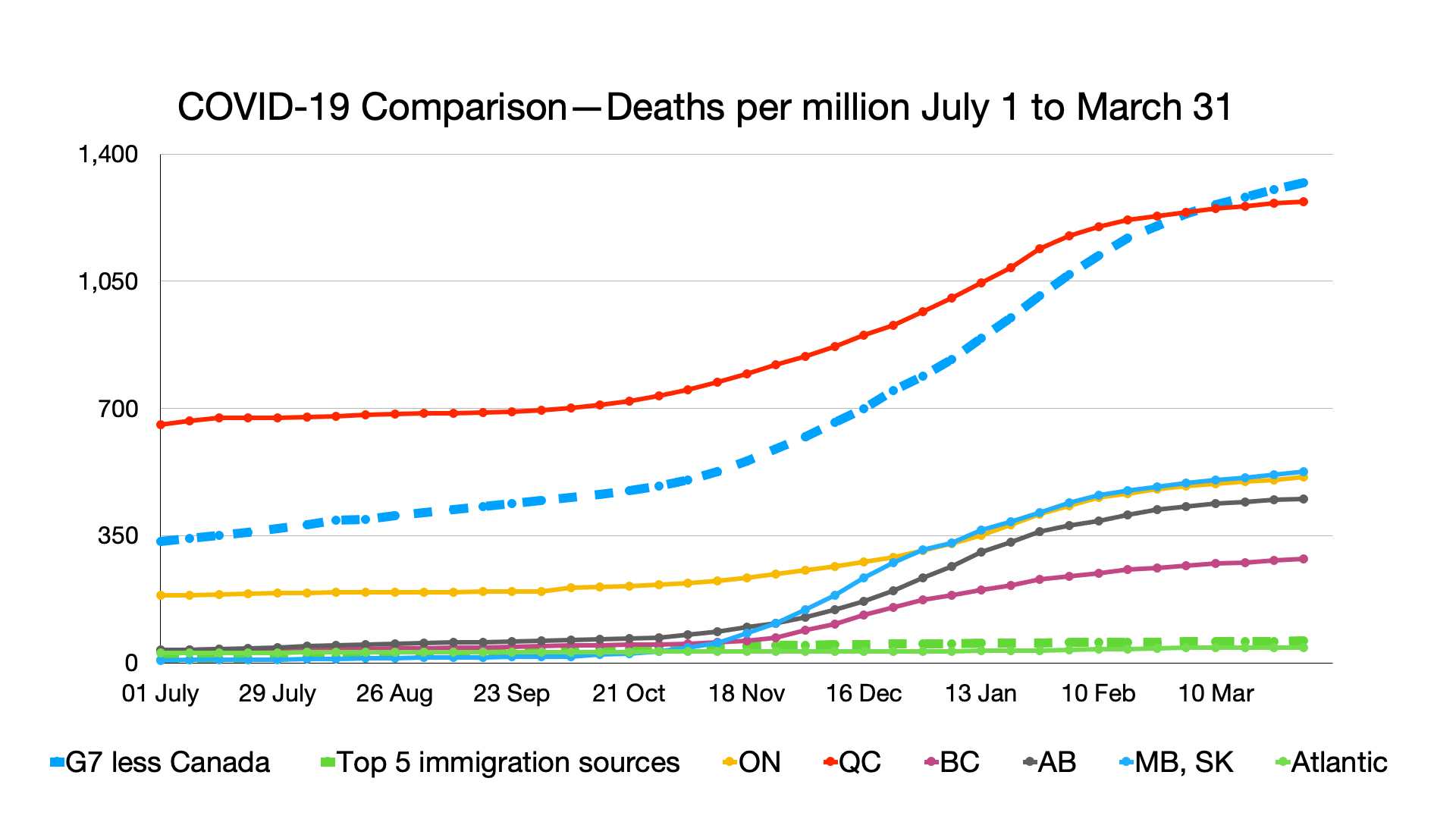
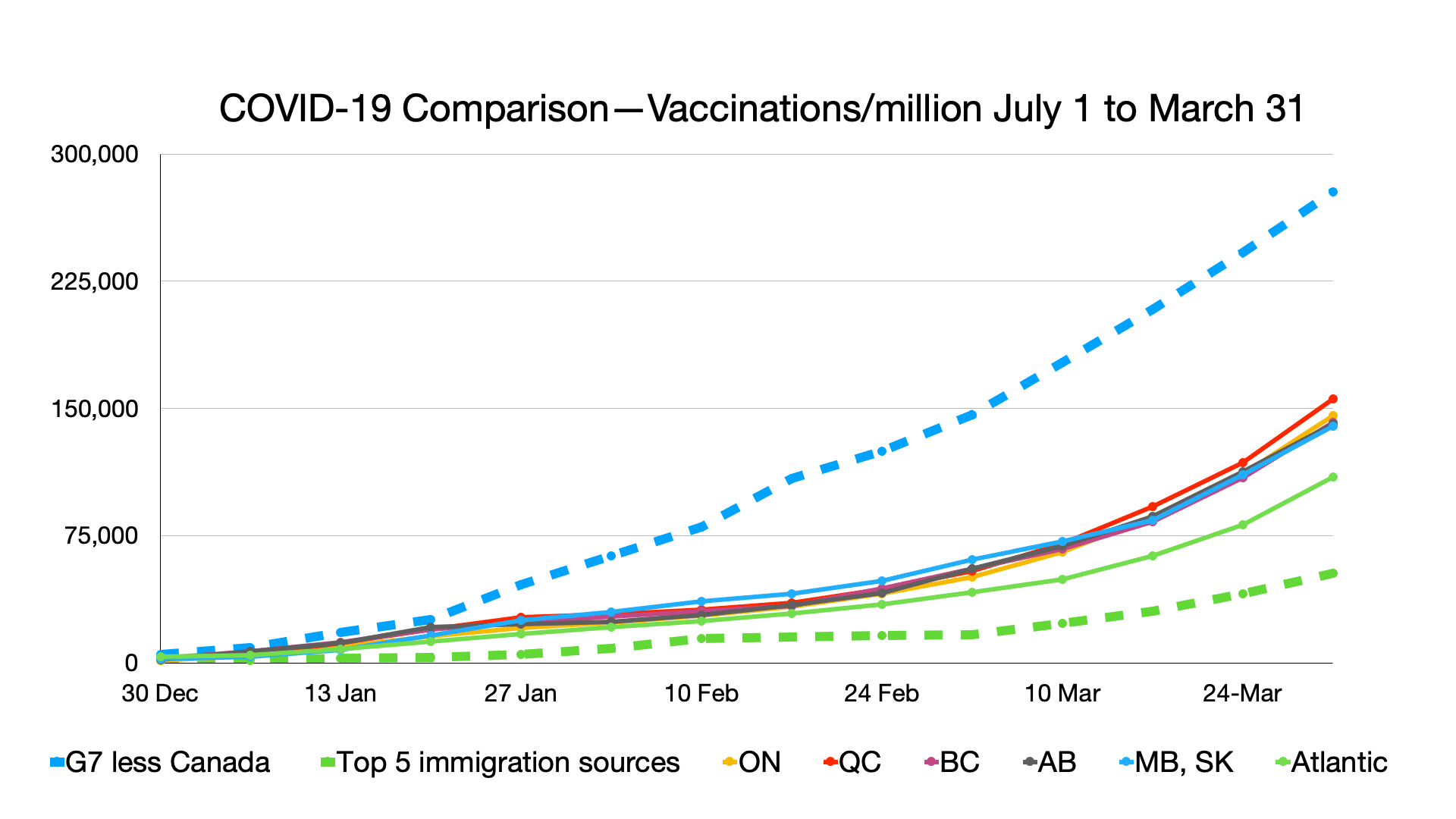
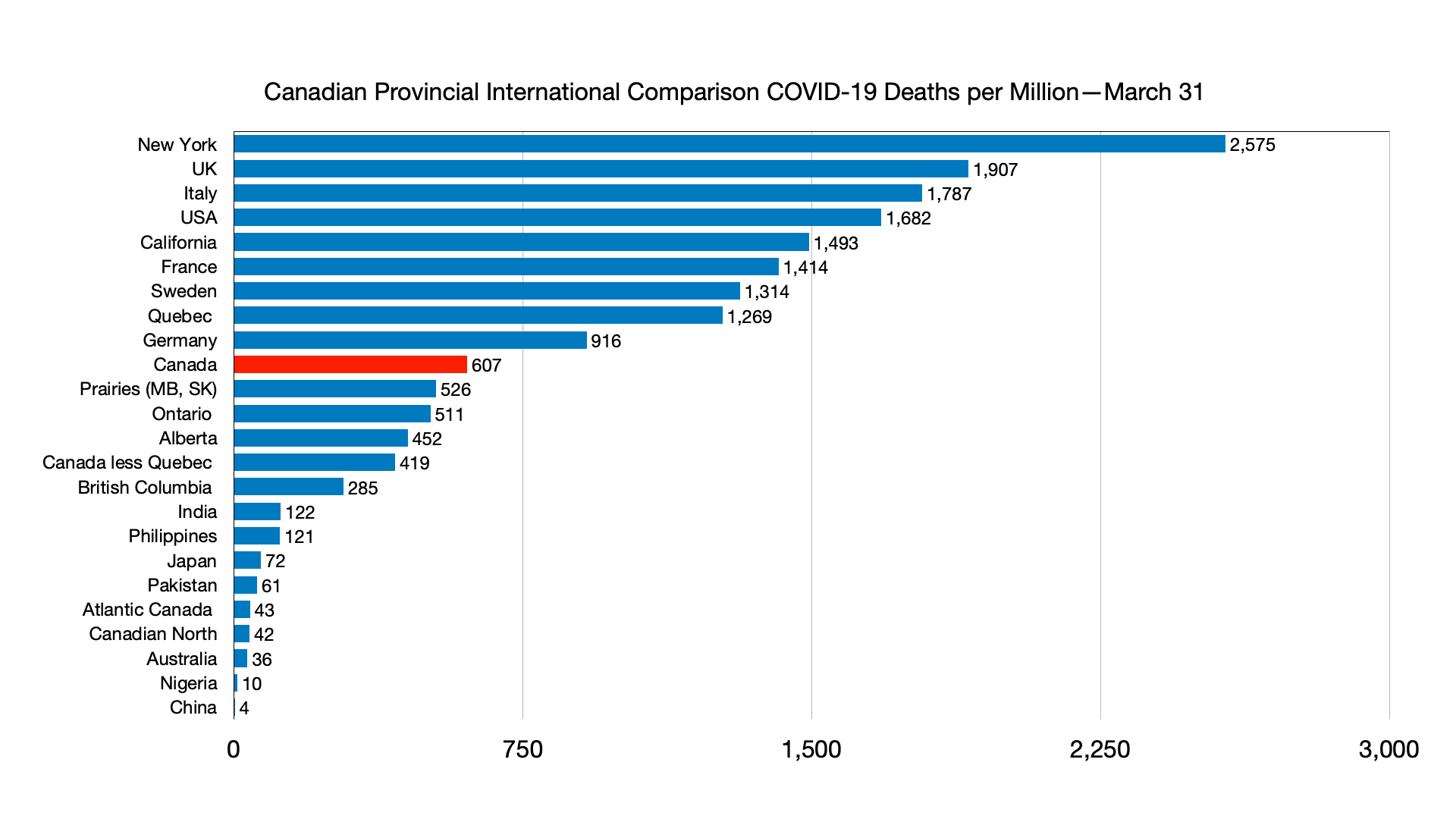
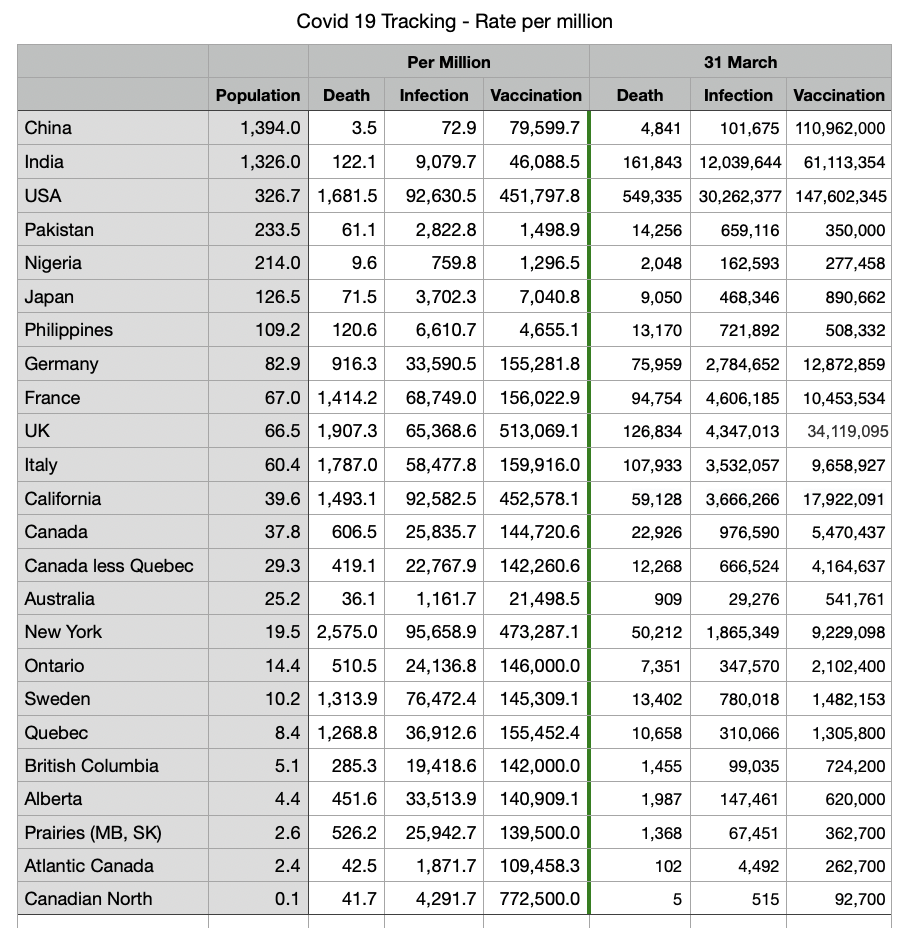
#COVID-19: Comparing provinces with other countries 31 March Update

The latest charts, compiled 31 March, in the context of a likely third wave.

Vaccinations: Change from last week: Slight decline in gap between EU countries and Canadian provinces. USA overall ahead of California, New York, France and Quebec ahead of Germany, Ontario ahead of Sweden but Sweden ahead of Canada and Canada less Quebec, British Columbia ahead of Alberta and Prairies.

Trendline charts

Infections per million: The previous trend of a flattening curve is seen in G7 countries and most provinces appears to be changing for the worse.

Deaths per million: Most Canadian provinces continue to flatten the curve, Quebec most dramatically. Overall G7 death rate continue to surpass Quebec’s by an increasing margin.

Vaccinations per million: While the gap between G7 and Canada remains despite the arrival of more vaccines, one can see that Canadian provinces have been ramping up. The increase in vaccination rates of immigration source countries driven by China and India.

Weekly

Infections per million: Some minor shifts: New York ahead of USA and California, Germany ahead of Alberta.

Deaths per million: No relative change.

Turkish Germans are finally finding their voice

Interesting overview and history (long read):

IScores of young Turkish men in sober suits move towards the train that will take them to Germany, while their wives and mothers cry on the platform. A few days earlier, these hopefuls had been bare-chested as their teeth and bodies were checked by German doctors to ensure they were strong enough for the physical work awaiting them. Those that pass the test feel immense pride: “I am Yılmaz Atalay from Çorum!” announces one, gazing wide-eyed into the camera in footage originally shot by Turkish state television.

Atalay was among the first Gastarbeiter, or guest workers, to leave a poor part of Turkey for West Germany’s booming post-war economy and a better life. The deal signed in 1961 by Ankara and Bonn sparked an enormous migration between two countries that shared little in terms of culture, religion or prosperity. It changed not only the workers’ lives, but also the nature of their new country. By the end of the first year, 5,623 Turkish workers lived in Germany. When the scheme officially ended, in 1973, there were 900,000. Now the Turkish-German community, comprising the original migrants and their descendants (about half of whom are German citizens) numbers nearly three million, constituting the biggest minority group in the country.

Most of those original migrants spent their working lives in low-paid, backbreaking jobs on assembly lines and building sites, as well as in mines. Their descendants include global successes, such as Game of Thrones actress Sibel Kekilli and World Cup-winning footballer Mesut Özil as well as—most recently—the Covid-19 vaccine creators, the married couple Uğur Şahin (whose parents were doctors) and Özlem Türeci of BioNTech.

But while such figures conjure up an immigrant rags-to-riches story, the truth for most is less romantic. As the 60th anniversary of the Turkish Gastarbeiter programme approaches, the younger generation is struggling to find its proper place. In 2021, Turkish Germans are still among the least integrated, least educated in the country. At the same time, the effects of German xenophobia remain pervasive. Many young Turkish Germans are angry that even after three generations, they don’t appear to fully belong.

Les immigrants auront peu d’incidence sur le déclin du français au Québec

More demystification:

Deux nouvelles études mettent en lumière les défis auxquels fait face la langue française au Québec. Elles confirment le recul net anticipé du poids des francophones au Québec d’ici une quinzaine d’années — et cela, peu importe les efforts déployés pour accueillir plus d’immigrants parlant français —, de même que l’importance que prend l’anglais en milieu de travail.

Dévoilées lundi après-midi par l’Office québécois de la langue française (OQLF), ces études viennent étoffer des données contenues dans le grand Rapport sur l’évolution de la situation linguistique, publié en avril 2019, et dans une étude de Statistique Canada publiée en 2017.

Pas de grande surprise par rapport aux constats, donc, mais les conclusions « confirment ce que plusieurs études ont montré — le français décline », commentait lundi Myriam D’Arcy, directrice générale de la Fondation Lionel-Groulx, qui s’intéresse de près à ce dossier. « Il est temps d’agir : on attend impatiemment le projet de loi » que doit déposer le gouvernement Legault pour mettre à jour la Charte de la langue française.

La première étude s’appuie sur les Projections linguistiques pour le Canada, 2011-2036. Ce rapport prévoit notamment une diminution importante de la part de la population utilisant le français à la maison (de 82 % en 2011 à 75 % d’ici 2036).

L’OQLF a demandé aux chercheurs de Statistique Canada d’étudier différents scénarios — touchant tous la composition de l’immigration — pour mesurer s’ils auraient un effet sur la part relative du français dans les différentes catégories habituelles (langue maternelle, principale langue d’usage à la maison, etc.). Résultat ? Les « scénarios auraient somme toute un effet assez limité sur l’accroissement du poids démographique de la population québécoise de langue française », notent les chercheurs.

Même un scénario « théorique peu probable » qui ferait en sorte que 100 % des immigrants du volet économique (c’est Québec qui assure leur sélection) seraient originaires de pays francophones « ne permettrait de faire progresser que marginalement les différents indicateurs du français ».

L’OQLF conclut donc elle aussi que « le poids des francophones de langue maternelle et celui des personnes dont le français est la langue parlée le plus souvent à la maison diminueront d’ici 2036 ». Dans le premier cas, on parle d’un recul d’au moins sept points de pourcentage ; dans le second, d’au moins six points.

Au travail

Pour l’étude Langues utilisées dans diverses situations de travail au Québec en 2018, l’OQLF a mandaté une firme de sondage pour qu’elle éclaircisse qui parle anglais au travail et pour quelles raisons. L’Office s’est gardé d’établir des comparatifs ou de commenter la situation.

Sur l’île de Montréal — là où se concentrent les questions liées à la protection du français —, 53 % des travailleurs parlent surtout français au travail, alors que près de 19 % utilisent surtout l’anglais. Le quart des travailleurs passent d’une langue à l’autre.

Pourquoi ? Près de la moitié (49 %) des répondants qui utilisent au moins régulièrement l’anglais le font pour « offrir un service à la clientèle du Québec ». Parmi les autres raisons mentionnées régulièrement, il y a notamment le fait que des « collègues préfèrent utiliser » l’anglais (25 %).

Source: Les immigrants auront peu d’incidence sur le déclin du français au Québec

ICYMI: Canada’s schools draw fewer international students due to pandemic travel rules

Seeing this in the monthly stats:

Many international students have postponed or cancelled their plans to study in Canada since Ottawa decided last month to limit entry options to the country to just four airports and require international travellers to pay for a mandatory hotel quarantine.

Denise Amyot, the chief executive officer of Colleges and Institutes Canada, said a $2,000 hotel bill is the cost of half of a semester for many students.

“(They) don’t have that kind of means,” she said.

If a group of international students are heading to New Brunswick, for example, Amyot said they might arrive in Toronto, where they would go to a hotel for three days as part of a 14-day quarantine.

Then, because they will be moving to another province with its own rules, they will have to quarantine again for 14 days when they arrive in New Brunswick.

“This is nonsense. It just doesn’t make sense,” she said. “It means that for the spring and summer, we have a large number of deferrals.”

Amyot said the number of international students at Canadian colleges has declined by 20 to 30 per cent in the 2020-21 academic year compared to 2019-20.

“It has varied across the country, and we had larger declines in smaller cities and rural and remote areas.”

She said many international students are deferring their plans to study in Canada since the federal government funnelled all international flights to Toronto, Montreal, Calgary or Vancouver and began requiring travellers to quarantine at government-approved hotels.

“Those two measures that the government has put in place are jeopardizing the number of students arriving,” she said.

Amyot called on the government to exempt international students from the three-day stopover requirement.

The office of Transport Minister Omar Alghabra said in a statement that any decision to ease or modify border measures in Canada will be based on scientific evidence.

“Entry prohibitions, coupled with mandatory isolation and quarantine, continue to be the most effective means of limiting the introduction of new cases of COVID-19 into Canada at this time,” the statement said.

Even before the new entry restrictions were imposed, the total number of all international students in Canada had already declined by about 17 per cent last year, to 531,000 students at the end of 2020 from 639,000 in 2019, according to an analysis of Statistics Canada data.

Paul Davidson, the chief executive officer of Universities Canada, said the overall enrolment of international students at Canadian universities has declined by 2.1 per cent this year compared to last.

“It’s against a backdrop where typically the number of international students at universities has grown at over 10 per cent in each of the last five years, so it is quite a setback,” he said.

“We have 96 universities at Universities Canada, and 51 of those institutions saw a decline in the international students … Overall, 26 institutions saw a loss of over 10 per cent of their international students.”

Fewer international students in Canadian post-secondary schools means less revenue for these institutions, which will affect domestic students, said Amyot.

“It means that there will be less programs that can be offered,” she said.

“It’s not only a matter of dollars … There are some programs that are very popular with international students, but not so much for domestic students, and that’s especially in more technical areas linked to engineering or mining … Now (these programs) won’t be offered, because there’s not enough students.”

Amyot said the decrease in international student numbers will eventually create a gap in the labour force in Canada.

“(International students) also come with skills,” she said. “It means that there will be a gap because we won’t be able to count on those students, and who will suffer? The industry, because there will be a labor shortage.”

She said Canadian colleges and universities have used innovation to allow international students to complete their studies online.

Robert Falconer, a researcher at the University of Calgary School of Public Policy, said international students studying online at Canadian schools from their home countries might lose interest in immigrating to Canada.

“They might decide, after getting their Canadian degree, that they’re not going to really bother coming to Canada because they’ve never been, they don’t have prospects here and no social network or job opportunities.”

Amyot said education institutions had quarantine plans in the fall for their international students, letting them go to their quarantine locations safely. Local public health authorities and the provincial and federal governments approved.

“It was working very well for the fall intake, but now with this new measure that was taken in place, everything is in the air,” she said.

Davidson said all international students, from kindergartners to PhDs, contribute about $22 billion a year to Canada’s economy.

“It’s a major contributor to Canada’s economic growth,” he said. “The decline in international student numbers is having a widespread economic impact in Canada.”

A spokesman for Immigration Minister Marco Mendicino said the government has encouraged international students to stay in Canada during the pandemic.

“While other countries told international students to go home during the pandemic, we went to great lengths to support them and create a system that allowed them to continue their studies,” Alexander Cohen said in a statement.

The department has tried to make it easier for international students to apply for work permits after they graduate, including counting the time they spend studying online toward the period of time needed to make them eligible, for instance.

Davidson said the United States is reducing barriers to immigration for international students and the government of the United Kingdom is marketing to international students and expediting visa processing for them.

“This is a competitive landscape we’re working in,” he said. “The government of the U.K. is offering guaranteed visa approvals (for international students) in about three weeks, which is much faster than Canada.”

Source: Canada’s schools draw fewer international students due to pandemic travel rules

Shree Paradkar: ‘Random’ tax audits of Muslim charities provide cover for biased terrorism suspicions, report finds

Of note. Can understand why some of the speakers prompted questions regarding charitable status, the point made inconsistency with respect to some Christian charities and institutions is valid:

When the Ottawa Islamic Centre and Assalam Mosque found its charitable status revoked in 2018, it was told it had promoted “hate and intolerance” by hosting four speakers who were found to have previously espoused dubious views elsewhere.

There was no record of what was said at the mosque, which the government found to be a violation of the Income Tax Act.

“The mere possibility that the views of the speakers … could have been expressed” warranted concern, wrote the Charities Directorate, a federal agency that sits within the Canada Revenue agency and oversees compliance with income tax laws. The fear was that the centre might be a hot spot for radicalized Muslims.

A new report titled “Layered Suspicion” released Monday studies three organizations that lost their charitable status to two key policies: anti-terrorism financing and anti-radicalization. The three are the Ottawa Islamic Centre and Assalam Mosque, the Islamic Shi’a Assembly of Canada and IRFAN-Canada.

The report examines how long-standing tropes of Muslims as the menacing outsiders who pose an imminent threat to society influence tax audits of Muslim-led charities. It looks at biases implicit in the audit, what interpretations auditors make and if there was bias in the selection of their evidence.

Authors Anver Emon, a University of Toronto law professor and director of its Institute of Islamic Studies, and Nadia Hasan, chief operating officer of the National Council of Canadian Muslims (NCCM), found that tax audits are often used as a cover for structural biases in policies related to financing terror and radicalization.

These policies operate in the shadows of an otherwise ordinary audit, the authors write, raising concerns about basic fairness, transparency and accountability.

Organizations are often told it’s a random audit. But for years, Hasan said, “we were hearing all kinds of grumblings about the kind of information auditors were asking that didn’t seem right. But nobody could put their finger to what was going on.”

The Ottawa Islamic Centre was created for the purpose of “advancing religion,” which is one of the categories that satisfies the requirement of charitable status. It served a largely Somali Muslim community. Canadian government focus on this community changed from humanitarianism to national security after 9/11, the authors write. Those fears are based on stories of a “small handful of young Somali-Canadians” recruited by al-Shabab extremists as foreign fighters, the report says.

The four speakers were considered to have what the government called “extreme ideas.” Extreme ideas, a nebulous concept based on the belief they can be transformed into violent activities, is key to Canada’s anti-radicalization strategy. It grants Public Safety agents discretionary authority and the power to determine what is extreme and what constitutes a threat to national security.

A BBC documentary reported one of those speakers, the American Abu Usamah at-Thahabi, saying in a Birmingham mosque, “No one loves the kafir (non-believers)” and that “I don’t agree with (Muslim terrorists) but at the same time they are closer to me than those criminals of the kufr (disbelief).”

Others were accused of homophobic and misogynistic attitudes; one of them was banned from multiple countries.

“Our point is even if they have conservative views whether we agree with them or not, they cannot become a pretext for radicalization concerns,” says Emon.

This approach was not applied equally across racial and religious groups, the report says.

“In 2019, pastors from Christ’s Forgiveness Ministries … were arrested in Toronto while preaching anti-gay ideas during Pride Week,” the report says. “At the date of writing this report, Christ’s Forgiveness Ministries remains registered as a charity.”

The report offers other examples: Canada Christian College is registered as a charity with the CRA despite its president Charles McVety’s open homophobia. If the Ottawa speaker was slammed by British broadcasting, McVety was castigated by the Canadian Broadcast Standards Council as “abusive.”

Journey Canada, accused of supporting practices of conversion therapy and Northern Youth Programs, which operated some of the last residential schools in Canada, and is accused of running programs in Northern Ontario that LGBTQ2 members claim are harmful to youth, also keep their status.

The other policy of note for the report is Canada’s anti-terrorism financing policy that involves 13 federal departments and agencies, eight of which receive funding totalling $70 million annually.

The CRA is one of those agencies.

The terrorist attacks of 9/11 and what the report calls “the exaggerated and generally debunked belief” that the wealthy Osama bin Laden was bankrolling al-Qaida brought global attention to the issue of terrorist financing.

In 2015, as part of a risk assessment review process, Canada named 10 groups that posed the greatest threat to terrorist financing.

Out of those, eight are Muslim or Arab including al-Qaida, Hamas, al-Shabab and Hezbollah. One is a vaguely named “Khalistani Extremist Groups” and another is “Remnants of the Liberation Tigers of Tamil Eelam.”

“What’s this risk-based assessment going to do?” Emon says, “It’s going to put the focus on Muslim charities in particular.”

The Islamic Shi’a Assembly’s troubles began in 2011 right after Stephen Harper was elected prime minister, the report says. The Charities Directorate first determined that the organization’s operations did not support “advancing religion” as its purpose. And if it wasn’t advancing religion then it deemed it to be supporting a political purpose.

Its audit began at a time of tense Canada-Iran relations, days after Harper declared it “probably the most significant threat in the world to global peace and security.” The directorate concluded the organization was a Canadian front for an Iranian-controlled global organization that had among its membership people from Hezbollah.

How did the organization run afoul of its “advancing religion” mandate? The audit report said it found the organization hosting Eid festivals for Ramadan two-and-a-half weeks after the recognized religious dates for Eid ul-Fitr. But there are no statutory holidays for Muslim festivals. And because they follow the lunar calendar, the festival sometimes falls mid-week. As with other non-Christian groups, Muslims have to decide whether to take time off work or school to attend religious services. It is therefore standard for organizations to schedule festivities on a weekend at a later date.

The decision “smacked of a protestant Christian bias that manifested as state protection and state oversight,” Emon says.

IRFAN-Canada or the International Relief Fund for the Afflicted and Needy (Canada) also ran afoul of the terrorism financing rules, but via a different route. Its mandate was “poverty relief” not advancing religion. Among regions it worked in was the West Bank and Gaza Strip and it was given charitable status in 1999.

But when Hamas won the parliamentary election in the Palestinian territories in 2006, it sent the world into a tailspin. Depending on a nation’s politics, the social wings and political wings of Hamas were either considered separate or they were collapsed. The report reproduces various arguments in Parliament during question period in the early to mid 2000s to show how “the Israeli-Palestinian conflict became a political battleground for domestic partisan feuds.”

By 2011 the directorate revoked IRFAN-Canada’s charitable status alleging direct links to Hamas. Any of its projects funded through a government ministry in Gaza were automatically deemed to support Hamas after 2006.

The report calls for an immediate suspension of the CRA’s Review and Analysis Division, the agency’s investigative unit of charities and terrorism funding and a review of Canada’s risk assessment model and strategy to combat extremism and radicalization. It seeks transparency from the Charities Directorate to let organizations know why they’re being audited.

It’s calling for the suspension of discretionary use of revocation powers in audits where counter-radicalization policies are involved.

Mustafa Farooq, chief executive officer of the National Council of Canadian Muslims, said these organizations have to constantly second-guess themselves. “If we invite this Imam do we have to search everything this Imam ever said so we don’t someday lose our charitable status? Will it matter if we hold an Eid celebration a week later. What happens when we’re trying to donate to an international cause domestically but that someday might be unpopular with the government?

“There is always this spectre haunting Muslims that animates and weaves its way through this report.”

Source: Shree Paradkar: ‘Random’ tax audits of Muslim charities provide cover for biased terrorism suspicions, report finds

Methodology for Investment Migration Programs 2021 (Henley & Partners)

For those of you interested in indexes and citizenship and how the private companies make their assessment:

In constructing the Global Residence Program Index (GRPI) and Global Citizenship Program Index (GCPI) we have referred to multiple sources and experts to obtain and interpret the primarily qualitative data used. We have relied principally on the expertise of residence and citizenship analysts and the experience of investors and government officials. As a result, the explanatory power that supports the scores in the different categories is based on surveys, interviews with respondents, and opinions solicited from selected experts. Where possible, the subjectivity of the various factors has been assessed against publicly available data and widely accepted composite indicators.

The data for surveys and interviews has been consistently collected from a representative sample that includes respondents, experts on citizenship, and practitioners who have been involved in the design of qualitative research in global mobility and related spaces. The sample frame for respondents consists of existing and potential investors, their advisors, and government officials in countries that either already have, or are in the process of establishing, investment migration programs. Relying on potential clients means that the responses of those who decided against proceeding with any program are also included. It may also be noted that among our respondent and expert base are government officials and consultants engaged in investment migration programs that have been discontinued as well as those that are in the process of being established or reformed.

The factors that are analyzed in each of the indexes are as follows:

Global Residence Program Index

  • Reputation
  • Quality of Life
  • Visa-free or Visa-on-arrival Access
  • Processing Time and Quality of Processing
  • Compliance
  • Investment Requirements
  • Tax
  • Total Costs
  • Time to Citizenship
  • Citizenship Requirements

Global Citizenship Program Index

  • Reputation
  • Quality of Life
  • Visa-free or Visa-on-arrival Access
  • Processing Time and Quality of Processing
  • Compliance
  • Investment Requirements
  • Residence Requirements
  • Relocation Flexibility
  • Physical Visit Requirements
  • Transparency

Reputation 

Reputation relies on the perceptions of investors and advisors regarding the image of the countries in which they invest. This indicator is subjective by nature, but much like the Attractiveness Indicators employed by the IMD in its Executive Opinion Surveys, our intention was to allow our respondents and informants the space to consider intangible and unanticipated factors while assessing the reputation of destination countries.

Endeavoring to assess reputation is not new, and the relationship between reputation and outcome is a popular mechanism for assessing the competitiveness of organizations, cities, and even regions. Furthermore, the reputation of a country, much like the reputation of a corporate, is a historical indicator that allows its previous efforts to meet investor expectations to be assessed.

Quality of Life 

The assessment of Quality of Life (QoL) uses a wide range of methods to evaluate subjective perceptions of various sample groups in different contexts, as well as developing factors that are independent of subjective perceptions. Like Reputation, QoL could well benefit from considering investors’ experiences and what is particularly relevant to individuals who are interested in investment migration.

We are aware, moreover, that there are substantial institutional efforts in developing composite indicators for QoL — the United Nations Human Development Index is one of the most comprehensive (relying on life expectancy at birth, schooling, literacy rates, and gross national income per capita). These factors do not cover all civil and political liberties though; for assessing democratic values, Freedom House’s Freedom in the World report is a preferable indicator.

As our focus is also on investment, the World Bank’s Doing Business reports are pertinent, since investors may have to negotiate the regulatory environment of destination countries for a variety of economic activities. We have sought to anchor the framing of our questions in established indicators but recognize that such indicators do not always correspond to what is being assessed in the GRPI and GCPI.

Visa-free or Visa-on-arrival Access

The methodology for this factor is relatively straightforward. It aims to measure an improvement in the mobility of an investor, or their ability to enter additional countries visa-free or with visa-on-arrival access as a result of being a citizen of, or resident in, a particular jurisdiction.

For the GCPI this factor relies on the 2021 Henley Passport Index, which curates data from 227 different travel destinations (including countries, territories, and micro-states), collated by the International Air Transport Association, to arrive at the ranking. The Henley Passport Index compares data on the number of destinations that a citizen of a given country can visit without requiring a prior visa. A relaxed travel policy is worthwhile in itself, but it also characterizes a country’s political regime and the extent of its civil liberties.

While acquiring alternative citizenship is more directly linked to ease of travel, an alternative residence can also enhance the mobility of individuals. It thus also features as a factor that motivates residence investments and is included in the GRPI.

Processing Time and Quality of Processing

Processing time for applications and their quality of processing are two distinct aspects that are assessed differently. Some countries may offer a short processing time between lodging an application and issuing a visa or permit, but there may be uncertainties in administrative processes. In this regard, input from respondents has proved valuable: the responses and analysis thereof have verified the official or declared processing time and complemented the ‘hard’ data on actual processing time taken (namely, the number of days), including obstructions faced.

Compliance

Countries have different procedures and varying due diligence requirements for profiling applicants (including criminal records and financial statements), sources of funds, the manner of fund transfers, and the vulnerability to abuse of the funds invested. The standard measures adopted are best practices developed by international associations and professional agencies for anti-money laundering, counter-terrorist financing, and anti-bribery and corruption. The EU, unlike the USA, does not have a joint or federal procedure for conducting due diligence, so EU countries differ widely in terms of their national rules. Clear information and frameworks regarding due diligence facilitate better risk assessments for potential investors. A more intensive due diligence requirement may be an advantage as this translates into less uncertainty in private investments. Since financial institutions usually engage in Know Your Customer audits regardless of the regulations of investment migration programs, they are less vulnerable than private investments. Vulnerability to money laundering in different sectors could, furthermore, be avoided in the presence of clear regulations.

Investment Requirements

The upfront investment amounts for residence differ in terms of amount required, nature of investment, and additional costs. For this indicator, we consider the required investment amounts. The range in the stated amounts is broad and the nature of the investment is not always left to the discretion of the investor. Options for different forms of investment are specified by the destination governments, largely depending on policy considerations and benefits to the respective countries. Generally, a country offering more choice in how to invest and requiring lower investment amounts (including additional costs) scores higher.

Because of the unique nature of citizenship-by-investment (CBI) programs, investment amounts are substantial, and the accompanying conditions do not allow much choice in the nature of the investment. There is a noticeable pattern to the investments required for CBI programs: the investment amounts are generally greater than those required by residence-by-investment (RBI) programs, there is usually a requirement or at least an option to purchase real estate, and there is usually a requirement or an option to make a non-refundable contribution.

Tax

This factor raises the question of the extent of the tax burden that a resident is required to bear for both corporate and personal economic activities. It is rare for a country not to impose any taxes on its residents. The only two countries in our indexes that have that distinction are Monaco and the UAE, since they do not impose personal income tax, property tax, capital gains tax, or net worth taxes. For all other countries, preferential tax schemes and tax waivers, and incentives for applicants with significant investments heavily influence the score arrived at for this factor.

Total Costs

The stated investment amount does not always constitute the total actual cost an investor must bear to acquire residence status. As the nature of investment differs considerably across programs, it is difficult to compare the total actual cost of investment. Programs that offer a range of investment options score higher in this sub-indicator. Some investors have, however, raised questions about the uncertainties and volatility of foreign markets and therefore the value of choosing options that appear to be safer. Generally, destination countries that reduce investors’ opportunity costs by providing a wider choice of investments or by offering incentive-based investments are considered by investors to be more attractive.

Time to Citizenship

The time it takes applicants to gain citizenship is one of the criteria for assessing a RBI program’s attractiveness.

This refers to the process of naturalizing as a citizen once already a resident, which is distinct from direct CBI. Countries that have appeal in this regard offer a relatively fast path to citizenship, mainly because the time it takes to naturalize is comparatively short. However, this factor considers both the formal time required and any physical presence requirements. Countries with prohibitive rules governing the transition to citizenship score zero.

Citizenship Requirements

This factor examines all the requirements to qualify for naturalization after the specified minimum time has been fulfilled, including physical presence requirements, additional investment requirements or other ‘commitment’ requirements, and other requirements to qualify for citizenship, such as language requirements and cultural integration tests. In some countries, the transition from permanent residence to citizenship is less demanding and there are minimal additional requirements. Other countries have stringent physical presence but few additional requirements.

Residence Requirements

None of the countries ranked in the GCPI impose demanding conditions of residence. Smaller countries keen on attracting investment use waivers or substantial reductions in residence requirements to their competitive advantage.

Relocation Flexibility

An assessment of the number of citizenship investors in the different countries reveals that a substantial percentage of them apply for the migration of family members with the intention of either settling in the destination country or keeping the option open in case they need to leave their home countries. For this factor, we evaluated first the number of investors who indicated their intention to relocate and compared it to the number of investors who have relocated, in order to gauge which countries are conducive to relocation. Subsequently, we assessed the factors facilitating relocation. In this regard, EU member states have a clear advantage because a citizen of an EU member state can consider relocating to another member state or to a choice of several additional countries that have agreements with the EU, such as Switzerland. Though such relocation is not automatic, the rules are well established, they provide clarity on how and when relocation to another EU member state is permissible, and the process entails lower information costs. Destination countries’ efforts towards enabling family unification, and the ease with which they deal with private property, reduce the uncertainties that relocation can entail. Furthermore, for citizens who can support themselves financially, EU law imposes very few restrictions on their freedom to relocate.

The rule of law plays an important part in informing investors’ choices in relocation: their confidence in an existent fair process for securing personal freedom, settling investment disputes, and the legal wherewithal to negotiate with government authorities, all point towards a higher score.

Physical Visit Requirements

This indicator assesses whether physical visits are required as part of the application process, usually for interviews, oath-taking ceremonies, and passport renewals, by evaluating the number of visits required and the bureaucracy of the processes that precede them.

Transparency

The World Economic Forum’s transparency indicators for CBI programs are: public support, evaluation studies, availability of public data, and due diligence criteria. No GCPI countries publish evaluations of CBI inflows, but the other criteria inform the structure and content of the surveys, which inquired about access to clear information on application processes, including due diligence, and how funds are used. Although many investors wish to understand, and preferably choose, where their investments are used, investments are often deployed in predetermined ways, making it difficult to influence their use. The visibility of such contributions in domestic projects and the earmarking of funds influence investors’ decisions and perceptions of program transparency.

Circulating such information is advantageous as it enables investors to conduct meaningful risk assessments. Furthermore, the impact of investments on potential and existing businesses could influence business decisions. The pivotal aspects for transparency are program rules and regulations, and processes and their implementation in program administration.

Source: https://www.henleyglobal.com/publications/investment-migration-programs-2021/methodology

In inclusivity push, workers reject prods to allow mispronounced or ‘whitened’ names

Of note. Just ask – not a microaggression:

When Janani Shanmuganathan was in law school, she remembers hearing some misguided professional advice.

“You should take your husband’s name,” Shanmuganathan recalls someone telling her, because her own name was hard to pronounce. Her colleague speculated it would make it harder to get clients.

Shanmuganathan says she remembers being angered by the comment, not only because she was proud of her name, but because it is spelled phonetically — and she doesn’t mind helping people who ask her how it’s pronounced. Plus, she says, she wants up-and-coming lawyers to see Tamil women represented in the law community.

Shanmuganathan has indeed faced professional challenges over time. She says that it was not uncommon for a judge to refer to other lawyers by name, but refer to her only as “counsel,” and her racialized client as “the accused,” raising questions about differential treatment from clients and their families.

“There is something more dignified in a name,” says Shanmuganathan.

Research suggests that “whitened” names have historically made job candidates more likely to be hired. But as many employers claim to be changing course and trying to attract diverse talent, experts say companies must also do more to respect whatever name a worker chooses to identify with.

Shanmuganathan wrote about her experiences with her race, including being mistaken for the interpreter in court, in a publication sent out to other criminal lawyers. Her assessment — which described courts skirting around her name as one of many symptoms of bias in the legal system — resonated with people.

The Federation of Asian Canadian Lawyers began a social media campaign to “make hearing Asian names more commonplace” and help lawyers who were being passed over for opportunities because someone else was uncomfortable with their name pronunciation. Several years ago, law firm Borden Ladner Gervais added a clickable blue megaphone buttons on its staff’s web pages that play a recording of each person pronouncing their name in hopes of levelling the playing field for incoming lawyers.The feature on BLG’s website came out of concern that when summer students joined the firm each year, senior lawyers would be more likely to reach out and assign work to the aspiring lawyers they could comfortably call by name, says Laleh Moshiri, national director, diversity and inclusion at the firm. While it’s far from the only answer to diversity and inclusion issues at the firm, the pronunciation tool shifted some of the onus of learning students’ names to the lawyers.

LinkedIn last year added a similar tool to its website, in an announcement that said “correct pronunciation is not just a common courtesy — it’s an important part of making a good first impression and creating an inclusive workplace.” A tool made by NameCoach is also used for MBA students at the University of Toronto’s Rotman School of Management, says Sonia Kang, Canada research chair in identity, diversity and inclusion at the university.

Kang says that the pressure for people to “whiten” their names in many industries can stem from discrimination that begins as early as the hiring process. Resumes with whitened first names and extracurricular experiences led to more callbacks than the unwhitened resumes for both Black and Asian applicants, according to a paper Kang co-authored. Similar findings have been repeated in multiple studies.

“When I’m talking to hiring managers about this — put aside for a second discrimination, which we know exists, for sure. But some of the time, the reason that they might not call someone is because they don’t want to offend them by saying their name wrong,” says Kang. “It’s this kind of benevolent racism.”

Shanmuganathan says things have improved in the legal world, but the issue persists. Last month, Vancouver immigration lawyer Will Tao wrote an essay on how his work with immigrants and community organizers has reinforced to him how many Biblical names have roots in colonialism and, for Indigenous colleagues, the residential school system.

“I am in a profession where marketability, presentation, professionalism, and competency is everything. Why is Will Tao more competent and presentable than Wei Tao?” he wrote.

In a recent talk explaining her perspective as a woman in banking, Laurentian Bank chief executive Rania Llewellyn cited her name as one factor that has motivated her to raise diversity and inclusion expectations at her company.

“My first job in Canada with my degree from a Canadian university was working at Tim Hortons. My last name was not Llewellyn. It was very Middle Eastern. No one would even call me for an interview… inclusive hiring is really, really important,” said Llewellyn. “Nobody ever asked me about where I’m from anymore … When I introduce myself, I always say Rania, like Tanya, and all of a sudden people are like, ‘Ah.'”

Shanmuganathan says that she urges co-workers to refer to her and introduce her by name, so others get used to hearing it. Moshiri, meanwhile, says that she encourages her colleagues to write down phonetic spellings in their notes so they don’t forget name pronunciations.

Kang says that no one can be expected to know every name in the world — and she says asking for name pronunciations should be seen as normal, not awkward. At the same time, learning the sounds and spellings that crop up commonly in your line of work is a skill that will continue to be valuable in building relationships, says Kang.

Encouraging authenticity — whether that is a name a worker was given at birth or one they choose to identify with — can reap benefits for employers, says Kang.

“It’s just about having a choice, and not feeling pressured either way,” she says.

Source: In inclusivity push, workers reject prods to allow mispronounced or ‘whitened’ names