Rights groups take French racial profiling case to top body

Of note:

After months of government silence, leading rights organizations and grassroots groups took France’s first class-action lawsuit targeting the nation’s powerful police machine to the highest administrative authority Thursday, to fix what they contend is a culture of systemic discrimination in identity checks.

The 220-page file, chock full of examples of racial profiling by French police, was being delivered Thursday to the Council of State, the ultimate arbiter on the use of power by authorities. It was compiled by Amnesty International, Human Rights Watch, Open Society Justice Initiative and three grassroots organizations that work with youth.

The NGOs allege that French police target Black people and people of Arab descent in choosing who to stop and check. Police officers who corroborate such accounts are among people cited in the file.

The groups behind the lawsuit contend the practice is rooted in a culture of systemic discrimination within the police with far-reaching consequences for people of .

“It’s a humiliating experience. You’re in the street, you’re frisked, patted down and questioned in front of everyone,” said Issa Coulibaly, head of Pazapas, a youth association in eastern Paris involved in the suit.

Instead of money for victims, the suit seeks deep reforms within law enforcement to ensure an end to racial profiling, including a change in a penal code that currently gives officers carte blanche to check IDs — with no trace that they have done so. Among other things, they also want an independent mechanism to lodge complaints and training for police officers.

The groups took the case to the Council of State after the government failed to meet a four-month deadline to respond to the opening salvo in the class-action suit.

The prime minister’s office and the justice and interior ministries were initially served notice of the suit in late January — the first step in a two-stage process in a French class-action case. The law gave them four months to open talks with the NGOs on how to meet their demands for change within the police, before the matter could go before a court.

Those who brought the action contend it is in the interest of authorities, including law enforcement, to improve the notoriously poor relationship between police and youth in some .

Antoine Lyon-Caen, the lead lawyer in the case, said it is the first time a class-action suit against the French state is going before the Council of State. He called the government silence “humiliating” for racial profiling victims.

“Lots of people suffer from these practices and the government didn’t even feel a need to say something,” he said in an interview.

Coulibaly said the official silence is in keeping with “institutional denial” of the problem. But he said this next legal step is a new dose of hope for change.

Children as young as 10 can be checked if they are Black or perceived as of Arab descent, said Coulibaly, a 41-year-old Black man who said he was subjected to numerous undue ID checks starting at the age of 14.

“It’s a reality for all working class and a reality for the poor and where there are people of immigrant origin,” he said.

French courts have found the state guilty of racial profiling in identity checks in the past, most recently in June when a Paris appeals court ruled that discrimination was behind police ID checks on three high school students of at a train station in 2017. The court convicted the French state of a “grave fault” and ordered reparations paid.

“The ID check is really the door for lots of things that can be very destructive in the life of a person,” Coulibaly said. “It can degenerate. After a 50th check in your life, the 10th in a week or the third check in a day, especially when you’re young, you have a tendency to react, to react badly.”

The Council of State has the power to order the French state to end such practices and make the requested changes, Lyon-Caen said. The law requires a decision in a “reasonable” time, but that could be a year or more, he said, noting that the unprecedent case takes the Council of State into uncharted territory.

Source: Rights groups take French racial profiling case to top body

Immigration and the Aging Society

The same characteristics apply to Canada in terms of the limited impact of immigration on addressing an aging demographic. However, given Canada’s prioritizing skilled immigration, the fiscal drain arguments don’t apply (previous studies by Grubel that argued thus were flawed):

The idea that immigration is the solution to the aging of American society has become an article of faith among those arguing for ever-higher levels of new arrivals. They assert that, in societies such as the United States, where fertility rates are low relative to historic patterns, the native population will not supply enough workers to maintain a robust economy and pay for government services, particularly retirement programs. If native-born Americans aren’t going to have enough children to balance the longer-lived elderly population, the argument goes, then our only option is to increase immigration levels.

It’s not a crazy argument; it just happens to be incorrect. In reality, a significant body of research shows that the impact of immigration on population aging is small. While immigration can certainly make our population larger, it does not make us dramatically younger.

And yet, commentators have been making such arguments for years. The late Washington Post columnist Charles Krauthammer asserted in 1998 that America has been “saved by immigrants” from the kind of aging taking place in other first-world countries. Former Florida governor Jeb Bush famously said that America needed higher levels of immigration to “rebuild the demographic pyramid.” At the data-journalism site FiveThirtyEight, Ben Casselman has argued that immigration is the “only thing” preventing the country from facing a “demographic cliff.”

The release of the 2020 census showing the U.S. population grew by only 22.7 million since 2010, coupled with preliminary data indicating a sharp drop in fertility during the Covid-19 pandemic, have prompted a new round of articles asserting that immigration is the solution to population aging. The title of a recent Vox piece by Nicole Narea summed up this view: “The Census Shows the US Needs to Increase Immigration — By a Lot.” Similarly, George Mason University’s Justin Gest has called for doubling immigration to make the United States “younger, more productive and richer.”

But demographers have known for a long time that, absent truly gargantuan and ever-increasing rates of immigration, it isn’t actually possible for immigrants to undo or dramatically slow the overall aging of society. As Oxford demographer David Coleman observes, “it is already well known that [immigration] can only prevent population ageing at unprecedented, unsustainable and increasing levels of inflow.”

Those who argue that immigration is the key to dealing with an aging society are right about one thing: Both the share of the population that is of working age (16 to 64) and the ratio of workers to retirees are declining as Americans live longer and have fewer children. It is also true that, primarily due to post-1965 immigration, immigrants and first-generation Americans represent a growing share of the U.S. population and workforce. But this does not mean that immigration can dramatically slow or halt the aging of American society to nearly the degree that many seem to believe.

There are four broad reasons why the demography doesn’t support the political credo. First, not all immigrants arrive young — in fact, a growing share are arriving at or near retirement age. Second, immigrants age just like everyone else, adding to the elderly population over time. Third, immigrant fertility rates tend to converge with those of the native born. Fourth, to the extent that immigrants do have higher fertility rates than the native born, their children add to the dependent population — those too young or old to work. All of this means that immigration has only a modest impact on the working-age share of the population and the ratio of workers to retirees.

Immigration and Population

Studying the impact of immigration on population aging is nothing new for demographers. In a 1992 article in Demography — the top journal in the field — economist Carl Schmertmann explained that mathematically, “[c]onstant inflows of immigrants, even at relatively young ages, do not necessarily rejuvenate low-fertility populations. In fact, immigration may even contribute to population aging.” In 1994, Thomas Espenshade, the former chairman of Princeton’s sociology department and director of its graduate program in population studies, concluded the same. “Immigration,” he observed, “is a clumsy and unrealistic policy alternative to offset a shortage of domestic labor or to correct a perceived imbalance in the pensioner/worker ratio in the United States.” Likewise, as part of its population projections in 2000, the U.S. Census Bureau stated that immigration is a “highly inefficient” means for increasing the working-age share in the long run.

More recent studies only confirm these conclusions. A paper I co-authored for the 2012 annual meeting of the Population Association of America, for instance, shows that future levels of immigration have a modest impact on population aging. A 2019 version of that paper, which is based on the most recent Census Bureau population projections, demonstrates the point yet again.

According to those projections, the total U.S. population will reach 404 million in 2060. This figure assumes current trends in net migration — the difference between the number of people arriving and those leaving — will continue, at an average rate of about 1.1 million each year. To determine the effect this level of immigration will have on the U.S. population, we can compare the bureau’s 2060 projection to the projected population under a scenario where net migration is zero (which is unlikely in the extreme, of course, but useful for our analysis). In this scenario, the U.S. population would decline slightly, to 329 million. The 75-million difference between the two figures represents the impact that immigration will have on the total population over the next 39 years.

The Census Bureau also estimates that, in 2060, 59 percent of the population will be of working age. Again, this is based on the assumption that net migration will amount to an average of 1.1 million each year. Under a zero-immigration scenario, just under 57 percent of the population would be of working age. In other words, while immigration is projected to add 75 million people to the American population by 2060, it will only increase the working-age share of the population by about two percentage points. Even if annual net immigration were expanded by 50 percent above what the Census Bureau projects, so that it averaged about 1.65 million a year, it would still only increase the working-age share of the population by three percentage points.

Part of the reason immigration has such a small effect on the working-age share of the population is that while it certainly adds new workers, it also adds to the number of retirees over time, as well as to the number of children. To be sure, these children eventually grow up and become workers. But by the time this happens, many of their immigrant parents will have reached retirement age. These two developments tend to cancel each other out over time. As a result, immigration does not have much of an impact on the share of the population that is of working age in the long run.

This fact is key to understanding why immigration has such a modest impact on overall population aging. Looking at the average age of immigrants over time, as opposed to projecting into the future, shows how this works. In 2000, the average age of all immigrants — not just new arrivals — was 39.2 years. By 2019, it was 46 — a seven-year increase. Over the same period, the average age of native-born Americans increased only slightly, from 35.4 years to 38 years. Part of the reason for the disparity is that all children born to immigrants are considered natives, so they add only to the native-born population. Nonetheless, the relatively high and increasing average age of all immigrants is a good reminder that they grow old like everyone else, even if they do arrive when relatively young.

Most people recognize why a larger senior population increases government expenditures, but fewer acknowledge that a larger population of children does so as well. Government spending on children makes up a sizeable portion of federal, state, and local budgets: The United States spent $726 billion on public schools during the 2017-2018 school year alone. Federal and state governments also spend more than $1 trillion per year on means-tested programs, a large share of which goes to families with children. Indeed all societies, including ours, devote enormous resources to providing for children, and for good reason. But a larger population of children means the state must spend more to provide for them.

Even if we were to exclude children from the analysis and focus solely on the ratio of working-age people to retirees (those 65 and over), the impact of immigration would still be modest. Under the Census Bureau’s current projections, there will be 2.5 working-age people per retiree in 2060. If the projected immigration rate were cut in half, there would be 2.3 workers per retiree. Commenting on our findings at a panel discussion, American Enterprise Institute scholar Nicholas Eberstadt summarized the upshot succinctly: “[I]mmigration cannot possibly over the long run maintain a youthful population structure.”

Of course, as Espenshade and Coleman suggest, it is theoretically possible to use immigration to preserve the current working-age share of the population, as well as the ratio of workers to retirees. But doing so would require levels of immigration that have no precedent in American history. Our analysis shows that, to roughly maintain the working-age share of the population, immigration rates would have to increase five-fold over what the bureau currently foresees. This would create a total population of 706 million in 2060 — more than double the current population. Under such a scenario, by 2060, most U.S. residents would be post-2019 immigrants or their offspring. This level of immigration would be transformative in the extreme; few aspects of society would remain untouched by adding so quickly and so dramatically to the U.S. population.

Immigration and Aging

Population projections provide a reasonable picture of what is likely to happen demographically in the future, but they also rely on assumptions about trends that are always changing. As a result, the newest Census Bureau projections do not fully reflect the significant increase in the age at which immigrants are now coming to America.

Although newcomers were slightly younger in 2019 than they were in 2018, the average age of new immigrants, including illegal immigrants, is still much higher than it was in the past — increasing from 26 in 2000 to 31 in 2019. Perhaps even more surprising, the share of newly arrived immigrants who are 55 and older more than doubled, from 5 percent in 2000 to 11 percent in 2019. This means that one in nine new immigrants is arriving old enough to move directly into a retirement community.

Why are immigrants arriving at older ages? One reason is that, as the United Nations has reported, fertility is declining and life expectancy is increasing worldwide. Rapidly aging populations in countries that send immigrants to the United States almost certainly translate into immigrants arriving at older ages, at least to some extent.

Even more importantly, U.S. citizens can sponsor their parents for permanent residence without numerical limits. Parents typically immigrate to the United States after age 50, meaning they tend to be at or near retirement age as soon as they arrive. As the number of naturalized citizens living in the United States has nearly doubled since 2000, it should come as no surprise that the number of immigrants arriving each year in the parents category has increased in turn.

It is fair to criticize this category of permanent immigration — at least for a society facing an entitlement-funding crisis, such as ours. But it would be politically difficult to end the program. Press accounts in recent years indicate that the Trump administration considered offering parents a continually renewable temporary visa instead of permanent residence, but no such policy was formally proposed. The Biden administration is unlikely to advance such an idea. And in any case, the approach would still have meant the arrival of perhaps 150,000 or more parents each year, who would have added to overall population aging.

The understandable desire of many immigrants to bring their parents to the United States means that any immigration reform that emerges from Congress will almost certainly allow a substantial number of older immigrants to enter the country on both permanent and long-term temporary visas. Once these individuals arrive, it is hard to imagine the government refusing to provide some level of assistance for them — after all, many elderly immigrants who did not work long enough to qualify for Social Security or Medicare often end up receiving Supplemental Security Income and Medicaid. Like our devotion to providing for children, our commitment to assisting the elderly is not without merit. But we should also be cognizant of how immigration policy affects our ability to make good on this commitment as our society ages.

Immigration and Fertility

A key reason for the aging of America’s population is the declining fertility rate among the native born. Many commentators assume that immigration can help reverse this trend, as they believe immigrant women tend to have many more children than do American-born women.

Yet as mentioned above, declining fertility rates are a near-universal trend. Several of the top countries that contribute to America’s immigrant population — including Cuba, Vietnam, China, and South Korea — have fertility rates near as low as, or even lower than, that of the United States. More importantly, immigrants living in the United States are increasingly reflecting these trends: Despite a 9 percent increase in the total number of immigrant women of childbearing age between 2008 and 2019, there were 158,000 fewer births to immigrant women in 2019 than there were in 2008.

As the graph below indicates, the total fertility rate (TFR) — the number of children a woman is expected to have in her lifetime — for immigrant women has fallen steadily. In 2008, immigrant women had a TFR of 2.75. By 2019, the rate had fallen to 2.02. A TFR of 2.1 is widely considered necessary to maintain the existing population. Thus, for what is almost certainly the first time in American history, the immigrant fertility rate was below replacement level.

As the graph above indicates, the TFR for native-born women also declined over the same period. But it did so by roughly half as much as it has among immigrants. To be sure, the overall immigrant TFR of 2.02 is still higher than the 1.69 TFR of natives. But the presence of immigrants only pulls up the overall TFR in the United States to 1.76 — an increase of just 4 percent.

The steep decline in immigrant fertility has not received much media coverage, even while the fall-off in births nationwide has received a good deal of press. In fact, many people remain unaware that it has occurred. The Census Bureau is aware of the development, but again, the trends it relies on are always changing, and it takes time to incorporate changes of this kind into its population projections. As a result, the bureau’s most recent projections do not fully capture this trend, instead assuming a 2019 TFR for immigrants of 2.5 — well above the actual rate of 2.02. Because immigrant fertility is much lower than projected, the small, positive impact of immigration on population aging shown in the bureau’s projections is even smaller. What’s more, although the fertility numbers for 2020 are preliminary, we do know that fertility was down significantly in the country during the pandemic. There is no reason to believe immigrants bucked this trend.

Among native-born Americans, Hispanics have seen the steepest drop in fertility in recent years. American-born Hispanic women had a TFR of just 1.77 in 2019. The TFR was 1.42 for American-born Asian women that same year — both well below replacement level. The rate for native-born whites and blacks was 1.69 and 1.68, respectively. In short, among native-born whites, blacks, and Hispanics, there is now no meaningful difference in fertility rates, while the native-born Asian fertility rate is a good deal lower than the rest. Thus, in a very real sense, immigrants and their children are assimilating to American norms when it comes to family size. This means immigration is no game changer when it comes to the nation’s birth rate.

Intriguingly, some research indicates that immigration may actually lower the fertility rate of the native born, most likely by driving up housing costs, which discourages couples from starting or expanding their families. Kelvin Seah of the National University of Singapore has found that the Mariel Boatlift to Miami — during which about 125,000 Cuban immigrants arrived in the city during a five-month period in 1980 — caused a significant decline in native fertility. In an analysis completed this year, Karen Zeigler and I show that in large metropolitan areas, a higher share of immigrants in the population correlates with lower fertility among the native born, even after controlling for each city’s demographic characteristics. If this finding is confirmed, it could erase, and perhaps even reverse, the small positive impact of immigration on the nation’s overall fertility.

The Fiscal Picture

One of the central concerns about population aging is the ability of an older society to pay for government. With immigration, the hope is that young immigrants will help pay for entitlement programs. Of course, this depends on their actual tax payments relative to the fiscal costs they create. While many immigrants are young, are highly skilled, and have high incomes, immigrants on average have less education and lower incomes than do native-born Americans. This makes it difficult for them to generate the kind of fiscal surplus that would be necessary to help them pay for entitlement programs.

In 2017, the National Academies of Sciences, Engineering, and Medicine (NASEM) estimated the current net fiscal impact of all immigrants and their dependents using eight budgetary scenarios. In all eight of these scenarios, immigrants and their dependents were found to be a net fiscal drain, paying less in total taxes than the costs they created. Though they were found to be a surplus in four of the scenarios at the federal level, their fiscal drain at the state level offset the federal surplus.

Even if immigrants were able to shift the ratio of workers to retirees dramatically, it would not help fill public coffers if they are a net fiscal drain on government funds before they reach retirement age. The best evidence indicates that this is in fact the case, at least at present. One might think this fiscal drain is due to the immigrant population consisting of mostly newcomers who are still trying to find their way in America, but this is not so. In 2017, the average immigrant had lived in the United States for 21 years.

NASEM also ran long-term fiscal projections (out 75 years) for immigrants and their descendants, which showed a fiscal deficit in four of the scenarios and a surplus in the four others. Projections of this kind are quite speculative, involving not just predicting births, deaths, and migration in the way that population projections do, but also predictions about future tax rates, spending, economic growth, and the progress of immigrants over several generations. The upshot of the fiscal analysis is that the current situation is clearly negative, while the long-term impact is uncertain.

To be clear, immigrants are not a fiscal drain because they are lazy or because they came to America for welfare. In fact, working-age immigrants are slightly more likely to hold a job than are working-age natives. This is especially true of the least-educated immigrants, who are much more likely to work than are the least-educated natives. The main reason for the current fiscal drain is straightforward: Immigrants are less educated on average than are native-born Americans, and as a result, they have lower average incomes, lower average tax payments, and a higher use of means-tested programs than natives do.

One way to change the fiscal picture, at least for future immigrants, would be to move away from the current system, which admits people primarily because they have a family member here, and toward a system that selects more highly educated immigrants who are likely to earn high incomes. But given political realities, it’s hard to imagine that the admission of family members will not remain a significant component of U.S. immigration policy.

The bottom line is that it’s simply not reasonable to expect a family-based immigration system to create an inflow of highly educated, high-income immigrants who are likely to help solve our fiscal problems, no matter what it does to the age structure. This is especially true because, as a society, we have been unwilling to tax ourselves enough to pay for government — hence our enormous federal debt, even before the pandemic, and heavy borrowing at the state and local levels. As a result, the average American, whether immigrant or native born, is in fiscal deficit. Our unwillingness to pay for the programs we desire is, of course, not the fault of immigrants. But given current circumstances, admitting higher numbers of immigrants, even if they were average taxpayers, would worsen our fiscal situation.

Beyond Projections

Population projections, with their inherent uncertainty about future trends, are not the only way to think about the impact of immigration on the nation’s age structure; it’s also possible to estimate the impact of immigration based on what has happened in the recent past. The Census Bureau collects detailed data on immigrants (including most illegal immigrants) in the American Community Survey and the Current Population Survey, making such retrospective analysis relatively straightforward. Since this method frees analysts from having to make any of the assumptions that would otherwise be necessary for developing a population projection, it is useful to our purposes here.

Zeigler and I have taken Census Bureau data from 2017 and found that, since 1990, immigrants — including the original immigrants, their children, and their grandchildren — have added 43 million people to the country. This total exceeds the combined population of 22 states and represents one in eight U.S. residents. Looking at this large and relatively young population offers a good test of the argument that immigration can solve the problem of an aging society.

Our analysis shows that these post-1990 immigrants and their progeny increased the overall working-age population percentage from 63.9 percent of Americans to 64.4 percent. The impact is small because, as already discussed, immigration added to both the number of workers and the number of people too young or too old to work. Even if the number of post-1990 immigrants and their offspring had been double the actual number, the working-age share would have increased to 64.8 percent — just 0.9 percentage points higher than if there had been no immigration at all.

As for the ratio of working-age people to those of retirement age, post-1990 immigrants raised it from 3.7 workers per retiree in 1990 to 4.1 potential workers per retiree in 2017. While not a trivial impact, this increase was still quite modest. The post-1990 immigrants did add a significant number of workers, but they also added over 2 million people aged 65 and older, as well as 2.7 million people nearing retirement (ages 55 to 64).

The overall conclusion from this retrospective analysis is that immigration had little effect on the working-age share of the population and a larger, but still modest, impact on the ratio of workers to retirees. This largely confirms the projection-based conclusions discussed above.

Alternative Strategies

If immigration is unlikely to dramatically transform the age demographics of our society, how can low-fertility, high-life-expectancy countries like the United States deal with population aging?

The most obvious solution is to raise the retirement age. One of the main reasons for the entitlement crisis as it relates to providing for the elderly is the increase in life expectancy. Pushing back the age of retirement — or at least the age when people can receive publicly funded old-age entitlements — would align policy with demographic reality.

The retirement age is not set in stone, as even today, programs like 401(k) accounts, private pensions, and government pensions can all be accessed at different ages. At present, the retirement age for full Social Security benefits is set to rise from 66 to 67 by 2027, while Medicare eligibility remains fixed at 65. Meanwhile, remaining in the workforce has become more common among the elderly, particularly among the so-called “young old” — those ages 65 to 69. In 2000, about a quarter of the people in this age group worked. By 2019, the portion had increased to one-third.

People who reach age 66 today can expect to live substantially longer than their counterparts in the 1930s did, when Social Security was created. If the retirement age for Social Security were increased to 70, it would still allow the average recipient to receive benefits for longer than retirees did in the 1930s while nearly preserving the working-age share of the population through 2060. As Eberstadt put it during the panel mentioned above, “raising the age of retirement has a bigger bang” when it comes to the share of the population who are workers than does immigration.

Our retrospective analysis confirms this conclusion. Raising the retirement age by just one year in 2017, assuming no post-1990 immigration, would have increased the ratio of workers to retirees by as much as the 43 million post-1990 immigrants and their offspring did. Increasing the retirement age by two years would have improved the worker-to-retiree ratio in 2017 more than did all 43 million post-1990 immigrants and their descendants combined.

Besides raising the retirement age, another effective option for addressing population aging is to increase the number of Americans in the labor force. By historical standards, the number and share of working-age people outside the labor force was quite high in 2020, even before the pandemic hit. At the start of 2020, about 71 percent of working-age non-institutionalized people — those not incarcerated or in long-term care facilities — were employed; the rest were either unemployed and looking for work or had left the labor force entirely. By then, labor-force participation rates across every major demographic subgroup had been declining among people without a bachelor’s degree for decades.

In our population projections, we found that if we assume the working age remains at 16 to 64, but the share of those working were raised to 75 percent from the pre-pandemic level of 71 percent, it would increase the worker share of the population by as much as would adding 75 million people to the population through immigration over the next four decades.

Returning discouraged workers to the labor force may not be easy given all the social problems many, especially the least educated among us, face. That said, as recently as 2000, 74 percent of working-age people were employed. Moving a larger share of working-age Americans back into the labor force is thus hardly unimaginable. Doing so would directly improve the ratio of workers to retirees and, as non-work is associated with significant social ills, would have some desirable non-economic effects on society to boot.

What Immigration Can’t Do

Every analytical approach to the question of aging demonstrates that, unless the level of immigration is truly enormous and ever-increasing, it will not solve or even significantly alleviate the challenges associated with an aging population.

The reason behind this truth is simple: Immigrants are human beings, not just the idealized workers or child-bearers that some commentators imagine. As humans, they immigrate at all ages, grow old over time, and are choosing to have smaller families. As a result, they add to the population across the age distribution and do not fundamentally change the nation’s age structure.

One can advocate for immigration for any number of reasons, including the fact that immigrants themselves benefit greatly by coming here. But it is simply dishonest, and therefore irresponsible, to claim that immigration will address the fiscal and other challenges of an aging society that maintains an enormous welfare state for the elderly.

Given this reality, we will need to think about other means of addressing our fiscal troubles, including changing the structure of our entitlement programs and coaxing more native-born Americans into the workforce. If we are serious about addressing the challenges associated with an aging society, we cannot depend on immigrants to save us.

Source: Immigration and the Aging Society

Ottawa is holding separate summits on anti-Semitism and Islamophobia. Should it have tackled them together?

Yes, they should have given some of the commonalities and the need for all Canadians, whatever their origins, religions or other characteristic have to work on reducing bias, discrimination and prejudice together.

Otherwise, more for show and signalling than the longer-term work required:

As two anti-hate summits grappling with a rising tide of hatred against Canada’s Jewish and Muslim communities get underway, could both groups forge a stronger path forward if they were to convene as one?

That’s a question being posed by Bernie Farber, the chair of the Canadian Anti-Hate Network and former CEO of the Canadian Jewish Congress, who will be attending both events.

“These are two groups, two faith communities, that have travelled parallel roads but have rarely intersected. And they are two communities that face the same form of hateful, violent targeting,” Farber told the Star.

“Wouldn’t it have made maybe a little bit more sense, in my view, to have had a summit … that would focus on both anti-Semitism and Islamophobia instead of having two separate ones, which has a tendency to not bring us together but to keep us apart?”

On Wednesday, the federal government will host a virtual summit on anti-Semitism, bringing together municipal and provincial political leaders to hear how the Jewish community would like to see hate, discrimination and harassment stamped out on a national scale. Former justice minister Irwin Cotler, now Canada’s special envoy for preserving Holocaust remembrance and combating anti-Semitism, will take part in the event.

Just one day later, the same task will befall members of Canada’s Muslim community, many of whom are still reeling from a targeted attack in June that killed four members of a Muslim family in London, Ont., as they were out for an evening walk. MPs unanimously voted in favour of a motion to hold a national summit on Islamophobia in the aftermath of the violent incident. 

But as political tensions over the conflict in the Middle East began to boil over earlier this year — leading to clashes and police intervention at several rallies between pro-Israeli and pro-Palestinian demonstrators across the country — so did hateful acts targeting Jews and Muslims.

“Once you’ve targeted people here in Canada for something that may have happened in the Middle East … it is either Islamophobia or anti-Semitism,” Farber said.

The tensions also trickled down to two leading Jewish and Muslim groups in Canada.

In May, the Centre of Israel and Jewish Affairs (CIJA) sent an email to members of the federal government laying out the groundwork for an emergency summit to combat “a shocking wave of anti-Semitism” in Canada.

In one paragraph of the email, which was viewed by the Star, the organization called on Ottawa to “engage directly — and privately” with the National Council of Canadian Muslims (NCCM), to “challenge them to recalibrate their rhetoric and activities in a way that ensures the safety of the public square for all.”

NCCM, which released its list of priority policy recommendations on Monday ahead of Thursday’s summit, would not comment on the email.

The remarks referred to NCCM’s call to the federal government to “denounce in no uncertain terms Israel’s deliberate attack on the Al-Aqsa Mosque,” a compound in Jerusalem’s Old City that is part of a site revered in both Islam and Judaism. 

In a statement to the Star, CIJA CEO Shimon Koffler Fogler said such language has been used to “foment anger” and violence against Jews in the past.

“We have communicated these concerns — in particular, the need for all civil society groups to engage with the issues in a constructive and respectful manner — directly to the NCCM as well as our government,” the statement read.

Farber, who has worked closely with Jewish and Muslim groups in Canada, told the Star he has worked “for years” to bring the groups together to jointly tackle hate.

“We can’t battle hatred from different outposts. There is strength in numbers. And I would say eventually, wouldn’t it be nice if we could actually bring all these targeted groups together under one umbrella, to share ideas, to share strategies?”

Mustafa Farooq, CEO of NCCM, said he would be happy to “work towards a broader summit” in Canada for all groups facing an upswing in hate.

“The reality is, we are facing a unique time where it’s all on the rise,” he said. 

But first, Farooq is focused on harms plaguing his own community.

“We are committed to working with all communities to solve Islamophobia and all forms of hate, but we do need to address the specific problems facing the Muslim community,” he said.

In an interview with the Star last Friday, Diversity and Inclusion Minister Bardish Chagger said it’s still clear there is “a lot more work to do” to eradicate hate in this country.

Chagger acknowledged that there is a “sense of urgency” in addressing these issues at the upcoming summits, particularly since the COVID-19 pandemic exposed even more inequities in Canadian society.

“It is important that the government listen and hear the ideas and suggestions and try to put them into actionable items,” she said. 

Source: https://www.thestar.com/politics/federal/2021/07/19/ottawa-is-holding-separate-summits-on-anti-semitism-and-islamophobia-should-it-have-tackled-them-together.html

Hayden Taylor: For some, the definition of ‘settler’ is as difficult to pin down as reconciliation

Interesting reflections on the term “settler:”

In a lot of my writing, I frequently use the term “settler” in referring to those comprising the dominant society of Canada. In another time and age, they might be referred to as white people – i.e. the colour-challenged, or people of pallor. But in these more politically correct times, we in the Indigenous community prefer “settler.” It sounds more neutral and historically relevant.

However, some disagree with that title. Not long ago, I received an e-mail from a gentleman named Mike who objects to the term. After several paragraphs on how his Irish family were abused by the English and ended up celebrating St. Patrick’s Day in Canada, he adds, “When writers, almost always Indigenous, use the term ‘settler’ to describe people like me, I can’t help picking up a tone of, what is it? Bitterness, anger, maybe even submerged hatred. At a minimum, what I sense is passive aggression.”

He finishes his complaint off by asking me, specifically, “that you please not refer to people as ‘settlers’ unless they really were ‘settlers.’ ”

I mentioned this to some friends and they called it settler fragility.

Let’s deconstruct the argument. Technically, who are these settlers of which we speak? That has been an intense topic of discussion in recent times. For some, its definition is as difficult to pin down as reconciliation. Some would argue it’s anybody whose ancestors were not a part of this land since Time Immemorial. Similarly, others might further define settlers as all the non-Indigenous peoples living in Canada who form the society we live in today, politically, economically and culturally. Basically, if your ancestors came here, and you are enjoying and revelling in the end product of turning Turtle Island into Canada, you are a settler. So enjoy your latté and non-fat Greek yogurt.

Numerous settlers I have talked with accept and acknowledge that. Many have told me “guilty as charged,” “I’m a settler. It is not an insult, it’s a fact” or “where do I sign up for Settlers Anonymous?” Instead of a 12-step plan, their charter includes the 94 recommendations from the Truth and Reconciliation Commission.

But let’s face it, not every person walking the streets and roads of Canada can claim the divine right of terra nullius. If you were brought here, either by physical force (i.e. that all-expense-paid boat trip from Africa) or through intense economic coercion (i.e. come for the railway-building and stay for the racism), you might have a get-out-of-jail-free card.

Still, is it a nasty, critical moniker? It appears it can be. One person on Twitter reported they got a five-day ban on Facebook for calling somebody a settler. When you think about it, “settler” seems to be one of the least offensive terms that could be used. Others that have been suggested during a brief and highly unscientific poll I did online (from mostly settlers responding) include colonizer, occupier, original boat people, squatters, second-generation settlers, beneficiaries of genocidal Canadian Indigenous policies, colonial invader, Euro invaders, economic refugees, and my personal favourite, the Second Nation people, as opposed to First Nations. Actually, no, this is my favourite suggestion: the year-round multi-generational campers. It’s kind of a mouthful, but you get the picture.

Additionally, it would make a hell of a good name for a sports team. I hear a few out there are looking for a new one.

And I don’t think Mike is alone, although I am puzzled why he wants me, and it seems just me, to stop using the term. Everybody else is okay, I guess. I’m getting used to responses like this. Several weeks ago, I wrote an article about how many First Nations people find themselves sympathetic to the Palestinian cause. It was just a report on conversations I had with many Indigenous people and listing the reasons I had been told.

The response to the article, some positive but mostly negative, was surprising. I had e-mails from quite a few people telling me that I should tell those same Indigenous friends how wrong they are. Several different people, possibly settlers, sent detailed lists breaking down why Indigenous people should stay clear of the Palestinian perspective.

To the settlers of the world – Mike, this includes you – I know many of you may disagree with the argument I have posted, and may find it a little … unsettlering. If you don’t agree, just remember, I earn most of my salary from making things up.

Additionally, we could spend the next pandemic playing the “what if …” game: i.e. “what if my ancestors fled in religious terror and found themselves in Canada because they weren’t allowed into … let’s say Monaco?” As of yet, I can’t answer those. But I am currently putting together a detailed chart that should be able to answer all those questions.

Source: https://www.theglobeandmail.com/arts/article-for-some-the-definition-of-settler-is-as-difficult-to-pin-down-as/

Liberals promise to boost number of parents and grandparents sponsored to Canada

Targeting key voting groups and ridings:

In an election-style campaign stop in B.C., Immigration Minister Marco Mendicino said Ottawa is going to triple the number of parents and grandparents Canadians can sponsor to Canada in 2021 to 30,000.

Flanked by two Liberal colleagues in Surrey, where South Asians make up almost 60 per cent of the population, the Ontario MP made an in-person appearance at a community centre to praise the importance of family reunification, a big issue for newcomer communities.

Mendicino was quick to remind the audience how the Liberals have raised the annual quota of the parents and grandparents program — which allows Canadians and permanent residents to sponsor their parents to the country — since it took over from the Conservative government in 2015, when the intake was capped at 5,000 a year.

“We are going to welcome under it to a record level of 30,000. Let’s not gloss over that fact, in 2015, when we took reigns over from the last Conservative government, they were at just 5,000. We are now at six times that rate under this program,” he said.

“And worse, they put a two-year pause on the parent and grandparent program when there wasn’t even a pandemic.

“So my message to the community is: continue to see the parent and grandparent program as an opportunity to reunite with your loved ones, to reunite with your families. This is a government that believes in you, believes in family reunification, and we will deliver on these commitments.”

Due to the COVID-19 pandemic, the federal government scaled back its 2020 intake under the program to 10,000, half the level in the previous year. Now, with speculation that an election call is coming, the Liberals are promising to reverse that.

“Every immigrant that I go to, this is what I’m hearing, ‘Parents and grandparents play a major role in the success of new immigrants,’” said Sukh Dhaliwal, MP for Surrey—Newton, citing other immigrant-friendly policies his party has rolled out since coming into power.

Through a random draw, the immigration department will select 30,000 applicants from a pool of potential sponsors who have already submitted “an expression of interest” to sponsor their parents and grandparents from abroad to be permanent residents in Canada.

Selected individuals will be invited to submit the full applications over two weeks, starting the week of Sept. 20, through a new digital platform created to “speed up and simplify” the process.

Citing the financial challenges faced by Canadians during the pandemic, Mendicino said sponsors’ income requirement for the 2020 tax year will be reduced. For instance, to bring in two people, a sponsor only needed to make $32,270 last year, down from $41,007 in 2019.

Incomes from regular employment insurance benefits and temporary COVID-19 benefits such as the Canada Emergency Response Benefit will be counted toward their 2020 income.

Source: Liberals promise to boost number of parents and grandparents sponsored to Canada

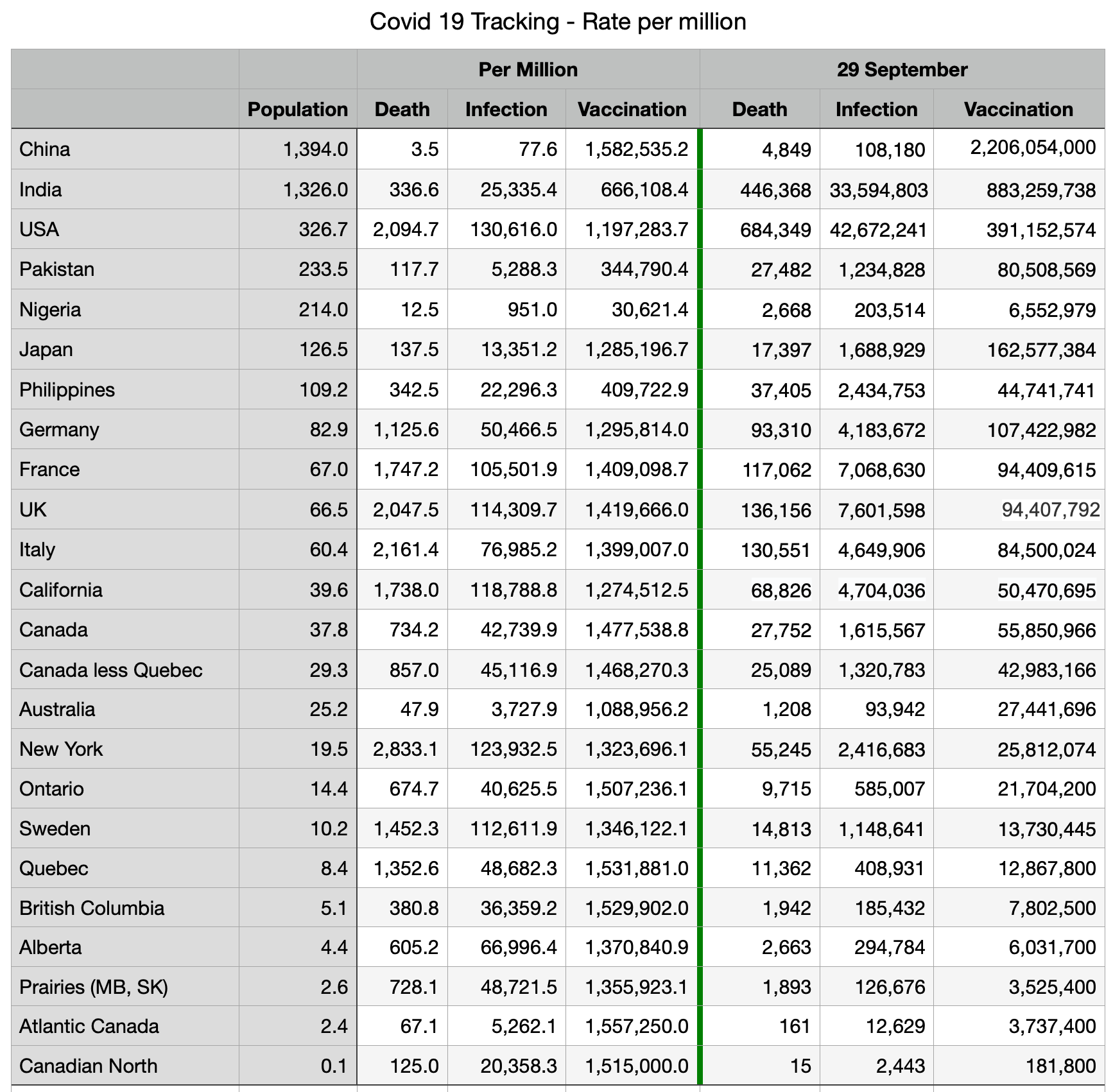
#COVID-19: Comparing provinces with other countries 21 July Update, India unreported cases

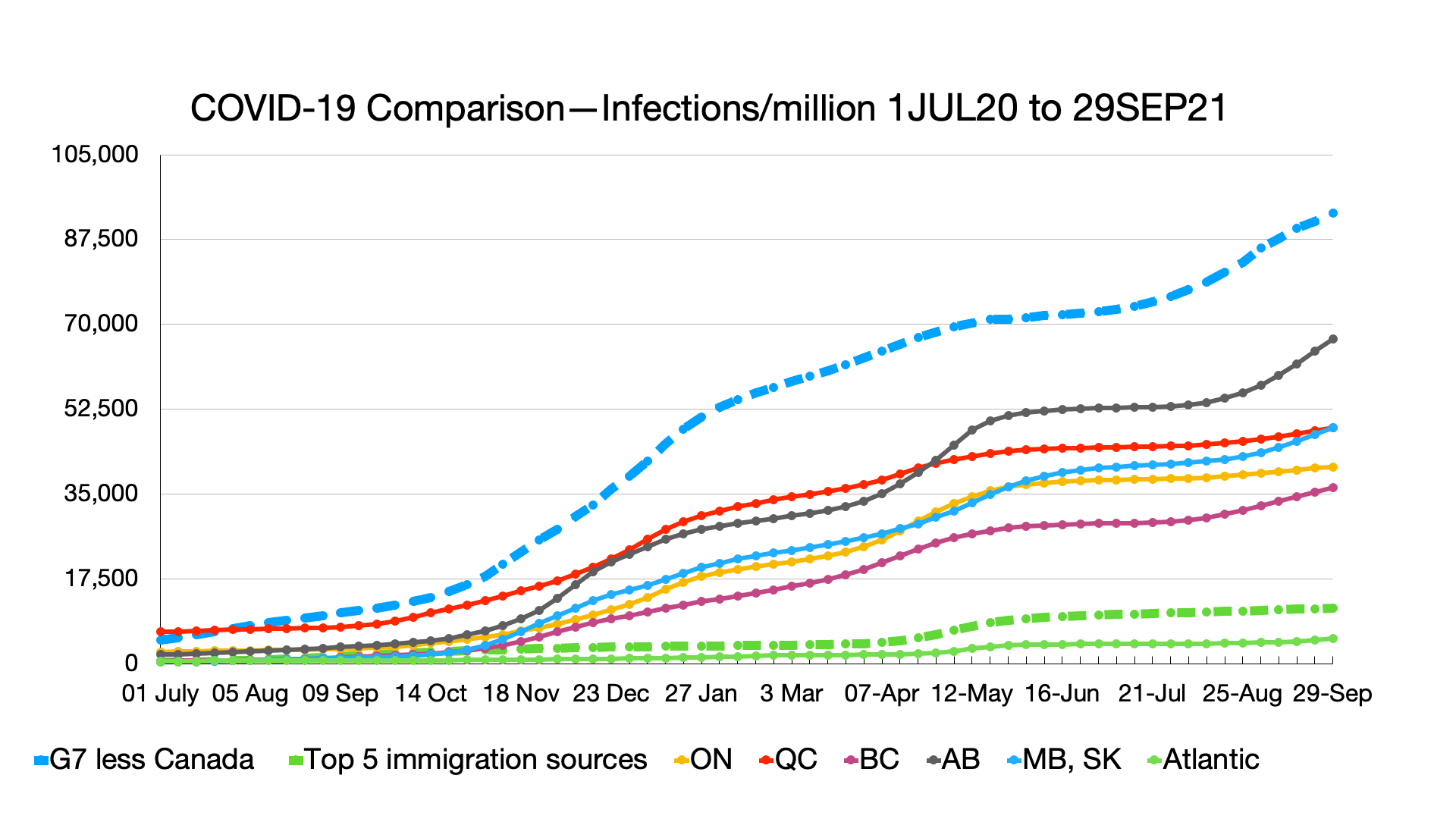
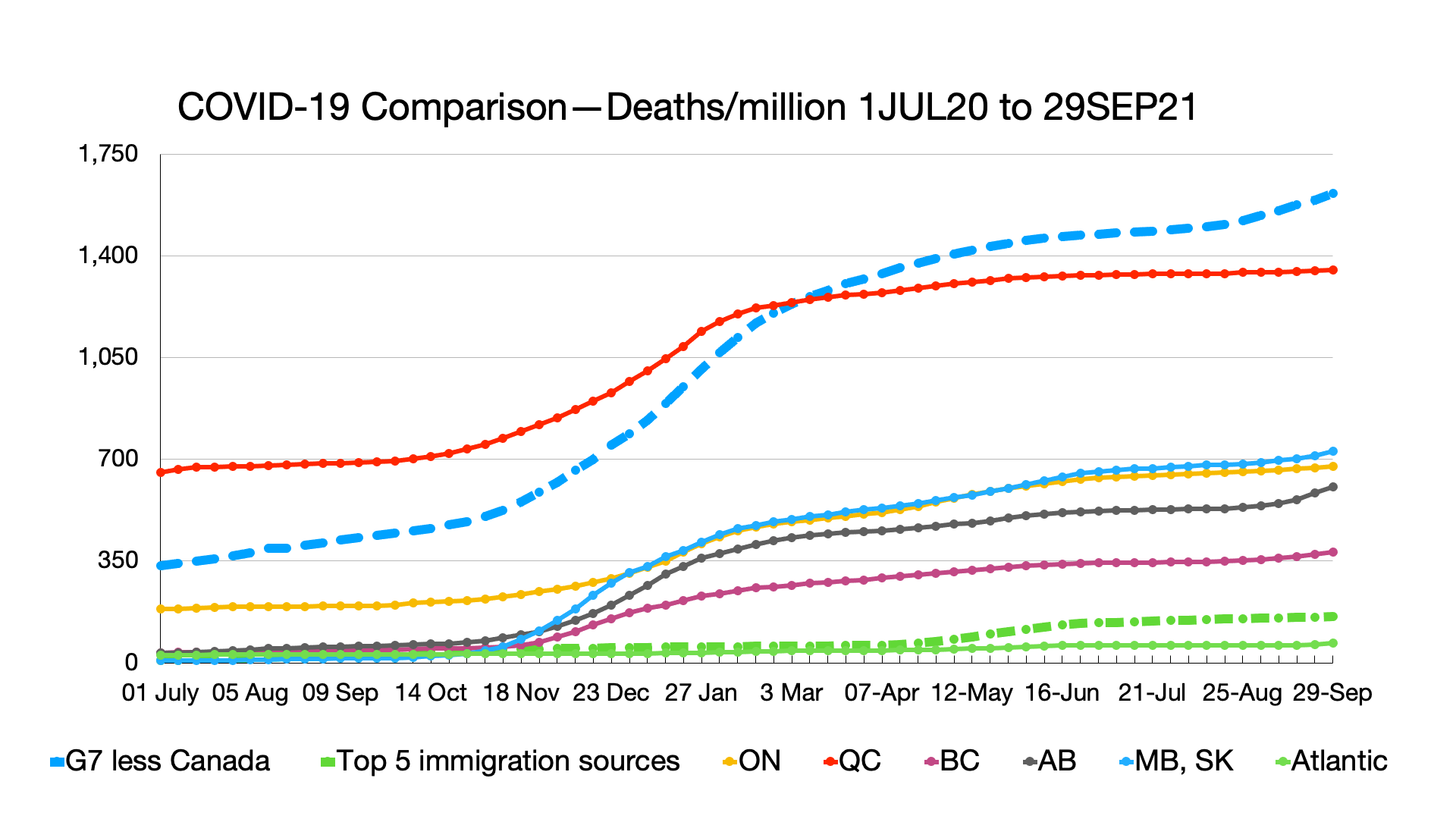
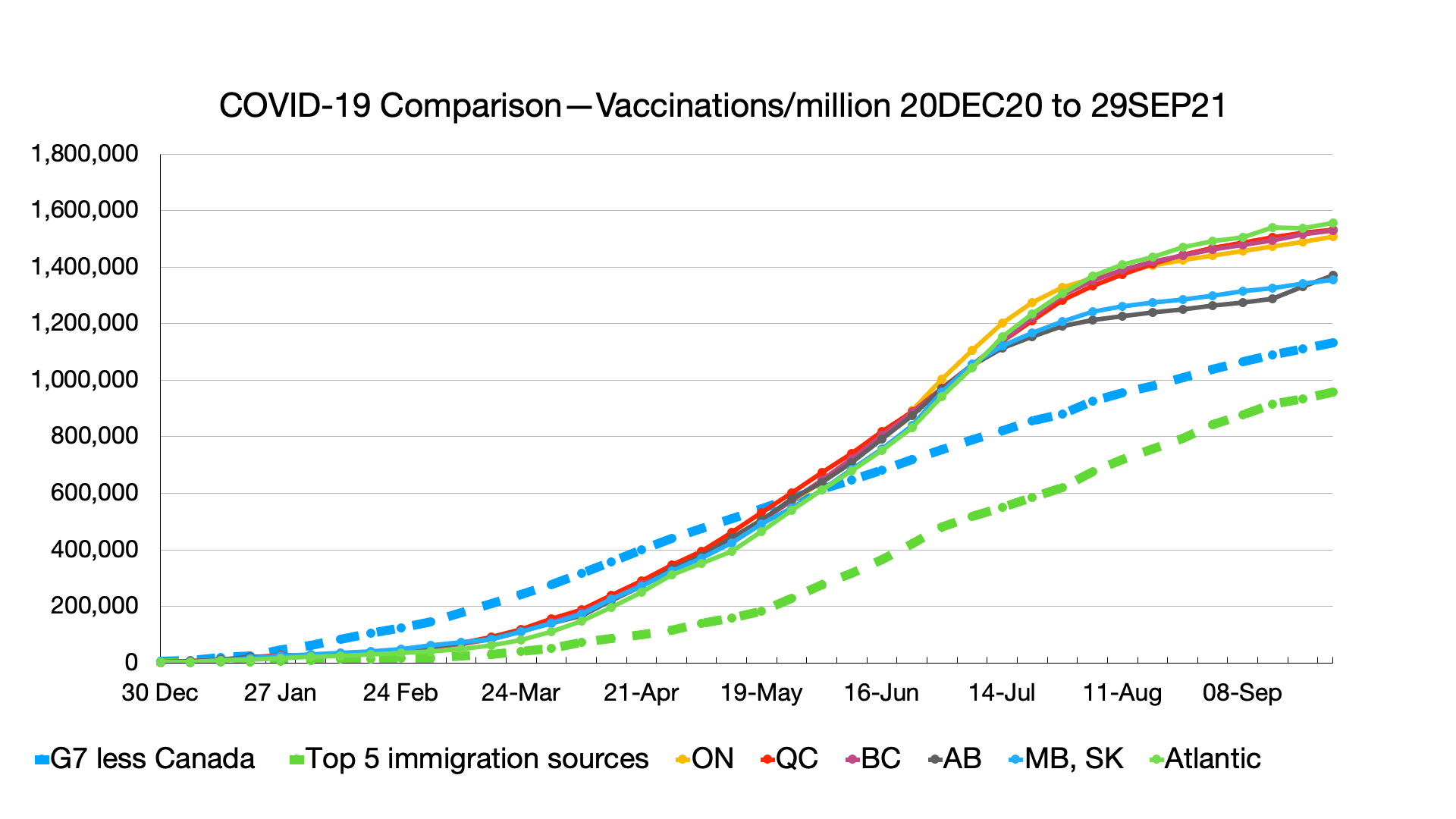
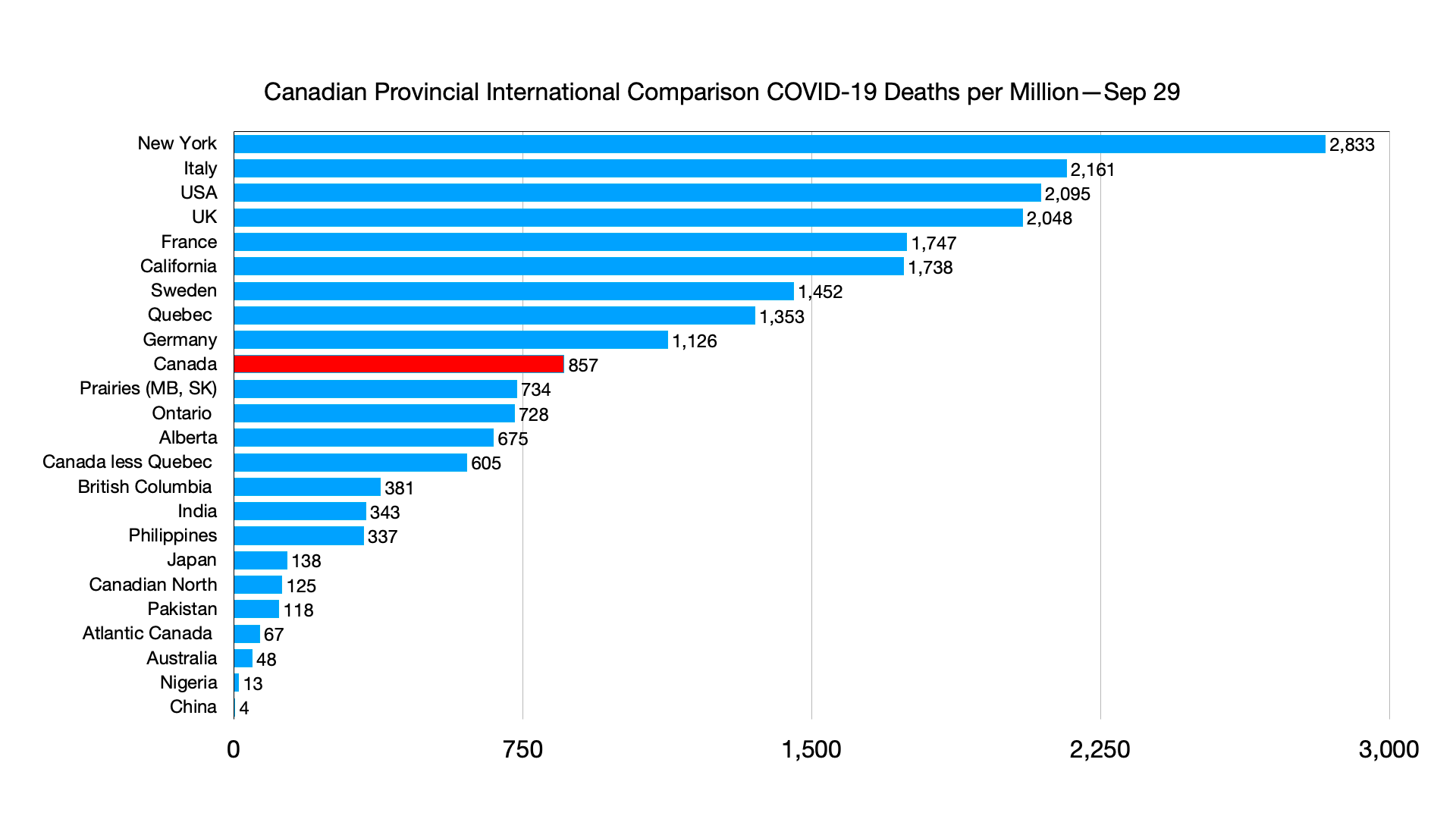
The latest charts, compiled 21 July as overall rates in Canada continue to decline along with increased vaccinations (Canadians fully vaccinated 51.7 percent, higher than USA 49.2 percent and and just behind UK 54.2 percent).

Vaccinations: All Canadian provinces ahead of USA and EU countries.

Trendline charts

Infections: No significant change but slight uptick in G7 less Canada given increased infections in UK and USA.

Deaths: No significant change.

Vaccinations: Captured above, with steady gap between Canadian provinces and G7.

Weekly

Infections: No relative change.

Deaths per million: No significant change.

Interesting and relevant analysis of India’s under-counting of COVID-19 cases:

India’s excess deaths during the pandemic could be a staggering 10 times the official COVID-19 toll, likely making it modern India’s worst human tragedy, according to the most comprehensive research yet on the ravages of the virus in the south Asian country.

Most experts believe India’s official toll of more than 414,000 dead is a vast undercount, but the government has dismissed those concerns as exaggerated and misleading.

The report released Tuesday estimated excess deaths — the gap between those recorded and those that would have been expected — to be between 3 million to 4.7 million between January 2020 and June 2021. It said an accurate figure may “prove elusive” but the true death toll “is likely to be an order of magnitude greater than the official count.”

The report, published by Arvind Subramanian, the Indian government’s former chief economic adviser, and two other researchers at the Center for Global Development and Harvard University, said the count could have missed deaths occurring in overwhelmed hospitals or while health care was delayed or disrupted, especially during the devastating peak surge earlier this year.

“True deaths are likely to be in the several millions not hundreds of thousands, making this arguably India’s worst human tragedy since Partition and independence,” the report said.

The Partition of the British-ruled Indian subcontinent into independent India and Pakistan in 1947 led to the killing of up to 1 million people as gangs of Hindus and Muslims slaughtered each other.

The report on India’s virus toll used three calculation methods: data from the civil registration system that records births and deaths across seven states, blood tests showing the prevalence of the virus in India alongside global COVID-19 fatality rates, and an economic survey of nearly 900,000 people done thrice a year.

Researchers cautioned that each method had weaknesses, such as the economic survey omitting the causes of death. 

Instead, researchers looked at deaths from all causes and compared that data to mortality in previous years — a method widely considered an accurate metric. 

Researchers also cautioned that virus prevalence and COVID-19 deaths in the seven states they studied may not translate to all of India, since the virus could have spread worse in urban versus rural states and since health care quality varies greatly around India. 

And while other nations are believed to have undercounted deaths in the pandemic, India is believed to have a greater gap due to it having the world’s second highest population of 1.4 billion and its situation is complicated because not all deaths were recorded even before the pandemic. 

Dr. Jacob John, who studies viruses at the Christian Medical College at Vellore in southern India, reviewed the report for The Associated Press and said it underscores the devastating impact COVID-19 had on the country’s under-prepared health system. 

“This analysis reiterates the observations of other fearless investigative journalists that have highlighted the massive undercounting of deaths,” Jacob said.

The report also estimated that nearly 2 million Indians died during the first surge in infections last year and said not “grasping the scale of the tragedy in real time” may have “bred collective complacency that led to the horrors” of the surge earlier this year.

Over the last few months, some Indian states have increased their COVID-19 death toll after finding thousands of previously unreported cases, raising concerns that many more fatalities were not officially recorded.

Several Indian journalists have also published higher numbers from some states using government data. Scientists say this new information is helping them better understand how COVID-19 spread in India.

Murad Banaji, who studies mathematics at Middlesex University and has been looking at India’s COVID-19 mortality figures, said the recent data has confirmed some of the suspicions about undercounting. Banaji said the new data also shows the virus wasn’t restricted to urban centers, as contemporary reports had indicated, but that India’s villages were also badly impacted.

“A question we should ask is if some of those deaths were avoidable,” he said.

Source: https://apnews.com/article/business-science-health-india-pandemics-334c326d86efa73a0631bf7cb6e3f92e?utm_source=Sailthru&utm_medium=email&utm_campaign=MorningWire_July20&utm_term=Morning%20Wire%20Subscribers

Olivier Roy: Religion and the state: unintended effects of anti-radicalisation policies

Thoughtful  commentary:

In most European countries, violent radicalisation is usually understood as a consequence of religious radicalisation.

Consequently, policies for countering or preventing radicalism assume that the key is to regulate the practice of Islam, in particular, either by promoting moderate or liberal interpretations of it or by pushing for secularisation in order to reduce faith to the private sphere.

The issue I would like to raise here is not so much whether such a policy stigmatises Muslims, rather whether such a policy is relevant.

First, from a purely statistical point of view, the link between religious and violent radicalisation is very weak. There have been some hundreds of terrorists in Western Europe in the last 25 years, while we can conclude that the number of believers in ‘fundamentalist’ Muslim schools of thought are in the hundreds of thousands if we consider the percentage of mosques defined as ‘Salafist’ or ‘Tablighi’ by the authorities (in France fewer than 300 out of a total of more than 2,000).

Moreover, if we look at the profile of the actual terrorists (people who committed deadly attacks in Europe during the last 25 years), few of them have belonged to a fundamentalist faith community or regularly attended a mosque considered fundamentalist.

More specifically, if we take into consideration the terrorist attacks perpetrated since the Bataclan attack in 2015 in Paris, we are confronted with lone wolves who have never been part of a fundamentalist network. That is not to say that these radicals have nothing to do with Islam: they consider themselves Muslims; they hope to become martyrs and go to paradise; they claim to avenge the sufferings of the Muslim Ummah. But they have almost never been trained for years in a fundamentalist theological school.

Nevertheless, in all countries involved in counter radicalisation efforts, the dominant doctrine has been to target religious practices, and, as I will demonstrate, this is not confined to Islam.

Secularisation vs liberalisation

This policy has been developed with two apparently opposed strategies. One promotes the reformation of Islam or the adoption of liberal forms of the religion, the other the extension of secularism. The apparent contradiction between the two approaches (the first acknowledging that religion has its place in social life and public space, the other confining religion to the private sphere) led to tensions between the so-called French model (laïcité) and the so called Anglo-Saxon model of multiculturalism. In fact, they both imply a reshaping of the traditional relationship between state and religion.

The first issue is how to define ‘religious radicalisation’? To do this you need a concept of ‘religious moderation’; but what is a ‘moderate religion’? The dominant religions in Europe are ‘revealed’ religions that believe in a transcendent God, creator and lawmaker. In this sense, the Abrahamic religions are not ‘moderate’ because they believe in an absolute truth and consider that the word of God is above human laws, even if the faithful citizen is supposed to obey and respect the laws of the state.

In any case, the debate is shifting from ‘truth’ to values, from ‘moderate’ to ‘liberal’: religions are requested to accept women and LGBTIQ+ rights, and this, of course, does not only apply to Islam. Should this move to promote liberal values go as far as to pressure the Catholic Church to have female priests, and ultra-orthodox Jews to adopt co-education in the yeshiva?

In addition, aside from its objectives, the simple move from the states to promote ‘good’ religion is upsetting the trend that has characterised the democratisation process since the 18th century: separation of church and state.

What remains of the mixing of both are just symbolic remnants (like the position of the British queen as head of the Anglican Church, for example). For the state, to interfere with religion means to ignore the separation principle and to run up against another pillar of the state of law: human rights. Freedom of religion is a human right and ensures the believer that the state will not interfere with faith and theology, even if it can limit some religious practices in the public space.

Far from ensuring religious freedom, any state intervention in the religious field will, on the contrary, contribute to the politicisation of the practice of religion and eviscerate the autonomy of religion, leading to a new form of state secularisation.

The French state steps in

Nevertheless, French policy is not shy about imposing secularisation on Islam. And this policy is popular in the country. But there is a side effect that is rarely perceived. The policy is more than an anti-Islam or Islamophobic stance: it is an anti-religious one. And the Catholic Church is feeling this cold wind, especially at a time when the scandal of paedophilia has undermined its prestige in society, with the trials of priests and cardinals widely covered by the media, and the pope being forced to acknowledge the issue.

A string of laws, from the 2004 act banning ‘religious signs’ in schools to the law against ‘separatism’ approved by the French parliament this February, have been passed to fight ‘Islamism’ or ‘Islamist separatism’. Explicitly, they target religious practices across the board: all religious symbols are banned from schools; any kind of home schooling (practised by Catholics or progressive supporters of alternative education, but not by Muslims) is severely restricted; and associations that receive public funding are supposed to sign a ‘charter of republican values’ that bans any gender segregated activities or rejection of gay rights.

Curbing religious practices to undermine radicalisation simply does not work. On the contrary, it contributes to a process of strict secularisation of the religious space, targeting first of all mainstream, ordinary believers who are the best bulwark against any kind of radicalisation.

Source: Religion and the state: unintended effects of anti-radicalisation policies

Anger as French protesters compare vaccines to Nazi horrors

Outrageous but unfortunately all too typical of the more extreme anti-vaxxers:

A French Holocaust survivor has denounced anti-vaccination protesters comparing themselves to Jews who were persecuted by Nazi Germany during World War II. French officials and anti-racism groups joined the 94-year-old in expressing indignation.

As more than 100,000 people marched around France against government vaccine rules on Saturday, some demonstrators wore yellow stars recalling the ones the Nazis forced Jews to wear. Other demonstrators carried signs evoking the Auschwitz death camp or South Africa’s apartheid regime, claiming the French government was unfairly mistreating them with its anti-pandemic measures.

“You can’t imagine how much that upset me. This comparison is hateful. We must all rise up against this ignominy,” Holocaust survivor Joseph Szwarc said Sunday during a ceremony commemorating victims of antisemitic and racist acts by the French state, which collaborated with Adolf Hitler’s regime.

“I wore the star, I know what that is, I still have it in my flesh,” Szwarc, who was deported from France by the Nazis, said with tears in his eyes. “It is everyone’s duty to not allow this outrageous, antisemitic, racist wave to pass over us.”

France’s secretary of state for military affairs, who also attended the ceremony, called the protesters’ actions “intolerable and a disgrace for our republic.”

The International League against Racism and Anti-Semitism said the protesters were “mocking victims of the Holocaust” and minimizing crimes against humanity committed during World War II.

Saturday’s protests involved a mix of people angry at the government for various reasons, and notably supporters of the far right. Prominent French far-right figures have been convicted in the past of antisemitism, racism and denying the Holocaust.

The government is introducing a bill Monday requiring all health care workers to get vaccinated against the coronavirus and requiring COVID passes to enter restaurants and other venues.

At a large protest in Paris on Saturday against vaccine rules, one demonstrator pasted a star on his back reading “not vaccinated.” Bruno Auquier, a 53-year-old town councilor who lives on the outskirts of Paris, drew a yellow star on his T-shirt and handed out arm bands with the star.

“I will never get vaccinated,” Auquier said. “People need to wake up,” he said, questioning the safety of COVID-19 vaccines.

Auquier expressed concern that the new measures would restrict his two children’s freedom and pledged to take them out of school if vaccination becomes mandatory.

Polls suggest most French people support the measures, but they have prompted anger in some quarters. Vandals targeted two vaccination centers in southwest France over the weekend. One was set on fire, and another covered in graffiti, including a reference to the Nazi occupation of France.

France has reported more than 111,000 deaths in the pandemic, and new confirmed cases are increasing again, raising worries about renewed pressure on hospitals and further restrictions that would damage jobs and businesses.

Source: Anger as French protesters compare vaccines to Nazi horrors

If governments want to combat Islamophobia, they will need to take a hard look in the mirror

More on CRA reviewing Muslim charities:

On July 22, the federal government will host a national summit on Islamophobia. All levels of government in Canada will be represented, as will Muslim-Canadian community organizations and leaders, so as to chart a path forward to combat racism and discrimination in Canada.

This path will not be easy. If done in good faith and with integrity, this project will not only require our governments to work on fighting Islamophobia in the broader public, but will also require them to take a hard look in the mirror to face their complicity.

The list of missteps is long, from racial profiling at our borders to disproportionate and highly disruptive surveillance of Canadian Muslim communities in the name of national security. These state practices have permeated our lives at many levels, and have been a drain on our collective psyche for far too long.

Take, as an example, one seemingly mundane and routine government practice: tax audits of charitable organizations by the Canada Revenue Agency (CRA) – a commonplace and needed part of how our government regulates the country’s charitable sector. We embarked on a study of this practice as it relates to Muslim-led Canadian charities when we heard an increasing chorus of fear and anxiety from them that something was amiss in the way such audits were unfolding. Those organizations had a simple question: Is this normal?

What we found was a simple answer: No.

We set to work investigating what was happening, and a year later released our co-authored study, Under Layered Suspicion: A Review of CRA Audits of Muslim-led Charities. The only evidence we had access to were the audit files provided to us by three charities who lost their charitable status after a CRA audit – none of our Access to Information and Privacy (ATIP) requests directed to the CRA yielded any files; in fact, we are still waiting for that information to this day.

Despite the obstacles we faced when it came to government transparency, we were able to glean valuable insights through a deep analysis of the audit files we had in our possession. By examining in close detail how auditors read and research, how they select evidence and how they interpret information, we found that these were no ordinary audits of charities – they were, in one way or another, informed by Canada’s whole-of-government policies on anti-terrorism financing and anti-radicalization.

This, in and of itself, is not an issue. It is imperative that the government undertake activities to combat terrorist financing. However, what we found was that the Canadian government identifies 100 per cent of terrorism-financing risk with groups that map onto Canada’s racialized communities, and 80 per cent (or more) of that risk maps directly onto Canada’s Muslim communities. This fact is drawn directly from Finance Canada’s 2015 assessment report to the global Financial Action Task Force.

We identified a bizarre approach that has been adopted by the CRA that to us signalled deeper systemic problems: mosques that had charitable status yanked through six degrees of alleged fault (for example, an imam who once spoke at an impugned mosque had made allegedly discriminatory remarks years before in another setting); charities that were questioned because they celebrated the Eid holiday at a time that didn’t sync with when the CRA thought they should have celebrated Eid; and humanitarian organizations that came under watch during the Harper regime.

Our findings have since been validated by a second report, issued by the International Civil Liberties Monitoring Group (ICLMG). That report focuses on a bureau within the CRA – the Review and Analysis Division (RAD) – which integrates the CRA with the national-security apparatus. It also attempted to gather statistical data on RAD audits as it mapped a disturbing trend of the disproportionate focus of such audits on Muslim-led charities. While the ICLMG’s findings require further validation, the lack of transparency of these audit processes requires immediate review and action by the government.

The reality is, as we show in our report, government-sponsored structural discrimination creates the conditions for a bureaucratic culture of Islamophobia to fester in the everyday, ordinary activities of government officials. We cannot hope to combat Islamophobia in this country as long as our own government enables it so overtly, without any oversight or appropriate checks and balances.

Source: https://www.theglobeandmail.com/opinion/article-if-governments-want-to-combat-islamophobia-they-will-need-to-take-a/

She Said She Married for Love. Her Parents Called It Coercion.

More disturbing trends:

Manmeet Kour Bali had to defend her marriage in court.

A Sikh by birth, Ms. Bali converted to Islam to marry a Muslim man. Her parents objected to a marriage outside their community and filed a police complaint against her new husband.

In court last month, she testified that she had married for love, not because she was coerced, according to a copy of her statement reviewed by The New York Times. Days later, she ended up in India’s capital of New Delhi, married to a Sikh man.

Religious diversity has defined India for centuries, recognized and protected in the country’s Constitution. But interfaith unions remain rare, taboo and increasingly illegal.

A spate of new laws across India, in states ruled by Prime Minister Narendra Modi’s Bharatiya Janata Party, or B.J.P., are seeking to banish such unions altogether.

While the rules apply broadly, right-wing supporters in the party portray such laws as necessary to curb “love jihad,” the idea that Muslim men marry women of other faiths to spread Islam. Critics contend that such laws fan anti-Muslim sentiment under a government promoting a Hindu nationalist agenda.

Last year, lawmakers in the northern Indian state of Uttar Pradesh passed legislation that makes religious conversion by marriage an offense punishable by up to 10 years in prison. So far, 162 people there have been arrested under the new law, although few have been convicted.

“The government is taking a decision that we will take tough measures to curb love jihad,” Yogi Adityanath, a Hindu monk and the top elected official of Uttar Pradesh, said shortly before that state’s Unlawful Religious Conversion Ordinance was passed.

Four other states ruled by the B.J.P. have either passed or introduced similar legislation.

In Kashmir, where Ms. Bali and Mr. Bhat lived, members of the Sikh community have disputed the legitimacy of the marriage, calling it “love jihad.” They are pushing for similar anti-conversion rules.

While proponents of such laws say they are meant to protect vulnerable women from predatory men, experts say they strip women of their agency.

“It is a fundamental right that women can marry by their own choice,” said Renu Mishra, a lawyer and women’s rights activist in Lucknow, the Uttar Pradesh state capital.

“Generally the government and the police officials have the same mind-set of patriarchy,” she added. “Actually, they are not implementing the law, they are only implementing their mind-set.”

Across the country, vigilante groups have created a vast network of local informers, who tip off the police to planned interfaith marriages.

One of the largest is Bajrang Dal, or the Brigade of Hanuman, the Hindu monkey god. The group has filed dozens of police complaints against Muslim suitors or grooms, according to Rakesh Verma, a member in Lucknow.

“The root cause of this disease is the same everywhere,” Mr. Verma said. “They want to lure Hindu women and then change their religion.”

Responding to a tip, the police in Uttar Pradesh interrupted a wedding ceremony in December. The couple were taken into custody, and released the following day when both proved they were Muslim, according to regional police, who blamed “antisocial elements” for spreading false rumors.

A Pew Research Center study found that most Indians are opposed to anyone, but particularly women, marrying outside their religion. The majority of Indian marriages — four out of five — are arranged.

The backlash against interfaith marriages is so widespread that in 2018, India’s Supreme Court ordered state authorities to provide security and safe houses to those who wed against the will of their communities.

In its ruling, the court said outsiders “cannot create a situation whereby such couples are placed in a hostile environment.”

The country’s constitutional right to privacy has also been interpreted to protect couples from pressure, harassment and violence from families and religious communities.

Muhabit Khan, a Muslim, and Reema Singh, a Hindu, kept their courtship secret from their families, meeting for years in dark alleyways, abandoned houses and desolate graveyards. Ms. Singh said her father threatened to burn her alive if she stayed with Mr. Khan.

In 2019, they married in a small ceremony with four guests, thinking their families would eventually accept their decision. They never did, and the couple left the central Indian city of Bhopal to start a new life together in a new city.

“The hate has triumphed over love in India,” Mr. Khan said, “And it doesn’t seem it will go anywhere soon.”

In Bhopal, the capital of Madhya Pradesh state, the B.J.P.-led government passed a bill in March modeled after the Uttar Pradesh law, stiffening penalties for religious conversion through marriage and making annulments easier to obtain.

The government is not “averse to love,” said the state’s home minister, Narottam Mishra, “but is against jihad.”

Members of Kashmir’s Sikh community are using Ms. Bali’s marriage to a Muslim man, Shahid Nazir Bhat, to press for a similar law in Jammu and Kashmir.

“We immediately need a law banning interfaith marriage here,” said Jagmohan Singh Raina, a Sikh activist based in Srinagar. “It will help save our daughters, both Muslims and Sikhs.”

At a mosque in northern Kashmir in early June, Ms. Bali, 19, and Mr. Bhat, 29, performed Nikah, a commitment to follow Islamic law during their marriage, according to their notarized marriage agreement.

Afterward, Ms. Bali returned to her parents’ home, where she said she was repeatedly beaten over the relationship.

“Now my family is torturing me. If anything happens to me or to my husband, I will kill myself,” she said in a video posted to social media.

Source: https://www.nytimes.com/2021/07/20/world/india-interfaith-marriage.html?action=click&module=In%20Other%20News&pgtype=Homepage