A look at the workings of Canada’s immigration system — through the eyes of a longtime insider

Kudos to Cochrane for writing about his experiences and the impact of large numbers and paper processing:

…“When I worked there, you would give people your business card and you would meet with them face to face,” said Cochrane, who retired from public service in 2015.

“I realized today people don’t even know the name of the officer and they’ll surely never meet the officer,” the first-time published author told the Star.

During his time at the Immigration Department, between 1982 and 2005, the number of new permanent residents Canada welcomed each year almost tripled as public support for immigration grew, unlike what has been seen in the past couple of years.

Officials have moved from meeting clients and the public in person to interacting with applicants via mail-in documents — and now through online portals and webforms. Application processing has turned into factory-like production, boiling down to box-checking.

With the insatiable demand for migration to Canada and a push to digitalize operations, the “depersonalization” of the Immigration Department may be inevitable. But Cochrane said human connection plays a key role in immigration matters, given that any decision made could have far-reaching impacts on people’s lives and a country that’s built on immigration.

It’s through those face-to-face encounters that skilled officers can properly communicate with applicants, assess the genuineness of an application and guide it through the system, he added….

Source: A look at the workings of Canada’s immigration system — through the eyes of a longtime insider

Immigration department halts skilled refugee jobs program, leaving employers in limbo

Another example of the impact of the changes, resulting from previous efforts to ramp up numbers:

…November’s immigration levels plan set out the number of permanent and temporary residents the government plans to accept over the next three years. The plan included specific targets for economic immigration pilots, including the EMPP and another for caregivers. 

The government aims to offer 8,175 permanent-residence places through such economic pilots in 2026, and 8,775 in each of the following two years.

Dana Wagner, co-founder of TalentLift, a non-profit international recruitment company that links displaced people with businesses, said being told about the imminent pausing of the program in a letter two days before Christmas was “very disappointing.” 

“The program has been working extremely well. But this is a signal that the EMPP is not being treated like a serious economic program or a vehicle for talent attraction. You shouldn’t leave employers such little runway to plan and pivot,” she said. 

“Sending a letter right before Christmas when the government signs off for the holiday is an awful way to communicate such a major change at the 11th hour.” 

Several employers that have already offered jobs to displaced people abroad were planning to submit their paperwork to IRCC in January, Ms. Wagner said.

She said those employers include an auto body collision repair company in British Columbia. It has offered a job to an experienced technician from Venezuela living as a refugee in Ecuador, to fill a local shortage.

IRCC delays in processing applications have been “ballooning” and now can take up to 17 months, Ms. Wagner said. Many employers are still waiting for skilled refugees they have hired to arrive in Canada. …

Source: Immigration department halts skilled refugee jobs program, leaving employers in limbo

Adams and Parkin: Will 2025 be remembered as the year Canadians re-embraced nationalism?

Good reflections:

…All of these flavours of nationalism that shaped events in Canada in 2025 will continue to swirl around us in 2026. We will wave the flags and sing the anthem and cheer on the athletes at the Winter Olympic Games – and sit on the edges of our seats as the men’s and women’s hockey teams play the Americans for gold. We will find comfort in our denouncements of Trump’s distasteful America-first rhetoric while reducing our own intake of immigrants and cutting back on our foreign-aid spending. We will see how much prosperity “Buy Canadian” policies will bring us. We will be challenged by Quebec nationalists to explain why Canada’s quest for independence is so much more noble. We will be equally challenged by First Nations to account for which nations stand to benefit from new “nation-building” resource projects. 

All of this is as it should be. We are and always will be a deeply multicultural society and federated country, hanging on next to an aggressive and sometimes expansionist United States. Our various expressions of nationalism will keep tying us up in knots, and for that we should be thankful. Canadians are better off when we are not only humble, but exasperated by the need to keep justifying and rethinking the terms of our own existence. There is no shame in having only enough national pride to get by. And struggling to reconcile seemingly irreconcilable claims to rights and status is what genuine democracies do. This ongoing soul-searching is our true national sport, the one at which we can be shyly confident of outperforming all others – though with luck we will take home ample gold from Milano Cortina as well.

Source: Will 2025 be remembered as the year Canadians re-embraced nationalism?

Polgreen: One of America’s Most Successful Experiments Is Coming to a Shuddering Halt [#immigration]

Good critique of Trump’s National Security Strategy view on immigration:

…Arguments in favor of migration tend to focus either on its economic benefits or its moral claim on the American psyche. But from the nation’s founding these two have been intertwined in ways both productive and confounding. Over the past year, as I’ve written about migration across the globe, I have often asked opponents of migration whether they would prefer to live in a country people flee from or flee toward. The answer, invariably, is the latter. The recent surge in support for immigration reflects, I suspect, that America’s status as the destination of choice for the world’s best minds is an intense source of pride.

It is also a source of strength. Trump clearly prefers the menacing snarl of hard power, but America’s openness to the world’s most ambitious people — and its unique ability to absorb and make use of human talent — has perhaps been its most potent form of soft power. Why try to defeat the world’s richest country when you might have the chance to join it and reap its ample rewards?

That is not the Trump administration’s way of thinking. For all the talk about abolishing D.E.I. in favor of merit, it seems to believe that for Americans to compete with the best of the world, merit must be redefined in nationalist terms, if not entirely set aside. Its National Security Strategy said so explicitly.

“Should merit be smothered, America’s historic advantages in science, technology, industry, defense and innovation will evaporate,” the document states. However, it continues, “we cannot allow meritocracy to be used as a justification to open America’s labor market to the world in the name of finding ‘global talent’ that undercuts American workers.” Trumpism seems to be seeking a form of talent autarky.

This is a radical change, and one that will surely leave the United States poorer, weaker and more isolated. I cannot help but detect in these nativist outbursts against Indian immigrants and their descendants a profound loss of confidence. The protesters repulsed by the towering Hanuman statue saw it as a threat to their culture, religion and traditions. But to me, that glittering hulk of alloyed metal symbolizes something else: the enduring magnetism of America’s promise, tarnished though it may be.

Source: One of America’s Most Successful Experiments Is Coming to a Shuddering Halt

Le Devoir Éditorial | Bouchard-Taylor, un legs ignoré

Good editorial:

À l’hiver 2007, le Québec semblait littéralement au bord de la rupture. Une série d’incidents impliquant des accommodements religieux enflammaient le débat public. L’installation de vitres givrées au YMCA d’Outremont, un jugement de la Cour suprême autorisant le port du kirpan à l’école, le code de vie de la municipalité d’Hérouxville destiné aux immigrants : les manchettes s’enchaînaient, nourrissant une perception de crise identitaire. Dans ce climat d’anxiété collective, le premier ministre Jean Charest annonçait, le 8 février 2007, la création de la Commission de consultation sur les pratiques d’accommodement reliées aux différences culturelles, confiée à deux éminences : le sociologue Gérard Bouchard et le philosophe Charles Taylor.

M. Charest en appelait alors à une réflexion sensée. « Il est clair que le débat s’enlise et qu’il sert la division plus que la compréhension », rappelait-il au moment de propulser Bouchard-Taylor. Pendant des semaines, les deux commissaires ont sillonné le Québec, permettant à quelque 3400 personnes de participer aux audiences publiques qui faisaient souvent salle comble. Cette vaste consultation populaire a permis de prendre le pouls d’une société profondément divisée sur la question de son identité et de sa relation avec les minorités religieuses. Certains témoignages étaient empreints de préjugés et de peurs irrationnelles, d’autres exprimaient un désir sincère de préserver les acquis de la Révolution tranquille. L’exercice démocratique a été aussi cathartique qu’éprouvant.

Dans leur rapport final, Fonder l’avenir. Le temps de la conciliation, les deux commissaires arrivent à un constat aussi cinglant que libérateur : non, il n’y avait pas de véritable crise des accommodements raisonnables au Québec, et ce, malgré les apparences. Ce que les médias avaient présenté comme une avalanche de demandes déraisonnables formulées au nom de la liberté de religion relevait largement de la distorsion des faits. La commission Bouchard-Taylor conclut que, parmi les cas les plus médiatisés, 71 % s’éloignaient de l’exactitude des faits. L’emballement médiatique avait considérablement enflé la « crise ».

Les commissaires décèlent derrière cette enflure un malaise identitaire dont souffrent plus particulièrement les Québécois d’ascendance canadienne-française. Ceux-ci vivent difficilement leur double statut de majoritaire au Québec mais de minoritaire en Amérique du Nord, et craignent peut-être d’être submergés par les minorités culturelles et d’être dépossédés de leurs valeurs communes. La crise des accommodements camoufle donc une réaction de défense de plusieurs Québécois inquiets de perdre leur identité culturelle.

Le rapport Bouchard-Taylor propose une voie médiane fondée sur l’interculturalisme québécois, un modèle distinct du multiculturalisme canadien et de la laïcité fermée à la française. Les commissaires recommandent notamment d’interdire le port de signes religieux uniquement aux personnes en position d’autorité coercitive — juges, policiers, gardiens de prison, procureurs de la Couronne — tout en permettant leur port ailleurs dans la fonction publique, y compris pour les enseignants. Cette approche visait à équilibrer la neutralité de l’État avec le respect des libertés individuelles. La formule n’est pas retenue.

Sous la gouverne du Parti québécois, le Québec adopte en 2013 la Charte des valeurs, qui propose d’aller plus loin que les recommandations de Bouchard-Taylor. La nation n’en a pas fini de ses crispations identitaires, car le Québec s’entre-déchire autour de cette charte. En 2019, la Coalition avenir Québec présente enfin le projet de loi 21 sur la laïcité de l’État. Sur le modèle de la Charte des valeurs, on y interdit le port de signes religieux aux personnes en position d’autorité, y compris les enseignants du primaire et du secondaire. La loi fait l’objet de vives contestations.

L’adoption de la Loi sur la laïcité de l’État marque l’aboutissement d’un processus qui a pris le chemin inverse de celui tracé par Bouchard et Taylor. Là où le rapport de 2008 appelait à la conciliation, à la nuance et au dialogue, le Québec a opté pour une solution législative plus rigide qui, si elle répond aux inquiétudes d’une majorité, pose des questions profondes sur notre capacité collective à vivre ensemble dans le respect de nos différences et force la mise à l’écart de certains groupes.

Le véritable héritage de Bouchard et de Taylor réside dans la démarche qu’ils ont incarnée. À un moment où le Québec aurait pu basculer dans l’intolérance et la xénophobie pure, ils ont rappelé l’importance de l’analyse rigoureuse, de l’écoute et du dialogue. Ils ont démontré que les perceptions pouvaient différer radicalement de la réalité et que les débats identitaires devaient être menés avec intelligence et compassion. Dix-huit ans après leur nomination, Bouchard et Taylor nous rappellent qu’une société mature ne se construit pas sur la peur de l’autre, mais sur la capacité à dialoguer, à comprendre et à chercher des solutions qui honorent à la fois les valeurs collectives et les droits individuels.

Source: Éditorial | Bouchard-Taylor, un legs ignoré

In the winter of 2007, Quebec seemed literally on the verge of rupture. A series of incidents involving religious accommodations inflamed the public debate. The installation of frosted windows at the YMCA of Outremont, a Supreme Court judgment authorizing the wearing of the kirpan at school, the code of life of the municipality of Hérouxville for immigrants: the headlines followed one another, feeding a perception of identity crisis. In this climate of collective anxiety, Prime Minister Jean Charest announced, on February 8, 2007, the creation of the Consultation Commission on Accommodation Practices Related to Cultural Differences, entrusted to two eminences: Sociologist Gérard Bouchard and Philosopher Charles Taylor.

Mr. Charest then called for a sensible reflection. “It is clear that the debate is getting bogged down and that it serves division more than understanding,” he recalled when propelling Bouchard-Taylor. For weeks, the two commissioners crisscrossed Quebec, allowing some 3,400 people to participate in public hearings that were often a fulle. This broad popular consultation made it possible to take the pulse of a deeply divided society on the question of its identity and its relationship with religious minorities. Some testimonies were imbued with prejudices and irrational fears, others expressed a sincere desire to preserve the achievements of the Quiet Revolution. The democratic exercise was as cathartic as it was trying.

In their final report, Founding the Future. At the time of conciliation, the two commissioners came to an observation as scathing as it was liberating: no, there was no real crisis of reasonable accommodation in Quebec, despite appearances. What the media had presented as an avalanche of unreasonable demands made in the name of freedom of religion was largely a matter of distortion of the facts. The Bouchard-Taylor Commission concludes that, among the most publicized cases, 71% were far from the accuracy of the facts. The media runaway had considerably inflated the “crisis”.

The commissioners detect behind this swelling an identity malaise suffered more particularly by Quebecers of Canadian-French descent. They hardly live their dual status as a majority in Quebec but as a minority in North America, and perhaps fear being overwhelmed by cultural minorities and being dispossessed of their common values. The accommodation crisis therefore camouflages a defensive reaction of many Quebecers worried about losing their cultural identity.

The Bouchard-Taylor report proposes a middle path based on Quebec interculturalism, a model distinct from Canadian multiculturalism and French-style secularism. The commissioners recommend in particular that the wearing of religious signs be prohibited only to persons in a position of coercive authority – judges, police officers, prison guards, Crown prosecutors – while allowing their wearing elsewhere in the public service, including for teachers. This approach aimed to balance the neutrality of the State with respect for individual freedoms. The formula is not retained.

Under the leadership of the Parti Québécois, Quebec adopted the Charter of Values in 2013, which proposed to go further than the recommendations of Bouchard-Taylor. The nation has not finished its identity tensions, because Quebec is torn around this charter. In 2019, the Coalition avenir Québec finally presented Bill 21 on the secularism of the state. On the model of the Charter of Values, it prohibits the wearing of religious signs to people in positions of authority, including primary and secondary school teachers. The law is the subject of strong challenges.

The adoption of the State Secularism Act marked the culmination of a process that took the opposite path from that traced by Bouchard and Taylor. Where the 2008 report called for conciliation, nuance and dialogue, Quebec has opted for a more rigid legislative solution that, if it responds to the concerns of a majority, raises deep questions about our collective ability to live together with respect for our differences and forces the exclusion of certain groups.

The true legacy of Bouchard and Taylor lies in the approach they embodied. At a time when Quebec could have turned into intolerance and pure xenophobia, they recalled the importance of rigorous analysis, listening and dialogue. They demonstrated that perceptions could differ radically from reality and that identity debates should be conducted with intelligence and compassion. Eighteen years after their appointment, Bouchard and Taylor remind us that a mature society is not built on the fear of the other, but on the ability to dialogue, understand and seek solutions that honor both collective values and individual rights.

From Bouchard lui-même: Quand l’espoir vient des citoyens

« En haut, en haut ! C’est un grand concept sociologique sophistiqué, ça, en haut ! », s’exclame-t-il d’un ton faussement bourru. Me sentant désarçonné au bout du fil, il éclate d’un grand rire.

Le ton est donné : interviewer Gérard Bouchard sera tout sauf ennuyant. Ce monument de l’histoire et de la sociologie a codirigé la fameuse commission Bouchard-Taylor sur les accommodements raisonnables, a enseigné à Harvard, a écrit de nombreux ouvrages. Et à 81 ans, le sociologue chéri des Québécois est vif, drôle, versant autant dans l’autodérision que dans les critiques acerbes.

Des critiques qu’il dirige beaucoup vers le gouvernement du Québec actuellement. C’est là, « en haut », qu’il déplore les plus grandes dérives. Mon intention n’était pas nécessairement d’amener mon interlocuteur dans l’arène politique, mais il y a sauté lui-même à pieds joints.

Lorsque je lui demande ce qu’il souhaite collectivement aux Québécois pour 2026, sa réponse est immédiate.

« Je souhaiterais que tout le débat sur l’identitaire perde enfin de l’actualité. L’identitaire est un sac vide. Cette affaire-là ne va nulle part. C’est un débat qui divise, mais qui n’ouvre pas sur grand-chose. »

— Gérard Bouchard

Il enchaîne en dénonçant la désinvolture avec laquelle, selon lui, le gouvernement Legault écarte les droits fondamentaux pour imposer sa vision de la laïcité.

« Ça relève d’un sentiment antireligieux, je ne vois pas autre chose, dit-il. L’idée qu’une société, pour être laïque, doit repousser le religieux dans ses derniers retranchements pour qu’il ne soit finalement plus visible du tout… Ce n’est pas un idéal pour une société, ça ! Ou alors, si c’est un idéal, ça en est un qui repose essentiellement sur la violation d’un droit fondamental. »

« On vit encore sur cette espèce de revanche que l’on prend contre les abus du clergé que notre société a subis jusqu’au milieu du XXsiècle, analyse-t-il. On avait de sacrées bonnes raisons de le faire, on a beaucoup souffert. Mais là, il faudrait en finir avec ça. On ne va quand même pas vivre sur ce ressentiment de génération en génération ! »…

“Up, up! It’s a great sophisticated sociological concept, that, at the top! “, he exclaims in a falsely gruff tone. Feeling distraught at the end of the line, he bursts out laughing.

The tone is set: interviewing Gérard Bouchard will be anything but boring. This monument of history and sociology co-led the famous Bouchard-Taylor Commission on Reasonable Accommodations, taught at Harvard, wrote many books. And at 81, the beloved sociologist of Quebecers is lively, funny, pouring as much into self-deprecation as in harsh criticism.

Criticisms that he directs a lot towards the Quebec government currently. It is there, “at the top”, that he deplores the greatest drifts. My intention was not necessarily to bring my interlocutor into the political arena, but he jumped there himself with his feet together.

When I ask him what he collectively wishes for Quebecers for 2026, his answer is immediate.

“I would like the whole debate on identity to finally lose news. The identity is an empty bag. This case is not going anywhere. It is a debate that divides, but does not open up much. ”

— Gérard Bouchard

He continues by denouncing the casualness with which, according to him, the Legault government discards fundamental rights to impose its vision of secularism.

“It’s an anti-religious feeling, I don’t see anything else,” he says. The idea that a society, to be secular, must push the religious to his last entrenchments so that he is finally no longer visible at all… This is not an ideal for a society! Or, if it is an ideal, it is one that is essentially based on the violation of a fundamental right. ”

“We still live on this kind of revenge that we take against the abuse of the clergy that our society suffered until the middle of the 20th century,” he analyzes. We had damn good reasons to do it, we suffered a lot. But now, we should end this. We are still not going to live on this resentment from generation to generation! “…

Year in review and look ahead

Time for my looking back piece, even if a bit self-indulgent.

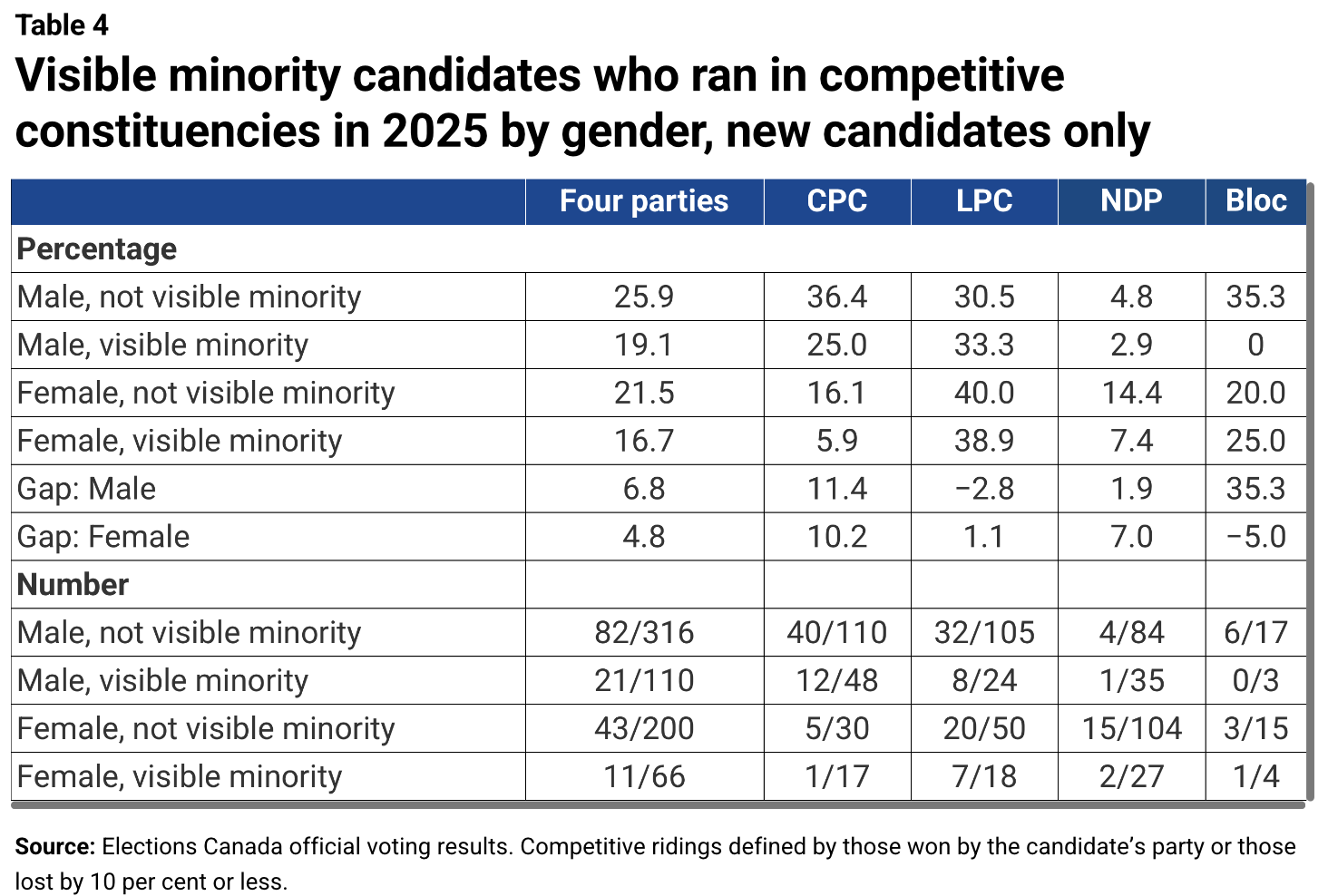
Most of my time was spent on an analysis of the 2025 election results from a diversity analysis with Jerome Black, highlighting how representation of visible minorities had increased while that of women and Indigenous had stalled. A second area of major work was following and participating in C-3 citizenship discussions and debates. Annual updates on public service diversity and birth tourism, and setting the baseline for appointments that will be made by PM Carney.

2026 will continue with my various annual updates. Jerome Black and I have an analysis in train on the intersectionality of women and visible minority candidate in competitive ridings. I will be analysing the impact of C-3 in relation to age, gender, and country of origin and comparing that with expatriate voting data, given that the latter has grown significantly and the number of expatriate votes cast exceeds the winning margin in a number of ridings. No doubt other issues of interest will emerge.

Lots to keep me busy and engaged, along with maintaining my blog.

Best wishes for the holidays, whichever ones you celebrate.

Print below by my late father.

Citizenship 

Citations

Immigration – Citations

Multiculturalism 

Diversity and Employment Equity

Before the cuts: a bureaucracy baseline from an employment equity lens (Hill Times)

Political Representation 

The diversity of candidates and MPs stalled for some groups in this election (Policy Options, The Hill Times, with Jerome H. Black)

Citations

A Conspicuous Gap May Undermine Trump’s Birthright Citizenship Plan

Interesting argument:

In asking the Supreme Court to let him do away with birthright citizenship, President Trump has urged the justices to restore “the original meaning” of the 14th Amendment.

What the amendment meant when it was ratified in 1868, Mr. Trump’s lawyers said in a brief, was that “children of temporary visitors and illegal aliens are not U.S. citizens by birth.”

The court will hear arguments in the spring to decide whether that is right. There are many tools for assessing the original meaning of a constitutional provision, including the congressional and public debates that surrounded its adoption.

But one important tool has been overlooked in determining the meaning of this amendment: the actions that were taken — and not taken — to challenge the qualifications of members of Congress, who must be citizens, around the time the amendment was ratified.

A new study to be published next month in The Georgetown Law Journal Online fills that gap. It examined the backgrounds of the 584 members who served in Congress from 1865 to 1871 and found good reason to think that more than a dozen of them might not have been citizens under Mr. Trump’s interpretation of the 14th Amendment. But no one thought to file a challenge to their qualifications.

That is, said Amanda Frost, a law professor at the University of Virginia and an author of the study, the constitutional equivalent of the dog that did not bark, which provided a crucial clue in a Sherlock Holmes story.

The study raises new questions about Mr. Trump’s legal battle to narrow protections under the 14th Amendment’s citizenship clause, which says: “All persons born or naturalized in the United States, and subject to the jurisdiction thereof, are citizens of the United States and of the state wherein they reside.”

The Constitution requires members of the House of Representatives to have been citizens for at least seven years, and senators for at least nine. It adds that each House “shall be the judge” of its members’ qualifications.

“If there had been an original understanding that tracked the Trump administration’s executive order,” Professor Frost said, “at least some of these people would have been challenged.”…

Source: A Conspicuous Gap May Undermine Trump’s Birthright Citizenship Plan

USA: The next step was citizenship. Then these immigrants were pulled out of line.

Cruelty personnified:

For immigrants, naturalization ceremonies represent the culmination of their yearslong effort to earn citizenship. In front of a federal judge, permanent residents raise their right hands, repeat the Oath of Allegiance to their new country, and usually wave a small American flag with pride once the judge confirms their citizenship.

On Dec. 4, inside Boston’s Faneuil Hall – a historic site where revolutionaries like Samuel Adams fostered the idea of American freedom – one such event took a turn. U.S. Citizenship and Immigration Services officers denied entry to several people who showed up for their naturalization ceremony, according to Project Citizenship, a nonprofit providing legal support for those seeking citizenship. Each of these individuals was from one of 19 countries the Trump administration identified as high-security risks under a Dec. 2 Department of Homeland Security memo, which mandated the immediate pausing and review of immigration applications from those countries, including Haiti, Afghanistan, and Venezuela.

What happened at the Boston ceremony is part of a tightening of the naturalization process throughout the country. In late November, New York state Attorney General Letitia James wrote a letter to USCIS questioning its decision to cancel ceremonies in several counties in her state; USCIS said the counties “did not meet the statutory requirements.” On Dec. 9 in Indianapolis, 38 out of 100 prospective citizens were turned away at their ceremony, according to local news reports. Local outlets in Atlanta reported that, on Dec. 12, three immigrants had their oath ceremonies canceled.

The efforts to clamp down on legal immigration pathways follows the shooting of two National Guard members in Washington, one fatally, just before Thanksgiving. An Afghan national, who entered the country legally in 2021 through a program for allies who served alongside the U.S. military, has been charged with first-degree murder. Following that attack, President Donald Trump quickly announced significant immigration restrictions, including a pause on all asylum decisions. This week, the Trump administration added 20 countries to a list of nations whose citizens face full or partial bans on entering the U.S.

Those who apply for naturalization are some of the most thoroughly vetted immigrants in the country. To be eligible, an immigrant must generally have been a lawful permanent resident for at least five years, be a “person of good moral character,” and pass tests in civics and English. The process can take decades, and the oath ceremony is largely seen as a formality.

Gail Breslow, the executive director of Project Citizenship in Boston, said that 21 clients of the organization had their naturalization ceremonies canceled this month. Clients were either pulled out of line at the Dec. 4 ceremony or notified via email that their ceremonies, scheduled for Dec. 4 or Dec. 10, had been canceled.

Source: The next step was citizenship. Then these immigrants were pulled out of line.

Adams et al: Writing a new immigration story for Canada

It’s both, the contribution immigrants make and the limits of absorptive capacity:

…The Canadian success story about immigration we celebrated just a few years ago has changed, and we are now writing a new chapter. The world is changing rapidly in ways that we cannot expect to avoid, and the path forward will be like navigating rapids in a surging river. Sustaining public and political support for the multicultural and immigrant-welcoming society that Canada has built over the past half-century will require a careful balance between the immigration inflow necessary for economic growth and labour market demand, and our collective capacity to ensure a place (that is, a home, a job, health care, education and other essential public services) for everyone, native-born and newcomer alike. The newly-released federal budget appears aimed in this direction, and time will tell whether it helps us reach such balance.

This new chapter calls upon our leaders across all sectors to reframe the narrative around how we think about newcomers who arrive in our country. The tendency is to think of them primarily as people who require housing, jobs and other supports like language training – as a drain on government funding and places pressure on existing resources. Instead we need to focus more on newcomers as an essential influx of talent and needed skills that can help energize our communities and maintain our current standard of living now and into the future.

Source: Writing a new immigration story for Canada

Keller: Canada’s falling population is exactly what the doctor ordered

mmMore from Keller:

…There’s a compelling logic to choosing many permanent immigrants from the temporary resident pool. But with such a large pool, and so many more applicants than permanent residence spaces, Canada can afford to be choosy. For the sake of the economy, we must be choosy. 

Unfortunately, that’s not what Ottawa and the provinces are doing. The Carney government gets a small gold star for a couple of quarters of right-sizing immigration quantity, but it gets a question mark, and even a black mark, when it comes to correcting the significant downgrade in immigration quality and selectivity that took place under the Trudeau government.

Source: Canada’s falling population is exactly what the doctor ordered