Kuluberhan: Why do some asylum seekers make it into the West quickly – while others have to wait more than a decade?

More questioning of double standards. Reality is a bit more complex than presented as Canada’s response to Syrian refugees attests (but not so with respect to Afghan refugees):

They were middle-class Europeans who looked more like the family living next door than the refugees Western countries had become so accustomed to seeing trickle across their borders. At least, that’s how Western news media and politicians often depicted the Ukrainian citizens who were forced to flee their homes following the start of Russia’s invasion of Ukraine in February.

As a second-generation Canadian and the daughter of two Eritrean refugees, the distinctions made between refugees felt like textbook dog-whistles that were impossible to ignore. Indeed, when I travelled to Ethiopia and visited my uncle this past May, I witnessed first-hand how refugees who don’t look like people who might live next door – who come from places that are not seen as “civilized” – have become forgotten casualties of broken asylum systems.

Picture this: You grow up living in an eight-bedroom home in a residential neighbourhood two hours outside the capital city. Your father runs a public transportation business, and your mother is a shopkeeper who sells spices. You and your seven siblings attend the only private school in town. The life you lead is a good one – until one day, the political situation in your country changes and suddenly your family loses everything. Before you know it, nearly two decades pass by in the refugee camp where you’ve been waiting in limbo for your asylum papers to arrive.

This is my uncle’s story, in a nutshell. Despite hailing from Ethiopia, the life he led prior to the 1998 Ethiopia-Eritrea border war was not all that different from the life of your average middle-class Canadian citizen. Yet December will mark 18 years since my uncle first filed an asylum claim in 2004. He does not “seem so like us,” as one Telegraph writer described Ukrainian asylum seekers – and there is no telling when his ordeal will end.

Meanwhile, the Canadian government announced measures in March that would fast-track the arrival of an unlimited number of Ukrainians fleeing the war and allow them to apply for a renewable three-year temporary residence. Many wondered why the same quick action couldn’t be taken for the refugees who have languished in the system for years. But during a CBS News broadcast report from Kyiv in late February, senior foreign correspondent Charlie D’Agata voiced what had to that point been largely implicit: Ukraine, he declared, “isn’t a place, with all due respect, like Iraq or Afghanistan, that has seen conflict raging for decades. This is a relatively civilized, relatively European – I have to choose those words carefully, too – city, one where you wouldn’t expect that, or hope that it’s going to happen.”

Research studies have long indicated that lengthy asylum processes adversely affect the mental health of refugee claimants, leading to an increased risk of life-long psychiatric disorders. My uncle is no exception. After my uncle spent15 years in the Shimelba camp in Ethiopia’s Tigray region, we lost all contact with him for two years until 2021, when he was found homeless on the streets of Addis Ababa. When I met him, his mental health had deteriorated to such a point that my family decided to pool resources and place him in a private facility where he could receive treatment for depression while he continued waiting to be granted asylum.

While his case is an extreme one, long asylum wait-times are not uncommon. In a 2017 memo, the Immigration and Refugee Board of Canada estimated that by 2021, wait times for asylum claims would take up to 11 years – much closer to the bleak reality faced by refugees than the projected 24-month period indicated on the board’s website.

Canada moving at a breakneck speed to implement targeted supports for Ukrainian asylum seekers was a reminder that our refugee policies are not race-blind commitments to humanitarianism. Who a country welcomes across its borders and into its society reveals who that country believes belongs, who doesn’t, and which lives are worth saving.

Criticism of slow resettlement processes are usually met with the excuse that the increase in the number of asylum claims has placed an untenable weight on a system already weakened by a mounting backlog. Yet the response to the Ukraine crisis, in Canada and elsewhere, has revealed how governments in the West can operate like well-oiled machines when they feel the need.

Of course, we should applaud our government for the exemplary support it provided to Ukrainians in need. Now we must urge them to apply this same urgency and care to all refugees, equally.

Hermona Kuluberhan is an Ottawa-based writer currently completing a master’s in journalism at Carleton University.

Source: Why do some asylum seekers make it into the West quickly – while others have to wait more than a decade? 

Tatour: Israel can now strip away 48 Palestinians’ #citizenship

Of note, even if reference to broader “ethnic cleansing” is overstated:

Last week, in a precedential decision, Israel’s Supreme Court ruled that the state had the power to revoke the citizenship of a person convicted of offences that amounted to “breach of loyalty”, even if the person would become stateless as a result and in violation of international law.

The decision deliberated on the case of Alaa Zayoud, a Palestinian who holds Israeli citizenship. In October 2015, Zayoud rammed his car into a bus station and stabbed three Israelis. In 2017, a year after his conviction, the minister of interior notified Zayoud of his intent to revoke his citizenship, in accordance with the Citizenship Law.

The importance of this decision cannot be overstated. Its implications are grave and will be seen in the near and far future

The administrative court in Haifa approved the decision. Zayoud appealed and the case ended up in the Supreme Court.

In its decision, the Supreme Court determined that: “No constitutional defect in the arrangement that allows the revocation of the citizenship of a person who committed an act that constitutes a breach of loyalty in the State of Israel, such as: an act of terrorism; an act of treason or serious espionage; or the acquisition of citizenship or the right of permanent residency in a hostile state or in hostile territory.

“This is so, even if as a result of the revocation of his citizenship, the individual becomes stateless, provided that if the individual becomes stateless, the interior minister must grant him a status of permanent residence in Israel or another designated status.”

The importance of this decision cannot be overstated. Its implications are grave and will be seen in the near and far future. This decision has created a legal path for revoking the citizenship of the 48 Palestinians (also known as Palestinian citizens of Israel), a stepping-stone in Israel’s efforts to advance the ethnic cleansing and expulsion of Palestinians.

‘Terrorist intent’

On a practical level, the court has cleared the way for what would become the routine denaturalisation of Palestinians with Israeli citizenship, making them vulnerable to deportation, something Israel has long aspired to.

The decision to substitute citizenship with a so-called permanent residency status might enable individuals to continue to have access to some social services, but it strips them from the utmost protection that citizenship is designed to grant: the right to remain at home.

Israel knows that to make 48 Palestinians vulnerable to expulsion, it has first to revoke their citizenship. The court’s decision facilitates just that.

And it is Israel and its security services who define what constitutes a “breach of loyalty”, which according to the Citizenship Law creates the grounds for revoking citizenship. At the moment, Israel defines a “breach of loyalty” based on Israel’s Counter-Terrorism Law, which permits it to classify different offences as terrorist acts.

Israel routinely applies “terrorist intent” when it comes to Palestinians. For example, in the aftermath of May 2021’s Unity Intifada, Israel arrested thousands of Palestinians and filed indictments against hundreds of protesters, with 167 of them charged with terrorist offences, based on the Counter-Terrorism Law.

Following the Supreme Court’s recent decision, all of them face the threat of having their citizenship revoked. Palestinians know all too well what this could potentially mean: expulsion from their homeland.

The act of revoking citizenship would leave the affected Palestinians stateless. Israel already made all Palestinians stateless in 1948 with the nullification of Palestinian citizenship under the British Mandate. Many Palestinians remain stateless. The Palestinians who remained after the Nakba (the Catastrophe) in 1948 received Israeli citizenship in the first two decades of the state.

Now Israel is threatening to make them stateless again.

Although this decision clearly violates international law, the court still determined that it was constitutional to denaturalise Palestinians, stating – falsely – that the condition of statelessness could be remedied through the extension of “permanent residence in Israel or another designated status”.

A secret plan

The experience of Jerusalemites teaches us that there is nothing permanent in “permanent residence” when it comes to Palestinians. Since 1967, Israel has regularly revoked the residence of Jerusalemites, effectively banning them permanently from their city and homes. So far, over 15,000 residencies have been revoked, as part of the ongoing effort to eliminate Palestinians from the city.

Israel has never made peace with the existence of its Palestinian citizens. It pursued plans for the mass expulsion of 48 Palestinians in its first decade. The Kafr Qasim massacre of October 1956, in which the army executed 51 Palestinians, was part of a larger secret plan, called Operation Hafarperet, to oust the Palestinian population from the Little Triangle.

In addition, in the early 1950s, Israel attempted to advance a plan for the expulsion of 10,000 Palestinians from seven villages in the Galilee, as well as other plans for the resettlement of Palestinians in Argentina and Brazil.

The quest to expel Palestinians persisted. It re-emerged in the Israeli public and political landscape during the 1980s with the rise of Meir Kahane, an American-born ultra-Orthodox nationalist rabbi, and his fascist party, Kach. Kach advocatedthe denaturalisation of Palestinian citizens and their transfer, as well as the expulsion of Palestinians in the occupied 1967 territories.

Proposed plans to reduce the number of Palestinian citizens are now an integral part of the Israeli mainstream political discourse

Since the 2000s, there have been significant efforts to make the citizenship of Palestinians more easily revocable. Proposed plans to reduce the number of Palestinian citizens are now an integral part of the Israeli mainstream political discourse and are supported by most of the Israeli public.

We have seen calls to demand that 48 Palestinians sign an oath of allegiance to the Israeli state as a Jewish state; the adoption of the Nation-State of the Jewish Peoplein 2018; and the advancement of what is known as the “population exchange” plan– the planned transfer of Little Triangle villages and their estimated 300,000 residents to the Palestinian state against the will of the Palestinians in these areas.

Instrument of sumud

In an alarming development, in recent years Israel has been revoking the citizenship of Palestinian Bedouins in the Negev in an apparent test case for a wider project of denaturalisation of Palestinian citizens. In 2010, the Ministry of Interior began a review of the citizenship status of the Bedouin.

Its report concluded that thousands of Bedouin had been erroneously registered as citizens. Subsequently, Israel denaturalised hundreds of Bedouin in the Negev, rendering them stateless.

It is no coincidence that Israel began with the Bedouin – the most vulnerable and marginalised population among 48 Palestinians.

It is no secret that Israel wants to see all Palestinians, including 48 Palestinians, vanish. Even though the latter were granted Israeli citizenship, Israel sees 48 Palestinians as guests whose presence is not only undesirable, but always conditional.

Israel sees in their citizenship a gesture, not a right – and gestures can always be undone – as articulated by Israel’s former transport minister, Bezalel Smotrich: “We are the landlords of this land. This land has belonged to the Jewish people for thousands of years. God did promise us all of the Land of Israel, a promise he kept. We’ve just been the most hospitable people in the world since the days of Abraham and so you’re still here. At least for now.”

We need to see it for what it is: Israel is working step by step to create legal paths for making denaturalisation, and thus the expulsion, of 48 Palestinians possible. For 48ers, Israeli citizenship has been an instrument of sumud or steadfast perseverance.

It guarantees – for the most part – their continued presence in their homeland. For 48 Palestinians, citizenship means survival.

Source: Israel can now strip away 48 Palestinians’ citizenship

Aging South Korea turns to immigration

Notable shift:

The Ministry of Justice will open a bureau to facilitate immigration as South Korea struggles to cope with falling birth rates and an aging population.

After briefing President Yoon Suk-yeol on Tuesday morning, Justice Minister Han Dong-hoon told reporters that the plans for a central bureau overseeing policies relating to immigration will begin to take shape over the remaining year.

Since taking office in May, Han has said that during his term, he would make it his mission to institute an immigration-friendly system within the government. “Building forward-looking, effective immigration policies is critical for the country’s future,” he said.

The ministry is trying out new programs for attracting and retaining immigrants.

One of them is a “fast-track” path to citizenship and residence for highly-skilled applicants, set to open in October. Another is a “region-specific” visa to encourage foreigners to settle in regions with steeper population declines.

The ministry will also set out initiatives for removing barriers for children of immigrants in accessing education, health care and other social services.

In the same briefing, Han said the ministry plans to crack down on serious, widespread crimes in South Korea, as prosecutors are about to lose their powers to investigate and prosecute most crimes. Once the Democratic Party of Korea-backed laws come into effect in September, prosecutors can no longer be involved in the investigations of the crimes that they prosecute.

He said the ministry will zero in on crimes targeting vulnerable populations such as minors and women. Child maltreatment surveillance will be increased. Power-based sexual violence will be dealt heavier penalties. GPS tracking anklets will be used on those convicted of stalking.

More investigations will be encouraged against corporate and white-collar crimes such as tax evasion, as well as fraud rings perpetuating phishing and cryptocurrency scams, he added.

Han said key goals of the ministry under his leadership would be establishing a judicial system that is adaptive to future challenges; criminal justice collaboration with police and concerned ministries to reduce violence and corruption; and promotion of human rights and a victim-centered approach in the administration of justice.

Source: Aging South Korea turns to immigration

Rioux Soucy: Entrave Canada [passport, visa and immigration delays]

More on backlogs and delays:

L’administration canadienne est-elle en train de s’écrouler sous le poids de sa propre incurie ? Dans l’ombre de la crise des passeports et des longs reports déplorés par d’infortunés prestataires de l’assurance-emploi, d’autres crises — celles des visas, des permis d’études pour les étudiants étrangers et des permis de travail pour les travailleurs étrangers — font rage. Les chiffres et les témoignages colligés par Le Devoir ces derniers jours montrent que tous les indicateurs sont au rouge. Un rouge très foncé.

L’Orchestre de la francophonie a dû se résoudre à faire le deuil de plusieurs stagiaires estivaux, faute de visas obtenus à temps. Une première depuis que l’académie s’est ouverte au monde, en 2009. Le Festival international Nuits d’Afrique, lui, a vu la porte se refermer au nez de sa tête d’affiche. Ces dernières semaines, le passeport de la vedette pop nigériane Yemi Alade l’aura fait voyager en Grande-Bretagne, en France et en Belgique. Pas ici, on a eu trop peur qu’elle et son orchestre s’enracinent au pays.

Dans le milieu culturel, on est familiarisé avec ce type d’embûches, qui n’ont cessé de se multiplier, notamment pour les festivals, force vive et carte de visite mondiale de la culture d’ici. Immigration, Réfugiés et Citoyenneté Canada (IRCC) compte sur une Unité des événements spéciaux avec laquelle les organisations ont douloureusement appris à travailler. Elle aurait même développé une certaine expertise, blaguent mi-figue, mi-raisin, certains programmateurs.

Mais à l’image de l’administration canadienne, la fameuse Unité connaît « des délais plus longs que d’habitude », admet candidement IRCC. Avec pour effet que de nombreux invités internationaux du congrès mondial en agroforesterie à l’Université Laval, en majorité des Africains, n’ont pas pu faire le voyage jusqu’au Québec. On craint maintenant la même chose pour la venue de centaines de spécialistes africains à une conférence internationale sur le sida qui s’ouvrira vendredi, à Montréal. Un point commun entre ces déconfitures en série ? Les voyageurs recalés viennent en majorité d’Afrique, ou de certaines zones d’Amérique du Sud ou d’Asie.

Pour un pays qui se drape dans les vertus d’un multiculturalisme tous azimuts, cette frilosité étonne. Elle a toutes les allures d’un système discriminatoire. Une compilation du Devoir montre que le Canada met jusqu’à cinq mois pour traiter une demande dans certains pays. Du jamais vu. Les disparités par pays sont énormes, avec des pics évidents au Moyen-Orient et en Afrique. Si on attend son visa entre 10 et 20 jours au Royaume-Uni ou au Suriname, à l’autre bout du spectre, l’Arabie saoudite remporte la palme des pires délais avec 219 jours d’attente. Le Bénin suit avec 177 jours.

IRCC nie tout parti pris : les demandes seraient examinées de « façon uniforme », et avec « les mêmes critères ». Un exercice semblable mené par Le Devoir pour décortiquer les délais auxquels se heurtent les travailleurs étrangers pour l’obtention d’un permis de travail expose pourtant une répartition en tous points semblable à celle des visas, avec des pics vertigineux de plus d’un an dans certaines régions du monde. Sur le terrain, les employeurs s’arrachent les cheveux, au point de faire parfois une croix sur les pays qui affichent les pires bilans. Trop long, trop incertain, trop paupérisant.

Il est consternant de constater combien la machine canadienne est aveugle à ses propres turpitudes. Non, elle ne voit pas le déséquilibre que nos cartes permettent de voir en un clin d’oeil. Pire, elle s’illusionne en publiant des délais estimés de traitement qui n’ont parfois rien à voir avec la réalité. Les voyageurs qui ont attendu leur passeport ont déjà joué dans ce mauvais film. C’est le cas aussi pour des étudiants étrangers en attente d’un permis d’études. IRCC évalue leur traitement à 12 semaines. Le Devoir a montré ce week-end que des dizaines d’étudiants francophones africains admis dans des universités canadiennes attendent plutôt leur précieux sésame depuis de longs mois, certains depuis plus d’un an.

Le gouvernement Trudeau admet que ses services sont surchargés, mais il refuse l’idée qu’ils soient rendus dysfonctionnels. Il préfère se réfugier derrière le commode paravent pandémique. Sclérosante pour toutes les organisations, la COVID-19 a certainement mis du sable dans l’engrenage. Mais cet engrenage, on le savait déjà passablement mal huilé. En 2017, une étude du World Economic Forum plaçait le Canada 120e sur 136 pays en matière de visa, voyant sa politique en la matière comme l’une des plus alambiquées et opaques au monde. En 2019 ? 125e sur 139.

Avec la pandémie, cette étude annuelle a été mise sur pause, mais on peut parier qu’avec les délais que l’on connaît cette année, le Canada n’a pas pu améliorer son score. Le contrôle des frontières est légitime, mais il y a la manière. Ce n’est pas la première fois qu’IRCC se fait rappeler d’être plus transparent et, surtout, plus juste. À force de reporter ce chantier, le Canada joue sa réputation.

Source: Entrave Canada

Paul: There’s More Than One Way to Ban a Book

Significant and worrisome:

In the 1950s, Vladimir Nabokov’s “Lolita” was banned in France, Britain and Argentina, but not in the United States, where its publisher, Walter Minton, released the book after multiple American publishing houses rejected it.

Minton is part of a noble tradition. Over the years, American publishers have fought back against efforts to repress a wide range of works — from Charles Darwin’s “On the Origin of Species” to Maya Angelou’s “I Know Why the Caged Bird Sings.” Just last year, Simon & Schuster defended its book deal with former Vice President Mike Pence, despite a petition signed by more than 200 Simon & Schuster employees and other book professionals demanding that the publishing house cancel the deal. The publisher, Dana Canedy, and chief executive, Jonathan Karp, held firm.

The American publishing industry has long prided itself on publishing ideas and narratives that are worthy of our engagement, even if some people might consider them unsavory or dangerous, and for standing its ground on freedom of expression.

But that ground is getting shaky. Though the publishing industry would never condone book banning, a subtler form of repression is taking place in the literary world, restricting intellectual and artistic expression from behind closed doors, and often defending these restrictions with thoughtful-sounding rationales. As many top editors and publishing executives admit off the record, a real strain of self-censorship has emerged that many otherwise liberal-minded editors, agents and authors feel compelled to take part in.

Over the course of his long career, John Sargent, who was chief executive of Macmillan until last year and is widely respected in the industry for his staunch defense of freedom of expression, witnessed the growing forces of censorship — outside the industry, with overt book-banning efforts on the political right, but also within the industry, through self-censorship and fear of public outcry from those on the far left.

“It’s happening on both sides,” Sargent told me recently. “It’s just a different mechanism. On the right, it’s going through institutions and school boards, and on the left, it’s using social media as a tool of activism. It’s aggressively protesting to increase the pain threshold, until there’s censorship going the other way.”

In the face of those pressures, publishers have adopted a defensive crouch, taking pre-emptive measures to avoid controversy and criticism. Now, many books the left might object to never make it to bookshelves because a softer form of banishment happens earlier in the publishing process: scuttling a project for ideological reasons before a deal is signed, or defusing or eliminating “sensitive” material in the course of editing.

Publishers have increasingly instituted a practice of “sensitivity reads,” something that first gained traction in the young adult fiction world but has since spread to books for readers of all ages. Though it has long been a practice to lawyer many books, sensitivity readers take matters to another level, weeding out anything that might potentially offend.

Even when a potentially controversial book does find its way into print, other gatekeepers in the book world — the literary press, librarians, independent bookstores — may not review, acquire or sell it, limiting the book’s ability to succeed in the marketplace. Last year, when the American Booksellers Association included Abigail Shrier’s book, “Irreversible Damage: The Transgender Craze Seducing Our Daughters,” in a mailing to member booksellers, a number of booksellers publicly castigated the group for promoting a book they considered transphobic. The association issued a lengthy apology and subsequently promised to revise its practices. The group’s board then backed away from its traditional support of free expression, emphasizing the importance of avoiding “harmful speech.”

A recent overview in Publishers Weekly about the state of free expression in the industry noted, “Many longtime book people have said what makes the present unprecedented is a new impetus to censor — and self-censor — coming from the left.” When the reporter asked a half dozen influential figures at the largest publishing houses to comment, only one would talk — and only on condition of anonymity. “This is the censorship that, as the phrase goes, dare not speak its name,” the reporter wrote.

The caution is born of recent experience. No publisher wants another “American Dirt” imbroglio, in which a highly anticipated novel was accused of capitalizing on the migrant experience, no matter how well the book sells. No publisher wants the kind of staff walkout that took place in 2020 at Hachette Book Group when the journalist Ronan Farrow protested its plan to publish a memoir by his father, Woody Allen.

It is certainly true that not every book deserves to be published. But those decisions should be based on the quality of a book as judged by editors and publishers, not in response to a threatened, perceived or real political litmus test. The heart of publishing lies in taking risks, not avoiding them.

You can understand why the publishing world gets nervous. Consider what has happened to books that have gotten on the wrong side of illiberal scolds. On Goodreads, for example, vicious campaigns have circulated against authors for inadvertent offenses in novels that haven’t even been published yet. Sometimes the outcry doesn’t take place until after a book is in stores. Last year, a bunny in a children’s picture book got soot on his face by sticking his head into an oven to clean it — and the book was deemed racially insensitive by a single blogger. It was reprinted with the illustration redrawn. All this after the book received rave reviews and a New York Times/New York Public Library Best Illustrated Children’s Book Award.

In another instance, a white academic was denounced for cultural appropriation because trap feminism, the subject of her book “Bad and Boujee,” lay outside her own racial experience. The publisher subsequently withdrew the book. PEN America rightfully denounced the publisher’s decision, noting that it “detracts from public discourse and feeds into a climate where authors, editors and publishers are disincentivized to take risks.”

Books have always contained delicate and challenging material that rubs up against some readers’ sensitivities or deeply held beliefs. But which material upsets which people changes over time; many stories about interracial cooperation that were once hailed for their progressive values (“To Kill a Mockingbird,” “The Help”) are now criticized as “white savior” narratives. Yet these books can still be read, appreciated and debated — not only despite but also because of the offending material. Even if only to better understand where we started and how far we’ve come.

Having both worked in book publishing and covered it as an outsider, I’ve found that people in the industry are overwhelmingly smart, open-minded and well-intentioned. They aren’t involved in some kind of evil plot. Book people want to get good books out there, and to as many readers as possible.

An added challenge is that all of this is happening against the backdrop of a recent spate of shameful book bans that comes largely from the right. According to the American Library Association, of the hundreds of attempts to remove books from schools and libraries in 2021, a vast majority were made in response to content related to race and sex — red meat for red states, with Texas and Florida ranking high among those determined to quash artistic freedom and limit reader access. Republican politicians, for so long forces of intolerance, are now deep in the book-banning business.

We shouldn’t capitulate to any repressive forces, no matter where they emanate from on the political spectrum. Parents, schools and readers should demand access to all kinds of books, whether they personally approve of the content or not. For those on the illiberal left to conduct their own campaigns of censorship while bemoaning the book-burning impulses of the right is to violate the core tenets of liberalism. We’re better than this.

Source: There’s More Than One Way to Ban a Book

UK Conservative Leadership: Sunak’s hardline immigration plan includes a cap on refugees and floating detention centres for asylum seekers

Of note as the two contenders compete for the anti-immigration vote:

Rishi Sunak has sparked outrage as he set out a hardline plan to deal with immigration if he becomes prime minister. The package features a cap on annual refugee numbers and the withholding of aid from some of the world’s poorest countries if they refuse to take back failed asylum seekers.

The former chancellor, who is trailing Liz Truss in polls of Conservative Party members in the current leadership election, said he would ramp up the controversial plan to operate deportation flights to Rwanda and that he would seek to establish similar schemes with other countries

And he said he would bar anyone arriving by small boat across the Channel from remaining in the UK – despite the fact that the majority of unauthorised arrivals are currently awarded asylum status.

Meanwhile, Ms Truss has also doubled down on support for the controversial plan, calling it the “right” policy and indicating she could extend the scheme further.

“I’m determined to see it through to full implementation, as well as exploring other countries that we can work on similar partnerships with. It’s the right thing to do,” she told the Mail on Sunday.

Source: Sunak’s hardline immigration plan includes a cap on refugees and floating detention centres for asylum seekers

Russia moves to shut agency handling immigration to Israel amid Ukraine rift

Of note:

Russia has threatened to shut down a major Jewish agency that promotes immigration to Israel amid tensions between the two nations over the invasion of Ukraine.

The Justice Ministry seeks to liquidate the country’s branch of the Jewish Agency for Israel, according to a notice from Moscow’s Basmanny district court, where the case will be heard Thursday.

The court’s website does not say what laws the nonprofit agency had broken, and Russia’s Justice Ministry, which filed for its dissolution on July 15, did not respond to a request for comment.

Kremlin press secretary Dmitry Peskov said the dissolution was related to a breach of “compliance with Russian legislation.” He refused to give further details at a news conference Friday.

Acting Israeli Prime Minister Yair Lapid said in a statement Thursday that a delegation with representatives from his office and several other ministries would travel to Russia for talks ahead of the hearing about the agency, which operates in coordination with his government.

Lapid accused Russia of carrying out war crimes in Ukraine when he was foreign minister in April.

Established in 1929, the Jewish Agency, or Sochnut, was instrumental in the formation of the state of Israel in 1948.

It was banned by the Soviet Union, where state-sanctioned antisemitism barred Jews from many jobs and schools. Yuri Kanner, the president of the Russian Jewish Congress, told NBC News on Friday that an office opened in Russia shortly after the Soviet bloc collapsed in 1989.

Since then, it has helped to advance Israel’s Law of Return, which states that any Jewish person, or a person with one or more Jewish grandparents, has the right to settle in Israel and obtain citizenship.Hundreds of thousands of people have relocated from Russia.

“This is an old and reputable institution,” Kanner said, adding that it had never been embroiled in any scandals.

NBC News has asked the agency for comment.

Calls to combat Islamophobia prominent in record-setting June for federal advocacy

Of note. Reflects the anniversary of the London killings:

Representatives of Canada’s Muslim population were on Parliament Hill in June calling on Ottawa to do more to combat Islamophobia during an advocacy event held on the anniversary of the fatal attack against an Ontario Muslim family.

“That attack forever changed the way that Muslims view their relationships with Canada and the country as a whole, and so we noticed a need for more,” said Fatema Abdalla, the communications coordinator with the National Council of Canadian Muslims (NCCM). “We placed our call for more to be done against systemic Islamophobia, and we’ve been calling for that for many years, but there’s so much more that needs to be done.”

The NCCM led the way in federal lobbying in June, filing 64 communication reports for the month. This was more than twice the number of communication reports contributed by other leading advocacy groups during the month, which included the Grain Farmers of Ontario (GFO), which filed 29 reports, and the Canadian Association of Petroleum Producers (CAPP), which filed 26.

All but three of the NCCM’s communication reports for last month were for activity on June 6, when the organization’s representatives were on the Hill for a federal advocacy day.

Communities across Ontario held marches and vigils on June 6 to commemorate the lives of a Muslim family killed on the same date last year in London, Ont., On June 6, 2021, Yumna Afzaal, 15, her mother Madiha Salman, 44, father Salman Afzaal, 46, and her grandmother, Talat Afzaal, 74, were killed when a vehicle jumped a curb while they were out for a Sunday walk. Police believe the driver targeted the family because of their Muslim faith.

The youngest son, who family members have asked not to be named, was injured but survived.

Abdalla told The Hill Times that this wasn’t the only attack of its kind in Canada, and referred to the terrorist attack on Jan. 29, 2017, where 27-year-old Alexandre Bissonnette shot and killed six worshipers at a mosque in Québec City.

To help protect Canada’s Muslim population, the NCCM’s representatives are pushing for the Liberal government to develop a national action plan to combat Islamophobia. The plan should include a national support fund intended to help survivors of hate-motivated crimes, and funding to improve security at mosques, according to Abdalla. NCCM members would also like the federal government to create a provision in the criminal code that mandates a special process to deal with hate crimes, including stiffer penalties for violent offenders and a rehabilitation path for specific and relevant offenders.

NCCM representatives met with Prime Minister Justin Trudeau (Papineau, Que.), Deputy Prime Minister Chrystia Freeland (University-Rosedale, Ont.), and nine other federal ministers during the advocacy event on the Hill. The NCCM is represented on the federal lobbyists’ registry by CEO Mustafa Farooq and assistant advocacy officer Amar Abdisamed.

During the advocacy day, Minister of Diversity and Inclusion Ahmed Hussen (York South-Weston, Ont.) announced that Ottawa has begun the hiring process to find a Special Representative on Combating Islamophobia. This announcement fulfilled a Liberal government commitment made in January, according to an NCCM press release from June 27.

Islamophobia is a daily reality for far too many Muslim communities in Canada and around the world, according to Daniele Medlej, the director of communications in Hussen’s office, in an emailed statement to The Hill Times on July 20.

“From the Quebec Mosque shooting to the London attack just last year, we are reminded of the devastating consequences Islamophobia can have,” said Medlej in the email.

Medlej did not provide details on when the federal government is hoping to have filled the role of Special Representative.

In the email, Medlej said the Special Representative will serve as “a champion, advisor, expert and representative” to the Liberal government, and will collaborate with domestic partners, institutions and stakeholders to support Canada’s efforts to combat Islamophobia, anti-Muslim hate, systemic racism, racial discrimination and religious intolerance.

The Liberal government is committed to getting the appointment of the Special Representative right, and will share more details as they become available, she added.

“[The Special Representative] will impact Canada’s fight against Islamophobia by enhancing our efforts, addressing barriers faced by the community, and promoting awareness of the diverse and intersectional identities of Muslims in Canada,” said Medlej in the emailed statement. “Our government stands with, and continues to support, Muslim communities across Canada. We unequivocally condemn Islamophobia, hate and discrimination of any kind.”

Also on June 6, the NCCM welcomed an announcement by Liberal MP Salma Zahid (Scarborough Centre, Ont.), who said she plans to begin public consultations on a private member’s bill that would aim to hold intelligence and justice officials accountable for breaches of the “duty of candour” they have towards the Federal Court. The duty of candour refers to the responsibility that the Canadian Security Intelligence Service (CSIS) officials and Department of Justice lawyers have to present a judge with all the relevant facts, including information that may sway the judge against their request.

Zahid’s announcement followed complaints she has received from her constituents and from racialized Canadians in general about being unfairly targeted by CSIS, as previously reported in The Hill Times.

The NCCM argued in the June 27 press release that violations of the duty of candour by intelligence officials has caused serious and long-term harm to marginalized communities.

June was a record-breaking month for federal lobbying, with 2,587 communication reports in total posted for that month, according to a search of the federal lobbyists’ registry on July 21. June had the highest total of communication reports for that month since at least 2009, which is the earliest that online records are available for June. The previous record for June was 2,468 communication reports filed in June 2021.

Source: Calls to combat Islamophobia prominent in record-setting June for federal advocacy

ICYMI – Australia: Spike in racism compels national strategy

Of note:

Spikes in anti-Asian sentiment and discrimination against Indigenous, Jewish and Muslim groups since the COVID-19 outbreak have triggered moves for a new national framework to combat racism.

Incidents targeting Aboriginal and Torres Strait Islander people, amplified by the Black Lives Matter movement, and the rise of far-right extremism have also highlighted a need for change.

With no current coordinated national strategy to curb racism, the proposed framework – uniting governments, NGOs, businesses, educators, human rights agencies and civil society – sets out legislative improvements, and upgrades data collection and discrimination protections.

While the UK and the US have systems to collect data on racist incidents, Australia has no official statistics, instead adopting ad hoc indicators, all of which point to spikes in racism since the start of the pandemic.

Race Discrimination Commissioner Chin Tan says there is limited understanding of anti-racism and racial equality measures and their impact across Australia, increasing the need for improved data collection, evaluation and sharing.

“A National Anti-Racism Framework will provide a central reference point for actions on anti-racism to be undertaken by all sections of Australian society,” Mr Chin told AAP.

“It will identify opportunities to address racism through coordinated strategies, set measurable anti-racism targets and provide tools and resources to address racism.

“It’s not enough to simply condemn racism. We need clear goals and the means to ensure accountability to commitments if we are to make progress on tackling racism.”

Over the past year, the commission has held more than 100 consultations for the framework with about 300 organisations nationwide and received 171 submissions.

During COVID-19 restrictions right-wing extremist groups tried to further embed anti-government sentiment by portraying administrations as overreaching and “globalisation, multiculturalism and democracy as flawed and failing”, according to ASIO.

At a 2021 parliamentary inquiry into extremist movements and radicalism in Australia, the national security agency confirmed investigations into ideologically-motivated violent extremism comprised about 40 per cent of its cases, compared to 10 to 15 per cent in 2016.

Jewish communities have been documenting racist incidents since a 1989 national inquiry into racist violence, spokesman Jeremy Jones from the Australia/Israel & Jewish Affairs Council told AAP.

The inquiry was established by the then-Australian Human Rights and Equal Opportunity Commission.

“Since then, every Jewish organisation and Jewish person in Australia who experiences or hears about an anti-Semitic incident sends it to a central database,” he said.

“So we have a long-term way of saying what sort of incidents are happening and where, is the situation getting better or worse in a particular year, and what is effective, or what isn’t.”

Racial incidents taken to court in three states under the federal Racial Hatred Act delivered positive outcomes with anti-Semitism decreasing in those geographic areas.

Mr Jones said telephone threats which led to abusers’ identities being divulged also reduced anti-Semitic incidences.

It’s difficult to compare exact numbers of verbal incidents originating overseas because many were online, but the global trend shows more people are getting away with hate crimes and harassment.

“Particularly during the COVID lockdown, there were horrific anti-Semitism conspiracy theories and propaganda than at any time during the post-war period,” Mr Jones said.

The Jewish community is also addressing the rise in incidents in various ways through the Australian National Dialogue of Christians, Muslims and Jews – which aims to foster respect and mutual understanding of other faiths – and by multicultural dialogue and Jewish-Indigenous relations.

Any national anti-racism framework must balance freedom of expression with state and federal laws that protect people from racism, Mr Jones said. It should also look at overseas experiences for examples of best practice.

“It’s far too early to say whether this will be a successful campaign or if it was one well-intentioned,” Mr Jones said.

Racist attacks against Asians and Asian Australians surged after the outbreak of COVID-19, as Wuhan in China was recognised as the source of the virus.

Since April 2020, the COVID-19 Coronavirus Racism Incident Report, partnering with several groups including the Asian Australian Alliance, collected more than 410 reports of virus-related Asian racism.

Most involved physical and verbal attacks.

Of those, 37 per cent were in NSW, followed by 32 per cent in Victoria and 13 per cent in Queensland, with most attacks occurring in the capital cities.

Federation of Ethnic Communities’ Councils of Australia CEO Mohammad Al-Khafaji said incidents of racism were generally under reported, “so the same goes for reporting of Islamophobia”.

Fears over anti-Muslim sentiment were exacerbated by the 2019 Christchurch mosque attack in New Zealand and reflected in an Islamophobia Register Australia report.

In collaboration with Charles Stuart University Centre for Islamic Studies and Civilisation, the latest 2018-19 report found offline cases increased four times and online cases rose 18 times two weeks after the Christchurch killings.

The report analysed 247 verified incidents from January 2018 to December 2019 and found 138 occurred in physical circumstances, while 109 occurred online.

The research aims to raise awareness of the increase and normalisation of Islamophobia and take action to counter it.

“What is disturbing … is that Islamophobia continues to occur and that many of the victims are women, distinctively wearing hijabs,” Mr Al-Khafaji said.

“What is appalling is that Islamophobia and racism, in general, seems to still be socially acceptable to some Australians.”

A revamped Human Rights Commission advertising campaign has been designed to increase awareness of racism and equip Australians the tools to respond.

Source: Spike in racism compels national strategy

IRCC Anti-Racism Strategy 2.0: “Energy, Conviction and Courage” [too preachy for my taste]

Apart from the overly preachy tag line, this strategy reflects considerable work and reflection (disclosure I know some of the people involved). Like so many government reports, far too much emphasis on process and general messaging, but the strategy includes 24 specific action items under four pillars: leadership accountability, equitable workplace, policy and program design, and service delivery.

While it may be churlish to note, reading this detailed over 30 page strategy that clearly involved significant resources across the department is in sharp contrast with IRCC’s inability to deliver on its core responsibilities as seen in immigration and citizenship backlogs and the lack of oversight over Service Canada’s failures on passport.

A large department like IRCC should, of course, be able to “walk and chew gum” at the same time, but, as in so many areas, these kinds of initiatives, valid as they are, further distract or make it harder to deliver on core responsibilities.

Concrete measures highlighted in the report are highlighted below.

Starting with representation, the main gap is with respect to executives with the greatest gap being non-Black visible minorities.

In relation to the overall populations (Census 2016) – Indigenous 4.9 percent, visible minorities 22.3 percent of which Blacks represent 3.5 percent – Black representation at all three levels is the strongest. While the population of Black and non-Black visible minorities will likely be about 10 percent higher in the 2021 Census, the revised numbers are unlikely to change the overall picture significantly.

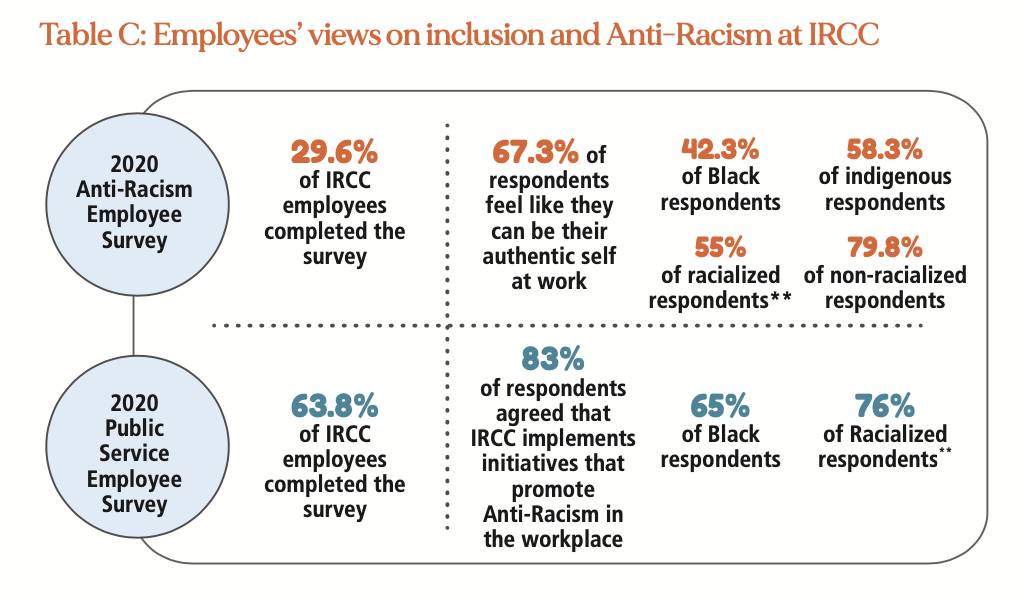
Usefully, the report provides a clear benchmark to measure success: the degree to which IRCC anti-racism initiatives moves the needle on the percentage that feel that “IRCC implements initiatives that promote anti-racism in the workplace.” Current numbers highlight the issue – only 65 percent of Blacks and 76 percent of non-Black visible minorities compared to 83 percent of not visible minorities.

But if the range of initiatives, engagement and comprehensiveness do not move the needle and reduce disparities, one will have to question their effectiveness, the reasons for lack of progress and the reasons why the perception by employees that not much has changed.

Failure to move the needle may also call into question the Clerk’s Call to Action on Anti-Racism, Equity, and Inclusion in the Federal Public Service, as in many ways IRCC was a model department in responding to the call.

And of course, service delivery failures in immigration and citizenship have a greater impact on Black and other visible minorities than than IRCC employees.

Source: Anti-Racism Strategy 2.0