Alberta UCP government’s anti-racism action plan met with criticism, questions

Of note:
Some advocates and the Opposition NDP say the Alberta government’s anti-racism action plan avoids taking important action.
Released on July 18, the Alberta government’s 20-page anti-racism action plan, presented as a “living document” that will change based on feedback, outlines three years’ worth of initiatives, including some the government has already done or begun to work on.Irfan Chaudhry, director of MacEwan University’s office of human rights, diversity and equity, said in an interview with Postmedia Wednesday the plan offers some constructive initiatives, but he doesn’t have much hope in it achieving its goals.

“I think it’s really weak,” he said

The action plan comes more than a year-and-a-half after the Alberta Anti-Racism Advisory Council, whose membership has since shifted, submitted a report to the government in January 2021. The public report with 48 recommendations was released last June, after the government had already announced action, including creating a hate crime liaison, a Hate Crimes Coordination Unit and the rollout of a grant program for religious and ethnic organizations to boost security against potential hate crimes.

Some recommendations of the council, however, including to mandate the collection of race-based data across government departments and police services, appear to have been either rejected, or relegated to another day.Over the next three years, the latest plan commits to developing data standards, and commissioning an expert report to guide the potential collection and use of race-based data

“There’s likely zero to no commitment from this government to any collection of race-based data … to me that just sounds like kicking the can down the road,” said Chaudhry.

In April, a UCP-led committee rejected a bill from NDP MLA David Shepherd that would have required the collection of race-based databy government.

Roy Dallmann, press secretary to Labour and Immigration Minister Kaycee Madu, said the government wants to get the collection of race-based data right, citing the historic misuse of such information.Alberta NDP multiculturalism critic Jasvir Deol said in a statement he was “deeply disappointed” the government sat on the recommendations of the council for a year and a half, and then failed to deliver a comprehensive action plan, including avoiding committing to data collection

“The UCP has not carefully or mindfully consulted with community members on the actions that would improve the lives of racialized Albertans,” said Deol.

The plan promises to tackle public education and cultural awareness, enable skills training for racialized and Indigenous peoples, create new grant and recognition programs for racialized and newcomer Albertans, and help remove barriers to cultural organizations applying for grants.

Bukola Salami, an associate professor in the faculty of nursing at the University of Alberta whose research focuses on health and immigration policies, said in an interview with Postmedia there are good elements, including promised grant funding.“It’s basic, it’s general, but at least it’s better than nothing,” she said, adding there is much to still be addressed in terms of accountability measures, including protection from backlash for those reporting injustices.

“The question is will it push the needle? Will it make any much difference, without having an accountability piece?” she said.

Chaudhry said helping cultural organizations apply for grants is a critical step that can help address systemic bias. However, he said he finds it disingenuous for the government to commit to new grants,since in 2019 the UCP removed the Human Rights and Multiculturalism Grants program.

“I have a hard time buying what’s being sold on this one, because there has been a patterned, sustained removal of a commitment to anti-racism from this specific government,” he said.While the plan promises to act to ensure “inclusion and diversity training” for law enforcement officers, it does not make clear whether that training might be mandatory, and for whom.

The government said it’s currently reviewing the Police Act to modernize policing, including officer training requirements, but it referred specific questions about recruiting and in-service training to police services.

Chaudhry said a focus on further discussion with community groups can put off taking action.

“I don’t think communities want more talking or discussion, I think they’ve already ‘been there, done that,’ so to speak, and that’s where I think a lot of this is going to fall flat.”

While the government’s release noted that the actions “build on” the work of the council, Postmedia did not receive a response to an email to the current advisory council asking for comment on how the action plan relates to its work.Madu said in the news release announcing the plan that his government has shown a proven track record in dealing with racism, discrimination and systemic racism, but there is more to be done.

“This action plan serves as a road map for our province to confront and take steps to eliminate racism to ensure Alberta is a free, fair and prosperous place for everyone,” Madu said. In the document, Madu acknowledges the effort of the council, and of Associate Minister of Immigration and Multiculturalism Muhammad Yaseen, who did the work developing the plan

Heather Campbell, a former co-chair of the advisory council, said in a Twitter thread shortly after the plan’s release that it’s “terrible and offensive.”

“There is so much ugly ‘collect information’ and ‘do nothing with the information’ in the document,” she wrote.

Dallmann said that kind of reaction to the first such anti-racism plan from any Alberta government is “unfortunate” because it downplays the importance of steps being undertaken.

“Given that this plan is rooted in the recommendations from the former (council) chair, we’re surprised she doesn’t recognize that this is a huge step forward to set Alberta up for increasingly successful diversity, inclusion, and equity efforts in the future,” Dallmann said.

Source: Alberta UCP government’s anti-racism action plan met with criticism, questions

Nyers and Moffette: Canada must grant permanent immigration status to undocumented residents

Not necessarily for the country as a whole, and for public confidence in government management of immigration.

Immigration always is based on both inclusion and exclusion, and thus discrimination between those who are deemed to meet criteria and those who are not.

The authors also are silent on the increased numbers of temporary residents that are transitioning to permanent status (mainly IMP, PGWP, students, less so Temporary Foreign Workers).

But calling to provide permanent status to “all” temporary residents is unrealistic. From an economic perspective, if some move from precarious employment, others will likely take their place, and of course, increased labour supply reduces the incentives for business to invest in technology and productivity.

And the authors are silent on overall levels of immigration, leaving the impression, fairly or not, that they favour none.

Temporary workers in key sectors (e.g. healthcare) have a stronger case from a Canadian interest point of view that those in less important sectors, or those who are seasonal workers:

In the December 2021 mandate letter to the newly appointed Minister of Immigration, Refugees and Citizenship, the Liberal government tasked him with exploring “ways of regularizing status for undocumented workers who are contributing to Canadian communities.” 

Sean Fraser has since said he’s working on designing a regularization program that can help address this issue. 

In May, MPs passed motion M-44 urging the government to design a plan to provide permanent residency to temporary foreign workers. If planned and executed correctly, these programs could be a historic opportunity to improve the lives of up to 1.7 million people who live in Canada without a secure status. 

Demanded action

In July 2021, migrants and advocates in Montréal, Toronto, Edmonton and St. Catharines held rallies demanding that the programs be inclusive, comprehensive and permanent.

Now the question is whether the government will create a program that can provide status to all undocumented and temporary residents through permanent residency permits, or whether it will create a small symbolic program that will fail to properly tackle the issue. 

There’s a lot at stake.

Most industrialized countries host a substantial number of undocumented residents. It’s an institutionally produced phenomenon that occurs when migrants travelling in search of safety, work, love or community encounter immigration and refugee policies that provide only limited protection to asylum-seekers and precarious and temporary permits to immigrants. Canada is no exception.

Our immigration system is geared towards temporary and conditional permits, many of them lacking a clear pathway to permanent residency and citizenship. Every year, more migrants enter Canada with temporary permits than permanent ones. This leaves them undocumented when their permits expire.

Strategies that make it possible to circumvent our international obligations towards asylum-seekers, in particular the Safe Third Country Agreement as well as an outdated definition of “refugee,” also leave many people without protection and official status to remain in the country.

Without addressing these root causes, regularization programs are only a temporary fix to a problem that was institutionally produced. However, these programs have tremendous positive outcomes for both migrants and society. 

Common in the EU

Regularization is a common policy tool in the European Union. France, Italy, Spain, Ireland, the United Kingdom, Poland and many other countries all routinely implement regularization programs. 

Spain, for example, implemented ad hoc programs under both conservative and progressive governments that regularized more than a million people between 2000 and 2006. It then launched a permanent ongoing mechanism to provide status to undocumented residents.

While less common in Canada, regularization programs have been implemented in the past. Under Pierre Trudeau’s government in 1973, some 39,000 people were regularized as part of the Adjustment of Status Program

But so far, the Canadian approach has been extremely restrictive, limiting access to relief programs to specific nationalities or people with specific family or work situations. A 2002 program that provided status to only 900 Algerians is a good example of the Canadian government’s lack of ambition. 

The mention of “undocumented workers” in Fraser’s mandate letter makes us fear this restrictive trend may continue.

Benefits, potential policy pitfalls

Regularization programs have many benefits

For migrants and those concerned about their well-being and rights, such programs can provide safety, stability and access to rights and family reunification. 

For the government, a well-designed program can “reset” the growing population of people without status or at risk of losing it, thereby remediating a problem produced by years of policies favouring temporary and conditional permits. 

Regularization can also provide a boon to the economy and the labour market by allowing workers to move from precarious jobs to more stable and better work in sectors where their skills are most needed.

For regularization programs to be effective policy tools, they need to be inclusive and comprehensive. Here are some potential pitfalls: 

1) Imposing a low arbitrary cap on the number of permits available, while useful for budgeting and staffing purposes, would make the program inaccessible to most. 

2) Limiting the program to undocumented workers in specific sectors would have the sole purpose of addressing labour market needs while failing to recognize undocumented residents’ contributions in all sectors of the economy and society. The “guardian angels” initiative — a program that provided a pathway to permanent residency to a few asylum-seekers who worked in very specific health-care jobs during the COVID-19 pandemic — has taught us that such an approach risks imposing restrictive professional criteria that would disqualify many workers. 

3) Providing only temporary and conditional permits would be counter-productive because those permits are largely responsible for the growing number of undocumented residents in Canada. 

This is a historic opportunity to tackle a long-standing problem and start rethinking our immigration and refugee model. 

In the next few months, we’ll see whether the government intends to use this policy tool to its full potential or settle for a small symbolic program that will fail to bring about long-term structural change.

Source: Canada must grant permanent immigration status to undocumented residents

Allos: A case for a Parliamentary Immigration Officer

Seeing more calls for an immigration ombudsman or this call for an officer of parliament, given ongoing policy and operational problems at IRCC.

Personally, not convinced that adding another layer will result in any significant improvements. IRCC is accountable before the courts, there is an active ecosystem of lawyers, academics and activists that are effective in raising issues. Periodically, the OAG conducts program specific audits and IRCC conducts program evaluations that I have found substantive.

In terms of the concerns raised on retention rates, tax filing data is providing insights. Given that tax filing data is linked to immigration files, it should be possible to assess retention rates by category, gender, country of citizenship etc, recognizing that there are, like all data, some limits. StatsCan also conducted a recent study that indicated about four million Canadian expatriates, higher than the APF number some 10 years ago (the APF included Permanent Residents, StatsCan included correctly only Canadian citizens).

So while better data on retention rates and undocumented migrants is of course needed, IRCC could start including this information in the annual report on immigration, as CIMM could and should press for, particularly in the context of a minority government:

Immigration is a vital sector and dynamic of the Canadian Economy. Immigrants keep the growth of our economy on the proper trajectory. Their numbers in the workforce keep the Canadian Pension Fund afloat.

Immigration levels are always a source of debate: too many; not skilled enough; too old; no net benefit or a drain on our social programs. But regardless of what your position is on immigration,  Canada’s declining birth rate aging population and labour shortage crisis reveal that immigration is an integral part of Canada.

The federal government’s 2022 immigration target is 431,000. Whether this number is based on any performance criteria is another matter. However, there is no independent Parliamentary Officer to track the functioning of the department for the House of Commons and for the Canadian public.

For example, Immigration, Refugees and Citizenship Canada (IRCC) does not disclose retention rates, so the public doesn’t know whether the recruitment is efficient (recruits or approved “ideal numbers”) or effective (success rate measured by the numbers who strive to contribute to the country once landed). Knowledge of these retention rates is especially important for decision-makers looking to build support for one immigration stream or another.

How do we know that there is a retention problem? In 2019, the Munk Centre published a summary of all existing literature and numbers on retention. The report details how Ottawa “estimates” and “lowballs” the retention rates and numbers while agreeing that, as of 2011, there were at least 3.0 million Canadians living abroad,

The Munk Report acknowledges that nothing much has been written on the subject since a 2011 report by the Asia Pacific Foundation.

There are several immigration streams. Knowing which stream has higher retention, would give the government direction on where to focus immigration policies. Streams with low retention rates tend to muck up the system with higher backlogs.

While IRCC can provide annual intake [landed] numbers for all streams, it does not provide any “exit”  (naturalized Canadians and immigrants leaving Canada) numbers. There is no audit of the “net numbers” (those landing as immigrants vs those leaving Canada). Crudely put, there is no analysis of “people in, people out,” and no measurement of performance outcomes.

Two problems immediately come to mind. First is the number of naturalized Canadians who leave Canada annually – effectively abandoning the investment made in going through the process of immigration. Estimates based on a study by Statistics Canada in December 2018, suggest annual numbers in the 200,000 range.

If this is the case, is IRCC obligated to inflate the annual landing targets to 431,000 just to cover the economic loss of 200,000 Canadians leaving Canada? If that many are leaving, of what value are IRCC’s policies?

The second is the scope of illegal/undocumented workers in Canada. Again, the estimates vary but the numbers fall in the one million range. If there are over one million undocumented workers in Canada, again –  how effective are IRCC’s policies?

Immigration, Refugee, Citizenship Canada (IRCC) publishes annual statistics of immigrants landing in Canada whether they are immigrants under different immigration programs, refugees and work permit visas. However, IRCC does not publish numbers of naturalized Canadians (immigrant, refugee, foreign workers) who leave Canada annually; we do not know if those numbers are tracked. In addition, there are no formal numbers of foreign workers who choose to stay beyond the expiration of their work permit visas.

IRCC has never published data on Canada’s retention rates for immigrants and refugees. The data is essential to audit the government’s immigration policies and optimize them. Being able to know how each immigration stream performs and retention rates for each stream will enable the government to emphasize one stream over another. Immigration streams that has low retention rates should be scrapped and give way to streams that have higher retention rates. IRCC will have to keep increasing the immigration quota to compensate for those who are leaving the country. The higher the immigration quota, the higher the backlog will be.

As for undocumented workers, Ottawa does not deny the issue. A Parliamentary Standing Committee studied the problem. Some MPs have quietly provided the one million number. But there has been a political/bureaucratic/media/industry/union consensus to not publicly acknowledge it as a problem. 

How do government Agencies like the Canada Revenue Agency (CRA) and Statistics Canada treat “retention numbers” or “undocumented workers?” Do CRA or Statistics Canada have reliable data on “retention numbers?”

In a word – no, they deny having reliable data. If there is no data, there is no problem. It is ironic to have several millions of citizens/Immigrants leave Canada, while one million undocumented workers remain in Canada. It is proof of how flawed IRCC’s selection process is.

It is time to create an independent body to oversee IRCC. A body that provides independent audit and analysis of the IRCC’s different immigration streams, retention numbers, backlogs, as well as any other data that can help the government improve Canada’s immigration system. A Parliamentary Immigration Officer is needed, now more than ever, to ensure that IRCC operates in an efficient and effective way to ensure program integrity.

Rabea Allos is the co-founder and member of the executive committee of the Catholic Refugee Sponsors Council. Rabea has advocated for refugees since 2005, particularly for Christians and other vulnerable minorities from the Middle East. He has appeared a few times in Canadian Parliamentary Committees, including Foreign Affairs and Citizenship & Immigration.

Source: A case for a Parliamentary Immigration Officer

Police-reported hate-motivated crime rises sharply for second year in a row

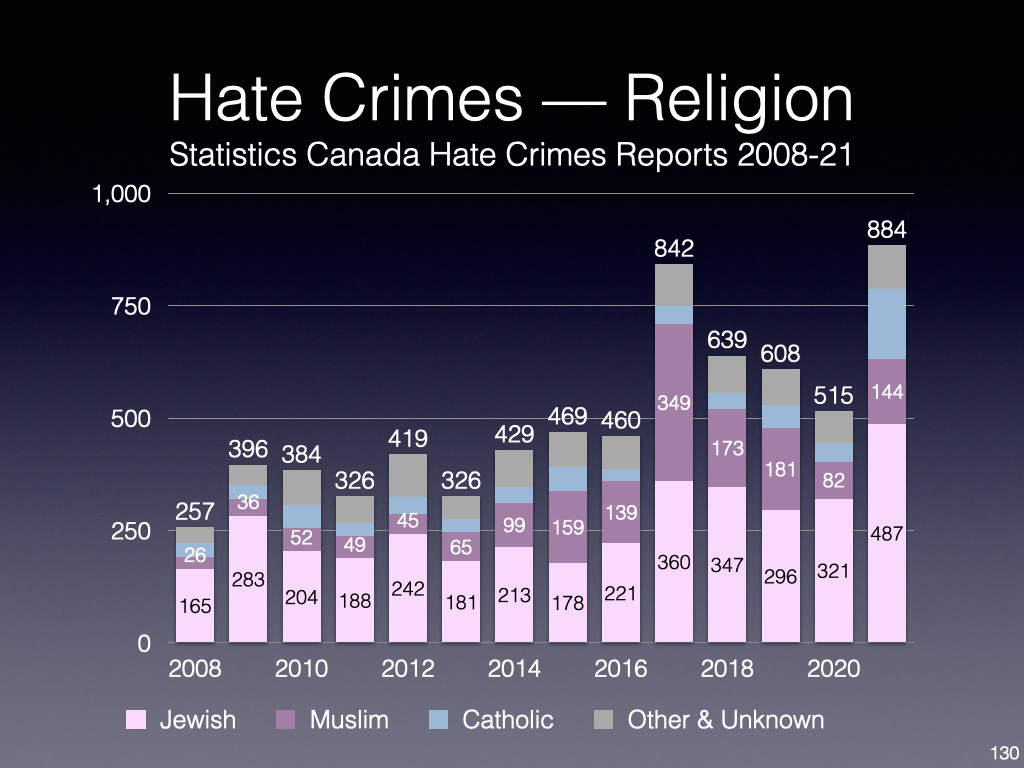
Latest numbers by StatsCan, showing particularly high increase in 2021 of religiously motivated hate crimes, with biggest relative increase for Catholics, likely due to the discovery of unmarked graves. In terms of ethnicity motivated, the rise of anti East and SE Asian hate crimes during pandemic stands out:

The number of police-reported hate-motivated crimes in Canada increased by 27%, up from 2,646 incidents in 2020 to 3,360 in 2021. This follows a 36% increase in 2020. In total, the number of police-reported hate crimes rose 72% from 2019 to 2021. Higher numbers of hate-motivated crimes targeting religion (+67%; 884 incidents), sexual orientation (+64%; 423 incidents) and race or ethnicity (+6%; 1,723 incidents) accounted for the majority of the increase. All provinces and territories reported increases in the number of hate crimes in 2021, except for Yukon, where it remained the same.

Police data on hate crimes reflect only those incidents that come to the attention of police and that are subsequently classified as hate crimes. As a result, fluctuations in the number of reported incidents may be attributable to a true change in the volume of hate crimes, but they might also reflect changes in reporting by the public because of increased community outreach by police or heightened sensitivity after high-profile events. Reporting may also be influenced by language barriers, issues of trust or confidence in the police, or fear of further victimization or stigma.

Source: Police-reported hate-motivated crime rises sharply for second year in a row

Reactions:

The head of the Canadian Race Relations Foundation is calling for action to combat hate and more federal help for victims, as new statistics show that hate crimes in Canada rose by 27 per cent last year. 

Executive director Mohammed Hashim warned that unless action is taken to combat hate-motivated abuse, including online, it will continue to spread.

He said the “slew of hate” online is so prevalent it risks becoming normalized and those affected are changing their behaviour to deal with it, including by not reading social media comments.

“It is a firehose of hate that is growing, honestly, like a wildfire,” he said. “And unmitigated it will grow even further to a point where we will normalize being in a wildfire.

“That is because we have left this environment unchecked.”

Statistics Canada reported a dramatic increase in hate crimes in 2021. Last year, the number of hate-motivated crimes reported to the police rose to 3,360 incidents from 2,646 in 2020. This followed a 36 per cent rise in 2020. 

In total, the number of hate-motivated crimes recorded by the police has gone up 72 per cent since 2019, according to the agency. 

Four Muslim Canadians from the same family were killed in June last year when a man rammed a truck into them in London, Ont. Police have said the attack was motivated by Islamophobia.

Public Safety Minister Marco Mendicino said the figures are “further evidence of the alarming and unacceptable rise of hate that marginalized communities have experienced in recent years.”

Mendicino said the federal government is taking action on a variety of fronts, led by new legislation to tackle the rise of hate speech and hate crimes.

“We will not rest until all Canadians feel safe in their communities,” he added. 

A report by the race relations foundation, published Tuesday, calls for greater federal help for victims of hate, many of whom do not qualify for financial compensation because their abuse does not count as a crime.

Hashim warned that “not supporting victims and leaving hate to proliferate freely disintegrates Canadian multiculturalism as a whole and a sense of collective belonging to this nation.”

Hate-motivated crimes targeting a person’s religious affiliation were up 67 per cent last year, according to Statistics Canada. Crimes based on a victim’s sexual orientation were up 64 per cent year over year. Another 1,723 recorded incidents targeted a person’s race or ethnicity, a six per cent increase, and together these categories made up the majority of the overall rise.

Marvin Rotrand of B’nai Brith Canada said Jews were the No. 1 target of hate crimes aimed at religious minorities. 

“All Canadians should be worried about the alarming explosion of hate crimes witnessed in 2021,” Rotrand said. “Our community comprises 1.25 per cent of the Canadian population but were the victims of 56 per cent of hate crimes aimed at religious minorities. That is more than all other religious groups combined.”

Shimon Koffler Fogel, president and CEO of the Centre for Israel and Jewish Affairs, said incidents targeting the Jewish community have risen by 47 per cent since 2020.

“Statistically, Canadian Jews were more than 10 times more likely than any other Canadian religious minority to report being the target of a hate crime,” he said.

All provinces and territories reported increases in the number of hate crimes in 2021, except for Yukon, where the numbers remained the same.

Hashim, who regularly tours the country speaking to victims of hate as well as community groups and police forces, said more focus must be put on victims. He said young women are facing huge amounts of abuse online, particularly young Black women. 

“Right now we talk a lot about hate crime statistics, how police are dealing with it or not dealing with it, being reported or not being reported,” he said. “What we are constantly missing is what is the effect on victims.”

The Department of Canadian Heritage is working on drafting an online hate bill to set up a framework to combat abuse online.

A previous anti-hate bill, introduced at the tail end of the last Parliament, died when the election was called. 

Heritage Minister Pablo Rodriguez appointed an expert panel to make suggestions for a future bill, including faster takedown obligations on platforms, in particular over child pornography.

During a consultation by the federal government last year, some minority groups raised concerns about directly involving the police to combat hate speech online.

Hashim warned against “digital carding” and a mass trawl of content online. He acknowledged there is concern about whether police should be able to access all takedown materials for investigative purposes.

“I don’t think that is the proper way of doing online safety. There need to be checks and balances between how much information is accessible to the police. That is why we have warrants,” he said.

“Just creating open access for all police, for all takedown data, for all social media platforms is overkill in my opinion.” 

The report commissioned by the Canadian Race Relations Foundation, and written by PricewaterhouseCoopers, said 80 per cent of hate crimes go unreported each year.

The report recommends Canada mirror Germany’s model for supporting victims of hate with millions of dollars of funding for community groups, which people who encounter hate “instinctively” reach out to, as well as a further victims fund. 

It says the government’s current compensation schemes exclude many victims of hate because few hate-motivated acts are designated as criminal.

The report also suggests the government establish an emergency response fund for communities hit by hate attacks on a large scale, as well as a central national support hub for victims.

Source: Race relations foundation urges more help for victims as hate crimes rise further

Ray: Critical Race Theory’s Merchants of Doubt

Important context:

Protests over George Floyd’s 2020 murder were the largest civil rights demonstrations in American history. The brutal footage of officer Derek Chauvin’s suffocating knee on George Floyd’s neck led many white Americans to, at least briefly, acknowledge the reality of structural racism in policing. In response, corporations questioned their diversity policies, “defund the police” became an activist rallying cry, and books on anti-racism became unexpected bestsellers. A narrative arose that America experienced a “racial reckoning” that challenged white racism’s worst excesses.

Conservative media and think tanks, fearing a lost battle in the war of ideas over racism in American life, counter-mobilized. Morality plays need villains, and conservative activists conjured a caricature of critical race theory—a forty-year-old academic framework–as an ominous and pervasive evil. Conservative groups claimed their villain was everywhere—from the federal bureaucracy to elementary schools—and fomented a moral panic over anti-racist education. Pundits credited Virginia Governor Greg Youngkin’s win to his scaring white parents into thinking their children might learn about the nation’s history of white supremacy. Conservative lawmakers have exploited the panic, attempting to remake the educational landscape with banning so-called “divisive concepts” that might make white kids uncomfortable. Propaganda victories are victories, nonetheless. And killing the messenger can destroy the message (if you can’t beat them, ban them). “Facts don’t care about your feelings” has become a conservative rallying cry. But critical race theory’s merchants of doubt, by legislating against accurate teaching of America’s racial history, put their feelings over empirical facts.
[time-brightcove not-tgx=”true”]

But victories aside, propaganda exposes its proponents’ intellectual bankruptcy. Conservative caricatures of critical race theory are unrecognizable to scholars familiar with the idea. According to the Washington Post, Christopher Rufo, the principal architect of the anti-critical race theory of moral panic admitted his crusade distorted the meaning of critical race theory when he tweeted:

“We have successfully frozen their brand—’critical race theory—into the public conversation and are steadily driving up negative perceptions. We will eventually turn it toxic, as we put all of the various cultural insanities under that brand category. The goal is to have the public read something crazy in the newspaper and immediately think ‘critical race theory.’ We have decodified the term and will recodify it to annex the entire range of cultural constructions that are unpopular with Americans.”

Incoherence and confusion are virtues for opponents of anti-racist teaching. And Rufo and his fellow travelers are simply updating the misinformation campaigns targeting accepted scholarship that elements of the right have trafficked in for decades. Heedless of both the actual content of critical race theory and the human cost of their panic, conservatives turned to propaganda because the weight of empirical evidence undermines their ideological preferences.

In their classic book Merchants of Doubt: How a Handful of Scientists Obscured the Truth on Issues from Tobacco Smoke to Global Warming, the historians of science Naomi Oreskes and Erik Conway outline a series of propaganda campaigns designed to undermine the scientific consensus on many of our most pressing collective problems. Conservative scientists, politicians, and think tanks sowed confusion over the link between cancer and smoking, acid rain’s environmental impact, and civilizational threats over global warming. Conspirators exploited the structure of scientific inquiry—which contains inherent uncertainties—to cast doubt on settled facts. Conspirators also played the media, manipulating the false objectivityof both-sides framing to claim equal time for scientific consensus and quackery. The strategy of sowing confusion works not because anti-empirical claims are correct but because manufactured uncertainty is often enough to bring political action to a halt.

Anti-scientific campaigns, whether focused on acid rain or climate change, often relied upon a close-knit cabal of think tanks, funders, and individual scientists (who sometimes lacked subject area expertise). Corporate profits and individual livelihoods were at risk if facts about the harms of smoking or environmental crisis were acknowledged and regulated. For short-term financial or political gain, anti-science propagandists made progress on long-term collective problems difficult, if not impossible, to achieve. In the meantime, these propagandists profited as the harms from industries they were protecting were passed onto an unsuspecting and credulous public.

Critical race theory’s merchants of doubt use strategies similar to those of previous anti-intellectual propaganda campaigns. And like these prior movements, the moral panic over critical race theory rests on a weak intellectual foundation.

No serious analyst doubts that American society is rife with racial inequality. Yes, there is debate among social scientists about the cause of racial inequality. But the consensus among honest scholars is that racial inequality is a long-standing, complex, intractable, and pressing social problem. The empirical evidence on structural racism and the inequality it produces is massive, overwhelming, and hard to contest. From unemployment to life expectancy, it is difficult to find a domain of American life where Black people aren’t worse off. Critical race theorists developed a flexible set of tenets that showed how often seemingly neutral social processes reproduce racial inequality. And these tenets were so useful they’ve been adopted by scholars of education, public policy, and sociology. Critical race theory’s main principles—that race is a social construction and racial progress is fragile and easily overturned—have substantial empirical support.

Intellectual weakness on race matters doesn’t make the anti-critical race theory campaign any less dangerous. Desperation and ruthlessness born of knowing facts aren’t on their side may make the campaigns more treacherous. Accuracy isn’t necessary to terrify teachers into changing lesson plans and avoiding basic truths about the American past (and present) or mangling lectures to make understanding difficult. Teachers are worried that clear explanations of slavery and Native American genocide may run afoul of the law and have received physical threats for vowing to teach the truth about American history.

I’m hardly the first analyst to connect attacks on critical race theory and prior ignorance promoting campaigns. Several historians have shown the similarities between the Scopes Money Trial—perhaps the paradigmatic case of anti-intellectual campaigns in U.S. history—and the moral panic surrounding critical race theory. Adam R. Shapiro notes that “Darwinism had been around for about half a century,” when it became the object of conservative ire. Shapiro claims that it wasn’t Darwin’s theory, per se, that led to opposition. The scientific consensus around Darwinism was representative of larger cultural trends that worried conservatives. Evolution stood in for a broad swath of economic, cultural, and political changes. The backlash to critical race theory is driven by a similar set of fears of lost white prerogative amidst cultural and demographic change.

Historical connections between the Scopes Monkey Trial and the current moral panic aren’t simply analogies. Christopher Rufo, who has been credited with taking the moral panic mainstream, is a former employee of the anti-evolution Discovery Institute. Perhaps better described as an anti-think tank, the Discovery Institute promotes misinformation around evolutionary theory, arguing that in place of the scientific consensus, schools should “teach the controversy.” Of course, there is little controversy among biologists aside from what the Discovery Institute itself foments. Claiming there is a scientific controversy where none exists muddies the waters, allowing unscrupulous actors to push their political agenda. Conspiracy theories travel in packs, and the Discovery Institute also promotes climate change denial and raises questions about the legitimacy of the 2020 election.

Ideas from critical race theory can help explain moral panic. Moral panics are immoral exercises, designed to create group cohesion, target ideological or political enemies, and shape norms. Critical race theorists draw attention to structural racism to find solutions to racial inequality. Critical Race Theorists maintain that structural racism is a profitable political system for the system’s beneficiaries. Finding solutions to climate change and tobacco addition threaten those who benefit from emissions and smoking. And finding solutions to racial inequality threatens those who benefit from structural racism. 2020’s protests put these beneficiaries on notice, so it’s no surprise they responded to defend their interests. Banning teaching about racism is a justification of existing racial inequality and a prelude to producing more. Barring teaching about diversity distorts basic facts about American life and creates the idea that difference is strange or dangerous.

Legislators claim they want to stop divisive teaching and are worried about lessons that demonize white people. But what is more divisive than outlawing basic descriptive facts about American history? Critical race theory doesn’t demonize white people. But by blocking teaching about America’s segregationists, eugenicists, and white citizen councilors, legislators may end up demonizing themselves. Dr. King warned about the dangers of this racial ignorance when he said, “Whites, it must frankly be said, are not putting in a similar mass effort to reeducate themselves out of their racial ignorance. It is an aspect of their sense of superiority that the white people of America believe they have so little to learn.”

Academic knowledge production depends upon good faith and verifiable fact. And when facts about structural racism make their way into the schools, they ban books and threaten teachers. It makes collective problems harder to solve.

Source: Critical Race Theory’s Merchants of Doubt

Former MP calls on Parliament Hill security to stop racial profiling

Of note:

A former MP who says she was racially profiled by parliamentary security last month is calling on the service to address racism within its ranks.

Celina Caesar-Chavannes said she was questioned by the Parliamentary Protective Service members in June when she tried to access the precinct wearing her parliamentary pin.

The pin, worn by current and former MPs, is meant to grant the wearer access to any building on the parliamentary precinct without having their bags and person searched, she said. But she said security services asked her where she got the pin and tried to do a search anyway.

Caesar-Chavannes was elected as a Liberal MP in 2015 for the riding of Whitby, Ont., but left the caucus in March 2019 and sat as an Independent member until the election that fall.

After she was questioned, Caesar-Chavannes said former New Democrat MP Peggy Nash was able to walk through security without incident.

“Peggy left politics long before I did,” said Caesar-Chavannes. “Nobody’s expecting them to recognize us, but the pin is universal. Security knows what that is.”

Nash was an MP for the Parkdale-High Park riding in Toronto from 2006 to 2008, and regained her seat in 2011 until 2015.

Source: Former MP calls on Parliament Hill security to stop racial profiling

Ottawa cheated 107 Iranians out of a fair shot at their Canadian dream, judge finds

Yet another example of IRCC struggles to manage demand and took a shortcut that was justifiably called out for by the court. Kudos to the lawyer involved, Pantea Jafari:

The Federal Court has ordered Canada’s immigration department to reconsider the cases of 107 Iranian immigration applicants who were turned down en masse.

The court also ordered the immigration department to pay the litigants a total of $50,000 in costs — one of the highest amounts ever awarded in an immigration case.

In what he called “an unusual circumstance of litigation,” Justice Henry S. Brown said he had no difficulty finding immigration senior management made “a deliberate and calculated decision” that “reduced” the rights — and fairness — for the applicants.

The issue arose after the files of the applicants — all Iranians who were seeking to come to Canada under the self-employed category of economic immigrants — were moved from a backlogged visa post in Ankara, Turkey, in March 2018 so they could instead be processed in the office in Warsaw, Poland.

There, the applications were all refused for failing to demonstrate the ability and intent to become self-employed in Canada.

At issue was whether the “mass” refusals made in “haste” — according to the applicants’ claim — were the direct result of an effort to clear a backlog, allegedly “at the cost of violation of legal principles.”

The judge was sympathetic to the applicants’ cause.

“Those whose applications are filed before a decision-maker institutes material changes in procedure are entitled to have notice of and be given an opportunity to refile or otherwise so as to comply with the new procedures,” Brown wrote in a 76-page decision last Friday. 

“Failure by a decision-maker to provide an applicant with notice of the case to meet constitutes a breach of procedural fairness.”

Rokhsar MousaviNezhad, a Persian carpet designer and maker, said she and other litigants — who initiated the suit in 2018 — were happy with the decision.

“We were treated unfairly and the court understood what happened,” said MousaviNezhad. “It restored our faith in the Canadian judicial system.

“We hope immigration is now going to act on our applications” according to the court instructions, she said.

The self-employed immigration program is meant to lure exemplary athletes, artists and farmers. The Iranian applicants in this program had been processed by the Ankara visa office, but 479 files in this category were transferred to Warsaw on March 7, 2018, due to backlogs in Turkey.

The court heard that the success rate of self-employed applications by Iranians plummeted from around 80 to 85 per cent between 2015 and 2017, when they were processed by Ankara, to less than 50 per cent when processed by the Warsaw office.

It identified a number of problematic procedural issues when immigration officials in 2016 “purported” to replace an operational manual that had been in place for at least eight years with a new one to guide visa officers in processing applications under the self-employed class.

The older manual referred to the possibility of interviews with applicants and actually instructed visa officers that formal business plans should be “discouraged” where they “would entail unnecessary expense and administrative burden” to the applicants. 

Under the old guideline, officers were also “expressly” advised that if they had “concerns about eligibility or inadmissibility, the applicant must be given a fair opportunity to correct or contradict those concerns” in compliance with the procedural fairness requirements.

“It seems to me this language strongly tends to require visa officers to deal with these concerns through procedural fairness letters, or possibly even through interviews,” wrote Justice Brown.

“The entirety of this procedural fairness-focussed provision was eliminated … Its wholesale removal cannot be seen as other than a deliberate, significant and material reduction in the legitimate expectations of procedural fairness.”

The court was told officials in Ankara always adhered to the practice of asking for supplementary documents, accompanied by a detailed checklist of other documents for additional information required to support a self-employed application, which Brown said was necessary, given lengthy immigration backlog and delays. 

However, he said, officials in Warsaw not only ended the practice of sending supplementary document requests, but made “material change” in assessing an applicant’s business plans and evidence of the person’s intent and ability to establish in Canada.

Given that Ankara had regularly approved Iranian self-employed applications without going into a great deal of specifics in the business plans, the judge said that also gave rise to justified expectations among applicants about the level of detail expected of the business plans they submitted for assessment.

“This legitimate expectation was not carried over to the Warsaw visa post, which rejected a great number of Iranian SE applications based in whole or part on perceived inadequacies of business plans filed in support of ability and intent,” Brown pointed out.

“This resulted in claims being dismissed without the applicants knowing the case they had to meet or having a full and fair chance to respond.”

Although it’s within immigration officials’ authority to replace operational manuals and change procedures, the judge said they did not notify the litigants in the system or prospective claimants, nor did they provide an opportunity to refile to meet “these significantly different requirements.”

Given the lack of notification, the court ruled that only those Iranian self-employed applicants whose cases were filed within six months (when represented by legal counsel) or nine months (if self-represented) after the new operational manual was introduced in 2016 and the applications were moved to Warsaw should be given a chance for reconsideration.

Due to the different timelines of the litigated cases, the judge only sent the eight lead cases back for reconsideration under the old rules and procedures, while asking immigration officials to review the rest and determine which ones meet the timeline and should be reopened.

Pantea Jafari, lawyer for the litigants, said the remaining 99 cases will be examined and those that meet the timeline under the court order will be automatically reopened and resolved, while the rest would be further adjudicated either by negotiation or by a further court order, if necessary.

She said Brown’s decision has a significant implication in the administrative law in the immigration context.

“Essentially, any time where an instruction set to officers or clients from the respondent has been persistent for a prolonged period of time — in our case, eight years — people can argue that created a legitimate expectation that would be followed,” said Jafari.

“Where the respondent makes significant changes to forms, processes, things like that, it is now under the purview of requiring some sort of notice of that or it will be deemed reasonable for people to have relied on the old versions within six or nine months.”

Source: Ottawa cheated 107 Iranians out of a fair shot at their Canadian dream, judge finds

Que se passe-t-il avec les demandes de visa pour le Canada? [sigh…]

Another are of problems at IRCC. Surprising in one sense as visitor visas have been one of the programs that has advanced the most on AI, and thus should be reaping benefits of faster processing for most cases. Requiring applicants to resubmit applications is not, needless to say, good service practice:

En contradiction avec l’information affichée sur son site Web, le gouvernement fédéral demande à certains visiteurs de déposer une seconde demande de visa pour le Canada si leur première a eu le malheur de se retrouver dans la pile des dossiers non traités lors de la pandémie. Une « file d’attente » au sort incertain qui cause bien des maux de tête.

« Si vous devez voyager au Canada en ce moment, veuillez noter qu’une nouvelle demande devrait être soumise. »

L’avocat spécialisé en immigration Denis Girard a été surpris de la réponse que lui a envoyée le bureau des visas de Dakar le 13 décembre 2021, alors qu’il se questionnait sur l’important retard dans la délivrance du visa de visiteur d’une de ses clientes originaires du Mali.

Celle-ci voulait venir visiter sa fille et ses petits-enfants au Canada, un voyage pour lequel elle fait une demande le 25 juillet précédent. Mais voilà que dans ce courriel, que Le Devoir a consulté, on demandait sans explication à la dame de refaire le processus. C’est qu’un événement important est survenu entre-temps : le Canada a rouvert ses frontières aux voyageurs vaccinés venant au pays pour des raisons non essentielles.

Immigration, Réfugiés et Citoyenneté Canada (IRCC) en a profité pour balancer toutes les demandes de visa effectuées avant cette date dans un étrange purgatoire bureaucratique où sont coincés des milliers de dossiers sans que leurs auteurs en soient informés. Cela a eu pour effet de faire gonfler les statistiques d’attente pour l’obtention d’un visa dans certains pays.

Sur son site Web, IRCC recommande aux personnes qui ont soumis une demande de visa de visiteur avant le 7 septembre 2021 d’en soumettre une nouvelle si leur situation a changé. Une consigne qui a rendu perplexe Me Girard. « Une nouvelle demande de visa ne semble pas requise [pour ma cliente], si on se fie aux représentations d’IRCC, représentations qui se révéleront être fausses », souligne l’avocat, qui note une contradiction entre la directive envoyée par courriel et ce qui se retrouve sur le Web.

Sa cliente a finalement déposé une nouvelle demande, sans remboursement, pour un visa qui a été produit 16 jours plus tard.

Le Devoir a tenté d’obtenir des explications d’IRCC concernant l’exigence de dépôt d’une nouvelle demande. À cinq reprises, IRCC a refusé de dire quelle était sa recommandation pour les personnes sans nouvelles de leur dossier et dont la situation n’a pas changé, hormis l’impatience de l’attente. Le ministère recopiait chaque fois la procédure pour les personnes dont la situation a changé.

Manque d’informations

Ce manque de clarté cause beaucoup d’incertitude. Originaire d’Haïti, Michelet Joseph a déposé une demande de visa de visiteur en août 2021. Il fit face à un dilemme : la refaire, ou pas ? « Je n’ai pas envie de retirer ma demande sans être remboursé. Je la maintiens, mais cette dernière n’est pas traitée », laisse-t-il tomber.

IRCC souligne qu’« il n’y a pas de garantie de remboursement » si une nouvelle demande est déposée.

Celui qui travaille comme journaliste à Port-au-Prince, où « il gagne très bien sa vie », souhaite venir au Canada pour rencontrer des artistes de son pays qui se produisent en terre canadienne. « J’ai besoin de les connaître pour pouvoir parler d’eux, dit-il. J’hésite à renvoyer une demande parce que j’ai déjà soumis plein de documents et je ne sais pas s’ils les reçoivent ou s’ils les mettent de côté. C’est frustrant. »

« Je ne sais pas quoi faire », indique également Natasha, qui préfère témoigner sous un nom d’emprunt par crainte de répercussions sur son propre dossier d’immigration. « Si je dépose une nouvelle demande, est-ce qu’on va l’abandonner de nouveau et encore nous dire les mêmes choses ? »

L’étudiante haïtienne à Montréal tente de faire venir sa mère (qui vit toujours en Haïti, mais qui est une habituée des voyages au Canada) pour sa cérémonie de collation des grades au mois d’août. Le Devoir a confirmé que la demande de visa a été enregistrée avec un an d’avance, le 27 août 2021, mais Natasha n’a eu aucune nouvelle du dossier depuis 11 mois. Les délais de traitement pour un visa demandé depuis Haïti sont pourtant estimés à 91 jours, selon le site Web d’IRCC.

« L’information, honnêtement, n’est pas claire du tout. Personne n’est joignable », témoigne celle qui ignore toujours si elle doit ou non déposer une nouvelle demande pour la visite de sa mère.

Petite histoire d’une file d’attente

Trois sources diplomatiques contactées séparément ont confirmé que l’arriéré des demandes de visa pose un problème aux ambassades canadiennes. Deux d’entre elles affirment que des responsables d’IRCC, le ministère qui gère de manière autonome les dossiers d’immigration, leur ont carrément fait savoir que les demandes déposées avant le 7 septembre 2021 ne seraient jamais traitées.

Officiellement, le ministère dit continuer à examiner ces vieilles demandes. Mais par la même occasion, il présente un portrait peu rassurant pour ceux qui attendent leur visa depuis près d’un an.

D’abord, le ministère a suspendu le traitement des demandes non urgentes entre avril et juillet 2020, tout en permettant le dépôt de dossiers. « Ceux qui ont demandé à voyager au Canada pour des raisons non essentielles pendant cette période ont vu leur demande placée dans la file d’attente », explique la porte-parole d’IRCC, Julie Lafortune.

Ensuite, et durant les 14 mois qui ont suivi, les fonctionnaires ont traité principalement les demandes de visiteurs exemptés des restrictions de voyage. « Un arriéré de demandes de visa de visiteur s’est accumulé », admet sans détour un document du ministère.

Finalement, lorsque les restrictions de voyage ont été assouplies, le 7 septembre 2021, IRCC a décidé que les demandes déposées avant cette date tomberaient dans cette malheureuse « file d’attente », qui a pour caractéristique d’imposer un traitement beaucoup plus lent. Le ministère invoque la « complexité » des dossiers, comme des documents périmés ou l’évolution des circonstances.

IRCC soutient par ailleurs toujours suivre un modèle du « premier entré, premier sorti », soit le traitement des plus vieilles demandes de la file d’attente avant les plus récentes ; le ministère se permet toutefois de traiter d’abord des dossiers moins complexes.

Seulement en 2021, près de 250 000 demandes qu’IRCC n’est pas arrivé à traiter se sont ajoutées à la file. La majorité des demandes déposées en 2022 ont, elles, été traitées.

Source: Que se passe-t-il avec les demandes de visa pour le Canada?

‘A specific form of anti-Black racism:’ Scholars want Canadian apology for slavery

Not unexpected given the growing number of apologies. But as Senator Bernard notes “apology is empty without action.”

The federal government has shifted resources and initiatives towards anti-black racism, both inside and outside government, as have some provinces and parts of the business sector (e.g., BlackNorth Initiative). Legitimate to press for more and faster, based upon an assessment of which approaches are likely to be more effective:

More than a year after Canada proclaimed Aug. 1 as Emancipation Day, Black leaders and scholars are renewing their calls for Ottawa to make a formal apology for the country’s history of slavery and its intergenerational harms.

Author Elise Harding-Davis said Sunday that the federal government’s vote last March to recognize Emancipation Day shows Canadian leaders know that the country’s history of slavery has caused generations of harm to Black people.

To ignore years of calls for a proper apology is “shameful,” she said.

“An apology would mean recognition of the fact that we were enslaved in this country,” Harding-Davis said in an interview. “It would also be an amelioration of the harsh treatment Black people have received and the validation that we have honestly contributed not only to this country, but to the making of this country.”

Emancipation Day recognizes the day in 1834 that the Slavery Abolition Act came into force, thus ending slavery in most British colonies including Canada, and freeing over 800,000 people. Thousands of slaves from Africa were brought against their will to Nova Scotia, New Brunswick, Prince Edward Island and Newfoundland, as well as to Lower Canada and Upper Canada, which is now Ontario.

In the colony of New France — which became British territory in the 1760s — the majority of slaves were Indigenous, historians say.

The Slavery Abolition Act freed all enslaved people, including Indigenous people, Harding-Davis said, adding: “A determination to free Black people helped free all people, and that’s huge.”

She said she doesn’t feel most Canadians are even aware of the country’s history of slavery.

“It’s just been sidelined and brushed under the rug as much as possible,” she said. “This anti-racism movement that has happened … in the last10 years, but more focused since George Floyd’s death in the United States, has only highlighted that there’s a small awareness that there’s anything wrong with the treatment of Black people in Canada.”

Dalhousie University history professor Afua Cooper said Sunday that she first asked Ottawa in 2007 to apologize for slavery and its harms. The principal investigator for the Black People’s History of Canada project noted that in the meantime, other groups have received apologies for historical harms.

“There can’t be any other explanation except that this is a specific form of anti-Black racism,” Cooper said in an interview. “Black people are not seen as fully-fledged citizens and it’s the federal government’s way of saying, ‘Too bad.'”

Some will argue that an apology isn’t warranted, she said, since Canada was formed in 1867, more than three decades after slavery ended. But Cooper said that reasoning doesn’t hold up, adding that the country formed in 1867 was built from what it was in the years before.

“And OK, how about apologizing to the Black community for things that happened after 1967?” she asked, pointing to examples including segregation, and a 1911 proposal in government that sought to ban Black immigrants from entering the country.

The last segregated school in Canada — in Lincolnville, N.S. — didn’t close until 1983.

Harding-Davis also doesn’t buy that argument. Black people have been subject to marginalization because of laws and practices that allowed and came from slavery, she said.

“The mindset, the beliefs have been left in place,” she said. “We continue to face prejudice and discrimination and longtime disparities, and the government has really done little to nothing to change that.”

Nova Scotia Sen. Wanda Thomas Bernard said Sunday that it is “absolutely” time for a federal apology for the country’s practice of enslaving Black people and its lasting harms, but she said an apology is empty without action.

The question she is asking Canada after last year’s recognition of Emancipation Day is, “What’s next?”

“There’s such a significant need for education, there is such a significant need for us to create greater awareness, but there’s also a need for us to engage in actions,” she said in an interview.

“We really need more engagement from everyone to move forward to walk this path in a more positive way. We need allies to be more impactful, more committed as they go forward, and not just performing allyship.”

The federal Department of Housing, Diversity and Inclusion did not immediately provide a comment upon request.

Source: ‘A specific form of anti-Black racism:’ Scholars want Canadian apology for slavery

Visa denials denounced at Montreal AIDS conference, federal minister cancels speech

Of note. Wonder whether the organizing committee (and the Canadian government when agreeing to host it) foresaw the visa difficulties and the extent to which other international conferences in Canada have encountered similar visa issues or not:

The International AIDS Society will re-evaluate how it organizes international conferences as a result of visa denials by the Canadian government, the organization’s president said Friday in Montreal.

The comments came as International Development Minister cancelled a planned appearance at the conference.

Adeeba Kamarulzaman told attendees at the opening ceremony of the AIDS 2022 conference that she is “deeply upset by the high number of denials and pending visas that prevented many registered delegates, including IAS staff and leadership, from entering Canada.”

She said the International AIDS Society, the association of HIV/AIDS professionals that organizes the conference, wants to ensure its conferences include the communities most affected by HIV.

“We know that underlying the difficulty experienced by many attendees of AIDS 2022 to enter Canada, lies a broader problem of global inequity and systemic racism that significantly impacts global health,” she said. “HIV, in particular, has always disproportionately affected the most marginalized.”

Other speakers had strong criticism for Canada’s visa policies. Activist and writer Tim McCaskill told attendees that if countries like Canada aren’t up to allowing “all stakeholders” to attend, “then we need to hold these conference in places that are.”

At one point during the opening ceremony, a group of protesters took the stage, condemning the visa denials and inequalities in the global response to HIV. “No more AIDS conferences in racist countries,” one woman said as she made a short speech.

Sajjan had been scheduled to speak at the conference opening, but he cancelled and was not replaced by another Canadian government representative.

Sajjan’s office said “operational issues” prevented him from attending. “We remain steadfast supporters of UNAIDS, the Global Fund and our trusted partners,” Haley Hodgson, a spokeswoman for the minister, said in an email.

Omar Sharif Jr., the master of ceremonies of the opening event, said Sajjan had notified organizers of the cancellation “a short while ago,” drawing boos from the crowd.

Winnie Byanyima, the executive director of UNAIDS, said she was “sad the government of Canada isn’t here.”

In her speech, she called for a more just world, where everyone has access to quality health care and where those living with HIV don’t face stigma, “including a world where people from the global south are not denied entry into wealthy countries to bring their expertise,” she added.

The conference, which draws researchers, medical practitioners, activists and people living with HIV, focuses both on scientific progress in the fight against AIDS and the need for increased funding for HIV response.

UNAIDS, the Joint United Nations Program on HIV/AIDS, has said that millions of lives are at risk due to disruptions in HIV care caused by the COVID-19 pandemic and declining funding for HIV response.

“As new infections are rising in many regions and access to treatment is slowing, how can it be right also that funding is declining?” Byanyima said to reporters earlier on Friday.

One of the messages of the conference is that if treatment has rendered the viral load undetectable, the virus is no longer transmissible.

That applies both to sexual partners and to pregnant HIV-positive women who could pass the virus on to children, said Maurine Murenga, the director of the Lean on Me Foundation. Her Kenyan organization works with adolescent girls and young women living with HIV or affected by tuberculosis.

“When I was diagnosed with HIV 20 years ago, I was given six months to live because there was no treatment. I didn’t know I would live long enough to come to a point where people living with HIV, on effective treatment, cannot pass HIV to our partners,” she told reporters.

The conference runs through Tuesday, and more than 9,000 delegates are expected to attend in person, with another 2,000 registered to participate remotely.

Source: Visa denials denounced at Montreal AIDS conference, federal minister cancels speech