Hicks: The radical improvement of data will transform public sector reform

The comparatively easier issue is developing and accessing more reliable and granular data (evidence-based policy development). The harder issue is the extent to which whether governments will use the data to inform policies and programs, compared to political and short-term considerations (policy-based evidence development).

I am less optimistic than Hicks:

Recent Policy Options articles have reflected on the need for public sector reform to deal with “wicked problems” related to decentralization, outsourcing, lack of public trust, lack of openness and the politicization of policy advice. Donald Savoieargues that the public service, with its obsolete policies and processes, has come so irreparably off its moorings that only an independent royal commission can fix it. Others, including Daniel Caron, Evert Lindquist and Robert Shepherd, call for internal reform processes.

An obvious question is why experiences over the past 50 or so years with both royal commissions and internal reforms have had such poor results. One factor has been the lack of the kind of reliable, granular evidence that would be needed to assess and learn from past initiatives that would also be needed to ensure that new directions can be managed in a transparent, accountable manner. As Caron, Lindquist and Shepherd say, institutional learning must be based on ongoing evidence and much of that needed evidence has, until now, not existed.

However, that is changing. As I demonstrate in a recent article, a radical improvement in evidence has become possible as a result of the availability of rich sources of new information, new ways of combining data from multiple sources in ways that protect privacy and the development of new predictive analytic tools based on big data. Much of this new evidence will be based on calculations using detailed administrative files. Ground-breaking information from other sources are on the horizon. For example, the use of data from personal monitoring devices from volunteers (with guaranteed anonymity) will be possible in the near future.

Another factor contributing to the failure of past reforms has been a tendency to examine the way in which services are administered separately from the actual content of those services. Many issues of public trust, morale, transparency, efficiency and service quality can only be addressed though deep changes in outdated policies and programs. They cannot be addressed by changes in the way programs are administered by the public service.

A third factor is that most reforms have taken place within existing programming and jurisdictional silos. This has made things worse by reinforcing overly fragmented programming, especially in the social policy area. Social policy in Canada is too often characterized by confusing sets of income supports and tax measures administered by both orders of government as well as overlapping but uncoordinated services provided by health care, educational and community organizations.

If the goal is to help people improve the quality of their lives and to increase trust between individuals and their governments, reforms need to be based on accountable partnerships that provide integrated services and supports based on an individual’s needs and aspirations. In practice, that hasn’t happened, largely because there’s been no source of routine evidence about which mixes of intervention are likely to work best for people with diverse characteristics in different circumstances.

However, that could change soon. Formerly wicked problems will be much easier to solve. Progress will soon make it possible to produce the kind of evidence that will allow us to learn from past experience and will support the accountability regimes needed to sustain reform efforts. That same evidence will also support major reform in the way policies are formulated, and the way in which programs are designed and delivered.

The new evidence will allow powerful new kinds of causal analysis. For example, it will become possible to make comparisons of the previous and subsequent characteristics and experiences of the participants in particular programs with those of non-participants with similar characteristics and in similar situations. This information would allow analysis of which programs (and combinations of programs) are working best, for whom and in what circumstances.

Using predictive analytic techniques, information on “what is likely to work best” will be available instantly – at the time when decisions are being made on choices of interventions. It will allow programs to continually improve and evolve based on automatic feedback loops showing what has been working best for people, including those who now feel alienated by standard, often fragmented programs that do not reflect their individual circumstances.

Over time, the new information is likely to reshape the way in which people are matched with programs. It would support the growth of an independent case management function where individuals with the greatest needs are referred to the service most likely to be effective (or, often, a combination of services and income supports) by counsellors who have access to evidence on what is likely to work best, regardless of who offers the service. The same information would allow other individuals, acting on their own, to learn what services exist and which are likely to work best for them given their needs and interests.

Development has reached a point where Statistics Canada is considering plans to use these new techniques to radically improve its social statistics. It is the only agency with the mandate and technical capacity to ensure the privacy and confidentiality of the source data and to ensure the quality of the resulting statistics.

The next logical step would be for it to gradually and cautiously enter into partnership arrangements with agencies in different jurisdictions and in different policy domains. Those agencies who wish to be early reformers can experiment with ways of using the anonymous “what works” evidence using the big data that is securely held within Statistics Canada.

It will take time to develop a fully mature system based on the new analytics. Progress will be slow and uneven across different policy domains. Issues related to public acceptability will be paramount. However, much of the needed background development work has already taken place. If the demand is there, significant progress is possible in many areas within five to 10 years.

To be successful, a public sector reform initiative should have a broad mandate that will result in the creation of the inter-agency partnerships needed to test out the new “what is likely to work best” evidence in practical program and policy applications. It should also propose ways of systematically applying lessons learned to mainstream programming.

Source: Hicks: The radical improvement of data will transform public sector reform
Eight key takeaways from landmark French immigration study [2021 data]

Most notable finding for me was the social mobility of the second generation:

A major new demographic study has explored immigration into France for the first time in a decade.

The dossier, by the French statistics bureau Insee, was published on Thursday (March 30).

It mainly used data from 2021, the most recent available.

Here we look at its main findings.

1. One-in-ten people in France is an immigrant

The study found that there were an estimated seven million immigrants living in France in 2021, equivalent to 10.3% of the population.

The study defined ‘immigrant’ as someone who was “born with a foreign nationality in a foreign country”.

2. More than a third of immigrants acquired French nationality

The study found that many immigrants become significantly integrated into France, especially those who have children (second-generation) and grandchildren (third-generation), in the country.
It also found more than a third (36%) of people who arrived in France as immigrants acquired French nationality.

3. Nearly half of immigrants in France come from Africa

The study found that 50 years ago, most immigrants in France had come from southern Europe. This has now changed.

In 2021, they were more likely to come from north Africa (the Maghreb region), Africa, or Asia.

  • In 2011, there were 882,000 immigrants to France from Spain and Italy
  • In 2021, this had dropped to 543,000
  • In 2011, there were 1.63 million immigrants from the Maghreb
  • In 2021, there were more than 2 million immigrants from the Maghreb

Overall, almost half of the immigrants in France come from Africa (3.31 million of a total of 6.96 million).

4. More than half of the immigrants living in France are women

Challenging the stereotype that most immigrants are single men, the study revealed that 52% of immigrants living in France are women.

This has risen from 44% in 1968.

As with the immigrant population in general (see below), women are particularly likely to be “estranged” from the world of work, even though they are likely to have similar, if not higher, levels of education than immigrant men.

Insee said: “{Women are] nine times’ more likely to be inactive and three times less likely to be in full-time employment than men.”

The bureau said that while this could be partly because many immigrants make their journeys for family reasons, “including, often, the goal of raising a family,” this alone did not explain the gap.

“The probability of being inactive rises with the number of children, and whether they live with a partner,” Insee said.

5. Immigrants are more likely to be affected by unemployment

In 2021, 13% of immigrants were unemployed, compared to 7% of the general population in France.

Immigrants are over-represented in certain jobs, such as at-home carers and maternelle assistants for women, and the construction sector for men.

They are more likely to be in interim and temporary contracts compared to the rest of the population, and “often are in less-skilled jobs, associated with lower pay and more difficult working conditions”.

Insee said that 39% of immigrant men in employment are unskilled workers, compared to 29% of men who are neither immigrants themselves nor descendants of immigrants.

Insee suggested that lower employment levels among immigrants could partly be due to “hiring discrimination”. It said that it had tested the difference between immigrant job applications and non-immigrant applications.

“Similar candidates with a suspected Maghreb origin receive 32% fewer callbacks than those without the suspected origin, even though both say that they have done all of their education, diploma, and work, exclusively in France,” it wrote.

The lower employment levels could also be due to employers not recognising foreign qualifications, and also due to immigrants tending to have lower levels of French language skills.

This is especially the case for refugees, who are less likely to be from French-speaking countries (30%) compared to other immigrants to France (67%).

6. Immigrants are more likely to be poor

Immigrants are twice as likely as the rest of the population to suffer from financial poverty, especially those from Africa and Asia.

In 2019, at least half of immigrants earned less than €1,417 per month; 15% less on average than immigrant descendants, and 26% less on average than people without any recent immigrant background.

Insee said: “19% of immigrants born in Africa cannot have a personal car for financial reasons, versus only 3% of immigrants born in Europe. 47% of those from Africa cannot have a week of holiday away from home, compared to 22% of immigrants from Europe.”

Immigrants are also more likely to be in poor health. Insee found that 10% of immigrant men are likely to be in “bad or very bad health”, compared to 7% of the non-immigrant population, and 5% of descendants of immigrants.

7. Descendants of immigrants have high social mobility

Despite these challenges, the study shows that descendants of immigrants tend to have upward social mobility in terms of education and work.

Insee said: “The level of diplomas among immigrant descendants is very close to the non-immigrant and non-descendant-of-immigrants population.” This shows a strong rise in education levels and social mobility from one generation to another.

“A third (33%) of descendants of immigrants, whose father was an unskilled worker, go on to become managers or have a semi-skilled profession,” the study states.

This is higher than the figure (27%) for those who are not descendants of immigrants.

Around 32% of immigrants have higher-education qualifications, which rises to 38% among the descendants of immigrants, compared to 41% of the non-immigrant population.

8. Immigrants are more likely to be religious

Immigrants in France are more likely to be religious than the wider non-immigrant population.

In 2019-2020, 51% of the general population aged 18-59 in metropolitan France said they did not have a religion.

This rises to 59% among people with no recent (within three generations) immigration background.

In contrast, only 19% of immigrants who arrived in France after age 16 say the same, rising to 26% among descendants of immigrants.

  • 29% of the immigrant population said they were Catholic
  • 10% said they were Muslim
  • 9% said they were another form of Christianity

Among descendants of religious families:

  • 91% of people raised in a Muslim home follow their parents’ religion
  • 84% of people raised in a Jewish home do the same
  • As do 67% of people raised in a Catholic home
  • And 60% among other forms of Christianity

Insee said: “The fact of having grown up in a family of mixed religious or Catholic background is decisive when it comes to the secularisation of immigrant descendants.”

Source: Eight key takeaways from landmark French immigration study

Temporary Foreign Worker program sees 68% jump in approvals 

The absence of temporary residents from the annual departmental immigration plan becomes more and more untenable given how temporary workers and students form a larger number than new Permanent Residents, particularly given the impact on housing availability and affordability, healthcare and infrastructure:

Employers in Canada were approved to fill more than 220,000 positions through the Temporary Foreign Worker program last year, taking advantage of government decisions that broadened access to migrant labour.

TFW approvals jumped 68 per cent from 2021, according to a Globe and Mail analysis of figures recently published by Employment and Social Development Canada. Over the final three months of 2022, companies were authorized to hire nearly 69,000 positions through the TFW program – the most in a quarter since at least 2017.

The numbers reflect part of the hiring process: Foreign workers still need to get the appropriate permits to fill those positions.

Even so, the ESDC figures show that employer demand for temporary foreign labour is soaring at a time of near-record-low unemployment rates and elevated job vacancies.

Companies also benefited from an overhaul of the TFW program last spring, when the federal government increased employers’ access to low-wage labour, among other changes.

As businesses rush to use the TFW program, Canada is experiencing the largest population gains in decades. The country grew by slightly more than one million people in 2022, a 2.7-per-cent increase that was the most since 1957, according to a recent Statistics Canada report.

Temporary immigration was the primary driver of growth. In 2022, the number of non-permanent residents jumped by around 600,000 on a net basis, a record increase. This group includes international students, along with those temporary workers whose permits are issued outside of the TFW program.

In its report, Statscan said the federal government is deliberately courting more immigrants to boost the supply of labour as the country ages. However, the agency also noted: “A rise in the number of permanent and temporary immigrants could also represent additional challenges for some regions of the country related to housing, infrastructure and transportation, and service delivery to the population.”

In the fourth quarter, farms and food-processing plants were the largest sources of TFW approvals, which is usually the case. Over all, nearly 25,000 roles as general farm workers were authorized to be filled. Procyk Farms Ltd., of Wilsonville, Ont., received 599 approvals in the quarter, the most of any company.

Collectively, the restaurant industry was approved to hire thousands of people, including more than 3,100 cooks. Those employers included franchisees of Tim Hortons and McDonald’s Corp.

Other high-demand roles included truck drivers, construction workers and nurse aides.

The federal government said the expansion of the TFW program was meant to address a shortage of workers, something that companies have openly complained about for years.

In one of last year’s changes, companies are now able to employ 20 per cent of their staff through the low-wage stream of the TFW program, up from a previous 10-per-cent cap for most employers. In seven sectors with “demonstrated labour shortages,” such as restaurants and construction, the limit was temporarily set to 30 per cent. Earlier this week, Ottawa extended the 30-per-cent cap until late October.

However, many economists have criticized those moves, saying it helps companies avoid paying higher wages, and that it could lead to the exploitation of migrant workers, whose immigration status is tied to their employer.

“Unfortunately, we increasingly have a system where our temporary and permanent immigration systems are focused on the same objective – satisfying employers’ current labour needs,” economists Parisa Mahboubi and Mikal Skuterud wrote in a recent memo for the C.D. Howe Institute. “The risk is that the overall immigration system fails to do anything well.”

To hire a TFW, a company must submit a Labour Market Impact Assessment to the federal government, showing that they can’t find local workers to fill their open jobs. The ESDC figures refer to the number of roles that received positive assessments.

Most temporary foreign workers in Canada are not employed through the TFW program. At the end of 2022, there were more than one million active work permits in the International Mobility Program. This group includes a range of workers, such as company transfers from abroad. IMP permits have jumped by 193 per cent over the previous decade.

International students, who mostly don’t need work permits to secure employment in Canada, are a rapidly growing part of the labour force. At the end of last year, there were slightly more than 800,000 active study permits – nearly triple the volume from 10 years earlier.

Source: Temporary Foreign Worker program sees 68% jump in approvals

Vaughn Palmer: B.C. wants federal housing dollars tied to immigration patterns

Good to see the discussion happening at the political level and that Don Wright’s assessment getting attention (https://www.theorca.ca/commentary/don-wright-will-trudeau-make-it-impossible-for-eby-to-succeed-6762001):

Finance Minister Katrine Conroy expressed disappointment this week that the federal budget did not respond to B.C.’s calls for more funding for housing.

“There doesn’t seem to be funding for the housing that we have been asking for,” she told reporters Tuesday.

Ottawa did allocate new money to an Indigenous housing plan, valued at $4 billion.

Conroy was “really happy to see more funding for that,” though she noted B.C. already funds Indigenous housing.

Based on what she didn’t see in the budget, it appeared to her that B.C. would be left on its own to fund other types of social housing as well as develop housing for middle income levels.

“We need to be in a partnership with the federal government, municipal governments and our provincial government to ensure that we have enough housing for people,” said Conroy.

However, federal Finance Minister Chrystia Freeland had a ready explanation for the apparent shortfall when she visited B.C. on Thursday.

There was no new money for the housing crisis in this year’s budget, because Ottawa is still rolling out the $10 billion commitment in last year’s budget.

“This was a multi-year plan,” Freeland told a news conference in Surrey. “You don’t deploy $10 billion in one month or in one year.”

The plan includes the $4 billion “housing accelerator program” that Prime Minister Justin Trudeau launched in mid-March.

The goal is to accelerate construction of 100,000 homes over 10 years.

To tap the fund, municipalities must submit plans for fast-tracking housing units, with an emphasis on affordability.

“Tell us what your plan is to get more homes built,” said Freeland. “Tell us how some of that money can help you build those homes, and we will write a cheque. And $4 billion will mean we can write a lot of cheques.”

Premier David Eby, who shared the platform with Freeland, took a more conciliatory tone than his finance minister had done earlier in the week.

“There are very significant parcels of federal housing funding from the last budget that have yet to be deployed in a significant way in British Columbia,” he acknowledged. “B.C. needs to see our fair share of that funding. We have partnered with the federal government on many projects and many more to come.”

By way of a hint, the premier added: “If they have surplus from other provinces that is unspent, bring it to British Columbia, because we’re going to put it to work right here. We’re an excellent partner for that.”

On the fairness question, Eby was referring to his government’s argument that B.C. is entitled to a disproportionate share of housing funding because the province receives a disproportionate share of immigrants to Canada.

B.C. Housing Minister Ravi Kahlon made the case at the beginning of the year, and he’s reinforced it at every opportunity since.

“I’ve spoken to the federal ministers multiple times, urging them to consider tying their immigration numbers to both housing starts and affordable housing,” he said recently.

“We know it is going to be critical to build that stock for the amount of people that are coming, not only the new immigrants but also the temporary residents that are being approved to come to Canada.”

Kahlon’s concern was reinforced this week in an opinion piece from Don Wright, who headed the provincial public service in the first term of the John Horgan NDP government.

“B.C.’s success in addressing the public’s concerns here will be largely hostage to the federal government’s immigration policy,” Wright wrote in an article Monday in the online Orca publication that asked, “Will Trudeau make it impossible for Eby to succeed?”

His point was that the federal government’s ambitious immigration targets will add to existing pressures on the supply of doctors and housing, two challenges Eby is pledged to address.

Wright challenged the conventional wisdom that housing affordability is best addressed by the supply side of the housing equation.

“Demand matters too,” he wrote. “And as quickly as we have built new homes, the population in our major urban centres rises as well.”

“The federal government’s prescription for this? Ramp up immigration numbers!” said Wight.

“A story is spun that this will actually increase housing supply because we are going to bring in more trades workers to build the houses we need,” notes Wright, before knocking down the “heroic assumptions” in that statement.

“It is not going to work,” he wrote. “Of the 160,000 new British Columbians last year, more than 95% settled in the Lower Mainland, Southern Vancouver Island, and the Okanagan — where affordable housing was already acutely unavailable.”

Net result, concludes Wright: “Premier Eby is going to have even more difficulty in delivering more affordable housing.”

Wright did not conclude his piece with a call for Ottawa to slam the brakes on immigration.

In less judicious hands, it might come to that. But the New Democrats don’t want it to come to that.

Hence their argument that B.C. should get a greater share of federal housing dollars in recognition that the province also welcomes a greater share of Canada’s newcomers.

Source: Vaughn Palmer: B.C. wants federal housing dollars tied to immigration patterns

La lutte contre l’islamophobie est un écran de fumée

Extreme take IMO but valid critique of the some of the polemic around CRA audits and reflects the tensions between the more and less secular:

Lors de l’annonce du poste de représentant canadien à la lutte contre l’islamophobie, nous avons été nombreux à souligner l’utilisation abusive et militante de ce terme qui confond dans son usage le respect de la personne de conviction musulmane avec le respect absolu des préceptes de l’islam.

Le dernier sondage Angus Reid illustre bien notre propos en reconduisant une telle confusion. Selon ce sondage, les Québécois auraient une opinion plus négative de l’islam que la moyenne canadienne et seraient davantage favorables à la loi 21.

On le sait, le Québec a une vision plus négative que le reste du Canada de toutes les religions et une plus grande aspiration à la laïcité. Cela découle de son parcours historique et de son attachement à un modèle de vivre ensemble basé sur des valeurs citoyennes communes. Or, la firme Angus Reid ne manque pas de conclure que les Québécois seraient plus islamophobes, au sens de racistes, que le reste du Canada. La lutte contre l’islamophobie consisterait-elle, au nom d’un antiracisme dévoyé, à inculquer une vision positive de l’islam ? Faudrait-il en faire autant pour toutes les religions ?

Ce que cache la lutte contre l’islamophobie

Plus concrètement, on vient d’apprendre que la Division de la revue et de l’examen (DRE) de l’Agence du revenu du Canada, chargée de veiller à ce que les organisations caritatives ne soient pas utilisées pour financer le terrorisme, fait l’objet d’une enquête en raison d’allégations d’islamophobie. Les plaignants font notamment valoir que 75 % des organismes dont le statut d’organisme de bienfaisance a été révoqué sont musulmans. Il appartiendra à l’Office de surveillance des activités en matière de sécurité nationale et de renseignement de trancher après enquête, mais soulignons d’emblée qu’un tel écart statistique ne présume aucunement d’une injustice.

Parmi les organisations révoquées, les médias ont déjà rapporté le cas du Centre islamique d’Ottawa pour promotion de la haine et de l’intolérance, de l’IRFAN-Canada pour financement du Hamas ou de l’ISNA pour financement de Jamaat-e-Islami, tous deux inscrits sur la liste des entités terroristes du Canada. Un simple parcours de cette liste permet d’ailleurs de constater qu’elle est constituée dans sa grande majorité de groupes islamistes. Du reste, un document sur la stratégie antiterroriste du Canada tire la même conclusion : « L’extrémisme islamique violent est la principale menace pour la sécurité nationale du Canada ».

En fait, suspendre les travaux de la DRE était l’une des recommandations du Conseil national des musulmans canadiens (CNMC) lors du sommet national sur l’islamophobie de 2021 ayant mené à la création du poste de représentant canadien à la lutte contre l’islamophobie. Parmi ses autres recommandations, le CNMC appelle le gouvernement à interrompre sa stratégie nationale de lutte contre l’extrémisme violent et la radicalisation, ainsi qu’à surveiller les organismes de sécurité nationale, dont le Service canadien du renseignement de sécurité et l’Agence des services frontaliers du Canada. Pourquoi ? Le CNMC les soupçonne de racisme, d’islamophobie et exige même une étude sur « la pénétration de la suprématie blanche » en leur sein.

Faire cesser la surveillance des organisations susceptibles de financer le terrorisme et mettre sous contrôle les organismes de sécurité nationale sous prétexte de racisme, est-ce à cela que contribuera le poste de représentant canadien à la lutte contre l’islamophobie ? Les Canadiens prennent-ils la pleine mesure de ce que tout ceci implique ?

La laïcité comme arme de diabolisation massive

À la suite du sondage Angus Reid, les médias ont relayé des propos outranciers sur la supposée « islamophobie » rampante au Québec, le CNMC allant même jusqu’à parler de danger de mort pour les musulmans.

À ce propos, Fatima Aboubakr a apporté un témoignage éclairant sur la façon dont la loi 21 était utilisée, quitte à exagérer son champ d’application, pour diaboliser le Québec et faire avancer des objectifs islamistes. Témoin de la radicalisation de jeunes de son entourage, Mme Aboubakr a participé à la fondation d’une association arabo-musulmane à vocation humaniste et laïque pour aider ces jeunes. Or, cette vocation humaniste a rapidement été mise à mal par des pressions interdisant tout propos favorable à la laïcité. Elle témoigne aussi de l’état de dépendance dans lequel se trouvent de nombreux immigrants embrigadés par des intervenants associatifs en rupture avec leur société d’accueil.

Ce n’est pas la première fois qu’un tel constat est brossé. En 2016, dans le cadre du départ d’une dizaine de jeunes du cégep Maisonneuve vers la Syrie, un rapport du Centre de prévention de la radicalisation menant à la violence faisait état d’un climat polarisant entretenu par des « agents de radicalisation » manipulant le sentiment de victimisation des jeunes en instrumentalisant le projet de Charte de la laïcité. Ces agents de radicalisation auraient considérablement contribué « à semer la haine chez les jeunes, en insistant sur le rejet collectif des musulmans et de l’islam de la part de la société québécoise ».

La lutte contre l’islamophobie est un écran de fumée permettant à des individus peu scrupuleux ou radicalisés de maintenir leurs concitoyens dans un état d’enfermement communautaire les isolant du reste du Québec, sans parler d’OBNL à vocation religieuse profitant de l’impunité qui en découle pour servir de courroie de transmission au financement du terrorisme international.

Si le gouvernement canadien doit assurément lutter contre la haine, il ne doit pas se laisser berner par l’usage volontairement confus du terme « islamophobie » au point d’entraver le bon fonctionnement des organismes de sécurité nationale. Son rôle premier est d’assurer la sécurité de ses citoyens tout en préservant sa crédibilité à l’étranger.

Source: La lutte contre l’islamophobie est un écran de fumée

The Liberal Maverick Fighting Race-Based Affirmative Action

Of interest and agree on need for more focus on class issues rather than conflating them with race:

For the college class he teaches on inequality, Richard D. Kahlenberg likes to ask his students about a popular yard sign.

“In This House We Believe: Black Lives Matter, Women’s Rights Are Human Rights, No Human Is Illegal, Science Is Real,” it says.

His students usually dismiss the sign as performative. But what bothers Mr. Kahlenberg is not the virtue signaling.

“It says nothing about class,” he tells them. “Nothing about labor rights. Nothing about housing. Nothing that would actually cost upper-middle-class white liberals a dime.”

Since picking up a memoir of Robert F. Kennedy at a garage sale his senior year of high school, Mr. Kahlenberg, 59, has cast himself as a liberal champion of the working class. ‌ For three decades, his work, largely at a progressive think tank, has used empirical research and historical narrative to argue that the working class has been left behind.

That same research led him to a conclusion that has proved highly unpopular within his political circle: that affirmative action is best framed not as a race issue, but as a class issue.

In books, ‌articles and academic papers, Mr. Kahlenberg has spent decades‌ ‌arguing for a different vision of diversity, one based in his 1960s idealism. He believes that had they lived, Kennedy and the Rev. Dr. Martin Luther King Jr. would have pursued a multiracial coalition of poor and working class people, a Poor People’s ‌Campaign that worked together toward the same goal of economic advancement in education, employment and housing. ‌ ‌

Race-conscious affirmative action, while it may be well intentioned,‌ ‌does just the opposite, he says — aligning with the interests of wealthy students‌ and creating racial ‌animosity.

With class-conscious affirmative action, “Will there be people in Scarsdale who are annoyed that working-class people are getting a break? Probably,” he said in an interview. “But the vast majority of Americans support the idea, and you see it across the political spectrum.”

His advocacy has brought him to an uncomfortable place. The Supreme Court is widely expected to strike down race-conscious affirmative action this year in cases against Harvard and the University of North Carolina. He has joined forces with the plaintiff, Students for Fair Admissions, run by a conservative activist; the group has paid him as an expert witness and relied on his research to support the idea that there is a constitutional “race-neutral alternative” to the status quo.

That alliance has cost him his position as a senior fellow at the Century Foundation, the liberal-leaning think tank where he had found a home for 24 years, according to friends and colleagues. (Mr. Kahlenberg and the Century Foundation said he left to pursue new opportunities and would not elaborate.)

Critics‌ ‌dispute everything from his statistics to his rosy outlook on politics. They say that the concept of race-neutral diversity underestimates how racism is embedded in American life. They say that class‌-conscious affirmative action will bring its own set of problems as universities try to maintain high academic standards. ‌

And they argue that his class-based solution could backfire.

“It may well be where we wake up,” said Douglas Laycock, a law professor at the University of Virginia who has been involved in litigation on the side of universities. “But if you get rid of affirmative action, then you create racial hostility in the other direction.”

Mr. Kahlenberg is unfazed.

“I think people will have to come around,” he said, “because class will be the only game in town.”

The Harvard Legacy

Mr. Kahlenberg’s own life shows the complicated calculus of college admissions.

He grew up in White Bear Lake, Minn., a suburb of St. Paul, where his father was a liberal Presbyterian minister and his mother was on the school board. His father had gone to Harvard, and when he came of age, so did Mr. Kahlenberg. His grandfather paid for his college tuition.

Decades later, he seemed a little defensive about possibly having benefited from the “tip” that Harvard gives to the children of alumni.

“This will sound incredibly insecure or something, but I was gratified that I got into Yale and Princeton, because it made me feel like, OK, it wasn’t just legacy, hopefully,” he said.

Around the time he was accepted to Harvard, he was smitten by a memoir of R.F.K. by the Village Voice journalist Jack Newfield. Mr. Kahlenberg wrote his senior thesis on Kennedy’s campaign for president. And today, a nicked and scratched poster of his idol hangs in his study at home.

At Harvard, Mr. Kahlenberg was surrounded by “immense wealth,” he recalled. “I didn’t feel like an outsider. I was second-generation Harvard, I was upper middle class and a lot of my friends went to boarding school.”

But his roommate, who came from more modest circumstances, “helped educate me on the idea that working-class white people had a raw deal in this country, too,” he said.

Mr. Kahlenberg studied government and went on to Harvard Law School, where he wrote a paper about class-based affirmative action, advised by Alan Dershowitz, his professor, known for defending unpopular causes and clients.

The paper inspired him to write his influential 1996 book, “The Remedy,” which developed his theory that affirmative action had set back race relations by becoming a source of racial antagonism.

“If you want working-class white people to vote their race, there’s probably no better way to do it than to give explicitly racial preferences in deciding who gets ahead in life,” he said. “If you want working-class whites to vote their class, you would try to remind them that they have a lot in common with working-class Black and Hispanic people.”

The book caused a stir, in part because of the timing. California voters adopted a ban on affirmative action in public colleges and universities the same year. Such bans have since spread to eight other states, and California voters reaffirmed it in 2020.

Today, as in the mid-1990s, polls show that a majority of people oppose race-conscious college admissions, even as they support racial diversity. Public opinion may not always be right, Mr. Kahlenberg said, but surely it should be considered when developing public policy.

What has changed, he said, is the political environment. Universities and politicians and activists have hardened their positions on affirmative action.

And the Supreme Court supported them, at least until now.

A Different Measure of Diversity

If Mr. Kahlenberg had his way, college admissions would be upended.

His basic recipe: Get rid of preferences for alumni children, as well as children of faculty, staff and big donors. Say goodbye to recruited athletes in boutique sports like fencing. Increase community college transfers. Give a break to students who have excelled in struggling schools, who have grown up in neighborhoods of concentrated poverty, in families with low income, or better yet, low net worth. Pump up financial aid. Look for applicants in towns that do not normally send students to highly selective colleges.

It’s an expensive punch list and requires more financial aid for working class and poor students, which is the main reason, he believes, that universities have not rushed to embrace it.

Meanwhile, elite colleges have become fortresses for the rich, he said. Harvard had “23 times as many rich kids as poor kids,” Mr. Kahlenberg testified in 2018 at the federal court trial in the Harvard case, referring to a 2017 paper by Raj Chetty, then a Stanford economist, and colleagues. 

Mr. Kahlenberg said the civil rights movement has made strides, while overall, poor people have been left further behind. He points to studies that found that the achievement gap in standardized test scores between rich and poor children is now roughly twice the size of the gap between Black and white children, the opposite of 60 years ago.

He said his theories are working in states with affirmative action bans, pointing to his 2012 study that found seven of 10 leading universities were able to return to previous levels of diversity through race-neutral means.

Even the University of California, Berkeley, which was having trouble achieving its pre-ban levels of diversity, has made progress, he said. In 2020, Berkeley boasted that it had admitted its most diverse class in 30 years, with offers to African American and Latino students rising to the highest numbers since at least the late-1980s, without sacrificing academic standards. 

Mr. Kahlenberg’s analysis of Harvard’s outlook is also optimistic.

In a simulation of the class of 2019, he found that the share of Black students at Harvard would drop to 10 percent from 14 percent, but the share of white students would also drop, to 33 percent from percent from 40 percent, mainly because of the elimination of legacy and other preferences. The share of Hispanic students would rise to 19 percent from 14 percent and the Asian American share would rise to 31 percent from 24 percent.

The share of “advantaged” students (parents with a bachelor’s degree, family income over $80,000, living in a neighborhood not burdened by concentrated poverty) would make up about half of the class, from 82 percent. SAT scores would drop to the 98th percentile from the 99th.

Because he is focused on class-based diversity, Mr. Kahlenberg is satisfied with these results, but for many educators, the rise in low-income students does not make up for a drop in Black students.

Harvard, for instance, says it crafts every class carefully, looking for diversity of life experiences, interests and new ideas — and to cultivate potential leaders of society. Fewer Black students make that mission harder.

In the affirmative action trial, Harvard said that Mr. Kahlenberg’s model would produce too little diversity, and water down academic quality. Its actual class of 2026 is 15.2 percent African American, 12.6 percent Hispanic and 27.9 percent Asian American.

Universities should not turn to class-conscious admissions, “under the illusion that it will automatically produce high levels of racial diversity,” said Sean Reardon, an empirical sociologist at Stanford.

“It’s just sort of the math of it,” Dr. Reardon said. “Even though the poverty rates are higher among Blacks and Hispanics, there are still more poor whites in the country.”

Dr. Reardon does not dispute that society should provide more educational opportunity for low-income students. But, he said, “I think in recent years, there’s been much more of a perspective that there’s structural racism in America society. The idea that race and racial differences are sort of explainable by class differences is no longer the dominant idea.”

An Uneasy Alliance

Edward Blum, the conservative activist behind the lawsuits against Harvard and U.N.C., said Mr. Kahlenberg came to his attention when “The Remedy” was published. The focus on class seemed like a powerful bridge between the left and the right, Mr. Blum said.

“If we’re going to agree on one thing,” he said, “it is that colleges and universities should consider lowering the bar a little bit for kids from disadvantaged backgrounds, who are maybe the first in their family to attend college, who come from very modest if not low-income households.”

“I don’t know who could be against that,” he said. “That’s the unifying theme that Rick Kahlenberg — he’s the godfather of it.”

Although the two men have had a long correspondence, Mr. Kahlenberg said they are more strange bedfellows than ideological soul mates, and that his views have been unfairly conflated with Mr. Blum’s.

“If the choice were race-based preferences or nothing, I would be for race-based preferences,” Mr. Kahlenberg said, his delivery more emotional than usual. “For those who think in terms of guilt by association, that point is lost.”

There are those who think that Mr. Kahlenberg is being used by Mr. Blum, who has made a specialty of challenging laws that he believes confer advantages or disadvantages by race. He  orchestrated a lawsuit that led to the Supreme Court gutting a key section of the Voting Rights Act, and was responsible for litigation against the University of Texas, charging discrimination against a white applicant, which failed.

Dr. Laycock, of the University of Virginia, expects that once the Supreme Court rules, conservative groups that are now promoting race-neutral alternatives will claim they are racial proxies and turn against them. “Everybody knows that’s why it’s being used,” he said. (Mr. Blum said his group will not, though other conservative groups could do so.)

In other words, that Kennedy- and King-style multiracial coalition may not come easily.

Since leaving the Century Foundation, Mr. Kahlenberg still consults for the organization on housing. He has a few unpaid gigs at the Progressive Policy Institute and at Georgetown. 

He recently moved from Bethesda, Md., to a modest house in Rockville, now strewn with baby toys from a visiting daughter and grandchild. Mr. Kahlenberg’s wife, Rebecca, works with homeless people.

There is no “We Believe” sign in the yard. But on the living room wall, a sign says, “Live simply, dream big, be grateful, give love, laugh lots.”

In that spirit, his stubborn campaign might be traced to being the son of a pastor whose family could afford to make him a Harvard graduate, twice over. “I do have some measure of class guilt,” he said. “I wish people who are far richer than I am had more class guilt.”

Source: The Liberal Maverick Fighting Race-Based Affirmative Action

Canada hired more female police officers in 2022, while the number of racialized officers remained unchanged

Of note:

The representation of women in police departments across Canada continued to increase in 2022, according to a new report by Statistics Canada, while the number of racialized officers remained largely the same.

More than 2,000 police officers and nearly 1,900 recruits were hired in 2021/2022, an increase of about 900 between the categories compared to the year before, the report says.

That year, 15 per cent more female officers were hired than the year before and 16 per cent more female recruits were hired. Recruits are people training to be police officers.

Overall, women represented 23 per cent of police officers in 2022, while just eight per cent of the police force comprised racialized officers, the report says.

Number of women officers continues to increase steadily

Police services in the country have been hiring more and more women since 1986, the report notes, when data on gender was first collected. At the time, women represented less than 4 per cent of all officers in Canada.

As of May 2022, there are more than 16,000 women working in Canadian police departments, up by more than 270 compared to 2021.

Most women on the force last year held positions as constables, making up about 24 per cent of all such positions in the country.

While women still represent a slightly smaller portion of senior and nonsenior ranks (commissioned and non-commissioned), the number of officers is rising on both fronts.

In 2022, 18 per cent of senior officers were women — the highest number recorded to date.

Racialized officers continue to represent less than 10 per cent of the force

While 26.5 per cent of Canada’s population was racialized in 2021, according to census data, only eight per cent of all police officers were racialized in 2022, the report found.

The figure did not change from 2021.

The report notes efforts are underway to boost diversity and inclusion among the ranks, highlighting the importance of representing the diversity of the population among police.

Racialized recruits, training to be police officers, did increase by three percentage points compared to 2021. That year, 11 per cent of recruits were people of colour, while the same was true for 14 per cent of recruits in 2022.

In the RCMP, racialized officers made up 13 per cent of personnel. In municipal services, they made up seven per cent.

Indigenous populations, meanwhile, made up five per cent of people in Canada in 2021, and four per cent of police in 2022.

In First Nations police services, more than half of officers identified as Indigenous.

They comprised 7 per cent of the RCMP, one per cent of officers in municipal police and two per cent of those in the Sûreté du Québec and Ontario Provincial Police, the report says.

Police operating expenditures increased by 12 per cent

Across the country, police services spent $18.5 billion in 2021/2022 on operating budgets.

After factoring in inflation, operating expenditures increased by eight per cent. That amounts to $342 per person for the 2021/2022 year, the report adds.

Salaries and wages accounted for 67 per cent of expenses, benefits were 17 per cent and other operating expenditures accounted for 16 per cent of the money.

The report credits the implementation of the first collective agreement for RCMPmembers and reservists, in part, for the increase.

Since a reckoning hit police services across the country in 2020, many anti-racism advocates have called for police funding to decrease or for services to be abolished altogether.

Others have made the case for initiatives such as new body cameras, that have added funding to police, and some have called for more police in the face of growing violence, as has sometimes been the case in Toronto.

‘Police strength’ decreases despite an increase in number of officers

The number of police officers compared to the Canadian population had been relatively stable for two years, but that rate decreased in 2022, the report says.

In 2022, the rate of “police strength” was 181 officers per 100,000 population, down one per cent from 2021.

This rate decreased despite there being about 70,560 police officers in 2022 — 400 more than the year before — due to the growth in the Canadian population.

This occurred as police calls increased by 2.7 per cent, which the report points out happened as pandemic restrictions eased and fewer people stayed at home.

The report also notes that civilian employees — clerks, communications staff, managers and other administrative professionals — are making up more police employees.

Source: Canada hired more female police officers in 2022, while the number of racialized officers remained unchanged

Germany to change immigration laws to attract skilled labor

Legislation moving through the system:

Germany’s dearth of skilled laborers has forced Berlin to look hard at existing immigration policies, and the government’s new plan designed to attract more with greater easek put forth jointly by the Interior and Labor Ministries cleared the Cabinet on Wednesday. It will still need to go through both houses of parliament.

The new bill is part of a comprehensive migration package the ruling coalition says will modernize the country’s immigration, residency and citizenship laws. Existing skilled labor immigration rules were established in March 2020, when Germany was governed by the so-called grand coalition headed by Angela Merkel.

The draft law estimates that it could increase skilled labor migration from non-EU countries by around 60,000 per year, roughly doubling the pre-COVID pandemic figures of 2019.

The policy would be based on a new points system that considers attributes in five categories.

These are qualifications, German language skills, career experience, connections to Germany (for instance relatives already living in the country), and age.

Labor Minister Hubertus Heil said in December when first unveiling the plans that people deemed to meet three or more of these criteria would be eligible for closer consideration.

Changes include a lowering of various hurdles that have made it difficult for the country to attract workers from abroad, something Germany must do if it is to fill the historically high number of job openings in its labor market. Berlin said the number of vacant jobs reached 1.98 million in the fourth quarter of 2022, the highest ever recorded.

What are the most important changes?

The bill was presented to the Cabinet by Labor Minister Hubertus Heil and Interior Minister Nancy Faeser.

Asked to describe the nature of the changes to the immigration rules, Heil said there were “three pillars” to the new system.

The first was to ensure “that people with a qualification and a job offfer — including those who qualified on the job [not at university] — can come to Germany more easily,” he told DW.

The next, he said, was that “qualifications are important, but a qualification that applies in your native country plus a job offer should be enough” to come to Germany, and then to square any issues with paper qualifications later. Famously, Germany is often reticent to recognize international qualifications, for instance university degrees, as comparable to its own.

“And the third pillar is, we also want to give people the chance to seek work in Germany,” Heil said.

This third option would operate on a points-based system, with people scoring well in categories like work experience, qualifications, German language skills, age and ties to Germany being more likely to qualify for consideration.

As before, those individuals who have a recognized diploma and a job contract will be given an EU Blue Card that will allow them to remain in the European Union for up to four years. The annual income required to qualify for this will also be lowered from its current levels.

Immigration: Can Germany’s new ‘green card’ deliver?

New rules aim to make it easier for workers to bring their families to Germany as well as attaining permanent residency status.

IT specialists with pertinent job experience will receive EU Blue Cards even if they do not possess an university degree.

Those specialists possessing recognized academic diplomas or trade certification will also be allowed to work in sectors other than those for which they have degrees.

Foreigners with adequate job experience and qualifications from their country of origin will be allowed to work in Germany even if those vocational degrees are not recognized in Germany. However, those individuals will be required to show proof of proper salary levels as a means to combat wage dumping.

Moreover, individuals will be allowed to work up to 20 hours a week while looking for long term employment.

Lastly, it will now be possible for individuals in possession of academic degrees or vocational certificates to remain in Germany for up to one year while looking for employment.

Source: Germany to change immigration laws to attract skilled labor

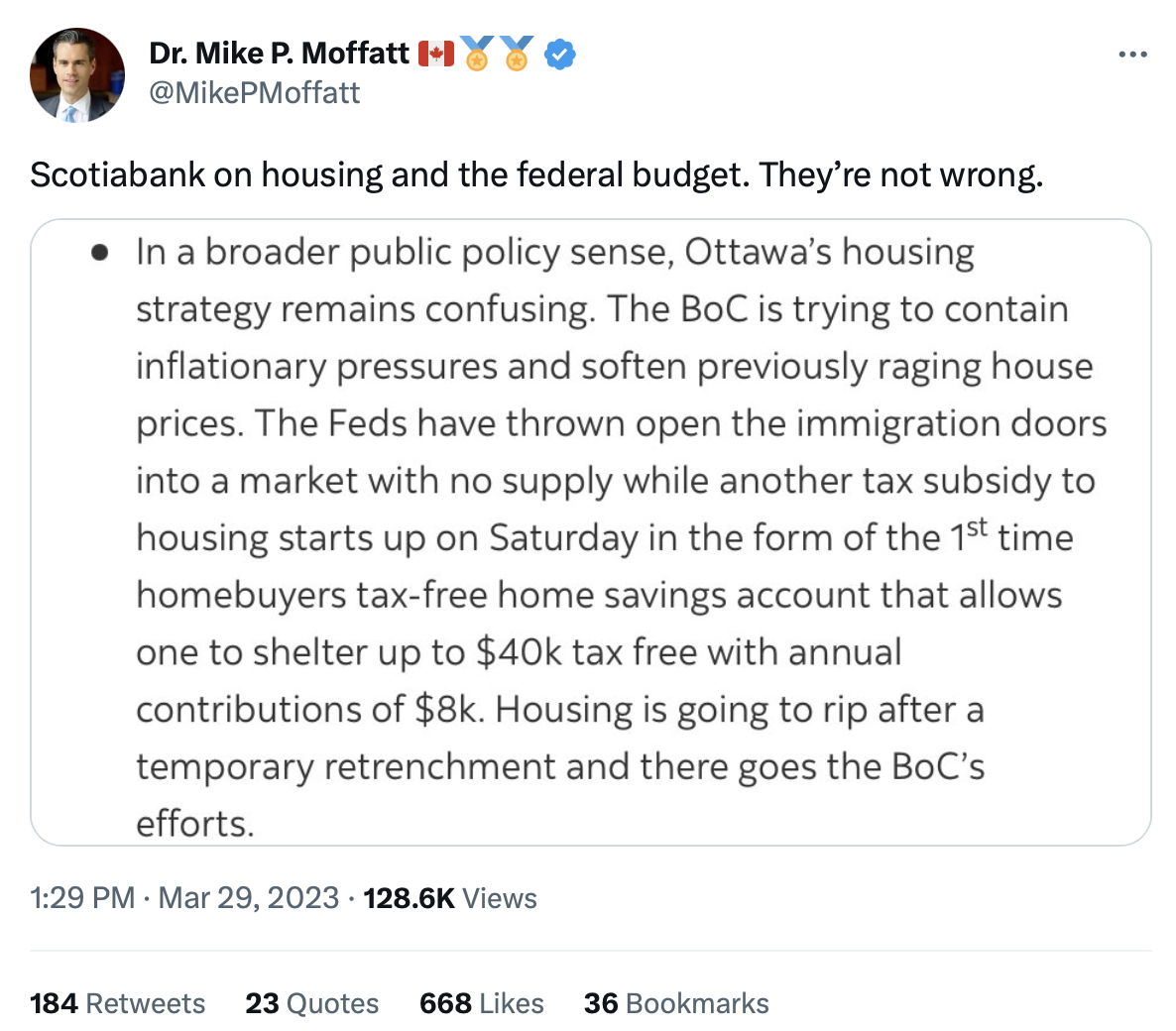
Moffat on disconnect between immigration policy and housing:

Captures the contradiction and policies working at cross-purposes:

Source: https://twitter.com/MikePMoffatt/status/1641130382425833632?s=20

Don Wright: Will Trudeau make it impossible for Eby to succeed?

Another “pointing out” the contradictions between immigration policy, levels set by the federal government, and housing, healthcare, infrastructure etc, largely under provincial jurisdictions:

It is three-and-a-half months since David Eby took the reins of power in B.C. There is no denying the energy and ambition he has brought to the role. Announcement after announcement has rolled out of the Premier’s Office since December 8 across a broad spectrum of initiatives in health care, housing, energy, infrastructure, increases in affordability tax credits and family benefits, and many, many more.

This column isn’t going to analyze the pluses and minuses of this ambition. Instead, I will argue that Premier Eby’s success on the big questions that will ultimately determine his political success may well be largely out of his control.

The most recent polling in B.C. shows that the most important issues are housing affordability, inflation/rising interest rates, and health care. Inflation and rising interest rates are overwhelmingly determined by federal monetary and fiscal policy, so largely outside the control of Premier Eby.  What about the other two big issues – health care and housing affordability?  While these two areas look to be within the domain of the provincial government, B.C.’s success in addressing the public’s concerns here will be largely hostage to the federal government’s immigration policy.  Let me explain.

Since it came to office, the current federal government has increased the level of immigration into Canada significantly.  Most of the attention has been focused on the increase in new permanent residents.  Last year, 438,000 people were granted permanent resident status, a 60% increase over 2015.  The federal government plans to raise this to 500,000 by 2025.

What receives less attention is another category of people coming to Canada – “non-permanent residents.”  This category includes Temporary Foreign Workers, International Students, and the International Mobility Program, which provides multi-year permits to live and work in Canada.  This category has been growing as well.  In fact, this category has been growing at a faster rate than permanent residents.  Last year there was a net increase of 608,000 in non-permanent residents. 

So, in total, the federal immigration policy resulted in an additional 1.045 million people coming to Canada – far and away the largest number of newcomers to Canada in one year ever.  Last year 160,000 of the 1.045 million came to B.C.

The rationale for these unprecedented numbers is that Canada has a “worker shortage.”  This rationale is almost entirely fallacious, but that is a subject for another column.  Let’s focus here on what this means to Premier Eby.

What is the basic problem in health care?  An inability to meet the public’s demands for medical services.  One million British Columbians don’t have a family doctor.  Waiting lists to get to see specialists and to get necessary surgery continue to get longer.  No doubt part of the problem is a result of the Covid pandemic.  But that rationalization is buying less and less forbearance by the public as we get further and further away from those dire days in 2020 and 2021.

The federal government’s prescription for this?  A rapid increase in the number of people who will need services from our health care system!

A story is spun is that the government will use the higher immigration numbers to bring in more health care professionals.  But this would only work if the proportion of qualified doctors, nurses and allied health workers in the more than one million new Canadians is significantly larger than the existing proportion of those professionals in the current Canadian population, and that they could get licenced immediately to practice in Canada.  Neither of these conditions will be met. 

The net result of this?  Premier Eby is going to have even more difficulty in delivering improved health care accessibility to British Columbians.

And then there is housing.  Almost all of the narrative around the shortage of affordable housing focuses on the supply side.  If only we could force municipalities to make permitting easier and faster, and to zone more density, our housing affordability would be solved.  The fact is, we build a lot of homes in B.C.  In Greater Vancouver – ground zero in our housing affordability problem – 365,000 homes were built in the 20 years between 2001 and 2021.  And there has been ample densification, as a walk through any of the redeveloped neighbourhoods in Vancouver shows. 

But supply is only half of the equation. Demand matters too.  And as quickly as we have built new homes, the population in our major urban centres rises as well. 

The Federal Government’s prescription for this?  Ramp up immigration numbers!

Again, a story is spun that this will actually increase housing supply because we are going to bring in more trades workers to build the houses we need.  Suffice it to say there are some pretty heroic assumptions here.  It is not going to work.

Of the 160,000 new British Columbians last year, more than 95% settled in the Lower Mainland, Southern Vancouver Island, and the Okanagan – where affordable housing was already acutely unavailable.

The net result?  Premier Eby is going to have even more difficulty in delivering more affordable housing.

This is all good for one group of British Columbians – those that are fortunate enough to already own a home.  So, thank you, Mr. Trudeau for making me wealthier and my fellow boomers wealthier. 

But if I were Premier Eby, I don’t think I would be quite as grateful.

Don Wright was the former deputy minister to the B.C. Premier, Cabinet Secretary and former head of the B.C. Public Service until late 2020. He now is senior counsel at Global Public Affairs.

Source: Don Wright: Will Trudeau make it impossible for Eby to succeed?