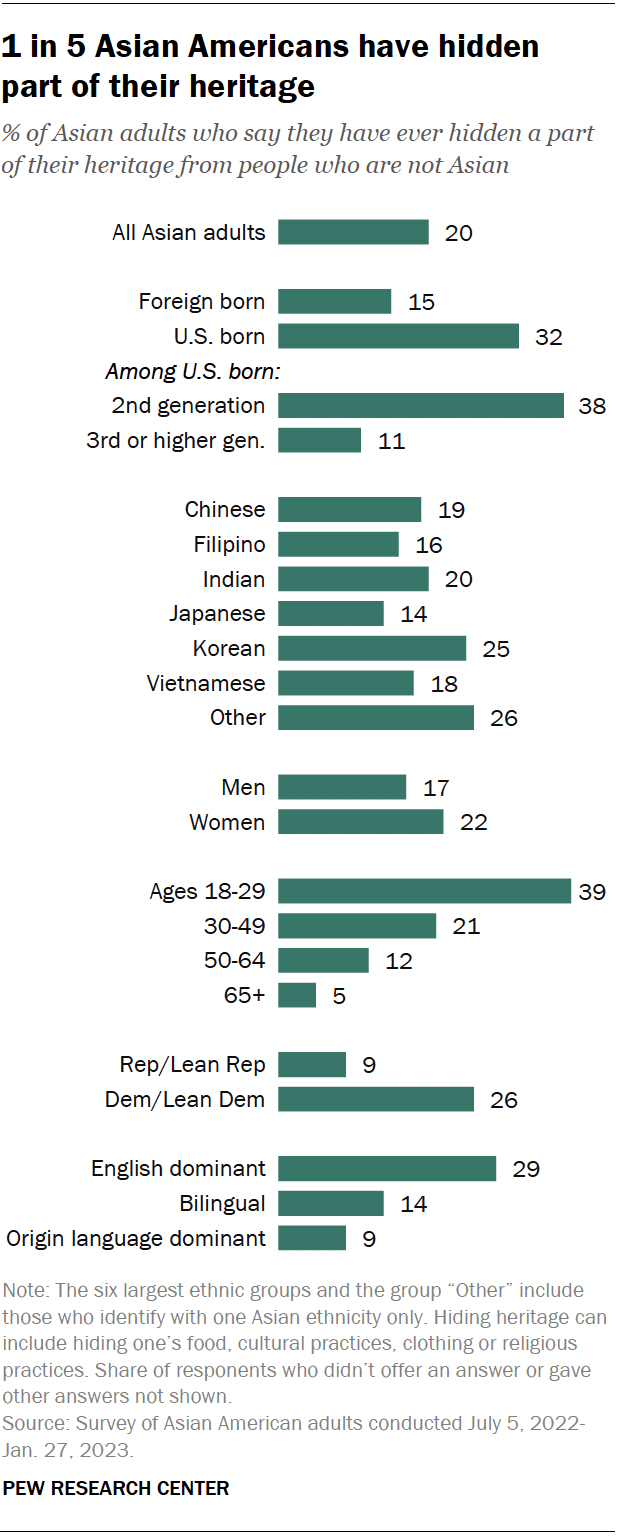
Noteworthy. Also of interest is that it sharply declines in the third or higher generations, along with being highest in the second generation, where many of the integration and identity struggles are:
One-in-five Asian American adults say they have hidden a part of their heritage – cultural customs, food, clothing or religious practices – from non-Asians at some point in their lives. Fear of ridicule and a desire to fit in are common reasons they give for doing this, according to a Pew Research Center survey of Asian adults in the United States conducted from July 2022 to January 2023.
How we did this
Birthplace and immigrant roots play a role in who is most likely to hide their heritage: 32% of U.S.-born Asian adults have done this, compared with 15% of immigrants. Among those born in the U.S., second-generation Asian adults (in other words, those with at least one immigrant parent) are more likely than third- or higher-generation Asian Americans (those with U.S.-born parents) to have hidden their culture from non-Asians (38% vs. 11%).
Second-generation Asian Americans make up 34% of the U.S. Asian population, at approximately 7.9 million people, according to a Center analysis of the 2022 Current Population Survey. The majority of this group (66%) is under age 30. And according to our survey, they also primarily speak English.
Aside from generational differences, here are other survey findings about who is most likely to have hidden their heritage from non-Asians:
Korean Americans are more likely than some other Asian origin groups to say they have hidden part of their heritage. One-in-four Korean adults (25%) say they have done this, compared with smaller shares of Chinese (19%), Vietnamese (18%), Filipino (16%) and Japanese (14%) adults.
Asian Americans ages 18 to 29 are about twice as likely as older Asian adults to have hidden their culture. About 39% of Asian adults under 30 have hidden their culture, food, religion or clothing from non-Asians. About one-in-five Asians ages 30 to 49 (21%) have done this, as have 12% of Asians 50 to 64 and 5% of those 65 and older.
Asian adults who are Democrats or lean Democratic are much more likely than those who identify with or lean toward the Republican Party to have hidden their identity. Among Asian adults, 29% of Democrats have hidden their culture from others, compared with 9% of Republicans.
Asian Americans who primarily speak English are more likely than those who primarily speak the language of their Asian origin country to have hidden part of their heritage. Some 29% of English-dominant Asian adults have hidden their heritage, versus 14% of those who are bilingual and 9% who primarily speak their Asian origin language.
Why some Asian Americans hide their heritage
Asian Americans who said they have hidden part of their heritage also shared why they did so. Some of the most common reasons were a feeling of embarrassment or a lack of understanding from others.
However, different immigrant generations also cited various other reasons for hiding their culture:
Many recent Asian immigrants said they have tried to fit into the U.S. and fear that others may judge them negatively for sharing their heritage.
U.S.-born Asian Americans with immigrant parents often said they hid their heritage when they were growing up to fit into a predominantly White society. Some in this generation mentioned wanting to avoid reinforcing stereotypes about Asians.
Some multiracial Asian Americans and those with more distant immigrant roots (third generation or higher) said they had at times hidden their heritage to pass as White.
What U.S.-born Asian Americans say about growing up in the U.S.
In 2021, the Center conducted 17 focus groups in which Asian Americans born in the U.S. answered questions about their experiences growing up. Some second-generation Asian Americans shared distinct examples of hiding their heritage and having to balance their family’s cultural practices with the culture of broader American society:
“[It] was kind of that stigma when you were little, a teen, or you were younger that [you] don’t want to speak Chinese … because people would think that you’re a FOB [fresh off the boat] or an immigrant.” – Early 30s man with Chinese immigrant parents
“I remember in elementary school, I don’t even know what my mom brought me, [but] it was some Taiwanese dish. I guess it just had a more pungent smell to it. The kids would just be like, ‘Oh, what is that smell? You guys smell that?’ I would just cover my lid and be like, ‘Okay, I’m not going to eat my lunch.’” – Early 20s woman with Taiwanese immigrant parents
“[I] used to roll as Asian/Hispanic because I was too scared of my identity to say I was Pakistani. I remember 2011 or 2012, when [U.S. special operations forces] killed [al-Qaida leader Osama] bin Laden in Pakistan, after that happened, I was like, ‘Yeah, I’m definitely not saying I’m Pakistani,’ because people were coming up to me and they’re like, ‘Oh my God, they killed your uncle. They found him in your homeland.’” – Early 20s man with Pakistani immigrant parents
Alongside these struggles, many second-generation Asian Americans talked about being proud of their cultural background and wanting to share it with non-Asians:
“[W]hen I go to Cambodia and speak the language, it’s like connecting with an old friend … or meeting somebody from my past because so many of those ideas of what love is, of what it is to be part of a community, and even to live by example comes from having that language still alive within me.” –Early 30s man with Cambodian immigrant parents
“[T]here are going to be ups and downs. Definitely one of the downs is being labeled by other people for our differences. But one of our ups is that we have culture and language that we can always rely on; we have some diversity in customs and cultures that we could go back to. And if people are willing to experience these new differences, we can definitely pass it on and spread awareness of different cultures.” –Early 20s man with Korean immigrant parents
Every year for the last four years, Maha Al-Zu’bi, a former Calgary professor, her husband Tahseen Kharaisat, a former local restaurant owner, and their five-year-old son Furat have dressed in red and white to celebrate Canada Day from the apartment they’re renting in the northwest suburbs of Amman, Jordan.
Maha says, while it’s always a celebratory day, it’s a hard one — because sometimes even the thought of looking at pictures from home brings her to tears.
“We strongly believe we’ll be back in Canada someday. But we don’t know when,” Maha told CBC News. “We love Canada, but sometimes when you love someone you close your eyes to their mistakes because you love them.”
The “mistake” Maha refers to is a federal policy with roots stretching back through the last decade. Families, their lawyers and advocates say it effectively blocks Canadians from adopting children from many Muslim-majority countries. The sticking point is a difference in terminology between how those countries, and Canada, view adoption.
CBC News spoke with two families who say their lives are on hold while they’re left waiting for the government to recognize their adoptions as legal.
‘The way I was being treated never felt like I was Canadian’
Al-Zu’bi and Kharaisat are Canadian citizens. When they moved to Calgary in 2011, Al-Zu’bi quickly got a job at the University of Calgary, where she completed a PhD in environmental design, while Kharaisat opened a shawarma restaurant.
But their family didn’t feel complete — the couple had always hoped to have a child.
After years of exhausting and expensive fertility treatments, and with Al-Zu’bi in her early 40s and Kharaisat about to enter his 50s, time felt like it was running out.
The waitlist to adopt a child in Canada was at least five years, so the couple turned to their country of origin, Jordan, to find a child in need of a home. That’s where they met Furat. The three-month-old boy was born with a cleft hand — a congenital condition where the centre of the hand is missing fingers. He was abandoned by his birth mother due to his disability.
“The first moment the lady gave him to me, I was staring into his eyes and he gave a big smile — it was a great sign that he’s as happy as we are,” Al-Zu’bi said.
They decided to welcome Furat into their family and completed the Jordanian adoption process, under a law called kafala. It never occurred to them to consult a lawyer to investigate whether Canada would treat some international adoptions as different than others — and there was nothing clearly visible on theCanadian government’s website that would indicate that adopting from an Islamic country would be prohibited.
One week after Furat was adopted, the family applied to the Canadian embassy for his visitor visa. It was promptly rejected.
“It was a surprise. And, to be honest, it was very disappointing,” Maha says. “I file taxes every year. We’ve always been good citizens. I love Canada … but [once I started being interviewed] the way I was being treated never felt like I was Canadian. It wasn’t welcoming.”
The family’s lawyer wrote to Alberta Adoption Services to request a review of the department’s policy. Alberta’s justice department instead responded, stating the federal government would need to amend its immigration regulations for the adoption to proceed.
The U.S. issued Furat a visitor visa, despite Canada’s reluctance. The CBC has blurred the photo to hide any personal information. Supplied by Maha Al-Zu’bi (Supplied by Maha Al-Zu’bi)
While adoption is provincially regulated in Canada, few provinces allow for exemptions to the policy, and advocates say the federal restriction means it’s difficult, if not impossible, for families to adopt children under a certain type of Islamic legislation.
That’s because in many Islamic countries, like Jordan, guardianship is established under kafala law, by which adoptive parents become the sponsors or guardians of a child, but not their official adoptive parents. It’s based on an interpretation of the Qur’an that encourages fostering children in need, without severing the possibility of ties to the child’s biological family.
The official reason Furat is barred from entering Canada is that Canada, as a signatory of the Hague Convention on intercountry adoption, does not recognize parent-child guardianships established in countries under Islamic law. Yet the United States, Britain and Australia, all signatories to the same convention, allow adoptions from Islamic countries.
Countries affected by the legislation include Jordan, Somalia, Pakistan, and Morocco. It’s a policy the current federal government promised to review five years ago — but questions from CBC News to the government about the status of that review went unanswered.
Immigration, Refugees and Citizenship Canada maintains these countries’ policies don’t meet Canada’s legal definition of adoption. However, critics say Canada’s policy is based on a misinterpretation of Islamic adoption law that unfairly discriminates against Muslim families.
The IRCC says that while the government is “sensitive to the emotional stress that can be caused when there are issues with cases involving children” it must take precautions to ensure international adoptions comply with laws in Canada, the Hague Convention, and the child’s country of origin.
“Once the adoption process has been completed in accordance with the laws of both countries, then the immigration or citizenship process to bring the child to Canada can proceed,” the IRCC said in an emailed statement.
The family has submitted all requested legal documents, including a letter of support and verification of legal guardianship from Jordan’s foreign affairs ministry and the minister of social development. The IRCC says, as Furat’s case is before the courts, it’s unable to comment further.
Policy’s origins date back to counter-terrorism memo
In British Columbia, unlike Alberta,provincial legislation allows an adoption agency to sign off on non-Hague-recognized adoptions in advance, before a family adopts from overseas, which has allowed some adoptions to be completed in countries like Morocco.
Delia Ramsbotham, managing director of B.C.’s Sunrise Family Services Society, says her agency has received calls from families across the country asking how to adopt from nations that don’t have an established adoption process with Canada — and that sometimes she has to break the news the adoption might not be possible, due to the country they’re trying to adopt from or where they live.
She says that one of the reasons Hague adoption rules are so restrictive is because they’re meant to ensure children are legally available for adoption, and that they’re able to legally immigrate into their adoptive parents’ country.
“It’s an attempt to try to put safeguards in place for everyone involved,” she said. “The powers that be don’t want people who live in Canada flying overseas and doing an adoption and bringing those kids back if we don’t know if those kids were trafficked, if those kids were actually in need of a family or if their parents were paid off … it’s not just protecting the children, it’s protecting the birth parents, and adoptive parents.”
She suggests that anyone preparing to adopt first contact their province or territory’s adoption agency, to get guidance on navigating the complex patchwork of laws between Canada and whichever country they’re interested in adopting from.
When asked by CBC News why Alberta doesn’t recognize guardianship adoptions, like B.C., a spokesperson for Alberta’s minister of children and family services said its legislation doesn’t “recognize guardianship orders as equivalent to adoption orders.”
They added that it’s outside the province’s legislated authority to be involved in international adoptions that only grant guardianship orders.
While Canada ratified the Hague Convention in 1995, adoptions from Islamic countries still appear to have been accepted across Canada until about 2013. That year, Canada abruptly issued a notice that it had banned all adoptions from Pakistan, stating “Pakistani law allows for guardianship of children but does not recognizeour [Canada’s] concept of adoption.”
The CBC’s Fifth Estate releasedan investigation into the policy in 2018, where it found that the restriction had quietly been extended to virtually all Islamic countries, and that emails from federal officials to provinces and territories were attempting to drum up support for the change.
It found that just days before the Pakistan adoption ban, a heavily redacted memo addressed to former foreign affairs minister John Baird, titled “Canadian programming to counter the terrorist threat from Pakistan,” raised questions of whether the decision was motivated by a national security agenda.
CBC News has filed requests under the Access to Information Act with the hope of clarifying the origins of the policy and determining whether the current federal government has endeavoured to change the policy, but has yet to receive the results of those inquiries.
The office of then-federal immigration minister Ahmed Hussen said in 2018 that it would undertake a review of the policy and determine a path forward to recognize Muslim adoptions. But the results of that review, if complete, do not appear to have been made public.
CBC News asked Immigration Minister Sean Fraser’s office for comment on the status of that review and was told that the office does not have an update to share. Any further comment was referred to the IRCC.
The federal government’s website states it can providehumanitarian exemptions to the policy. And legal decisions, like one by an Edmonton Court of Queen’s Bench Justice in 2015, have declared that kafala law does create “apermanent parent-child relationship.”
And yet, five years later, the government policy remains the same, with no clarity. And more families are left in legal limbo.
‘I was so hurt’
Farhan Abdi Omer, a Canadian citizen from Somalia who works as a security officer at the Calgary Courts Centre, is another parent confounded and, in his words, “heartbroken” by the government’s denial of his application to bring his two sons to Canada.
For three-and-a-half years, Omer, like the Al-Zu’bi family, has applied, been denied, and is now in the process of appealing Canada’s immigration system.
Fifteen years ago, Omer was working as a police officer in Somalia. One evening, while inspecting an area of Mogadishu that had seen intense violence and targeting of Somali Christians, he happened across two boys, Ayanle and Khader, on an abandoned street.
They were approximately three and five years old. Omer and his late wife took the boys in, and searched for their birth parents for over a year before deciding to formally adopt them via a secular, United Nations-recognized court in Somalia in 2009.
Later, the family fled Somalia, and became refugees in neighbouring Djibouti. Omer and his wife decided he should immigrate to Canada first, to save money and prepare for the entire family’s arrival down the line.
While in Djibouti, Omer’s wife was diagnosed with cancer, delaying their immigration process as his earnings in Canada went toward her chemotherapy treatments. She passed away in 2017, leaving the boys in the care of Omer’s mother before he began the process to bring them to Canada.
By this point, Omer’s two sons had become Christians, which he says makes them more vulnerable to discrimination in Djibouti.
In 2019, the same year Maha Al-Zu’bi and Tahseen Kharaisat applied for Furat’s temporary visa, Omer applied to sponsor his boys to come to Canada. The application was referred to the Canadian High Commission to Kenya in Nairobi. The visa office twice expressed concern that the Somali adoptions were not legally valid because Somalia is predominantly Islamic.
“I am concerned that there is no official law or legal structure that allows full adoption in Somalia,” reads one of the letters from the high commission, dated May 17, 2021, which Omer provided to CBC News.
“While issues and obligations related to guardianship, custody and care of children left without biological parents may be addressed in Islamic Sharia law as understood in Somalia, Islamic Sharia law and other bodies of law in Somalia do not allow for full adoption of a child, as generally understood in Canada.”
The letter also says the immigration program manager was concerned the arrangement may not be in the best interests of the child because there is “no competent recognized central government adoption authority or child welfare agency in Somalia” with the capacity to approve adoptions, verify the origins of the child or verify adoption documents.
In response, Omer explained, with supporting documentation, that the Somali adoption order was issued by a secular, UN-recognized court.
Further, Omer obtained an order from an Alberta Court of Queen’s Bench (now King’s Bench) justice that establishes that Omer’s Somali adoption order has the legal effect of an adoption order under Alberta law.
Despite these responses, Omer says the visa office refused the applications on the basis that adoptions are not available in Somalia as it is a majority Islamic jurisdiction.
“I was so hurt … Because I’m a Muslim?” Omer said. “I’m a citizen, a Canadian. I respect everyone, all religions. I am integrated. I mean, I can’t hear that from Canada. If I heard that from Somalia, I would say, ‘OK,’ but from Canada? I can’t hear that. It’s not acceptable.”
Last summer, Omer’s application was officially denied, with the family being told by the immigration program manager that he was not satisfied that a legal adoption had taken place.
Ramsbotham, the B.C. agency adoption director, says even if Omer had moved to B.C. and not Alberta, B.C. law likely still wouldn’t allow for him to bring his children to Canada — because it only allows for adoptions approved in advance, and Omer had taken guardianship of his children long before he immigrated.
She said she’d like to see more targeted humanitarian exemptions to the law.
“I do wish that the government would create a provision for valid placements of kids in different circumstances,” Ramsbotham said. “The human experience is too complicated to fit nicely into all the laws that are drawn out.”
A legal fight
Omer is currently in the process of appealing the decision with the support of pro bono legal counsel. In the meantime, he has been working seven shifts a week at the courthouse, sending money to the boys, who are now 18 and 20, and his mother.
Omer’s immigration agent, Tewolde Yohannes, says he has been approached by about half a dozen other Somali families in Calgary struggling to bring their adopted children into Canada, but that after his experience with Omer’s case, he will no longer take on their cases.
“It just drains you,” he says, “knowing the outcome will most likely be negative.”
Omer’s current pro bono counsel is Nick Ettinger. He says the immigration appeal process “can be virtually unnavigable without legal counsel, which may be financially out of reach for many newcomers to Canada.”
In their appeal, Omer’s counsel raised concerns that a ban on adoptions from Islamic countries is discriminatory. An appeal earlier this year argued that the denying visa officer’s blanket statement that Islamic law doesn’t allow for full adoption “lacks transparency … and constitutes an unfounded generalization.”
Omer says his sons face risks to their safety back in East Africa, due to their identity, and he is anxious to bring them to Canada as soon as possible. In the Alberta court’s endorsement of Omer’s adoption order, the presiding judge noted the particular vulnerability of the boys and the urgency with which their application should be processed.
“They need somebody to guide them to success in their life. They need somebody to help them. I need them because I need, you know, to be happy with them — because I was happy,” Omer said. “They’re really smart kids and I want them to have a better life.”
Impossible choices
Al-Zu’bi and Kharaisat are also fighting the government’s decision in Federal Court.
After four years of waiting to return to Canada, they’ve incurred enormous costs — Tahseen was forced to sell his restaurant, the couple depleted their savings, and they sold off all their furniture to pay for their legal expenses.
In one letter from the immigration office in Jordan, an immigration officer told the family that since the Canadian couple chose to adopt their child in Jordan, they might as well just stay there.
“I have considered the emotional and financial hardship to the guardians who have chosen to leave Canada … I do not find that the hardship of the situation they have chosen to pursue is undue,” the officer wrote.
Maha Al-Zu’bi says that since adopting Furat, she hasn’t spent a day away from his side. They could stay in Jordan, but it would mean selling their home in Canada, declaring non-residency, losing their careers, and starting over. Back in Canada, more than 100 friends have written letters of support on their behalf to the government.
Michael Greene, the couple’s lawyer, calls the denial “unfair, [and] grossly unjust.”
Greene says the decision to interpret the Hague Convention to exclude kafala adoption is an entirely political one — no court was involved in the change. He points to a number of changes to immigration legislation either made or considered at the time of the decision, during former federal immigration minister Jason Kenney’s tenure, such as the examination of a plan to cut off refugees withhealth issues and the passage of a law that allows the immigration minister to decide who can and can’t enter the country on the basis ofnational security concerns.
“It’s a political decision. It wasn’t like the courts came down and said, ‘You can’t recognize kafala adoptions anymore.’ I’m suspicious of how the law came about,” Greene says.
However, Kenney, who is no longer in politics, says he had not heard of Canada’s policy on kafala law until CBC News contacted him in August to ask about its origins, and says it never came up during his time as immigration minister.
He added that he does feel the IRCC needs to be rigorous when it comes to international adoptions, whether to prevent child trafficking through “failed states and deeply corrupt countries” or to avoid creating a “back door for de facto immigration for young people who are not bona fide adoptees.”
‘We encourage Furat to always be happy’
Furat, who is now four, is a bubbly and bright little kid.
In a recent Zoom interview with CBC News, he seemed unaware of his family’s plight — but eager to talk about his excitement to see Canada, and to show off his taekwondo moves. But the burden of the situation was apparent on Al-Zu’bi’s face, as she wiped away tears while speaking.
“It’s not easy. We encourage Furat to always be happy. We are trying our best to give him whatever we can for a normal child. We will keep pushing,” Al-Zu’bi said.
Meanwhile, Omer is still preparing to bring his sons to Canada. He talks to the boys and their grandmother daily, before work. He tells them the process has been delayed, but does not share the reason their applications have been rejected.
“They think Canada is very open, and there is freedom of religion here. I don’t want them to lose hope,” he says.
When asked to clarify its policy on adoptions under kafala law, the IRCC sent the following statement:
The Government of Canada’s first priority is to protect the safety and well-being of the child/children involved in international adoptions.
Immigration, Refugees and Citizenship Canada (IRCC) is sensitive to the emotional stress that can be caused when there are issues with cases involving children. Nonetheless, IRCC must take all necessary precautions to ensure that all international adoption cases involving children comply with Canadian laws, international laws, as well as the statutes and regulations of the child’s country of origin.
The Hague Convention on Protection of Children and Co-operation in Respect of Intercountry Adoption (“Hague Convention”), to which Canada is a party, covers only international adoptions that create a permanent legal parent-child relationship between the adoptive parents and the adopted child. Some countries have other systems in place, such as guardianship or Kafala, which does not sever the legal relationship between the biological parents and the child and does not create a new permanent legal parent-child relationship.
These types of systems do not meet Canada’s legal definition of adoption (see s. 3(2) of the Immigration and Refugee Protection Regulations). The Hague Convention, as well as federal, provincial and territorial legislation in Canada, state that the laws of both the country of origin and the receiving country must be complied with for all international adoptions. A key consideration under the Hague Convention is that the child’s availability for adoption must be determined by the child’s state of origin.
For all international adoptions, two separate processes must be completed:
1. The adoption process, and
2. The immigration or citizenship process.
The adoption process involves the adoption authorities in the province or territory of residence of the prospective adoptive parents and the State from which the child is being adopted. Once the adoption process has been completed in accordance with the laws of both countries, then the immigration or citizenship process to bring the child to Canada can proceed.
In Canada, adoption is the responsibility of the provinces and territories, and they all have their own legislation implementing the Hague Convention. IRCC’s role as the competent authority for immigration and citizenship is to make a determination on the right of the child to enter and reside permanently in Canada.
Odd that former minister of immigration is signalling possible changes rather than the current immigration minister. Whether deliberate strategy for the minister who was responsible for increases to take some of the possible heat over high immigration levels, or simply that he now understands (better late than never) the linkages between immigration levels and housing pressures.
Will only know whether this is just a series of trial balloons or a significant pivot with the release of the immigration levels plan later this fall:
Canada’s housing minister says the federal government isn’t ruling out changes to its ambitious immigration targets, but maintains the country should also focus on what it can do to increase housing supply when it comes to addressing current housing challenges.
“When we look to the future of immigration levels planning, we want to maintain ambition and immigration, but we want to better align our immigration policies with the absorptive capacity of communities that includes housing, that includes health care, that includes infrastructure,” Sean Fraser said in an interview on CTV’s Question Period with Vassy Kapelos on Sunday.
Fraser said he believes the federal government has “some work to do” with its temporary immigration programs, which currently operate on the basis of demand in an “uncapped way,” but doesn’t “necessarily” need to reduce the number of newcomers who become permanent residents each year. It’s common for almost half of those individuals to already be in Canada as temporary residents, he noted.
Before making any changes, however, Fraser said the federal government would have to consult with other levels of government — since deciding which institutions take in international students is within the purview of provincial governments — as well as institutions that have “a duty to play part of a role in housing the people who come here.”
He also stressed that conversations around addressing the country’s housing crisis should not solely revolve around immigration.
“It’s important that when we’re looking at the answer to our housing challenges, we also focus on what we can do to increase the supply,” the minister said.
“I think it’s essential that we remember that immigration remains one of Canada’s strongest competitive advantages in the global economy.”
Fraser introduced Canada’s ambitious immigration targets in November 2022 when he was the federal immigration minister, with a goal of bringing in 465,000 permanent residents in 2023, 485,000 in 2024 and 500,000 in 2025.
At the time, he said the move was necessary to ensure Canada’s economic prosperity, by helping businesses find workers to fill in labour gaps and to attract the skills required in key sectors including health care, skilled trades, manufacturing and technology.
Academics, commercial banks, opposition politicians and policy thinkers, however, have been warning the federal government the country’s high-growth immigration strategy is exacerbating Canada’s housing crisis.
But when speaking with Kapelos on Sunday, he said his preference is to continue to welcome “significant numbers” of international students “because the program is good for Canada, both in the short term and the long term when you create a pipeline of potential new citizens.”
“If we were going to shift the way that we operate, to set a target or to align the numbers with the housing capacity, it’s a monumental change in the way that Canada does immigration,” Fraser said.
“That doesn’t mean we shouldn’t do it. But it does mean if we’re seeking to make a permanent change to the way that Canada’s immigration laws operate, we have to do it right.”
Welcoming people to Canada who are making a productive contribution to the country’s economy is “essential,” Fraser said, adding he doesn’t “want to lose that.”
Surprising that the amounts have not changed since 2015 and that these are not based or adjusted based local costs:
The Canadian government is likely severely underestimating the cost of living for international students when weighing if they can support themselves financially, a new survey suggests.
According to a recent survey by the Daily Bread food bank, which was released on Wednesday, Immigration, Refugees and Citizenship Canada’s estimated living expense used during the application process is nearly half of what a student in Toronto typically spends.
When applying for a study permit, a prospective international student must show “proof of financial support.” This means they must be able to show they can support themselves in Canada.
Applicants currently must prove they have $10,000 to support themselves on top of their tuition fees, which amounts to $833 per month.
If an applicant intends to bring a family member with them, they must also show an additional $4,000, or $333 per month.
For every additional family member, they must show $3,000, or $255 per month.
Daily Bread surveyed 180 international students who frequent four major Toronto food banks and found those numbers don’t seem to reflect the realities students face.
“In contrast, when we asked survey respondents how much they were spending per month on living expenses, excluding tuition, they reported an average of $1,517, which is close to double what the Government of Canada advertised as the cost of living,” the survey report said.
It added, “When asked how their experience in Canada compared to what they were expecting, respondents noted that Canada was much more expensive than they thought it would be, particularly with respect to housing and food.”
The survey continued, noting: “This is not surprising, given that, in 2022, rents in Toronto increased by 29% for vacant units and food inflation was at 9.1% from June 2022 – June 2023.”
The report also suggested the government has not updated its estimated cost of living figure for international students since 2015.
An IRCC spokesperson told Global News, “The financial requirements for a study permit application are not based on one static figure. A student’s proof of financial support must take into account their specific tuition fees, return transportation for themselves and any family members who come with them to Canada, and living expenses for themselves and any family members who come with them to Canada.”
The spokesperson did not clarify when the proof of funds requirement was last updated to $10,000 for international students.
Talia Bronstein, vice president of research and advocacy at Daily Bread, said, “We surveyed 180 food bank clients who are international students. And we found that there was a disconnect between what they had expected when they came to Canada and the reality of living in Canada.”
The report said while all students are at risk of food insecurity, the high cost of living and high tuition for international students makes them three times more likely than domestic students to be food insecure.
One survey respondent is quoted in the report as saying, “The cost of living and rent shot up too quick to be able to manage. I starve myself of healthy food and meat products because I cannot afford it after paying my monthly rent. I only survive on lentils and noodles. This is not what I expected. My health has deteriorated in the last two years greatly.”
Bronstein said, “We looked at external literature and found that there was clear evidence that international students are at a higher risk of being food insecure than domestic students. But we also know that all university students and post-secondary students are at higher risk of being food insecure than the general population.”
The average tuition fee for domestic undergraduate students in Ontario is $7,920, while for international students it is $40,525. While Ontario’s gulf is bigger than the national picture, the numbers are quite similar nationwide.
The average domestic undergraduate student in Canada paid $6,872 and the average international student paid $35,836.
Bronstein said while the survey respondents were from and around Toronto, the rising cost of living and high tuition costs across Canada indicates that this may be a nationwide problem.
The report also noted that students had a hard time finding a safe and affordable place to live.
“Landlords may be less willing to rent to international students because they do not have a Canadian credit score, or because there is discrimination against post-secondary students in general in the housing market,” the report said.
It added that many participants found it harder than anticipated to find a job. The majority of students, 61 per cent, earned between $15.50 (minimum wage) and $18.50 an hour. Around 17 per cent said they earned below minimum wage.
The report also makes recommendations to all three levels of government as well as to colleges and universities. It calls on Ottawa to review and update requirements for how much money students will need for monthly expenses and permanently increase the number of off-campus hours international students can work.
It called on universities and colleges to enhance support for on-campus housing and on-campus employment for international students. It even called on the City of Toronto to make public transit cheaper for students.
But Bronstein said the most important recommendation was for the province.
“The most important recommendation is for the government of Ontario to better fund colleges and universities,” she said.
“We have the lowest per capita domestic student funding from the government across the provinces, and I think that really speaks to the fact that universities are turning to international students to subsidize domestic students. And that’s not a fair way of running an institution.”
Bronstein said while food banks are fulfilling a key role in battling hunger, they cannot be a permanent solution.
“We need to look beyond food banks as a solution. We need to be looking at the public policy opportunities that there are to address it. The three areas we should focus on are income supports, affordable housing and decent work.”
Useful explainer and a large part of the reason why numbers have increased more for immigration reasons than for education. Another dubious legacy of the Ford government given their policy changes in 2018. Not illegal, but bad public policy. And shameful shifting of blame to the private colleges by public colleges who are equally complicit:
Back around 2012, Ontario colleges were coming around to the idea that there might be a lot of money in recruiting international students. The Harper government had come up with the idea that we could attach a permanent residency/citizenship pathway to any credential of two years length or more. And why not? There was a lot of evidence at the time that the return to foreign credentials among immigrants was low: why not pair Canadian credentials to Canadian degrees and diplomas?
The problem was that it was widely believed that international students would only gravitate towards the big cities (Cape Breton University’s contrary experience was still in the future). So, from the perspective of colleges outside the Greater Toronto Area (GTA), this was a bonanza in which they could not participate. Until they hit on the idea of public-private partnerships.
Here’s the way these Ontario PPPs work. A public college from outside the GTA contracts with a private institution located in the GTA. Under this contract, the public institution admits students (thus making it possible for them to get a visa) and takes their tuition money. It then turns around and sends these students to the GTA-located private college. The private college is contracted to teach these students according to the public college’s curriculum and receives a fee-per-student. Because this fee is less that what colleges charge in tuition, what is effectively happening is that colleges are receiving a couple of thousand dollars per student simply for admitting the student: the bulk of the money is used by the private college to do the actual teaching.
(To be clear: if you feel like attacking PPP colleges for their “poor teaching standards” – a common line of attack – keep in mind that they are teaching a public-college curriculum, and that their instruction is vouched for by a public college. See what I mean by blurring lines?)
Back in 2017 or so, the provincial government started getting worried about these arrangements. It asked David Trick, a former ADM at the (then) Ministry of Training, Colleges, and Universities, to write a report on these colleges. His recommendation was unequivocal: existing quality assurance structures had no way of checking up on the quality of the education being delivered in these institutions (they still don’t). The reputational risk stemming from potential failure was too high, Trick said. Shut ‘em down.
To be clear: Trick was not making any claims about the quality of instruction in these institutions. Presumably, some of them are good, some are so-so and some are not so good. What he was saying was that we have no way to identify and remediate the not-so-good ones, and that was going to cause a problem.
The Wynne government acted on Trick’s suggestion: in 2017, they gave the four colleges which at the time operated such PPP arrangements two years to shut them down. But then an election happened, and Doug Ford replaced Kathleen Wynne. The Ford government reversed course, hard: more PPPs for everyone! Whether this was due more to an ideological preference for private education over public, or because enriching college coffers without touching the public purse appealed to them is unclear but ultimately immaterial. They did it. And then it was open season: by 2022 nearly all the non-GTA colleges had one.
It’s not that the Ford government refused to regulate the sector so much as they were determined to make regulations so lax that anyone could pass them. Here is there 2019 Binding Ministerial Policy on Public-Private Partnerships (removed from the Ministry website, but still available on the Wayback machine). In theory, this limited international enrolment at a PPP to twice what it is at the “home campus”; however, there was a grandfather clause where northern institutions with 4,000 students at its PPP in Toronto but only a couple of dozen international students in Sudbury or Timmins or North Bay (for example) just had to make vague suggestions about “coming into compliance over the long term” in order to avoid problems with the government.
In 2022, as housing pressures in the 905 became more palpable, the Ford Government intervened to mess things up still further. It repealed its 2019 Ministerial Policy with a new one, which put a hard cap on each institution’s PPP enrolment…at 7,500. Doesn’t matter how big the home campus is. Call it the David Bowie/Cat People approach to public policy management (i.e. Putting Out the Fire With Gasoline). And since virtually all the anglophone non-GTA schools have schools, we’re talking about max enrolment in these PPPs of something on the order of 120,000 next year, or about twice what it was in 2021-22.
None of this is illegal. There is no “scam” here, unless you disagree with the consensus POV of both the Harper and Trudeau governments that Canadian postsecondary education is a legitimate pathway to permanent residency. Institutions are acting to monetize this route to citizenship, surely, but aren’t governments always asking them to behave more entrepreneurially? And while there is almost certainly some agent mis-selling going on, to which institutions both public and private have taken a see-no-evil/hear-no-evil approach, institutions have been actively abetted in this by a provincial government which has refused to take regulation seriously time and time again.
Oh, and of course, the Ontario government funds FTE college students at just 44% of the rate that the other nine provinces do. Never forget that bit.
One thing I will say about that is that Ontario colleges have been wicked-smart about their comms game for the last couple of years. An unfortunate Canadian trait is that a lot of people simply lose their minds when they hear the words “private” and “education” in the same sentence. There’s simply no nuance here, no possibility that anything they do is good – or conversely public institutions cannot do anything bad. And so, when they hear about “bad” privates in PPP arrangements, the baseline assumption is to assume that whatever bad stuff is going on is the fault of the private partner. So, not only have colleges managed to find a set of partners who can bring them large sums of money, these partners also act as handy scapegoats that shield the public sector from too much scrutiny about their role in this whole thing. Win-win!
Interesting the large number of Israels who have taken advantage of the Descendants Policy to become Portuguese citizens, mainly citizens of convenience as most are non-residents:
The Parliament is considering a change in the current legislation, which would enable foreigners who already live in the country to obtain Portuguese citizenship more easily.
According to Journal Jurid, all foreigners who have spent a certain time necessary to achieve naturalisation can be subject to this potential change. The Parliament is expected soon to analyse the current legislation and propose changes to the time required for a foreigner to stay in the country to acquire naturalisation, SchengenVisaInfo.com reports.
“Currently, a foreigner residing in the country has his time count reset when receiving formal authorisation to stay in Portugal,” the Journal Jurid points out.
The interest in Portuguese nationality has risen in the past few years, as the local media report that in 2022, around 37 per cent more people have filed their applications. According to the Foreigners and Borders Service (SEF), the total number of applications during this time reached 74,506.
Out of this total, the respective authorities issued 64,040 opinions, with only 911 of those being negative, while the majority received a positive answer. As per the origin countries, the majority of those who obtained Portuguese citizenship in 2022 came from Israel (20,975), followed by Brazil (18,591) and Cape Verde (3662).
However, for the acquisition of nationality in terms of marriage or de facto union, the majority of applications were filed by Brazilian nationals (9,435), followed by Venezuelans (1,536) and Cape Verdeans (900).
What is really interesting about Israelis in Portugal is that, more than often, they don’t reside in the country after obtaining their citizenship. Only 569 Israeli citizens are Portuguese residents despite 60,000 Israelis having Portuguese nationality as of 2022. As per Brazilians, 239,744 of them continue residing in Portugal after obtaining citizenship.
Some of the benefits that Israelis can enjoy after obtaining Portuguese citizenship include paying less taxes, having better living costs and, in general, spending a less stressful life compared to other countries. However, as pointed out, some disadvantages are the language barrier and lower income.
But one of the greatest benefits of Portuguese citizenship is travelling in the Schengen borderless zone, which Israeli passport holders are still subject to talks for the EU and US visa waiver programmes.
“This was a big deal for Israelis as carrying an Israeli passport is much more restrictive. This general conversation also touched on higher education. The academic prerequisites for state universities in Israel are high, and private schools are costly. In the EU, however, the terms of acceptance are more relaxed, and the cost is lower if you are an EU national. This general discussion motivated many families with European origins to apply for EU nationalities,” Lior, an Israeli national who now has Portuguese nationality, pointed out.
However, the number of Israelis applying for Portuguese citizenship might experience a decrease as 2022 was the last year when they could apply for nationality under the Descendants Policy – a programme that enables Israeli nationals with descendants in the country to acquire Portuguese nationality easier compared to other nationalities.
Agree. UK “offloaded” him to Canada despite him having born and raised in the UK and never having spent any time, or significant time, in Canada. Feel for the parents but not a reason to provide consular and other support:
Once again, pressure is being brought on the federal government to provide consular assistance to Canadians in Syrian prison camps.
Canadians are being held in camps run by Kurdish forces that reclaimed the area from the terrorist group Islamic State of Iraq and the Levant (ISIL) — a military organization that seeks to establish an Islamic caliphate in Iraq and Syria.
A recent Canadian Press story recounted the visit of a four-person “civil society” delegation, including a senator, to the camp to discuss the repatriation to Canada of some of those held there. The report omitted vital details about one of the men mentioned, Jack Letts.At 18, Letts left his home in the U.K. to join the terror group ISIS. Dubbed “Jihadi Jack” by the British media, Letts gets his Canadian citizenship through his father, John Letts. It’s unclear how much time — if any — his son has actually spent in this country. Jack was born and educated in the U.K. and that country has revoked his citizenship. As a signatory to the Convention on the Reduction of Statelessness, Canada can’t deprive a person of citizenship if it renders them stateless. So the U.K.’s pre-emptive action in revoking Letts’ citizenship has dumped the whole mess into our laps.
In 2019, then Public Safety Minister Ralph Goodale said, “Canada is disappointed that the United Kingdom has taken this unilateral action to off-load their responsibilities.” He told the CBC, “We have no obligation to facilitate his travel from his present circumstances, and we have no intention of facilitating that travel.”
This country should hold fast to that sentiment. It’s true Letts was young when he made the bad decision to join ISIS. His parents are exhausting every avenue in an attempt to return their son to them, as most parents would. Nevertheless, his presence in this country would be an insult to all those who honour the principles of freedom and democracy and those who have come here to escape terror.
Canadian citizenship is not a flag of convenience. It’s a badge of honour, hard won by those who fought and died for our rights and freedoms. Jack Letts does not in any way embody those values.
None of the commentary I have seen blames international students for the housing crisis but rather correctly notes that they, along with high levels of permanent and temporary residents, are significant contributors. After all, over 90 percent of Canada’s population increase is immigrant-driven.
The advocates/activists claims are self-serving, as is often the case. Equally, they fail to acknowledge time lags in increasing housing.
The only encouraging note is Minister Miller’s recognition of the “perverse incentives” by provincial governments and education institutions that have let us to this situation. But his interest in having discussions “with provinces about the systemic underfunding of higher education” is unlikely to deliver any meaningful results in the short-term:
Immigration Minister Marc Miller and student advocates across the country say they worry about immigrants and international students being singled out for blame because of the housing crisis.
“It’s one of my fears,” Miller said in a recent interview with CBC News. “I do worry about the stigmatization of particularly people of diversity that come to this country to make it better, and that includes international students.”
Miller told CBC Radio’s The House last week that Canada is on track to host around 900,000 international students this year. In 2011, that figure was just shy of 240,000.
Housing Minister Sean Fraser last month floated the idea of capping the number of international students Canada brings in.
Miller told CBC News Canadians’ concerns about the number of international students go beyond housing to questions about the public’s confidence in the “integrity” of the immigration system itself.
Advocates for students and immigrants say they fear that talk of an admission cap could lead to vulnerable communities being targeted unfairly.
“Even if that’s not how it was meant, we at the College Student Alliance realized straight away that that’s how people would translate it and it would give people the opportunity to stigmatize this already at-risk population,” said Azi Afousi, president of the College Student Alliance.
Afousi, whose organization represents 50,000 college students in Ontario, insists international students are not causing the housing crisis.
“It did not start with them. It is ongoing. It is about planning. It’s not just a single-issue concern,” she said.
She said post-secondary institutions in Canada would not be able to offer the programs they do to Canadian students if they couldn’t collect the high fees international students pay to study here.
Miller said international students pump $20 to $30 billion into universities and colleges every year through tuition and other fees, and their contributions are “big for the economy.”
Wasiimah Joomun, executive director of the Canadian Alliance of Student Associations, said “there’s no real data that shows that international students are causing this issue.”
“If we are able to get data that says, ‘This amount of international students are taking up this amount of housing, that’s why we need to decrease the number,’ we’ll be happy to look around and see,” she said. “But I don’t think there is much factual data.”
Syed Hussan, executive director of the Migrant Workers Alliance for Change, said there is “absolutely no connection between migration and housing.”
“We know that,” said Hussan, whose organization represents roughly 30,000 current and former migrant students, “because in 2020 Canada closed its borders. So there were no newcomers coming into the country and yet housing prices went up.
“When you create a simplistic supply and demand argument … to say, ‘More people are coming, there’s not enough housing, and that’s the problem,’ it overlooks the role of investors, profiteers, the fact that there are no limits on how much you raise rental prices in most parts of the country.”
Blaming newcomers is nothing new: Hussan
The MSA is a part of the Migrants Rights Network, which advocates for temporary foreign workers employed on farms, in fisheries and as caregivers and health care workers.
Hussan said blaming immigrants and migrants for low wages or shortages in health care or housing is nothing new.
“When wages are low, people blame foreign workers … This is the same story and international students are effectively migrant workers,” he said.
Hussan said most international students take on low-wage jobs in the service, construction or health-care sectors to help pay for their education.
Gauri Sreenivasan, co-executive director of the Canada Council for Refugees (CCR), said international students already face racism when trying to find housing.
“The CCR is deeply concerned that the current blame game will only expose these populations to more harm, and lets those with power in this situation, including industry and financial actors, off the hook,” she said.
Build more dorms, student housing: advocates
Damanpreet Singh, the international students’ commissioner for the Canadian Federation of Students, said that despite Fraser’s “very shameful” statement, he doesn’t think international students will be scared away.
“Canada is flexible and welcoming,” he said, adding that governments need to fund the construction of more purpose-built housing for students and provide rent vouchers in the meantime so students can afford rising rents.
Joomun said she has spoken with a number of universities that report they have space for more student residences but lack the money to build them.
Student advocates say providing universities and colleges with funding for housing construction would allow universities to pull Canadian and international students into campus settings, where housing is cheaper and simpler to build.
“When you build student housing … they do not have to have the same amenities that a luxury condo does,” Afousi said.
Miller told CBC News international students and immigrants are no more responsible for the housing crunch than they are for rising interest rates — but the rapidly rising number of international students is a problem.
He said the fact that international students pay tuition fees three to four times higher than those paid by domestic students creates “perverse incentives” to attract them to Canada.
Part of that issue can be addressed, he said, by having a discussion “with provinces about the systemic underfunding of higher education” that has led institutions to rely on higher fees from international students
Good commentary, highlighting the issues and failures. Understates the role of provincial governments in creating the problem by underfunding institutions and thus incentivizing recruitment of international students and the resulting diminishing of education objectives in favour of meeting lower-skilled service and related employment.
So while the federal government needs to take the issue seriously by considering caps and reimposing work time requirements, the provinces have a more important role in shutting down the various private colleges, sometimes under sub-contract to public institutions, that are more employment visa mills than education institutions:
Canada’s export education sector has experienced significant growth in recent years. The federal government has recently completed consultations towards the development of Canada’s third International Education Strategy, coinciding with broader consultations about the future of Canada’s immigration system. Significant changes to Canada’s International Student Program (ISP) are expected in the coming year.
Canada’s education export growth has been unmatched in recent years, but these accomplishments may also be its Achilles’ heel.
Some of its competitor countries have proceeded with more modest growth, while developing and enhancing their policy and regulatory frameworks to ensure sustainability. Canada’s current approach is highly susceptible to unwanted behaviours and future deflation if student expectations don’t match student experiences.
For a number of years, the international education sector has contributed more than CA$20 billion (US$14.6 billion) to the Canadian economy, supporting approximately 170,000 jobs. This roughly equates to the size and value of Canada’s aerospace industry.
However, while there are a plethora of federal regulations impacting the aerospace sector, only a handful impact an international student’s immigration process, and zero federal regulations govern international student recruitment.
Canada now appears ready to reconsider some of the sector-wide issues and its current highly unregulated approach. Whether the new policy initiatives will lead to a sustainable path forward, or allow the status quo to flourish, remains to be seen. However, this may be the federal government’s last chance to act before irreparable harm is perpetuated on Brand Canada.
Brand Canada: Advantages and challenges
Brand Canada has been recognised as the main value proposition by which to lay the foundation for Canada’s education export. Selling international education abroad has come with automatic advantage, based on positive perceptions of Canada, including the standards and values Canada represents.
This country brand advantage should not be considered unique to educational exports, but rather it is an advantage to many areas of Canada’s trade and investment. Mechanisms ensuring the quality of products and services are important.
In recent years, a number of occasions have been reported where Canada’s ISP has not been measuring up to the standards international students have been led to expect.
A lack of housing means that some international students haven’t been able to secure safe accommodation.
Furthermore, some education providers seem to have been poorly prepared to accommodate the sharp growth in student numbers. Provincial government authorities have not taken sufficient action despite concerns on record that some offerings are likely to be deficient in terms of facilities, academic delivery or student support.
The quality of education received has been called into question by recent government oversight audits. For instance, in 2021 in Ontario the auditor general expressed concerns about the processes used to validate whether private colleges are providing quality education. In this context, concerns related to Brand Canada deflation can no longer be considered blown out of proportion.
Band aid solution or brand reboot?
Amidst growing media reports highlighting foul play in Ontario’s international education sector, a registered lobby group, Colleges Ontario, assembled college presidents province-wide to lay out a ‘Standards of Practice’.
However, it is unclear to what extent this type of self-regulatory approach will lead to any significant improvements. For instance, the institution with the largest international student body refused to sign the statement of principles.
Some stakeholders who find the current status quo acceptable or want to see a relaxation of the rules that exist are those who are most likely to be exploiting the gaps in policy and oversight.
For instance, some overseas recruiters are purchasing institutions in Canada and consequently control the full cycle of recruitment, admissions and administration. This may enable alarming business practices, such as producing fake tuition receipts or transcripts for students who have never attended classes.
Some colleges continue to be listed by the Immigration, Refugees and Citizenship Canada (IRCC) despite the suspicions that many of their enrolled international students are not actively pursuing their studies. The data received under the Access to Information Act show potential non-compliance rates that are extremely high (89%-100 %).
Practices at public institutions also have concerning aspects if international students’ best interests are considered, such as brazen tuition fee increases, with the cost of tuition sometimes doubling from one intake to the next.
Some institutions also issue up to multiple times the volume of letters of acceptance than they have enrolment capacity for, then rescind them at the last minute or force large volumes of deferrals to intake periods up to two years later.
It is unclear whether, and to what extent, admission standards have been compromised, but the data received under the Freedom of Information Act demonstrate that some institutions issue letters of acceptance to 99% of all international applicants.
The promise of permanence
The draw of skilled, high-paying post-graduation employment opportunities is another example of a Brand Canada promise that has now worn thin.
Offshore-based education agencies run campaigns linking the prospects of international education in Canada to the realisation of wealth and success at a young age, justifying the cost of international tuition fees to new cohorts.
Of most grave concern is also Canada’s biggest draw: the prospects of students transitioning to permanent residency. This education-immigration pathway is often marketed openly and routinely abroad, with the standard marketing spiel holding that upon completion of an academic programme and a post-graduation work phase, students will have the opportunity to stay in Canada permanently – as if it was that simple.
For instance, 2022 data obtained under the Access to information Act from IRCC suggests that only about 10% of people transition annually to permanent residency through Canada’s post-graduation work permit programme. While other options exist, these are limited in volume and-or rife with the potential for exploitation.
Is the gig up?
There are some signs that the IRCC is set to take some meaningful action. There can be no doubt that one of the greatest irritants to the federal government, caused by lack of oversight and control, has been the strained resources and resulting immigration processing backlogs caused by a dramatic increase of non-bona fide study permit volumes.
The federal government is the party that has the most to lose. Once Brand Canada is damaged, the value proposition used for education exports becomes untenable. The way the advantages of a positive Brand Canada have filled up classrooms is the same way negative impressions can sink future investment, contracts and collaboration – for generations.
The damage to Brand Canada comes with a real long-term cost that reaches well beyond the international education sector. That is exactly what should be motivating significant federal action now, if protecting the interests of international students is not seen as an equally worthy cause to do so. In the education-export industry, Brand Canada has been without a babysitter for too long.
Earl Blaney is a regulated Canadian immigration consultant who has been an outspoken critic of Canada’s international study policy. Most of his research focuses on exposing concerns associated with inadequate consumer protection standards in Canada’s edu-export industry. Dr Pii-Tuulia Nikula is a principal academic at the Eastern Institute of Technology (Te Pukenga) in New Zealand. Most of Pii-Tuulia’s research focuses on international student recruitment and sustainability questions within the international education sector.
Will be interesting to see whether the increased discussion of the linkages between immigration and housing pressures (not just in right wing media) will have an impact on the Conservatives being public about any reservations they have regarding current levels of permanent and temporary migrants:
Have we reached an immigration tipping point in Canada? Figures released by Statistics Canada on Friday definitely point in that direction.
In releasing the latest employment figures, StatsCan said we are bringing in people faster than we are creating jobs.
“Employment rose by 40,000 (+0.2%) in August. This increase in employment was outpaced by population growth (+103,000; +0.3%) and the employment rate — the proportion of the population aged 15 and older who are employed—fell 0.1 percentage points to 61.9%,” the report said.
That figure of 103,000 in a month is only the working age population of people 15 and older. It doesn’t include young children. Still, bringing in 103,000 in a month is the equivalent of adding Pickering in Ontario, Lethbridge in Alberta or Kamloops in British Columbia.
Since the beginning of the year, StatsCan says we have averaged 81,000 newcomers aged 15 and older per month. That will equate to just over one million new people this year if the trend continues.
“Given this pace of population growth, employment growth of approximately 50,000 per month is required for the employment rate to remain constant,” the report said.
This level of growth is double what Canada was experiencing between 2017-2019 and before the pandemic effectively closed borders.
So, can we create 50,000 jobs per month so that employment keeps pace with immigration?
In the last 12 months we’ve been over the 50,000 jobs mark four times, lost jobs in two of those months and for the other six, didn’t hit the mark. If we continue to bringin in an average of 81,000 working aged people per month but don’t create at least 50,000 new jobs, then the unemployment rate will go up.
A report from StatsCan issued on August 1 looked at this issue of immigration and employment and found that for the most part, employment has kept up with immigration. That was before this latest increase though and with each increase it becomes more difficult to manage.
Over the last several years we have gone from bringing in between 250,000 to 300,000 new permanent residents each year — people who are immigrating to settle here — to more than 430,000 permanent residents in 2022. The government’s goal is to lift that to 500,000 new permanent residents a year by 2025, a mark they will easily hit.
We have gone from a few hundred thousand international students studying in Canada each year to more than 800,000 last year and estimates of more than 900,000 this year. None of this takes into account the thousands of people claiming asylum in Canada each month or the hundreds of thousands of temporary foreign workers.
A recent CIBC report suggested that Canada’s population count could be off by one million thanks to an undercounting of non-permanent residents, mostly temporary foreign workers.
We have a housing crisis driven by more demand than supply and the ever-increasing population, especially among foreign students, is adding to that. This week we saw a story of international students in North Bay living in tents because of the lack of housing options available.
For the most part, Canadians have been supportive of high levels of immigration. All the major political parties have supported policies of increased immigration.
The current levels, though, unprecedented in our lifetime, could change all of that and result in calls to slow things down.
We don’t have enough housing for the people already in the country, never mind adding a new city per month, but we are also told we need the new arrivals to fill the jobs to build the houses. Our health care system is regularly at a tipping point without enough doctors and nurses to deal with the population already here, but we are also told that we need newcomers to fill the jobs in health care.
Yet, when they get here, we won’t have proper housing, health care, education for their children or infrastructure for the communities they settle in.
It is quite a conundrum.
Is any of this good for the country, or good for the people who are coming here, quite possibly on the false notion that Canada is a country that still functions properly?
Perhaps now is a time to hit pause, perhaps slow the intake until we have a handle on the situation and are sure we can absorb this many people so quickly.