Petition e-4511 – Opposing self-affirmation of the #citizenship oath “citizenship on a click” – Signatures to August 15

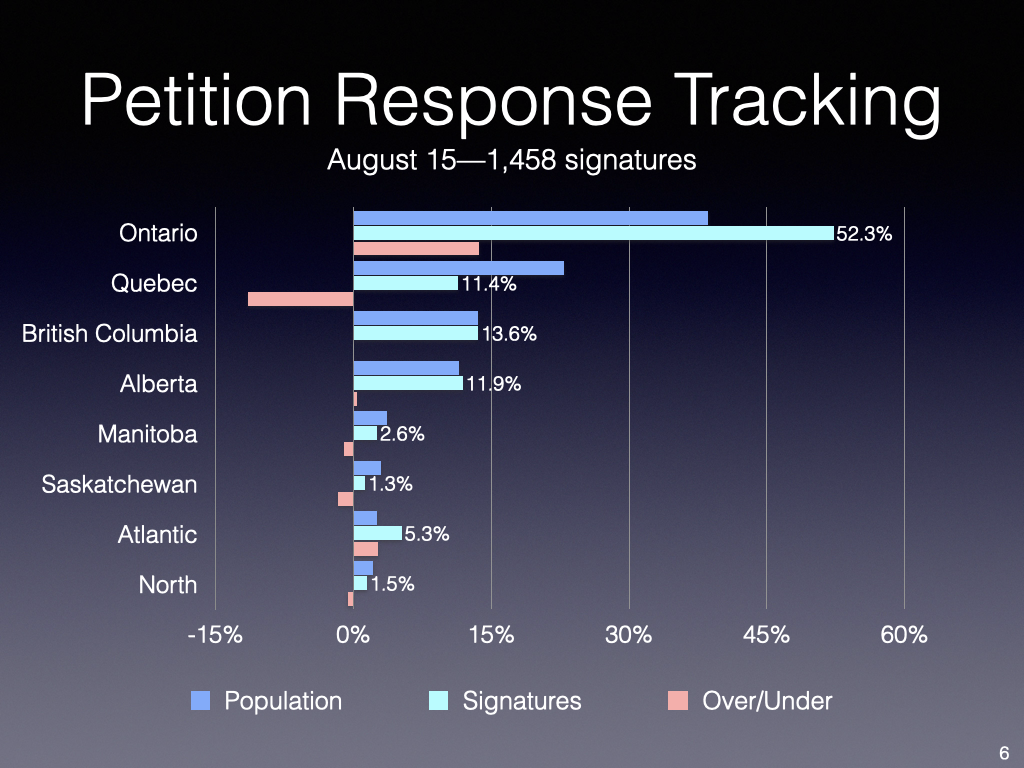
The chart below breaks down the 1,458 signatures as of 15 August by province. No major changes by province as numbers plateau.

And if you haven’t yet considered signing the petition, the link is here: https://petitions.ourcommons.ca/en/Petition/Details?Petition=e-4511

Colby Cosh: Nonsense for Trudeau to open immigration, but not the economy

Kind of funny column as he turns around the left wing critique of mobility of capital and restrictions on mobility of people to a critique of mobility of people and restrictions on capital. Reflects his ideology but nevertheless interesting contrast:

This week, the Wall Street Journal, a strong candidate for “best newspaper in the English-speaking world,” became the latest news outlet to lift a questioning eyebrow at Canadian immigration policy. WSJ’s superb Ottawa reporter Paul Vieira gestures, for the benefit of his paper’s international audience, at facts most of our readers already know well. Inflexible, highly regulated parts of the economy like housing, medicine and transport are screaming under the burden of immigration levels with few precedents anywhere — levels the Liberal government has done nothing but increase.

Recent immigrants themselves are starting to become disillusioned with the promise of Canada, and pollsters say the broad public is beginning to balk at the “more, more, more” approach to immigration — no wonder, because our per-capita economic output is now in active decline. Our multi-decade embrace of super-high immigration was supposed to flood our country with entrepreneurs and innovators; the practical overall result appears to be stagnant labour productivity, along with frank inattention to research and development on the part of our businesses. Everywhere you look it is economists who are shooting warning flares into the sky, and even the central bank is making Marge Simpson dissatisfaction noises. Only federal politicians, fearful of a third rail that may soon be totally disconnected from any power, remain quiet.
Something maddening struck me for the first time while reading Vieira’s piece, even though there’s nothing in it you and I don’t know. It’s that when it comes to economic policy, Canada’s philosophy has strong, inherited cultural-nationalist premises. In law, large parts of our economy are protected from the taint of foreign capital, lest it serve as a wedge for the destruction of our precious sovereignty.
Some of the economic ills I just mentioned are attributable to this. We’re subject to a strangling oligopoly in telecom services because our phones, for some damn reason, require cultural protection (culture is the explicit legal pretext for the foreign-ownership limits in that line of business). Our news industry, up against similar fences, grows ever leaner; our airlines subject us to unapologetic unredressed abuse; the internet, a realm of unlimited bandwidth, turns sludgy before our eyes as our government quarrels with foreign “tech giants” of a sort we could never grow here. And if I so much as mentioned foreign corporate involvement in a super-protected setting like health care, I’d probably be picketed by my own readers before the end of business.So let me ask: isn’t this double stupidity? How can our besetting economic nationalism be reconciled with haphazardly controlled mass immigration? Something called our “economy” is a precious national treasure that might come to harm if we let Verizon or Gannett or KLM trod our sacred soil. But when it comes to nose counts, no one will admit that anything valuable, anything distinctively Canadian, is at stake or might be threatened by unruly immigration. (Such as, say, your ability to afford a house or find a doctor.)

I’m a libertarian: I think the classic economic story of immigration’s benefits is essentially true, or can be true in a free and liberal economy. But Milton Friedman is supposed to have once remarked that you cannot have both free immigration and a welfare state. I suspect that’s right, but what seems especially clear, whether you regard Friedman as a hero or a devil, is that you really cannot have both free immigration and economic nationalism. And why would you want that? For one purpose we are Fortress Canada, and for another closely related purpose we have walls made intentionally from Kleenex?

Source: Colby Cosh: Nonsense for Trudeau to open immigration, but not the economy

John Robson: So we need more immigrants … to build homes for all the immigrants?

Robson captures the circular argument before his overall rant:

With the Australian government hiring a consultant for advice on dealing with consultants, Momus, the Greek god of satire, retreats helplessly from the stage. Which is too bad since we could use a satirical hand, or mouth, when told Canada’s minister of immigration says we must bring in an endless stream of immigrants to build houses for the endless stream of immigrants we’re bringing in to build … um … hang on a second.

Are Canadians incapable of constructing dwellings? I’m a journalist by trade, so presumptively as useful in real life as, say, a poet. Or a consultant. But I have built a sleeping cabin and helped on that most iconic of Canadian dwellings, a cottage. I have even mixed cement. And doubtless others in this land surpass me. Including pros.

The minister cannot possibly think absent mass immigration we couldn’t build any homes. Where did our existing stock come from? The real issue is whether the current flood of immigrants contains enough extra homebuilders to provide extra shelter for that flood and then some. Especially as the minister cannot possibly think Canadian immigration policy is structured to bring in hundreds of thousands of framers, joiners, engineers and guys who use “footer” in everyday conversation.

Of course it derives from the more general, insulting notion that Canadians are such shlumps that without new immigrants we won’t work hard or effectively at anything. And not just those of us born in this notorious land of slackers; the millions who have poured in over the past quarter-century, and their offspring, are evidently assimilated to our culture of sloth so rapidly they can no longer be bothered hoisting a two by four instead of a 2-4 or something.

It’s the demographic version of the “bicycle” economic theory popular in Japan, that if they stopped pedalling they’d fall over. Whereas Japan’s real problem, and ours, is a plunging birth rate as we increasingly regard life as a burden or, at best, a brief party followed by MAID when the music stops, not a precious gift to be passed on. And you can’t fix despair with immigration because you really will get assimilation to that anomie unless we find a fix from within.

Canadians are famously pro-immigrant. Possibly because we are so famously polite that we don’t dare question bringing in another 60-odd million people to turn our fabled environment into one continuous strip mall from Saint John to Surrey.

To dissent against mass immigration risks wild accusations of bigotry. But what doesn’t nowadays? Like the joke about the patient who calls every single Rorschach ink blot a nude woman, then when the psychiatrist suggests he has a sexual obsession retorts, “Hey doc, you’re the one showing all the dirty pictures,” our elites increasingly see white supremacy in every defence of our heritage then say “Hey Canuck, you’re the one obsessed with race.”

Not everyone goes as far as our prime minister with his claim of an ongoing genocide in Canada on his watch. But the federal cabinet did approve a state-funded pamphlet from the Canadian Anti-Hate Network declaring the Red Ensign a red flag for white supremacy because it “denotes a desire to return to Canada’s demographics before 1967 when it was predominantly white.”

Do the Trudeau Liberals not concede that someone from afar, not remotely white let alone predominantly, might regard Canada’s heritage of individual liberty, capitalist prosperity and resolute defence of freedom as something to be admired and embraced? That someone who does not look like me, or them, might take their children to the Vimy Memorial and shed tears over the fallen?

Apparently not. It only recently dawned on them, with Muslim parents protesting radical sex ed, that not every non-white person is automatically left-wing in every dimension. And the Liberals are still struggling with not every white person being a right-wing xenophobic clod, though Justin Trudeau himself is only occasionally cosmetically non-white. But trying to stifle real debate with nonsense about bringing in immigrants to build homes for immigrants we bring in to build homes for immigrants is insolent, particularly as the housing crisis gets worse, not better, as people pour in. (Toronto is nearly half foreign-born, for instance.)

Of course if you’re trying to immigrate to Canada you favour a relatively open border. But once you succeed, and realize this country is everything you hoped for plus lakes and loons, you might well decide that as soon as you bring in your immediate family we should reduce the inflow dramatically.

Even people who admired Canada from a distance need time to internalize the habits that make it what it is. Which are not sloth, incompetence and bigotry, it’s apparently necessary to add.

Or inability to use hammers.

Source: John Robson: So we need more immigrants … to build homes for all the immigrants?

Housing crisis: Feds stick by immigration plan, rethink international student flows

Possible partial pivot but limited to international students, Minister Miller linking this to fraud concerns, not permanent residents and temporary workers.

Kind of an interesting contradiction in the article between “pace of population growth, facilitated by immigration, is making the housing crisis worse” and “Most experts agree that the root causes of this housing shortage are unrelated to immigration.”

The alarm bells are becoming bull horns: Canada’s housing supply isn’t keeping up with the rapid rate of population growth.

Academics, commercial banks and policy thinkers have all been warning the federal government that the pace of population growth, facilitated by immigration, is making the housing crisis worse.

“The primary cause for (the) housing affordability challenge in Canada is our inability to build more housing that is in line with the increase in population,” said Murtaza Haider, a professor of data science and real estate management at Toronto Metropolitan University.

A TD report released in late July also warned that “continuing with a high-growth immigration strategy could widen the housing shortfall by about a half-million units within just two years.”

But the Liberals are doubling down on their commitment to bring more people into the country, arguing that Canada needs high immigration to support the economy and build the homes it desperately needs.

“Looking at the (immigration) levels that we have recently approved as a cabinet (and) as a government, we can’t afford currently to reduce those numbers,” Immigration Minister Marc Miller said in an interview with The Canadian Press.

That’s because Canada’s aging population risks straining public finances, he said, as health-care needs rise and the tax base shrinks.

A report by Statistics Canada published in April 2022 finds the country’s working population has never been older, with more than one in five people close to retirement.

At the same time, Canada’s fertility rate hit a record low of 1.4 children per woman in 2020.

The TD report, co-authored by the commercial bank’s chief economist Beata Caranci, notes that economists are the ones who have been warning of the economic consequences of Canada’s aging population.

“A ramp-up in skilled-based immigration offered a solution. Government policies have delivered, but now the question is whether the sudden swing in population has gone too far, too fast,” the report said.

The federal government’s latest immigration levels plan, released last fall, would see Canada welcome 500,000 immigrants annually by 2025.

In contrast, the immigration target for 2015 was under 300,000.

Although the half-million figure has caught considerable attention, it’s not just higher immigration targets that are driving the surge in population.

Canada is also experiencing a boom in the number of temporary residents who are coming to the country, which includes international students and temporary foreign workers.

In 2022, Canada’s population grew by more than one million people, a number that included 607,782 non-permanent residents and 437,180 immigrants.

Miller said in the interview that the federal government is open to reconsidering international student enrolments, particularly amid fraud concerns.

Earlier this year, hundreds of people were suspected of being caught in a fraud scheme that saw immigration agents issue fake acceptance letters to get students into Canada.

“There is fraud across the system that we are going to have to clamp down on,” Miller said.

The increased scrutiny of Canada’s immigration policies and population growth comes as the country faces a housing affordability crisis caused in large part by a shortage of homes.

Most experts agree that the root causes of this housing shortage are unrelated to immigration. Red tape and anti-development sentiment at the municipal level, for example, can lead to major delays in projects.

Federal tax incentives that helped spur purpose-built rental constructions were rolled back decades ago, leading to a massive shortage in rentals that has slowly built up over time.

Given these existing challenges, experts are concerned strong population growth will add fuel to the fire.

BMO published an analysis in May that estimated that for every one per cent of population growth, housing prices rise by three per cent.

The rebound of the Canadian real estate market this year also shows how immigration is helping to maintain demand for housing, despite decades-high interest rates.

In contrast, the immigration target for 2015 was under 300,000.

Although the half-million figure has caught considerable attention, it’s not just higher immigration targets that are driving the surge in population.

Canada is also experiencing a boom in the number of temporary residents who are coming to the country, which includes international students and temporary foreign workers.

In 2022, Canada’s population grew by more than one million people, a number that included 607,782 non-permanent residents and 437,180 immigrants.

Miller said in the interview that the federal government is open to reconsidering international student enrolments, particularly amid fraud concerns.

Earlier this year, hundreds of people were suspected of being caught in a fraud scheme that saw immigration agents issue fake acceptance letters to get students into Canada.

“There is fraud across the system that we are going to have to clamp down on,” Miller said.

The increased scrutiny of Canada’s immigration policies and population growth comes as the country faces a housing affordability crisis caused in large part by a shortage of homes.

Most experts agree that the root causes of this housing shortage are unrelated to immigration. Red tape and anti-development sentiment at the municipal level, for example, can lead to major delays in projects.

Federal tax incentives that helped spur purpose-built rental constructions were rolled back decades ago, leading to a massive shortage in rentals that has slowly built up over time.

Given these existing challenges, experts are concerned strong population growth will add fuel to the fire.

BMO published an analysis in May that estimated that for every one per cent of population growth, housing prices rise by three per cent.

The rebound of the Canadian real estate market this year also shows how immigration is helping to maintain demand for housing, despite decades-high interest rates.

Source: Housing crisis: Feds stick by immigration plan, rethink international …

Clark: Go big or go home on housing, Mr. Trudeau

As well as “going smaller” on immigration given the increased pressure and demand on housing:

Maybe it was just a coincidence that the new federal Housing Minister, Sean Fraser, told the press he’d be taking the train to an announcement in Burnaby, B.C., on Monday.

But Conservative Leader Pierre Poilievre had been talking about building housing next to train stations in a social-media video he posted Saturday that garnered over two million views and won plaudits from housing experts.

That made Mr. Fraser’s arrival on the SkyTrain to talk about housing seem a little late. That’s a recurring problem for the Liberals.

The biggest, loudest, most obvious political issue in Canada is the high cost of housing. Yet Prime Minister Justin Trudeau’s Liberals have been slow to see it build. And they still haven’t matched the public’s angst with governing ambition.

That’s baffling, if only because of the politics. Mr. Poilievre has been banging the housing issue like a drum for a year and half, striking a chord with couples who can’t afford a house and folks facing skyrocketing rents. NDP Leader Jagmeet Singh is now making it his theme in tour stops, too. And housing is a top-of-mind concern for many in cities and suburbs – and that’s core Liberal electoral geography.

Mr. Trudeau likes big policy initiatives in areas like child care or clean energy, yet he has sounded pretty ambivalent about housing lately. A few weeks ago, he backed into a vague answer about Ottawa’s plans with an assertion that much of the problem is in provincial jurisdiction, not federal.

But it should be obvious that Mr. Trudeau has to expand the scale of federal housing policy to another level.

Former Liberal policy adviser Tyler Meredith argues Mr. Trudeau should go big: by bringing the federal government back into funding large-scale development of affordable housing, creating tax incentives for residential building, adjusting infrastructure programs and policies in areas such as immigration and banking. Then, he suggests, the PM should call provincial premiers to a national housing summit.

Mr. Meredith wants to see the Canada Mortgage and Housing Corporation put tens of billions of dollars into developing affordable housing, noting that can be done without a major impact on Ottawa’s budget deficit or net debt, because Ottawa will own the buildings as an asset. It doesn’t have to be a landlord: It might lease those houses to non-profit organizations.

Policy thinkers have already proposed a number of solid, relatively low-cost ways to change the tax system to provide incentives to build – and acting on such things now should be a no-brainer.

One is eliminating the GST on purpose-built rental housing, which should seem like a good idea to Mr. Trudeau because it was in his 2015 Liberal election platform. Another, proposed by economist Mike Moffat and former Stephen Harper adviser Ken Boessenkool, working with the Smart Prosperity Institute, is more generous tax treatment for depreciation of residential buildings. Those two measures would cost the treasury relatively small sums.

Both the Liberals and the Conservatives have proposed using infrastructure spending as a lever to get municipalities to permit more building. Mr. Poilievre has called for Ottawa to withhold funds from cities that don’t approve housing projects quickly, while the Liberals have created a $4-billion “housing accelerator fund” to encourage towns to speed up the process.

And it’s pretty clear money will talk: Municipalities will be reluctant to lower the costs they charge to developers unless someone – Ottawa or the provincial government – replaces the revenue.

Mr. Meredith also thinks the Prime Minister should call premiers to a national housing summit, because a lot of the obstacles are at the provincial or municipal level, from building rules and permits to fees. Provinces are responsible for municipal governance.

Usually, prime ministers are wary of such summits as premiers tend to come to them with demands. But the cynical political calculation could be different for a prime minister launching major federal housing initiatives and inviting premiers to join the mission. It could shift some of the political pressure to act back to the provinces.

At any rate, Mr. Trudeau has reached a point where he has little time to catch up to the urgency many Canadians feel. The alternative is to roll out small initiatives and argue his government has done enough, and that means missing the train on the country’s hottest political issue.

Source: Go big or go home on housing, Mr. Trudeau

Housing experts, advocates, industry have unified message for government: Get more rentals built

Impressive coalition with practical recommendations, even if they sidestep the demand side and the time lags between current immigration levels and housing availability and affordability:

A coalition of housing experts, advocates and industry representatives are calling on the government to overhaul its policies to get more rental units built.

In a new report titled A Multi-Sector Approach to Ending Canada’s Rental Housing Crisis, the report is co-authored by Mike Moffatt, founding director of the PLACE Centre at the Smart Prosperity Institute, , president & CEO of the Canadian Alliance to End Homelessness, and Michael Brooks, head of REALPAC, a group that represents 130 real estate firms.

“A lot of the conversation is ‘Whose responsibility is it to solve this?’ And the answer should be ‘It’s everyone’s,'” Moffatt told CBC News.

The report, being released Tuesday, makes a number of recommendations to address a dearth in rental units in Canada’s largest cities.

According to the Canada Mortgage and Housing Corp. (CMHC), Canada needs to build 5.8 million new homes — including two million rental units — by 2030 in order to tackle housing affordability.

The report notes that Canada’s renting population and the price of rentals have continued to increase in recent years.

One of the report’s key recommendations calls on the federal government to take on a leadership role and co-ordinate with provinces, territories and municipalities to ensure that more rental units are built.

“This is too big for any one government or sector to handle alone and so we’re hoping the federal government will jump into a leadership role and meet us in the square to have this conversation,” Richter said.

Specifically, the report calls on Ottawa to create a national workforce strategy —  in co-operation with other levels of government, trade unions and education institutions — to ensure Canada has enough skilled labour to build the number of units needed to meet the needs of renters.

It also calls for financial reforms to ensure rental units are viable for builders and developers. Brooks said that costs to the industry have increased to the point where the number of construction projects for rental units is likely to drop significantly in the coming years.

“We’ve got a problem that’s likely to get worse before it gets better without changing some of the elements,” he said.

Some of the financial solutions the report puts forward include creating a tax credit for developers that invest in community rental units and deferring the capital gains tax when a rental housing project is sold and the proceeds are reinvested into the construction of further rental units.

The report also calls for the government to offer fixed-rate financing through CHMC or the Canada Infrastructure Bank on rental builds.

To better help low-income renters, the report suggests a targeted housing tax benefit for families spending more than 30 per cent of their income on rent.

The report also contains recommendations that federal opposition parties would support.

Conservative Leader Pierre Poilievre has suggested in the past that the federal government should tie infrastructure funding to municipalities to local housing permit approvals. Similarly, the report suggests the federal government tie funding to municipal housing targets.

The report also suggests that the government waive the GST on rental housing construction, something that NDP Leader Jagmeet Singh has been calling for.

The author’s said they hope their report sends a signal to all governments of varying political stripes to work together to solve the housing crisis.

“This is about communication and collaboration,” Brooks said. “Get together in a room and talk to each other and make that conversation be based on evidence.”

“I think we were all pleasantly surprised just how much common ground there was,” Richter said of working on the report with his two co-authors.

“There’s plenty of stuff that I’m sure that we don’t agree on, but there was more that we do agree on then we didn’t and I think you see that in the report,” he said.

Source: Housing experts, advocates, industry have unified message for government: Get more rentals built

ICYMI: New federal immigration minister pressures Quebec to increase family reunification capacity

Not sure how well that went over:

Canada’s new immigration minister has only been in the office for a few weeks and he’s already entered into his first clash with Quebec.

For five years, he tried to improve relations between the federal government and indigenous communities. Now, after last month’s cabinet shuffle, Montreal MP Marc Miller has been handed another challenging job as Canada’s new immigration minister.

At his first press conference in that function, he took aim at Quebec’s policy on family reunification.

“Quebec controls a good chunk of its immigration policy, particularly on the family reunification envelope, which is capped at about 10,000 right now,” Miller said. “There’s a backlog of of 30,000 families that want to come here and support their kids, and…Quebec says we need to cut it off.”

Under Premier François Legault, Quebec has been working to gain more and more control over immigration from the federal government. The province does have a say on things like economic immigration and  family reunification.

“The cap of 10,000 is not a lot of people,” said immigration lawyer Patrice Brunet. “It’s very alarming because here we’re not in the context of economic immigration, we’re in the context of families waiting to be reunited.

Brunet says because of Quebec’s family reunification limit, some files are taking two years to be processed, which is nearly double the delay in the rest of Canada.

“Two years to be reunited with your family is absolutely too long. It’s inhumane,” he said, adding he fears delays will only get longer as the backlog grows.

Miller says family reunification is a topic he wants to address with the Legault government.

“We need to have mature conversations with provinces and territories about how we welcome newcomers, and that’s one that I plan to have,” he said.

Political scientist Daniel Béland points out Quebec has been trying to get even more control from the federal over family reunification.

“There is a clear disagreement between Ottawa and Quebec City,” he said. “I don’t expect Ottawa to cave on that really, in terms of powers to Quebec over immigration, but I think some fine tuning is certainly possible.”

In its quest to protect the French language, the Legault government recently announced plans to accept only economic immigrants who can speak French.

Miller says he’s willing to work with Quebec on preserving French.

“I think we have a role as the federal government and I would say primarily that is to make sure we are supporting the diaspora of French-speaking communities outside Quebec, to make sure that they are thriving,” he explained. “French is one of the largest languages in the world, but it is threatened in North America and we have to be vigilant.”

In a statement Quebec’s immigration ministry said it has requested a first meeting with Miller and hopes it takes place quickly so that priority issues can be discussed.

Source: New federal immigration minister pressures Quebec to increase family reunification capacity

Une laïcité à géométrie variable

Useful reminder:

Je ne suis pas entièrement d’accord avec le titre de la lettre de Benoît Pelletier (« La laïcité, un principe phare de l’identité profonde du Québec », Le Devoir, 5 août 2023) et plusieurs de ses énoncés, mais je suis d’accord avec sa proposition suivante : « La laïcité ne va pas à l’encontre de la liberté de religion. Elle en fait plutôt partie intégrante. Elle en constitue une dimension essentielle. » Cela a d’importantes conséquences.

La laïcité comporte deux éléments essentiels : elle implique la séparation de l’Église et de l’État, d’une part, et la laïcisation des services publics, d’autre part. Au Québec, la séparation s’est progressivement amorcée aux XVIIe et XVIIIe siècles et sera confirmée dans la Loi sur la liberté de culte de 1853. La jurisprudence est claire là-dessus. Quant à la laïcisation des services publics, c’est différent, car elle s’amorce à partir de la Révolution tranquille des années 1960 et se conclut dans le domaine de l’éducation par les lois de 1999 et 2005. Ce n’est pas de l’histoire ancienne…

Pour ce qui est de la séparation de l’Église et de l’État, dans la réalité politique et sociale, elle est loin d’être aussi tranchée qu’on le dit. On trouve partout de nombreux assouplissements. Dans des États laïques comme la France, l’État est propriétaire de dizaines de cathédrales, les municipalités sont propriétaires de milliers d’églises, avec obligation constitutionnelle de les entretenir ; l’État français consacre d’énormes budgets au patrimoine religieux ; l’État finance de nombreuses écoles privées religieuses.

Dans plusieurs États européens, tous officiellement laïques, il peut y avoir de l’enseignement religieux dans l’école publique, un financement public de certains cultes (Belgique) et la présence de crucifix dans l’école publique (Italie, Bavière). Aux États-Unis, où, en vertu du First Amendment, on parle du « wall of separation », la Cour suprême autorise la prière au Congrès, dans les législatures et les conseils municipaux, permet l’installation de crèches de la nativité dans un parc municipal, de croix sur le domaine public ; le port de signes religieux est possible au Congrès et dans les législatures.

Au Québec, la séparation de l’Église et de l’État ne dispense pas l’État de devoir permettre la construction de lieux de culte ; la législation autorise le financement d’écoles privées religieuses, subventionne le patrimoine religieux, accorde aux associations religieuses des avantages fiscaux. On est loin de la laïcité stalinienne.

Si, comme le dit le professeur Pelletier, la laïcité est « un principe phare de l’identité profonde du Québec », cette profondeur est à géométrie variable ! Certes, les disciples des Lumières de l’Institut canadien et les membres du Parti patriote ont parlé de laïcité, mais le Bas-Canada et le Québec ont très longtemps baigné dans une atmosphère globale de stricte religiosité.

Aussi, cela fait sourire lorsqu’on lit, dans la Loi sur la laïcité, l’un des « considérants » solennels : « CONSIDÉRANT que la nation québécoise a des caractéristiques propres, dont […] un parcours historique spécifique l’ayant amenée à développer un attachement particulier à la laïcité de l’État. » Ce parcours est spécifiquement fort court…

Source: Une laïcité à géométrie variable

Meggs: When it comes to immigration levels, temporary permits are the elephant in the room 

Good reminder of the need to manage the number of temporary residents, not just the permanent residents in the annual levels plan.

No sign yet that the government is seized with the pressures on housing, healthcare and infrastructure that result from high levels of permanent and temporary residents or an appreciation of how this issue will harm them politically and how it risks damaging the overall Canadian consensus in favour of immigration.

Anne and I often compare observations but our respective pieces were written separately and complement each other (see Griffith: Canada badly needs an immigration reset):

With pressure mounting to rethink Canada’s immigration policies, it’s no surprise to see a new minister, Marc Miller, take charge of the portfolio. Over recent months, we have seen an increasing number of articles, studies and reports warning that the rapid rise in population is stretching housing and health services and that the current immigration levels might be too high. More voices are calling for a course correction or restoring balance in Canada’s immigration policy.

The federal government may, indeed, want to propose a temporary slowdown of the pace of arrivals in response to these calls for a reset, and the new minister might be more open to this approach. However, any realignment in pace, numbers or skill levels of new arrivals will be much easier said than done. Mr. Miller can certainly level off permanent immigration targets, at least for the short term, but this would make little or no difference to the number of arrivals, since almost all people arriving from other countries now do so on temporary visas and permits.

Permanent immigration planning was relevant years ago when the number of permanent residents each year coincided relatively closely with the number of new arrivals. This was because permanent immigration applications had to be made from outside Canada. It is also important to note that people arriving with permanent status benefit from the same protections and public services as Canadian citizens from the moment they land in the country.

The bulk of people granted permanent resident status these days are already living in Canada with some sort of temporary immigration status, such as a work permit or a student visa. These are not the people driving new demand for housing or health services, because they are already here.

Meanwhile, the number of people arriving as temporary residents isn’t directly managed by the federal government – there are no targets and no ceilings. The former immigration minister Sean Fraserwas very clear that temporary immigration is based on the demand of postsecondary institutions and employers. The number of temporary work permit holders in Canada at the end of 2022 had soared to 798,100. The number of foreign students in Canada has also soared, with more than 807,260 in the country at the end of 2022.

The requirement to apply for permanent residence from outside the country was abolished several years ago. Most people with temporary study or work status (and their spouses and children) nevertheless arrive seduced by the promise of permanent residence. Multiple pathways for just that purpose have been put in place both federally and provincially.

Temporary residents do not have the security, rights or protections associated with permanent residence. They often can’t get a mortgage or a car loan because they’re in the country ostensibly on a temporary basis, even though the positions they hold are often permanent. Many are tied to their employer and therefore to the municipality where they work. The nature of their permit determines which public services are available to them.

Provincial governments will resist cutting back on the number of international students because they would have to find new ways to finance postsecondary institutions. These young people have also become essential to fill low-paid jobs in certain key sectors of the economy.

Employers have been led to believe that temporary immigration is the best and quickest solution for their job vacancies. But this is contrary to international evidence showing that countries with faster-growing populations are not seeing their job vacancy rates decrease: as immigrants spend their incomes, the pressure on demand for workers returns. Naturally, it is cheaper for employers to bring in foreign labour for low-paid, low-skilled jobs than to put in the effort and resources necessary to improve salaries, working conditions and productivity.

No realignment on immigration policy, whether it be slowing the pace of arrivals or getting back to focusing on selecting highly skilled immigrants, will have any effect if it does not include temporary immigration. Restoring balance to the immigration system will not be easy, but Mr. Miller must try.

Anne Michèle Meggs is the former director of planning and accountability at Quebec’s ministry of immigration and the author of L’immigration au Québec: Comment on peut faire mieux.

Source: When it comes to immigration levels, temporary permits are the elephant in the room

Long way home: Blamed for affordability crisis, Liberals look to pivot on housing

But a real pivot has to include both immigration and housing….

Chris Burke and his fiancée have been less than a year away from buying their first home for the past three years.

Saving for a down payment was the first challenge. Now, rising interest rates have kicked home ownership down the road again, stalling the couple’s plans to get married and have children.

“Any gains we make towards purchasing a house, we’re watching the goalposts move further and further away,” the 31-year-old Ottawa resident said.

Feeling “stuck,” as Burke put it, is a sentiment shared by many young Canadians who are increasingly pessimistic about their home ownership prospects.

For the federal Liberals, the growing discontent with the state of the housing market is becoming a political threat.

“I’m a former Liberal voter,” Burke said. “I certainly wouldn’t be voting for them this time around.”

Experts say the housing crisis poses a great risk to the incumbent government in the next election if it doesn’t take drastic action soon.

“This has become probably the most important both economic and political problem facing the country right now,” said Tyler Meredith, a former head of economic strategy and planning for Finance Minister Chrystia Freeland.

“And especially given the significant emphasis the government has put on immigration and the relationship between immigration and the housing market, there is a need to do more.”

Conservative Leader Pierre Poilievre has taken direct aim at the Liberals for the state of the housing market, highlighting the dramatic increases in home prices, rents and even interest rates.

According to the Canadian Real Estate Association, the national average price of a home sold was $709,000 in June 2023, up from $455,000 in Oct. 2015, when the Liberals first came to power.

And the cost of getting a mortgage has soared, following a series of aggressive interest rate increases by the Bank of Canada in response to rising inflation following the COVID-19 pandemic.

Rent prices have also skyrocketed, with some cities seeing double-digit increases over the last year.

Trudeau has tried to deflect for the housing crisis, recently saying there are limits to what the federal government can do.

“I’ll be blunt as well: housing isn’t a primary federal responsibility,” Trudeau said during a housing announcement in Hamilton on July 31.

“It’s not something we have direct carriage of. But it is something that we can and must help with.”

His remarks were quickly blasted by Poilievre, who reminded people of earlier promises Trudeau had made on housing.

“(Trudeau) held a news conference … to tell you all he’s not responsible for housing. That’s funny, because eight years ago, he promised he was gonna lower housing costs,” Poilievre said in a news conference the next day.

Most experts agree that Ottawa isn’t solely responsible for the problem. But many say the federal government could still be doing more to alleviate the shortage of housing at the root of the affordability crunch.

The Canada Mortgage Housing Corp., the national housing agency, warned last year that the country needs to build 5.8 million homes by 2030 to restore affordability.

If the current pace of building continues, then only 2.3 million homes will have been added to the housing stock by then.

There are several things experts say the federal government could be doing, such as better calibrating its immigration policy with housing and reforming tax laws to incentivize rental developments. It could also push local governments to get housing built faster.

The federal government has been hearing from stakeholders and housing experts on these potential solutions, as rumblings grow about a focus on housing in the coming fall economic statement and next year’s budget.

A senior government official who spoke on the condition of anonymity so they could discuss matters not yet made public, says the Liberals plan to take steps over the next year to get other levels of government, the private sector and the not-for-profit sector to build more homes.

Trudeau’s recent cabinet shuffle might be an early sign that the federal government plans to prioritize housing. The prime minister appointed one of the stronger communicators and a rising star on the Liberal bench, Sean Fraser, to take on housing and infrastructure as one, amalgamated file.

“The prime minister said something to the effect of, ‘I’ve got a big job for you to do,'” Fraser said in an interview.

Fraser said he hopes to help restore a housing market closer to the one he grew up with in small-town Nova Scotia: one where having a job was enough to buy a home.

“It might take a bit of time for us to solve the housing challenges that are before us,” he said. “But man, is it a challenge we’re solving.”

That challenge includes overcoming jurisdictional issues. Many of the policy levers that could help spur more housing development are at the provincial and municipal levels of government.

Urban planning, zoning laws and red tape are the purview of local governments, which have decision-making powers that can help or hinder housing development.

Ben Dachis, associate vice-president of public affairs at the C.D. Howe Institute, says the predicament the Liberals find themselves in speaks to the “insidious nature of consistent federal overreach.”

“The cautionary tale is that the federal government needs to stick with jurisdiction,” Dachis said.

But housing expert Carolyn Whitzman has a different take. The University of Ottawa adjunct professor says the federal government can’t turn its back on Canadians in the middle a crisis.

“The federal government: it’s where the buck stops,” Whitzman said.

“If housing and climate change are the crises that they’re certainly treated (as), the federal government is going to have to put on its big kid pants and actually deal with it.”

Source: Long way home: Blamed for affordability crisis, Liberals look to pivot on housing

Related article: Canada ‘absolutely’ can’t build more houses without more immigrants, minister says
Canada’s housing crisis “absolutely cannot” be solved without the aid of new immigrants who bring their skills here, Immigration Minister Marc Miller told reporters on Friday

“The federal government is making housing more affordable and bringing in the skilled workers required to build more homes,” Miller said in Montreal.

“Without those skilled workers coming from outside Canada, we absolutely cannot build the homes and meet the demand that exists currently today.”

Miller was asked by reporters if he was considering slashing Canada’s immigration targets, which are currently at historic highs, in response to a recent Bank of Canada report that new immigrants are adding to housing demand.

The minister said he was not.

“People coming to this country are resourceful. When they bring capital, they are able to acquire houses,” he said.

“If people are asking us to slash, what does that mean? Does that mean slashing the skilled workers that we need to actually build those houses? Slash family reunification, which can be devastating for the mental health and well-being of the families that are already here?”

Canada aims to welcome 451,000 new immigrants in 2024.

By 2025, the number is expected to go up to 500,000 new immigrants in one year.

Miller said around 60 per cent of new immigrants to Canada are economic migrants, many of whom are the kind of skilled workers needed to build more housing. Family reunification visas account for around 20 per cent of those migrating. The rest, he said, are refugees and asylum seekers.

“We have a humanitarian duty towards people that are fleeing war and persecution,” Miller said.

Last week, a spokesperson from Miller’s office told Global News that fulfilling Canada’s labour shortages is one of his key priorities, and a key goal of the government’s immigration targets.

“Strategies like Express Entry, and the historic Immigration Levels Plan, which is largely made up of economic migrants, are a great asset to our nation as they will directly help combat the ongoing labour shortage. This is especially true when it comes to the housing sector,” Bahoz Dara Aziz, press secretary to the immigration minister, told Global News.

“With provinces like Ontario needing 100,000 workers to meet their housing demands, it is clear that immigration will play a strong role in creating more homes for Canadians.”

The federal government increased its immigration targets in November 2022, and Miller has suggested those targets may need to keep rising.

The construction industry is short tens of thousands of workers, and experts say a coming wave of retirements could make the problem worse.

Meanwhile, Canada is millions of homes behind what’s needed to reach housing affordability this decade.

The job vacancy rate in construction is at a record high with around 80,000 vacancies in the industry,  CIBC deputy chief economist Benjamin Tal said in a recent note.

Those vacancies, which push up building costs and impede productivity, come at a time when the residential construction industry is under pressure to meet the demands of a growing population.

Canada Mortgage and Housing Corp. forecasts a need for 3.5 million more homes by 2030 than the country is currently on track to build.

The number of new homes built, however, has been in decline, from just over 271,000 in 2021 to 260,000 in 2022. And in May this year, the annual pace of housing starts dropped 23 per cent month over month, leading the CMHC’s chief economist to predict that just 210,000 to 220,000 new homes will be built by the end of the year.

Last week, the federal government launched a separate stream of entry for newcomers with work experience in skilled trades.

“It’s absolutely critical to address the shortage of skilled trades workers in our country, and part of the solution is helping the construction sector find and maintain the workers it needs,” Miller said in a statement, making his first major announcement as Canada’s new immigration minister.

“This round of category-based selection recognizes these skilled trades workers as essential, and I look forward to welcoming more of these talented individuals to Canada.”

Immigration, Refugees and Citizenship Canada (IRCC) said that by welcoming people in skilled trades such as carpentry, plumbing and welding, Canada can help its construction sector attract skilled workers.

But there remain questions about how the government can ensure those bringing the skill set to work in construction actually end up working in the sector and are able to navigate the certifications processes across the country.

Source: Canada ‘absolutely’ can’t build more houses without more immigrants, minister says