Trudeau says temporary immigration needs to be brought ‘under control’

Better late than never (who let it get out of control?) One of the bigger policy and program fails of this government, one than is damaging the overall consensus in favour of immigration:

Prime Minister Justin Trudeau says the government wants to rein in the number of temporary immigrants coming to the country, saying the situation needs to be brought “under control.”

“Whether it’s temporary foreign workers or whether it’s international students in particular, that have grown at a rate far beyond what Canada has been able to absorb,” Trudeau said at a housing announcement in Dartmouth, N.S.

“To give an example, in 2017, two per cent of Canada’s population was made up of temporary immigrants. Now we’re at 7.5 per cent of our population comprised of temporary immigrants. That’s something we need to get back under control.”

The prime minister then said that this is driving mental health challenges for international students and that more businesses are relying on temporary foreign workers, driving down wages in some sectors.

“We want to get those numbers down. It’s a responsible approach to immigration that continues on our permanent residents, as we have, but also hold the line a little more on the temporary immigration that has caused so much pressure in our communities,” Trudeau concluded.

Immigration Minister Marc Miller said on March 21 Ottawa would set targets for temporary residents allowed into Canada to ensure “sustainable” growth in the number of temporary residents entering the nation. Over the next three years, Miller said the goal is to reduce the amount of temporary residents to five per cent of Canada’s population.

For permanent residents, Canada has a target of 485,000 new immigrants, increasing to 500,000 in both 2025 and 2026.

In their last immigration plan update, the government said there are plans to “recalibrate” the number of temporary admissions to Canada in order to ensure the system is sustainable.

In January, Miller announced a cap on student visa admissions to Canada at 360,000 permits, a 35 per cent decrease from 2023.

Source: Trudeau says temporary immigration needs to be brought ‘under control’

Contrast: Anti-Muslim bias reports skyrocket after Oct. 7 Hamas attack on Israel, Stephens: The Appalling Tactics of the ‘Free Palestine’ Movement

Starting with anti-Muslim bias complaints:

The Council on American-Islamic Relations (CAIR) released its annual Civil Rights Report today. The organization says that last year it received the highest number anti-Muslim bias complaints ever.

CAIR says it took in 8,061 bias reports in 2023 and that nearly half of them came in the final three months of the year, following the Oct. 7 Hamas attack on Israel.

“I was stunned by the sheer volume of complaints we got,” says Corey Saylor, CAIR’S Director of Research and Advocacy.

“In 2022, our numbers showed the first ever drop since we started tracking incidents,” he says. “And then to see all of that erased, it’s real insight in to how easy it is for someone to just flip the Islamophobia switch back to on.”

The report, titled “Fatal: The Resurgence of Anti-Muslim Hate,” says 15% of complaints the group received involved employment bias. 8.5% of bias reports involved schools — including colleges and universities. And 7.5% of complaints involved allegations of hate crimes, including the case of 6-year-old Palestinian American Wadea Al-Fayoume who was allegedly stabbed to death by his family’s landlord near Chicago.

“I just don’t know how much hate it takes to drive an adult to target a child,” says Saylor. “And I think it’s also fair to say that hate did not originate last October.”

Prosecutors in that case have charged suspect Joseph Czuba with first-degree murder and attempted first-degree murder for allegedly stabbing the child’s mother during the attack as well. Authorities have also charged Czuba with two counts of hate crimes.

Additionally, the CAIR report highlights a controversy highlights a controversy in Maryland’s Montgomery County Public Schools. The district allows parents to opt out of a Family Life and Human Sexuality unit, but it does not allow parents to opt out of books assigned for English classes that portray LGBTQ+ characters. A number of Muslim parents protested, saying the books were not in line with their religion’s teachings.

“The sincerely held religious beliefs of parents were completely ignored, disregarded, and even in a couple of instances criticized,” says Saylor.

The report also relays the story of how a regional airline accidentally posted to the internet part of the U.S. Government’s so-called No Fly List. CAIR’s analysis of a downloaded version of the list found that nearly all the names on it – 98.3% — were what the organization calls “identifiably Muslim.”

CAIR’s report also included mention of some bright spots. In 2023, New York City and Minneapolis permitted the call to prayer to be broadcast over loudspeakers. New Jersey and Georgia began recognizing Muslim Heritage Month. And school districts in at least 6 states added at least one Muslim holiday to academic calendars so students will have the day off from class.

Source: Anti-Muslim bias reports skyrocket after Oct. 7 Hamas attack on Israel

Brett Stephens in the NYT how many pro-Palestinian protesters have crossed the line into anti-semitism and being anti-Jewish (American examples but comparable ones in Canada):

Last week, Susanne DeWitt, an 89-year-old Holocaust survivor who later became a molecular biologist, spoke before the Berkeley, Calif., City Council to request a Holocaust Remembrance Day proclamation. After taking note of a “horrendous surge in antisemitism,” she was then heckled and shouted down by protesters at the meeting when she mentioned the massacre and rapes in Israel of Oct. 7.

At the same meeting, a woman testified that her 7-year-old Jewish son heard “a group of kids at his school say, ‘Jews are stupid.’” She, too, was heckled: “Zionists are stupider,” a protester said. At the same meeting, others yelled, “cowards, go chase the money, you money suckers” and “you are traitors to this country, you are spies for Israel.”

Protest movements have an honorable place in American history. But not all of them. Not the neo-Nazis who marched in Chicago in 1978. Not the white supremacists who chanted “Jews will not replace us” at their Unite the Right rally in Charlottesville, Va., in 2017.

And not too much of what passes for a pro-Palestinian movement but is really pro-Hamas, with its calls to get rid of the Jewish state in its entirety (“from the river to the sea …”), its open celebration of the murder of its people (“resistance is justified …”) and its efforts to mock, minimize or deny the suffering of Israelis, which so quickly descend into the antisemitism on naked display in Berkeley.

How did this happen?

It wasn’t a response to the human suffering in Gaza in recent months. A coalition of Harvard student groups issued a statementon Oct. 7 holding “the Israeli regime entirely responsible for all unfolding violence.” Pro-Hamas demonstrations broke out worldwide on Oct. 8. A Black Lives Matter chapter posted a graphic on Instagram of the Hamas paragliders who murdered hundreds of young Israelis at the Nova music festival. A Cornell professor said he found the massacre “exhilarating,” and demonstrators rallied in his support.

This is only a partial list. But it reveals the bullying mentality at the heart of the pro-Hamas movement. It isn’t enough for them to speak out; they must shut other voices down. It isn’t enough for them to make a strong or clear argument; they also aim to instill a palpable sense of fear in their opponents. American civil libertarians of the past once understood that inherent in the right to protest was the obligation to respect the right of people with differing views to protest as well. That understanding seems to be wholly absent from the people who think that, say, heckling Raskin into silence is also a form of democracy.

In this sense, critics of Israel who claim that American Jews must choose between Zionism and liberalism have it backward. The illiberals aren’t the people defending the right of an imperfect but embattled democracy to defend its territory and save its hostages. They are the people who, like the former Iranian president Mahmoud Ahmadinejad, want Israel wiped off the map and aren’t ashamed to say so. Not surprisingly, they also seem to share Ahmadinejad’s attitudes toward dealing with dissent.

It’s true that in nearly every political cause, including the most justified, there are ugly elements — the Meir Kahanes or the Louis Farrakhans of the world. But the mark of a morally serious movement lies in its determination to weed out its worst members and stamp out its worst ideas. What we’ve too often seen from the “Free Palestine” crowd is precisely the opposite.

Source: The Appalling Tactics of the ‘Free Palestine’ Movement

Why a Montreal video game consulting studio is at the centre of an online anti-diversity storm

Of note:

Kim Belair says she wasn’t surprised at the harassing and threatening messages that she and her team have been receiving since last fall. Still, their details have been enough to shake them.

That included threats of violence, suggesting they should kill themselves or each other, and even graphic photos, said Belair, CEO and co-founder of Montreal-based Sweet Baby Inc., a video game consulting company.

“It’s not something that’s entirely new to us, especially to our marginalized team members who have existed in this industry … for quite some time.”

Belair’s 16-person team has become the centre of a new storm of online arguments, conspiracy theories and harassment, as self-described gamers accuse them of pushing a “radical leftist” agenda into games they claim players — and even developers themselves — want no part of.

“They said they want to take over the games industry. They hate white, straight, male gamers,” said commentator Ryan Kinel, in a video on YouTube, where he has over 300,000 followers.

Some have likened the backlash to Gamergate, a harassment campaign mostly targeting women in the video game industry that began in 2014.

The online storm even caught the attention of X owner Elon Musk.

“Sweet Baby Inc is an evil blight on the gaming industry. All they do is make games terrible and try to cancel people,” Musk posted on X, formerly known as Twitter, on March 16. “They cannot go broke soon enough!”

The past several months have seen a rise in “organized harassment against anyone who has been associated with the company,” Alyssa Mercante, senior editor at the video games site Kotaku, told The Current‘s Matt Galloway.

The Sweet Baby ‘detected’ group

Sweet Baby was founded in 2018 and works with video game companies on projects ranging from small independent titles to AAA blockbusters like Assassin’s Creed Valhalla and Suicide Squad: Kill the Justice League.

Belair says its services include writing feedback, narrative direction and helping “punch up” scripts — but also “consultations around perspective and identity.”

That last element started to gain attention in October 2023, after users on message boards noticed the studio was credited on two big-budget newly released games: Marvel’s Spider-Man 2 and Alan Wake 2.

Though both games were critically acclaimed, some said Sweet Baby made unwanted changes during development, including changing Alan Wake 2 protagonist Saga Anderson from a white woman to a Black woman, which the game’s director has denied.

Others blamed the studio’s work on Suicide Squad for that game’s middling reviews and lagging sales. Warner Bros. Discovery said the game fell short of expectations, but did not give specifics.

The discourse intensified in January, when a user created a tracking page on the online games store Steam called “Sweet Baby Inc detected.”

The page, which currently has over 355,000 followers, tracks games with which Sweet Baby has been involved — and marks them all as “not recommended.” The label does not affect any games’ visibility on the store.

Its creator, who uses the online name Kabrutus, said Sweet Baby “forces political agendas and DEI [diversity, equity and inclusion] into their games,” in an interview with the site Geeks + Gamers on March 7.

“I started noticing patterns in some games, like ugly women, and male characters being weakened to make female ones look stronger.”

Kabrutus declined to comment to CBC News for this story.

Several Sweet Baby staff members posted on X about their displeasure with the tracker; one staff member called for users to report the Steam page and its creator. Some have argued that only gave the detractors more attention.

Kabrutus and his supporters accused Sweet Baby of censorship.

Belair denied that claim, saying the studio chose not to reach out Steam’s parent company, Valve….

Source: Why a Montreal video game consulting studio is at the centre of an online anti-diversity storm

Regg Cohn: India’s anti-Muslim citizenship law is discriminatory and disappointing — but not surprising

One of the better articles on the law:

…Modi’s BJP followers (and their historical antecedents) argue they are not merely throwing off the yoke of British colonial rule, which retreated in 1947. No, his supporters insist they are uprooting — decolonizing — a more enduring form of historical domination by India’s Moghul conquerors who imported Islam centuries ago, long before the British era.

That is one of the complications of the decolonization paradigm — the push for purification can easily go further back in time. People can keep peeling back layers of colonization and conquest until they reach their target, which is why Modi’s Hinduization movement is less concerned with the idea of white supremacy than Islamic hegemony.

There’s yet another conceptual challenge for Hindutva’s critics (of which I am one). India is far from alone in embracing religiosity or ethnicity as the measure of who shall qualify for citizenship or be disqualified, who will be welcomed with open arms or herded into closed camps.

Israel is increasingly criticized for religious discrimination for granting automatic sanctuary to Jewish immigrants under its Law of Return, enacted after its founding in 1948 (in the post-Holocaust era when Jews still faced pogroms in parts of Eastern Europe and persecution much of the Middle East). That Israel, as a Jewish state, privileges Jews is one of the reasons many critics claim “Zionism is racism.”

Yet it is a curious double standard. For India is only the latest in a long line of countries that prioritize religion in a way that Canadians — who welcome people of all faiths — perhaps cannot fathom.

Religion has been the raison d’être of the Islamic Republic of Pakistan, the Islamic Republic of Iran, and the Islamic Emirate of Afghanistan. Lebanon has kept its Palestinian refugees in camps since they fled their homes in 1948, long restricting their permitted occupations lest an influx of Sunni Muslims alter the country’s delicate religious balance — or compete for coveted jobs (after protests, those restrictions were partly eased in recent years).

Bhutan, a little-known kingdom nestled in the Himalayas along India’s northern border, has long been seen as a Buddhist paradise despite its mistreatment of Hindu refugees fleeing strife in neighbouring Nepal (shunting them into camps for years without letting them settle, for fear of changing the kingdom’s ethnic makeup). Germany has long recognized ethnicity for citizenship, regardless of place of birth — granting automatic status to those with German blood who “resettle” in Deutschland.

Against that backdrop, India’s new discriminatory citizenship law is surely disappointing, but hardly surprising — and assuredly not unique. It merely reminds us of the complexity of ethnic identity and religious rivalry around the world — and how historical grievances are so easily transformed into political grudges and legal cudgels.

Source: India’s anti-Muslim citizenship law is discriminatory and disappointing — but not surprising

The U.S. Is Rebuilding a Legal Pathway for Refugees. The Election Could Change That.

Indeed:

With national attention focused on the chaos at the southern border, President Biden has been steadily rebuilding a legal pathway for immigration that was gutted during the Trump administration.

The United States has allowed more than 40,000 refugees into the country in the first five months of the fiscal year after they passed a rigorous, often yearslong, screening process that includes security and medical vetting and interviews with American officers overseas.

The figure represents a significant expansion of the refugee program, which is at the heart of U.S. laws that provide desperate people from around the world with a legal way to find safe haven in the United States.

The United States has not granted refugee status to so many people in such a short period of time in more than seven years. The Biden administration is now on target to allow in 125,000 refugees this year, the most in three decades, said Angelo Fernández Hernández, a White House spokesman.

By comparison, roughly 64,000 refugees were admitted during the last three years of the Trump administration.

“The Biden administration has been talking a big talk about resettling more refugees since Biden took office,” said Julia Gelatt, an associate director at the Migration Policy Institute, a nonpartisan research group in Washington. “Finally we are seeing the payoff in higher numbers.”

But as the presidential campaign heats up, immigration advocates fear that the gains will be wiped out if former President Donald J. Trump is elected. The former president has vowed to suspend the program if he takes office again, just as he did in 2017 for 120 days.

Mr. Trump has characterized the program as a security threat, even though refugees go through extensive background checks and screening. He reassigned officers, shuttered overseas posts and slashed the number of refugees allowed into the country every year.

The result, when Mr. Biden took office, was a system devoid of resources.

“The refugee program hangs in the balance with this election,” said Barbara L. Strack, the former lead refugee official at U.S. Citizenship and Immigration Services….

Source: The U.S. Is Rebuilding a Legal Pathway for Refugees. The Election Could Change That.

Douglas Todd: Canada’s tough-talking immigration minister makes headlines, but how much is spin?

More than spin IMO given his actions to cap international students, reduce the number of Temporary Foreign Workers, and cap at 500,000 Permanent Residents in 2025 (albeit after the election).

Not far or fast enough, but the first Liberal minister of immigration to tackle some of the problems his predecessors created and make life somewhat easier for a possible Conservative successor:

It’s rare when a politician criticizes the record of his own party, but that’s the approach Immigration Minister Marc Miller has been adopting.

The teenage friend of Prime Minister Justin Trudeau has become quotable as he goes after the “perverse effects” and “lack of integrity” in the migration system that his Liberal predecessors — John McCallum, Ahmed Hussen, Marco Mendocino and Sean Fraser — built up upon gaining power nine years ago.

When Trudeau appointed Miller in June 2023 he started off sounding like every other Liberal immigration minister — trotting out well-worn cliches about how record levels of permanent and non-permanent residents would replace retiring baby boomers and deliver economic opportunity for all.

But Miller’s tune suddenly changed last fall, along with polling results. They showed a huge shift to the federal Conservatives, a switch pundits attribute almost entirely to the rapidly increasing cost of living, especially in housing and rents, which economists say links to unparalleled population growth.

“There should be an honest conversation about what the rise in international migration means for Canada as we plan ahead,” Miller said last month.

His call for national frankness seemed a refreshing change from the Liberal habit of reinforcing English Canada’s historical taboo against debating migration policy.

At the same time he promised to decrease the number of temporary residents to five per cent of the population, from 6.5 per cent. The target for new permanent residents, meanwhile, would remain 500,000, almost double that of the Stephen Harper era.

Miller also had something blunt to say in regard to the way his own party increased the number of foreign students in Canada — hiking totals to 1.028 million last year from 352,000 in 2015.

Before promising to cap new undergraduate study permits for next year at 360,000, which he maintained is a 35 per cent reduction from the year before, Miller had admitted reluctance to reduce Canada’s “very lucrative” foreign student scheme.

Yet he conceded it “comes with some perverse effects, some fraud in the system, some people taking advantage of what is seen to be a backdoor entry into Canada.”

Miller also said he would curb the country’s dependence on the “cheap labour” supplied by guest workers, which includes international students, most of whom, unlike in most countries, are permitted to work while aiming to become citizens.

Miller appears to be taking heed that bank economists have pronounced that Canada’s migration-fuelled population expansion of 3.2 per cent last year is killing productivity rates, lowering real wages, and hiking the cost of rents and housing.

A pace of growth above three per cent has “never been seen in any developed country” since the 1950s, says Frederic Payeur, a demographer at Quebec’s provincial statistics agency.

Economists increasingly complain the unnecessary reliance on temporary foreign labour leads to lower wages in Canada, which are falling far behind other nations.

“The volumes (of non-permanent resident admissions) are a byproduct of a lack of integrity in the system,” Miller said.

He also talks of “punishing the bad actors,” including employers, immigration consultants and temporary workers who exploit Canada’s welcome.

“We want to attack the fraud in Labour Market Impact Assessments, which in some places I think is rampant,” he said, referring to the way some bosses falsely claim (sometimes after taking kickbacks) that they must hire a foreign national because no Canadian is available to do the job.

There are more such stark Millerisms out there. And they sound vital. But could they be hollow?

More than a few wonder if Miller and his party could be indulging in a new strategy of political spin. Of saying one thing and doing another.

It’s quite plausible. Britain’s long-standing Conservative government is being accused of just that. It held onto power in 2019 by promising to reduce migration levels. But last year net migration to the U.K., population 67 million, soared to an all-time record of 745,000.

But it’s also possible that Miller — who attended College Jean-de-Brebeuf with Trudeau and travelled with him on adventures to Africa and beyond — has delivered the unpleasant news to Trudeau that his one-dimensional strategy to rescue our sputtering economy by pumping up population growth is doing Canadians and newcomers more harm than good.

Whatever the motivation for Miller’s change of tone, there are reasons to be skeptical. For instance, historically, the government is promising only a modest proposal to reduce temporary resident numbers. And the Quebec MP is delaying bringing in the needed legislation to the fall.

As well, when Miller said he would take three years to trim numbers to a level that would still be much higher than before the Liberals came to power, it opens up a lot of political wiggle room. The end date for the cut would be at least 18 months after the next election, which is scheduled for October 2025.

In the meantime, it’s hard for even Miller to keep up with the catapulting numbers. Two weeks ago he said there were 2.5 million temporary residents in Canada. But, last Wednesday, Statistics Canada said the country actually had 2.7 million such guest workers, asylum seekers and foreign students.

We will have to wait and see if Miller’s self-critical rhetoric provides his party with a bump in the polls.

The harsh reality is the Liberals have strayed far from the numerical “sweet spot” that Scotia Bank says is necessary “when it comes to economic immigration — where everyone is better off over time.” Canada, population 41 million, has already blown past such a sweet spot “by multiples,” says the bank.

With so many Canadians, especially young adults, facing stagnant wages and housing distress, National Bank economists Stéfane Marion and Alexandra Ducharme have gone so far as to actually suggest a sweet spot.

“At this point,” they say, “we believe our country’s annual total population growth should not exceed 300,000 to 500,000.”

That is a far cry from what StatCan reported last week: that in 2023 the country’s surging population increased by 1.3 million, 98 per cent of it from international migration.

Is Miller willing to make a serious dent in such totals? If so, that could offer newcomers and Canadians more hope, especially in regard to the cost of shelter, but also as an antidote to sluggish wages.

The minister can say all he wants but, as with all of us, he will ultimately be judged by whether his words correspond to his actions.

Source: Douglas Todd: Canada’s tough-talking immigration minister makes headlines, but how much is spin?

Open letter to Canada’s political leaders calls for greater civility in public discourse

Worthy initiative but will any currently serving politicians follow their advice?

Dozens of former politicians, academics, artists, religious leaders and human-rights advocates are calling on Canada’s political leaders to improve civility in public discourse and mend divisions that they say are undermining peace and security in this country.

They argue in an open letter published Tuesday that many Canadians are afraid because of their identities or beliefs, as public aggression and overt hatred have increased alongside geopolitical events, such as the Israel-Hamas war, and domestic issues that include the trucker convoy protests that erupted in response to pandemic-related health restrictions. The letter argues the phenomenon is part of a worrisome trend in which Canadians are “unwilling, unable or ill-equipped” to interact with people who have divergent views.

The letter has 51 signatories – a list that includes former Quebec premier Jean Charest, former Bank of Canada governor Mark Carney, film director Deepa Mehta, former federal finance minister Bill Morneau and screenwriter Karen Walton, as well as groups such as the Ghanaian Canadian Association of Ontario. The letter urges political leaders to put aside their differences to research the cause, scale and impact of various tensions across Canada and take action through law enforcement, education and personal accountability to foster a safer country.

They propose a number of recommendations, from better enforcing existing laws around hate crimes to updating school curricula and postsecondary programs. They want more research into the root causes of such disunity. And they say politicians need to lead by example by changing their own behaviour.

“Perhaps a growing number of us no longer consider it part of a common Canadian value system to put aside our differences and work alongside those with whom we disagree in the broader interests of Canada. Or perhaps such negative tendencies were always present in Canada and it has taken the increasing ubiquity of social media to reveal them fully,” the letter reads.

“Whatever the reasons for the increasingly belligerent nature of many of the current interactions between Canadians with different perspectives on hostilities in the Middle East or other divisive issues, we believe that no Canadian should ever be fearful because of their identities or their beliefs.”

Many Jewish and Muslim Canadians have expressed heightened fear since the Oct. 7 surprise attack by Hamas that left about 1,200 Israelis dead and Israel’s subsequent bombardment of Gaza that has killed tens of thousands of Palestinians. Police agencies in Canada have reported a steep increase in hate crimes, while the war and questions about how this country should respond have fuelled heated debates in Parliament and revealed divisions within political parties.

The letter also acknowledges divisions whose origins are rooted in Canada, such as the violent dispossession of Indigenous people or racism targeting Black communities.

Barry Campbell, a former Liberal MP, said he began brainstorming ideas for the letter last summer after violent clashes between Eritrean groups at community festivalsand the killing of a Sikh separatist leader in British Columbia that heightened India-Canada tensions. He said the group is not suggesting that people can’t disagree vehemently but rather that citizens should be able to engage in complex and difficult conversations without intimidation, violence or expressions of hatred.

“I think political leaders have to take responsibility for where we find ourselves now as a nation and if, in that examination, they consider that they’ve contributed in some fashion, either knowingly or unknowingly, then it’s time to take stock,” he said.

The open letter makes eight recommendations, principal among them that politicians do everything they can to “address hate at its origins” and speak out about the “values that bind us together as a country.” It implores political leaders to partner with academic and civil society to research the root causes of issue-driven tensions and conflict in Canada, support national and local initiatives to confront hate, and strengthen awareness of what constitutes hate speech under the law.

The group also wants politicians to fund the development of curricula in primary, secondary and postsecondary institutions to “foster greater intercultural competency” and “increase community-level empathy.” They are urging politicians to review whether laws that penalize hate-motivated harassment, threats or intimidation are sufficient, while also ensuring that such laws are consistently enforced and do not obstruct the right to freedom of expression.

Lori Lukinuk, an expert in parliamentary procedure, said decorum in the House of Commons and provincial legislatures has been deteriorating for some time. Elected officials, she said, are more concerned with finger pointing across the aisle and reciting partisan speaking notes than engaging in healthy debates on issues affecting the citizenry.

While federal politicians are supposed to be setting an example, she said, their bad behaviour is filtering into other levels of government and society at large. Ms. Lukinuk said there appears to be an unwillingness, generally, for people to follow proper and respectful avenues to push for change. Instead, people are “yelling and screaming” and picking fights in person and online, even on issues as mundane as the weather.

“We’re always looking for the arguments that support the way we presently think. We’re not looking for those arguments that might be as strong or stronger that might persuade us otherwise,” she said. “That’s a cardinal rule, to have a willingness to be persuaded, and you don’t see that because in politics – those political realms – it’s often toe the party line.”

Art Eggleton, who previously served as a senator, federal cabinet minister and Toronto mayor and is a signatory of the open letter, said the anger, aggression and toxic politics currently on display in Canada are threatening democracy. He said American politics have played a role in Canada’s undoing and hatred is on display in the House of Commons.

“Throughout [my] lengthy career, I have taken considerable pride in Canada being a beacon of civility in the world – a place where people of different origins, faiths, beliefs could come together and live in peace and harmony. I see that as is being threatened,” he said. “We need a call to action.”

Source: Open letter to Canada’s political leaders calls for greater civility in public discourse

Irwin Cotler: Canada needs to fundamentally rethink its approach to the Israel-Palestine conflict

Missed opportunity in not addressing the blockage by the current Israeli government over many years and the need for political renewal on the Israeli side and reduced political influence by religious hardliners and extremists, although I agree on how the debate reflects poorly on parliamentarians:

The debate, amendment and passing of the NDP motion on Palestine on March 18 was a perfect representation of the current state of discourse on the Israeli-Palestinian conflict in Canada today: chaotic, toxic, reactive and polarized; grounded in disinformation and misrepresentations; and performative rather than productive.

From a procedural standpoint, the motion made a mockery of the parliamentary process. After hours of polarized debate, it was amended significantly. These amendments were presented with mere minutes to spare, leading to parliamentarians raising concerns about the lack of debate on the substantially changed motion. Notably, the amendments were initially tabled without any French translation, characterizing the chaotic and ad-hoc nature of the process.

The substance of the debate was similarly flawed. Members of Parliament speaking in favour of the motion consistently relied on statistics provided by the Gaza Health Ministry — an arm of Hamas, a listed terrorist group in Canada. Even the text of the motion itself relies on these flawed statistics. Sadly, this is emblematic of the preponderance of disinformation and misrepresentations in current Canadian discussions on Israel and the Palestinian territories.

The ultimate result — the adoption of a watered-down motion that served primarily to inflame sectarian tensions and incentivize the anti-democratic behaviours of a domestic mob — is representative of Canada’s unproductive, performative and harmful approach to this issue.

It is clear that Canada needs a new framework for the Israeli-Palestinian conflict — one that is coherent, principled, fact-based and characterized by long-term strategic thinking; one that promotes both coexistence in Canada and peace in the Middle East.

This new framework should encompass four dimensions: (1) it must be informed by, and anchored in, the global context; (2) it must contribute to a new regional reality; (3) it must centre on justice and accountability in Israel and the Palestinian territories; and (4) it must involve responsible leadership here at home.

The first dimension is necessary because the global context plays a substantial role in shaping the conflict and our perceptions of it. We are in the midst of a new global struggle between liberal democracies and authoritarian regimes that are seeking to undermine liberal democracies and dismantle the rules-based international order.

The new authoritarian “axis of evil” — led by Iran, Russia and China — is using the Israeli-Palestinian conflict as a powerful tool to further their destabilizing agenda. They are spreading Hamas propaganda and disinformation, co-opting international institutions, weaponizing international law and directly funding, arming and supporting Hamas and other terrorist groups.

This facilitates their efforts to weaken and divide liberal democracies, undermine international norms and distract the West from their ongoing crimes — including the Russian invasion of Ukraine, the Uyghur genocide in China and the horrific repression of Iranian women.

This authoritarian destabilization campaign is aided by pervasive, systemic, global antisemitism, which has been used by autocrats to further their repressive ends for centuries. Antisemitism is responsible for Israel being held to higher levels of scrutiny than any other country, and enables hatred of, and lies about, Israel to spread with unparalleled ease. Canada’s new policy framework on the Israeli-Palestinian conflict must both account for, and actively counter, these harmful global factors.

The second dimension is that discourse and policy on Israel and the Palestinian territories must both acknowledge and support the new regional reality in the Middle East. The Abraham Accords provide new opportunities for working towards peace. Canada should encourage these new and potential allies to play a key role in regional peace-building.

As part of this, Arab countries must take greater responsibility for supporting and aiding the Palestinian people, rather than simply criticizing Israel. They should provide funding, humanitarian aid and other forms of assistance to Gaza and the West Bank. Arab countries should also be held accountable for their cynical treatment of Palestinians within their own countries, keeping them stateless and dispossessed as a political tool against Israel.

Crucially, Canada must also work with its regional partners to counter the malign influence of Iran and its proxies — the greatest enemies of peace in the Middle East — which are currently instigating a multi-front war against Israel, an asymmetrical dynamic that is noticeably absent from Canadian discourse.

The third dimension is the most important: ensuring justice and accountability for actors on the ground in Israel and the Palestinian territories. The status quo — for international institutions, governments, the media, human rights organizations and grassroots activists — is to hold Israel to an inequitably high threshold of accountability, while allowing the Palestinian leadership to shirk accountability altogether.

While it is true that democracies can be expected to demonstrate greater adherence to international laws and norms, it is an inversion of justice to impose stringent accountability on the lesser rule-breaker, and minimal accountability on the greater rule-breaker. Basic principles of fundamental justice demand the precise opposite — graver crimes and more persistent rule-breaking must result in greater sanctions and more accountability.

In addition to being unjust, the status quo creates perverse incentive structures that facilitate a continuous cycle of hatred and violence. Although, like any other state, Israel must be held accountable for any violations of international law, it is demonized and attacked no matter what it does, which contributes to its threat perception and domestic support for leaders who are obstacles to peace.

Hamas is able to garner global sympathy no matter how abhorrent its crimes, thus enabling its continued criminality, which culminated in the heinous mass atrocities of Oct. 7. Furthermore, Hamas is incentivized to ensure maximum Palestinian casualties and suffering, because it knows that all the blame will be placed on Israel.

This informs and emboldens Hamas’s comprehensive strategy of using its own citizens as human shields, including by placing its headquarters, weapons arsenals and rocket launchers under hospitals, next to mosques and in schools.

To bring justice and accountability, Canada must dedicate vastly more resources and energy towards holding Hamas, other Palestinian terrorist groups and the Palestinian Authority accountable for their contraventions of international law, their role in the continuation and deepening of the conflict, and their repression of their own citizens.

For Hamas, this requires more than lip-service condemnations. It requires pressure to be put on its allies in Qatar, Iran, South Africa and elsewhere; the mobilization of international legal mechanisms to put Hamas, rather than Israel, in the docket of the accused; and combating the spread of Hamas propaganda and disinformation on social media and in the mainstream media.

For the Palestinian Authority, accountability means refusing to accept its continued corruption and refusing to ignore the fact that its leader is in the 19th year of his four-year term and frequently engages in antisemitic incitement and Holocaust denial.

Accountability means ensuring that terrorism is not incentivized through the PA’s infamous “pay-for-slay” program. Accountability means the media shining a light on how Hamas and the Palestinian Authority repress their own citizens. Accountability also means putting strict conditions on funding for organizations such as UNRWA, which was not only complicit in the Oct. 7 crimes against humanity, but has indoctrinated children with hate and helped to keep Palestinians stateless for decades.

The fourth and final dimension is that of responsible leadership here at home. Responsible leadership means actively combating hatred and incitement rather than merely condemning it. A simple way for policymakers, pundits, the media and activists alike to embody responsible leadership on this charged and complicated issue is by always “starting with the endpoint.”

Hopefully, Canadians broadly agree that the ideal endpoint is: (a) peaceful coexistence in Canada, characterized by lowering tensions, reducing hate and polarization, and bridging communities; and (b) peace in the Middle East, characterized by a two-state solution, with mutual acknowledgement of each other’s legitimacy — two democratic states for two peoples.

When making statements or taking policy actions, responsible leadership means stopping to consider whether those statements or actions will bring us closer to that endpoint, or move us further away from it. Divisive and polarizing motions, such as the NDP’s opposition motion, fail this test by creating greater rifts between Canadians and perpetuating the perverse incentives that feed the cycle of hatred and violence in the Middle East.

Source: Irwin Cotler: Canada needs to fundamentally rethink its approach to the Israel-Palestine conflict

Poilievre wades into Middle East conflict during speech to Montreal-area synagogue

More fulsome account of CPC leader Poilievre’s views on Israel, Palestine, Gaza/Hamas that let to the CP analysis of political fall-out with Canadian Muslims (‘We won’t forget’: How Muslims view Pierre Poilievre’s stance on Israel-Hamas war):

It can be one of the thorniest issues for Canadian politicians — highly divisive and filled with decades of fighting, with potential for political blowback from one side or the other.

While conflict has raged in the Middle East in recent months, federal Conservative Leader Pierre Poilievre has tended to focus on bread-and-butter domestic issues, such as inflation and the Liberal government’s carbon tax.

In the House of Commons, Poilievre has referred to Israel or Gaza only a handful of times.

However, during a speech at a Montreal-area synagogue last week, Poilievre provided one of the most comprehensive glimpses since becoming Conservative leader of his relationship with Israel, his views on the conflict in the Middle East and the history of the Jewish people.

His speech at Beth Israel Beth Aaron Congregation — an Orthodox synagogue in Côte Saint-Luc, Que. — also potentially foreshadows the approach a Poilievre government would take on issues such as the Middle East, which he described as a difficult question, and antisemitism.

Officials from Poilievre’s office have not yet responded to requests from CBC News for comment.

The synagogue is located in Liberal MP Anthony Housefather’s riding of Mount Royal. Housefather, a longtime Liberal who is Jewish, is currently reflecting on his future in the party after most of his fellow caucus members voted on March 18 in favour of a controversial but non-binding NDP motion to work toward the recognition of the State of Palestine as part of a negotiated two-state solution.

Conservatives, three Liberals, including Housefather, and independent MP Kevin Vuong voted against the motion.

Speech gets standing ovation

At the March 26 event at the Quebec synagogue, Poilievre was introduced as the “next prime minister of Canada.” A video of the event that was shot by a member of the audience, who allowed CBC News to view it, shows Poilievre’s 33-minute speech peppered by applause and standing ovations. Conservative MP Melissa Lantsman, the party’s deputy leader, later posted video of the speech to YouTube.

The event provided a showcase for Poilievre’s knowledge of Jewish religion and culture. He recounted the story of Purim, where the Jewish people refused to relinquish their religion, and sprinkled his speech with familiar expressions, referring to himself as “a simple goy from the Prairies.”

Poilievre recounted his hitchhiking trip to Israel in his youth and the impressions it left on him — such as participating in a Shabbat in Betar and hearing songs being sung in Hebrew.

“The Jewish people are the only people I know of who, in the same language, worship the same faith on the same land in the same country as they did 3,000 years ago. That is a true indigenous people,” Poilievre said to applause and cheers.

Israelis and Palestinians both maintain that they are indigenous to the area.

Poilievre talked about staying in a kibbutz near Ein Gedi, a historic site and nature reserve located near Masada and the Dead Sea — then standing in the Golan Heights in the north, watching missiles being fired from Lebanon.

“We literally witnessed with our own eyes Hezbollah lobbing missiles into northern Israel and the courageous IDF forces flying back into south Lebanon to retaliate against the attack,” he said.

The Canadian government does not recognize permanent Israeli control over the Golan Heights.

Poilievre said when he returned to Canada, he helped launch “a full-scale campaign to criminalize Hezbollah.”

Palestinians ‘a chess piece in an evil chess game’

As he has done in recent months, Poilievre blamed the Oct. 7 attacks in Israel on Iran, saying it has been occupying Gaza through its intermediary, Hamas, and wanted to prevent peace accords.

About 1,200 people were killed in the Hamas-led attacks on southern Israel and about 250 people were taken hostage, according to Israeli tallies. More than 32,000 Palestinians in Gaza have been killed during Israel’s military response since then, health officials in the territory say.

“It was the fear that discord would come to an end and that hope would take root that most terrified the regime in Iran,” Poilievre told the audience. “And so, they orchestrated the attack. The Hamas leaders travelled to Tehran. They got funding and weapons from Tehran and ultimately co-ordination.”

Duration 1:17Conservative Leader Pierre Poilievre, asked about civilian deaths in Gaza, said Israel has the right to defend itself and Hamas is ‘in violation of international law by using human shields.’

“I’m sorry, but I refuse to believe that rag-tag terrorists in Gaza were able to accumulate all of those weapons and all of that intelligence and co-ordination on their own,” the Conservative leader said to applause. “This was an outside job.”

Poilievre repeated his past call for Canada to ban Iran’s Islamic Revolutionary Guard Corps, saying it was responsible for the downing in 2020 of a Ukraine International Airlines plane that killed 55 Canadian citizens and 30 Canadian permanent residents.

“This group operates legally on Canadian territory,” he said. “It can recruit, co-ordinate, mobilize, fundraise legally on Canadian soil over three years after they murdered 55 of our citizens.”

Poilievre said his heart goes out to the families of dispossessed Palestinians, saying the “Palestinian people have been made by the Iranian regime and other dictators in the regime, in the region, into a chess piece in an evil chess game.”

“I understand why the political pressures are high, and I understand why our Muslim friends and neighbours are suffering and are legitimately speaking out for the suffering of their loved ones in Gaza and in the West Bank.”

Poilievre told the audience he says the same things in mosques as he does in synagogues: “I love meeting with the Muslim people. They are wonderful people. When the issue of Israel comes up, I say, ‘I’m going to be honest with you. I am a friend of the State of Israel, and I will be a friend of the State of Israel everywhere I go.'”

Poilievre wants UN relief agency to be defunded

Poilievre accused Prime Minister Justin Trudeau of delivering different messages to different groups for political gain.

“He sends one group into synagogues to say one thing, and then he sends another group of MPs into mosques to say precisely the opposite.”

Poilievre said he believes in a negotiated two-state solution, with Palestinians and Israel living in peace and harmony. He said a Conservative government would stand up for Israel’s right to defend itself and would reject any motions or resolutions at the United Nations that it believes unfairly target Israel.

The Canadian government should defund the United Nations Relief and Works Agency for Palestinian Refugees in the Near East (UNRWA) and ensure that “Canadian aid actually goes to the suffering Palestinian people and not to those promoting terrorism in UNRWA,” he said.

“We, as a rule, around the world, common-sense Conservatives under my leadership will be cutting back foreign aid to terrorist dictators and multinational bureaucracies and using the money to rebuild the Canadian Armed Forces.”

Poilievre pledged to “remove the bureaucracy and streamline the funding” for the federal government program that funds security infrastructure for places of worship and to “defund antisemitism.”

“We will go line by line through all the groups that get dollars from the federal government, and we will defund every single one of those that promote antisemitism in our country.”

Poilievre recalled a trip he made to Auschwitz, a concentration and extermination camp primarily for Jews that was run by Nazi Germany in Poland during the Second World War, and said it left him in tears. In April 2009, when he was parliamentary secretary to then-prime minister Stephen Harper, Poilievre attended the Conference Against Racism, Discrimination and Persecution in Geneva, and also visited Auschwitz and Birkenau to commemorate the victims of the Holocaust.

He praised the resilience of the Jewish people.

“I don’t know what the world will bring tomorrow. I don’t know, much less 100 years from now. But I do know this, that a thousand years from now, whatever is going on, on Fridays, as the sun goes down, there will be a Shabbat in Israel,” Poilievre said to a standing ovation. “Those songs will be sung. The Jewish people will go on.”

Source: Poilievre wades into Middle East conflict during speech to Montreal-area synagogue

Dave Snow: The federal government is spending millions on equity, diversity, and inclusion research

Informative data-based analysis of SSHRC funding for its Race, Diversity and Gender Initiative, revealing an overtly ideological and activist social justice and equity agenda:

…A year before, SSHRC awarded $19.2 million in funding for 46 grants of up to $450,000 for its Race, Diversity, and Gender Initiative to create partnerships to study disadvantaged groups. The program description encouraged projects that seek to “achieve greater justice and equity,” and its list of “possible research topics” included questions such as “How can cisgender and straight masculinity be reinvented for a gender-equitable world?” and “Which mechanisms perpetuate White privilege and how can such privilege best be challenged?” The language used in these new grants denotes the clearest shift yet towards more activist priorities in federal research grant funding.

SSHRC data on EDI

To determine whether the “hard” EDI of social justice activism has had a real effect on the types of projects that received funding for SSHRC grants, I conducted a content analysis of the titles of 680 grants awarded under four programs between 2022-23, the latter two of which are explicitly EDI-focused: 

  1. Insight Grants announced in 2023, which “support research excellence in the social sciences and humanities,” valued between $7,000 and $400,000 over five years. (504 total)
  2. Partnership Engage Grants announced in 2023, which provide short-term support for a partnership with a “single partner organization from the public, private or not-for-profit sector,” valued between $7,000 and $25,000 for one year. (100 total)
  3. Knowledge Synthesis Grants to study “Shifting Dynamics of Privilege and Marginalization” announced in 2023, valued at $30,000 for one year. (30 total)
  4. Race, Gender, and Diversity Initiative grants announced in 2022, which support partnerships “on issues relating to systemic racism and discrimination of underrepresented and disadvantaged groups,” valued at “up to $450,000” over three years. (46 total)

First, I categorized each grant recipient according to whether their project title was clearly adopting a critical activist perspective (if there was any uncertainty, it was categorized as “no”). 

I then categorized each grant according to which EDI identity markers the projects covered—Indigenous Peoples, women/gender, LGBTQ+, race, and disability (including mental health). 

As Table 1 shows, the contrast between the two “traditional” grants and the two new EDI-focused grants was striking. Fully one-third of grants in the Race, Gender, and Diversity initiative focused on Indigenous Peoples, and 30 percent mentioned race or racism (compared with 3 percent and 1 percent of the Insight Grants). 

The disparity is especially pronounced when you compare the Race, Gender, and Diversity grants to the Insight Grants, where there was an 11-1 ratio in the proportion of grants awarded on the topic of Indigenous peoples (33 percent versus 3 percent). There was also a 30-1 ratio in the proportion of grants awarded on the topic of race (30 percent versus 1 percent).

Graphic credit: Janice Nelson

It might seem obvious that the two EDI-focused grants produced so many recipients with explicitly activist titles (63 percent compared with 9 percent of traditional grants). Yet it didn’t need to be this way. Examples of non-activist titles of Race, Gender, and Diversity Initiative recipients included “Understanding Race and Racism in Immigration Detention” and “Open-Access Education Resources in Deaf Education Electronic Books as Pedagogy and Curriculum.” One can study marginalized communities without engaging in social justice activism. 

However, most of the EDI-focused grants awarded left no doubt as to the type of research that would be undertaken. Choice titles included:

  • “‘So what do we do now?’: Moving intersectionality from academic theory to recreation-based praxis” ($450,000 grant awarded)
  • “Queering Leadership, Indigenizing Governance: Building Intersectional Pathways for Two Spirit, Trans, and Queer Communities to Lead Social and Institutional Change” ($446,000 grant awarded)
  • “Carceral Intersections of Gender Identity, Sexual Orientation and Trans Experience in Confronting Anti-Black Racism and Structural Violence in the Prisoner Reentry Industrial Complex” ($400,075 grant awarded)

In addition to grant titles, I also examined SSHRC’s diversity data on grant recipients from “underrepresented groups” for all major grants in SSHRC’s own EDI dashboard. This included Insight Grants, Insight Development Grants, Partnership Grants, and Connection Grants contained in SSHRCs (diversity data for the two new EDI-focused grants described above were not available). 

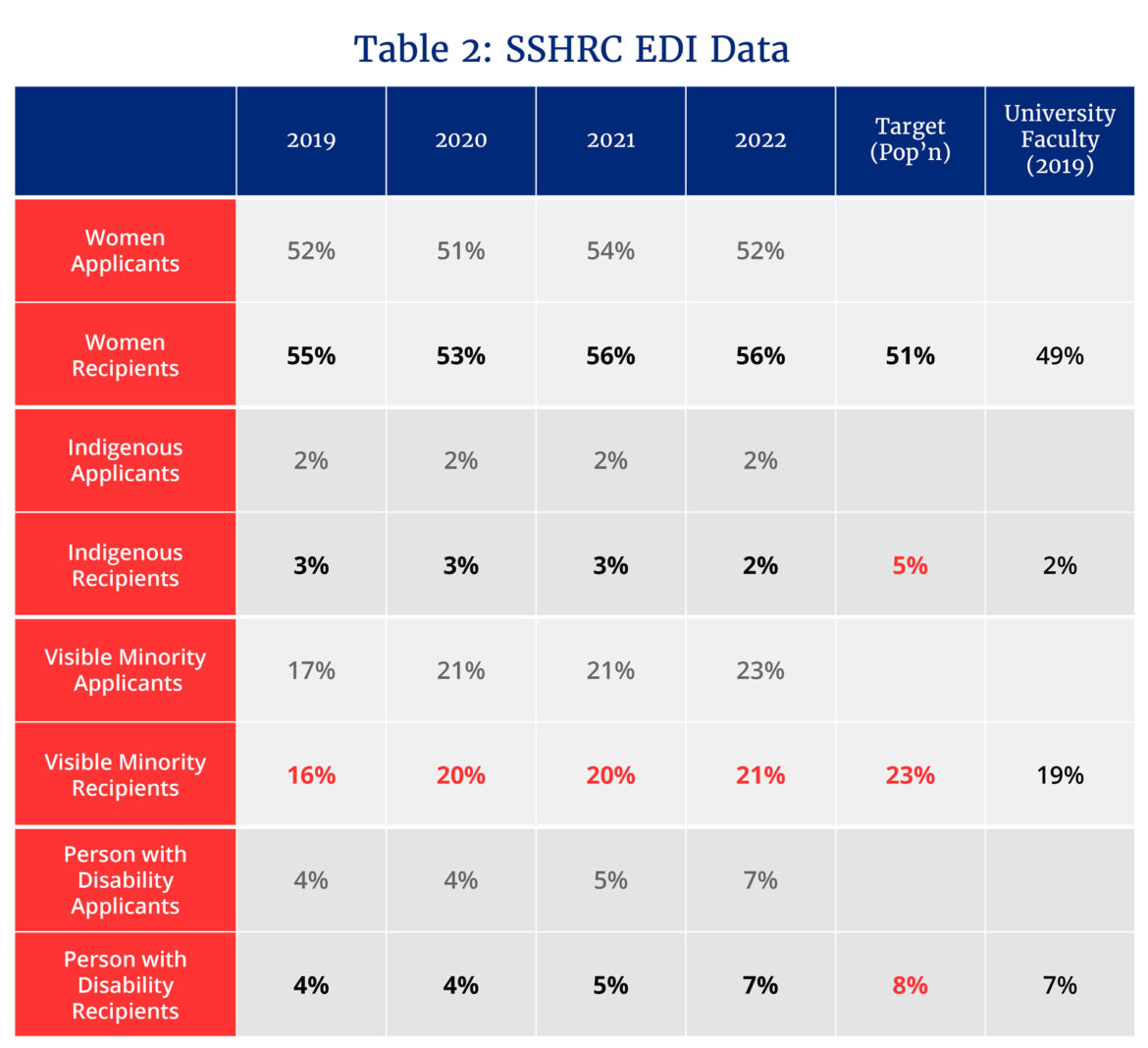
Table 2 provides these numbers alongside SSHRC’s equity targets for 2024/2025 and the groups’ proportion of Canadian university faculty as of 2019. Numbers in red show “under-performance” in the applicant-recipient ratio and SSHRC’s own targets.

Graphic credit: Janice Nelson

Four things are notable. First, only one of SSHRC’s four target groups (visible minority applicants) has been underrepresented in terms of the applicant-recipient ratio. Second, while women are the only group who have exceeded SSHRC’s equity target, the percentage of recipients has been growing rapidly for visible minority applicants and persons with a disability. Third, no target group is underrepresented relative to its proportion of university faculty members, with women (56 percent of recipients) especially outperforming their faculty proportion (49 percent). Finally, Indigenous grant recipients (2 percent) are underrepresented relative to their proportion of the overall population (5 percent), but not relative to their proportion of university faculty members.

Damaging the pursuit of truth

The above analysis leads me to three broad conclusions. First, while the language of EDI has permeated SSHRC, the federal agency oscillates between the “soft” EDI of affirmative action and the “hard” EDI of critical social justice activism. Most of the time, SSHRC focuses on achieving “equity targets” and frames EDI as complementary to research excellence. However, SSHRC’s new EDI-themed grants explicitly adopt activist language, and it is little wonder that those awards have been dominated by activist projects.  

Second, when it comes to the “soft” EDI of affirmative action, SSHRC’s policies are clearly having their intended effect for all groups except Indigenous Peoples. The number of grants awarded to women, visible minority applicants, and persons with a disability is rising. Grants are being awarded to members of these three groups at a proportion equal to or greater than their share of university faculty, and in the case of women, well above their share of the overall population. At this rate, it will soon be inaccurate for SSHRC to refer to “underrepresented groups” when it comes to prestigious national grants.

Finally, the “hard” EDI of critical social justice activism poses the biggest threat to SSHRC’s commitment to research excellence. While there are important critiques of the effects of “soft” EDI of affirmative action, it does not necessarily pose the same existential threat to research excellence. But the “hard” EDI of critical social justice activism is utterly incompatible with the objective pursuit of truth. One need only skim the titles of grants awarded under SSHRC’s two new EDI-focused initiatives to see how far they have strayed from the objective, empirical knowledge creation that we expect our national granting agencies to fund. Ironically, the more an award is pitched in terms of “diversity,” the less intellectually diverse the recipients seem to be. Thankfully, such activist research remains primarily confined to the new (and for now temporary) EDI-focused grants. 

If the federal government wants universities to keep the public’s trust, it should avoid any future activist-themed grants and ensure that granting agencies eschew social justice priorities. Federal granting agencies using taxpayer dollars should be explicit that their primary commitment is to promote excellence via the creation and dissemination of objective, falsifiable research knowledge. The university is supposed to function as a system of knowledge production. Policies that openly tie research to activist political ends threaten to undermine that very system.

Source: Dave Snow: The federal government is spending millions on equity, diversity, and inclusion research