Temporary residents in Canada rise to 2.8 million ahead of government restrictions

Highlights the challenges the government has in reversing growth that it encouraged and enabled:

The number of temporary residents in Canada swelled to 2.8 million in the first quarter, underscoring the challenge facing a federal government that is looking to restrict migration to the country.

Temporary residents – a group that includes international students, people here on work permits and asylum claimants – now comprise 6.8 per cent of the total population, up from 3.5 per cent two years ago, Statistics Canada reported on Wednesday.

Over all, the population grew by roughly 243,000 or 0.6 per cent during the first quarter, bringing the total to more than 41 million.

Canada is experiencing some of its fastest population growth in decades, fuelled almost entirely by immigration. The number of temporary residents has more than doubled over the past two years, raising concerns about Canada’s ability to welcome so many people, particularly in housing markets with low supply.

Source: Temporary residents in Canada rise to 2.8 million ahead of government restrictions

Chris Selley: TMU’s anti-Israel meltdown is a warning sign for Canada’s legal community

Cutting but all too accurate. Thanks agin to Robyn Doolittle and the Globe for the in-depth article:

….The “wording that questioned Israel’s legitimacy” was expressed in the letter as follows: “‘Israel’ is not a country.”

But … it is, though. That’s precisely what the signatories are angry about, isn’t it? This is the sort of non-argument you make through a megaphone out front of the student union when you’re, say, 19, not once you’ve invested tens of thousands of dollars in a legal education.

Some in the legal community worry about the free-speech implications of this metropolitan meltdown. On the bright side, these students have helpfully taken that concern out of play by indicating they’re happy to sign very sensitive documents that they haven’t read. There might be a place for them in future on Donald Trump’s legal team, but probably not at one of Canada’s top firms.

And hang on, what the hell is the point of a petition that isn’t public?

It’s as if these people thought they had enrolled in some kind of activist-lawyer fantasy camp, rather than an actual law school. Tough error to make, one would have thought, as it’s a bloody expensive fantasy camp: Upwards of $22,000 per annum; upwards of $25,000 if you’re from outside Ontario. How do you make it to law school not knowing actions have consequences?

Source: Chris Selley: TMU’s anti-Israel meltdown is a warning sign for Canada’s legal community

Islamisme et droits des trans, même combat ? Le grand paradoxe des campements pro-palestiniens

Some of these contradictions are truly hard to understand:

Les campements contre Israël et en soutien aux Palestiniens se sont multipliés sur les campus des universités occidentales, surtout canadiennes. Ils sont notamment installés à l’Université McGill, à l’Université de Toronto et à l’Université de la Colombie-Britannique.

Ils révèlent selon moi une tendance plus profonde que de simples circonstances géopolitiques.

Les étudiants et professeurs mobilisés pour soutenir la résistance palestinienne représentent un courant de radicalisation où la défense des droits LGTBQ+ et le radicalisme islamiste coïncident.

Je m’intéresse depuis un certain temps aux problématiques liées à la liberté universitaire et aux discours des groupes radicaux dans le contexte universitaire et l’éducation en général.

Les paradoxes du radicalisme

Il y a une contradiction apparente dans cette alliance entre des islamistes et des militants occidentaux pour les droits de la personne. On peut en effet penser que là où la charia, la loi musulmane, est appliquée, les personnes gays ou trans subissent de la répression, écopent de peine de prison et risquent même la mort (c’est le cas en Iran, en Arabie saoudite, en Afghanistan et dans d’autres pays musulmans). On pourrait dire la même chose de la situation des femmes dans des pays musulmans où leurs droits sont constamment bafoués.

Mais cela ne semble pas perturber les militants universitaires. Ils voient dans la résistance islamiste contre le sionisme le feu révolutionnaire nécessaire pour en finir avec l’Occident « hétéro-patriarcal », c’est-à-dire un supposé ordre social dominé par les hommes depuis la nuit des temps.

Michel Foucault, l’un des pères du postmodernisme qui inspire nombre de ces militants pro-palestiniens, avait exprimé le même enthousiasme dans les préludes de la révolution iranienne. L’athée homosexuel de gauche qu’était Foucault écrivait avec une vision presque prophétique en 1979 sur les conséquences de la révolution islamique naissante :

En effet, il est exact de dire qu’en tant que mouvement « islamique », il peut incendier toute la région, renverser les régimes les plus instables et perturber les plus solides […].

Dans une chronique plus récente sur le campement à l’Université de Turin, le journaliste Stefano Cappellini observait :

Dans la salle de classe occupée de l’université, les étudiants accroupis écoutent l’imam qui glorifie le jihad. Pas le jihad coranique, la tension morale vers la pureté religieuse. Précisément la guerre sainte du jihad, la destruction physique des infidèles […] alors qu’autrefois le motif politique de la solidarité pro-palestinienne était la communauté d’objectifs, aujourd’hui c’est l’adoption des objectifs des autres : des filles et des garçons suspendus aux lèvres d’un homme religieux qui, au fond, les enrôle dans une guerre sainte dont ils pourraient potentiellement être eux aussi de futures victimes ».

Plusieurs signes confirment la confluence du radicalisme de gauche et des revendications de l’islamisme palestinien. Beaucoup d’entre eux participent au discours mondial très uniforme et synchronisé des militants pro-Hamas dans les universités. C’est également le cas dans leurs omissions ou non-dits, selon le linguiste Oswald Ducrot, qui a fait des contributions significatives à l’analyse du discours. Ainsi, les silences « stratégiques » dans le discours des militants pro-palestiniens cachent les aspects du conflit qui ne vont pas dans la direction idéologique de leur rhétorique.

Les mêmes slogans partout

La diabolisation du sionisme, le mouvement national qui prônait la création d’un État juif sur la terre d’Israël où la nation juive est née, est le thème qui unit la rhétorique de ces universitaires.

Les slogans que l’on entend et lit sur les campus universitaires sont simplistes, mais choquants : « Le sionisme est le nazisme » (l’inversion des rôles de victimes et de victimaires) ; « Le sionisme est du racisme » (une vieille accusation promue par la défunte URSS qui a pris de l’ampleur parmi les radicaux d’aujourd’hui) ; « Le sionisme est génocidaire » (les exterminés deviennent des exterminateurs).

Autre expression récurrente : « Le sionisme est colonialiste » : les Juifs seraient des « Européens blancs » qui auraient colonisé les terres des « vrais » aborigènes palestiniens, même s’il est bien connu que des milliers de musulmans égyptiens, algériens et bosniaques ainsi que des Circassiens ont émigré vers la Palestine ottomane au XIX siècle. Bien que cela soit nié par plusieurs, il s’agissait alors d’un territoire assez dépeuplé, en raison de son manque d’importance commerciale pendant l’occupation ottomane, des dures conditions de vie dans le désert, ainsi que des marais infestés par la malaria.

Boycotter Israël

L’autre stratégie discursive exige que les universités mettent un terme à leurs relations de coopération et d’échange avec leurs pairs israéliens et cessent d’investir leurs fonds dans des entreprises liées à Israël. Cette initiative suit la même logique du Boycottage, Désinvestissement et Sanctions promu par des groupes pro-palestiniens, et ce bien avant le conflit actuel à Gaza.

Il y a ceux qui ont réussi à exclure des professeurs sionistes de l’université, comme cela s’est produit à l’Université de la République en Uruguay.

Des omissions significatives

Le discours de la résistance comporte aussi des omissions significatives. Le massacre et les horreurs du 7 octobre 2023 perpétrés par le Hamas et le Jihad islamique ne sont pas évoqués ou sont minimisés. Pour ces militants de gauche radicale, il n’existe pas d’otages israéliens, vivants ou morts. Leur silence l’est autant sur la participation du régime iranien, lequel apporte un soutien financier et logistique en matière de renseignement et d’armement aux islamistes palestiniens, ou du Qatar, le principal bailleur de fonds de Hamas.

Il n’y a aucune mention du rôle déstabilisateur du Hezbollahdans la région, une milice pro-iranienne qui attaque le nord d’Israël. Aucune mention non plus des attaques terroristes du Hamas survenues lors de la seconde Intifada (2000-2005).

Un phénomène générationnel

Les racines du conflit israélo-palestinien remontent à plus de cent ans et couvrent toute l’histoire du XXe siècle. Il comprend les horreurs de l’Holocauste et la collaboration avec les nazis du grand mufti de Jérusalem, Amin Al-Husseini, qui s’est installé à Berlin pendant la Seconde Guerre mondiale pour faire la propagande anti-juive en arabe.

Il y a eu aussi l’exode des communautés juives des pays arabes, soumises à des persécutions, des attaques et dans certains cas des expulsions (des centaines de milliers de ces réfugiés juifs ont été intégrés dans l’État d’Israël). Mais la nouvelle génération d’étudiants ne connaît pas cette histoire.

En outre, notamment dans le cas des universités aux États-Unis et au Canada, une population plus diversifiée sur le plan social et ethnique est entrée dans les universités, modifiant ainsi la composition démographique des campus. Elle inclut des groupes qui étaient soit marginalisés (par exemple, des populations « racisées ») ou peu représentés dans les universités. Sous l’influence des politiques identitaires, qui s’expriment aujourd’hui dans les initiatives de diversité, d’équité et d’inclusion (DEI), certains jeunes ont tendance à voir le monde sous l’angle de la dualité des oppresseurs et des opprimés.

Le rôle des réseaux sociaux dans ces mobilisations ne peut pas non plus être exclu. Ces plates-formes façonnent la perception des conflits dans le monde avec leur charge de désinformation, leurs images terribles (parfois manipulées) et leur forte émotivité qui suscite l’indignation.

Les étudiants chantent « du fleuve à la mer », c’est-à-dire que tout le territoire de la Palestine (y compris celui d’Israël avant la guerre de 1967) soit libéré des Juifs souverains. Il s’agit de la réalisation du rêve islamiste de garder les Juifs comme dhimmis, le mot en arabe qui les désigne comme des sujets de seconde classe. N’excluons cependant pas que les jeunes ne comprennent même pas ce qu’ils chantent. Ce serait très typique de cette époque d’ignorance « informée ».

Source: Islamisme et droits des trans, même combat ? Le grand paradoxe des campements pro-palestiniens

Dejean | Faut-il tolérer la tenue d’activités religieuses dans l’espace public?

The latest Quebec religion/laïcité debate:

Une prière organisée le dimanche 16 juin par une communauté musulmane dans le parc des Hirondelles (Ahuntsic-Cartierville) a suscité une controverse, au point que la mairesse de l’arrondissement est allée en ondes pour justifier la tenue de l’événement. Il faut souligner qu’il ne s’agissait pas d’une première fois, mais la diffusion sur les réseaux sociaux d’une vidéo montrant des musulmans, en marge d’un rassemblement en soutien à la Palestine, priant aux intersections de Stanley et Sainte-Catherine n’est sans doute pas étrangère à la controverse.

Ces deux événements posent plusieurs questions : faut-il tolérer la tenue d’activités religieuses dans l’espace public ? Et si oui, à quelles conditions ? Et parmi les traditions religieuses qui organisent des activités religieuses dans l’espace public, l’islam fait-il l’objet d’un traitement différentiel ?

Dans une chronique en date du 12 juin, Richard Martineau déclarait : « Imaginez des gens avec des croix qui décident, eux autres, en plein milieu du centre-ville de Montréal, ils arrivent et puis ils prient avec des croix et puis Jésus et puis tout ça. On aurait raison de dire : “ça, c’est des crinqués”. Les gens diraient : “L’extrême droite chrétienne, l’extrême droite catholique, ça a pas de bon sens.” »

J’invite donc le chroniqueur à participer le 13 juillet prochain à La marche pour Jésus, qui correspond précisément à ce qu’il décrit. Lors de l’édition de 2023, plusieurs centaines de chrétiens — majoritairement protestants évangéliques — défilaient dans le centre-ville de Montréal (sur René-Lévesque et Sainte-Catherine), distribuaient des dépliants qui invitaient les passants à « donner leur vie à Jésus », tandis que des haut-parleurs diffusaient de la musique pop chrétienne. Étrangement, personne ne s’en est ému.

De la même façon, la présence de membres de l’Association internationale pour la conscience de Krishna, plus connus sous le nom des « hare krishna » en référence au mantra que les fidèles scandent en musique, à proximité de certaines stations de métro de Montréal ou encore les opérations de prosélytisme de prédicateurs évangéliques dans les transports en commun ne suscitent pas vraiment de réaction.

La controverse autour de la prière dans le parc des Hirondelles, tout comme La marche pour Jésus ou encore les nombreuses processions organisées par des groupes religieux à proximité de leurs lieux de culte, remet sur le devant de la scène la question de savoir si l’expression collective du religieux doit être autorisée dans l’espace public. Quand un chroniqueur comme Richard Martineau, dans la même chronique que celle citée précédemment, déclare : « Que tu pries dans une mosquée, que tu pries chez toi, j’en ai rien à foutre. Mais prier dans la rue, c’est une manifestation de force, c’est un symbole », il se positionne en faveur d’une limitation du religieux à l’espace domestique ou cultuel.

Cette position, assez courante, se fonde sur l’idée que la neutralité de l’État passe nécessairement par l’évacuation de toute manifestation religieuse de l’espace public. Une telle idée est rendue possible par l’ambiguïté de l’expression « espace public », à la fois « sphère publique » (domaine du politique et de la discussion démocratique) et espace géographique de circulation ouvert à toutes et tous (les rues, les places, les parcs…).

Si la laïcité implique bien une neutralité de la sphère publique envers les différentes traditions religieuses, il n’en va pas de même de l’espace public au sein duquel les différentes visions du monde (notamment religieuses) peuvent s’exprimer librement, dans les limites de ce qui est autorisé par la loi. Il serait d’ailleurs malvenu dans une société libre et démocratique que l’État en vienne à réguler l’expression des convictions de ces citoyennes et citoyens.

Pour autant, faut-il accepter toutes formes d’expression collective du religieux sur la base du respect de la liberté de conscience et de religion énoncées dans les chartes ? Il apparaît que non, et l’on a tendance à oublier que le premier article de la Charte des droits et libertés de la personne rappelle que ceux-ci ne sont pas absolus et peuvent être restreints « dans des limites qui y sont raisonnables et dont la justification peut se démontrer dans le cadre d’une société libre et démocratique ».

Ajoutons que, sur un plan pratique, la Ville de Montréal possède un Règlement concernant la paix et l’ordre sur le domaine public qui permet d’encadrer la tenue d’activités, quelle qu’en soit la nature. Par exemple, l’article 10 stipule que « l’initiateur ou l’organisateur de tout défilé, parade, procession, marathon, tour cycliste, doit présenter au directeur du Service de la circulation et du transport une demande d’autorisation à cette fin, au moins 30 jours avant la date prévue pour l’événement ». Sur cette base, il est possible d’évaluer de façon objective les conséquences, et les nuisances potentielles, de la tenue d’activités dans l’espace public.

Frédéric Dejean est professeur au département de sciences des religions de l’Université du Québec à Montréal.

Source: Idées | Faut-il tolérer la tenue d’activités religieuses dans l’espace public?

More reasonable, IMO, than the contrary view expressed by Nadia El-Mabrouk and the Rassemblement pour la laïcité: Idées | Les parcs ne sont pas des lieux de culte

RCMP surprised hate groups are “increasingly racially diverse”

Always interesting to see how organizations operationalize specific laws, regulations and policies. Pretty thorough information kit and their assessment is reasonable. One pet peeve, absolute numbers rather than numbers per thousand of people is less helpful in assessing the extent even if many hate crimes and incidents are not reported.

The RCMP is surprised that hate groups in Canada are recruiting racialized people and becoming increasingly ethnically diverse

In a report on hate crimes and incidents released this year, the RCMP noted about a notable shift in the racial diversity of individuals joining what it calls “hate groups.” 

The RCMP defines a “hate group” as any organization or collection of individuals “whose goals and activities attack or vilify an entire group of people on the basis of colour, race, religion, national or ethnic origin, age, sex, sexual orientation, gender identity or expression, or mental or physical disability.”

In its report, the RCMP blames the “rise of populist politics and the normalization of racist and incendiary political rhetoric” on the rise of said groups without pointing to specific examples.

The RCMP notes that while hate groups are still “overwhelmingly white and male” there’s been a recent shift in the demographic. 

True North reached out to the RCMP for comment but did not receive a response. 

“People who join hate groups come from all socioeconomic backgrounds, professions, and, perhaps surprisingly, they appear to be increasingly racially/ethnically diverse,” the report reads. 

“In recent years, some hate groups in the United States and Canada have actively recruited members from racialized groups in an attempt to soften their public image and bolster recruitment.”…

Source: RCMP surprised hate groups are “increasingly racially diverse”

Full report: Facts, Trends and Information for Frontline Police Officers

A new law will finally grant citizenship to ‘lost Canadians’. Are we ready for the consequences?

Good questions and the answer would appear to be no, judging by the lack of analysis of the possible impacts by the Minister. Like any changes in citizenship or immigration policies, persons can be expected to respond to any perceived incentives provided by the change and IRCC needs to present any analysis during parliamentary consideration of C-71, not the subsequent regulatory stage.

Past experience with responding to “lost Canadians” and expanding voting rights suggests that the number of “lost Canadians” who want to be “found” is small subset of the total expatriate population, particularly for those living in the USA. But given the increased diversity of Canadian expatriates, that may be changing:

Last week, faced with a court-imposed deadline, Immigration Minister Marc Miller introduced new legislation that would automatically give citizenship to people born outside of Canada to Canadian parents, as long as the parents have lived here for a cumulative 1,095 days before the child’s birth.

The legislation, Bill C-71, will correct the arbitrary creation of a generation of ”Lost Canadians”. Under the current Citizenship Act, subject to a few notable exceptions, a person born outside of Canada would only be a Canadian citizen if their parents were either born in Canada, or naturalized in Canada. If their parents were born outside of Canada and became a Canadian citizen through their own parents, they did not qualify for Canadian citizenship by descent.

A particular blind spot was border babies. For example, a mother in Point Roberts, Wash., may give birth in British Columbia, while a mother in Emerson, Man., might give birth in North Dakota, simply because it is the nearest hospital to her. If those mothers were born outside of Canada, their babies would not have had automatic Canadian citizenship. 

Unlike their Canadian counterparts, however, American parents in border communities do not have to worry about where they themselves were born. Under U.S. citizenship law, if either parent meets the prescribed residency requirements (five years with at least two years after the age of 14), their child will be American. While there is some disagreement with Canada’s adoption of a less burdensome cumulative 1,095 day rule, we see it as similar to the American law. Both legislation mirror the residency requirement for naturalization and ensure a substantial connection to the country is met.

While advocates are rightly celebrating this “monumental” change for cross-border families, as immigration lawyers we have mixed feelings in light of the current political environment. Will the Canadian public “open their arms” towards the potentially untold number of U.S. residents who can now claim Canadian citizenship?

Removing outdated values and addressing historic wrongs in citizenship law

As the Senate argued in 2007, the current Citizenship Act relies on past legislation, which was built on outdated values. For example, gender and marital status played a major role in determining who was or wasn’t Canadian. Bill C-71 is likely to be the first legislation that does not consider gender or marital status.

Bill C-71 also addresses racial discrimination in the Citizenship Act. Bill C-71, would for example rightfully restore citizenship to the descendants of Japanese-Canadians, who were interned and deported during the Second World War.

Bill C-71 would also restore citizenship to those who lost it because they did know they had to meet retention requirements by their 28th birthday

These changes are long overdue. The Citizenship Act historic issues were first identified by the Supreme Court of Canada in 1997.

All these above changes are positive as they add greater coherence to the law, bridging past shortcomings with a forward-looking lens to safeguarding Canadian citizenship.

Encouraging Canadians to Return to Home

Bill C-71 could play a role in encouraging Canadian families with young children born abroad to return home. A government study found that over half of Canadians abroad are citizens by descent. Bill C-71 would allow these families to avoid the difficult processes for sponsoring their children as permanent residents because they would automatically become Canadian citizens.

It is also important to contextualize that the citizenship rules that created “Lost Canadians” was itself the product of resistance within Canada to recognizing citizens abroad attempting to return home — in particular, a public backlash to the government evacuating Canadian citizens from Lebanon in 2006. It’s important to recognize that this new legislation comes at a time when anti-immigration sentiment is on the rise and to interrogate the 180-degree motivation shift.

While much of the support for these changes has come from U.S. cross border families, we have noticed the brunt of the online discussion about the potential law change surrounding Asian birth tourism and allegations of elaborate family schemes for descendants to claim a right to Canadian citizenship.

The reality is the flood gates might open to more Canadian citizens — but the bulk will not come from Asia. Based on our reading of this current bill, anyone who descends from a person that was born or naturalized in Canada before this bill comes into force would qualify for Canadian citizenship and the vast majority of those people are American.

This can be supported not just by anecdotal data from our own practices, but also statistics. According to the Vermont Historical Society, 20 per cent New Englanders are of French Canadian descent. This is only descended from French Canadians; The fact is we do not know how many Canadians of descent live in the United States.

Considering the more affordable post-secondary tuition in Canada for citizens (including those by descent), and our more generous social programs, such as publicly funded health care, this may become a pull factor for Americans, both young and old, to claim Canadian citizenship — in fact one of the reasons Americans claim their Canadian citizenship.

Our recommendation is that, notwithstanding political pressure to possibly pass this bill quickly, the government takes a collaborative approach that consensus-builds, not consensus-divides on the topic of citizenship. Future work must centre both ameliorating historical wrong but also strengthening a conception of Canadian citizenship that reflects modern day transnationalism beyond unpredictable shifts in domestic political values.

This process may result in amendments that impose some limits, or add additional residence obligations for Canadian citizenship, but it is one we hope will give Canada coherent and predictable legislation on who is a Canadian citizen.

Amandeep Hayer and Will Tao are immigration lawyers based in British Columbia.

Source: A new law will finally grant citizenship to ‘lost Canadians’. Are we ready for the consequences?
Christopher Dummitt: Four ways Pierre Poilievre and the Conservatives can fight woke ideology 

Suspect some of these ideas are being seriously considered by the Conservative Party in planning for a likely change in government. In an ideal sense, this would lead to a new thesis, anti-thesis and synthesis, reversing some of the excesses of the current government while recognizing that greater attention to diversity and inclusion issues was needed to address representation and other gaps.

However, it is more likely that the temptation will be to wade into such “cultural war” virtue signalling given its appeal to their base and the lesser importance of these issues to Canadians compared to housing, healthcare, infrastructure, foreign interference etc. Checking and rating candidates for political viewpoints raises any number of issues whether with respect to right or left-wing views.

But Kaufmann and Dummitt should know better the risks of simply replacing one dominant ideological tendency with another rather. Interesting that they choose that approach rather than arguing for a “merit-based” or more balanced approach., suggesting the intent is as much ideological than arguing for of …Kaufmann outlines a 12-point plan but I’ll simplify it to four points and a coda.

I have sympathy for the view that the pendulum has shifted too far and that a rebalancing is needed but not convinced that some of these ideas are workable or lead to an improved syntheses:

Insist on politically neutral institutions

Conservatives should take the high ground and insist on politically neutral institutions. In everything from the CBC/Radio Canada to university research funding and heritage institutions, the government should enshrine political neutrality. This means not disseminating politically divisive concepts like “white privilege” or claiming that psychological “harm” can override free speech.

Even though some conservatives might not agree, the BBC in the U.K. could be a model. I used to live in London and attend live tapings of topical radio comedy shows. For every joke they did about one political party or idea, they had to have another taking on the other side. It was sometimes over the top—certainly, the comedians poked fun at it—but the emphatic insistence on equal treatment mattered. Right up and down the public service, a new conservative government should insist on politically neutral institutions and the end of spreading woke ideas “on the sly” through the seemingly neutral dissemination of leftist ideas. If an overwhelming majority of the public accepts these ideas—only then should they be taken up by public institutions.

Redo DEI to include political viewpoints

Kaufmann thinks that while it might be tempting to get rid of DEI this probably isn’t feasible. What is possible is to insist that it be done right. Any institution that wants to hire based on categories of identity must include political viewpoint as an equity category. Many of our institutions, especially but not only universities, are now left-wing monoliths. A Conservative government should insist that this obvious lack of diversity be tackled right alongside other issues.

A Conservative government should also insist that DEI be done accurately. That is, it can’t be done by comparing the share of a certain group’s place in a profession, like engineering, with their share in the general population. It should instead be based on that group’s share in the applicant pool. We should try to identify where the problem arises. Are discrepancies happening because of actual discrimination in hiring or are there just not enough applicants? If there aren’t enough applicants, deal with that problem (if indeed it is a problem). We shouldn’t expect every group’s share of the population to be exactly replicated in every field of work. Only if we have evidence of discrimination should discriminatory hiring quotas be implemented.

Focus on national belonging

Different groups of Canadians will find different parts of the Canadian story more meaningful. Maritimers will likely be more interested in our seafaring heritage. African Canadians might take more pride in Canada’s place as one part of the Underground Railroad (though others will of course be fascinated too). But our national heritage institutions should stop focusing on what divides us and instead embrace what brings us together.i

It doesn’t mean overlooking our blind spots. However, it does mean interpreting them correctly. A Conservative government should insist that those dark places in the Canadian record be considered from a global perspective. We should get rid of woke parochialism which exclusively focuses on Canadian and Western sins. When dealing with issues like colonialism and violence, heritage institutions must be made to interpret these parts of our history in line with the existence of worldwide non-Western forms of slavery, imperialism, and violence including among pre-contact Indigenous peoples.

This means embracing a “retain and explain” cultural policy where the assumption should be that names, statues, and other honorifics are retained except in very exceptional circumstances. What’s more, explanations cannot be one-sided accounts but must interpret figures and events within their global context.

 Remember it’s about the people

Given that so many of our institutions have been taken over by woke activists and their liberal sympathizers, a new Conservative government should make it a priority to restaff the boards and institutions to achieve political diversity. Time and again, conservative governments are stymied because the actual people in the public service align with non-conservative beliefs. This means working on two fronts.

First, find and appoint non-woke political candidates to cultural and public service institutions across the country. The goal is political balance. Second, and this is where Kaufmann really focuses, conservatives need to build pipelines to ensure that when a government goes looking for people, they can find qualified and trained individuals. This means creating a Federalist Society for the public service—the equivalent of that highly influential American conservative legal organization that funnels law students and ideas into the American legal system. Similarly, we need an Austrian School for culture—a conduit for woke-critical ideas in our university world that can generate an idea base that can serve as the cultural equivalent to what the Austrian School did for economic liberalism.

Coda

Finally, a coda. All of the above will help and can be put into action. But Kaufmann also has one final and important bit of advice that can be done right now. Stop using the woke language. Rip off the velvet glove and expose the radioactive illiberalism that lies beneath.

This means insisting on using evocative words and images. Unless there is specific evidence that a particular institution has been discriminatory, when that institution hires based on DEI quotas this should be called out for what it is: anti-White or anti-Asian or anti-male or anti-heterosexual prejudice. Unmask the language of equity to show the discriminatory and vengeful impulse at its heart.

Don’t accept the language of “gender-affirming” care when we are talking about giving adolescents drugs that might chemically castrate them. When people want to bind young girls’ breasts or surgically remove them, describe it for what it is: gender-based violence. Use vivid imagery like pictures of the outsized prosthetic breasts of the Toronto area teacher who caused such controversy recently. Canadians support liberal non-discrimination. They want a country that accepts all its citizens. But they also can smell when something is foul and conservatives need to be sufficiently brave and clear to point out when woke ideas are illiberal.

What all of this means is that modern social conservatism can look a lot different from the Liberal attack-ad caricature. A new Conservative government could stand for policies that treat all Canadians equally, could enshrine politically neutral public institutions, and could show pride in our national history and culture. These aren’t just defensible shield issues; they are worth going on the attack to promote.

Source: Christopher Dummitt: Four ways Pierre Poilievre and the Conservatives can fight woke ideology

J.J. McCullough: How you’re supposed to talk about immigration in Canada—and how Poilievre is poised to capitalize 

Another late to the party commentary.

I agree, however, that the Conservatives have greater licence to engage in immigration policy, not only because of the various commentary noting the need for a more measured approach but also because the Liberal government has largely accepted (or ceded) the arguments and is walking back some of its more ill-advised policies.

And even the Century Initiative appears to be flailing around, trying to remain relevant, when their fundamental premises are largely discredited:

…All this puts the Conservatives under Pierre Poilievre in an interesting position. The Canadian press, and thinky class more generally, has created a permission structure for him to run for prime minister on a platform of reducing immigration without fear of being characterized as a racist fearmonger. Polls suggest over 60 percent of Canadians both want and expect him to do this. Yet Poilievree himself has so far avoided articulating the extent to which he agrees; at his tightly scripted rallies he has no standard immigration-related applause line.

It’s possible his party is still captive to the legends of the Harper years—that they believe immigrant voters are “their” constituency to lose, and Conservatives must therefore tread lightly on rhetoric that could be seen as anti-immigrant. Despite a clearly changing tone in media coverage, the party might also simply not trust the press to accurately characterize a restrictionist Conservative immigration plan, and thus feel there’s no PR incentive to spend much time talking about the issue when they’re already enjoying such a solid lead in the polls.

Or, and perhaps most likely, Poilievre simply wants a restrictionist immigration agenda to be something he can roll out at a more politically opportune time—closer to the official fall 2025 election campaign when Canadians will be paying the most attention, and will be most aware of his promises.

Yesterday’s political taboo could be tomorrow’s ace in the hole.

Source: J.J. McCullough: How you’re supposed to talk about immigration in Canada—and how Poilievre is poised to capitalize

StatsCan: Recent immigrants report greater difficulty making ends meet and are less satisfied with their amount of free time

Of note (albeit not surprising):

According to the most recent data from the Survey Series on People and their Communities (SSPC), in April 2024, slightly over 3 in 10 Canadians (31%) found it difficult to meet their financial needs in terms of transportation, housing, food, clothing and other necessary expenses in the past 12 months. During this period of higher living costs, Canadians may also need to work more hours to make ends meet. Indeed, about one-third (31%) of Canadians reported having a high level of satisfaction with the amount of free time they had to do the things they like.

Not all individuals are experiencing this period of economic contraction equally. Recent immigrants, for example, often report experiencing income-related challenges, which may affect their level of satisfaction with free time. Canada has admitted record numbers of immigrants in recent years, and to better understand the experiences of recent immigrants, this release presents an analysis using the April 2024 wave of the SSPC: Social Cohesion and Experiences with Discrimination.

Recent immigrants report having greater difficulty meeting their financial needs during the past 12 months

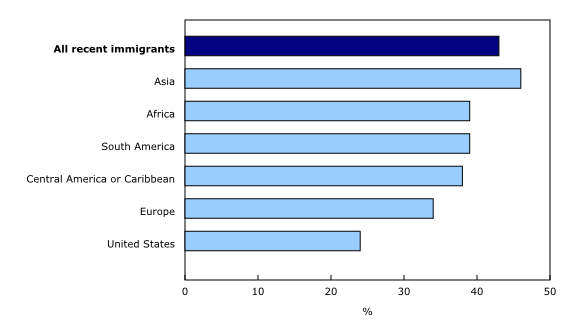
Recent immigrants (defined in this release as those admitted in 2005 or after) often face unique economic challenges in adapting to a new country and were more likely to report having greater difficulty in making ends meet. Specifically, in April 2024, a larger proportion of recent immigrants (43%) reported finding it difficult or very difficult to meet their financial needs over the past 12 months, compared with more established immigrants (29%) and non-immigrants (29%). Similarly, non-permanent residents were more likely to report finding it difficult or very difficult to make ends meet (37%) than non-immigrants.

Not all immigrants share the same economic experiences when arriving in Canada. In April 2024, while newcomers from the United States (24%) and Europe (34%) were the least likely to report experiencing financial difficulty in the past 12 months, newcomers from other regions were more likely to experience hardship during this transition. In general, newcomers arriving from Asia (46%) reported having the highest level of difficulty making ends meet. Some of these differences may be related to category of admission, which was not considered in this study.

Chart 1 
Percentage of recent immigrants (arriving since 2005) who reported having difficulty meeting financial needs over the past 12 months, by region or country of birth, Canada, April 2024

Chart 1: Percentage of recent immigrants (arriving since 2005) who reported having difficulty meeting financial needs over the past 12 months, by region or country of birth, Canada, April 2024

Racialized Canadians, especially racialized immigrants, are more likely to report experiencing financial difficulty 

Previous studies have shown that racialized Canadians may face greater economic uncertainty and, therefore, may have a more difficult time meeting their financial needs than non-racialized Canadians. In April 2024, West Asian (48%), South Asian (43%), Latin American (42%), Black (40%), Arab (38%) and Filipino (35%) Canadians were more likely to report having difficulty meeting their financial needs in the past 12 months than the non-racialized, non-Indigenous population (28%). In contrast, Chinese Canadians (22%) were the least likely to report experiencing financial difficulty in the past 12 months. 

Most of these observed differences are related to also being an immigrant. In April 2024, most Canadian-born racialized people reported having a similar experience as Canadian-born non-racialized people in Canada. For example, 28% of South Asian people born in Canada reported having difficulty making ends meet, the same proportion as the non-racialized, non-Indigenous population. However, nearly half (47%) of South Asian immigrants reported having difficulty making ends meet in the past 12 months. These results highlight the importance of understanding financial difficulty through a lens of intersectional identities, including experiences of immigration. 

Recent immigrants are less likely to report having satisfaction with their amount of free time

Economic challenges may lead to work-life balance conflicts, if workers need to work more hours, and potentially reduced satisfaction with the amount of free time available. As of spring 2024, 40% of Canadians who did not report having difficulty making ends meet also reported having a high level of satisfaction with their amount of free time. However, 12% of people who experienced difficulty making ends meet in the past 12 months reported having a similar level of satisfaction. 

In April 2024, more recent immigrants to Canada reported having lower satisfaction with their amount of free time than immigrants who had arrived earlier and non-immigrants. In fact, 23% of recent immigrants said that that they had a high level of satisfaction with their amount of free time, compared with 33% of more established immigrants and 32% of non-immigrants. About 27% of non-permanent residents reported having high satisfaction with their amount of free time.

Not all newcomer groups experienced similar levels of satisfaction with their amount of free time. For instance, in April 2024, newcomers from Asia were the most likely to report having financial difficulty and were one of the least likely to report having satisfaction with their free time (22%). In contrast, despite being the least likely to report experiencing financial difficulty, recent immigrants from Europe were among the least likely to report having a high level of satisfaction with their free time, at 20%. 

Further, in April 2024, recent immigrants from the United States (32%) were as likely to report having high satisfaction with their amount of free time as non-immigrants. These results indicate that satisfaction with amount of free time may depend on many other factors that were not measured by this study, including work-life balance, cultural perception of free time, family structure and supports, and personal outlook. 

Source: Recent immigrants report greater difficulty making ends meet and are less satisfied with their amount of free time

IRCC introduces interim measure allowing some foreign nationals to gain Canadian citizenship faster

Pending legislative approval of C-71, the tabled bill that essentially abolishes the first generation limit, and responding to the timeline of the court.

IRCC’s new measure applies to those who have applied for proof of citizenshipunder urgent processing, and may be impacted by the FGL (First Generation Limit) by descent. Specifically, it will apply in either of the following scenarios:

  • Scenario One: The applicant has submitted a proof of citizenship application that would be subject to the FGL rule change, and has requested urgent processing in accordance with urgent processing criteria; or
  • Scenario Two: The applicant has a proof of application in process and IRCC has identified that the application is impacted by the FGL rule. The application had previously been de-prioritized until new rules come into effect, but the applicant has since requested urgent processing.

In both of these circumstances IRCC will respond to and review the request, in addition to verifying an applicant’s eligibility for urgent processing.

If an applicant is eligible, they will receive a notice from IRCC that the FGL rule is still currently enforced. The department will also give eligible applicants the option to request a “discretionary grant of citizenship”* with relevant information for how to apply for this grant.

If an applicant chooses to apply for this grant, their application will be processed by the Immigration Minister, or delegated decision maker. If the application satisfies necessary criteria, applicants can be granted citizenship.

*The Immigration Minister has the authority under Canadian law to grant citizenship to individuals in special or exceptional cases.

Who is eligible for urgent processing?

IRCC allows three groups of citizenship certificate (a crucial document in proving one’s Canadian citizenship) applicants to apply for urgent processing.

To be eligible for urgent processing of a citizenship certificate, applicants are required to prove they need urgent processing for one of the following three reasons:

  • The applicant needs to access benefits, including but not limited to: a pension, health care, or their Social Insurance Number (SIN)
  • The applicant needs to prove they are a Canadian citizen to get a job
  • The applicant needs to travel to or from Canada due to a death or serious illness in their family

Note: IRCC clarifies that the department cannot guarantee applicants will receive their citizenship certificate on time, even if they qualify for urgent processing.

Source: IRCC introduces interim measure allowing some foreign nationals to gain Canadian citizenship faster