Google diversity report highlights white male workforce

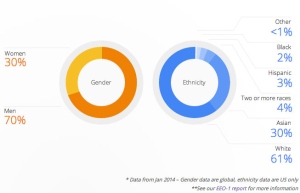
google-diversity-dataInteresting piece on Google’s efforts to increase diversity. The problem applies to much of the tech industry:

Gender and ethnic disparities are reflected throughout the tech industry. About seven per cent of tech workers are black or Latino in Silicon Valley and nationally. Blacks and Hispanics make up 13.1 and 16.9 per cent of the U.S. population, respectively, according to the most recent Census data.

In the coming months, Google said, it will work with the Kapor Center for Social Impact, a group that uses information technology to close gender and ethnic gaps in the Silicon Valley workforce. The centre will be organizing a Google-backed conference in California focusing on issues of technology and diversity.

Co-founder Freada Kapor Klein, who started the Level Playing Field Institute 13 years ago to teach and mentor black and Latino students in science and math, said Google is showing leadership “which has been sorely needed for a long time.”

“Google is the company known for the moonshot, and applying that part of Google DNA to this problem is a breath of fresh air,” she said.

Google diversity report highlights white male workforce – World – CBC News.

Younger Canadians hold more negative views about religious groups – CRRF

Further to an earlier release of the CRRF and ACS Survey on Religion, Racism and Intergroup Relations in Canada Shows Differences in Attitudes Among Anglophones, Francophones and Other Groups, a further release pertaining to attitudes to religious diversity by age group. Remarkably consistent across religions, except for Muslims:

Table 1: Negative attitudes towards certain groups, according to age groups
 Negative Opinion

Total

18-24

25-34

35-44

45-54

55-64

 Muslims 44% 43% 45% 40% 43% 40%
 Jews 19% 24% 25% 20% 15% 15%
 Protestants 15% 24% 23% 14% 15% 8%
 Catholics 19% 25% 25% 22% 18% 13%
 Atheists/Agnostics 21% 14% 18% 21% 21% 22%
 Religious 31% 36% 33% 31% 31% 27%
 Immigrants 24% 24% 27% 24% 30% 16%
 Aboriginals 26% 26% 26% 25% 29% 22%

Younger Canadians hold more negative views about religious groups

Whereas on diversity in general, young people are more supportive than older age groups, as another relatively recent study by ACS shows:

Do you have a very positive, somewhat positive, somewhat negative or very negative opinion of Canadian Multicultural Policy
Total 18-24 25-34 35-44 45-54 55-64 65 + French English Other
TOTAL positive 58% 74% 61% 61% 56% 54% 47% 48% 60% 67%
Very positive 15% 34% 18% 15% 10% 12% 8% 8% 14% 26%
Somewhat positive 43% 40% 43% 46% 46% 42% 39% 40% 46% 41%
TOTAL negative 35% 14% 29% 33% 35% 39% 50% 45% 32% 28%
Somewhat negative 23% 7% 19% 24% 25% 25% 33% 29% 22% 18%
Very negative 12% 8% 10% 9% 11% 14% 17% 16% 10% 11%
I prefer not answering 7% 11% 10% 6% 9% 7% 3% 7% 8% 5%

Younger Canadians Believe Multiculturalism Works; Older Canadians, Not So Sure 

I expect a further breakdown by region (urban vs rural, QC vs ROC), cross-referenced to more broad-based attitude polling, may cast more light, or it may simply reflect that younger people, in general, may be less religious.

No surprise, and consistent with other surveys, distrust of Muslims is higher than other religions (they did not ask about Sikhs which generally “rate” between Muslims and other religions). There may be a link between the categories “religious” and Muslims, given perceptions of more religious fundamentalism or conservatism.

Like all polling, one question leads to another …

U.S. investors begin to imagine a return to Iran – Washington Post

Not terribly surprising that US companies, like companies from other countries, are positioning themselves for a post-sanctions environment should the current nuclear talks lead to a deal:

“There will be phenomenal opportunities for American investors. I would definitely consider investing in Iran, and I think that’s the universal answer,” said Dick Simon, chief executive of RSI, a Boston-based real estate development and investment management company, who helped organize a recent trip to Iran composed of mostly U.S. entrepreneurs, as well as several who were Canadian or British.

In the absence of diplomatic relations, such contact can serve to de-escalate tensions between the two governments — which analysts say is a strategic goal for the administrations of President Obama and Rouhani — as negotiations over Iran’s controversial nuclear program are ongoing.“

An increasing number of Americans, both inside and outside government, understand the value of whetting the appetite of business people in Iran,” said Reza Marashi, research director at the National Iranian American Council NIAC.

According to Marashi, NIAC has been inundated this year by calls from Americans who want to travel to Iran. The organization, which favors greater contact between Americans and Iranians, is one of the few non-governmental entities in regular communication with officials in both governments.

As to Canada, still stuck in its standard “huff and puff” rhetoric, with no sign of change (see my earlier piece in the Globe, If Iran opens for business, Canada will need a new approach – and fast).

U.S. investors begin to imagine a return to Iran – The Washington Post.

Australia: Multiculturalism faces uncertain future in more polarised nation

Results of a survey for Australia’s Special Broadcasting Service (somewhat equivalent to OMNI) by Andrew Jakubowicz, and some of the divisions within Australian society:

A more “traditionalist” group perhaps as high as 47% wants conservative certainties, rejecting or fearing social change. A large middle group around a third of Australians is “open-minded” about the future, but highly protective of its own lifestyles and interests. Only a “cosmopolitan” minority one in five is drawn towards new opportunities while welcoming an evolving and changing world.

Evidence from the Census for the past two decades reveals some basic information. Australians are ageing; we are more culturally diverse; we live in smaller family units or alone; we are less religious; and we consume more stuff per head.

The divisions between us – the shape of the society we desire and the threats we fear – are deepening. The focus is on apprehension about, as against desire for, diversity and innovation. The multicultural future that all expect to increase lies at the heart of these tensions.

Multiculturalism faces uncertain future in our more polarised nation.

Alexander blasts critics of immigration bill as C-24 goes to second reading

On the eve of Second Reading of C-24 Citizenship Act revisions, a broadside by Minister Alexander against the critics of the Bill.

Not quite in the Pierre Polievre school of how to promote your Bill, but quite remarkable given Alexander’s previous career as a diplomat where language was more nuanced, to say the least (see Konrad Yakabuski’s earlier profile Chris Alexander balances his portfolio and power).

Always unfortunate when a Minister feels more comfortable attacking those opposed to legislation as hypocrites, rather than arguing the merits of the Bill.

But the opposition also has some responsibility. While active in Committee, there is by no means the same focussed attention on C-24 as there was for Bill C-23 (elections), C-13 (cyberbullying and surveillance) and the ongoing Temporary Foreign Workers controversy. Opposition parties also make choices on how hard to push issues on both policy and political grounds. Their calculation appears to favour more pro-forma opposition, albeit based upon legitimate concerns over some aspects of the Bill, rather than a more high profile effort. Unless I have missed it, have not heard either opposition leader say much on C-24:

Immigration Minister Chris Alexander is accusing the opposition of “folly and hypocrisy” as the government prepares to shepherd its controversial citizenship bill over its next legislative hurdle.

“Both the Liberals and the NDP remain offside with Canadians who recognize the immense value of Canadian citizenship and the importance of protecting its integrity,” Alexander said in a statement.

“It is shameful that activist immigration lawyers, who never miss an opportunity to criticize our governments citizenship and immigration reforms, are attempting to drum up business by promoting the interests of convicted terrorists and serious criminals over the safety and security of Canadians.”

As to the “drumming up business” line, all of those supporting or opposing the Bill do so from their perspective, values and interests. This does not necessarily diminish the value of their comments, for or against.

And while some elements of C-24 may “reduce the business” for immigration and refugee lawyers (i.e., revocation for fraud at Ministerial discretion, rather than the courts), other may “drum up business”  (i.e., revocation for terror and treason). Somewhat ironic to say the least.

Last night’s somewhat perfunctory Parliamentary debate at Second Reading allows C-24 to proceed to a vote today.

We will see how the next stages proceed and whether the Government will consider any changes to the Bill (some C-24 supporters recommended some process changes). In any case, the Bill will make it through by the summer recess.

Alexander blasts critics of immigration bill as C-24 goes to second reading.

Bias-Free Hiring: Interview questions not to ask

An interesting but somewhat frustrating checklist of what to ask and what not to ask in interviewing candidates, as bias-free as possible. All too familiar to those of us in government, where the guidelines below are followed religiously and yet are deeply unsatisfying given the over-scripting that occurs. Sometimes it works out fine, sometimes less so:

  • Use the job description to identify the essential skills and abilities needed for the job. Determine which of these skills and abilities are best assessed through a written or practical test, through an interview, and from reference checks. From there, interview questions should be developed and clearly linked to the skills and abilities needed to do the job.
  • Develop the responses which you will look for in the candidates’ responses.
  • Attach a score to each question.
  • Use an interview panel when interviewing. Require each interviewer to write down each candidates’ responses to each question.
  • Ask each candidate the same questions.
  • After each interview, have the interview panel discuss the candidate’s responses and come to an agreed score for each question.

Bias-Free Hiring: Interview questions not to ask.

Roland Paris: Scripted foreign ministries will disappear from public debate | Embassy

Good piece by Roland Paris on digital diplomacy. Nails the big challenge for the Canadian government at the end (broader than just for foreign policy):

“Time will tell. In the Canadian example, Canada was slow to recognize the importance of digital diplomacy. “The Canadian government talks about digital diplomacy and direct diplomacy as two different things. They did get on top of [direct diplomacy] using technology to circumvent constraints [to free speech] on Iranians through the Global Dialogue on the Future of Iran, alongside the [University of Toronto’s Munk School of Global Affairs]. For a while Foreign Minister [John] Baird was saying ‘Canada is a leader in digital diplomacy,’ displaying the fact that he didn’t seem to understand that digital diplomacy is so much greater than using electronic tools to allow the dissidents of a country that we have hostile relations with to communicate with each other.

“[John] Baird and the ministry did eventually…announce a new initiative in digital diplomacy, which was essentially to go forth and Tweet, to use these tools. He explicitly said that there has to be a greater tolerance of risk. So is this going to continue, or is this going to be reeled in? We’ll see when the first mistakes are made.

“In the United States, there have been mistakes in digital diplomacy, which did not lead to a retreat at all. The question in Canada is, we have a government that has a particular penchant for message control, compared to most other democratic governments; what will this government do when one of its diplomats follows Minister Baird’s advice, takes risks on Twitter, and puts a foot wrong? That will be the proof, and it will be a test for Minister Baird, and it will also be a test of his ability to deal with message control officials in the Prime Minister’s Office. He’s going to have to show that he meant what he said, when he said there will be greater tolerance of risk, and that might mean facing down message control officials in the Prime Minister’s Office. We’ll see if he can do that.”

Roland Paris: Scripted foreign ministries will disappear from public debate | Embassy – Canadas Foreign Policy Newspaper.

Changes to McGill faculty of medicine admissions pay off – ICYMI

Another example of historical bias and exclusion (‘check your privilege’) and McGill’s effort to address it:

History and tradition dictate that this person is probably white, well-moneyed and English-speaking. As such, he has had the run of McGill’s medical school for the quasi-entirety of the faculty’s existence. It is the stuff of cliché: One of the most exclusive degrees from one of the country’s best institutions has been the chattel of fathers and sons of rich anglophones, to the exclusion of nearly everyone else. It took a few brave female souls and nearly a century to chip away enough of that hardened privilege so as to allow women entrance into this rarefied club…..

Nevertheless, the reaction was equal parts swift and outraged. “The English community that has supported McGill for 150 years is being stabbed in the back,” Debra Finestone, a McGill professor and emergency room physician whose daughter was recently denied a spot in the school, told the Montreal Gazette. Dr. Finestone provided the most quotable bit of pith-and-vinegar emanating from what the Gazette quaintly called “McGill’s traditional stakeholders,” and epitomized this group’s overriding sense of entitlement. We supported you, so you owe us something—like a spot in your school for my kid. It’s interesting that much of the noise seems to come from physicians associated with McGill whose progeny was similarly rejected. And you thought universities were meant to be a respite from this sort of tribalism….

What has changed is competition. Thanks to McGill’s initiatives, the number of successful French-only applicants is up by two percentage points, to seven per cent, between 2009 and 2013. The number of bilingual medical students is up six percentage points, to 66 per cent, during the same time period. Meanwhile, the percentage of students from families earning more than $100,000 decreased from 64 to 52 per cent between 2010 and 2013. (All statistics come from the faculty’s admissions office.) Slowly, steadily, McGill’s medical school is starting to resemble the population beyond its walls.

Changes to McGill faculty of medicine admissions pay off.

Whither the Muslim Brotherhood | hilltimes.com

Tom Quiggan and Danny Eisen (Canadian Coalition Against Terror – C-CAT) on the Muslim Brotherhood and their advocacy of a Canadian inquiry on the activities of the Brotherhood in Canada, similar to that in the UK:

Those opposing further investigation into the Brotherhood point to the Ikhwan’s current eschewal of violence and its support for democracy as emblematic of changes within the Ikhwan, notwithstanding the historic and ideological indicators cited above. But in doing so, they have often overlooked the fine print of the Ikhwani paradigm and the blazing headlines regarding the Brotherhood’s forays into terror sponsorship. They have ignored Brotherhood definitions of democracy as legitimate only when defined by its version of Sharia, and as a principle that can be accepted or rejected once Islamic rule is attained. They have allowed the Brotherhood’s democratic slogans to drown out its annihilationist proclamations against “international Judaism” and incitement and assaults against Egyptian Copts. They have sidestepped the Brotherhood’s endorsement of suicide bombings, not only against Israel, but in “Iraq, Afghanistan, and all [other] parts of our Muslim world.” And perhaps most seriously they have sanitized the Ikhwan’s moral and material support of Hamas. This terrorist organization, renowned for its rabid anti-Semitism and brutality towards Palestinians who do not endorse their path, is defined in its charter as the Palestinian branch of the Muslim Brotherhood.

Whither the Muslim Brotherhood | hilltimes.com.

In other articles, they cast the net broader:

All this also shines some light on the libel suit recently launched by the National Council of Canadian Muslims (NCCM) against Prime Minister Stephen Harper and PMO spokesman Jason MacDonald, after MacDonald publicly noted NCCM’s “documented ties” to Hamas.

NCCM was formerly known as CAIR-CAN or the Council of American Islamic Relations-Canada. Its U.S. parent, CAIR-USA, was originally established by the Muslim Brotherhood and later designated by the U.S. Justice Department as an unindicted co-conspirator in the Holy Land Foundation case, meaning it might have been suspected but was never charged with an offence. One of CAIR-CAN’s founding directors was also an unindicted co-conspirator in the trial, which pertained to the illegal funding of Hamas. Not coincidently, Hamas is defined in its charter as the Palestinian branch of the Muslim Brotherhood. So despite the current denials by NCCM of any connection to the Brotherhood-affiliated CAIR-USA, the two organizations have extensive historical ties, with both groups having made repeated claims in the past that they are connected to each other.

Terrorists in our midst – Winnipeg Free Press

Which in turn provoked a response by NCCM:

Instead, they [Quiggan and Eisen] presented a conspiracy-laden diatribe that, in a sweeping stroke, smeared our long-standing Canadian organization as “terrorists” and despicably suggested we intend to destroy Canada from within.

By painting a far-fetched plot of sedition, the writers deliberately avoided the truth and mimicked the documented anti-Muslim cottage industry south of the border.

Rather than educate, their article misled readers by suggesting associations between known terrorist groups and Canadian Muslim organizations that have roundly condemned terrorism and extremism.

Since 2000, the National Council of Canadian Muslims (NCCM) has engaged with fellow Canadians, promoting active citizenship and outreach. As a mainstream organization, we have worked tirelessly, educating Canadian Muslims about their rights and responsibilities, building mutual understanding between communities, participating in major public inquiries and appearing before the Supreme Court of Canada.

We participate in important coalitions with respected organizations such as Amnesty International Canada and the Canadian Civil Liberties Association to uphold fundamental rights and the rule of law — indeed, to help make Canada an even better place for all.

NCCM’s entire body of work is public and we have consistently denounced all forms of violent extremism and specifically condemned terror groups such as al-Qaida and Hamas. No amount of mudslinging will change these facts.

Anti-Muslim diatribe promotes false suspicion

Given the upcoming court case on PMO comments on NCCM (Muslim group sues PM, spokesman for defamation), we shall see how this debate continues.

When working on radicalization and extremism issues, the easier ones, relatively speaking, were those that involved violence and terrorism. But from a multiculturalism and integration perspective, non-violent extremism, for whatever reason, also can undermine the fabric of society.

Live-in Caregiver Program faces nine questions | Vancouver Sun

Interesting piece by Douglas Todd on the live-in caregivers program. I was not aware of the high percentage of live-in caregivers working for members of their own families. Most of the experts cited are critical of the program rather than a more balanced selection, but this does not necessarily invalidate their concerns:

The nine debates:

1. How much does Canada need foreign caregivers who work for their own families?

Since 40 to 70 per cent of Filipino caregivers live with their own sponsoring families in Canada, Kurland says it makes it hard to tell whether a family “is pulling a fast one” and the foreign domestic worker is properly trained or “performing their duties.” …

2. Is the LCP a back-door family reunification program?

Statistics Canada data shows in any given year Canada grants permanent residency to almost as many dependents of live-in caregivers as to the domestic workers themselves. The backlog for live-in caregivers and dependents seeking permanent residency is three years and contains more than 25,000 people, mostly Filipinos. Still, in 2011 Canada gave permanent residency to more than 11,000 caregivers and their children or spouses; in 2012 the figure was 9,000.

3. Poor school and workplace performances

Numerous studies show the offspring of Filipino immigrants, especially boys, do not perform well in schools across Canada. UBC professor May Farrales has focused on the achievement gap among Filipino students in Vancouver, where they drop out of school more and have lower averages….

4. Filipino-Canadians rely more on taxpayers support

Filipinos earn less than Canadians in general, according to a York University study, which says the LCP’s “two-step” approach to immigration has “led to poor economic outcomes for those entering through the program, as well as long periods of separation from family.” Those who come to Canada in conjunction with the LCP, says the study, end up on average receiving more taxpayer support than other Canadians.

While some believe the family separation dilemma could be eased by giving live-in caregivers and their dependents permanent residency upon arrival in Canada, Kurland says that’s not feasible. It would remove live-in helpers incentive to complete even their two-year stint.

5. Does the LCP subsidize affluent families?

The media have run stories about well-off Canadian couples engaging in “nanny poaching” because of reportedly strong competition for live-in caregivers. But, if many caregivers work for their own families and virtually all leave such live-in duties as soon as they can, how intense can demand be?

Caregivers “from less developed countries are prepared to work long hours for low wages in order to obtain permanent residency,” says Martin Collacott, a former ambassador to Asia who is spokesman for the Centre for Immigration Policy Reform. “In effect, the relatively small number of affluent Canadians who can afford to bring in live-in caregivers from overseas are being underwritten by taxpayers.”

6. Other countries more attractive to domestic workers, except for one thing

Most Filipino live-in caregivers would avoid Canada and choose to work in Singapore, Hong Kong, Australia or Japan or if it weren’t for the offer of citizenship, say Serafico and Diesta….

7. Are live-in caregivers circumventing immigration screening?

Most immigrants to Canada are admitted based on job skills or potential to invest. But live-in caregivers are babysitters, nannies and seniors helpers, which Immigration Canada ranks as low-skill. They are not eligible to get into Canada through regular immigration categories.

“Is the LCP really meeting an ongoing labour-market need or simply functioning as a means of immigration to Canada by individuals who wouldn’t otherwise qualify?” asks Collacott, who frequently appears before immigration subcommittees in Ottawa….

8. How does the LCP affect the Philippines?

Filipinos who work abroad send home more than $23 billion a year in remittances. “It’s keeping the whole country afloat, even with all its corruption,” says UBC’s Laquian, who arrived in Vancouver in the 1960s when there were fewer than 1,000 Filipinos in Canada.

While Laquian and his wife, Eleanor, actively support the Vancouver Committee for Domestic Workers and Caregivers Rights, he worries about the downside of so many industrious people leaving behind their families and the Philippines….

9. Would an au pair program be more effective?

With so many questions about Canada’s offer of citizenship to foreign live-in-caregivers, Kurland thinks highly of instituting an alternative “au pair program.”

An au pair program would offer temporary work to foreign nationals, but lead to better, more regulated working conditions that would lure caregivers from a wider range of countries, including, he says, France, Spain and Ireland….
Live-in Caregiver Program faces nine questions | Vancouver Sun.