Justin Trudeau, Steven Blaney and Godwin’s law of Nazi analogies – From the author of Godwin’s Law

For those accusing Justin Trudeau and Minister Blaney of inappropriate Nazi and Hitler references, an interview with Mike Godwin, the coiner of Godwin’s law that whoever first invokes an (inappropriate) reference has lost the argument, to set the record straight:

Let’s start with Mr. Trudeau. Did you think what he said was appropriate? 

Yes I actually do I think that it’s served Canada well to remain aware that the singling out of people on the basis of their ethnic or religious background is not something that Canadians have totally been a stranger to. That in the run up to World War Two certainly Jews in Canada had that experience …. I think that Canada of this century is a better place and I think what Mr. Trudeau is saying is in line with what I think majority of Canadian values are today.

You are aware that some people did criticize him for that comparison perhaps unconsciously thinking of Godwin’s Law. 

I am aware of it and I think that the thing that I would say in defence of Mr. Trudeau is that he is not saying that anyone who is afraid of people of different cultures or people of different ethnic groups is inherently going to act like a Nazi or be like Hitler. I think what he’s saying is look, let’s be aware of history, we should remember our mistakes and not repeat them.

Let’s look at minister Blaney who seemed to draw a line between certain kinds of speech and the Holocaust. Do you think that that comparison was acceptable. 

…  I want to say, in defence of Mr. Blaney, that in fact bad ideas can lead to bad real world outcomes. That is certainly true and nobody can dispute that. But what free and open societies like Canada’s and like those of other developed nations really try to do is not attack the ideas by suppressing them.

For all the Canadian pundits, politicians and interest groups who condemned both, worth reading and reflecting upon, and appreciating the nuance in Trudeau’s remarks in contrast to the less sophisticated remarks of Blaney.

Justin Trudeau, Steven Blaney and Godwin’s law of Nazi analogies – Home | Day 6 | CBC Radio.

19th-century Toronto Irish immigrants a lesson in upward mobility

A good piece on the history of the Irish in Toronto, the original public fears, and how the Irish community eventually blended in, emerged from poverty, and was no longer was perceived as threat to the majority population:

So how did the Irish emerge from a climate of poverty, hostility and violence that too often defined their lives in Toronto? A range of factors contributed, of course, some hard to replicate in modern-day Toronto, but others more readily at hand.

It surely helped that the Irish spoke English, allowing them to sidestep the language barrier that would slow the integration of later generations of newcomers.

Physical mobility was another Irish advantage. Corktown and neighbourhoods like it may have served as landing pads for the new immigrants, but they rarely stayed in one place for long.

“By the 1890s, they’re everywhere,” said McGowan, himself descended from famine refugees. “If you went to an American city, there would be these long-standing Irish enclaves. You don’t have that here.” This geographic dispersal helped bring Catholics and Protestants into closer contact, driving mutual understanding and even encouraging intermarriage. “Cupid was probably more important than denomination at a certain point,” McGowan said.

At the same time, immigrants from other parts of the world began trickling into Toronto, loosening the Irish monopoly on the fears and resentments of the WASP majority.

“From the 1880s, Toronto started getting immigrants who were even more scary from the majority perspective,” said Allan Levine, author of Toronto: Biography of a City.

“Number one, Catholic Irish immigration peters out, so there are fewer paddies with cloth caps and accents in the downtown area,” said William Jenkins, a professor of North American Irish history at York University, and himself the proud owner of a lilting Irish accent. “People basically just forget about the Irish.”

In the meantime, the community was working doggedly to improve its lot. Mutual aid societies, church parishes, sports teams, card parties, and temperance leagues created a thick support net for Catholics trying to climb the social ladder or simply to avoid destitution.

“They created their own infrastructure,” said Levine. “They looked after themselves.”

19th-century Toronto Irish immigrants a lesson in upward mobility | Toronto Star.

Douglas Todd: Canada a blank slate, with no culture?

More on the ongoing (existential) debate on whether Canada has a unique culture. My favourite comments cited by Douglas Todd are below:

Eric Kaufmann, a Vancouver-raised political scientist at the University of London, said while there is no single Canadian identity, “as long as each resident of the country identifies with Canada in some way, the whole remains united.”

Somewhat like John Ralston Saul, Kaufmann emphasizes the “Métis,” or “mixed,” nature of Canadian culture — that many residents are a blend of such things as Anglo-American, Protestant, aboriginal, French-Canadian, Catholic and, increasingly, Asian origins.

The “northern landscape” is also a significant connector among Canadians, said Kaufmann. So is the way Canada is a more “ordered, equal society than the U.S. Then there are everyday things like maple syrup, hockey and the moose, which of course, matter, too.”

Kaufmann suggests governments not push too hard on promoting a single view of Canadian culture, but instead highlight “core values around respect for liberty, law and celebrating major historical episodes.”

All of this acknowledges that Canada is not an easy-to-define country. And there are semantic challenges around the word, “culture,” which some academics enjoy de-constructing.

But even highlighting core values, and the interpretation that can be attached to each core value, is never quite as easy or as neutral as it sounds.

Douglas Todd: A blank slate, with no culture?.

NDP tones down their defence of face-covering niqab in Quebec

More on some of the internal NDP debates:

But headlines in French-language media that say NDP is “in favour of the niqab” were not well received by all New Democrats, and provided fodder for the party’s opponents in the province.

The niqab is a controversial subject in Quebec, where a promise from the separatist Parti Québécois to ban overt religious symbols among government workers was a major issue in the most recent provincial election.

One of the NDP’s best known Quebec MPs, Alexandre Boulerice, gave media interviews this week to explain his “uneasiness” with the niqab.

“It seems to be a symbol of oppression, which is not something that pleases me,” Mr. Boulerice told The Globe and Mail on Friday. “I think the niqab is at the junction of the limits of what is accepted by the Charter [of Rights and Freedoms] and what Canadian society is ready to accept.”

He also questioned the ability of fully veiled bureaucrats to provide services to the public, stating Canada might need a country-wide consultation on religious symbols similar to one in Quebec in 2007-2008. However, he added that the Charter needs to be respected, and accused the Conservative government of “going overboard” on the issue.

The Liberal Party jumped on Mr. Boulerice’s comments, arguing that on minority rights, the NDP says “one thing in Quebec, and something else in the rest of Canada.”

New Democrat officials said the party’s position has not changed: it will continue to support minority rights vigorously and defend the Charter, including the right of women to wear a niqab when swearing the oath of citizenship.

The party also renewed its assault on Prime Minister Stephen Harper for attempting to use the issue of the niqab to win support in Quebec. New Democrats explained that in much of the country, the debate is among three federalist parties, but that in Quebec, the separatist Bloc Québécois, a federal party, is scoring political points by criticizing the niqab.

“Stephen Harper is helping the separatists by giving them a lifeline, by fanning the flames of division on this issue,” NDP principal secretary Karl Bélanger said in an interview.

NDP tones down their defence of face-covering niqab in Quebec – The Globe and Mail.

Quebec woman denied her day in court over hijab turns down $52,000 raised through crowdfunding

Class act:

The money collected on the gofundme website was to be used to help Rania El-Alloul buy a car.

The drive was in response to a judge’s refusal to hear her case against Quebec’s automobile insurance board, which had seized her vehicle.

El-Alloul said in a letter on the website that she appreciates the financial support offered by the “generous and warm-hearted campaign.”

But, she added, she can’t accept the gift.

“The awareness raised by this campaign has brought us people from all over, who have offered support to carry this issue forward,” El-Alloul wrote.

“As a result, I believe that these funds can be put to better use helping those whose rights have been forfeited and stories left untold.”

Quebec woman denied her day in court over hijab turns down $52,000 raised through crowdfunding

The EKOS poll: Are Canadians getting more racist?

Interesting contrast with annual CIC tracking survey which continues to show stable support for current levels of immigration as per chart below:

CIC_Tracking_Survey

Questions of race and religious dress have rarely been ballot box issues in Canada. Now, however, they appear to be the key factors behind major shifts in the voter landscape.

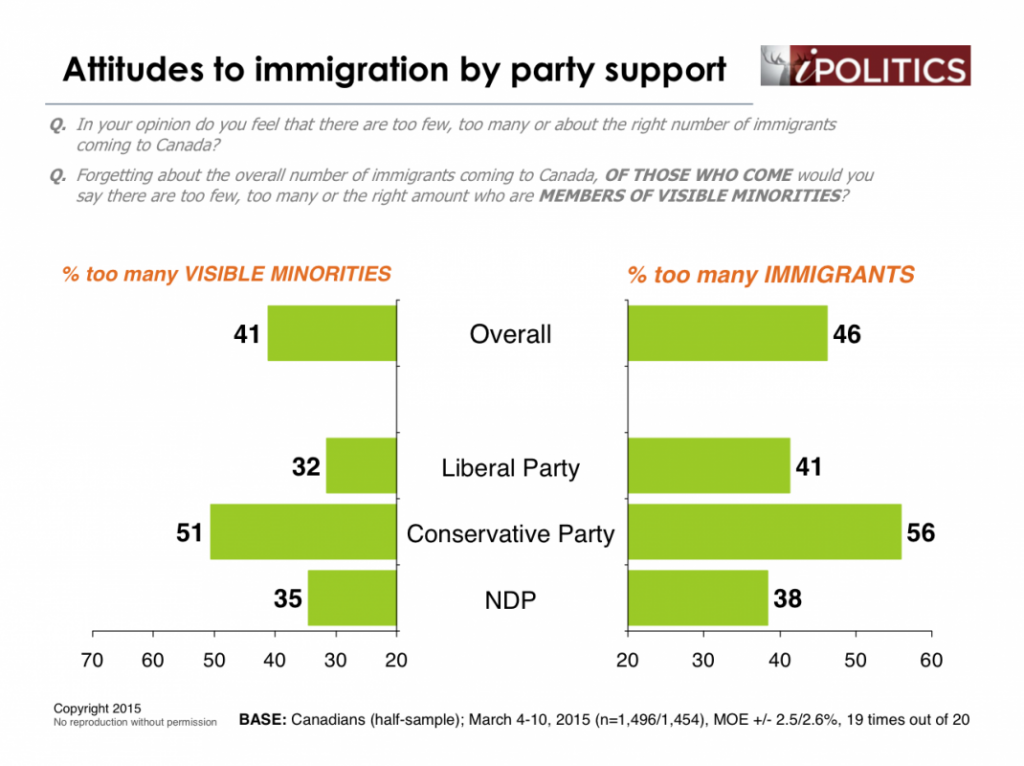
Visible minorities and Immigration - Ekos

Canada has absorbed a large number of visible minority immigrants over the past twenty years, turning us from a largely white society with ancestry drawn from Britain and France to an extremely heterogeneous one. Initial deep reservations about immigration dropped consistently over that period as we became more diverse. The public embraced the ideal of multiculturalism; dire warnings about ethnic enclaves and a fading national identity never came true. Our research over that period shows national attachment remained very high in Canada, while ethnic identifications actually dropped.

It’s useful to remember how far apart public opinion in Canada and the United States was following the 9/11 terrorist attacks. In both countries there was a sharp, immediate rise in opposition to immigration. In Canada, however, that trend soon dissipated, reaching an all-time low around 2005 — when only 25 per cent of us said there were too many immigrants and less than one in five said that too many immigrants were visible-minority. In the U.S., the level of opposition to immigration was nearly three times higher. Canada remained a nation open to the world: pro trade, pro-immigration and pro-diversity. This seemed to confer both social and economic advantages.

Recent polling shows opposition to immigration has nearly doubled since 2005 and is threatening to crack the 53 per cent level we saw in 1993. Not only is opposition to immigration in general scaling heights not seen in twenty years but the number of Canadians saying we admit too many visible minorities has just cracked the 40-point ceiling for the first time ever.

…When we look at how attitudes on immigration and race spread out among the main federal parties, a pattern emerges. Liberals and New Democrats have no cause to be smug; fully one-third of their supporters think too many of those coming to Canada are visible minorities.

But it’s the Conservative party — which owes much of its current success to wooing votes from new Canadians — that seems to have the problem. Jason Kenney, to his credit, wants new Canadians in his party’s corner. But half of the people who support his party would prefer to see fewer non-white immigrants.

Frank Graves of EKOS polling has some startling new numbers

Election Watch: Beyond the “Ethnic Vote” – New Canadian Media – NCM

Start of an interesting series in New Canadian Media in the lead-up to the October election by political science profs Inder S. Marwah, Stephen E. White and Phil Triadafilopoulos:

  • What exactly is the “ethnic vote”?  How is it understood and/or defined by different parties, media and researchers? Is there such a thing as an ethnic vote, or are there many different (perhaps conflicting) ethnic votes? Do assumptions about the “ethnic vote” portray widely diverse communities as sharing in a single set of values or interests?
  • What are the key ridings to watch in the lead-up to the 2015 election? How will demographic factors affect local, regional and national voting patterns?
  • What are the issues of greatest concern to new Canadians and/or longstanding ethnic communities? How are the different parties addressing them?
  • Are religious practices being politicized for electoral purposes, as has been the case in many European states? How are new Canadians likely to respond to such efforts?

We will explore how immigration and new Canadian communities are helping to shape the country’s political landscape. Broadly speaking, Canada is an immigrant-receiving success story. In the last few decades, the country has opened itself to a high volume of immigration, provided immigrant populations with relatively easy access to naturalization and citizenship, and maintained its social cohesion, political stability and economic wellbeing along the way. While new Canadians undoubtedly face barriers in accessing social, political and economic opportunities, they fare better in these respects than do immigrant communities in many other countries. New Canadians are, then, poised to profoundly influence the 2015 federal election, and more broadly, Canada’s political life. We look forward to analyzing their influence in the months ahead.

Election Watch: Beyond the “Ethnic Vote” – New Canadian Media – NCM.

Germany reverses ban on headscarves for Muslim teachers

Progress even if some dissent:

The court in Karlsruhe, ruling on a case brought by a Muslim woman blocked from a teaching job because of her headscarf, said religious symbols could only be banned when they posed “not just an abstract but a concrete risk of disruption in schools.”

“This is a good day for religious freedom,” said Volker Beck, a lawmaker from the opposition Greens.

He argued that headgear worn by devout Muslim, Jewish and Christian women and men was less of a threat to German society than “opponents of diversity” such as the right-wing Alternative for Germany (AfD), neo-Nazis and extremist Muslim Salafists.

Christine Lueders, head of the federal anti-discrimination agency, hailed the ruling for “reinforcing religious freedom in Germany.” With education administered by Germany’s 16 states, she called on local authorities to review the relevant rules.

But the German Teachers’ Assocation (DL) called the ruling “problematic,” saying it undermined the principle of political and religious “neutrality” in schools and public services.

“We fear this ruling could lead to disruption in certain schools if, for example, non-Muslim parents do not agree with their children being taught by teachers in headscarves,” said Josef Kraus, president of the teachers’ body.

Germany reverses ban on headscarves for Muslim teachers – The Globe and Mail.

Le Canada mûr pour une commission Bouchard-Taylor?

The Official Opposition struggles with the niqab issue and advocates greater public consultations rather than the current politicization of the Government. Hardly likely, a few months before the election:

Quelques heures plus tard, à sa sortie des Communes, le député est allé plus loin en s’opposant sans équivoque au port du voile intégral dans la fonction publique. « Moi, comme la plupart de mes collègues, on veut vivre dans une société où les gens sont à visage découvert. […] Je pense que la plupart des gens s’attendent à recevoir des services publics de la part de quelqu’un dont on peut voir le visage », a tranché le député. La veille, son chef Thomas Mulcair avait systématiquement refusé de préciser si le niqab était acceptable dans la fonction publique.

M. Boulerice ne va pas jusqu’à proposer de poser des balises légales. Avant tout, le Canada devrait à son tour — comme l’a fait le Québec il y a huit ans — consulter citoyens et experts.

« Il y a une espèce de vacuum en ce moment au niveau fédéral. Et ce qu’on voit, c’est des conservateurs qui jouent sur des préjugés et des amalgames pour essayer de marquer des points politiques. Et ça, on le déplore », a reproché le député de Rosemont.

…Le NPD croit au contraire que le niqab ne pose pas problème lorsqu’une femme prête un serment personnel, mais qu’il ne devrait pas être accepté lorsque cette même femme est en relation de services avec le citoyen. M. Boulerice doute d’ailleurs qu’une seule fonctionnaire fédérale porte le niqab. Le bureau du ministre Clement — qui s’est dit convaincu cette semaine qu’il y en a — a indiqué au Devoir qu’il ne « recense pas ce genre d’information ».

Thomas Mulcair était du même avis que son député, en avril dernier. « Le visage découvert, pour livrer des services au public, est tout à fait respectueux des libertés », avait-il réagi lorsque Philippe Couillard a promis une charte de la laïcité édulcorée.

Le chef néodémocrate a toutefois refusé de répondre à cette même question mercredi. Son bureau n’a pas répondu aux courriels du Devoir lui demandant si le chef partage la position de M. Boulerice.

Le Canada mûr pour une commission Bouchard-Taylor? | Le Devoir.

Michael Den Tandt: Conservatives would be wise to call a truce in the culture wars

Minister Kenney’s attempt to explain more coherently the reasons for the ban on niqabs at citizenship ceremony and tone down some of the government rhetoric, led by the PM with an assist by Minister Alexander, among others:

Mr. Kenney then ventured a Q&A with Macleans‘ John Geddes, in which he provided the first thoughtful defence, that I am aware of, of his banning the niqab from citizenship ceremonies.

“Something politically correct Liberals don’t understand, which I do rather profoundly,” Mr. Kenney told Macleans, “is that the vast majority of new Canadians, including new Canadians of the Muslim faith, believe that there are certain important hallmarks of integration. They don’t believe that multiculturalism should be misconstrued as cultural relativism. They believe that multiculturalism should mean a positive regard for what’s best about people’s cultural and religious antecedents. But it should not mean a completely unquestioning acceptance of every cultural practice, especially those of an abhorrent nature.”

Mr. Kenney continued: “I can tell you that the vast majority of Muslims that I’ve spoken with strongly supported my decision in 2010 to state what I thought was axiomatic that a public citizenship ceremony had to be performed publicly.”

So there you have it; the crux, about which reasonable people may disagree. Absent from Mr. Kenney’s construction was the overreach — whether it be Prime Minister Stephen Harper thundering that Islamic culture is “anti-women,” to Immigration Minister Chris Alexander’s earlier conflation of the niqab and the hijab or headscarf — that have opened the Conservatives up anew to the hoary old charge that they are anti-immigrant.

Michael Den Tandt: Conservatives would be wise to call a truce in the culture wars