Has Canada’s immigration system lost its heart?

Some good overall statistics on wait times, and a rather amusing comment from the CIC Minister’s spokesperson about anecdotes, given the reliance the government often places on anecdotes in formulating and communicating policy:

While the Conservative government has invested resources in expediting the processing of skilled immigrants, investors, refugees and people slated for deportation, wait times keep growing for family reunification programs.

Currently, it takes nearly four years (47 months) simply to assess a sponsor’s eligibility to bring in parents and grandparents. The aging would-be immigrants then have to wait years for their own assessment at visa posts abroad.

To sponsor a husband or wife already living in Canada takes 27 months. To renew a permanent resident card, it’s a minimum of 67 days; for citizenship, at least two and up to three years; and for eligible live-in caregivers to receive permanent status (so their spouses and kids can finally join them here), 44 months.

“I’m a proud Canadian and grateful for the opportunities this country has given me,” said Djordje Momcilovic, 48, an occupational health and safety consultant. “But I’m not proud that the Canadian government is promoting family values and reunion but in fact it is keeping and tearing families apart.” Momcilovic sought help from his local MP to temporarily delay his mother’s removal.

Immigration Minister Chris Alexander’s office said Canada will admit about 70,000 people as permanent residents under the family class in 2015.

“Anecdotal accounts are not necessarily more broadly representative or, unfortunately, even factual in some cases,” said Alexander’s spokesperson, Kevin Menard. “Certainly, each case is unique, and each is assessed on its merits based on the information applicants provide to officials.

“We are working to eliminate backlogs and reduce processing times of all kinds … Our government is committed to reuniting as many spouses and partners as possible, as quickly as possible, while ensuring permanent resident targets are met for all immigration streams.”

Has Canada’s immigration system lost its heart?

Canadian Race Relations Foundation: Directions Journal Call for Submissions

A reminder and should be an interesting edition, given the focus on words and lexicons:

Is our lexicon a positive force or part of the problem?

The Call for Papers for the Winter 2015 Issue is now open.

Published in print and online December 2015, The Power of Words speaks to the importance of reviewing and evolving social science terminology in response to changing demographics and settlement trends. The concept of hyphenated Canadians, terms such as ‘visible minorities’ and ‘newcomers,’ and even the idea of ‘race relations’ require ongoing reassessment, and are being challenged and re-examined in the context of our changing society.

Directions provides a space for established and emerging scholars, community organizations and race relations practitioners to publish their research. It also offers a forum for important dialogue and debate on race-related issues and best practices, and practical recommendations for policy development and change. Directions is curated to promote social cohesion amongst all individuals and groups living in a harmonious Canada.

Research Questions

How do language and lexicon in policy, in the media, and in daily interactions influence our experiences, identities, attitudes, and relationships? How can discourse create and perpetuate unbalanced power relations, marginalizing certain groups and individuals? How can we use language to promote positive race relations in a harmonious Canada?

These dynamic questions represent the types of issues that CRRF intends to explore in the upcoming issue of Directions in Winter 2015.

Call for Papers

Submit your research, editorial, abstract, or book review for the Winter 2015 Issue of Directions.

Submit a letter of inquiry or abstract by June 30, 2015 Submit online >


Ukraine Tears Down Soviet Symbols, Winks At Nazi Ones

Selective approach to history, destroying some monuments and keeping some others:

Both Soviet and Nazi symbols are now forbidden in Ukraine by law. But it’s the Soviet icons, once dumped on the country in industrial quantities, which now are disappearing in record numbers.

Since December 2013, Ukrainians knocked down 500 out of over 1,200 Lenin statues, a trend known as “Lenin-fall,” which in Ukrainian sounds like snowfall. Recently, Ukrainian President Petro Poroshenko signed a law that formally charged the state with removing Soviet-era monuments, so now Kiev’s municipal services are responsible for destroying statues.

…In April, 40 historians asked President Poroshenko not to sign the law recognizing a number of World War II nationalist organizations, including the Ukrainian Insurgent Army (UPA), as mere independence fighters. In a letter addressed to Ukrainian authorities the critics questioned the legitimacy of an organization “that slaughtered tens of thousands of Poles in one of the most heinous acts of ethnic cleansing in the history of Ukraine.”

Western historians pointed out that Ukraine should not be praising as heroes organizations that collaborated with Nazi Germany. The UPA “also took part in anti-Jewish pogroms in Ukraine and, in the case of the Melnyk faction, remained allied with the [Nazi] occupation regime throughout the war,” their letter said.

The U.S. Holocaust Memorial Museum has expressed concerns about Ukraine’s radical treatment of its history: “As Ukraine advances on the difficult road to full democracy, we strongly urge the nation’s government to refrain from any measure that preempts or censors discussion or politicizes the study of history.”

George Orwell put the fundamental problem rather more elegantly in an essay he wrote toward the end of World War II, when he argued that history is written by the winners. “The really frightening thing about totalitarianism is not that it commits ‘atrocities’ but that it attacks the concept of objective truth; it claims to control the past as well as the future.” And that tradition is one Ukraine is still trying to shake off.

Vyatrovych conceded, for instance, that some UPA activists were involved in Jewish pogroms, “since Jews were blamed for helping Bolsheviks,” but he rejected the idea that the whole of the UPA was at fault. “There were many Ukrainian nationalists who saved Jews, too, during the war,” he told The Daily Beast. “Besides, who could not be blamed for atrocities during that war? Americans bombed Dresden,” said Vyatrovych, whose title is director of the Ukrainian Institute of National Memory.

Ukraine Tears Down Soviet Symbols, Winks At Nazi Ones – The Daily Beast.

Girl players leave high school soccer game after complaints from Muslim boys’ team

Bad call but good corrective action:

The senior boys’ soccer team from Robert F. Hall Catholic Secondary School in Caledon, Ont., was up 3-1 at the half on Tuesday when the coach pulled aside Carla Briscoe, one of two girls on the team.

Briscoe, who was in the starting lineup, wondered if she was being called out for playing too rough, but it turned out the coach from the opposing school, ISNA High, an independent Islamic school in Mississauga, Ont., had told the referee his team could not continue playing because of the presence of girls on the field.

As much as the competitive 18-year-old senior wanted to continue playing, she agreed to sit out the rest of the game. The team needed the extra points and it would be unfair to stop the game when some of her teammates hadn’t taken to the field.

“I said to my coach, ‘I’d rather see everybody play. I don’t want to ruin this for the rest of the team. Me and the other girl will sit out.’ ”

Their team went on to win 6-1. But win or lose, the girls should never have been put in that situation, Paul Freier, chairman of the Region of Peel Secondary School Athletic Association (ROPSSAA), said Friday.

‘Our position on this is these are the rules of engagement. … Going forward, it’s our hope all teams will have an understanding’

The rules governing sports in the region mirror those set by the Ontario Federation of School Athletic Associations, which states if a sport is not available to girls at a school, they can join the boys’ team after a successful tryout.

Freier sent an email Friday to the ISNA coach making it clear schools must abide by those rules. If they don’t like them, they are free to leave the athletic association.

“Every school that joins ROPSSAA, it’s a voluntary membership,” Freier said. “We will continue to adhere strictly to those constitutions and bylaws.”

A statement issued by the school Friday said it regretted the female players felt they could not participate.

“It was never the team’s intention to exclude female participation, which was reflected in the offer to forfeit. The team sincerely regrets if any team members or participants were hurt or felt discriminated based on their gender.”

Earlier, Essa Abdool-Karim, the ISNA coach, told CityNews the team was “caught off-guard” by the presence of girls on the team.

Girl players leave high school soccer game after complaints from Muslim boys’ team

Chris Selley’s commentary:

Sometimes, religious accommodation is hard. Reasonable people will disagree. Is it an affront to secular society to allow a Muslim congregation to organize Friday prayers in a public school cafeteria? Or is it simply a practical way of minimizing disruption to the school day? Kirpans in schools? Public servants in niqabs? The Lord’s Prayer at city council? Hmm, well on the one hand, but on the other hand …

Sometimes, though, religious accommodation is not complicated. Sometimes you don’t even need those two words. Sometimes it’s just a soccer team refusing to play another soccer team. That’s what CityNews reports occurred this week on a Brampton, Ont., pitch: a team from ISNA Private Islamic High School objected to their opponents, Robert F. Hall Catholic School, fielding two girls. Losing 3-1 at halftime, the INSA team declined to finish the match unless the ladies left the pitch.

And you’ll never believe what happened next: “The girls on [the Catholic] team told CityNews they insisted on sitting out for the second half to allow the game to continue.”

Now, I choose to believe they did that so the thumping they were delivering could continue, perhaps redoubled in response to the No Gurlz complaint: Robert F. Hall added three more goals in the second half to win 6-1.

But they shouldn’t have been allowed to sit out. Period. Not by their coaches, and not by the referee. There is no need to parse the INSA coach’s attempts to foster what CityNews describes as an “an open dialogue.” There is no need to put ourselves in the INSA players’ shoes and walk a mile. “We want them to understand this balance between religion and having to sacrifice the sport you love is a difficult situation,” says the coach. “We want inclusion for all.”

This is dead simple: We have a perfectly good soccer team refusing to take to a perfectly good pitch to face another perfectly good team. Thus, they forfeit the game. Both teams advanced in the tournament. They might face each other again. The INSA coach told CityNews he doubted his team would agree to play. At last report the Region of Peel Secondary School Athletic Association was for some reason “gathering their facts” in order to determine “how to proceed” in this “uncharted territory.”

The facts: Perfectly good Team A refuses to play perfectly good Team B for no good reason. How to proceed: Team A forfeits. See how easy this is?

Don’t want to play soccer against girls? You lose
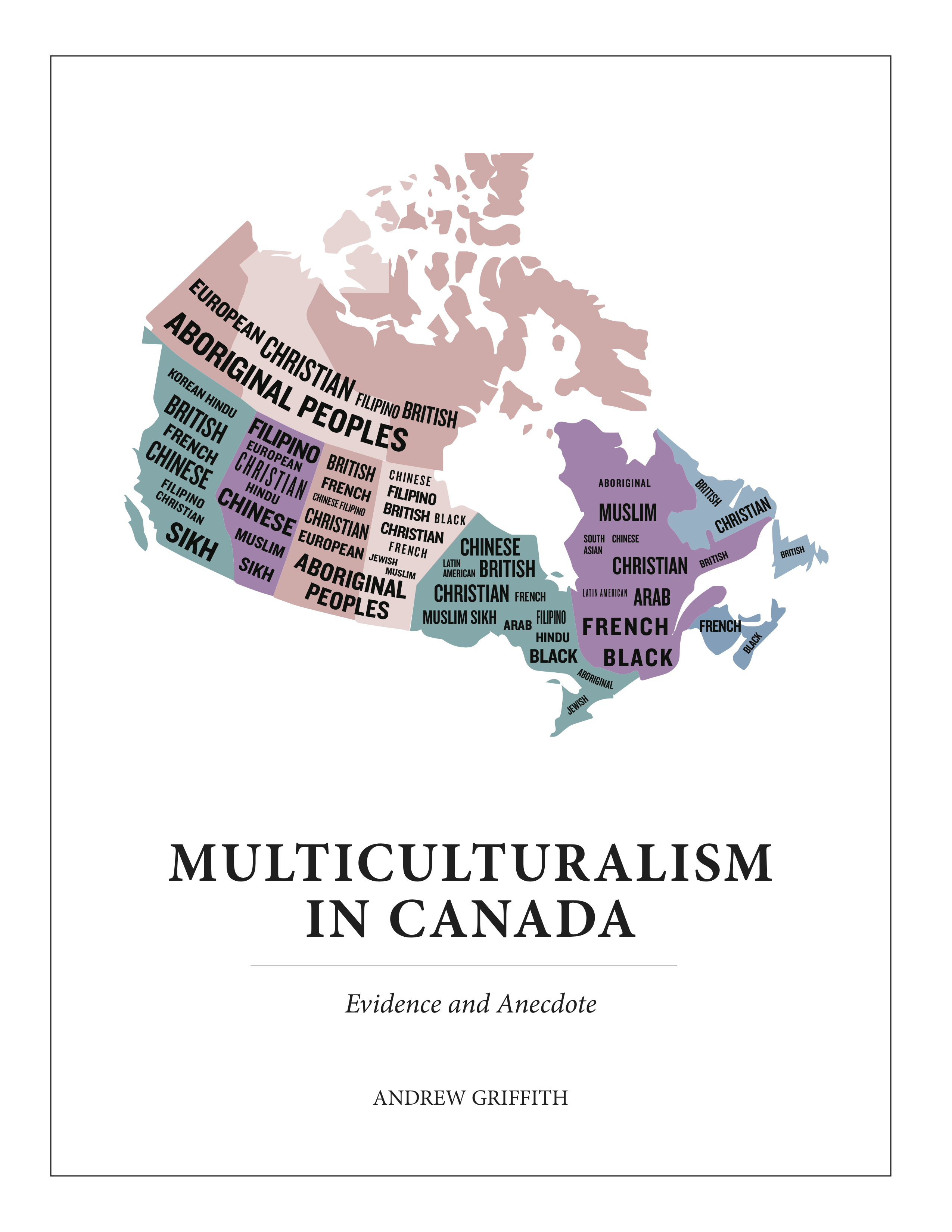
Multiculturalism in Canada: Evidence and Anecdote Executive Summary

For those interested in my forthcoming book, on schedule for release this coming August (both e-book and print-on-demand formats), please find below the Executive Summary:

***

MB - Draft Cover 24 April - PNGCanada is one of the world’s most multicultural societies. Of its population of almost 33 million people, 20.6 percent are foreign-born, and more than 250 ethnic origins are represented. The current ethnic and religious diversity is expected to continue growing alongside immigration in the coming years.

Multiculturalism, and the integration of newcomers and their descendants, has been part of our past, is part of our present, and will be part of our future, as Canada continues to receive more than 250,000 immigrants per year.

Given that multiculturalism and diversity are central to Canada’s past, present and future, Canada’s overall success is linked to its ongoing ability to integrate newcomers and their families, ensuring social inclusion and equality of opportunity. “Getting it right” matters.

Current and future policy choices should be largely based on an evidence-based analysis of the impact and outcomes from previous policy choices. This book aims to bring together the key data from a variety of sources to provide an overall portrait of the present as well as the likely impact of recent policy choices that have emphasized integration over accommodation in multiculturalism, and meaningfulness over facilitation in citizenship.

The data focus of this book provides a backdrop to current and future policy debates, hopefully resulting in more informed and balanced discussion. The story-telling power of anecdotes means that these also form part of the evidence base given their impact on public debate. However, having an overall sense of what the data shows should hopefully attenuate some of the tensions and rhetoric that can emerge. Read more of this post

Government of Canada now able to revoke citizenship of dual citizens convicted of terrorism – Coming into Force

Clear signal on which cases will be a priority: those tried and convicted in Canada, neatly avoiding some of the foreign judicial process issues raised during C-24 hearings.

But not avoiding, of course, the more fundamental issue of differential treatment for dual citizens compared to Canadian-only citizens:

Measures came into force officially today that enable Canada to revoke citizenship from dual nationals convicted of terrorism, treason and high treason, and/or spying for foreign governments.

Canadian citizenship can now also be revoked from dual citizens for taking up arms against Canada and the Canadian Armed Forces, whether as a member of a foreign army or in non-state terrorist groups like ISIS.

Also officially in force as of today is a new, more streamlined citizenship revocation process.  This new process will help ensure Canada and Canadians are protected, and that revocation decisions can be made quickly, decisively and fairly.

Citizenship and Immigration Canada (CIC) officials will be implementing these new measures immediately and will prioritize cases that have been tried and convicted here in Canada on at least one of the grave crimes listed above.

Government of Canada now able to revoke citizenship of dual citizens convicted of terrorism


Black teachers still face racism on the job in Ontario

Interesting study. According the National Household Survey data, black teachers form XX percent in Ontario schools:

Many black teachers across Ontario still face racism on the job, according to a new  study of educators, half of whom said they believe being black has hurt their chance of promotion. Some told of hearing the ‘N’ word used in the staff room and being mistaken for a trespasser.

“I had a supply teacher tell me I am not allowed to park my car in staff parking,” said one of the 148 black educators across 12 Ontario school boards surveyed for a report to be released Friday. “The ‘N’ word was used in casual conversation in our staff room,” said another. “I was introduced as ‘home girl’ to a student teacher.”

The 63-page report, The Voices of Ontario Black Educators, prepared for the Ontario Alliance of Black School Educators (ONABSE), calls for Ontario to enact tough employment equity legislation, provide training against anti-black bias, set targets for promoting teachers of colour and cluster black teachers in particular in schools where there are high numbers of black students.

“We’re disappointed, but not surprised at the findings — racism is still deeply ingrained in society,” said Warren Salmon, interim president of ONABSE, which commissioned the report because of concerns expressed by its members.

Of the black teachers, principals and vice-principals surveyed, one-third said they believe they have been passed over for advancement because they are black. Some 27 per cent said racial discrimination by colleagues affects their day-to-day work life and 51 per cent said they believe anti-black bias at their school board affects who gets promoted.

Equity consultant Tana Turner of Turner Consultants conducted the survey, and called for school boards to “set equity goals and timetables — not just have an employment equity office which merely measures the numbers of employees …

“If the government wants to close the gap in racial diversity between students and those at the front of the classroom,” she said, “legislation and other government interventions may be needed.”

Black teachers still face racism on the job in Ontario | Toronto Star.

Blind Auditions Could Give Employers A Better Hiring Sense

One way to address the biases in the hiring processes, whether diversity or background related (see earlier How an ethnic-sounding name may affect the job hunt regarding evidence of bias):

Typically, a hiring manager posts an opening, describes the ideal candidate and resumes come flooding in. After doing some interviews, the manager has to make a gut decision: Who is the best person for the job?

Research shows that more often than not, managers pick someone whose background is similar to theirs.

But, Vujosevic says, “There is definitely room to improve how we view talent, how we screen talent, how we engage with talent and how we end up interviewing talent.”

By “talent,” he means all the gifted young people he knew that weren’t getting job interviews at technology companies because they didn’t fit a certain idea of what a good job candidate looks like. They didn’t graduate from college, they taught themselves to code or they had a strong accent.

Vujosevic thinks he knows how to get around this problem with a completely different way of looking at hiring. He thought these unconventional applicants could get interviews if there was a way to show what they could do without revealing who they were.

So he created a website called GapJumpers where employers post a job along with some sort of challenge, like: Create a Web page or write a social media strategy. To apply for the job, you just take on the challenge.

“Right now, we are able to do blind auditions for software engineering roles, design roles, marketing roles, communication roles and allow candidates that might on paper not be a good fit, prove that they actually are,” he says.

He compares it to his favorite singing competition, NBC’s The Voice. Four celebrity judges sit in red super villain chairs with their backs turned to the stage. And then, someone sings. The judges hit a button and turn their chairs around. That’s the first time they see who’s performing, but they’ve already decided “I pick you for my team.” It’s a blind audition.

And that’s kind of how GapJumpers works.

Jeremiah Reyes is in charge of hiring at Dolby Laboratories. He wanted to spend less time sorting through applications and getting more qualified candidates, including people with nontraditional backgrounds.

Recently, a Dolby hiring manager was shocked to discover his favorite candidate came from a community college.

“The one that we did select, even in our debrief he basically said, ‘Wow, I think if I just saw his resume on my desk, I don’t know if I would have selected him,’ ” Reyes says. “It was one of those ‘aha’ moments for him that this is a really interesting tool.”

Blind Auditions Could Give Employers A Better Hiring Sense : All Tech Considered : NPR.

The Worst Kind Of Groundhog Day: Let’s Talk (Again) About Diversity In Publishing

Lack of diversity in the recommended summer reading lists by the major US publications:

Another day, another all-white list of recommended reading. This year’s New York Times summer reading list, compiled annually by Times literary critic Janet Maslin, offered up zero books by non-white authors. Gawker’s Jason Parham marveled that the list has achieved “peak caucasity” while Divya Guha and staff at Quartz offered an alternate reading list comprised of Indian writers.

And that’s what’s so frustrating about this list; this summer brings so many excellent books from writers of color, many of whom are very well known and have enthusiastic audiences — Balm by Dolen Perkins-Valdez, Loving Day by Mat Johnson, In the Country by Mia Alvar, Make Your Home Among Strangers by Jennine Capó Crucet, The Star Side of Bird Hill by Naomi Jackson, Only the Strong by Jabari Asim, Lovers on All Saint’s Day by Juan Gabriel Vasquez, Re: Jane by Patricia Park, Flood of Fire by Amitav Ghosh, and others — that it requires magical thinking to avoid an uncharitable reading of the NYT’s picks.

It is worth noting that the Times’s recommended summer readings lists in 2012, 2013, and 2014 were similarly lacking in diversity. To be sure, they’re not alone. NPR also published a monochromatic reading list recently. “We are not implying that this list is comprehensive,” says Cara Tallo, senior supervising producer for Morning Edition, which ran a story featuring that list. In a response emailed to NPR, the New York Times also stressed that their list was not meant to be comprehensive. “While our selection reflects the summer releases offered by book publishers, we will be more alert to diversity among authors in the future,” says communications director Danielle Rhodes Ha.

No list can be comprehensive, but when we see alabaster roundups year after year, it warrants some scrutiny.

It’s one thing if a media brand deliberately targets segmented audiences. The Root publishes reading lists of all, or mostly, African-American writers. Jezebel does the same with female ones. But those sites make it clear that they’re not trying to talk to everyone. Big, national, general interest news brands like NPR and the NYT say they are. If these sites truly want — and, increasingly, need — readers of all colors and all backgrounds to tune in, monochromatic content is working against them. The message we get is, “We don’t see you. We don’t need you.”

This isn’t a logistical issue, a problem of critics not including diverse authors because they simply don’t know about them. I put together the above list of books in five minutes in a hotel room. Had I been home with the collection of galleys I’ve recently received, the list would have been twice as long and composed in half that time. And I assure you, I’m not the only one getting these galleys. The arts, entertainment, and books desks at every major publication and outlet are flooded with them, and an entire ecosystem of critics, producers, and editors is involved in compiling and signing off on these lists. Narrow reading is a less passive activity than some will claim.

As a writer and critic, I am not just bored with this conversation. I am sick of it. I have written these sentences before. I will write them again. Discussing diversity in publishing is the worst kind of Groundhog Day. What’s more, these lists put writers and readers of color in a deeply awkward position. We don’t want to take anything away from the writers who have been included on the list. I am currently reading Don Winslow’s The Cartel and I never want to put the book down. It is thoroughly immersive, finely detailed and the action has me breathless.

The problem is and has always been the exclusion of writers of color and other marginalized writers who have to push aside their own work and fight for inclusion, over and over and over again. We beg for scraps from a table we’re not invited to sit at. We are forced to defend our excellence because no one else will.

The Worst Kind Of Groundhog Day: Let’s Talk (Again) About Diversity In Publishing : Code Switch : NPR.

Australia: Debacle over terrorism and citizenship is leak-based policy in its purest form | Lenore Taylor | Australia news | The Guardian

Lenore Taylor of The Guardian on the leak strategy being used to sell the proposed Australian revocation policy change for convicted terrorists:

One might ask what is to be gained from so many headlines galloping so far ahead of actual decisions, or indeed, actual facts.

Does it help the police and intelligence agencies with their very important task of “keeping Australians safe” either by preventing acts of violence in this country, or preventing dangerous foreign fighters from returning, or the strategy for countering violent extremism aimed at stopping people here from becoming radicalised and dangerous?

Or is it playing to a very different audience – with the much more political aim of keeping security threats at the forefront of the national conversation and, perhaps, goading Labor into disagreement so that they can be portrayed as “weak on terror”?

The prime minister’s most powerful advisor is taking a keen interest in the policy and politics of the issue – his chief of staff, Peta Credlin, told a recent meeting of Coalition staff she was spending at least 40% of her time on the issue.

Another clue might lie in yet more information from the prime minister’s office to the Daily Telegraph, this time in an article entitled “The first cracks in Australia’s bipartisan approach to terrorism could doom Bill Shorten” which revealed that the prime minister received 900 emails in the week after the budget expressing anger at the possibility that “repentant Australian jihadis” might be allowed back into the country.

The article praised the prime minister’s “instinctive” response that “If you go abroad to join a terrorist group and you seek to come back to Australia, you will be arrested, you will be prosecuted and jailed” in comparison with Shorten’s reaction that “There are laws in place, I’m not going to play judge and jury.”

But of course, there are laws in place, and they do have evidentiary requirements. Which means the courts may not in every case implement the prime minister’s “instinct”. Which is presumably where the new policy-thought about citizenship-stripping comes in. And Shorten has been pretty careful to make sure there are no “cracks” in the bipartisanship on these issues, no matter what the government proposes.

There is, of course, an alternative to slap-dash policy in response constituent-email reaction, or policy by cabinet-pre-empting, headline-seeking press leak, and that is that old-fashioned idea of policy developed to address a real problem, thought through and discussed by cabinet, before public announcement.

Debacle over terrorism and citizenship is leak-based policy in its purest form | Lenore Taylor | Australia news | The Guardian.