U.K. immigration crackdown could hit 6,000 Canadian students

Strange – the worry about fraud undermines a pathway to skilled immigrants (cancellation of pre-Permanent Resident credit in Canada towards citizenship residency requirements, while not as strong as UK measures, will likely reduce attractiveness of Canada as a destination):

British Home Secretary Theresa May has announced a wave of changes to the United Kingdom’s immigration rules, effective in November, that target international students.

The aim is to curb what the government calls an increase in visa fraud by students who arrive on a study permit and enter the job market instead, thereby bypassing the strict requirements needed to obtain a legal work visa.

It’s the latest in a series of crackdowns by Prime Minister David Cameron’s government, which has promised to reduce annual net migration to the U.K. from “hundreds of thousands to tens of thousands.”

The U.K. is one of the most popular places for Canadians to study abroad, second only to the U.S. For the 2013-14 academic year, there were more than 6,000 Canadian students enrolled at higher education institutions in the U.K., a three per cent increase from 2012, according to Britain’s Higher Education Statistics Agency.

Like Hirschy, many of these students hope to stay and work, but the new legislation will make this more difficult.

U.K. immigration crackdown could hit 6,000 Canadian students – Canada – CBC News.
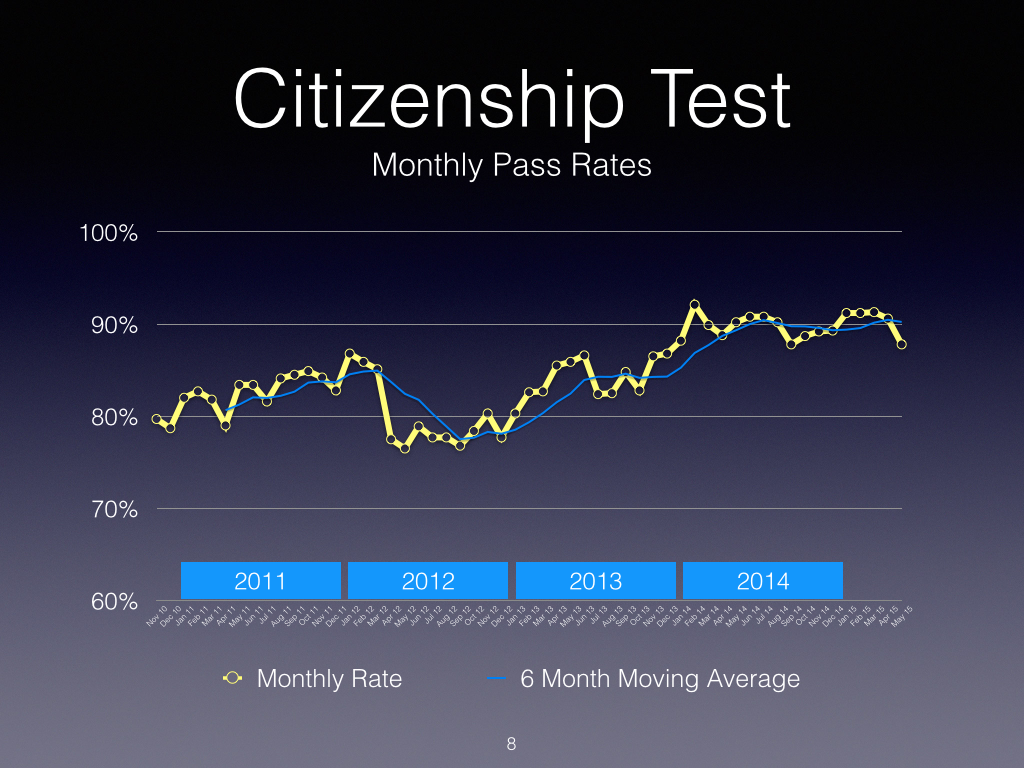
Monthly Citizenship Test Pass Rates 2011-2015

Citizenship Monthly Test Pass Rates.001This time series shows the variation in monthly citizenship test pass rates from November 2010 to May 2015, highlighting the dramatic shifts over the past 4 ½ years.

This chart highlights a number of challenges that CIC faced:

  • the difficulty in managing the citizenship test to ensure broadly consistent results;
  • the inability to introduce new questions in a predictable manner, likely reflecting political reluctance to engage in focus testing  (2012 drop);
  • the eventual corrective measures in 2013, both administrative and test question wording changes, that resulted in a reversion to the previous average pass rates in the 80-85 percent range; and,
  • other changes, likely reflecting conscious policy choices as part of the effort to address the backlog of citizenship applications, aimed to increase the average pass rate to the 90 percent range in 2014.

This roller-coaster variation, also seen in citizenship applications processed, once again reflects the lessor priority CIC (and Ministers) attach to sound management of the program, in sharp contrast to the relative consistency and predictability of the immigration program.

The relevant memos to the Minister were heavily (excessively in my view) redacted as the following example from a 2013 memo indicates:

Citizenship_Monthly_Test_Results_A201510634_2015-08-06_08-29-32_pdf__page_8_of_13_Lastly, the CIC analysis of the number of those affected by the extension of knowledge testing and language assessment is relatively small: 5.5 percent for 14 to 17 year olds, 5.9 percent for 55 to 64 year olds (both figures for the period 2009-13 (see Citizenship Impact of Extending Testing to 14-17 and 55-64 year olds, while accompanying memo less redacted than above example, still some serious redactions on cost implications and the like).

Quebec considering removing N-word from 11 place names

Hard to justify retaining the names, just as hard as it is justifying flying the Confederate flag:

A stretch of the Gatineau River that has officially been called Nigger Rapids for decades could be renamed — along with 10 other sites in Quebec whose names include the racial slur.

But the provincial body that manages Quebec’s place names says there has been little public pressure to rename the sites.

The rapids are located in the municipality of Bouchette about 120 kilometres north of Ottawa. They were named in memory of a black couple who drowned there in the early 1900s, said Jean-Pierre LeBlanc, spokesman for the Quebec Toponymy Commission.

After decades of being known by their informal name by the locals, the commission officially recognized the name in 1983.

“It was meant to describe the people who died,” LeBlanc said. “There was no pejorative connotation then as there is now.”

LeBlanc said that no formal request by residents has been made to change the name of the rapids but that the commission is considering whether it should rename all 11 sites that include the racial slur.

Claire Hamel, who lives near the rapids, said the official name is not a source of controversy among locals.

“Nobody talks about this,” she said. “It’s the name, that’s it. Like Bouchette, like Maniwaki, like Ottawa.”

Bouchette Mayor Réjean Major told Radio-Canada he has no intention of asking the commission to change the name of the rapids.

Changing an official name is a lengthy process that requires public consultation, LeBlanc said.

“These are names that date back a long time,” he said.

“Some people want to keep the names. They say that it’s a witness of the past. It shows the history of black people in Quebec and how it was at that time. Others say the names are no longer fit.”

The commission has recognized six place names that include the N-word in English and five that include the word nègre, which in French can mean both Negro and the N-word.

Quebec considering removing N-word from 11 place names – Ottawa – CBC News.

US: The Jobs Report Looks Good but Unemployment Rates Vary Widely for Whites, Blacks, and Hispanics

The persistence of economic differences among different groups:

For white Americans unemployment is back to pre-recession levels, or lower, in 14 states—and within 1 percentage point of pre-recession norms in another 28. African Americans, by contrast, remain the furthest away from their pre-recession levels. In Arkansas, Illinois, Maryland, Pennsylvania, and South Carolina, the unemployment gap is more than two and a half times as large as the rate for white Americans. In Washington D.C., it’s five times as high. This year is the first since then that the national unemployment rate for black Americans  has dipped below the double-digit mark—and that feat has only been accomplished in 11 states. The lowest state unemployment rate for black Americans—6.9 percent, in Tennessee—is equivalent to the rate of white unemployment in West Virginia, the state with the highest share of jobless white Americans in the country.

Hispanics also trail behind. In Connecticut, the Hispanic unemployment rate is more than 3 times as high as the white employment rate. In North Carolina, it’s more than 2.6 times as high, and in Pennsylvania and Nevada, it’s more than double the rate for white residents.

Racial inequality is a constant in the U.S. economy. Black and Hispanic workers consistently have a higher rate of unemployment than their white counterparts—for blacks it’s usually twice the rate of whites and for Hispanics, it’s closer to 1.5 times. (These gaps were the smallest at the peak of the recession, since so many white Americans were also losing their jobs.)

In the recovery, white unemployment numbers have improved more rapidly than minority numbers. According to Valerie Wilson, the director of the Program on Race, Ethnicity, and the Economy at the Economic Policy Institute, the recovery only really started for black and Hispanic Americans in 2014. “That’s when you saw the greatest improvements in the unemployment rate, the employment-population ratio, and labor-force participation,” she said.

To be clear, the unemployment rate between these minority groups and white Americans in most places never reached parity, and some of these states had pre-recession minority unemployment rates that were high to begin with. But the fact remains that seven years after the start of the recession, many black and Hispanic Americans are only now seeing their employment situation improve. That’s an important consideration especially when it comes to major policy decisions related to the recovery, such as  raising interest rates, which have been kept  low by the Fed after the downturn in an attempt to spur growth. Wilson says that changing things now, when the national picture looks better but just as many minorities are getting back on their feet, could dampen the long-awaited progress for these groups.

It’s also important to consider why this stubborn gap persists in the first place. Perhaps most troubling is the fact is that discrepancies in unemployment haven’t improved much over time, despite the fact that younger generations of minorities are graduating from college at higher rates. The stubbornness of the unemployment  gap points to other issues—such as systemic discrimination and racial biases—that existed long before the recession and its sluggish, unequal recovery.

The Jobs Report Looks Good but Unemployment Rates Vary Widely for Whites, Blacks, and Hispanics – The Atlantic.

The Religious Roots of Domestic Terror: Stuart Wexler

A reminder that violent extremism is not unique to any one religion:

From Charleston to Chattanooga to Lafayette, a series of mass murders has reignited debates over the nature of terrorism and how it is covered by the media—over whether these are terrorist acts to begin with, and—the latest wrinkle—whether or not they might be acts of religious terrorism.

In many ways the controversy has become part of a culture war. Those on the Left argue that an implicitly racist media too often dismisses mass violence by white men as the byproduct of mental derangement; Islam is seen an acceptable predicate for terrorism, but not white supremacy. Those on the Right argue that liberals, especially those in the Obama administration, are too quick to sugarcoat acts of Islamic terrorism as mere extremism devoid of religious impulse—jeopardizing security in the name of political correctness.

But if Americans want to understand and possibly even prevent domestic terrorism in the future, then they may have to abandon neat labels and presuppositions and start to deal in nuance.

The very act of defining terrorism is nuanced, something academics and national security experts have acknowledged for decades. The U.S. State Department (which once designated Nelson Mandela as a terrorist), the Federal Bureau of Investigation, and the United Nations all offer different criteria for who or what qualifies as a terrorist.

But almost every definition of terrorism includes at least two elements:  (1) an intention to strike at civilians or noncombatants; and  (2) the hope that the violence will serve as a symbolic act and/or advance some political or ideological outcome preferred by the perpetrator. The compulsion to label any act of mass violence as terrorism is counterproductive as it may create an overreaction to what is a one-off, if shocking and tragic, event.

…A full appreciation of these recent events thus confounds the conventional understanding of terrorism, especially religious terrorism. Together, the Charleston and Chattanooga shootings show that no religion is exempt from perversion by extremists, but that such perversion is often about finding ways to not apply religious norms and standards to large swaths of humanity. There is not that much distance between Charleston and Chattanooga.

The Religious Roots of Domestic Terror – The Daily Beast.

The British Left’s Hypocritical Embrace of Islamism

Majid Nawaz, head of Quillam on some British leftists and Islamism (almost a rant, but worth reading):

There is a natural fear among Europe’s left, that challenging Islamist extremism can only aid Europe’s far-right. But the alternative to this fear must not be to instead empower theocratic fascism. There is a way to both challenge those who want to impose islam, and those who wish to ban Islam. It has not escaped me, nor other liberal Muslims, that while challenging Islamist extremism we must remain attentive to protecting our civil liberties. We are born of this struggle, after all. Over the years I have opposed past UK government ministers on ethnic and religious profiling, opposed Obama’s targeted killings and drone strikes and opposed Senator King in the UK Parliament over his obfuscation and justification for torture. I have been cited by the UK PM for my view that though Islamist extremism must be openly challenged, non-terrorist Islamists should not be banned unless they directly incite violence. I have spoken out against extraordinary rendition and detention without charge of terror suspects. I have supported my political party, the Liberal Democrats, in backing a call to end Schedule 7. It is due to this very same concern for civil liberties that I vehemently oppose Islamist extremism and call for liberal reform within our Muslim communities, for our Muslim communities. We believe civil liberties cut both ways, for and upon minority communities, and it is due to this same passion for human rights that my organization Quilliam put out this anti-ISIS video only a day after the Guardian’s unfortunate sting. We chose to let our work speak for itself.

The British Left’s Hypocritical Embrace of Islamism – The Daily Beast.

Doctors Struggle With Unconscious Bias, Same As Police

Not surprising but some good examples of how these can play out:

Even as health overall has improved in the U.S., the disparities in treatment and outcomes between white patients, and black and Latino patients, are almost as big as they were 50 years ago. A growing body of research suggests that doctors’ unconscious behaviors play a role in these statistics, and the Institute of Medicine has called for more studies looking at discrimination and prejudice.

One study found that doctors were far less likely to refer black women for advanced cardiac care than white men with identical symptoms. Other studies show that African Americans and Latino patients are often prescribed less pain medication than white patients with the same complaints.

“We know that doctors spend more time with white patients than with patients of color,” says Howard Ross, founder of management consulting firm Cook Ross.

He’s developed a new diversity training curriculum for health care professionals that focuses on the role of unconscious bias in these scenarios.

Doctors and nurses don’t mean to treat people differently, Ross says. But, just like police, they harbor stereotypes that they’re not aware they have. Everybody does.

“This is normal human behavior,” Ross says. “We can no more stop having bias than we can stop breathing.

Unconscious biases often surface when we’re multitasking or when we’re stressed. They come up in tense situations where we don’t have time to think. Like police on the street at night who have to decide quickly if a person is reaching for a wallet, or a gun. It’s similar for doctors in the hospital.

“You’re dealing with people who are frightened, they’re reactive,” Ross says. “If you’re doing triage in the Emergency Room, for example, you don’t have time to sit back and contemplate, ‘why am I thinking about this,’ You have to instantaneously react.”

Doctors are trained to think fast, and to be confident in their decisions.

“There’s almost a trained arrogance,” Ross says.

This leads to treatments prescribed based on snap judgments, which can reveal internalized stereotypes. A doctor sees one black patient who doesn’t take his medication, perhaps because he can’t afford it. Without realizing it, the doctor starts to assume that all black  patients aren’t going to follow instructions.

Doctors Struggle With Unconscious Bias, Same As Police | State of Health | KQED News.

Only 1 in 10 candidates invited to immigrate under Ottawa’s new Express Entry system

Only_1_in_10_candidates_invited_to_immigrate_under_Ottawa’s_new_Express_Entry_system___Toronto_StarTeething pains or more substantial issues?

More than 112,700 people applied for permanent residency in Canada under a highly touted new system Ottawa introduced in January — but only one in 10 succeeded in getting an actual invitation to come.

Despite a promise that Express Entry would allow expeditious processing within six months, only 844 permanent resident visas were issued, including both the principal applicant and family members, and 411 people had arrived in Canada as of July 6, according to the program’s six-month review.

More than 85 per cent of the 12,017 candidates selected from the pool were already in Canada on temporary permits at the time of the application. The top five source countries included India, the Philippines, the United Kingdom, Ireland and China.

“It is remarkable that only 844 visas have been issued for a program which has invited over 12,000 people to apply. Within the 844, only 411 have actually used their visas and been admitted to Canada as permanent residents,” said Toronto immigration lawyer Shoshana Green.

“Is 844 visas considered a successful program? With over 85 per cent of the invitations being made for applicants currently residing in Canada, is the world really interested in Canada anymore?”

…In the first six months of the program, 11 rounds of invitations were held, with the cutoff scores ranging from a low of 453 to a high of 886. Some 70 per cent of people receiving an invitation had a score above 600 points, meaning the majority would be coming with an approved job offer.

Critics have argued that meeting the selection cutoff score and being invited does not necessarily mean the best candidates are chosen, as the new system favours those who have obtained the LMIA.

For instance, someone with a total score of 649 can actually be a weaker candidate than someone with 599 points who earned the score strictly from his or her personal attributes — rather than with the boost of 600 bonus points that comes from an approved job opportunity.

According to Citizenship and Immigration Canada’s six-month review, 112,701 candidate profiles were created as of July 6. Some 48,723 were deemed ineligible, and 6,441 were withdrawn.

Among the 41,218 active candidates remaining in the pool, more than half, or 27,000 people, had a score between 300 and 399. Only 355 had a score over 600; 51 had a score above 1,000.

Only 1 in 10 candidates invited to immigrate under Ottawa’s new Express Entry system | Toronto Star.

Top-Grossing Films Still Mostly White, Straight and Male

More confirmation of the biases we all have (Hollywood responds to these as well as reinforcing them):

Looking at the 700 top-grossing movies from 2007 to 2014, researchers at the Media, Diversity & Social Change Initiative at the University of Southern California found that on-screen characters are predominantly straight, white and male. Here are some of their most notable findings:

  • Gender: Only 30.2% of speaking roles or named characters in those 700 movies were women. Of the top 100 movies in 2014, only a fifth had a leading or co-leading actor who was a woman, and women only made up 15.8% of behind-the-scenes roles—directors, producers, writers.

  • Race: Of the top 100 movies last year, 73.1% of all characters were white, and only 17 of those movies had a leading or co-leading actor who was a minority. The study authors say this represents “no change” when compared to castings in the top 700 films from 2007-2014.

  • LGBT: In the top movies of 2014, only 19 characters were gay, lesbian or bisexual, and none of them were transgender. The LGB characters portrayed reflect other industry biases: they, too, are mostly white men.

Top-Grossing Films Still Mostly White, Straight and Male | TIME.

Toronto’s culture of harmony stifles debate on race

Interesting study by Jan Doering comparing Chicago and Toronto election messaging:

Comparing Toronto and Chicago offers a fascinating contrast. Although the two are often called “sister cities,” their ethnic and racial politics could not be more different. Toronto is a world-famous model of multiculturalism, while Chicago is one of the most segregated and divided cities in the U.S.

In analyzing printed campaign material — those brochures and flyers that cluttered your mailboxes just a few months ago — the study reveals that candidates in Toronto overwhelmingly emphasized their commitment to ethnic and racial harmony. Their messages encouraged inclusion and participation, but did not highlight the important racial challenges that Toronto faces.

Contentious ethnic or racial messages were practically absent in campaign material in Toronto. Candidates did not invoke ethnic or racial tensions and problems. In Chicago, campaign material was a lot more confrontational. African-American and Latino candidates vigorously attacked school closings in minority neighbourhoods, highlighted racist police abuse, and vowed to increase the share of minority contractors working on city projects. Racial politics in Chicago revolved around exposing racial injustice and exclusion.

The most striking feature of campaign material in Toronto was its focus on multicultural harmony and inclusivity. Candidates reliably portrayed members of visible minority groups in photographs. Additionally, the campaign material was full of passages in a multitude of languages other than English — a message of racial and ethnic unity.

There is much to celebrate about Toronto’s style of ethnic and racial politics. Photographs full of diversity and token statements in immigrant languages may seem hollow, devoid of any political substance. But they have symbolic implications for how we think about Canadian citizenship. Including visible minority groups in this way confirms that politicians regard them as legitimate participants in the democratic process. As Berkeley sociologist Irene Bloemraad has found, such messages effectively encourage immigrants to seek citizenship and to become more involved in politics.

Another upside of Toronto’s harmonious culture is that divisive tactics tend to backfire. Neither racism nor charges of racism bore electoral fruit during the 2014 elections. A smear campaign against Ausma Malik, who successfully ran for TDSB trustee, ignited outrage and, as ugly and hurtful as it was, probably ended up rallying support rather than undermining her campaign. Conversely, mayoral candidate Olivia Chow had to dissociate herself from political consultant Warren Kinsella after he described John Tory’s transit plan as “segregationist” because it ignored neighbourhoods with large black populations.

Nonetheless, this robust culture of harmony runs the risk of stifling debate around the ethnic and racial challenges that do exist. The issue of carding and its racial implications were well known in 2014. Yet I found only one candidate for councillor who explicitly took a stand on this issue in his campaign material (Nick Dominelli, who finished third in Ward 12). John Tory has now resolved to end carding, but an opportunity for political debate on this issue during the election was missed — presumably because candidates considered the issue too divisive. This is very disappointing.

…Toronto’s inclusive and harmonious political culture may actually act to silence legitimate racial and ethnic grievances that we should openly confront through public discourse, even if the debate becomes heated or uncomfortable. Our apparent preference for harmony is something we should keep in mind as the federal election approaches. Electoral campaigning has the crucial democratic function of bringing issues to the attention of the public. Are the people who want to serve as our political representatives gamely addressing the most important public issues — including race and ethnicity, but also many others — or are they dodging them in favour of feel-good politics?

Study would benefit from comparing the ethnic mix, both overall,  between and within neighbourhoods, to see if that also is a factor.

Toronto’s culture of harmony stifles debate on race | Toronto Star.