Donald Trump, Elizabeth I, and the English Origins of Birthright Citizenship

A good in-depth piece on the history of birthright citizenship, and how it was derived from British judicial decisions:

The Republican frontrunner’s assertion that the United States is “just about” the only country “stupid enough” to grant citizenship to all children born within its borders is easily proven false. Far from a scarlet letter of perversion, the U.S. policy is more like a badge of membership in the Western Hemisphere, where nearly all countries adhere to a version of the principle, a commonality some scholars argue is a legacy of colonial pro-immigration policies in the New World.

But the term “birthright citizenship” is also misleading. There are actually two common types of birthright citizenship in the modern world, and both are incorporated into U.S. policy. Trump and those who agree with him apparently only object to one of them.

You can be born into U.S. citizenship by being born in the United States—the principle known as jus soli, or “right of the soil.” Most countries in the Americas feature jus soli citizenship. And you can also be born into U.S. citizenship by being born to U.S. citizens, even if you’re born abroad—a concept known as jus sanguinis, or “right of blood.” “Roman law,” said University of Michigan law and classics professor Bruce Frier, “was very distinctly in the jus sanguinis category.” The policy has also frequently been incorporated into modern European states, emphasizing membership in the nation through parentage.

Yet the real irony of calling “birthright citizenship” a peculiarly American stupidity is that historically and theoretically speaking, geographical birthright citizenship is precisely as American as apple pie. That is to say: it’s English—and thoroughly monarchical in origin.

Given his “anchor baby” rhetoric, Trump may be pleased to learn one thing: The case many scholars cite as establishing the theoretical basis for geographical birthright citizenship did indeed involve a troublemaking toddler. The toddler was a Scottish aristocrat, and the case was a property battle.

In 1603, Elizabeth I, the “Virgin Queen,” died without an heir. The solution was to give her cousin Mary’s son, James VI of Scotland, a second crown, making him James I of England. The tough part about that, according to the University of Miami law professor Kunal Parker, author of a forthcoming history of immigration and citizenship law, was that “under English law, aliens—those who were born outside the allegiance to the king—were not able to hold or convey titles of real property.” Thus, in 1608, an English court found itself answering an intriguing question: If two-year-old Scottish infant Robert Colville had been given lands in England, were his claims on those lands valid? The traditional English position at the time of the case, Parker said, “was of course because he’s Scottish and hence an alien he should not have good titles to lands in England.” “Every one born within the dominions of the King of England is entitled to enjoy all the rights and liberties of an Englishman.”

In his influential report on what has, inexplicably given the actual names of those involved, become known as Calvin’s Case, the English judge Sir Edward Coke articulated a distinctly feudal-sounding jus soli principle that formed the basis of much law to come: “Every one born within the dominions of the King of England, whether here or in his colonies or dependencies, being under the protection of—therefore, according to our common law, owes allegiance to—the King and is subject to all the duties and entitled to enjoy all the rights and liberties of an Englishman.” Furthermore, “Seeing then that faith, obedience, and ligeance are due by the law of nature, it followeth that the same cannot be changed or taken away.”

In other words: People born in the king’s lands are his subjects and owe him allegiance, while he owes them protection, and there’s nothing the subject can do about it. This idea failed to delight the Lockean consent-of-the-governed junkies of later decades and centuries. As the law professor Peter Schuck and the political-science professor Rogers Smith put it in their famous 1985 critique of U.S. immigration policy, Citizenship Without Consent, “At a conceptual level, [birthright citizenship] was fundamentally opposed to the consensual assumptions that guided the political handiwork of 1776 and 1787.”

Source: Donald Trump, Elizabeth I, and the English Origins of Birthright Citizenship – The Atlantic

S. Africa may cancel dual citizenship to curb IDF enlistment | The Times of Israel

Foreign military service in principle suggests a greater loyalty to the country of military service, but this measure seems unduly targeted at South African Jews who join the IDF:

Obed Bapela, a senior ANC official who heads its National Executive Committee on International Relations, said the “model” of dual citizenship may not have “a place in the world,” the South African daily The Sunday Times reported.

The government in Pretoria has been among the most hostile to Israel in recent years. South Africa’s minister of higher education Blade Nzimande, a member of the Communist Party, has openly campaigned to boycott Israeli universities and other institutions, and was denied entry into the country for a working visit to Palestinian Authority areas in April.

An ANC party conference discussed the Israeli-Palestinian conflict, including the issue of South Africans serving in the IDF, in July. The issue would be taken up again in the party’s National General Council in October, the Times said.

The country’s Jewish Board of Deputies has accused ANC officials of singling out South African Jews.

While IDF enlistment was cited explicitly by Bapela and others as the reason for reconsidering South Africa’s acceptance of dual citizenship, no figures have been provided by the party for how many South Africans actually serve in the IDF. With a population over 53 million and large immigrant populations from Asia and other parts of Africa, any change to the South African constitution to enable stripping South African migrants to Israel of their citizenship may end up affecting millions of other citizens.

Jews account for an estimated 0.2 percent of the country’s population. It is not known how many currently serve in the IDF.

Source: S. Africa may cancel dual citizenship to curb IDF enlistment | The Times of Israel

Highlights of Media Coverage of the Politics of the Syrian Refugee Crisis

Canadians_divided_along_political_lines_over_whether_to_accept_thousands_of_refugees_in_current_crisis_-_Angus_Reid_InstituteMuch of the focus has been on Minister Alexander’s handling of the crisis. Starting with Calgary Mayor Nahid Nenshi:

“Minister Alexander should have been a star. He was an incredible diplomat. By all accounts he’s a brilliant man, but he’s also the minister behind Bill C-24, which I remind you means that me — born at St. Mike’s hospital in downtown Toronto — could have my Canadian citizenship stripped,” he said.

Calgary mayor lashes out at immigration minister on refugee crisis

Both Robin Sears and Scott Reid attribute his approach to the numbing effect of the overall Conservative party approach:

As one friend put it, he must have been given a Pierre Poilievre blood replacement treatment, so thoroughly have they crushed his humanity. Since becoming minister he has spoken in a wooden, angry snarl in interview after interview. Perhaps frustrated at the nonsense he has been instructed to deliver, he repeats it in a surlier tone. Few of us are able to be smiling, convincing liars in public. It is perhaps a testament to the angst he feels about the role he has been ordered to play that he does it so woefully.
The refugee story looks as if it might now become the pivot issue of the campaign. It speaks to the deep humiliation that many Canadians have come to feel about the harsh vision of Canada the Harper government flaunts to the world. (Alexander’s TV meltdown made the BBC’s front page online.) It speaks to their ferocious defensive attack in response to any criticism from any quarter. And it underlines how far their mean-spirited response to this crisis is from the values of a majority of Canadians.

Sears: The cost of mindless, heartless message control

But it’s not the first time he’s played the part of the unthinking partisan. Watching Wednesday night’s spectacle, one had to wonder what’s gone wrong. Where did that original Chris Alexander go? Up there on the screen that might as well have been Paul Calandra or Pierre Poilievre, government spokespersons that we’ve come to associate with transparent posturing.

That’s the really troubling thing. Alexander, a knowledgeable, talented and presumably well-motivated person, someone whose history and abilities once inspired sincere hopes for great things has allowed himself to become just another one of “them.” A snapping, snarling partisan.

Not because he’s a bad person. Not because he’s taken this particular stand on this particular issue. But because that’s what politics – specifically politics as it’s currently practiced on Parliament Hill – does to people. It brings them low.

If the Conservatives lose this election, don’t underestimate how much this sort of thing contributes to their downfall. When even the likes of Chris Alexander can be so diminished people can see that something about our politics simply has to change.

Reid: Chris Alexander the latest example of how politics debases even the best of us

Both Sears and Reid’s commentary recalls an early piece by Konrad Yakabuski on the almost Faustian bargain Alexander appears to have made (Chris Alexander balances his portfolio and power).

Turning to commentary on the Government and party leaders as a whole), Andrew Coyne calls for a combined non-partisan response by the three main parties (which has been echoed by Liberal leader Trudeau):

Into the void have stepped the country’s mayors. Toronto Mayor John Tory, in particular, has been attempting to organize some sort of coordinated municipal campaign, nationwide. The emphasis, it would appear, would be on encouraging private sponsorship. “I believe we should mobilize to sponsor Syrian refugees. This is who we are as Canadians,” he said Friday. “This will not happen by itself. It will happen when Torontonians step up.” Indeed, the mayor had reportedly already personally sponsored a refugee family, even before the events of recent days.

The thought occurs: what if our national leaders were to put themselves on the line in the same way? What if they were all to get behind the same campaign? What if they were to put politics aside, even for one day, and appear together on the same stage, exhorting the whole country to “step up”? What might we do then?

Andrew Coyne : It took a photo of a dead child to capture our attention. What matters is what we do next

One of the few to defend the PM and Government (silent on Minister Alexander) was Christie Blatchford:

Harper’s view is that only a three-pronged effort has a chance in Syria: accept more refugees and do it faster; give more humanitarian aid; continue to participate in the military campaign.

As he said once, “Laureen and I had the same reaction, but it doesn’t lead to the same conclusion. Our message is (also) we need to help people who are actually there, who can’t get away, and stop the violence being directed at them. I do not know for the life of me how you can look at that picture and say ‘Yeah, I want to help that family’ and say walk away from the military coalition. … It’s incomprehensible to me to see an image like that and conclude you do more of one thing and less of another.”

It wasn’t perfect, but it was a responsible, intelligent and reasoned response to that picture, and on a day when others took an easier path, the one strewn with flowers, teddy bears, balloons and sentiment. Alan Kurdi’s story certainly should galvanize the world, not only to be stricken and weepy, but to fury.

Blatchford: Alan Kurdi’s story should galvanize the world — but Harper can’t be blamed for this tragedy

Tasha Kheiriddin explains a likely factor in the Government’s reluctance:

Harper’s words reveal the unspoken subtext of fear in the Syrian refugee crisis: this new wave of migrants and refugees come from a country where the West is not only directly involved in a war, but in a war with an organization that threatens to take the fight beyond its borders, to our own shores. The fear isn’t simply that these refugees pose a security threat because there could be terrorists among them. The fear is that they pose a social threat — by bringing with them a worldview that could be at odds with the pluralist, secular and socially-liberal societies in which they seek sanctuary.
The fear is that even though the refugees are fleeing the depredations of ISIS, they will not integrate, but seek to change the fabric of their new societies against the will of the current citizenry. It’s a fear grounded in the experiences of European nations like Great Britain, France, the Netherlands and Sweden, which have witnessed social problems ranging from demands for gender-segregated swimming pools, to Islamic “takeovers” of local public schools in Birmingham, to riots in the banlieues of Paris.
It is grounded here at home in the debate over the former PQ government’s Charter of Values in Quebec, incidents of segregation at a Toronto public school and the federal government’s opposition to the wearing of niqabs during citizenship ceremonies.
No one wants to acknowledge the elephant in the room, but if the Syrian refugees are to be saved, someone must. It would be fallacious to deny that practices such as gender segregation, the wearing of the niqab and the subordination of man-made law to that of the divine would make it difficult for any immigrant to integrate into mainstream western society. But it’s just as wrong-headed to assume that all Muslims live this way, or that other religious groups already established in our country, such as the polygamous sect members of Bountiful, B.C., don’t also hold beliefs that conflict with those of the majority.
The answer is not to turn our backs on refugees from Syria, or refugees from any Islamic country, but to impress upon them and on all immigrants that immigration is a two-way street. Newcomers have the rights to their religion, beliefs and practices — but not if those practices violate the norms of the societies to which they must adapt. Values such as equality of the sexes, equal treatment for persons of different sexual orientation, freedom of association, and separation of church and state are not up for negotiation. Any “reasonable accommodation” must be just that: reasonable.
It’s the task of a mature democracy — and compassionate leadership — to find a way forward in this and future refugee crises, and to re-establish Canada’s reputation as a haven for those who need our help.

What’s holding us back from helping the Syrians? Fear.

Public opinion polling helps explain the different party positions.
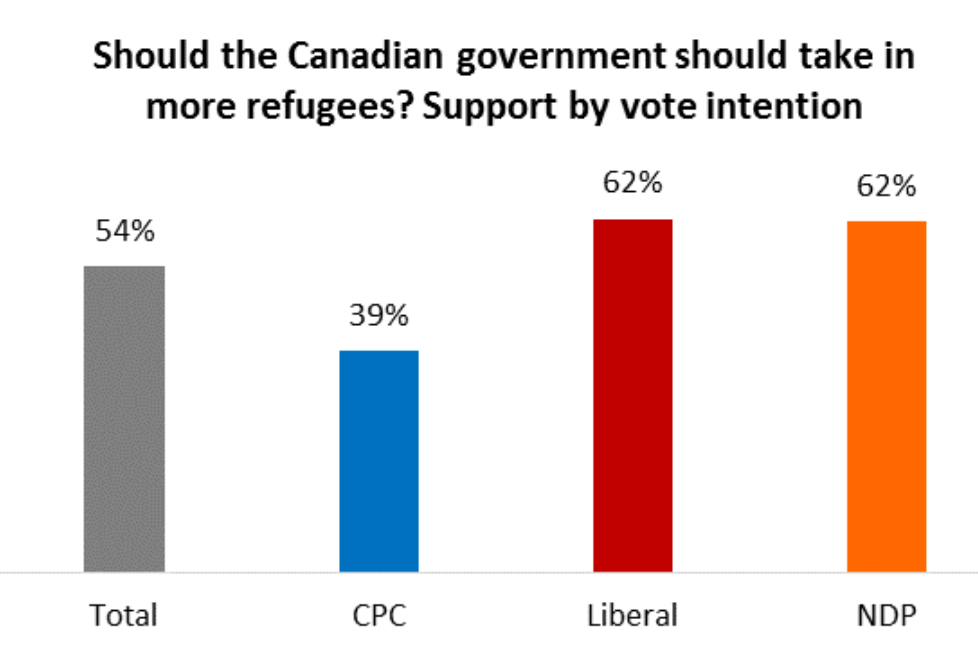
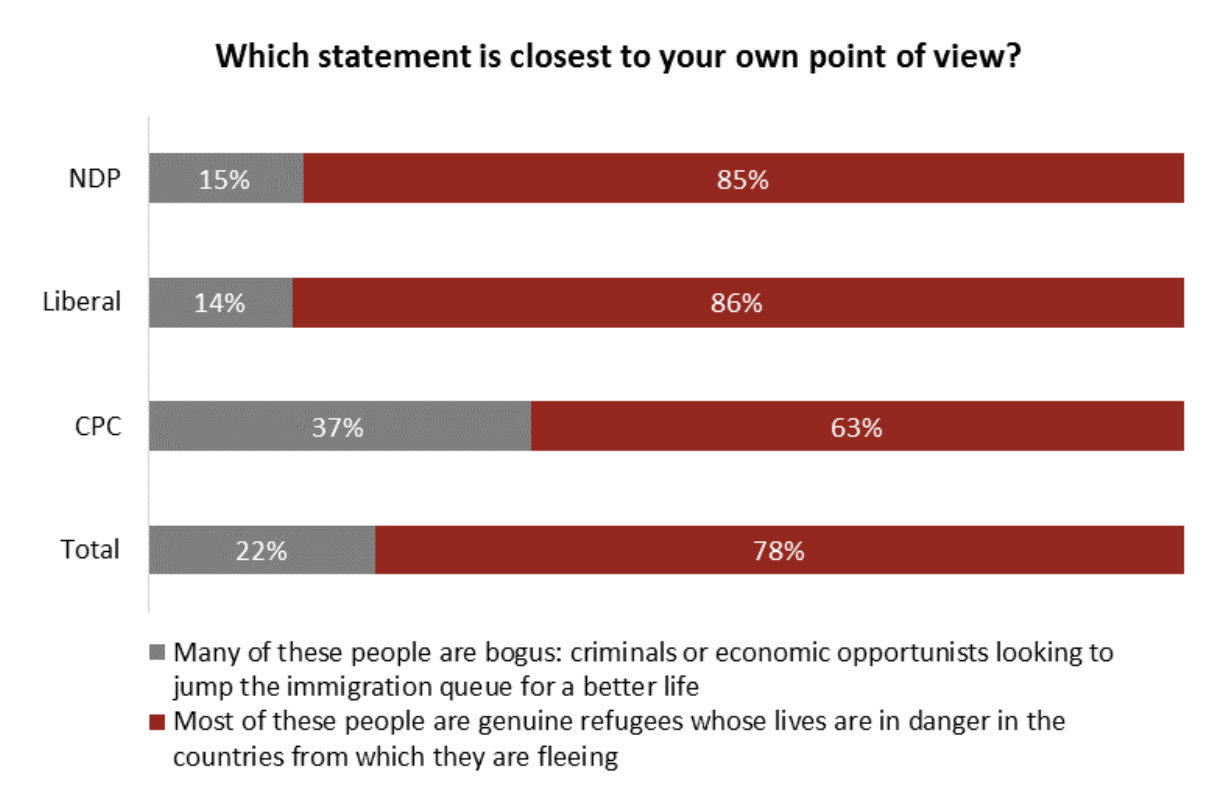
Bogus_refugees_or_notAngus-Reid conducted a useful poll, breaking down opinion by party affiliation, showing the Government’s position is aligned to the Conservative party base and messaging of “bogus refugees”, with the overall key findings being (all parties):

  • Overall, most Canadians (70%) say Canada has a role to play in the migrant crisis, but are divided on increasing the number of refugees the government sponsors and resettles here, and on seeing government spend more to make it happen. (54% and 51% support each, respectively)
  • A significant gender difference exists on whether the people fleeing to Europe from the Middle East are seen as “genuine”: Canadian men are twice as likely as women to say the migrants are “bogus”
  • As to what exactly this country should do, Canadians are most supportive of sending medical and armed forces professionals into the affected European countries areas to assist refugees, divided on taking more refugees and least supportive of “doing nothing”

Canadians divided along political lines over whether to accept thousands of refugees in current crisis
Chris Alexander defends Canada’s refugee response, blames media

For those who missed it, worth watching Alexander defending the Government’s policy and actions with respect to Syrian refugees.

Sep 2, 2015 | 17:53Power and Politics Syrian refugee crisis Video

Unfortunately, he clumsily reverted to attacking the media and getting the facts wrong, which became the focus of Twitter and other commentary:

Alexander, who has served as immigration minister since July 2013 and is running for re-election in Ontario, accused CBC News of ignoring the Syrian refugee crisis.

“I’m actually interested in why this is the first Power & Politics panel we’ve had on this,” he said.

Alexander went on to say that “the biggest conflict and humanitarian crisis of our time has been there for two years, and you and others have not put it in the headlines where it deserves to be.”

Barton noted later the subject had been discussed at least 32 times on Power & Politics, including in interviews with Alexander. As a minister, Alexander was not allowed to appear on panels.

No wonder that he has had to suspend his campaign and return to Ottawa, especially given that the file for the dead boy’s family had apparently been handed to him personally.

Source: Chris Alexander defends Canada’s refugee response, blames media – Politics – CBC News

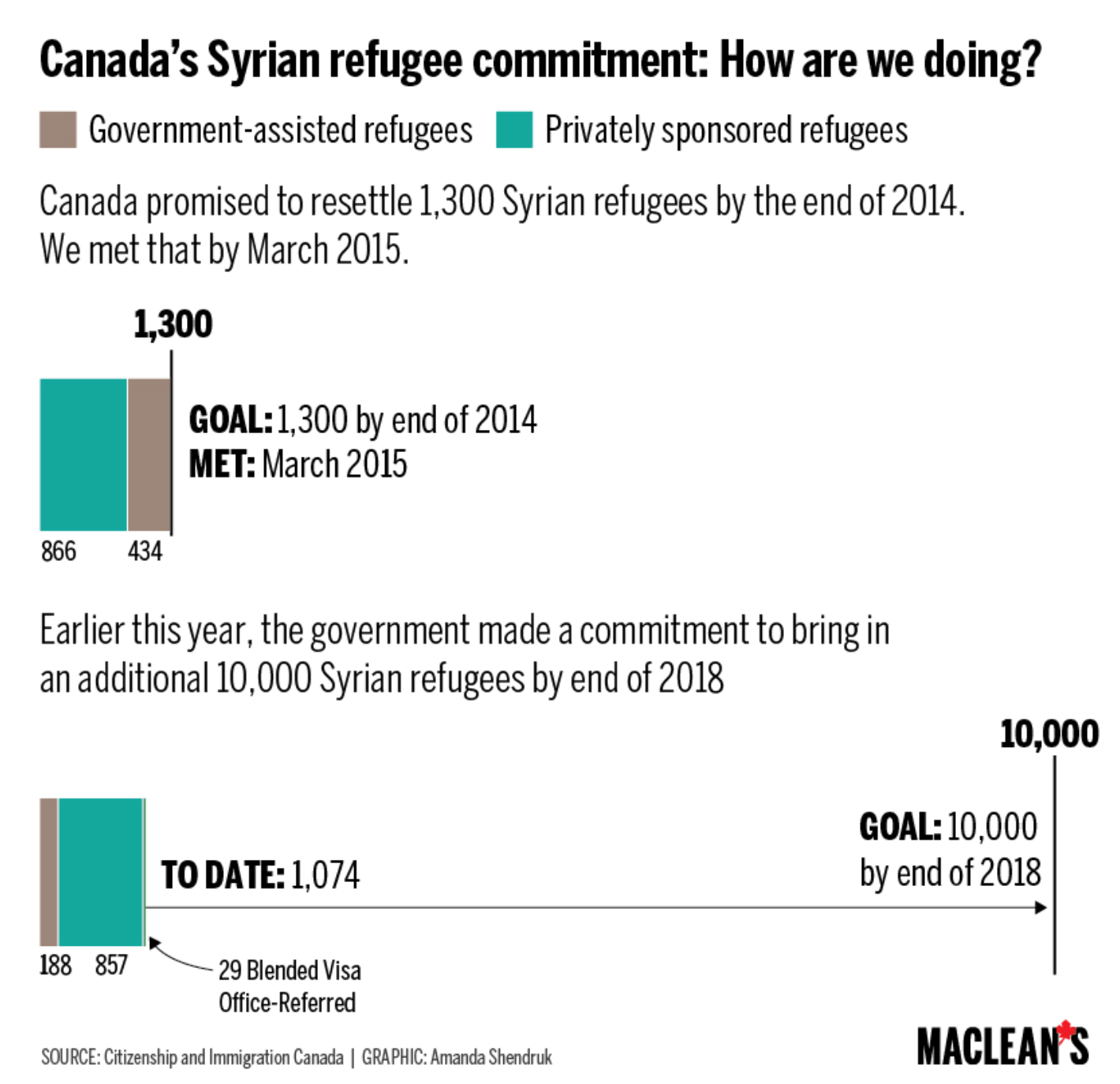
How has Canada fared on resettling Syrian refugees? And government not releasing information.

On how the Government avoids providing information that the public is entitled to:

It was clear, though, that the government had details about the number of arrivals on hand throughout the process. In December 2014, Alexander tabled in the House of Commons a written response to a question by NDP MP Paul Dewar indicating, as of three weeks previous, how many Syrian refugees had arrived and, of those, how many were privately sponsored and how many came with government assistance.

Alexander or his spokesman also made public statements in December and January updating these figures.

It stands to reason, then, that the government knows how many of the 10,000 promised spaces for Syrian refugees have so far been filled. They just won’t say.

Earlier this month, a spokesperson for Citizenship and Immigration (CIC) told me the information was “not available publicly.” The email from CIC went on to provide a link to make a request under the Access to Information Act.

This act is one of those creatively named pieces of legislation that don’t mean what their titles suggest they should. You file a request; weeks, months or sometimes years pass. What you finally receive is heavily redacted. Eventually, you stop asking. If it didn’t suggest such boggling cynicism on the part of the government, I’d swear that was the point.

I decided to play along and filed a request asking how many Syrian and Iraqi refugees have arrived in Canada since January, how many are privately sponsored, and how many came with government assistance.

Today I received a letter from CIC’s Access to Information and Privacy Division, informing me that the information I sought is excluded from the act because it concerned “published material or material available for purchase by the public.”

The letter continued: “Regulation 314 of the Immigration and Refugee Protection Regulations (attached) allows for the production of customized reports for immigration statistical data that have not been published by the Department.”

That’s right: I could buy my answer. The attached regulation informed me that the cost of processing my application for data would be $100 for the first 10 minutes or less of access to the department’s database, plus $30 for each additional minute or less of access.

Or maybe Chris Alexander could publicize that information, because he made a promise, and Canadians have a right to know what progress he’s made toward keeping it.

Given the Minister’s performance on Power and Politics Wednesday, he would be well advised to follow Petrou’s advice.

Source: How has Canada fared on resettling Syrian refugees? – Macleans.ca

Europe’s fear of Muslim refugees echoes rhetoric of 1930s anti-Semitism – The Washington Post

A useful historical reminder by Ishaan Tharoor:

Over the past year, many in Europe have bristled at the influx — from far-right political movements and fear-mongering tabloids to established politicians and leaders. The resentment has to do, in part, with the burden of coping with the refugees. But it’s also activated a good amount of latent xenophobia–leading to anti-Islam protests, attacks on asylum centers and a good deal of bigoted bluster.

Some governments in Eastern Europe have even specifically indicated they don’t want to accommodate non-Christian refugees, out of supposed fear over the ability of Muslims to integrate into Western society.

“Refugees are fleeing fear,” urged a spokesman for the U.N. refugee agency last week. “Refugees are not to be feared.”

It’s important to recognize that this is hardly the first time the West has warily eyed masses of refugees. And while some characterize Muslim arrivals as a supposedly unique threat, the xenophobia of the present carries direct echoes of a very different moment: The years before World War II, when tens of thousands of German Jews were compelled to flee Nazi Germany.

Consider this 1938 article in the Daily Mail, a British tabloid still known for its bouts of right-wing populism. Its headline warned of “German Jews Pouring Into This Country.” And it began as follows:

”  “The way stateless Jews and Germans are pouring in from every port of this country is becoming an outrage. I intend to enforce the law to the fullest.”

In these words, Mr Herbert Metcalde, the Old Street Magistrate yesterday referred to the number of aliens entering this country through the ‘back door’ — a problem to which The Daily Mail has repeatedly pointed.

The number of aliens entering this country can be seen by the number of prosecutions in recent months. It is very difficult for the alien to escape the increasing vigilance of the police and port authorities.

Even if aliens manage to break through the defences, it is not long before they are caught and deported.”

No matter the alarming rhetoric of Hitler’s fascist state — and the growing acts of violence against Jews and others — popular sentiment in Western Europe and the United States was largely indifferent to the plight of German Jews.

“Of all the groups in the 20th century,” write the authors of the 1999 book, “Refugees in the Age of Genocide,” “refugees from Nazism are now widely and popularly perceived as ‘genuine’, but at the time German, Austrian and Czechoslovakian Jews were treated with ambivalence and outright hostility as well as sympathy.”

Source: Europe’s fear of Muslim refugees echoes rhetoric of 1930s anti-Semitism – The Washington Post

Ontario says it can’t get data on effectiveness of carding for current review

Evidence-based policy requires data:

The provincial government cannot compel Ontario’s police forces to hand over their data on street checks — including information as to how many times the controversial practice has helped solve crimes, according to Minister of Community Safety and Correctional Services Yasir Naqvi.

That means that as the province continues its review of street checks, commonly known as “carding,” it will do so without knowing how often the practice has actually proved useful to investigations, by leading to an arrest, to the discovery of a weapon or drugs, or more.

“Legally we are not entitled to that data, under the Police Services Act, unless we require it in the regulation,” Naqvi told reporters during Tuesday’s public consultation at the Toronto Reference Library. Naqvi said his ministry has been consulting with Ontario’s Information and Privacy Commissioner about how to gain access to this policing data in aggregate form, stripped of any personal information.

“One of the reasons why this regulation is needed is to give the province the ability to require the disclosure of data, specific to how police services conduct street checks, to ensure that they are conducted in a way that is rights-based, fair and consistent across the province,” Lauren Callighen, Naqvi’s press secretary, said in an email.

Under Ontario’s Police Act, Callighen said, there are certain circumstances where the province may inspect municipal police services to review their practices, such as the use of force. “This regulation will ensure the same oversight for any policy on street checks.”

Nonetheless, in the absence of such data, the province described street checks in its online discussion document as a “necessary and valuable tool for police” when used properly —something critics of the provincial review have decried as, at best, presumptive.

Naqvi’s office did not respond to a question about what criteria were used to describe street checks as “a necessary and valuable tool,” if not police data.

The lack of information as to how carding interactions produce results has become one of the central issues in the heated debate around the practice.

Carding proponents, including Toronto Police Chief Mark Saunders and Toronto Police Association president Mike McCormack, defend it as a vital investigative tool. Police have said the information contained in carding records can help officers connect the dots, perhaps to show an association between individuals, to place someone in an important place at a key time, and more.

Source: Ontario says it can’t get data on effectiveness of carding for current review | Toronto Star

Débat dans Mont-Royal: Israël au coeur des échanges

Diaspora politics in action (Mont-Royal is 30.7 percent Canadian Jews):

Les personnes portant la kippa se comptaient par centaines dans la salle remplie à craquer d’une synagogue de Côte-des-Neiges hier soir où elles étaient venues entendre les candidats des trois principaux partis débattre d’économie, de langue et d’Israël.

C’est dans cette circonscription où le scrutin s’est révélé très serré en 2011 que Stephen Harper avait lancé sa campagne il y a un mois, dans l’espoir de conquérir le fief libéral longtemps détenu par le libéral Irwin Cutler.

À tour de rôle, les candidats du Parti libéral et du Parti conservateur, qui portaient tous les deux la kippa, ont croisé le fer sur la question israélienne.

«Je suis fier d’être Juif. Mon entreprise a des bureaux en Israël, j’y suis allé souvent. Je vais me battre pour Israël !», a lancé Anthony Housefather, le candidat libéral et actuel maire de Côte-Saint-Luc.

Sans s’en prendre à son adversaire libéral, le candidat conservateur a concentré ses attaques sur le chef Justin Trudeau, dont la «boussole morale varie avec le vent».

«Israël est certainement devenu un sujet important de cette élection, il n’y a aucun doute. Mais de dire que la position du Parti libéral sur Israël est la même que celle du Parti conservateur de Stephen Harper est vraiment tiré par les cheveux», a-t-il déclaré.

Le candidat conservateur a remis en question l’approche plus nuancée prônée par Justin Trudeau au sujet de la politique étrangère canadienne.

«Qu’est-ce que “nuance” signifie? Est-ce que ça veut dire que le Canada devrait diminuer son soutien à Israël? Est-ce que c’est ça que Justin Trudeau veut?», a-t-il lancé sous les applaudissements.

«L’appui du Parti libéral à l’endroit d’Israël est sans équivoque. Il n’y a aucune hésitation», a répété son vis-à-vis libéral.

Robert Libman a été chaudement applaudi par la foule lorsqu’il a ardemment critiqué l’accord sur le nucléaire de l’Iran, « pays qui veut détruire Israël».

Devant les attaques incessantes contre son chef, le candidat libéral s’est même senti obligé de préciser que le Parti libéral «ne support[ait] pas le régime en Iran».

«L’Iran est la plus grande menace du monde, je vais tout faire pour éviter que l’Iran n’obtienne la bombe nucléaire», s’est-il exclamé, également applaudi par une bonne partie des quelque 500 électeurs.

Le candidat du Nouveau parti démocratique (NPD) Mario Jacinto Rimbao, un membre bien en vue de l’importante communauté philippine de la circonscription s’est toutefois fait chahuter en évoquant la position néodémocrate sur l’accord iranien.

Source: Débat dans Mont-Royal: Israël au coeur des échanges | Louis-Samuel Perron | Élections fédérales

Our Radical Islamic BFF, Saudi Arabia – The New York Times

Tom Friedman on Saudi Arabia and its role in spreading extremism:

But if you think Iran is the only source of trouble in the Middle East, you must have slept through 9/11, when 15 of the 19 hijackers came from Saudi Arabia. Nothing has been more corrosive to the stability and modernization of the Arab world, and the Muslim world at large, than the billions and billions of dollars the Saudis have invested since the 1970s into wiping out the pluralism of Islam — the Sufi, moderate Sunni and Shiite versions — and imposing in its place the puritanical, anti-modern, anti-women, anti-Western, anti-pluralistic Wahhabi Salafist brand of Islam promoted by the Saudi religious establishment.

It is not an accident that several thousand Saudis have joined the Islamic State or that Arab Gulf charities have sent ISIS donations. It is because all these Sunni jihadist groups — ISIS, Al Qaeda, the Nusra Front — are the ideological offspring of the Wahhabism injected by Saudi Arabia into mosques and madrasas from Morocco to Pakistan to Indonesia.

And we, America, have never called them on that — because we’re addicted to their oil and addicts never tell the truth to their pushers.

“Let’s avoid hyperbole when describing one enemy or potential enemy as the greatest source of instability,” said Husain Haqqani, the former Pakistani ambassador to Washington, who is an expert on Islam at the Hudson Institute.

“It is an oversimplification,” he said. “While Iran has been a source of terrorism in supporting groups like Hezbollah, many American allies have been a source of terrorism by supporting Wahhabi ideology, which basically destroyed the pluralism that emerged in Islam since the 14th century, ranging from Bektashi Islam in Albania, which believes in living with other religions, to Sufi and Shiite Islam.

“The last few decades have seen this attempt to homogenize Islam,” claiming “there is only one legitimate path to God,” Haqqani said. And when there is only one legitimate path, “all others are open to being killed. That has been the single most dangerous idea that has emerged in the Muslim world, and it came out of Saudi Arabia and has been embraced by others, including the government in Pakistan.”

Consider this July 16, 2014, story in The Times from Beirut: “For decades, Saudi Arabia has poured billions of its oil dollars into sympathetic Islamic organizations around the world, quietly practicing checkbook diplomacy to advance its agenda. But a trove of thousands of Saudi documents recently released by WikiLeaks reveals in surprising detail how the government’s goal in recent years was not just to spread its strict version of Sunni Islam — though that was a priority — but also to undermine its primary adversary: Shiite Iran.”

Or consider this Dec 5, 2010, report on BBC.com: “U.S. Secretary of State Hillary Clinton warned last year in a leaked classified memo that donors in Saudi Arabia were the ‘most significant source of funding to Sunni terrorist groups worldwide.’ She said it was ‘an ongoing challenge’ to persuade Saudi officials to treat such activity as a strategic priority. The groups funded include al-Qaeda, the Taliban and Lashkar-e-Taiba, she added.”

Saudi Arabia has been an American ally on many issues and there are moderates there who detest its religious authorities. But the fact remains that Saudi Arabia’s export of Wahhabi puritanical Islam has been one of the worst things to happen to Muslim and Arab pluralism — pluralism of religious thought, gender and education — in the last century.

Source: Our Radical Islamic BFF, Saudi Arabia – The New York Times

Citizenship – Differences Among Visible Minorities

A recent Twitter enquiry asked what percentage of visible minorities are also Canadian citizens. The overall answer is 78.3 percent, but that question provoked me to prepare the following chart showing the differences between different groups:

Citizenship - Visible Minorities.001

The chart is ordered in increasing order of those who remain non-citizens (but does not distinguish between those who are eligible or not).

Hard to explain some of these differences as no one variable (e.g., education, income, number of second-generation or more) seems at play. Nor is the time resident in Canada (needed to be eligible) likely to be a significant factor as it could not explain the large differences between groups (e.g., Chinese and Filipino).

The relatively large share of dual nationals for West Asian, Arab and Latin American groups may be explained by the greater convenience of being able to return to one’s country of origin with that country’s passport (e.g., Iranian Canadians cannot enter Iran on their Canadian passport and thus need to maintain their Iranian nationality).