Liberal transparency reforms subject to ‘review’ next year

Not surprising, these kinds of changes take time to develop and require considerable consultation and preparation.

In the meantime, however, it would be nice if public servants could take a cue from the government’s signal change and implement a less restrictive redaction policy (it was funny for me to have my ATIP requests on documents that I had worked on overly redacted):

Delivery of a key Liberal promise on transparency is likely months away, as an election commitment to reform the Access to Information Act has morphed into a “review” of the legislation starting next year.

During the election campaign, Leader Justin Trudeau said a Liberal government would end fees for processing information requests; give the information commissioner the power to order release of documents; and make ministers’ offices subject to the act, among other changes.

But Trudeau’s mandate letter to the minister responsible for shepherding the reform, Treasury Board President Scott Brison, backs off from those categorical commitments, most of which the Liberals have been touting since at least June 2014.

Firearms RCMP

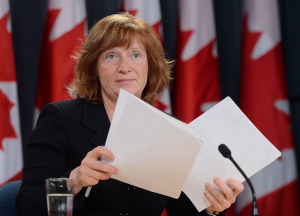
The office of Suzanne Legault, information commissioner of Canada, says it is not aware of any immediate changes to the access-to-information system since the Liberals came to power. (Sean Kilpatrick/Canadian Press)

The promise to cut fees disappears altogether from the mandate letter. It says other promises are to be part of a “review” that will include input from Information Commissioner Suzanne Legault and other stakeholders.

And the platform commitment to ensure the act “applies” to ministers’ offices, including the Prime Minister’s Office, has changed in the mandate letter to “appropriately applies.”

A spokesperson for Brison’s office says details of the “review” will be announced in the new year, and will include an examination of fees.

“Given the importance of these changes and their complexity, further consideration is required,” said Lisa Murphy. “The government will take the time necessary to fully examine all the options.”
Source: Liberal transparency reforms subject to ‘review’ next year – Politics – CBC News

Man set to recant oath to the Queen right after #citizenship ceremony

While I am no fan of the current citizenship oath and its reference to the Queen (even if the reference refers more to the institution of the Crown, rather than the Queen personally), I find these kinds of cases silly.

The proper way to change the oath is not through the courts but rather through Parliament.

And it does beg the question, whether recanting should be viewed as renouncing citizenship?

A soon-to-be Canadian has served notice that he plans to recant the mandatory Oath of Allegiance to the Queen immediately after he becomes a citizen.

In a letter sent to the citizenship court judge earlier this month, Dror Bar-Natan states his opposition to the oath, which he calls “repulsive,” and his plan to renege on the pledge following his citizenship ceremony on Monday.

The Queen is a symbol of entrenched and outdated privilege and the pledge is tantamount to a “hazing” ritual, Bar-Natan said in an interview.

“To become a Canadian citizen, I am made to utter phrases which are silly and ridiculous and offensive,” he said. “I don’t want to be there.”

Bar-Natan, 49, a math professor from Israel who has been in Canada for 13 years, was one of three longtime permanent residents who challenged the constitutionality of making citizenship conditional on promising to be “faithful and bear true allegiance to Queen Elizabeth the Second, Queen of Canada, her heirs and successors.”

In upholding the requirement, Ontario’s top court said the Queen remains Canada’s head of state and the oath was a “symbolic commitment to be governed as a democratic constitutional monarchy unless and until democratically changed.”

The court also found that all citizens have the right to espouse anti-monarchist views and new Canadians could “publicly disavow what they consider to be the message conveyed by the oath.”

Source: Man set to recant oath to the Queen right after citizenship ceremony – Macleans.ca

What ISIS songs reveal about the group’s evolution

Another side of Daesh/ISIS’ propaganda and recruitment strategy:

After this month’s attacks in Paris, ISIS released an audio recording celebrating the attacks and taking responsibility for them. The RCMP is still investigating the recording to determine whether the voice on the recording belongs to a Canadian. Some linguists are convinced it does, and that the speech patterns suggest he is from Ontario. But it’s still not clear whose voice is on that recording.

What we do know is that the audio statement begins with an acapella song that’s as hooky as any pop song, and it plays throughout the five and a half minute recording.

The song takes the form of a traditional Islamic holy chant, called a “nasheed”. These songs have become key to the ISIS propaganda machine. They’re the soundtrack to the shocking execution videos, they’re blasted from cellphones on the battlefield and now, they’re showing up more and more in English.

Aymenn Jawad Al-Tamimi,fellow at the Middle Eastern Forum, says the Islamic State is one of the leading producers – if not the­ leading producer – of jihadi nasheeds today.

Day 6 asked him to  listen to the music in ISIS’ latest audio recording following the Paris attacks, and to compare it to other jihadi songs that ISIS has produced.

“My immediate thoughts on that nasheed is the language used: English,” says Al-Tamimi. He says the Islamic State has recently branched out into producing nasheeds in other languages, including English, French, German and even Hindi and Uyghur to reach  out to non-Arabic foreigners to join the Islamic State.

“This one  is what you could call one of the more generic nasheeds in terms of content, referring to conceptions of martyrdom and virgins of paradise promised for those who die in the cause of jihad,” says Al-Tamimi.

And he says the catchiness of the songs serves a strategic purpose. “In regards to the melodies of nasheeds being catchy, it can help subconsciously imbibe the nasheed into your mind. The catchiness of the nasheed will help reinforce the messaging and indoctrination,” says Al-Tamimi.

Source: What ISIS songs reveal about the group’s evolution – Home | Day 6 | CBC Radio

Islamophobia is leading the West to a very dark place: Jebara

Good piece by Mohamad Jebara is Chief Imam and resident scholar at the Cordova Spiritual Education Center in Ottawa:

The demonization of peoples and religions is an insidious process that infects entire cultures. Shakespeare vilified European Jews when he wrote The Merchant of Venice, as Charles Dickens did when he made his child-slaver Fagin a Jew in Oliver Twist. For centuries, Jews were portrayed in Western media as sly, deceitful, evil and merciless — a portrayal that allowed the ‘civilized’ world to stand by in silence — and in some cases even rejoice — as the Nazis worked to annihilate European Jewry.

Muslim people, like people everywhere, are quite diverse. Some are saintly, a few demonic, but most lie somewhere in between — just ordinary people who want to live in peace with their families.

Since the formation of the so-called Islamic State, much of the non-Muslim world has continued to misdirect its rage and resentment against its victims. ISIS has killed over 100,000 Muslims, massacred top-ranking Islamic clerics and destroyed hundreds of mosques, seminaries and Islamic heritage sites. It is the Muslim world that continues to suffer most at the hands of these extremists, who try to disguise their depravity with the language of religion.

Centuries of demonization and scapegoating led directly to the death camps of the Second World War. Then, as now, we said, ‘Never again’ — never again would we allow indoctrination and mob mentality to take human civilization to the gates of hell.

Powerful words. Are we still ready to live by them?

Ottawa-based imam Mohamad Jebara wonders whether the racist panic-mongering

A change in government alone won’t fix the malaise: Savoie

Always interesting to read Savoie’s observations.

A good list of fundamental questions facing the public service:

A change in government in itself will not address the malaise confronting the public service. It can, however, open a window to answering fundamental questions about organizing government.

If nothing belongs to a single department any more, should we still rely on traditional line departments to come up with policy proposals and deliver public services? Should government have self-governing delivery arms tied to policy centres led by ministers? If government departments and agencies cannot retain revenues or their budget, how can we expect them to remain frugal? How can we streamline accountability requirements? How can we isolate, at least some government operations, so that missteps become lessons learned for managers rather than “gotcha” fodder for the blame game? How can we improve relations between ministers and the public service, government and Parliament?

Dealing with fundamental questions will force senior government officials to go beyond giving the appearance of change while standing still. The question needs the attention of at least some senior ministers and some senior public servants operating away from the demands of the day. Past reform attempts have sadly ignored Parliament, which may offer some explanations for their failure.

Why not structure a House of Commons committee and ask that it pursue these questions?

Public servants should be encouraging this debate. They should, however, shy away from partisanship, even the appearance of partisanship. The one thing that gives the public service strength, credibility and standing with Canadians and, yes, with politicians, is its non-partisan status and the ability to serve all politicians without fear or favour.

I would add to the list greater awareness and mindfulness of public servant biases and values, rather than just focusing on more avert partisanship, to improve the impartiality and neutrality of advice.

Source: A change in government alone won’t fix the malaise – The Globe and Mail

Immigration minister reviewing refugee loan program

Interesting – going beyond the mandate letters and platform:

The federal Liberal government will consider reforming a loan program that requires refugees to cover the hefty cost of their flights to Canada, Immigration Minister John McCallum said Friday.

Officials revealed earlier this week that the 25,000 Syrian refugees to enter Canada by February won’t have to pay the cost of their flights and pre-flight medical screening.

While that decision was praised by B.C. opposition MPs and some refugee aid groups, they said the policy should extend to all refugees. They argued that people fleeing persecution already face major challenges finding homes, work and language training, so the last thing they need is to have to service an interest-bearing loan of up to $10,000.

McCallum, in an interview with The Vancouver Sun, said his officials will brief him in coming days on the loans program and present him with options to change it.

“I don’t know what the options are, but I’m telling you this is a policy that we’re certainly considering changing,” he said.

The government’s Immigration Loans Program, created in 1951, provides up to $110 million a year in loans for travel and costs immediately after arrival, like rent deposits and buying work tools. It has a 91-per-cent payback rate.

Refugees can take up to six years to pay, depending on the loan amount, and the interest rate this year was 1.38 per cent. In some cases, loans are interest-free for one to three years, and federal officials will make alternative arrangements if borrowers are having trouble making payments, according to Citizenship and Immigration Canada.

Source: Immigration minister reviewing refugee loan program

Good example of Muslim criticism of violent extremists

A reminder to those who continually ask question the perceived lack of criticism of terrorism by Muslims that it is not too hard to find, as this short video attests:

Saudi-Born Singer Shams Bandar: Why Do We Pin All Our Problems on the West?

Banking on Arab youth to turn Arab countries around – Bessma Momani’s Arab Dawn: Arab Youth and the Demographic Dividend They Will Bring

Interesting study and conclusion:

Is the Arab world a lost cause? You’d be forgiven for reaching that conclusion. At a moment when the world’s other once-poor regions have all experienced significant improvements, the 22 Arabic-speaking countries stretched between Oman and Mauritania, with few exceptions, are stuck with stagnant economies, backward strongman political systems and simmering threats – and that’s the luckier ones.

But imagine for a moment that the current chaos and unrest is only a period of turbulence between two eras. Imagine if, a century from now, we were to look back upon the Arab 2010s as something like the French 1790s or the American 1770s or the English 1640s – a terrible time that foretold the creation of a better time.

To imagine this, you’d have to conclude that the current Arab “youth bulge” – the extraordinary proportion of the region’s population (at least a fifth) who are between 17 and 25 and whose unemployment, disappointment and youthful zealotry are currently key sources of its violence, instability and chaos – largely come of age, in a few years, as a new generation of adults seeking better economic and political futures.

Once the civil wars, riots, coups and countercoups played themselves out and some uneasy semi-democratic détente was reached, that generation’s education and literacy, urbanized and connected aspirations and entrepreneurial outlook gave rise to a period of improvement and reform that, while far from utopian, put the Middle East and North Africa onto the same modernizing track as the rest of the world.

This is exactly the mind exercise performed by Bessma Momani, a political scientist based at the University of Waterloo (and frequent Globe and Mail contributor) who specializes in the economies of the Middle East, in a new book surprisingly titled Arab Dawn: Arab Youth and the Demographic Dividend They Will Bring.

She spent several years surveying and interviewing young Arabs in half a dozen countries. She finds plenty of troubles – staggering unemployment, rising religiosity, sexism – but beneath it an emerging generation who are modern, educated and unwilling to settle for the closed nationalist economies, authoritarian politics and enforced subservience their parents endured.

Arabs are young, but aren’t having huge families, so are in a demographic sweet spot. Dr. Momani foresees this combination of factors paying the dividend her subtitle suggests.

Source: Banking on Arab youth to turn Arab countries around – The Globe and Mail

Peterborough synagogue welcomes Muslims displaced by mosque arson

Canada at its best:

A Muslim group in Peterborough, Ont., will kneel and pray today at a local synagogue, where they will be welcomed after their own mosque was damaged in an arson attack earlier this month that police are investigating as a hate crime.

“As Canadians we have to stick together,” said Larry Gillman, president of the  Beth Israel Synagogue, in an interview on  CBC’s Metro Morning today. “It’s not about religion, it’s not about race. Canadians do this.”

The Masjid al-Salaam mosque was damaged in a fire set deliberately on Nov. 14, part of a wave of anti-Muslim crimes after the attack in Paris a day earlier. A firebomb was placed in one of the windows of the mosque. The resulting fire caused $80,000 in damage.

The Beth Israel Synagogue will host two prayer sessions for local Muslims and a potluck dinner today.

It’s a partnership between Kenzu Abdella, the president of the Kawartha Muslim Religious Association, and Gillman.

As soon as Gillman heard about the fire at the mosque, he reached out to his synagogue’s board of directors to find out about sharing space with the Muslim congregation. They voted unanimously in favour.

“I hope this can be some kind of small example to others,” said Gillman.

Abdella wasn’t sure what to think at first. “Can we be here?” he remembered thinking.

Larry Gillman, president of the Beth Israel Synagogue, invited Muslims into his synagogue in Peterborough, Ont., for prayer. (Beth Israel Synagogue)

“In the beginning, it was a shock,” he said. “Within 24 hours, that changed. They walked to the mosque and told us that whatever we need, they will support us.

“Even though it came out of a tragedy, we are working together.”

Source: Peterborough synagogue welcomes Muslims displaced by mosque arson – CBC.ca | Metro Morning

Rick Mercer’s Rant on Refugee Worries

Short and to the point: