Time to name an Aboriginal justice to the Supreme Court: Hassan and Siddiqui

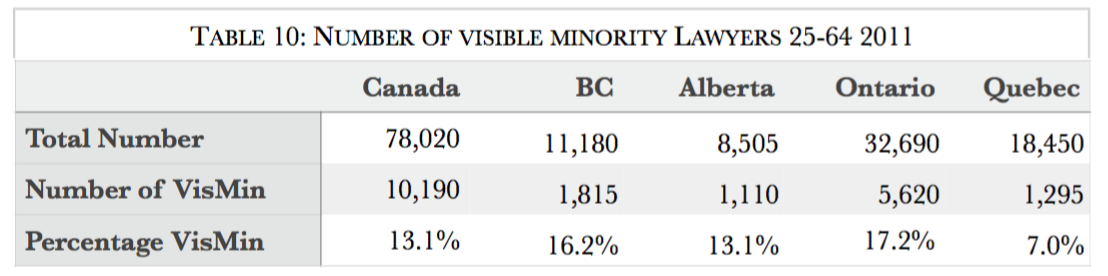
 Visible Minority LawyersNader Hassan and Fahad Siddiqui make the argument (the number of visible minority lawyers is higher than their article, based upon NHS data that I used in my book, Multiculturalism in Canada: Evidence and Anecdote):

These criteria narrow the field considerably [member of provincial superior court, bilingual, Maritime], and risk obscuring another important fact: our high court does not look like the rest of Canada. No Aboriginal or visible minority has ever been appointed to the Supreme Court. Regional representation — which convention so assiduously protects — is important, but in an increasingly ethnically and religiously diverse country, it is only one of many indicia of diversity.

Since the Abella Equality in Employment Royal Commission Report in 1984, a consensus has emerged among judges, lawyers and academics that judicial diversity matters. A diverse judiciary results in a broader range of perspectives, which is crucial to judicial decision-making. And greater judicial diversity fosters public confidence in the administration of justice.

Little progress has been made so far. Professor Rosemary Cairns Way of the University of Ottawa reports that Aboriginal and visible minority members account for roughly 23 per cent of the population, and yet from 2009 to 2014, only 1.04 per cent of appointees to the provincial superior courts were Aboriginal, and only 0.5 per cent were members of a visible minority group.

The same appears to be true of the senior reaches of the legal profession. The body that regulates lawyers in Ontario, the Law Society of Upper Canada, does not regularly collect comprehensive demographic data. But a Society report, released in 2010, shows that only 5 per cent of lawyers in Ontario between the ages of 45 and 64 are Aboriginals or visible minorities even though those two groups make up more than a fifth of that segment of the population.

It is sometimes argued that as Canada’s population diversifies, the legal profession will too. Problem solved — some years or decades down the line.

The statistics we have don’t bear out that claim though. Even among younger generations, Aboriginals and visible minorities are under-represented at the bar. And those who have managed to gain a foothold in the profession face unique challenges. The society reports that a majority of Aboriginal and visible minority lawyers believe that having a different cultural background has disadvantaged their careers. In that sense, the legal profession reflects trends in the broader job market. According to a recently released study led by University of Toronto researchers, black job applicants are 25.5 per cent more likely to land a job interview when they scrub their resumé of clues of their race.

The time has come for change. And this change requires leadership from the top. We need out-of-the box thinking, such as Trudeau’s laudable decision to name women to half his cabinet positions — including Canada’s first Aboriginal justice minister. The prime minister will have to take a similarly bold approach to fill the high court vacancy. An Aboriginal candidate should take priority. It’s an absolute shame that Canada’s highest court has never had representation from among our First Nations.

Liberals to let religious freedom office expire on March 31

Expected:

Mr. Dion confirmed the office’s closure at a global affairs conference in Ottawa on Tuesday.

“Our government shares the same conviction as the previous government, but it assesses the consequences of its chosen method of promoting this conviction differently. I am referring to freedom of religion or belief, which we will defend tooth and nail, but not through the office that the Harper government specifically set up for this purpose,” said Mr. Dion during a speech at the University of Ottawa.

The Liberals have previously indicated their intention to close the office. The office’s mandate expires March 31.

Last week, the Conservatives tabled a motion in the House of Commons to renew the mandate of the Office of Religious Freedom. The Liberals voted against the motion and it was defeated 225 to 90.

Prior to the motion, Religious Freedom Ambassador Andrew Bennett, who was appointed by the Conservatives in 2013, accepted a position as a senior fellow at Cardus, a leading Christian think tank. He will also serve as chair of the think tank’s Faith in Canada 150 program while he completes his term at Global Affairs Canada. His new position is voluntary and unpaid with support of Global Affairs Canada.

Mr. Bennett’s three-year term was originally set to end in February, but the Liberals extended it to March 31 to coincide with the expiration of the office’s mandate and $5-million in annual funding. While Mr. Bennett’s future at Global Affairs Canada is unclear, the minister’s office has applauded his work as ambassador.

The Conservatives first promised to create an Office of Religious Freedom during the 2011 election campaign. The office’s mandate is to “speak out and to protect and promote religious freedom around the world.”

While the Conservative initiative was criticized for mixing politics and religion, certain religious groups supported it. In a letter to Mr. Dion in January, Jewish, Sikh and Ahmadiyya Muslim organizations asked the Liberal government not to scrap the office.

On Tuesday, Mr. Dion reiterated the government’s thinking in determining how to best defend various rights.

“We believe that human rights are better defended when they are considered, universal, indivisible, interdependent and interrelated, as set out in the Vienna Declaration,” said Mr. Dion.

The remaining question is the degree to which future projects focused on religious freedom  will be funded within existing Global Affairs program funds. I expect not absent any declaration to the contrary.

Source: Liberals to let religious freedom office expire on March 31 – The Globe and Mail

Mr. Trudeau: Don’t be so quick to brag about Sikhs in your cabinet – Ramesh Thakur

The latest complaint regarding the number of Sikhs in Cabinet (the selection of Parliamentary Secretaries somewhat addressed under-represented groups – see my deck Big Shift or Big Return? Visible Minority Representation in the 2015 Election for the numbers):

India is an exemplar par excellence of power sharing and political accommodation in a multi-ethnic, multireligious society. In a country where 80 per cent of the people are Hindus, at one point the heads of government, state and army were a Sikh, Muslim and Sikh respectively; and the real power behind the throne was an Italian-born Catholic widow. Diversity and pluralism have no better champion. At the official White House banquet hosted by U.S. President Barack Obama for India’s Prime Minister Manmohan Singh – a Sikh – on Nov, 24, 2009, a glittering new dimension of Indian soft power was in evidence with the presence of many Indian and Indian-American women from the political, business, literary, cultural and educational worlds.

Sikhs make up under 2 per cent of India’s population, so two Sikhs in Mr. Modi’s cabinet is a better reflection of India’s diversity than four in Mr. Trudeau’s is of Canada’s demographic makeup. In fact the Congress Party, not Mr. Modi, needs a reckoning on Sikhs. After Indira Gandhi’s assassination by Sikh bodyguards in 1984, 3,000 Sikhs were slaughtered in a pogrom often orchestrated by senior Congress leaders, including more than 2,000 killed in the nation’s capital. One of the extraordinary features of modern Indian history is how Mr. Modi was demonized internationally for his alleged role in the anti-Muslim riots of 2002 in Gujarat but the Congress Party escaped global odium for its role in the worse atrocities of 1984. It is hard to see how there can be closure for the victims’ families until such time as there is criminal accountability for those events.

Moreover, any mention of Sikhs in the context of Indo-Canadian relations inevitably rakes up ugly memories from three decades ago, when Canada seemed to be home to a large number of separatist Sikh extremists.

On June 23, 1985, Air India flight 182 was blown up over the Irish Sea en route from Montreal to Delhi via London, killing all 329 people on board. Most were Canadian citizens of Indian ancestry. This was the first bombing of a 747 jumbo jet, the deadliest plane bombing, the deadliest attack involving an aircraft until 9/11 in New York and remains the biggest mass murder in Canadian history. The perpetrators are believed to have been Sikh terrorists, although the subsequent trials were less than satisfactory.

All in all, what may have been a lighthearted quip by Mr. Trudeau is fraught with hidden dangers and best avoided in future.

Source: Mr. Trudeau: Don’t be so quick to brag about Sikhs in your cabinet – The Globe and Mail

Hard Line on Immigration Resonates Less With Young Republicans, Survey Shows – The New York Times

Another example of the generation divide:

Young Republicans are much more likely to have favorable views of immigration and to support a path to citizenship for immigrants in the United States illegally than are older Republican voters, according to a survey published on Tuesday by the Public Religion Research Institute, a nonpartisan research group. The divide could mean trouble in the general election for either of the two leading Republican candidates, Donald J. Trump and Senator Ted Cruz of Texas, who have called for mass deportation of 11 million undocumented immigrants.

In the survey, 63 percent of Republicans under 30 said they supported giving those immigrants a chance to become citizens if they met certain requirements. Only 20 percent of young Republicans said they would identify and deport them. By contrast, about a third — 34 percent — of Republicans age 65 and over favored deportation, and less than half — 47 percent — said they supported a pathway to citizenship for those immigrants.

A third option, allowing the immigrants to become permanent legal residents but not citizens, was not supported by more than 15 percent of either group.

The institute’s survey is unusual because of the size and duration of its sample. The report is based on 42,586 telephone interviews conducted in English and Spanish from April 29, 2015, to Jan. 7, 2016. The margin of error is plus or minus one point.

Mr. Trump’s pledges to expel illegal immigrants and to build a wall along the border with Mexico consistently draw cheers at his rallies. Mr. Cruz has followed Mr. Trump and hardened his position, saying he would deport illegal immigrants and would not allow them to return.

In general, Republicans’ views of foreign newcomers are negative, the survey suggests, with 53 percent saying that recent immigration “threatens traditional American customs and values,” while only about a third — 32 percent — say immigrants “strengthen American society.” Among conservative Republicans, 58 percent think immigration is bad for the country.

But 51 percent of young Republicans say immigrants make the country stronger.

Source: Hard Line on Immigration Resonates Less With Young Republicans, Survey Shows – First Draft. Political News, Now. – The New York Times

In a highly competitive world, is diversity Canada’s advantage? Momani and Stirk

Op-ed by Bessma Momani and Jill Stirk on their research supported by the Pierre Elliott Trudeau Foundation on the business benefits of multiculturalism or pluralism (disclosure: I have been discussing with them how some of my data from my research and book Multiculturalism in Canada: Evidence and Anecdote could assist their work):

Research shows that diverse organizations make better decisions, and companies with diverse leadership see rewards in their bottom line. A 2015 study by McKinsey and Co., for example, shows that “companies in the top quartile for gender, racial and ethnic diversity are more likely to have financial returns above their national industry medians.” A recent study by the Peterson Institute found that 22,000 companies whose executive management was gender-diverse realized 6-per-cent higher corporate earnings.

Business leaders, both at home and abroad, tell us that the country’s diverse work force makes Canada an attractive partner for investment and trade. As one executive of a high-tech company noted, “I want my team to be diverse, and I know I can get that in Canada.” Research from the Conference Board of Canada shows that businesses operated by immigrant entrepreneurs are twice as likely to export outside Canada and the United States, and not necessarily to their country or region of origin.

But despite all this anecdote and evidence, it’s not clear that business leaders, even in today’s knowledge-based economy, truly embrace diversity of thought, experience, gender and ethno-cultural background as a key input into an innovative service or product. They understand that they must invest in science and technology, and generate ideas to create value. But is Canada taking full advantage of its rich diversity? Are we leveraging our globally connected citizens to the same extent as India, Australia or Britain?

Even though it’s increasingly clear that pluralistic societies are a magnet for talent and investment, governments too often focus on reinforcing borders or on protecting local monopolies, while businesses fail to see the opportunities that come with diverse international experience. Going forward, a national strategy to realize the benefits of diversity must involve a closer look at policies on labour mobility, taxation, fast-track visas for specialized needs, international research collaboration, foreign credential recognition and bridging, and ways to expand young Canadians’ opportunities to study and work abroad so they can gain vital international experience and build global connections.

With support from the Pierre Elliott Trudeau Foundation, we are taking an in-depth look at the links between pluralism and economic prosperity. Together with our partners, we are generating new academic research and consulting with business leaders, industry associations, universities and civic organizations to compile a comprehensive study of how diversity can be leveraged for greater economic advantage. We are documenting how Canadians are contributing to and benefiting from global connections, and how the growing Canadian diaspora – three million people living and working abroad – contribute to our role in an interconnected global economy.

Now, more than ever, as the discussion of global migration and diversity are increasingly polarized and scrutinized, it’s time to demonstrate the economic value of having a pluralist society. A diverse work force could be the comparative advantage for us to capitalize on in a highly competitive but slow-growing global economy.

Source: In a highly competitive world, is diversity Canada’s advantage? – The Globe and Mail

Why won’t the Liberals act on Harper’s overreach on appointments? Baar and Russell

Valid points by Carl Baar and Peter Russell (a former and excellent professor of mine):

One of the lingering excesses of the Stephen Harper government has remained largely unaddressed: awarding appointments for positions that would not be vacant until after the Oct. 19, 2015, federal election.

To the astonishment of many of our colleagues in political science and law, 49 order-in-council appointments were adopted by the Conservative cabinet from Nov. 27, 2014, to July 28, 2015 – all before the dissolution of Parliament – even though the effective dates of the orders were after Oct. 19, 2015, and in one case not until Jan. 1, 2019.

Of these, 48 were reappointments of existing members of agencies, boards and commissions, typically for fixed terms of two to five years, paying salaries as high as $200,000 a year or more.

The one new appointment was to the National Energy Board, for a seven-year term that began on Nov. 23, 2015 – a month after the election was over, and continues until Nov. 22, 2022.

We know of no constitutional principle that allows a government to fill vacancies that do not exist until after the end of its mandate – in this instance, when those vacancies occur after an election has been held.

The search for comparable events has been instructive if not troublesome. Last fall, elections in Poland led to the defeat of its previous government. The new government rescinded five appointments made by its predecessor to the country’s Constitutional Tribunal. That tribunal subsequently ordered three of those appointees reinstated, but declined to reinstate the other two because their positions were not vacant until after the new government came into power.

In Florida, the term of a member of its Supreme Court expired on Jan. 1, 1999, the same day governor-elect Jeb Bush was scheduled to take office to replace a Democratic incumbent. The situation was resolved when the two party leaders agreed on a single appointee to fill the vacancy.

Surely in Canada, with a system of government based on principles of responsible government and democratic accountability, this kind of overreach – making appointments that become effective beyond a government’s democratic mandate – is just as unacceptable as in other democracies.

….Our constitutional system is bulwarked by a set of “unwritten” principles or conventions to ensure that official conduct is consistent with the underlying spirit of our written Constitution.

One advantage of having unwritten conventions is that they can change and be adapted to new challenges to our constitutional order. However a disadvantage is that when unexpected abuses of power occur, there is no easily identified convention to apply.

Thus, for example, there is a caretaker convention that requires government to act with restraint between the time Parliament is dissolved and the newly elected parliament meets. Restraint means carrying on with the day-to-day governing of the country but without taking new policy initiatives or making important appointments.

The caretaker convention emerged in 1896 when Conservative prime minister Charles Tupper, after his defeat in the election but before the summoning of Parliament, presented the governor-general, Lord Aberdeen, with a long list of appointments. The governor-general refused to sign the more important appointments, including those to the Senate and the Supreme Court of Canada. When the House of Commons met after the election, the new prime minister, Wilfrid Laurier, supported the governor-general’s refusal and no member of Parliament supported Tupper.

What we need now, in 2016, is for a member of Parliament to challenge the Harper government’s overreach appointments, and get the same kind of support as Laurier received for challenging Tupper’s attempt to make unconstitutional appointments.

In that way, Canada will establish a constitutional convention that a government cannot make order-in-council appointments to positions that will not be open until after an election.

Source: Why won’t the Liberals act on Harper’s overreach on appointments? – The Globe and Mail

Canada’s tech startup sector wants easier access to hire top foreign talent

Yet some more expected tweaks to Express Entry:

After winning a big concession in the budget on taxing stock options, Canada’s tech startup sector is braced for its next battle: urging Ottawa to fix immigration rules that limit its ability to hire top foreign talent.

The Express Entry system brought in by the last government in 2015 “is fundamentally too rigid” and leaves employers waiting up to six months to discover if they can bring skilled foreign talent to Canada, said Tobi Lutke, CEO of Ottawa-based software firm Shopify Inc. “That puts us at a huge disadvantage for recruiting internationally.”

Under policy changes enacted by the Conservatives, employers now must validate a job offer by getting government approval for a “Labour Market Impact Assessment” – showing it couldn’t find Canadians to do the job. While that approach targeted abusers of the temporary foreign worker program, it meant fast-growing tech firms searching for the best employees globally had to submit to the same drawn-out process, only to be told in many cases by Ottawa that they should just hire a Canadian.

“It was a misguided approach,” said Sarah Anson-Cartwright, director of skills and immigration policy for the Canadian Chamber of Commerce.

Immigration Minister John McCallum wasn’t available to comment. But a department spokesman said the government plans to review the Express Entry program “to see how it can be improved for potential immigrants such as top-level foreign executives. The review will include, likely among other things, the LMIA requirement.”

Tech startup leaders say the rules not only add delays but that the process lacks transparency and consistency, imposes needless bureaucracy and lacks an appeals process. In many cases, would-be recruits choose other offers rather than waiting. Foreign students awaiting government approval for their job offers sometimes must leave Canada when their study visas expire.

Six out of 10 employers surveyed by the Canadian Employee Relocation Council (CERC) last year said the immigration changes under the Tories had hindered their strategy planning and recruiting. One out of six opted to create the jobs abroad instead.

Curious to know the relative competitiveness of Canada vis-a-vis the US, given my understanding of the problems Silicon Valley has in hiring global talent.

Source: Canada’s tech startup sector wants easier access to hire top foreign talent – The Globe and Mail

Was Mother Teresa Really ‘Saintly’? – The Daily Beast

One of the counterpoints:

So Mother Teresa’s friendship was for sale—but that wasn’t the worst that could be said about her. Hitchens’s hostility to religion could cross over into hysteria, even idiocy: he once reproduced in print the urban legend that Orthodox Jews have sex through a hole in a sheet, so that their bodies don’t touch. But he got something essentially right about Mother Teresa’s theology when he noted that she wanted those in her care to suffer. Why else did she—despite the unaudited millions that her order brings in donations—provide her homes’ dying residents with thin cots, instead of proper hospital beds? Why did she deny them adequate narcotic pain relief? And why did she treat their pain as a beautiful thing? Because she believed that suffering brought the sick closer to Jesus Christ.

“The point,” Hitchens wrote, after adducing careful evidence, “is not the honest relief of suffering but the promulgation of a cult based on death and suffering and subjection. Mother Teresa (who herself, it should be noted, has checked into some of the finest and costliest clinics and hospitals in the West during her bouts with heart trouble and old age) once gave this game away in a filmed interview.” Describing a person in the last agonies of cancer, she “told the camera what she told this terminal patient: ‘You are suffering like Christ on the cross. So Jesus must be kissing you.’ Unconscious of the account to which this irony might be charged, she then told of the sufferer’s reply: ‘Then please tell him to stop kissing me.’”

The Catholic Church, of course, does not canonize people for their moral perfection. For Catholics, all human beings are fallen and sinful in nature; canonized saints are not perfect beings but simply people who led lives worthy enough to receive special recognition in their afterlives (as a technical matter, saints are those whose names can be invoked in the liturgy). So Mother Teresa could be as bad as Hitchens said she was, and yet in relevant ways good enough to deserve sainthood. And therein lies a problem. For while the Church never claimed that saints are necessarily super-human, our popular perception of saints requires them to be, and so we develop historical amnesia about who they really were.

Some of the Catholic saints, even some of the real biggies, were perfectly dreadful. For starters, a startling number were anti-Semites. “How dare Christians have the slightest intercourse with Jews, those most miserable of all men,” asked St. John Chrysostom, the fourth-century church father. In Jesus’ time, the Jews’ “evil ways corrupted the morals of the people,” according to St. Thomas Aquinas. “Jews are slayers of the Lord, murderers of the prophets,” said St. Gregory of Nyssa. If it seems bit unfair to hold men ancient and medieval to our modern ideals of toleration—after all, to be a European Christian was, once upon a time, to be taught do despise Jews—then consider all the saints who were bloody crusaders, or cruel catechizers of unwilling native peoples. One begins to see that there’s something unnerving about the whole category. 

Of course, Wolf, the philosopher, would immediately recognize that Catholic saints were not supposed to be moral saints, not as she understands the term. The Catholic Church has historically looked to canonize people of grandeur—institution builders, martyrs, self-flagellators, mystics, and of course miracle workers—but not always men and women of particular kindness or generosity. Contemporary Americans have tacked on a third expectation of saints, the Winfrey expectation, that they publicly perform warmth and love, if possible after encountering, in their own lives, great suffering. By brushing against evil—Mother Teresa in the Calcutta slums, Wiesel in the Holocaust, Winfrey and Angelou in their own childhood abuse—and then emerging as beacons of love and optimism, they shore up our wishes for the perfectibility of the world.

It is our shortsighted, and very modern error, that we want Mother Teresa to be a saint by all these definitions. She was a shrewd operator, one of the great institution builders of our time. And she was a kind of witness to depravity. But she wasn’t always kind, and only by suspending our honest judgment could we find her easy to love. 

Source: Was Mother Teresa Really ‘Saintly’? – The Daily Beast

ICYMI – Douglas Todd: The dangers of a ‘postnational’ Canada

Douglas Todd wades into the post-nationalist debate and framing Canada in terms of common values, as does PM Trudeau, rather than on an ethnic basis.

Before digging further into the influences behind our over-heated housing markets, however, I’ll make a case for healthy nationalism.

Avoid extremes

The first thing to keep in mind is to not judge nationalism by its extremes.

As G.K. Chesterton once said, condemning nationalism because it can lead to war is like condemning love because it can lead to murder.

In recent years many regions have developed generally positive forms of nationalism, Scotland, the Czech Republic, the U.S., Argentina, Japan, Sweden to name a few.

Healthy nationalism encourages diverse people to cooperate.

“Patriotism is what makes us behave unselfishly. It is why we pay taxes to support strangers, why we accept election results when we voted for the loser, why we obey laws with which we disagree,” writes Daniel Hannan, author of Inventing Freedom.

“A functioning state requires broad consensus on what constitutes the first-person plural. Take that sense away, you get Syria or Iraq or Ukraine or — well, pretty much any war zone you can name.”

Though Canada’s particular style of nationalism is fluid and not simple to define, it’s part of what makes the country attractive to immigrants, who often arrive from dysfunctional regions torn by corruption and cynicism about national officials.

Many immigrants seem to realize that it’s not normally nationalism that foments catastrophic division, it’s religion, race or tribalism.

In contrast, some of the world’s most economically successful and egalitarian countries have a sense of mutual trust and appreciation for good government that is in part based on the glue of nationalism.

People in proud Nordic countries, for instance, often decorate even their birthday cakes with their national flags. At the same time Nordic nations are generous to their disadvantaged and in distributing foreign aid.

Michael McDonald, former head of the University of B.C.’s Centre for Applied Ethics, thinks Trudeau’s belief that Canada is the world’s first “postnational state” emerges out of his concern that it’s dangerous to “affirm a dominant culture that suppresses and marginalizes those outside the mainstream.”

But even though the ethics professor believes it’s important to protect minorities, he isn’t prepared to overlook the value of nationalism.

McDonald believes being Canadian is like being a member of a community, or a big family.

“Some are born into the family and others are adopted. There is a shared family history — interpreted in diverse ways,” McDonald says.

“Not everyone is happy being in the family. Some think being a family member is important and others do not. But we are shaped by our families, and we shape ourselves within and sometimes against our families. So also with our country.”

Transnationalist dangers

Embracing McDonald’s view that Canada is a giant, unruly but somewhat bonded family, I’d suggest Trudeau contradicts himself, or is at least being naive, when he argues Canada is a postnational state.

On one hand Trudeau claims Canada has no “core identity.” On the other hand he says the Canadian identity is quite coherent — we all share the values of “openness, respect, compassion, willingness to work hard, to be there for each other, to search for equality and justice.”

Can it be both ways?

Most Canadians don’t think so. Regardless of what Trudeau told the New York Times, a recent Angus Reid Institute poll confirmed what many Canadians judge to be common sense: 75 per cent of residents believe there is a “unique Canadian culture.”

Less a contradiction than a refinement of what is common to Canadians (imperfectly, of course).

Source: Douglas Todd: The dangers of a ‘postnational’ Canada

No longer buried: Rio’s slave past unearthed at Valongo Wharf during Olympic renovations

One of the likely enduring legacies of the Rio Olympics, a greater understanding of the past:

In an abandoned train depot near Rio de Janeiro’s derelict port area are stacked dozens of black plastic boxes. Two young researchers are sorting through their contents. Inside one box: a ceramic pipe. Inside another: a plate used in a traditional religious ceremony.

All of the objects belonged to former slaves and most of these finds wouldn’t have been discovered if it hadn’t been for work related to the Olympics.

In 2011, the city of Rio embarked on an extensive project to rejuvenate the long-neglected port area. Among the planned projects: the Museum of Tomorrow, an Olympic village for judges, light rail to carry the tourists expected during the Games, as well as better housing for the area’s residents.

To their surprise, they began unearthing hundreds of artifacts dating from the early 1800s.

“These objects prove the existence, the materialization of this terrible process in the human history — the history of the slave,” says Claudio Honorato, a historian with the New Blacks Institute for Research and Memory.

I meet Honorato at a spot rife with historical import: the Valongo Wharf, where close to half-a-million slaves were off-loaded during Brazil’s slave trade. It was built in 1811, then later buried, only to be unearthed again during a $2-billion excavation project.

Port Area Rennos-2

“The development work was really to be done faster but they had to stop the process,” Honorato says. “The Museum of Tomorrow and the Mauá Pier were expected to be opened in 2011 with a big party and were only opened now. When they came upon all the African-Brazilian materials — these archeological traces — the development work had to stop.”

That’s because developers have to comply with legislation passed in Rio relatively recently that says no development can go ahead on land where evidence of historical interest has been discovered, without doing further archeological research.

“This port area was a place where a lot of ships from Africa came, bringing 500,000 slaves,” says Ondemar Dias, with the Brazilian Archeological Institute. “The amount of materials related to these cultures demonstrates, along with other research, that it’s a very important place to tell the story of this culture that came to Brazil.”

….”We have lots of objects in the museums here that are, for instance, gifts of African embassies to our emperor, and even other objects that were conquered in wars in Africa,” Honorato says. “These, on the other hand, were objects built here. They are part of the culture of these individuals who lived in this society, who contributed to this society.

“I think this is a material that reveals the day-to-day life, the common life, in the places that these Africans lived, where they’ve worked, where they’ve celebrated. And that’s why we call this the ‘slavery paths in Rio de Janeiro.’ It reveals the aspects of this ‘Little Africa’ — what they were actually doing in their daily life.”

African history, he says, has rarely been valued in Brazil. At other sites of historical importance, discoveries have been quietly covered up to enable construction to continue. But now advocates are hoping to turn the area’s African history into an important tourist attraction.

“That’s why Brazil is requesting that this place go on the World Heritage list,” Dias says.

There are already tours incorporating the area’s African history, including an area where the bodies of dead slaves were dumped. Honorato says he hopes this will lead to a change in attitudes; that African history will no longer be buried, like the Valongo Wharf.

“[It’s important] to preserve this history, to preserve this culture, this memory,” he says. “And also ensure the memory of those who resisted, and are here, until the present moment.”

Source: No longer buried: Rio’s slave past unearthed at Valongo Wharf during Olympic renovations – World – CBC News