When Whites Just Don’t Get It, Part 6 – The New York Times

Kristof on some of the ongoing biases and their effects:

In one study, researchers sent thousands of résumés to employers with openings, randomly using some stereotypically black names (like Jamal) and others that were more likely to belong to whites (like Brendan). A white name increased the likelihood of a callback by 50 percent.

Likewise, in Canada researchers found that emails from stereotypically black names seeking apartments are less likely to get responses from landlords. And in U.S. experiments, when blacks and whites go in person to rent or buy properties, blacks are shown fewer options.

Something similar happens even with sales. Researchers offered iPods for sale online and found that when the photo showed the iPod held by a white hand, it received 21 percent more offers than when held by a black hand.

Discrimination is also pervasive in the white-collar world. Researchers found that white state legislators, Democrats and Republicans alike, were less likely to respond to a constituent letter signed with a stereotypically black name. Even at universities, emails sent to professors from stereotypically black names asking for a chance to discuss research possibilities received fewer responses.

Why do we discriminate? The big factor isn’t overt racism. Rather, it seems to be unconscious bias among whites who believe in equality but act in ways that perpetuate inequality.

Eduardo Bonilla-Silva, an eminent sociologist, calls this unconscious bias “racism without racists,” and we whites should be less defensive about it. This bias affects blacks as well as whites, and we also have unconscious biases about gender, disability, body size and age. You can explore your own unconscious biases in a free online test, called the implicit association test.

One indication of how deeply rooted biases are: A rigorous study by economists found that even N.B.A. referees were more likely to call fouls on players of another race. Something similar happens in baseball, with researchers finding that umpires calling strikes are biased against black pitchers.

If even professional referees and umpires are biased, can there be any hope for you and me as we navigate our daily lives? Actually, there is.

The N.B.A. study caused a furor (the league denied the bias), and a few years later there was a follow-up by the same economists, and the bias had disappeared. It seems that when we humans realize our biases, we can adjust and act in ways that are more fair. As the study’s authors put it, “Awareness reduces racial bias.”

That’s why it’s so important for whites to engage in these uncomfortable discussions of race, because we are (unintentionally) so much a part of the problem. It’s not that we’re evil, but that we’re human. The challenge is to recognize that unconscious bias afflicts us all — but that we just may be able to overcome it if we face it.

Source: When Whites Just Don’t Get It, Part 6 – The New York Times
USA: A Diverse Teaching Force? This Search Firm Can Help, But It’ll Cost You : NPR

Interesting market niche:

More than half of public school students are members of minority groups, but 83 percent of their teachers are white. Half of students are boys, while three-quarters of teachers are women.

Students can benefit in many ways from having teachers who look like them, but in many schools around the country the math doesn’t add up.

In recent years, attention to the issue has been increasing, with national teachers’ unions and the U.S. Education Department, among others, trying to raise awareness and drum up more diverse recruits.

One man working in the private sector to address this problem — or at least a slice of it — is a former elementary school teacher named Orpheus Crutchfield. He’s the president of Stratégenius LLC in Berkeley, Calif (yes, it’s spelled with the accent over that first e). It’s been around for 15 years. And to his knowledge, it’s the only search firm in the country that specializes in placing underrepresented candidates in schools.

If your school is looking for a male kindergarten teacher, a female physics teacher or a person of color in any position, Crutchfield says, he can help.

But it’s going to cost. The firm typically works with between 55 and 65 schools at a time, charging each one a $1,650 annual retainer. If you happen to call upon their help between December and June, when most schools are hiring, there’s an additional “high season fee” of $750. And, if they present you with a successful candidate, the one-time fee is 14 percent of that person’s annual salary up front — paid by the school, not by the teacher, of course.

In July, Courtney Martin, a Stratégenius candidate who is African-American, will become head of lower school at Hawken, a progressive private school in Cleveland. It’s a promotion over her previous position, and she’ll be the first person of color to be hired at that level at the school. “He knew who I was and what I believed as an educator,” Martin says. “Anything he suggested, I trusted his advice.” Since Crutchfield started working with Hawken a year ago, he’s matched them with candidates for three separate positions who have each become finalists.

The vast majority of Crutchfield’s clients over the years have been private schools like Hawken, with the occasional charter school. The obvious reason would seem to be the price tag, but Crutchfield says there’s also the matter of who is empowered to make the call to use a firm like his.

“Independent schools are very nimble. Decisions get made immediately,” he explains. “Whereas dealing with districts is very complicated. I’ve tried.”

Source: A Diverse Teaching Force? This Search Firm Can Help, But It’ll Cost You : NPR Ed : NPR

ICYMI: Hollande cancels plan to strip French citizenship in terrorism cases – The Boston Globe

Welcome pull-back, even if prompted more by politics than substance:

President François Hollande of France announced Wednesday that he was withdrawing a proposal to strip French citizenship from dual nationals convicted of terrorism, ending a months long debate that convulsed his governing Socialist Party, dominated political discussion after the November terrorist attacks and led to the resignation of the justice minister.

The idea, originally endorsed by right-wing parties and adopted by Hollande three days after the deadly attacks Nov. 13, drew furious opposition on the left in France, even though all sides agreed it was largely symbolic and would have little practical effect in combating terrorism.

But the proposal highlighted a growing split within the Socialist Party, between those who favored a tough law-and-order approach in the wake of the attacks that killed 130 people, and those worried that the government would be impinging on civil liberties.

Critics on the left complained that the plan would create two classes of citizens, saying it recalled the dark days of the World War II collaborationist government in France, which rendered hundreds of Jews stateless.

France is still under a state of emergency imposed after the attacks, and the police have conducted thousands of raids and put hundreds of suspects under house arrest.

Last week, after the Brussels bombings March 22, officials identified a possible terrorist attack in the “advanced stages” of planning, according to the French interior minister, Bernard Cazeneuve, and announced the arrest of a suspect with links to one of the November attackers.

On Wednesday, however, Hollande said he was pulling back from the citizenship proposal that had become the most intensely debated measure in a bill to overhaul the Constitution. The reversal is likely to reinforce among many voters what pollsters say is Hollande’s reputation for indecision.

Hollande blamed members of the right-wing opposition, which controls the Senate, for his decision.

“I take note that part of the opposition is against all constitutional revision,” he said. “I deplore, profoundly, this attitude, because we must do all we can, under the current serious conditions, to avoid divisions.”

Hollande also abandoned a proposal to create a constitutional provision for declaring a state of emergency, even though it had garnered broad support across the political spectrum.

Hollande’s government had slightly backtracked on the citizenship proposal in January, largely to mollify his critics on the left, in deciding that the bill would not contain any language explicitly referring to dual citizens.

The lower house, the National Assembly, where Socialists are in the majority, approved an amended bill that extended the measure to all French citizens, regardless of how many passports they held.

But the Senate insisted on sticking to the original idea and restricting the proposal to people with dual citizenship, with its leaders saying that the creation of stateless individuals was a “red line” they would not cross. With a presidential election scheduled next year, analysts interpreted the move as a way of dealing yet another blow to an already weakened Hollande.

Source: Hollande cancels plan to strip French citizenship in terrorism cases – The Boston Globe

Citizenship and Immigration Canada finds passport lost for 13 years

Fortunately, a very rare occurrence, but why should it have taken so long, and why were previous MPs not able to ‘encourage’ officials to find it?

A woman whose passport was lost in the depths of a federal department for over a decade is finally on her way to becoming a permanent resident.

“It has cost us so much heartache,” said Janina Ibarra. “I haven’t seen my mother in 11 years and I have not been able to go back.”

Ibarra came to Canada 17 years ago from Sri Lanka, which was in the midst of a civil war at the time. She says she had hoped to stay as a refugee.

Before her refugee case was settled, Ibarra met and married a Canadian citizen, and he applied to sponsor her for permanent residency status.

As part of that process, 13 years ago Sri Lanka sent her passport to Citizenship and Immigration Canada — but it went missing, leaving her with no official residency status in Canada.

Ibarra says for the past two years she has been under a deportation order she was told could be enforced at any time, which would mean leaving behind her husband and their two children.

The situation put her and her family in a precarious position — emotionally and financially — leaving them to rely on their community for support.

“There were times we would have money thrown in our mail slot,” she said. “At the end of the day it really was the benevolence of our church and church friends.”

Note buried in file

After the federal election last fall, Ibarra decided to ask her new MP Harjit Sajjan for help.

She got the answer she was hoping within three weeks. Buried in a half-metre-tall file was a note that said the passport had been archived by the government at least five years ago, if not longer, and where to find it.

Ibarra’s sponsorship application is on track for the first time since 1999. She says she hopes to have her permanent residency by late summer.

In the meantime, she’s looking for answers from the federal government for the years of her life she feels were put on hold waiting for her paperwork to get processed.

Source: Citizenship and Immigration Canada finds passport lost for 13 years – British Columbia – CBC News

Overshadowed by Islam: minority religions in Switzerland – SWI

Would have been helpful to have numbers for the other religions but nevertheless interesting:

Whether the issue concerns school, the workplace or the public domain, Islam monopolises debates on religion and integration of foreigners in Switzerland. The Islamic headscarf, prayer halls in schools, the practice of Ramadan, and separate areas in cemeteries for Muslims are recurrent topics of discussion in Swiss politics and public opinion.

While the attention may be justified by the international context and by the number of Muslims in Switzerland – they now represent 5% of the population – experts say it would be a mistake to ignore the fact that the religious environment in Switzerland today is very diverse. In addition Catholic and Protestant majority faiths, there are Jews, Buddhists, Hindu, Sikhs and Orthodox Christians, to mention just a few.

“In the media they are often ignored. There is talk about them only when something happens,” notes Martin Baumann, professor of religious studies at the University of Lucerne. He gives the example of the Hindu community in his city. “They [came under] some scrutiny in 2012 when, for the first time in Switzerland, they got the authorisation to sprinkle the ashes of their dead in the river Reuss.”

For Alexandre Sadkowski, priest of St Catherine’s Orthodox parish in Geneva, it is to be expected that the media will focus on current issues – and thus on Muslims. “It was that way a few years ago with the issue of minarets and then refugees. If you do not hear talk of other religions, it is because they do not have problems of integration – or it is just not an interesting topic.”

Search for recognition

Baumann points out another aspect: “Many religions with emigrant communities here have a problem of organisation. They have no representatives who speak a [Swiss] national language well and can talk to the media. There is a lack of professionalism in relations with the outside world.”

But he also points out that some religious groups, like the evangelical churches, prefer not to be in the media. “They can be a bit critical in their attitude to journalists because they feel they are not understood. I think some of them are just happy to be left in peace.”

Lack of focus on minority religions is common not just in the media, but also in the political and administrative spheres, Baumann says. “Some religious communities would like closer collaboration with the offices in charge of integration. The major discussion about official recognition of one’s religion in Switzerland is taking place not only among Muslims, but also members of other religions.”

Such recognition, which is a matter for the cantons, is quite important, explains Sadkowski. “It would give us a chance to be consulted and be in on decisions. We Orthodox do not have a lot of requests, but when we do have one, like building a church, we don’t get much of a hearing.”

Source: Overshadowed by Islam: minority religions in Switzerland – SWI swissinfo.ch

Is Canada A Nation Of Immigrants? | Jack Jedwab

Jack and I have a disagreement here, with significant policy implications.

The issue is not, in a labelling sense, of creating multiple classes of Canadians. We are now back in the world of “a Canadian is a Canadian is a Canadian,” whether born here, born abroad or children of immigrants.

In contrast to earlier waves of mainly white and Christian immigrants, with many similar integration challenges, today’s immigrants are largely visible and religious minorities.

Without looking a the different experiences between first and subsequent generations of immigrants, we overlook the very real differences in outcomes for different groups of the second-generation compared to non-visible minority Canadians (or “old-stock” Canadians).

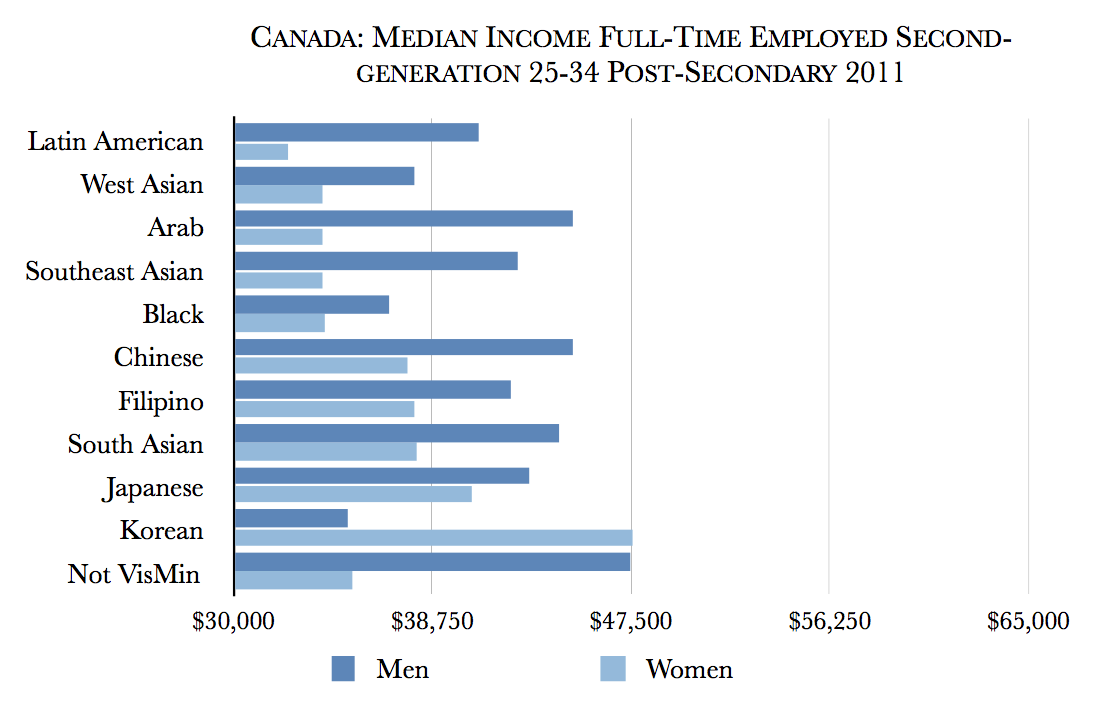
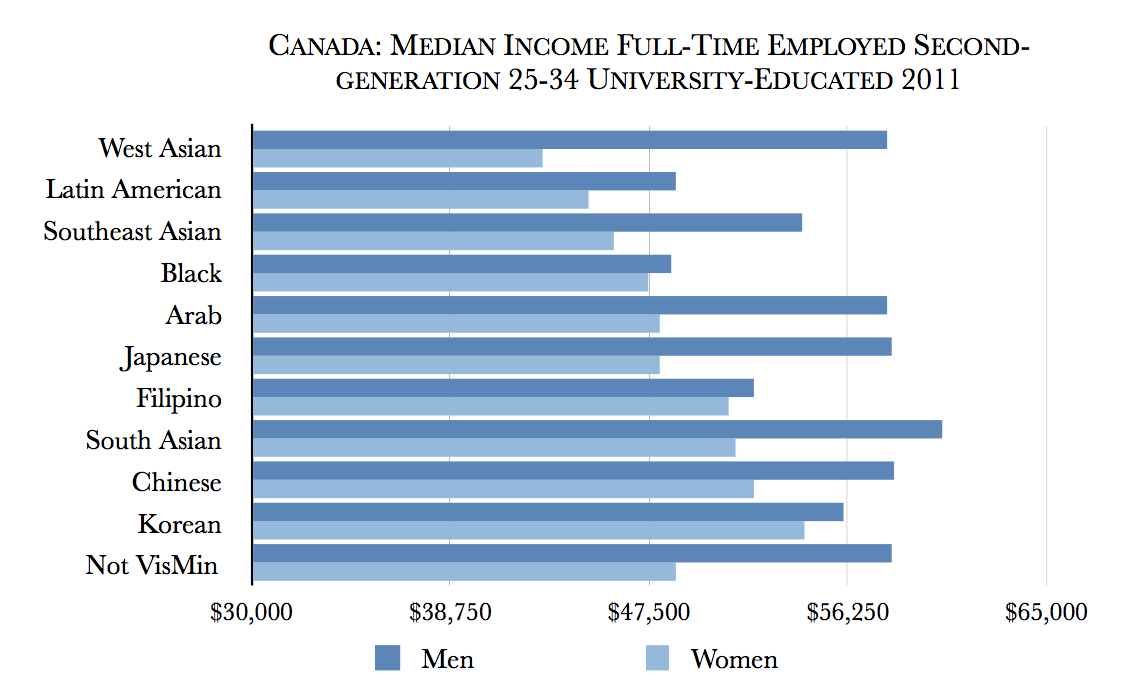
2G_University_Educated_25-34In some cases (i.e., percentage university-educated), the second-generation does significantly better than non-visible minority Canadians. And those that find employment have comparable median salaries.

However, the second generation has higher unemployment rates than non-visible minority Canadians. Those that are not university educated have lower median incomes, as shown in the chart below:

2G_Non-Univ_Educated_25-34This is not to mentioned the well-documented instances of discrimination in hiring, police carding and other areas that show significant differences between visible minorities and others.

So while as a ‘value statement,’ one may prefer to refer second-generation immigrants as non-immigrants, this effectively masks some of the ongoing integration challenges that some elements face.

And while I fully agree with Jack that comparisons with Europe are often inappropriate given our differences in history, geography and identities, we do, like other ‘new world’ countries, view ourselves as countries of immigrants, unlike Europe. And this, with the exception of the USA, both reflects and influences how we deal with integration.

Measuring and contrasting the outcomes of both first and second generation outcomes provides useful international and internal benchmarks allow us to identify ongoing integration challenges with a view to overcoming them. Not making the distinction obscures them:

But there a significant segment of the Canadian-born population that sometimes wrongly gets labeled as immigrants. I refer specifically to persons born in Canada of foreign-born parents (a group to which I belong). Much social science literature in Europe refers to these children of immigrants as “second generation immigrants”. To many North American observers the term must seem like an oxymoron. It nonetheless gets employed by a number of Canadian scholars.

There are statistical breakdowns in the census of Canada on the basis of generational status. Immigrants are generally designated as the first generation, their children as second generation and there is a category for third generation or more. It’s inaccurate to refer to second generation Canadians as something other than non-immigrants with whom they are grouped in the census question on immigrant status.

The confusion that is created by designating them as “second generation immigrants” is sometimes influenced by European analysis with the practice in several EU countries of not automatically conferring citizenship on persons born in the country. For example, children born in France of foreign-born parents do not become citizens until reaching the age of the majority. Switzerland does not automatically extend citizenship to a child that is born in the country. Rather, a person is automatically Swiss if at least one of the child’s parents is Swiss.

Relatively few Canadian scholars that use the term second generation immigrants necessarily think of such individuals as immigrants. Rather most simply echo terminology that is used in some of the Canadian literature on immigration and citizenship and/or seek to engage with European policy-makers or scholars by employing a common vocabulary. But the Canadian-European comparisons can be problematic and regrettably they sometimes don’t make for good scholarly work.

Is Canada a nation of immigrants? It is certainly a nation with many immigrants who have played a critical role in the process of nation-building. But it is simply too limiting a concept when “the nation of immigrants” conveys the idea that immigration is the country’s principal defining characteristic.

Source: Is Canada A Nation Of Immigrants? | Jack Jedwab

I’ll be ‘proud’ when Canada achieves justice for all: Denise Balkissoon

A needed broader perspective on the justice system than provided by Ghomeshi defence lawyer Marie Henein:

I don’t expect defence lawyers to be nice, and so I didn’t have any beef with Marie Henein until this week. Then she said that our legal system is one “we should all be proud of,” and now I’m compelled to reply: Don’t be absurd.

It’s one thing to state, as Jian Ghomeshi’s ferociously successful lawyer also did in her CBC Television interview, that justice was “absolutely” served when her client was acquitted. That proclamation refers to a single case – specific circumstances of evidence and reasonable doubt, one set of police officers and Crown attorneys, one particular judge.

But to say, as she did, that the Canadian justice system is impartial “each and every single day,” well that’s simply wrong. Training and intellect might help Ms. Henein skillfully navigate the system, but that doesn’t mean the system itself is admirable.

After Mr. Ghomeshi’s acquittal on multiple charges of assault and sexual assault, an unhappy group marched north from the courthouse to the Toronto Police Service headquarters on College Street. There, it merged with Black Lives Matter Toronto, justice advocates who have been sleeping outside the police HQ for almost two weeks now. Native Child and Family Services of Toronto is right next door, and indigenous demonstrators were soon in the mix as well.

Emotions were extremely high and the number of criticisms levelled at the Canadian justice system was overwhelming. Many of them were also valid, and reflective of my own personal list.

For example: A quarter of federal prisoners are aboriginal, even though just 4 per cent of the population is indigenous. Black Torontonians (and non-white Canadians across the country) are much more likely to be “carded,” meaning stopped randomly by police and asked to submit personal information despite not being accused of a specific crime.

Justice is expensive and the more impoverished you are, the less likely you are to receive it. The Legal Aid cutoff for a single person in Ontario is $14,000 a year, or about half of working full-time for minimum wage; Ms. Henein’s fee is rumoured to be up to $1,000 an hour. Lawyers who work with low-wage clients talk about the scourge of “pleading out” – when innocent defendants make deals, acquiring criminal records because they lack the resources for endless, unpredictable court dates.

If Ms. Henein truly considers herself a feminist, as has been endlessly discussed, a recent Criminal Lawyers’ Association report must surely upset her: Female lawyers are dropping out in droves, in part because of sexist treatment by police, court staff and judges. There are many ways that the law disappoints Canadian women – please also do not forget the hundreds of native women and girls whose disappearances and murders have been virtually ignored for decades.

To say, as Ms. Henein did, that justice in Canada is “very, very good,” is to consider all of these problems acceptable. It’s an attempt to write off dissenters as a motley crew with aimless complaints, when in reality many legal critics have clear, concrete suggestions for change.

For example, Black Lives Matter Toronto wants transparency around police violence toward civilians; this includes tracking the race of those killed by police and an inquiry into the death of Andrew Loku, a mentally ill father of five shot in his hallway last year.

One wish of many indigenous lawyers is increased application of the Supreme Court’s 1999 Gladue decision: When sentencing indigenous offenders, the focus is meant to be on rehabilitation, not punishment, with true consideration of the impact of residential schools and other historical inequities.

And advocates for sexual assault survivors have a number of ideas worth considering, such as greater use of the civil system versus the criminal courts, and increasing complainants’ access to legal support and information.

The list of proposed solutions is as long as the list of problems, and that’s good. A growing, evolving justice system is something we should all want, and I think we do. A 2014 Angus Reid Survey found that only about 60 per cent of Canadians said they trusted the police, while a mere 40 per cent said they had confidence in the criminal courts.

Victorious defence lawyers might be proud of our justice system, but the rest of the country has doubts that are more than reasonable. I guess winning is a heady drug, and intoxicants do tend to interfere with one’s sense of reality.

Source: I’ll be ‘proud’ when Canada achieves justice for all – The Globe and Mail

Rights groups call for oversight of Canada border agency

Another due process pressure point on the Government:

Civil society groups proposed a model Thursday for independent oversight of the Canada Border Services Agency, following the deaths of two immigration detainees in March.

Recent revelations that the CBSA had fully implemented just one of the 19 recommendations from a coroner’s inquest examining the 2013 death of Lucia Vega Jimenez at the Vancouver airport are another indication that the border agency is in need of oversight, said Josh Paterson of the B.C. Civil Liberties Association.

The CBSA is the only law enforcement agency in Canada that has no independent oversight body, noted Canadian Association of Refugee Lawyers president Mitch Goldberg, even though officers generally have more power and less training than police.

An oversight body for the CBSA would need to be independent of political influence and have legal power to both investigate and monitor CBSA activities, said Canadian Council for Refugees president Loly Rico. The council has proposed a model for a CBSA oversight body, recommending that it have the ability to receive and review complaints from citizens and non-citizens about their interactions with the CBSA, compel CBSA to share information, and make recommendations to the Public Safety Minister.

Canada has been criticized by three United Nations agencies in the last four years over its treatment of immigration detainees, said Alex Neve, secretary-general of Amnesty International Canada. Some of the practices criticized by the United Nations included the practice of keeping children in detention, the lack of a limit under Canadian law on the amount of time an individual can be detained, and the country’s extensive use of immigration detention, when it should be a last resort, Neve said.

“That is a very strong signal that Canada’s immigration detention system is broken,” he said, adding that it is “unconscionable” that there is no independent oversight of CBSA.

Source: Rights groups call for oversight of Canada border agency

Trudeau government asks for ideas on open government

Where do I begin?:

The Liberal government is asking Canadians for their ideas on making government more open.

Treasury Board President Scott Brison announced the national consultation today.

Brison says the transparency bus has left the station.

The minister says he believes that an open government is a more effective government.

Beginning today, people can go to open.canada.ca to offer their views on what should be in the next federal strategy on open government.

Officials will also hold in-person discussions across the country and the resulting plan is to be released this summer.

 Some initial thoughts on my short list:
  • The hardest issue of all: changing the culture and enforcing a default obligation of openness;
  • Provide information in electronic formats that allow manipulation for analytical purposes. The previous government only released public opinion research data tables in pdf format, rather than in spreadsheets. More recently, PCO was unable (or unwilling) to export its database of GiC appointments in spreadsheet format, requiring me to recreate this already public information;
  • Expanded data sets, issued regularly in a timely fashion. My initial list, starting with citizenship:
    • in addition to top 10 (consider top 25)  countries of birth, have complete table or one mapped to IRCC operational regions (top 10 only covers about 50 percent of new citizens)
    • naturalization rate after 6 years of permanent residency, broken down country of birth mapped to IRCC operational regions
    • naturalization rate after 6 years of permanent residency by immigration category, gender and province
    • citizenship test pass (language and knowledge) results by country of birth mapped to IRC operational regions
    For passports, numbers related to:
    • top 25 countries of birth (all)
    • top 25 countries of birth (foreign-born)
    • number of passports issued abroad mapped to IRC operational region (to give sense of Canadian expatriates)
    • breakdown by country of birth of passports issued abroad

    Appointments: regular employment equity type reporting for all GiC appointments.

Source: Trudeau government asks for ideas on open government – Macleans.ca

Liberals push Access to Information overhaul back to 2018

I am more forgiving of the Government than some of the critics. Better to take some time to get it right, given the policy and operational considerations, but in the meantime, Canadians need to hold the Government to account, provide input to the open.canada.ca consultation site, and continue to provide examples of where the system is not working (my experience under the previous government can be found in my  ATIP Delay Log):

The Liberal government is pushing their pledged overhaul of the outdated Access to Information system to 2018, Treasury Board President Scott Brison revealed Thursday.

The government will still move within a year to make some smaller changes to the 33-year old system, which allows Canadians to obtain government information for a $5 fee.

But the larger reforms to address well-documented problems such as delays and aggressively applied secrecy provisions will have to wait two years.

“This act hasn’t been updated since 1983. Getting it right is really important,” Brison told reporters Thursday.

“We feel we can move forward with some specific changes over the next several months . . . but that doesn’t obviate the need to do a deeper consultation in 2018, which will look at other areas of improvement.”

Once a world-leading law, the Access to Information Act has been allowed to decay under successive Liberal and Conservative governments. It has not been substantially updated since the early 1980s, when most government business was conducted on paper.

The situation reached a point where, in 2015, Information Commissioner Suzanne Legault was forced to call the system a “shield against transparency.”

In their election platform, the Liberals pledged to make government information “open by default” — the principle being Canadians ultimately own their government’s work, and should be able to access it unless their government has a compelling reason to keep it secret.

The government also promised to eliminate the sometimes exorbitant fees departments charge for searching for and photocopying documents to release.

While those changes will have to wait, Brison’s department is moving forward on other commitments: applying the system to ministers’ offices, including the Prime Minister’s Office, administrative bodies in Parliament and federal courts, as well as giving Legault’s office the ability to issue binding orders for departments to release documents.

Treasury Board is expected to unveil legislation incorporating those changes, and potentially others from a parliamentary committee and public consultations, either in 2016 or 2017.

Fred Vallance-Jones, a journalism professor at the University of King’s College in Halifax, said the government appears to be moving in the right direction. But he questioned why more dramatic changes need to wait.

“I don’t think there’s any lack of advice that’s been given to the federal government over the last number of years about what is wrong with how the act is working,” Vallance-Jones, who leads Newspapers Canada’s annual Freedom of Information Audit, said Thursday.

“Those kinds of things have been on the table for quite a long time.”

Source: Liberals push Access to Information overhaul back to 2018 | Toronto Star