Quebec minister refuses to sign off on new, controversial history course

Positive move:

A proposed high school history course that critics said ignored minorities in Quebec and promoted a rigid, nationalist ideology will not be implemented province wide as planned, the Education Department confirmed Thursday.

Instead, the department will make changes to the program to better reflect the province’s cultural and linguistic minorities, according to a government official as well as other well-placed sources.

The contentious plan was introduced by the Parti Quebecois government before it lost the 2014 election and was being piloted in a few Quebec schools.

Department spokeswoman Marie-Eve Dion said schools that want to try piloting the new program in August 2016 will be allowed to do so while all others will stick to the old curriculum until further notice.

“Many consultations have been done and improvements are constantly being implemented,” she said in an email. “The goal is to make the course as representative and inclusive as possible.”

The program was to be introduced province wide in the 2016-17 school year, which begins in late August.

“This is absolutely good news,” said Sylvia Martin-Laforge, head of the Quebec Community Groups Network, a federally funded organization that advocates for the province’s anglophone community.

“We understand that the minister was not happy with the material. It would seem that people were eager (in the Education Department) to roll out this program and the minister had the courage to say ‘No. We will not roll this out.’”

The proposed two-year program, called History of Quebec and Canada, was widely panned by First Nations groups, as well as by cultural and linguistic minority communities across the province.

Documents obtained by The Canadian Press revealed that non-European francophone immigrants are scantily mentioned.

In the guidelines teachers use to craft their lesson plans, Confederation in 1867 is not a theme, but tucked into the larger section called “1840-1896: The formation of the Canadian federal system.”

Moreover, the only discussion of former prime minister Pierre Trudeau, considered the father of multiculturalism in Canada, is in the context of him “inviting the provincial governments to reopen the Canadian Constitution,” after which Quebec left “empty-handed.”

Martin-Laforge said “we can only hope that the depictions of minority communities will not be stereotypical and that the new program doesn’t characterize us as bad guys.”

Jacques Beauchemin, who helped write the proposed curriculum, told The Canadian Press earlier this year the purpose of the program was to remove mentions about Quebec being a diverse society that promotes multiculturalism.

Source: Quebec minister refuses to sign off on new, controversial history course – Macleans.ca

Malta’s citizenship scheme ranks number one in Henley & Partners report – The Malta Independent

Best compilation of citizenship investment programs, by the company that promotes them:

Malta’s citizenship scheme has taken the number one spot in a report compiled by Henley & Partners.

Henley & Partners launched its Global Residence and Citizenship Programs 2016 report, which ranks the 19 most relevant residence-by-investment programs as well as the top eight citizenship-by-investment programs available throughout the world today.

“For the second year in a row, Malta’s Individual Investor Programme is the top ranking citizenship-by-investment program in the world, with a score of 73 out of 100. The Mediterranean island nation is followed by Cyprus (71), and Antigua and Barbuda (62) in 2nd and 3rd place respectively,” the report read.

“A Maltese citizen has the right of settlement in all 28 EU countries and enjoys visa-free travel to 168 countries worldwide including the EU, the US and Canada. For improved visa-free travel, permanent relocation, and financial security, Malta is the way to go”.

“The Malta Individual Investor Programme is a modern citizenship-by-investment program designed, implemented and globally promoted by Henley & Partners for the Government of Malta under a Public Services Concession. Moreover, it is considered the world’s most advanced and most exclusive citizenship-by-investment program, being capped at 1800 applicants. Compliance and due diligence standards are considered to be the world’s strictest, aiming to ensure that only the most respectable of applicants are admitted”

As for Residency programmes, out of the 19 programs reviewed, Portugal’s Golden Residence Permit Program has again emerged as the world’s best residence-by-investment program, with a score of 80 out of 100. It is followed by Belgium (78) and Austria (77) in 2nd and 3rd place respectively.

In order for a person to acquire Maltese citizenship, one would have to make a contribution to the development of Malta, make a purchase of stocks/bonds, and must undertake a property transaction. “The combined upfront financial requirement, including applicable government charges and citizenship application fees, is just under  €900,000, the Henley and Partners website says.

Source: Malta’s citizenship scheme ranks number one in Henley & Partners report – The Malta Independent

Facebook’s Bias Is Built-In, and Bears Watching – The New York Times

One of the more perceptive articles I have seen on the recent Facebook controversy and the overall issues regarding the lack of neutrality in algorithms:

The question isn’t whether Facebook has outsize power to shape the world — of course it does, and of course you should worry about that power. If it wanted to, Facebook could try to sway elections, favor certain policies, or just make you feel a certain way about the world, as it once proved it could do in an experiment devised to measure how emotions spread online.

There is no evidence Facebook is doing anything so alarming now. The danger is nevertheless real. The biggest worry is that Facebook doesn’t seem to recognize its own power, and doesn’t think of itself as a news organization with a well-developed sense of institutional ethics and responsibility, or even a potential for bias. Neither does its audience, which might believe that Facebook is immune to bias because it is run by computers.

That myth should die. It’s true that beyond the Trending box, most of the stories Facebook presents to you are selected by its algorithms, but those algorithms are as infused with bias as any other human editorial decision.

“Algorithms equal editors,” said Robyn Caplan, a research analyst at Data & Society, a research group that studies digital communications systems. “With Facebook, humans are never not involved. Humans are in every step of the process — in terms of what we’re clicking on, who’s shifting the algorithms behind the scenes, what kind of user testing is being done, and the initial training data provided by humans.”

Everything you see on Facebook is therefore the product of these people’sexpertise and considered judgment, as well as their conscious and unconscious biases apart from possible malfeasance or potential corruption. It’s often hard to know which, because Facebook’s editorial sensibilities are secret. So are its personalities: Most of the engineers, designers and others who decide what people see on Facebook will remain forever unknown to its audience.

Photo

CreditStuart Goldenberg 

Facebook also has an unmistakable corporate ethos and point of view. The company is staffed mostly by wealthy coastal Americans who tend to support Democrats, and it is wholly controlled by a young billionaire who has expressed policy preferences that many people find objectionable. Mr. Zuckerberg is for free trade, more open immigration and for a certain controversial brand of education reform. Instead of “building walls,” he supports a “connected world and a global community.”

You could argue that none of this is unusual. Many large media outlets are powerful, somewhat opaque, operated for profit, and controlled by wealthy people who aren’t shy about their policy agendas — Bloomberg News, The Washington Post, Fox News and The New York Times, to name a few.

But there are some reasons to be even more wary of Facebook’s bias. One is institutional. Many mainstream outlets have a rigorous set of rules and norms about what’s acceptable and what’s not in the news business.

“The New York Times contains within it a long history of ethics and the role that media is supposed to be playing in democracies and the public,” Ms. Caplan said. “These technology companies have not been engaged in that conversation.”

According to a statement from Tom Stocky, who is in charge of the trending topics list, Facebook has policies “for the review team to ensure consistency and neutrality” of the items that appear in the trending list.

But Facebook declined to discuss whether any editorial guidelines governed its algorithms, including the system that determines what people see in News Feed. Those algorithms could have profound implications for society. For instance, one persistent worry about algorithmic-selected news is that it might reinforce people’s previously held points of view. If News Feed shows news that we’re each likely to Like, it could trap us into echo chambers and contribute to rising political polarization. In a study last year, Facebook’s scientists asserted the echo chamber effect was muted.

But when Facebook changes its algorithm — which it does routinely — does it have guidelines to make sure the changes aren’t furthering an echo chamber? Or that the changes aren’t inadvertently favoring one candidate or ideology over another? In other words, are Facebook’s engineering decisions subject to ethical review? Nobody knows.

Source: Facebook’s Bias Is Built-In, and Bears Watching – The New York Times

Non-citizen voting in local elections is long overdue: Cole

Desmond Cole on municipal voting for non-citizens. While I understand this position, have never been convinced by the arguments in favour of municipal voting, as most of these also could be applied to provincial and federal voting (e.g., healthcare and education provincially, EI and employment programs federally).

Given that Canadian citizenship is relatively accessible (apart from the fees!) in contrast to many European countries, simpler and more effective from a political integration perspective to encourage and facilitate citizenship, with the full range of voting rights:

Immigrants are the backbone of Ontario’s economy and the source of much of its growth. Our government deems newcomers fit to live, work, invest and raise families here, but somehow unfit to make electoral decisions about the laws and regulations that govern their lives. Sheesh.

While municipalities all over the world allow at least some non-citizen residents to vote in local elections, Ontario’s politicians have long seemed afraid to follow suit.

Interestingly, our provincial political parties allow non-citizens to buy party memberships and to vote in partisan leadership contests. Ontario PC leader Patrick Brown allegedly signed up more than 40,000 new party members during his recent leadership bid, many of them from so-called “cultural communities” (i.e. black and brown first- and second-generation immigrants). His campaign didn’t ask if all these folks were Canadian citizens — it wasn’t deemed a relevant factor to their ability to partake in that democratic process.

Canadians seem increasingly supportive of allowing some non-citizens to vote in municipal elections. City councils in Toronto and North Bay have formally asked the province to enfranchise non-citizens who have obtained permanent residency; officials in Halifax, and in five municipalities in New Brunswick, have made the same request of their respective provincial governments.

This was what I hoped for all those years ago with I Vote Toronto and in retrospect I am only sorry I didn’t push the threshold even further than permanent residency.

Before 1988 in Ontario, you didn’t have to be a citizen to vote. You had to reside or hold property in the municipality where you planned to vote; Nova Scotia allowed non-citizen British subjects to vote in local elections until 2007.

The need to vote and the benefits of being able to do so — for permanent residents, foreign workers, students and undocumented people — are just as critical for new immigrants as they are for citizens. Premier Kathleen Wynne’s Liberals should acknowledge this and extend the municipal franchise to all non-citizen residents.

Source: Non-citizen voting in local elections is long overdue: Cole | Toronto Star

If Philosophy Won’t Diversify, Let’s Call It What It Really Is – The New York Times

Jay L. Garfield and Bryan W. Van Norden on the lack of diversity, in terms of both content and staff,  in philosophy departments in the US and Canada:

The vast majority of philosophy departments in the United States offer courses only on philosophy derived from Europe and the English-speaking world. For example, of the 118 doctoral programs in philosophy in the United States and Canada, only 10 percent have a specialist in Chinese philosophy as part of their regular faculty. Most philosophy departments also offer no courses on Africana, Indian, Islamic, Jewish, Latin American, Native American or other non-European traditions. Indeed, of the top 50 philosophy doctoral programs in the English-speaking world, only 15 percent have any regular faculty members who teach any non-Western philosophy.

Given the importance of non-European traditions in both the history of world philosophy and in the contemporary world, and given the increasing numbers of students in our colleges and universities from non-European backgrounds, this is astonishing. No other humanities discipline demonstrates this systematic neglect of most of the civilizations in its domain. The present situation is hard to justify morally, politically, epistemically or as good educational and research training practice.

We each — alongside many colleagues and students — have worked for decades to persuade American philosophy departments to broaden the canon of works they teach; we have urged our colleagues to look beyond the European canon in their own research and teaching. While a few philosophy departments have made their curriculums more diverse, and while the American Philosophical Association has slowly broadened the representation of the world’s philosophical traditions on its programs, progress has been minimal.

Many philosophers and many departments simply ignore arguments for greater diversity; others respond with arguments for Eurocentrism that we and many others have refuted elsewhere. The profession as a whole remains resolutely Eurocentric. It therefore seems futile to rehearse arguments for greater diversity one more time, however compelling we find them.

Instead, we ask those who sincerely believe that it does make sense to organize our discipline entirely around European and American figures and texts to pursue this agenda with honesty and openness. We therefore suggest that any department that regularly offers courses only on Western philosophy should rename itself “Department of European and American Philosophy.” This simple change would make the domain and mission of these departments clear, and would signal their true intellectual commitments to students and colleagues. We see no justification for resisting this minor rebranding (though we welcome opposing views in the comments section to this article), particularly for those who endorse, implicitly or explicitly, this Eurocentric orientation.

Some of our colleagues defend this orientation on the grounds that non-European philosophy belongs only in “area studies” departments, like Asian Studies, African Studies or Latin American Studies. We ask that those who hold this view be consistent, and locate their own departments in “area studies” as well, in this case, Anglo-European Philosophical Studies.

Others might argue against renaming on the grounds that it is unfair to single out philosophy: We do not have departments of Euro-American Mathematics or Physics. This is nothing but shabby sophistry. Non-European philosophical traditions offer distinctive solutions to problems discussed within European and American philosophy, raise or frame problems not addressed in the American and European tradition, or emphasize and discuss more deeply philosophical problems that are marginalized in Anglo-European philosophy. There are no comparable differences in how mathematics or physics are practiced in other contemporary cultures.

Of course, we believe that renaming departments would not be nearly as valuable as actually broadening the philosophical curriculum and retaining the name “philosophy.” Philosophy as a discipline has a serious diversity problem, with women and minorities underrepresented at all levels among students and faculty, even while the percentage of these groups increases among college students. Part of the problem is the perception that philosophy departments are nothing but temples to the achievement of males of European descent. Our recommendation is straightforward: Those who are comfortable with that perception should confirm it in good faith and defend it honestly; if they cannot do so, we urge them to diversify their faculty and their curriculum.

This is not to disparage the value of the works in the contemporary philosophical canon: Clearly, there is nothing intrinsically wrong with philosophy written by males of European descent; but philosophy has always become richer as it becomes increasingly diverse and pluralistic. Thomas Aquinas (1225-1274) recognized this when he followed his Muslim colleagues in reading the work of the pagan philosopher Aristotle, thereby broadening the philosophical curriculum of universities in his own era. We hope that American philosophy departments will someday teach Confucius as routinely as they now teach Kant, that philosophy students will eventually have as many opportunities to study the “Bhagavad Gita” as they do the “Republic,” that the Flying Man thought experiment of the Persian philosopher Avicenna (980-1037) will be as well-known as the Brain-in-a-Vat thought experiment of the American philosopher Hilary Putnam (1926-2016), that the ancient Indian scholar Candrakirti’s critical examination of the concept of the self will be as well-studied as David Hume’s, that Frantz Fanon (1925-1961), Kwazi Wiredu (1931- ), Lame Deer (1903-1976) and Maria Lugones will be as familiar to our students as their equally profound colleagues in the contemporary philosophical canon. But, until then, let’s be honest, face reality and call departments of European-American Philosophy what they really are.

We offer one last piece of advice to philosophy departments that have not already embraced curricular diversity. For demographic, political and historical reasons, the change to a more multicultural conception of philosophy in the United States seems inevitable. Heed the Stoic adage: “The Fates lead those who come willingly, and drag those who do not.”

Source: If Philosophy Won’t Diversify, Let’s Call It What It Really Is – The New York Times

Election 2016: the most exciting time to be multicultural in Australia?

Australian election platforms and multiculturalism – good overview by :

Laundry [of the governing Liberal party] does not believe in setting targets for diversity inclusion, preferring to let the market sort it out. Given the clear precedence of Australian law in all cases, as a practising Catholic, he strongly supports the freedom of communities to use religious tribunals to provide guidance for individuals in conflict. He cites Catholic Canon Law, Jewish Beth Din and Islamic Sharia as appropriate.

Laundy is opposed to extending racial vilification protection to religious vilification. He argues that religions are far stronger and don’t need it.

He is also opposed to a Multicultural Australia Act, rejecting even the option of debating it. He does not believe there is any need for a Multicultural Affairs office in the prime minister’s portfolio, nor mandated participation for cultural minorities in government advisory bodies.

Laundy accepts, however, that the Australian Multicultural Council needs serious work, with its membership changed to be far more representative.

As someone who has spoken out in defence of multiculturalism, he says:

“I know the views that vilify me are those of a small minority. Most Australians like what multiculturalism has done for the country.”

Reflecting on the past, he notes:

“Any prime minister who doesn’t support multiculturalism does so at his own peril.”

Rowland [Labour party shadow critic] shares many of Laundy’s social values. Labor, she stresses, has no policy for a Multicultural Act, though she also points to the party’s strong defence of Section 18C, especially through the shadow attorney-general, Mark Dreyfus.

Rowland agrees that perhaps an incoming government might charge a revised Australian Multicultural Council to explore legislative options for national multicultural legislation. But it is unlikely to be an election policy, and she doesn’t have a view.

The wider issues of diversity and representation have not been on Rowland’s radar. She admits she has never discussed with the shadow communications minister, Jason Clare, issues of diverse representation on either the ABC board or in its programming.

Rowland takes a diametrically opposed position to Laundy on where religious law sits. She believes religious groups should play no role in any Australian legal situation. For her, the law is and must remain secular – be it for Jews, Catholics or Muslims.

She is also wary of whether religious vilification should be part of the Racial Discrimination Act, flipping it to Dreyfus as his responsibility. She would, however, have the review of the Multicultural Council as a pressing issue, especially in terms of its ability to advise government on key areas such as employment, support for grassroots organisations, and the building of more community hubs.

Source: Election 2016: the most exciting time to be multicultural in Australia?

Immigrants Feel As Canadian As The Rest Of Us | Jack Jedwab

Jack Jedwab reviews some of the attachment findings of the General Social Survey, contrasting Canadian and foreign-born, along with the particularities of Quebec. Identity is more multifaceted than binary:

Critics of multiculturalism outside of Quebec believe that this undocumented lack of newcomer attachment — however defined — is an integration problem. If attachment to Canada is used as integration criteria, for some Quebec observers the newcomers in the province will appear too well integrated!

But contrary to what some Quebecers assume, those immigrants in the province that possess the strongest degree of attachment to Canada also exhibit a strong sense of attachment to Quebec. It might be said they feel at home in the province and the country, and refuse to see a contradiction in this regard.

You don’t have to live somewhere for a particularly long period of time to appreciate your home. Independent of how long you’ve lived somewhere it may feel as though you’ve always belonged there. Certain immigrants are especially grateful for the opportunity to reside in Canada and this can act as a catalyst for a relatively instant feeling of attachment to the country.

It’s quite possible that the strong initial connection to a place can diminish over time if an immigrant’s expectations are not met. But the same feeling about the country can apply to someone born here across their life cycle.

The 2013 General Social Survey confirms that there is no difference in the level of attachment to Canada between Canadians aged 15 to 24, whether they are domestic (rooted) or foreign-born (less rooted). Surveys repeatedly reveal that the youngest Canadians have the lowest sense of attachment to Canada, but this grows on many of us as we get older. In sum, it is one’s age and not immigrant status that is perhaps the most important predictor of the sense of attachment to country.

Source: Immigrants Feel As Canadian As The Rest Of Us | Jack Jedwab

Liberals edge closer to repealing Conservative citizenship changes, though Senate remains a wildcard

Will indeed be interesting to see how the Senate handles C-6, as will also be for C-14 (assisted dying):

The House Immigration Committee completed its study of Bill C-6, sending it back to the House with a pair amendments on May 5. The committee heard from 27 witnesses during five meetings devoted to studying the bill.

Liberal MP Borys Wrzesnewskyj (Etobicoke Centre, Ont.), who chairs the committee, said in an interview that while it was “hard to predict” what would happen once the bill reached the Senate, he was “cautiously optimistic” that “by the time we rise for the summer…we’ll be able to say that once again in Canada, ‘A Canadian is a Canadian is a Canadian.’”

The office of Government House Leader Dominic LeBlanc (Beauséjour, N.B.), who shepherds government legislation through the House, did not respond to a request for comment by press time.

Mr. McCallum told the House Immigration Committee last month that the implementation of C-6 would likely be delayed once it passed into law, “in order to prevent the buildup in [citizenship application] backlogs resulting from this change.”

Mr. McCallum also said that it would be “difficult to predict” how the Senate would handle the bill. There are more Conservatives in the Senate than either Liberals or independents, though Liberal and independent Senators have a narrow majority if they vote as a bloc.

The Senate Social Affairs, Science, and Technology Committee typically handles immigration-related legislation, and in the previous Parliament reviewed Bill C-24. The Conservatives currently have a majority on that committee.

None of the six Conservative Senators on the Senate Social Affairs Committee agreed or were available to be interviewed about Bill C-6. Conservative Senator Kelvin Ogilvie, the committee chair, declined through an office staff member, citing his role as chair.

Conservative Senator and committee member Judith Seidman also declined through a staff member on the grounds that the bill was still before the House.

Conservative Senator and committee member Carolyn Stewart Olsen wrote in an emailed statement that she would not comment on Bill C-6 or make up her mind about it before it was put before the Social Affairs Committee.

Source: Liberals edge closer to repealing Conservative citizenship changes, though Senate remains a wildcard |

USA: The disastrous, forgotten 1996 law that created today’s immigration problem – Vox

Good long-read on US immigration policies and their impact by Dara Lind (thanks to Arun with a View):

But one effect was clear: After IIRIRA, deportation from the United States went from a rare phenomenon to a relatively common one. “Before 1996, internal enforcement activities had not played a very significant role in immigration enforcement,” sociologists Douglas Massey and Karen Pren have written. “Afterward, these activities rose to levels not seen since the deportation campaigns of the Great Depression.”

A chart of Mexican deportations from the US.Douglas Massey/Julian Simon Lecture Series

This particular law was passed during an era where Congress and the Clinton administration were both working to increase the amount of spending and agents on the US–Mexico border.

And after 9/11, the way the federal government handled immigration changed in two major ways. The bureaucracy was reorganized — and moved from the Department of Justice to the Department of Homeland Security. And the funding for immigration enforcement got put on steroids.

The combination of those gave rise to what Meissner and the Migration Policy Institute have called a “formidable machinery” for immigrant deportations — a machinery that took the US from deporting 70,000 immigrants in 1996 to 400,000 a year though the first term of the Obama administration. But that machine was built on the legal scaffolding of the options IIRIRA opened up.

“Both of those things have had so much more force because of this underlying statutory framework that they were able to tap into,” says Meissner. In retrospect, “it was sort of a perfect storm.”

After ’90s immigration reform, the unauthorized population tripled

But even though deportations exploded after the passage of IIRIRA, it didn’t keep the population of unauthorized immigrants in the US from growing. It went from 5 million the year IIRIRA was passed to 12 million by 2006. (By contrast, during the decade between the Reagan “amnesty” and IIRIRA, the unauthorized population grew by only 2 million.)

These two things didn’t happen despite each other. More immigration enforcement is one big reason why there are so many unauthorized immigrants in the US today.

A lot of this is because of the increase of enforcement on the US–Mexico border — something that was happening even without IIRIRA. Many unauthorized immigrants used to shuttle back and forth between jobs in the US and families in Mexico. Once it got harder to cross the border without being caught, they settled in the US — “essentially hunkering down and staying once they had successfully run the gauntlet at the border,” as Massey and Pren write — and encouraged their families to settle alongside them.

(This wasn’t the only reason unauthorized immigrants started settling in the US around this time. The types of jobs available for unauthorized workers were changing, with seasonal agricultural jobs being replaced by year-round service-industry ones, for one thing. But it was certainly a major factor.)

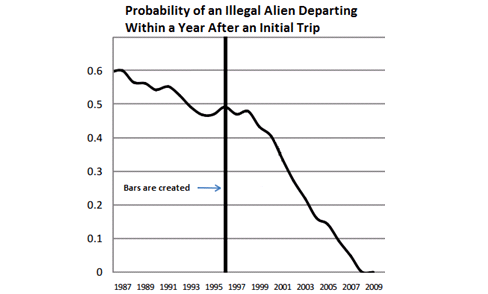
But if border enforcement encouraged families to stay, IIRIRA prevented them from obtaining legal status. By this point, a majority of the unauthorized-immigrant population of the US has been here 10 years — more than enough time to qualify for cancellation of removal, if IIRIRA hadn’t made it so difficult to get. Millions of them have children who are US citizens.

 Douglas Massey/Julian Simon Lecture Series

The 3- and 10-year bars alone have caused millions of immigrants to remain unauthorized who’d otherwise be eligible for green cards or US citizenship by now. According to Douglas Massey’s estimate, if those bars hadn’t been instituted in 1996, there would be 5.3 million fewer unauthorized immigrants in the US today. In other words, the population of unauthorized immigrants in the US would literally be half the size it is now.

Source: The disastrous, forgotten 1996 law that created today’s immigration problem – Vox

Feds should reboot cash-for-residence immigration program: Colin Singer

I am never sure whether to take these arguments – follow Austria, Malta and Cyprus models – seriously, or is it simply a way for immigration lawyers to expand their potential business? Singer made the same arguments at the Conference Board Immigration Summit this April.

CIC/IRCC’s study on the former business investor immigrant program was clear on the lack of benefits to Canada; there have been enough studies on the Quebec program showing that most leave Quebec for British Columbia (Study reveals awfulness of Canadian investor immigration; income tax averages C$1,400 per millionaire | South China Morning Post).

Factor in the debates over housing prices in Toronto and Vancouver, and the impact that overseas investors are having on the housing market, hard to see how expansion would benefit the broader Canadian economy or society:

The way out of this morass is clear. The Trudeau government should immediately get on with the task of redesigning the Immigrant Investor Venture Capital Pilot Program. It just needs to create the right policies and a restructured program that will succeed in attracting carefully chosen high-net-worth businesspeople who will bring billions of dollars to Canadian businesses and create new businesses that will in turn create more jobs.

The benefits of the Quebec immigrant investor program to that province are undeniable. From 2001 to 2016, it gave $714 million to 4,737 businesses in 17 territories in the province. As well, a compelling 2010 study conducted by three economists in Ontario and Quebec concluded that an average immigrant investor family directly injects more than $770,000 into the economy.

Additionally, a recent Statistics Canada report on immigration and business ownership in Canada, the first of its kind, confirms that immigrants are more likely than Canadians to establish businesses.

Ottawa should also consider establishing a citizenship-through-investment program for ultra-high-net-worth individuals and become a dominant top-tier country in the citizenship-through-investment arena.

Currently Austria, Malta, and Cyprus are the only top-tier countries offering a direct path to citizenship while Antigua and Barbuda, Dominica, St. Kitts and Nevis, and Saint Lucia also offer such programs.

In pursuing this new policy initiative, Canada would be in a position to attract the world’s most successful ultra-high-net-worth businesspeople along with their families and, by extension, their business networks. This could prove highly lucrative and provide Canada with a large inflow of cash, which it badly needs.

If executed strategically, Canada would also realize significant gains to its human capital in the immediate term and, through the children of such businesspeople, in the long term. The human capital benefit that the children of successful businesspeople bring to Canada is immeasurable and invaluable.

How beneficial can a new federal residency and citizenship program be? This year, some 5,000 newcomers will be admitted under the Quebec program alone, which has been selecting its own business investor immigrants since 1986. Under a revised federal immigrant investors’ program, Ottawa would likely account for more than 70 per cent of the market, a position it held at the peak of its popularity in 2010. In doing so, British Columbia and Ontario would then benefit from their share of Ottawa’s transfer payments as the two provinces would become the default choice for the overwhelming majority of applicants applying under the Quebec program.

Together with Quebec, Canada could again become a dominant player in the international residency-through-investment industry and perhaps match or surpass the popularity of the EB-5 program in the United States, which admits 10,000 business immigrants annually.

If Canada is to return to the forefront of the business immigration field, it must replicate a modified format of the Quebec program and other successful international programs by installing a well-devised, targeted model that creates a capital fund for Canadian businesses and attracts the right calibre of applicants on the basis of clear policy objectives featuring program integrity, international competitiveness, processing cost efficiency, and fast processing.

The federal Immigrant Investor Venture Capital Pilot Program is dead but the need for high-net-worth business immigrants to Canada is not. The substantial financial benefits to Canada, a welcome advantage in the face of our current economic difficulties, could well be surpassed by the undeniable human capital benefits it would receive from the world’s most innovative and wealthiest businesspeople and their families who would choose to live in Canada.

Additionally, Canada could take the lead on the global stage by creating an international charitable fund for refugees from a portion of the proceeds of investment inflow. In doing so, it would help ensure that the world’s wealthiest are directly assisting the world’s immigrant population who are most affected by international conflicts. This is one of the hallmarks of effective immigration policy.

Source: Feds should reboot cash-for-residence immigration program |