ICYMI: A Muslim get-out-the-vote group plans a flag initiative

While it should not be necessary (we don’t expect this from churches, temples or gurdwaras), appears a good idea in the current context:

Jawed Rathore wants to see a big Canadian flag flying from a prominently positioned flagpole in front of every mosque in the country to send the simple message that Muslims are proud Canadians.

The real estate development executive pitched the idea this week in a suburban Toronto banquet hall to a crowd of about 700 supporters of The Canadian-Muslim Vote, a non-partisan organization that made its mark by campaigning to boost turnout among Muslim voters in last fall’s federal election.

The group’s July 13 inaugural dinner to mark Eid, the end of the Muslim holy month of Ramadan, drew dozens of federal, provincial and municipal politicians, with federal Citizenship and Immigration Minister John McCallum delivering the keynote speech.

But Rathore took the podium earlier and proved a hard act to follow. The 39-year-old chief executive of Fortress Real Developments, father (as he mentioned more than once) of six children under seven, is a massively built six-three. His exuberant speaking style is as hard to ignore as his physical presence, and he offered an upbeat overview of the place of Muslims in Canada today. “For the first time ever, it’s kind of cool to be Muslim,” he proclaimed, arguing that every outburst of anti-Islamic bigotry tends to be followed by even more forceful statement of support for the Muslim community from sympathetic non-Muslims.

Still, Rathore proposed that Muslims should send a clear signal of patriotism by flying the Canadian flag in front of their mosques. In an interview with Maclean’s, he framed the initiative as a natural follow-up to the group’s push to boost the Muslim vote. (The Canadian-Muslim Vote points to exit polls that suggest the percentage of voting-age Muslims who cast a ballot might have soared to 79 per cent in the 2015 election, from an estimated 46.5 per cent in 2011.)

“We thought this would be a great opportunity,” Rathore said. “As we talked to the Muslim community about the most Canadian thing you can do, which is to vote, we [wondered], ‘What else can we do to engage with the community?’ And that’s where the team came up with this really exciting idea of getting big Canadian flags in front of every mosque across Canada.”

Although Rathore sees a high level of acceptance of Muslims in Canada, he doesn’t deny his community remains misunderstood by too many. “There’s a sense when you talk to people about Islamophobia, or even just people’s general unawareness of Islam, they think because of some of the things they see and hear that Muslims choose to exclude themselves, that Muslims choose to segregate themselves,” he said. “Nothing could be further from the truth.”

He said most Muslims want to be seen as part of the Canadian social fabric. “Nothing really says that more than a Canadian flag going up,” he said. “Sometimes the simplest medium is the most effective one.” [Note: See the Environics Institute Why Muslims are proud Canadians – The Globe and Mail which largely confirms this].

Rathore brings a business branding perspective to the image challenge facing Muslims. Fortress Real Developments, headquartered just north of Toronto, has real estate projects underway in six provinces. “You look at some of the big U.S. brands that have come north of the border, and Walmart is one of the big examples: at every supercentre they have there is a huge Canadian flag,” he said.

“When they were coming up here, there was the usual rhetoric about ugly Americans, and Walmart made the very simple gesture of saying, ‘We recognize that we are not seen as being from here, we’re outsiders, we’re strangers, and we are coming to Canada’—and they erected these huge flags.”

At the Eid dinner, Rathore showed slides of major mosques, then clicked to the same photos adorned with rudimentary illustrations of Canadian flags flying in front of them. It wasn’t high-tech, but it seemed to convey what he has in mind. In the 24 hours after the dinner, he said groups called, emailed and texted with offers to sponsor 55 flag poles at mosques. His company will pay for the first ten, though.

The Canadian-Muslim Vote plans to take the next few weeks to figure out how to proceed, Rathore said, and hopes to start putting up flagpoles in September or October.

Source: A Muslim get-out-the-vote group plans a flag initiative

Advocates call for minority judges as figures show ‘judiciary of whiteness’

Source: Advocates call for minority judges as figures show ‘judiciary of whiteness’ – Winnipeg Free Press

Asian Canadians launch letter campaign to address racism in their own communities

A reminder that racism is not just a white/black issue but that it exists among many groups.

One of the stronger legacies of former Minister Jason Kenney was his broadening the integration focus of multiculturalism to include such tensions between and among visible minority groups, not just between the “mainstream” and visible minorities.

Good initiative:

A group that represents young Asian Canadians is taking an anti-black racism education program to their parents, grannies, uncles and aunties to help break down longstanding tensions between the two minority groups.

In light of the backlash against Black Lives Matter, the aftermath of Toronto’s Pride parade and recent police gun violence in the U.S., hundreds of Asian Canadians plan to launch a letter campaign this week reaching out to elders in their own communities.

The campaign, which follows a similar effort in the United States, aims to create a space for “open and honest conversations” about racial justice, police violence and anti-blackness in Canada’s Asian diasporas.

“The letter is meant to help Asians start having conversations within their own communities about anti-black racism, and specifically, about the anti-black racism that Asians are complicit in,” said Ren Ito, a Japanese Canadian from Toronto and one of the organizers of the Canadian campaign.

“The reality, though, is that different Asian communities are shaped by race and racism in different ways. And this means that different communities have different needs when it comes to starting conversations about anti-black racism or even about racism in general.”

A similar letter effort by Asian Americans was spurred by the recent killings of Alton Sterling in Louisiana and Philando Castile in Minnesota.

“For some of us in Canada and in Toronto in particular, the timing was also apt because we’ve had to deal with controversy and racist backlash against Black Lives Matter-Toronto for their actions during the Pride parade to hold Pride Toronto accountable for its marginalization of queer and trans people of colour,” said Ito, 28, who came here with his family from Japan at age 2 and is a PhD student at the University of Toronto.

The letters are being translated into Japanese, Korean, Tagalog, Vietnamese, Chinese, Hindi, Farsi, Punjabi, Tamil, Urdu, Spanish and Arabic to help supporters from these communities reach out to their peers and their own ethnic media, said Anita Ragunathan, another campaign organizer.

“I began the conversation about anti-black racism within our community with my parents following the murder of Trayvon Martin in Florida (in 2012). It’s an ongoing conversation, and I am hopeful that this letter will help them understand why this is so important to me and others in our generation,” said Ragunathan, 27, who was born in Toronto to Tamil immigrant parents.

“To refuse to speak against racism is to be complicit in allowing it to happen.”

Another organizer, Sun, an artist and educator who has gone by one name for about 10 years, said anti-blackness is almost a given in many Asian communities.

“Many of our communities conform and internalize these ideas in very deep and unconscious ways. This is problematic, and we need to work towards unlearning these oppressive ideas so we can build healthier communities,” said Sun, who came to Canada from Korea when she was 5.

“The media is complicit in perpetuating these biases. Our parents turn on their televisions and see images of black men as ‘thugs’ and ‘criminals.’ Victims of police brutality are not treated as such. Instead of their humanity being the focus, we hear about their records alongside photos that are meant to make them look menacing. We are brainwashed to forget that these men and women are fathers, mothers, brothers and sisters.”

Sun had first-hand exposure to her community’s anti-black sentiment when her father disowned her six years ago because she had a black partner.

Source: Asian Canadians launch letter campaign to address racism in their own communities | Toronto Star

Harper’s Accountability Act, ten years on: Flumian and Salgo

This lengthy commentary is well worth reading and is should provoke considerable and deeper discussion both within and outside government beyond the online comments.

Would be interesting to hear from some of the former public servants who worked on the Act for their take:

Still, our own view, bluntly, is that both the Act and the audit culture it sustains are fundamentally wrongheaded, and have contributed to a normative culture that is a roadblock to modernization. Far from fostering genuinely efficient stewardship of public resources, this culture over-manages minor risks in government, ignores far larger ones, and stifles appropriate risk-taking and innovation. If Prime Minister Justin Trudeau’s government is serious about its focus on delivering better outcomes for Canadians, it needs to shift to a system of accountability that is itself more focused on outcomes and less on micro constraints and the avoidance of blame.

To this day, the FedAA — which was actually part of a broader program of initiatives described as the “Federal Accountability Action Plan” — stands, we would argue, as the definitive legislative monument to risk-averse, blame-avoiding institutional rigidity in the government of Canada.

So, as the Act approaches its tenth anniversary, we may well ask: Accountability for what? Has government become more accountable as a result of the act? More to the point, has the FedAA and similarly-spirited initiatives contributed to better societal outcomes? Does it position the Canadian government to evolve nimbly to meet the challenges of governing in the digital age?

…A methodologically rigorous assessment of the impact of the FedAA — like one of the need for it — remains to be conducted. To date, much reported criticism draws on a broadly negative assessment by the public service textured by compelling personal anecdotes. A public service thumbs-down is neither definitive nor something that should be casually dismissed. Indeed, a systematic survey of public service experience would make a good starting point for a robust analysis. In the meantime, however, our principal basis for assessing the FedAA remains a parsing of what the legislation did and did not do.

Before assessing the individual elements of the legislation, let’s consider its overall thrust. Did this act about accountability have anything to say about being accountable for better outcomes? For working collaboratively on horizontal files? Did it give deputy ministers the responsibility and flexibility to improve the bottom line? Indeed, did it include any inducements to work pro-actively for improvements?

On the contrary, almost every provision was a further proscription, a more refined behavioural restraint, an intensification of scrutiny to smoke out unknown misdemeanours. And more to the point, the requirements of this regime could be satisfied in a purely negative way — that is, not by actually delivering something good, but by keeping your head down and avoiding blame.

As befits accountability legislation, the FedAA strengthened internal audit requirements in government departments and designated deputy heads as “accounting officers” for their organizations, meaning that they had to account in some way to Parliament for their managerial custodianship. Now, internal auditing is itself a laudable practice — one that that should actually be welcomed by a CEO as a tool for keeping tabs on the organization. However, the actual impact of internal audits on government departments is an area that merits closer study; the decision to conduct an audit by external committees may at least initially have reinforced a tendency to see the function as something to be managed rather than embraced.

As for the accounting officer function, this was evidently structured to minimize the risk of public servants becoming politically accountable to Parliament (itself a defensible goal). Partly for this reason, the responsibility is cast heavily in terms of demonstrating compliance with Treasury Board rules. But again, that is really not an outcome-oriented focus for deputy ministerial accountability, and it is highly unlikely that disregard for Treasury Board requirements was a significant problem in the deputy community. There is also the possibility that it reinforced a siloed focus on one’s own department.

…We need to replace what the FedAA has given us — more detailed rules and more costly and powerful people to oversee them; a chilling effect on public service and engagement with the outside world; and redoubled focus on departmental siloes and accountability conceived as compliance — with a system oversight and accountability that hones in on real risks across the system and that encourages collaboration, innovation and a focus on outcomes. Are public servants accountable for ticking boxes, or for helping the government of the day improve the lives of Canadians in meaningful ways?

If there is a real risk to the effective governance in Canada today, it is the risk that government will not meet these challenges, diminish in relevance, and be beaten at its own game by external providers of goods and services with no mandate to look out for the public interest.

Source: Harper’s Accountability Act, ten years on

Let’s face it: The world has an Islamic problem – Marquardt

Felix Marquardt’s, founder of the Al-Kawakibi Foundation for Islamic Reform and the think tank Youthonomics, take on Islam and terror and, in particular, an interesting argument for showing the horrific videos:

If Muslims want to be taken seriously when we argue that our religion is one of love and peace and social justice, then we must not cede to the natural inclination to say we have “nothing to do” with the authors of the ignominious crimes committed in the name of Islam.

We have one thing in common with them. We all call ourselves Muslims. Of course, their vision of Islam is perverse and completely, well, wrong. There is a common thread between despicable acts of violence committed around the world these days. And that common thread is that the people who commit them think of themselves as Muslims.

In other words, no, there is no intrinsic “problem” with Islam, but yes, hell yes, there is a contemporary degenerescence of our religion that is threatening its very existence and future. If we, as Muslims, cannot agree on this, then we must brace ourselves, for Islam will disintegrate completely before our eyes in the coming years. To address a problem, one must first admit that there is a problem.

This brings into focus another major issue that has popped up since Thursday’s attack in Nice: the dissemination of the footage of the slaughter and its aftermath.

The French authorities are asking that people refrain from sharing the gruesome pictures and videos, claiming that doing so may galvanize or trigger other would-be kamikazes. Others argue the same thing out of respect to the families of the victims.

I have news for you: In this day and age, Islamic State admirers and supporters who want to gain access to this footage will find a way to do so.

And, as far as I am concerned, is it precisely out of compassion for the victims that I want all the people in the world who share my faith to see what is being done in the name of our religion. Images of Nazi extermination camps and the picture of the naked Vietnamese girl fleeing napalm bombings shocked the world and brought change, precisely because they shocked the world.

We are encouraged to share footage of police abusing and killing black people all over the United States to make the world aware of what is going on there, but we should hide what IS is doing in southern France? Muslims all around the world must see what is being committed in the name of their religion so they can finally confront the reality of Islam in the 21st century: Medina, Cairo …we have a problem.

Source: Let’s face it: The world has an Islamic problem – The Globe and Mail

ICYMI: Saunders – Why black Canadians are facing U.S.-style problems

Saunders on the similarities between the Black experience in Canada and the USA, and the associated risk of not addressing some of the underlying issues:

So the emergence of the Black Lives Matter campaign against police discrimination in Montreal, Toronto, Calgary and Vancouver is not some copycat echo of a far more violent U.S. crisis; it is a reflection of the lived experiences of many black Canadians, which are measurably different, on average, from those of white and other minority Canadians.

“Although there are certainly some differences in terms of broad historical contours, demographic patterns and patterns of migration, there are some really profound similarities,” between Canada and the U.S., says Barrington Walker, a legal historian at Queen’s University. “I do think that the history of anti-black racism that exists in Canada, that there is a kind of long, institutionalized state memory, the old idea that blacks do not belong as part of the Canadian landscape.”

Dr. Walker’s research has found a consistent pattern in Canadian courts of sharply different treatment of black defendants in trials, judgment and sentencing, and in likelihood of running afoul of the law.

These findings have been confirmed over and over. In 1995, a high-profile Ontario government commission (struck in the wake of the 1992 Yonge Street protests and riots against police discrimination) reported that black and white citizens were treated dramatically differently in policing, charges, court procedures, sentencing and imprisonment. For example, when faced with identical drug-crime charges in similar circumstances, 55 per cent of black defendants but only 36 per cent of white defendants were sentenced to prison – a difference that could not be accounted for fully by non-racial factors. A 2002 Toronto analysis found that black drivers were disproportionately more likely to be pulled over by police without evidence of an offence; they are 24 per cent more likely to be taken to the police station on minor charges and more than twice as likely to be held in jail while awaiting a hearing. (This was strictly a black phenomenon: the data for suspects listed as “brown” was nearly identical to that for whites.) And research in the last two years has shown that random police stops without evidence (“carding”) happens to black Canadians to a hugely disproportionate degree.

What’s the root of this discrimination, which takes place even when officials are racially diverse and liberal-minded? In part, it’s institutional path dependency: Police and judges have always responded to suspects based on traditional patterns (and on patterns learned from the U.S. media and justice system), and it’s hard to break those ugly traditions.

That’s dangerous, because black Canadians are also inordinately excluded from home ownership, neighbourhoods with good public transit and key employment markets. That’s partly due to the timing and economic circumstances of Caribbean immigration, partly due to racism.

Either way, it creates a spiral of discrimination: A group of Canadians who live in fringe rental-only neighbourhoods, with less secure employment and access to resources, who face a more hostile police and justice system, hurting their chances of advancement. It’s not too late to stop this spiral. If we want to be different from our southern neighbours, we need to stop reproducing their most infamous form of inequality.

Source: Why black Canadians are facing U.S.-style problems – The Globe and Mail

Children born abroad to Canadians may end up as ‘lost Canadians’

Hardly surprising, as the intent of the change from the previous system of allowing those born abroad to Canadian parents to retain their citizenship required a formal application and to either reside in Canada for one year prior to their application or have established a “substantial connection” to Canada by age 28, was to limit the transmission of citizenship to those with a more immediate connection to Canada.

Moreover, the previous process was hard to administer and, at least theoretically, allowed for endless transmission of citizenship.

One can debate whether a first or second generation limit is more appropriate and fair (unlike European ‘bloodline’ notions of citizenship, Canada, like most immigration-based countries, has more of civic approach to citizenship).

The same issue of how siblings may be treated differently depending on their birthplace can also arise in second and subsequent generations.

Bill C-6 took a relatively narrow and ‘surgical’ approach to addressing some of the concerns regarding the previous government’s citizenship legislation and related initiatives in line with the platform commitments and maintaining the emphasis on integrity.

This will be discussed during the Senate’s hearings on C-6 given that the family concerned intends to file a brief (it was not discussed at length during the Commons consideration of the Bill):

Like many Canadians, Jennifer and Evan Brown moved to the United States for work. In 2011, they jumped at the chance to live in New York when Evan, a chartered accountant, was offered a job there. After the couple had their first child a year later, they moved back to Canada, where they eventually had a second. But there’s a crucial difference between their children: One has more citizenship-transmission rights than the other.

The Browns, who now live in Victoria, are affected by a law passed by the government of Stephen Harper, whereby the children of Canadian citizens born abroad cannot – with only a few exceptions – pass on their own citizenship if they also have children abroad. The provision was introduced as part of changes the previous, Conservative government made to citizenship laws. While the current Liberal government is undoing much of that legislation, it has so far not addressed the concerns of families like the Browns.

Without citizenship, an individual does not have access to many of the benefits that come with being Canadian, including the ability to travel with a Canadian passport and to vote or run for political office. It can also complicate the individual’s ability to work in Canada and access all social benefits. With that much at stake for their children, Canadians born abroad may feel pressure to restrict their travels and working opportunities.

It took four years for the Browns to figure out that their four-year-old son, Jackson, born in the United States, was affected by the law. Like most children in the same circumstances, their son received a letter from the Canadian government explaining the rule, but the Browns didn’t fully understand it at the time.

Ms. Brown was recently at a local playground when another parent, Roy Brooke, told her how his son, five-year-old Nathan, may not be able to pass citizenship onto his children if they are born abroad as Nathan was. Ms. Brown realized the rule probably applied to her son as well.

“I had the assumption that he’d actually have more doors opened for him having been born in the U.S., and then I felt that possibly we’d actually restricted the most important door for his children,” Ms. Brown said.

The rule stipulates that someone born or adopted outside Canada to a Canadian parent is not a Canadian citizen if the person’s parent was also born abroad after April 17, 2009, when the provision became law. The limit was brought into force in an effort to “achieve greater simplicity and transparency in citizenship laws as well as to preserve the value of citizenship,” according to Immigration, Refugees and Citizenship Canada (IRCC).

The Brown and Brooke families were not working for the Canadian government or Canadian Forces when they had their children abroad – the only exception to the rule – so their children were not exempt from the first-generation citizenship limit.

Mr. Brooke has taken the fight for the citizenship-transmission rights of children like Nathan and Jackson to Ottawa. After two years of unsuccessfully attempting to persuade the Conservatives to change their policy, he is pushing the Liberals to do so. He had his eyes set on the Liberals’ Bill C-6, which aims to reverse some Conservative changes to the Citizenship Act, but was told it was too late to amend the legislation to remove the first-generation citizenship limit. The bill is currently at first reading in the Senate, where Mr. Brooke is now seeking witness status before committee and encouraging others affected to make their concerns known.

Immigration Minister John McCallum said at the end of May that he would look into the matter. His office referred further questions to the Immigration Department, which refused to speculate whether changes may be tabled in the future.

NDP immigration critic Jenny Kwan, who has met with other affected families, called the policy “discriminatory” against Canadians who choose to work abroad, especially in today’s global economy.

“The Prime Minister himself has said on many occasions now, ‘a Canadian is a Canadian is a Canadian.’ This also applies to second-generation Canadians born abroad as well. They shouldn’t be treated as second-class citizens,” Ms. Kwan said.

Mr. Brooke and his wife, Sara Bjorkquist, were working in Geneva, Switzerland, when their son was born in August, 2010. Had they been aware of this law, Mr. Brooke said he and his wife would have thought twice about having children overseas. He’s now concerned that Nathan may not be able to pass on citizenship to his children if he chooses to follow in his parents’ footsteps and work abroad.

“My decision to serve at the UN could penalize me, my son and his offspring,” Mr. Brooke said. “Three generations are hurt because we decided to live overseas for a few years and work for the UN, and that is not right.”

Only a couple of exceptions can apply to the children of Canadians like Nathan: if at the time of the birth abroad, the child’s other parent is a Canadian citizen by birth in Canada or by being granted citizenship through immigration, or if the affected parent is working for the Canadian government or Canadian Forces at the time of the birth.

“If [Nathan] works overseas, his children could be stateless if he works for the Red Cross, the UN or any non-federal government entity, and marries a non-Canadian,” Mr. Brooke said.

Parents of children born abroad who are not eligible for citizenship may sponsor their children to become permanent residents and then apply for citizenship.

In 2009, the Asia Pacific Foundation of Canada estimated that 2.8 million Canadians – or 8 per cent of Canada’s total population – lived abroad. IRCC said it does not know how many Canadians born abroad are affected by the first-generation citizenship limit.

Advocacy groups, including the Canadian Council for Refugees, have called on the government to restore the right to citizenship for the second generation born abroad or at least to provide citizenship to those who would otherwise be stateless under the law.

“By denying citizenship to the second generation born abroad, Canada is creating a new set of ‘lost Canadians’ and making some children born to Canadians stateless,” the CCR said in a report on Bill C-6.

Source: Children born abroad to Canadians may end up as ‘lost Canadians’ – The Globe and Mail

Israel: Facebook experiment reveals how ‘terror-related’ posts are treated differently

Interesting and revealing:

Two Israelis — an Arab and a Jew — posted messages on Facebook saying they were going to kill someone on the other side of the Israeli-Palestinian conflict.

The two posters were real people with active Facebook pages, but the threat was part of an experiment conducted by an Israeli news station last week. The goal was to monitor the reactions of individuals and Israeli authorities who are tasked with keeping tabs on social-media posts that they say might inspire terrorist attacks.

Critics in both communities say social media has served as a conduit for unstoppable deadly violence. While the low-intensity Israeli-Palestinian conflict has been burning for decades, the platforms have given rise to individual extremists and lone-wolf attackers who are much more difficult to stop, officials say.

After posting that he had been inspired to kill Jews, Shadi Khalileh, the Arab citizen, received calls from concerned friends and family. Israeli Arab members of parliament, who heard about his post via word of mouth, even called to ask why he would post such a message, or whether his page had been hacked. Only 12 people “liked” his post.

The Jewish citizen, Daniel Levy, wrote that he had to seek revenge after a Palestinian killed a 13-year-old Jewish girl in her bed. His post drew some 600 “likes,” 25 shares and comments such as “I am proud of you” and “you are a king.” One comment urged him to “please take the post down before you are arrested.”

Israeli police questioned Khalileh about his post — it took some work to convince them that it had all been an experiment. But Levy’s post went undetected by the authorities, the news station said.

In neither case did Facebook flag the posts, which remained online until the station ended the experiment.

The failure of social-media platforms to take action against posts calling for the murder of Israelis or Palestinians, Jews or Arabs, has become a growing issue for those on both sides of this decades-old conflict.

Source: Facebook experiment reveals how ‘terror-related’ posts are treated differently | Toronto Star

Vancouver’s housing debate not about race, it’s about public policy: Todd

Good long column by Todd:

I had coffee this week with three Canadian friends — one of us was born in Egypt, one in Hong Kong, one in Iran and one in Canada (me) — and the subject arose: Is there a relationship between Metro Vancouver’s out-of-control housing prices and racism?

We battered around a few arguments, including that the hundreds of thousands of transnational migrants and investors who have discovered Metro Vancouver in the past decade cannot be morally blamed, individually, for the city’s astronomical housing costs. That is, except for those involved in corruption or tax evasion.

In most cases, transnational migrants, many wealthy and with dual citizenship, are simply doing what anyone in their situation would do if they could afford it: Investing in Canadian real estate to create a safe economic landing for their families outside their often-troubled countries of origin.

While our coffee group recognized some people might scapegoat migrants from certain countries, especially Mainland China, we acknowledged the most crucial thing is to get up to speed on the multiple factors behind runaway housing prices — so we can encourage governments to finally do something to ease them.

Our discussion led me to conclude that the debate over housing affordability does not need to be dominated by race or ethnicity.

It needs to focus on public policy.

It should zero in on public policies that will help Metro Vancouver be a real community — a place not only of ethnic diversity, but of economic diversity, where power is mostly in the hands of the people and the gap between the poor, middle class and rich does not widen more than it has already.

That means discussing policy options, such as whether and how to impose a tax on foreign speculators, tax empty houses, stop international money laundering and tax avoidance, curtail Quebec’s immigrant-investor program, enforce rules in the real-estate industry, add social housing, increase zoning density, adjust immigration levels, shift interest rates and stop foreign donations to B.C. politicians.
But many Canadians don’t seem comfortable with such debates, unlike many in Europe and elsewhere, where it’s generally expected one will be up for a rousing dinner-table discussion about politics, money and power.

Rather than talking about overriding issues such as economic equality and justice, Canadians seem to find it easier, more socially acceptable, to talk about so-called identity politics; which emphasizes ethnicity, gender and individual freedoms.

As a result, in Canada, racial discrimination, or the possibility of it, is often the go-to topic. That’s so even while international agencies continue to rank Canada the most “tolerant” country in the world in regards to immigration. See the recent global surveys by Britain’s respected Legatum Institute and the Social Progress Imperative, a U.S.-based non-profit.

When it comes to housing, why do a relative few British Columbian voices remain fixated on racial issues?

It’s easy to dismiss real estate industry lobbyists who accuse those worried about high housing prices as racist or xenophobic — since their vested interest for the past three decades has been to distract politicians from imposing policies that might cool the flow of foreign money into the market.

Some other Canadians concerned about racism don’t have such dubious motives, but I’m convinced much of their super-vigilance arises out of a misunderstanding of the definition of racism.

The Oxford Dictionary understanding of racism is quite specific. It’s not as sweeping as believed by some people, including the liberal arts academics who build their careers on alleging that “undertones” of racism exist where they may not.

The Oxford Dictionary defines racism as: “Prejudice, discrimination or antagonism directed against someone of a different race based on the belief that one’s own race is superior.”

While the housing crisis may trigger some hard-core racists — people who actually do discriminate based on the belief their ethno-cultural group is superior — there is no evidence such behaviour is widespread in Canada or Metro Vancouver.

Residents of Metro would have a right to be morally concerned no matter where the billions of dollars flooding into the city’s housing market was coming from.

If, theoretically, it were pouring in from tens of thousands of Caucasians based in Kelowna, strong feelings, including resentment, and ethical concerns, including in regards to equality, would be justified.

A number of prominent Canadians who are committed to ethnic diversity and social justice tend to agree.

Vancouver’s housing debate “is not about racism. It’s about a difference in economic power,” said Clarence Cheng, former chief executive officer of B.C.’s SUCCESS Foundation, which supports program for immigrants. “It’s about the rich becoming richer and the poor becoming poorer.”

Albert Lo, head of the Canada Race Relations Foundation, says there’s nothing wrong with collecting information on the national origins of people buying and selling houses in Metro Vancouver, in part because it could combat tax evasion.

“In Canada, we are so used to the idea of tolerance that we sometimes find it odd to look at nationalities. That causes some people to jump up and start using the word ‘racism.’ I don’t think it’s helpful,” says Lo.

Ujjal Dosanjh, a former federal Liberal cabinet minister, lambastes politicians and property developers who misuse the word “racist” to stifle debate over important issues. He says people have to acknowledge the great distance Canadians have come in overcoming bigotry of the early 20thcentury.

UBC planning professor emeritus Setty Pendakur, who has advised the Chinese government, says hyper-vigilant worries about inter-cultural tensions provide a convenient coverup for wealthy investors, whether Canadian-born or from abroad, who “park illegal money here or avoid Canadian taxes.”

Vancouver’s Justin Fung, a member of Housing Action for Local Taxpayers or HALT, says “cries of racism” sidetrack British Columbians from facing the hard policy decisions that will be necessary if we are to ever again link Metro Vancouver wages to housing costs.

So, if as a society we can manage to stay focused on the central issue, how do we institute policies that will help Metro Vancouver become a place where average families can afford to buy or rent decent housing?

Even though it’s ethically fine to collect data on the nationalities of buyers and sellers — and, more importantly, on the country in which they are “residents for tax purposes” — any policies to cool down the housing market must, of course, be universal.

We should expect colour-blindness in all policies designed to counter runaway housing prices — including those that deal with speculation, empty houses, international money laundering, real estate trickery, social housing, political party financing or immigration policy.

The problem is that some hyper-vigilant peoples’ understanding of racism is so sweeping that even after I wrote last week about how B.C. politicians should stop being among the few in the world to accept political donations from foreign companies — someone suggested such a ban may be “xenophobic.”

If that’s the case, virtually the entire world is xenophobic. That includes those who operate The Organization for Economic Cooperation and Development, which covers 35 countries, including Canada.

The OECD, a defender of democracy and sovereignty, recently made it clear that citizens of a nation have a perfect right to protect themselves from transnational powers and money.

As a February OECD report plainly said: “Political parties need to be responsive to their constituents and not influenced by foreign interests.”

Source: Vancouver’s housing debate not about race, it’s about public policy | Vancouver Sun

What France thinks of multiculturalism and Islam – The Washington Post

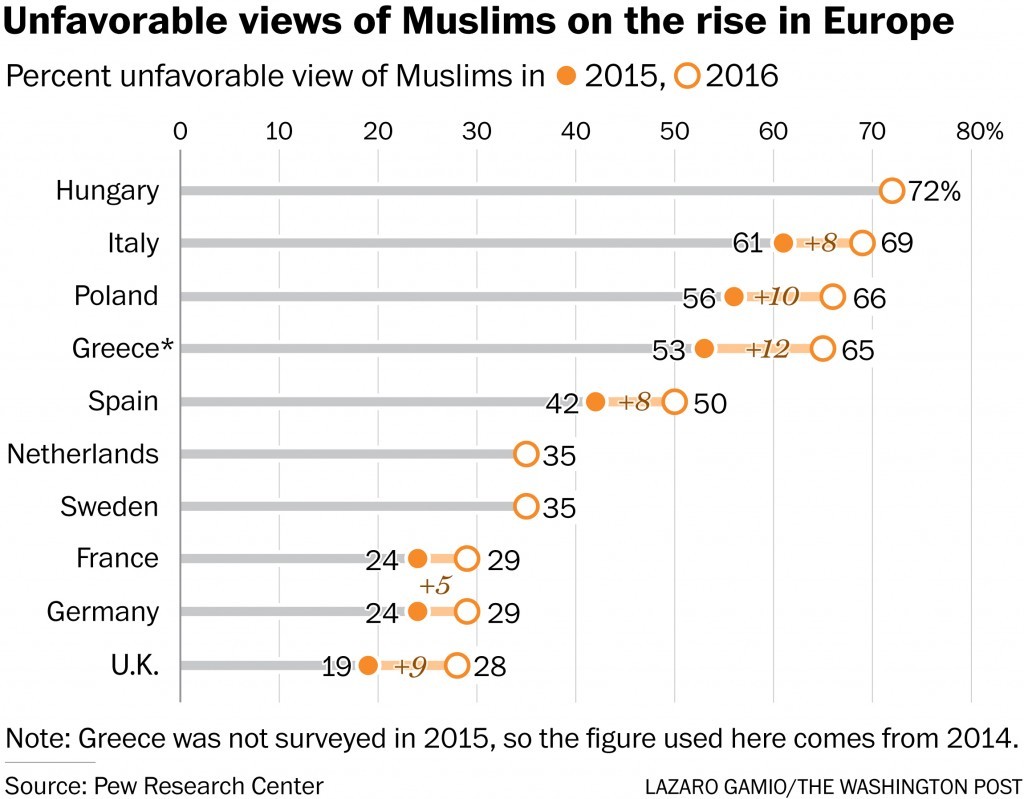
2300europemuslims-11-1024x799Some interesting polling data that sometimes gets lost in the rhetoric:

In the aftermath of a devastating attack in Nice, France, Poland’s interior minister, Mariusz Blaszczak, told reporters that the blame lay with the embrace of multiculturalism. “Have we not learned lessons from previous attacks in Paris and Brussels?” the Financial Times reported Blaszczak as saying. “This is a consequence of the policy of multicultural politics, and political correctness.”

A member of Poland’s controversial right-wing Law and Justice Party, Blaszczak’s point may be in bad taste. However, many around the world probably agree with it.

It’s certainly hard to disagree with the idea that France seems to be more embracing of multiculturalism than Poland. In a recently released study by the Pew Research Centerthat was conducted early this year, just 24 percent of French people were found to believe that diversity made France a worse place to live. A higher proportion, 26 percent, said it made France better, while 48 percent said that it didn’t make much difference.

These results appeared to show that France has one of the most tolerant, though also largely indifferent, attitudes to racial and ethnic diversity in Europe. Only Spain had a higher positive view of diversity. Meanwhile, in Poland, 40 percent of the population said that diversity was a negative, while only 14 percent said it could be a positive and 33 percent said it made no difference. Hungary, Italy and Greece were the only countries with higher negative feelings toward diversity.

The same poll found that France had a far more positive view of Muslims than much of Europe. Despite a series of terror attacks that were inspired by Islamic extremism, just 29 percent of French citizens were found to have a negative view of Muslims, while 67 percent had a positive view. While this was an increase of 5 percentage points over previous years, only Germany and Britain had more positive views.

Conversely, in Poland, 66 percent had negative views of Muslims, while only 19 percent said they had positive views. Hungary and Italy were the only countries with more negative views — 72 percent and 69 percent, respectively.

People in Poland were also far more likely to believe that Muslims in their country were supporters of groups like the Islamic State, a group whose supporters have cheered the attack on Nice but have not claimed official responsibility. Twelve percent of Poles were said to believe that “most” Muslims in their country supported extremist groups, and a further 23 percent said “many.” Just 12 percent said “very few” supported these groups. In France, 44 percent said “very few” Muslims in their country supported extremism, while just 6 percent said “most” and 13 percent said “many.”

And despite the perceived link between refugees from Muslim majority countries and terrorism that is widespread across Europe, Pew’s data showed that on the whole, French citizens were more concerned about economic factors.

Source: What France thinks of multiculturalism and Islam – The Washington Post