Racial profiling, by a computer? Police facial-ID tech raises civil rights concerns. – The Washington Post

The next frontier of combatting profiling:

The growing use of facial-recognition systems has led to a high-tech form of racial profiling, with African Americans more likely than others to have their images captured, analyzed and reviewed during computerized searches for crime suspects, according to a new report based on records from dozens of police departments.

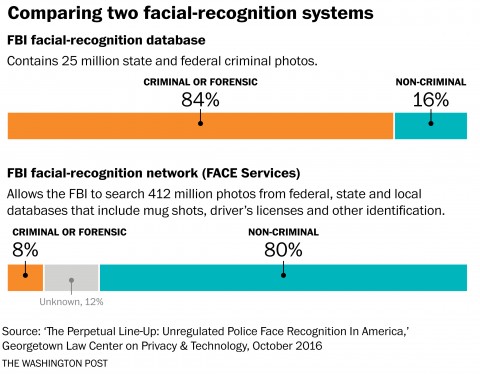
The report, released Tuesday by the Center for Privacy & Technology at Georgetown University’s law school, found that half of all American adults have their images stored in at least one facial-recognition database that police can search, typically with few restrictions.

The steady expansion of these systems has led to a disproportionate racial impact because African Americans are more likely to be arrested and have mug shots taken, one of the main ways that images end up in police databases. The report also found that criminal databases are rarely “scrubbed” to remove the images of innocent people, nor are facial-recognition systems routinely tested for accuracy, even though some struggle to distinguish among darker-skinned faces.

The combination of these factors means that African Americans are more likely to be singled out as possible suspects in crimes — including ones they did not commit, the report says.

“This is a serious problem, and no one is working to fix it,” said Alvaro M. Bedoya, executive director of the Georgetown Law center that produced the report on facial-recognition technology. “Police departments are talking about it as if it’s race-blind, and it’s just not true.”

The 150-page report, called “The Perpetual Line-Up,” found a rapidly growing patchwork of facial-recognition systems at the federal, state and local level with little regulation and few legal standards. Some databases include mug shots, others driver’s-license photos. Some states, such as Maryland and Pennsylvania, use both as they analyze crime-scene images in search of potential suspects.

At least 117 million Americans have images of their faces in one or more police databases, meaning their resemblance to images taken from crime scenes can become the basis for follow-up by investigators. The FBI ran a pilot program this year in which it could search the State Department’s passport and visa databases for leads in criminal cases. Overall, the Government Accountability Office reported in May, the FBI has had access to 412 million facial images for searches; the faces of some Americans appear several times in these databases.

Source: Racial profiling, by a computer? Police facial-ID tech raises civil rights concerns. – The Washington Post

‘There seems to be a paralysis’: Trudeau government has backlog of more than 300 appointments

Almost a year in, one would expect more vacancies to have been filled, given the overall policy – greater diversity – is clear. But I can also see the wish to ensure that the details of the policy and its implementation are addressed first.

One of the key things to look for is the degree of transparency in political appointments, with comparable employment equity reporting to the public service and federally-regulated sectors (telecoms, banking, transport). Currently for judges, only gender is tracked. For other GiC appointments, while gender has been tracked comprehensively for 25 years (as has official languages), there has been little systemic tracking of the other groups (visible minorities, Indigenous peoples, persons with disabilities).

And in some cases, there has been backsliding: the GiC appointment index (top view) has less information than previously, requiring more looking at the individual organizations than before.

For my baseline study, see my short ebook, “Because it’s 2015 …” Implementing Diversity and Inclusion, available either in an iPad/Mac version (iBooks) or Windows (pdf) Version.

Prime Minister Justin Trudeau and his cabinet have accumulated a backlog of more than 300 appointments that are due to be filled, a CBC News investigation has found.

Almost 20 per cent of governor in council (GIC) appointments, which include roles with Crown corporations, port authorities, agencies and tribunals, are currently vacant or occupied by a Conservative appointee whose term is past its expiry date.

Overall, 170 GIC positions are listed as vacant. Another 116 are past their appointment’s expiry date but the incumbent has been allowed to remain in the role until he or she is either replaced or renewed.

Currently, 61 federally appointed judge positions are vacant, including one seat on the Supreme Court of Canada.

In the Senate, 20 per cent of the 105 seats are empty. The government has pledged to fill the 21 spots “by the end of the year.” Three more senators are due to retire in January.

Taking a toll

In some cases, incumbents have been temporarily renewed only a day or two before their appointments were set to expire because the government had not yet launched the process to find a replacement.

For example, Graham Fraser’s appointment as commissioner of official languages, which was set to expire Sunday, was extended Thursday for two months. The government has yet to issue a job posting to find his successor.

The backlog has taken a toll on the operations of some boards and government bodies.

The CRTC hasn’t been able to hold a planned hearing on French music since November because it doesn’t have the necessary three French-speaking commissioners.

The parole board, where 21 per cent of positions are currently vacant, says it’s being stretched, with its remaining part-time board members putting in additional hours to ensure the work is done.

Alberta judges warned a Senate committee in late September that the 61 vacant judge positions could affect court proceedings, saying the province’s justice system is so backlogged they are now setting trial dates for 2018. Last week, an Edmonton judge stayed a murder charge against Lance Matthew Regan, citing delays in bringing the case to trial caused in part by the backlog in Alberta’s justice system.

‘Overwhelmed’

Liberal government insiders privately point to the Prime Minister’s Office and the Privy Council Office as the source of the problem, saying “the centre” has been “overwhelmed.”

The government is confident the problem will be resolved soon. It says the backlog was caused in part by the decision to overhaul the appointments process and bring in a more open, balanced, merit-based system. The new system is now up and running and vacancies are being filled, officials say.

Source: ‘There seems to be a paralysis’: Trudeau government has backlog of more than 300 appointments – Politics – CBC News

Sean Fine of the Globe focusses on the impact on the court system:

While Prime Minister Justin Trudeau is considering his first appointment to the Supreme Court of Canada – a vacancy became available on Sept. 1 – the shortage of lower-court judges may make it difficult for some jurisdictions to meet constitutional guarantees of timely criminal trials.

In July, the Supreme Court of Canada set a deadline of 30 months in superior courts (such as the Court of Queen’s Bench) from the time a charge is laid until the trial is completed. In Calgary, the wait is now just short of 15 months – 63 weeks – to schedule a trial of five days or more. (It can take months from the time a charge is laid until a trial is scheduled.) The situation is about the same in Nova Scotia, where the Supreme Court is now booking criminal trials of five days or more for next fall.

Civil trials, too, face long delays, which Chief Justice Wittmann said is especially hard on families seeking resolutions to legal problems. The lead time to schedule a civil or family trial of five days or more in the Court of Queen’s Bench in Calgary is now 138 weeks – bookings are being accepted for April, 2019. The Court of Queen’s Bench is Alberta’s top trial court, and it has seven vacancies and 59 full-time judges in office, according to the Office of the Commissioner for Federal Judicial Affairs. The province’s Court of Appeal has two vacancies and 12 full-time judges in office.

In Nova Scotia, the Supreme Court (the top trial court) has five vacancies and 31 full-time judges in office. The Court of Appeal has one vacancy and seven judges in office.

“On rare occasions in the past we’ve had to cancel matters. However, this is the first time we’ve had to send out multiple letters the month before suggesting that trial dates be rescheduled due to the shortage of judges,” Jennifer Stairs, the communications director for the Nova Scotia judiciary, told The Globe in an e-mail.

“That’s very difficult on the lawyers and on the litigants who are anxious to have their matters heard.”

B.C. has eight vacancies and 82 judges in office on its Supreme Court, and three open spots and 12 judges in office on its appeal court. Five-day criminal trials are available in January, 2017, while five-day civil trials, other than motor-vehicle actions, can be booked from August, 2017, onward. Dates for five-day motor-vehicle action trials are fully booked for the next 18 months, according to Superior Courts communications officer Bruce Cohen.

The Canadian Bar Association, representing the country’s legal profession, is also upset at the delays in appointing judges.

“We are very concerned. Ongoing judicial vacancies have created significant delays in the court system. These delays have a serious impact on separating families and their children, on criminal justice, on business in Canada,” CBA president René Basque said in an e-mail.

Canadian courts languish as vacancies on bench remain unfilled
Glass ceiling still in place for British Columbia public sector employees

Unfortunately (or fortunately, depending on the perspective), there is no equivalent federal ‘sunshine list’ on all public sector salaries.

british-columbia-public-service-2011

However, we do have data on federal Deputy and Assistant Deputy Ministers (for women, 2016 baseline 37.6 percent women and 4.7 percent visible minorities for deputies, 40.8 and 7.2 percent for ADMs). DM appointments by the current government are close to gender parity at 46.9 percent women.

My analysis of GiC appointments showed less representation of women and visible minorities, and a similar gap to British Columbia between senior and junior appointments for crown corporations and administrative tribunals:

GiC Baseline 2016.014

Prime Minister Justin Trudeau may have introduced a gender-balanced cabinet “because it’s 2015,” but that equality does not extend to public servants in B.C., where the vast majority of the highest-paid employees are men.

An analysis of The Sun’s exclusive public sector salary database reveals that of the 200 highest-paid public employees in B.C., during 2014 or the 2014-15 fiscal year, 70 per cent were men and 30 per cent were women. That increases to 77 per cent male when the field is narrowed to the top 100 (By contrast, 94 of the 100 highest-paid corporate executives in 2015 were men, according to Business in Vancouver.)

“There’s an old saying: the higher, the fewer, with respect to women,” said Barbara Arneil, head of the University of B.C.’s political science department. “We have what I think are structural, systemic reasons why women are not reaching the top of their profession, whether that is in the university, whether that’s in government, whether that’s in the private sector. And we’re wasting very good resources.”

Search The Sun’s exclusive public sector salary database.

The Sun analyzed the top 200 public-sector earners in this year’s database, which contains salary information for nearly 77,000 employees, and the top 50 earners in six of the seven sectors: B.C. government, Crown corporations, health authorities, local government, school districts, and colleges and universities. The Sun did not include municipal police in this analysis because forces generally withhold many names to protect undercover officers. The Sun relied on first names for this gender analysis, checking Internet profiles in cases where only a first initial was provided or the name was ambiguous.

The gender divide is most pronounced at colleges and universities, where men represented 41 of the top 50 earners, or 82 per cent, in the 2014-15 fiscal year. But because the University of B.C. accounts for 45 of the top 50 highest-paid employees in the sector in the province, these findings really only reflect that institution. At the University of Victoria, for example, five of the 10 highest-paid employees are women.

Pay equity is an issue UBC takes seriously, university spokeswoman Susan Danard said in an emailed statement.

“Compensation is affected by several factors, including the depth of experience and accomplishment that a faculty or staff member brings with them when they are first hired, and the length of employment with UBC, with people paid more as they progress in their careers,” she said. Faculty and area of specialization are also factors that affect pay equity, she said, noting specialists and top doctors in the faculty of medicine are often the highest paid given the demands and complexity of their jobs.

Source: Glass ceiling still in place for public sector employees | Vancouver Sun

Daphne Bramham picks up on issue:

Canada’s failure is in providing women the opportunities to fully participate in the economy. Not only does Canada lag the Nordic countries, it trails countries like the United States, Namibia, Mongolia, Belarus, Thailand and Burundi.

It’s because women don’t have equal opportunities, Canada’s overall gender ranking dropped to 30th in 2015, down 11 places from 2014.

Among the more troubling findings in the Sun’s gender analysis of B.C. public-sector wages is that the 25 universities and colleges have the fewest women in top-paid positions — only nine among the top 50. Of those, five work at the University of British Columbia.

The excuses/reasons are the usual ones. Prime career-building years coincide with the prime reproductive years and Canadian mothers continue to bear the largest share of the caregiving for both children and aging parents.

Even though 58 per cent of these institutions’ graduates are women, missing are the supports for those young women to succeed in academe. It’s all the more disappointing because post-secondary institutions are supposed to be places of innovation and change, not laggards.

What’s not surprising is that the health services authorities account for the most women on the top-earners’ list with 59; 35 of whom are at the Provincial Health Services Authority.

For more than a decade, the majority of medical school graduates have been women. Among the professionals in the B.C. government, women account for nearly 90 per cent of the nurses and nutritionists and three-quarters of the social workers and counsellors.

But that may be change for the worse because catching up wage-wise isn’t as simple as more women working in traditionally male jobs. When women do that, the pay scale drops. That’s what sociologist Paula England at New York University concluded after analyzing U.S. census data from 1950 to 2000.

When biologists went from being predominately men to women, England found that wages fell 18 percentage points (even accounting for changed value of the dollar over time). When workers in parks and camps went from mostly men to mostly women, the median hourly wages dropped 57 percentage points.

It’s because when women do the work, England told the New York Times, “It just doesn’t look like it’s as important to the bottom line or requires as much skill.”

Daphne Bramham: Few women in B.C. public sector’s top ranks, …

Brampton council says no to electoral reform despite ethnic mismatch with residents | Toronto Star

The gap between representation at the municipal level and other levels of government has been an issue for some time (all federal MPs and provincial MPPs from Brampton are Indo Canadians, over reflecting their share of the population and the first-past-the-post system).

Ranked balloting may be part of the solution but there are likely other factors involved, including the lack of political parties at the municipal level:

On Wednesday — as a federal debate on the issue draws near and with new Ontario legislation that gives cities the option of ranked balloting — Brampton council voted 11-0 against the idea. Meanwhile, Canada’s first-past-the-post electoral method is being used by fewer and fewer democratic nations around the world because it’s recognized as a system that too often puts people in power despite their having little voter support.

“Each city councillor in Brampton has the support, on average, of less than 4 per cent of the city’s voters, yet they’re making decisions that affect the entire city,” says Pat McGrail, chair of Fair Vote Peel, who made a presentation to council Wednesday, advocating for a ranked ballot system whereby candidates would need the support of a majority to get elected.

Brampton councillors who responded to the Star said they voted against ranked balloting because voters might find the system too confusing. It works by allowing voters to rank at least three top candidates (cities can opt to allow more candidates to be ranked on each ballot). The candidate who receives the least first place votes is eliminated in each round and their votes are redistributed until one candidate has a majority.

But critics point to research that shows the current first-past-the-post system often leads to municipal councils that do not accurately reflect the ethnic diversity of cities. In Brampton close to 70 per cent of the city’s residents are visible minorities. Only one out of eleven members of city council is a visible minority.

“That’s not just a Brampton problem,” says Dave Meslin, an expert on the subject who is authoring a book on electoral reform and has helped with the federal government’s current public consultations on the issue being conducted in every riding across Canada. He says Canada is now alone in its use of first-past-the-post for every level of government. “The lack of diverse representation on municipal councils is a glaring problem across Ontario.”

He points to U.S. research that shows ranked balloting in cities has significantly improved representation that more accurately reflects the electorate. Vote splitting, where an incumbent can rely on a concentrated base of supporters, while a number of other candidates fight for the remaining voters — often the vast majority — is something that can’t happen with ranked balloting, Meslin says.

In the 2014 municipal election, of all winners, Brampton Coun. Martin Medeiros received the least number of votes — 4,188, or 22 per cent of the votes cast in his ward. He beat Shan Gill by 100 votes. There were 15 candidates in total who ran for the council seat Medeiros now occupies. With a city-wide turnout of 36 per cent of eligible voters, applying the same rate, Medeiros received the support of about 7 per cent of eligible voters in his ward.

He did not respond when asked to comment on his decision not to support ranked balloting.

The provincial government was asked if its new legislation under Bill 181, which gives cities the option of using ranked balloting for elections, falls short because it leaves the ultimate decision to the very politicians who might get defeated by the new system.

“We feel that municipalities are responsible levels of government and are in the best position to make decisions in the best interest of their communities,” said Ministry of Municipal Affairs spokesperson Conrad Spezowka.

McGrail says low voter turnout is another problem with first-past-the-post. “The central problem of first-past-the-post is divide and conquer while appealing to your base. People become so disenfranchised they don’t even bother to vote.”

Sukhjot Naroo, a Brampton resident and co-founder of the social network Brampton Beats, which has almost 4,000 members who focus on municipal issues, says he doubts Brampton council will accurately reflect the city’s population as long as vote splitting continues. He lists an increasing number of issues accompanying Brampton’s rapid demographic shift, from zoning for places of worship to funding for a variety of culturally specific activities, that don’t get proper representation on council.

“Everyone on council will benefit from vote-splitting. The incumbents don’t want change. They’re just trying to protect the status quo. Out of eleven votes, not one even considered ranked balloting. Not even Gurpreet Dhillon, the only South Asian member of council, because he now has his base of supporters and can grow that through his growing political connections.”

Dhillon did not respond to questions emailed to him.

Toronto’s Katherine Skene says she’s dismayed, but not surprised by Brampton’s 11-0 vote. “I would hope that councils, before voting on the issue, there would be broad public consultation to find out what the voters actually want.”

Skene is co-chair of the Ranked Ballot Initiative of Toronto, where councillors last year voted 25-18 against a provincial option to allow for ranked balloting, a reversal of that council’s earlier position to bring ranked ballots about. Mayor John Tory supported the idea during his election campaign and maintained his support in last year’s vote.

Source: Brampton council says no to electoral reform despite ethnic mismatch with residents | Toronto Star

Nova Scotia’s towns and cities elect more diverse candidates

Nova Scotia is the most diverse province of Atlantic Canada (9 percent visible minorities, the largest group being Black Canadians):

Lindell Smith set out to start a conversation about diversity at Halifax city hall this summer, and it seems people listened: the 26-year-old has now become the first African Nova Scotian elected to city council in 16 years.

“People from all communities went out and voted. The numbers show … something different is needed,” Smith said after Halifax’s municipal elections wrapped up over the weekend. “When someone comes in and starts asking questions, people realize, ‘We don’t know why we still do it that way.’”

Towns and cities across Nova Scotia made modest gains in diversity with the results of municipal elections on Saturday, but Smith and others note the province still has a long way to go.

Smith decisively won a seven-way race for the city’s north-end district with about 52 per cent of the vote.

 The 26-year-old will be the first black city councillor elected since 2000—when Graham Downey, the only other visible minority member to serve in Halifax regional council since its inception in 1996, lost the seat Smith now occupies.

“For the black community, it’s like we have somebody who’s at the leadership table,” Smith says. “It’s almost this sigh of relief like, ‘Wow, it took this long.’ ”

Smith’s predecessor, outgoing councillor Jennifer Watts, did not seek re-election in the north-end district. She expressed hope this election would change the composition of the then all-white, three-quarters male and “predominately older” council to better reflect the city it serves.

Despite having a more diverse roster of candidates this year—including seven visible minorities and the city’s first openly transgender candidate—Smith was the only member of a previously unrepresented group to get elected. Meanwhile, the number of female councillors in City Hall shrunk from four to two.

“It’s great that we have someone who’s not of European descent and is not over fifty, but we need to have all different voices,” Smith says.

In Kentville, about an hour’s drive west of Halifax, political newcomer Sandra Snow defeated outgoing mayor Dave Corkum with 70 per cent of the vote. The retired military aviation contractor looks forward to leading a council with four of its seven seats occupied by women.

“Women tend to lead from the heart,” Snow says. “I think when we’re discussing issues, there will be a lot more collaboration around the table.”

It’s a sight that would make former Kentville mayor Gladys Porter proud, Snow says. Porter became the first woman in the Martimes to be elected mayor 70 years ago, and after 11 years in office, went on to serve as the first female member of Nova Scotia legislature.

“We still have a long while to go,” Snow says. “A woman has a very busy life … and often we don’t prioritize ourselves first and we don’t prioritize the fact that maybe we do have political ambitions.”

Wolfville saw the gender balance in its Town Hall shift dramatically with women clinching five out of six council seats.

Source: Nova Scotia’s towns and cities elect more diverse candidates – Macleans.ca

Australian extremist with dual nationality ‘will be stripped of his citizenship’ | Daily Mail Online

Australia’s first test case of its citizenship revocation law:

The government is preparing to prosecute an Islamic State terrorist with dual-nationality to strip them of their Australian citizenship in the first case tried under new security laws, officials claim.

It is understood the government will enforce a case against a well-known unnamed terrorist under amendments to the Citizenship Act, which was passed in December 2015, The Daily Telegraph reported.

The Citizenship Loss Board was created soon after to identify jihadis with Australian citizenship and that of at least one other country. It is understood there are more than 50 people who fit the profile.

The government is reportedly keen to pursue a test case of the controversial law.

Australian Federal Police and ASIO are believed to have recently raised concerns about the burden of proof needed under the new laws.

Officials must show the suspected terrorist is also a citizen of a new country, not that they are simply entitled to dual-citizenship – which could be difficult to prove, The Daily Telegraph reported.

A new parliamentary report published in September backed the government’s controversial plan to strip citizenship from convicted terrorists of dual nationality.

Abdul Nacer Benbrika, Mohamed Ali Elomar and Mostafa Mahamed Farag are believed to be part of an initial group of six people the government plans to boot from the country once the law is passed, the newspaper claims.

Elomar was part of a group found guilty in 2009 of planning an attack in Sydney, after he was arrested in 2005. He was sentenced to 28 years in prison in 2010, and is also the uncle of killed ISIS fighter Mohamed Elomar.

Farag, also known as Abu Sulayman, is believed to be one of the most senior Australian terrorists fighting in the Middle East. Before leaving the country, he preached at a centre in the western Sydney suburb of Bankstown.

 The Australian government has been increasingly concerned about the flow of fighters to Iraq and Syria to join extremist groups such as Islamic State, with some 110 Australians reportedly fighting in the region as of last year. As many as 45 have died in the conflict.

The Attorney-General George Brandis said at the time the law passed that they will not render individuals stateless, but will apply in ‘very limited circumstances’.

They cover people who engage in terrorist acts, including training, recruitment and finance, and are convicted of a terrorist offence and sentenced to at least six years in jail.

Those who fight for a declared terrorist group also automatically lose their citizenship.

‘Dual nationals who engage in terrorism are betraying their allegiance to this country and do not deserve to be Australian citizens,’ Mr Brandis said.

Source: Australian extremist with dual nationality ‘will be stripped of his citizenship’ | Daily Mail Online

The Evolution of Citizenship: Policy, Program and Operations

There are comparatively few articles on the history of Canadian citizenship, particularly with respect to the administrative and operational aspects.

This article, being published in installments by the Canadian Immigration Historical Society (CIHS), aim to fill that gap and provide useful historical context to some of today’s policy and public debates.

I would like to thank the CIHS for their encouragement and support, particularly Valerie de Montigny, whose critical review and careful editing helped enormously.

The first instalment: Bulletin 78 – September 2016

Given that this history may provide context for some of the upcoming debates over the amendments to the Citizenship Act in Bill C-6, currently before the Senate, the full article can be found at the following link:

The Evolution of Citizenship: Policy, Program and Operations

How Donald Trump’s vision of diversity divides us too: Cohn

Regg Cohn praising tolerance, drawing an appropriate distinction with full acceptance and celebration. And of course, tolerance happens within the context of the Charter and the legal system:

A recent column calling on politicians to espouse tolerance in their public speeches sparked comments from some readers (activists and politicos) criticizing me for using that very word: Tolerance, they argued, bespeaks condescension, superiority, insincerity and negativity.

After all, one tolerates something unpleasant — a loud noise, a bad smell. One has “zero-tolerance” for drugs. Surely we should celebrate diversity, not merely tolerate our differences, these readers argued.

Well, yes and no. To me, tolerance is a worthy objective in itself, because it is eminently realistic and achievable. Here’s how the Merriam-Webster dictionary defines tolerance:

First, a “willingness to accept feelings, habits or beliefs that are different from your own.” Second, “the ability to accept, experience or survive something harmful or unpleasant.”

Tolerance can, in fact, have a double-meaning — fairness versus forbearance. Which is quite apt.

It’s understandable that many Canadians try to put a relentlessly positive spin on diversity, calling on us to “celebrate” and “embrace” it — appealing to our better angels. But let’s be honest with ourselves.

There’s not always cause for celebration. Not all diversity is delightful.

For example, one can be tolerant of the face-concealing burqa, without necessarily celebrating it. The Islamic call to prayers wafting from a nearby mosque might annoy some neighbours, until they realize that church bells pealing nearby are also part of the religious landscape — and so one tunes out the noise, rather than praying for silence.

Tolerance is an antidote to intolerance and discrimination. We needn’t sugar coat all diversity. Far better to truly understand differences while seeking reasonable accommodation.

Let’s not make tolerance a dirty word. If we persist in pretending that all diversity is positivity, we will quickly get caught out in a lie — and feed the resentment that Trump harvests across America, or that Leitch is mining in the Conservative leadership race.

Live and let live. Even if you don’t always love the lives others lead.

It’s better than living a lie. The best way to defend diversity is with honesty — not defensiveness.

Source: How Donald Trump’s vision of diversity divides us too: Cohn | Toronto Star

Jordan Tones Down Textbooks’ Islamic Content, and Tempers Rise – The New York Times

Interesting article on one of the challenges facing Jordan:

When Jordan’s school year began last month, educators began noticing tweaks in the curriculum.

Along with the images of women wearing head scarves were a few who went without them. Cleanshaven men appeared alongside drawings of devout, bearded ones. And references to Islam, once sprinkled liberally throughout textbooks and other class materials, were scaled back.

The 70 or so tweaks to Jordan’s textbooks for first through 12th grades are small. The books are still laden with Islamic references: The 10th-grade science text, for example, encourages students to marvel over God’s creation as it discusses evolution.

But they are one of the Middle East’s first noticeable efforts to moderate the school curriculum in hopes of preventing youths from drifting to extreme ideologies.

“It could be a test case for the region,” said Musa Shteiwi, a sociologist who sat on an Education Ministry committee for six months last year to change the textbooks. “All of us in the Arab world have the same problems. We are all entering this battle.”

So far, this modest effort has not gone well. Islamists see it as a threat to their traditional domination of the education system. And among Jordan’s mostly conservative Muslim population, many view the changes as a declaration of war on Islamic values.

“Obama and Clinton’s schools are not for us!” shouted Mahmoud Abu Rakhiya, an Islamist in Maan, a desert town in southern Jordan, at a rally on a recent Friday in late September. In the capital, Amman, around the same time, teachers set a pile of textbooks on fire. A woman in a white face veil shouted: “We don’t need these textbooks anyway! We will teach them what we want!”

Even those who support changes to the curriculum say the government bungled the effort. Jumana Ghunaimat, the editor in chief of Al Ghad, a liberal newspaper that campaigned for a new curriculum, said the changes, introduced without public debate, had antagonized conservative Jordanians.

“I fear that this will not bring positive change,” Ms. Ghunaimat said.

She added, “And today we are in a hard place,” referring to growing fears of extremist violence in Jordan.

The curriculum changes are part of the balancing act that Jordan’s monarchy has long attempted to appease its conservative citizens; the United States, a loyal ally that provides crucial aid; its noisy secular elite; and its influential Christian minority. (Even as the government issued the new textbooks, it arrested a Jordanian writer, Nahed Hattar, for sharing a cartoon on Facebook that many saw as mocking God. Mr. Hattar, 56, a prominent writer from a Christian family, was fatally shot when he showed up at a courthouse on Sept. 25 to face criminal charges of insulting Islam.)

The problem with the previous Jordanian curriculum, advocates for change said, was that Islam dominated every subject, without teaching children about the shared humanity of non-Muslims, including other Jordanian citizens. For instance, Jordanians are taught, “You are a Muslim, and therefore you are moral,” said Oraib al-Rantawi, director general of Al Quds Center for Political Studies, which argued for revisions. “So the question is, what of others? Non-Muslims? Are they moral?”

Source: Jordan Tones Down Textbooks’ Islamic Content, and Tempers Rise – The New York Times

Farzana Hassan: It’s unjust to revoke the citizenship of refugees’ children

Good piece by Farzana Hassan on the streamlined revocation process, without right to a hearing or equivalent procedural protections. Welcome contrast to much of the other commentary in the Sun:

Monsef’s mother filed an application stating her children were born in Afghanistan, but it turns out the MP was born just across the border in Iran, during her mother’s several crossings to avoid persecution and harassment from the Taliban.

Did her mother lie about this? No one can be sure. Language could have been a barrier, or she may have been too distraught. After all, they were faced with the constant threat of harassment, even death.

It was the Harper government that revised the legislation to allow citizenship revocation without a hearing, but it is the Trudeau government that has been enforcing it quite aggressively, stripping people of Canadian citizenship at the rate of approximately thirteen individuals per month.

Such policing seems a little ironic considering Trudeau’s soft approach to revoking the citizenship of terrorists, people who should have professed binding loyalty to the people and soil of Canada. But they lied about their intention. The very basis of their entry into Canada was a false premise.

By contrast, should we be tolerant of the offspring of parents who may have committed errors on their application for a host of forgivable reasons? It may even be naive to expect poor and illiterate refugee status applicants trying to escape Taliban brutality to even understand the concept of citizenship. The law should show some flexibility towards such migrants, and more towards their hapless children.

Some migrants falsely filing their own application deserve to have their citizenship revoked. But by no means should their children be made to suffer.

Trudeau is silent on this controversy over a government insider. And Monsef too is hardly forthright enough. But the law is still unjust when it affects the children of refugees.

In order to rectify any past injustices and to bring some fairness to the debate, we are required to ask if mistakes of the past will be rectified. That is, once the MP’s case has brought the absurdity of the law into the limelight, will people already stripped of their citizenship and deported be allowed to have their citizenship status restored?

To quote Josh Peterson, executive director of the British Columbia Civil Liberties Association, “When we get a parking ticket, we have a right to a court hearing…and yet for citizens to lose their entitlement to membership in Canada based on allegations of something they may or may not have said 20 years ago, they have no hearing? It just doesn’t make any sense.”

Paterson is part of a group that launched a constitutional challenge to the law. Trudeau’s response to the Maryam Monsef case should have a huge bearing on this challenge. Let us hope a touch of humanity will soften this tough legislation.

Source: Farzana Hassan: It’s unjust to revoke the citizenship of refugees’ children | Ha