Will Hollywood Finally Learn From the Success of ‘Hidden Figures’? – The Atlantic

One of the films on my list to see (our daughter saw it and highly recommended it):

… it wouldn’t be hard for major studios to increase the number of films written by women: The ratio in 2015 was 69 percent male to 31 percent female, but by commissioning just five new scripts by women per year, things would be equal by 2018. But the supposed “surprise” of Hidden Figures’s success feels especially galling because it repeats a similar conversation from a year ago. Films like Creed and Straight Outta Compton were smash hits, clearly refuting the discriminatory maxim that films about people of color are more of a box-office risk for studios. A year later, Hidden Figures is “disproving” that trend yet again—even though that kind of backwards thinking about diversity should feel entirely irrelevant by now.

In its first weekend of wide release, Hidden Figures defied tracking numbers that saw it grossing less than the fourth weekend of Rogue One; it made $22 million, also beating out that week’s new blockbuster, Underworld: Brood Wars. For the subsequent four-day Martin Luther King, Jr. holiday weekend, Hidden Figuresactually increased its gross, making $26 million and staying at number one, holding off the expansion of La La Land, the horror film The Bye Bye Man, and Paramount’s broad-skewing children’s adventure Monster Trucks.

That last film provides a particularly interesting lesson in Hollywood economics. The industry, in general, has focused in recent years on films that have the potential to be launching pads for major franchises. As the movie business becomes more globally focused and tries to compete with TVs that can offer a near-theater-quality viewing experience at home, splashy big-budget extravaganzas have become a routine matter of course. This is frequently put forward as an explanation for why Hollywood seems loath to cast actors of color in leading roles, because they supposedly have less market pull worldwide (an argument soundly disproven by hits like the Fast & Furious franchise or Star Wars: The Force Awakens, as well as many smaller-scale films).

And yet Monster Trucks is a patently silly piece of kids entertainment about a young man who finds a squid-like monster living in his truck. It stars Lucas Till, hardly an A-lister (though he had a small role in the recent X-Men movies), and cost $125 million to make—$100 million more than Hidden Figures. Devoting such a large budget to a film with little brand recognition that was basically guaranteed to get terrible reviews was quickly regarded as a disastrous decision. Viacom, the company that owns the Monster Trucks studio Paramount Pictures, took a $115 million write-down in earnings last September in anticipation of its failure (it opened to a lackluster $15 million last weekend).

This is what Hollywood’s emphasis on big-budget films with “broad appeal” inevitably leads to: hundreds of millions of dollars being spent on toy-focused action films with no real audience. For the cost of Monster Trucks, Paramount could have made five Hidden Figures—smaller films, focused on telling grounded stories to fill a market gap that studios continue to ignore. That Hidden Figures’s success has to serve as a lesson to Hollywood in 2017 is ridiculous, but the lesson is nonetheless there to be learned. Audiences are hungry for films that look beyond the movie industry’s narrow worldview. It’s time to start delivering them.
Source: Will Hollywood Finally Learn From the Success of ‘Hidden Figures’? – The Atlantic

Let’s Work Together To Bring Down Canada’s Hierarchy Of Prejudice | Jack Jedwab

From both a policy and operational perspective, there is a challenge of finding a balance between community specific and general anti-discrimination approaches (see my earlier critique of partial approaches – The Canadian government must do more to combat hate crimes in Canada: Fogal, Godoy and Ansong, an example of not building a broad coalition):

Two year-end surveys of Canadians, respectively conducted by Forum Research Group and by Abacus, provide some potentially useful insights into the relationship between discrimination and prejudice. The surveys remind us that prejudice is uneven, and that some groups are viewed less favourably than others. In effect, the surveys reveal that Asians, Blacks and Jews are less likely to be regarded unfavourably by Canadians than are Muslims and Aboriginal Peoples, and that the latter two groups are also more likely than are others to be seen as objects of discrimination.

Although we’ve rarely described it as such, there has always been a hierarchy in the way racial, ethnic and language communities are viewed. Over time, what’s changed is how unfavourably some groups are viewed when compared with others. There is little doubt that prejudice towards Muslims has surged since September 2001 and by consequence they’ve moved to the top of the list of those regarded most unfavourably.

It’s not just where Muslims rank that has evolved. The gap has also widened in the extent to which they’re viewed more unfavourably. As a result, when looking across the list of groups in the two surveys, it’s possible to ascertain that prejudice towards Blacks and Jews is less important than it was in the past, simply by virtue of the fact that the percentage of persons expressing animosity towards them is currently much lower than it is for Muslims.

Eradicating negative stereotypes is essential in the fight against prejudice and discrimination.

This may also give rise to the broader conclusion that societal prejudice and discrimination are in decline. Yet the more cogent observation would be that, with time, there has been a displacement in the degree and the intensity of negative feeling towards those groups that become the object of greater public attention.

Amongst the issues raised by the hierarchy of prejudice and the accompanying perception of discrimination is identifying who’s best situated to combat this destructive phenomenon. It’s a key question for policy makers, educators and anti-racist activists. Often the leaders of those communities whose members are more likely to have experienced prejudice assume that they best understand discrimination and are therefore most qualified to combat it. Conversely, they may also feel that persons who have not been victims of prejudice are ill equipped to deal with it.

Explaining why some groups were liked or overlooked and others were disliked was difficult according to the renowned psychologist Gordon Allport. Yet there is consensus that eradicating negative stereotypes is essential in the fight against prejudice and discrimination. Stereotypes are generalizations that arise when people are either unable or unwilling to acquire the necessary information to make proper assessments about groups. Prejudices are not simple to debunk as they provide reassurance for people’s impressions.

Victims of prejudice may indeed be best placed to undo negative stereotypes about the communities with which they are identified. It’s also true that common stereotypes that serve to denigrate certain groups vary and hence some may assume different approaches are needed to tackle them. In other words, the common stereotypes about Muslims differ from the ones about Jews which in turn differ from those about Blacks, etc. However the removal of one stereotype may have no impact whatsoever on diminishing another. Indeed this appears to be confirmed by the persistence of a hierarchy of prejudice as revealed in the surveys referred to above.

Ideally victims of prejudice should band together across communities to insist that the generalizations that underlie stereotypes are wrong. Ideally they need to work with persons who have not been victims of prejudice and that perhaps previously harbored negative stereotypes and thankfully have since evolved. In the absence of such efforts we can expect some Canadians to continue to provide a rational and/or justification for why some groups deserve to seen more unfavourably than others.

Source: Let’s Work Together To Bring Down Canada’s Hierarchy Of Prejudice | Jack Jedwab

Ahmed Hussen, my kind of Muslim | Tarek Fatah

Interesting to see the various sources of praise for the new Minister for Immigration, Refugees and Citizenship on both sides of the political spectrum (Candace Malcolm, former Conservative communications assistant and Sun columnist tweeted her support and subsequently wrote a column Ahmed Hussen has shown courage and conviction).

Will be interesting to see how long this lasts as he makes policy decisions or implements existing one’s (i.e., C-6 repealing of the revocation and other provisions  of the previous government’s C-24):

On Jan. 10, Prime Minister Justin Trudeau made a decision that made ripples throughout the world.

From Singapore to India, to the BBC and beyond, the only news from Canada that made headlines was about Ahmed Hussen, a Somali-born refugee who arrived on our shores in 1993 and rose to become our Minister of Immigration, Refugees and Citizenship.

For spotting talent and lifting a backbencher into the Privy Council, I tip my hat to Trudeau.

For hundreds of thousands of African-Canadian boys and girls, Ahmed Hussen’s story is a beacon of hope.

(Readers should know Hussen is a close friend, though we disagree on much.)

He first came to my attention at the height of Ontario’s historic (and successful) fight rejecting the use of Sharia law in family law arbitration matters in 2004-2005.

On one side was the mosque establishment and many Islamic clerics who had set up quasi courts and appointed “Qazis” to invoke Islamic Sharia in settling family disputes.

Opposing them was a much smaller group of secular and liberal Muslims – including yours truly – for whom this was a do-or-die moment.

We knew how the UK had let this happen many years before, only to discover, too late, the Muslim community of Britain being held hostage by Islamic clerics.

At the time, Hussen was a Liberal staffer with ties to then Ontario cabinet minister George Smitherman.

Along with another Muslim staffer, Hussen helped us connect with Smitherman, where we made our case to ban Sharia courts in Ontario.

While Hussen supported our goals, he never crossed the line to help us more than what was appropriate, transparent and above board.

That same year, the Toronto Star listed Hussen as a “Person to Watch”.

People were already noticing the lanky lad from Regent Park, but I am not sure Hussen knew that at the time.

When asked by the Star if he had political ambitions, the future immigration minister said, “I don’t think I could handle the life of a politician . . . I don’t want to be front and centre.”

A community organizer in Regent Park, when the Toronto District School Board (TDSB) tried to pigeonhole Canadian-born kids of Somali ancestry as “Somali kids” in 2014, Hussen led the fight against this paternalistic orientalism, denouncing attempts by the board to segregate in the name of integration.

He told the TDSB: “Do you need to stigmatize and marginalize people to help them? … In the name of ‘help’ you can actually do a lot of damage if you don’t do it the right way.”

Canadians concerned about the global and Canadian rise of Islamism and jihad should be reassured they have an ally in Hussen.

Here is what he told the U.S. Committee on Homeland Security hearings in Washington in July 2007, in criticizing the idea of treating terrorism only as a criminal offence:

“The strategy of Canadian officials as they confront this phenomenon in my community has been to view this serious matter only through the prism of law enforcement … There has not been a parallel attempt to counter the toxic, anti-Western narrative that creates a culture of victimhood in the minds of members of our community.”

Hussen is already showing his mettle. On Monday, he told CBC News he was committed to bringing non-Muslim Yazidi refugees, victims of ISIS, to Canada, a group that has been largely excluded so far.

Source: Ahmed Hussen, my kind of Muslim | Fatah | Columnists | Opinion | Toronto Sun

Canadian filmmakers consider how to make Heritage Minutes fresh again

Good to see this kind of questioning and thinking given the need to broaden the reach of the Heritage Minutes (which I always liked):

Kari Skogland thinks it’s about time that filmmakers push the boundaries on Canada’s Heritage Minutes.

After directing two early instalments in the series of bite-sized historic moments, the Ottawa-born director suggests there’s an opportunity to re-envision the project as a collection of thought-provoking conversation starters, rather than simple recreations of the past.

“It’s one thing to say we’re proud of a moment,” Skogland says.

“It’s another thing to say we’re involved in a moment.”

Skogland, who has gone on to direct TV shows including “House of Cards,” “The Walking Dead” and “Vikings,” says the latest call out by Historica Canada for another two instalments of the series opens the door for artists to draft a few edgier proposals.

Past dramatizations often leaned towards safe, heart-warming tales like “Winnie,” the story of Winnie the Pooh’s creation. Even Skogland’s own Mennonite-set history lesson “Water Pump” played like a sugar-coated memory.

“Maybe it doesn’t need to be quite that saccharine,” she suggests.

Historica Canada has been making tweaks to the series in recent years, turning its lens to more shameful parts of Canada’s history. Two new Heritage Minutes last year acknowledged the country’s racism with stories that addressed residential schools and segregation.

Skogland thinks the next step could be acknowledging how our Canadian artists have impacted the world. A timely and important example, she suggests, would be dedicating a Heritage Minute to the story of Leonard Cohen.

“He was a poet and a social commentator,” she says. “He had a huge value in his time to make people think about the world and how we perceive it.”

Historica Canada’s chief executive says he’s open to all new ideas, but that he’s particularly hoping to fill glaring omissions in the series, which after nearly 26 years still hasn’t tackled some important subjects.

“There’s a lot of holes, a lot of things to do,” says Anthony Wilson-Smith.

In particular, Heritage Minutes haven’t paid much attention to stories of the LGBTQ community, young people, religion and the environment.

Wilson-Smith says he’d like all of those themes captured in vignettes sooner than later.

Storytelling diversity is another priority. A variety of technologies like 3D and CGI haven’t been used much at all, so they could become new tools for retelling a particular moment. Documentary-style formats are also on the table as a possibility.

“We’re not filmmakers here,” he adds.

“So when people come forward with ideas where we say, ‘We haven’t looked at it that way before,’ we’re gonna (consider them) very hard.”

Breaking the mould has been a top priority for Wilson-Smith. He recently green-lit the first animated Heritage Minute, which explores Canada’s immigration history. The clip is set for release later this year.

The less-conventional style could allow for more original ideas to flow in.

Source: Canadian filmmakers consider how to make Heritage Minutes fresh again – The Globe and Mail

Stephen Gordon: Canada doesn’t have a Harvard, and that’s a good thing

Stephen Gordon on the weakness of the US elite college system in terms of social mobility:

It’s hard to tell which theory is correct: human capital models and signalling models both make the same basic prediction about the salaries of university graduates. Researchers are obliged to leverage information from natural experiments to distinguish between the two theories, and it’s usually the case that evidence that seems to support one side can be re-interpreted as supporting the other as well. A reasonable conclusion is that both stories have support in the data, and that each may play stronger roles in different contexts.

This brings us back to Harvard. The lengths to which people will go in order to obtain a Harvard degree are easier to understand if you think if a Harvard degree as a signal, and not a measure of human capital. To be sure, Harvard’s faculty deserves its reputation, but to the extent that teaching assistants and contract lecturers are responsible for much of the teaching at the undergraduate level (as is the case at so many other universities), the amount of human capital on offer at Harvard is unlikely to justify the prestige a Harvard degree conveys.

A more plausible story is that a Harvard degree conveys a signal: it shows that you have what it takes to get into Harvard in the first place. And indeed, the signalling story would also explain the trend to grade inflation at Harvard and other Ivy League universities. The grade most frequently awarded at Harvard is an A, and the median grade is A-. If students (and their parents) are paying for a signal, elite universities are going to be expected to provide it.

Signalling — and the wasted effort that goes with it — is much less pervasive in the Canadian university system. While some universities and some programs may have relatively higher entrance standards, getting into a “top” Canadian university is nowhere near as difficult as entering an elite U.S. college: the entire undergraduate population of the Ivy League is roughly equivalent to that of the University of Toronto. Moreover, the consequences of not getting into a top Canadian school are relatively minor: those who graduate from a Canadian undergraduate program are on a much more equal footing than they are in the U.S.

The U.S. has a rigid hierarchy of universities: the fact that they have a certain number of high-prestige schools has to be set against the fact that access to them is extremely limited, and that those who don’t make it into the top are at a permanent disadvantage. And since children from high-income families have greater access (elite universities typically offer “legacy” admissions to children of alumni), post-secondary education in the U.S. is at best a weak force for social mobility.

If — as available evidence suggests — Canadian social mobility is significantly greater than it is in the U.S., then much of the credit goes to the fact that there is no Canadian university that plays the prestige-signalling game that Harvard does. A “Harvard of Canada” is the last thing we need.

Source: Stephen Gordon: Canada doesn’t have a Harvard, and that’s a good thing | National Post

Austria’s far-right party wants to ‘ban’ Islam – The Washington Post

More warning signs in Europe:

The head of Austria’s far-right Freedom Party called on Saturday for a total ban on “fascistic Islam.”

Heinz Christian Strache told an audience in Salzburg that he wanted to see a ban of Muslim symbols, something like the Austrian law that bans Nazi symbols. And he warned that Islam posed an existential threat to Europe. “Let us put an end to this policy of Islamization,” he said. “Otherwise we Austrians, we Europeans will come to an abrupt end.”

The Freedom Party is staunchly anti-immigrant. Stache said Saturday that “we need zero and minus immigration.” The country has received 130,000 claims for asylum since the summer of 2015. Most are former residents of Afghanistan, Syria and Iraq.

This attitude has made it hard for young Muslims to feel accepted. One recent study of Muslim youth in Vienna found that many do not feel recognized as Austrians, which has increased the risk of radicalization. According to the survey, “85 percent of young people who are in contact with a youth worker have an immigration background,” and “27 percent of those teenagers who are Muslim show strong sympathy for jihadism, and violent and anti-Western thinking.”

The Freedom Party’s anti-Muslim message has been well-received by a nearly a majority of Austria’s electorate. Its presidential candidate Norbert Hofer was defeated in a runoff vote last month, but gained 47 percent support.

In the Netherlands, the Freedom Party is running on a platform of closing mosques and Islamic schools, banning the Koran and Muslim migrants. It also wants to prohibit women from wearing headscarves. The next election is March 2017, and the party is expected to pick up seats to become the most represented party in the Dutch parliament.

Turkey begins process to give citizenship to eligible Syrian refugees | TRT World

Skills-based naturalization policy:

Turkey has begun the process of giving citizenship to some of the 3 million Syrian refugees living on its soil.

European countries are attracting Syrians with expertise and those with skills and capital.

It’s all part of a move announced by Turkish President Recep Tayyip Erdogan to give some of Turkey’s 3 million Syrian refugees citizenship.

Those who choose to be naturalised have to offer a skill set that’s valuable to Turkey.

Syrians in Turkey work in all kinds of fields.

And some of the most successful ones are able to employ others, both Syrians and Turks, in different workplaces.

The idea is for these successful people to be given the opportunity to apply for Turkish citizenship, at least in the first phase.

If the first phase is successful, more skilled Syrians may be invited to apply.

Those who have refugee status and are not eligible for citizeship, will retain their current status.

Source: Turkey begins process to give citizenship to eligible Syrian refugees | TRT World

Turkey a late entry in lucrative economic citizenship bandwagon – Daily Sabah

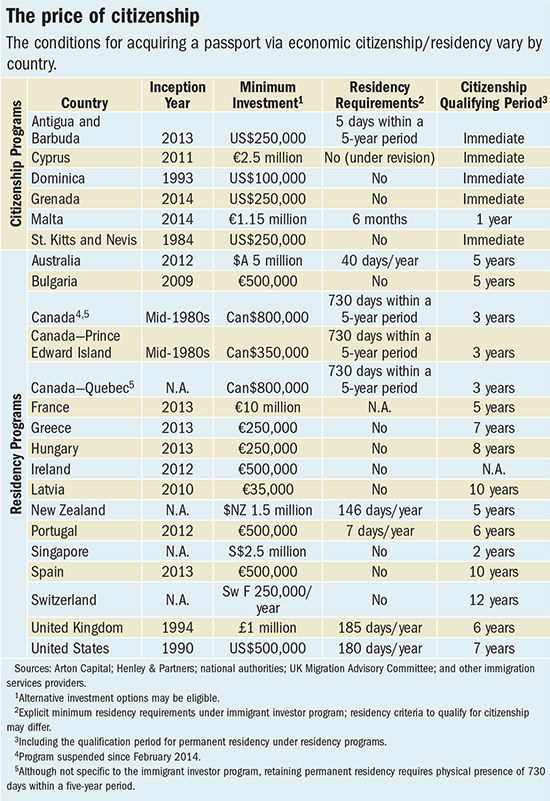
citizenship-investmentOne of the latest countries to embrace the trend, without the pretence that this will help the economy beyond real estate:

The increasing phenomenon of citizenship-by-investment – economic citizenship – has come to occupy the Turkish agenda with Thursday’s amendment of a citizenship law that offers citizenship to foreigners via four types of investment choices, including a real-estate investment of $1 million. In particular, the real-estate option is expected to boost Turkey’s real estate market and increase the ratio of real estate purchased by foreign investors.

Granting citizenship to foreigners in return for a determined amount of investment is a global phenomenon applied in many developed and developing countries, such as the U.S., Canada, the U.K., France, Australia, Dominica and Bulgaria. The growing phenomenon of “buying citizenship” is defined as “economic citizenship” by the International Monetary Fund (IMF).

Economic citizenship is offered by a number of small states and advanced economies, some of which, such as Canada, the U.K. and U.S., have had immigrant investor programs since the late 1980s or early 1990s, offering a route to citizenship in exchange for specific investment conditions with significant residency requirements. The rapid growth of private wealth, especially in emerging market economies, has increased the interest of wealthy people in greater global mobility and fewer travel obstacles posed by visa restrictions.

Source: Turkey a late entry in lucrative economic citizenship bandwagon – Daily Sabah

Note to Conservatives: There is no future in Donald Trump Lite – The Globe and Mail

From the ‘big shift’ to understanding Canadian political realities, John Ibbitson reflects on the Conservative leadership race.

While I share his general assessment, I always worry about complacency and assuming that Canada is resilient to the overall political trends in the US and Europe. Better to be less categorical; after all, whenever European leaders pronounce multiculturalism dead, there is an echoing chorus in Canada:

To varying degrees, several candidates for the Conservative leadership seek to unravel the conservative coalition forged by Stephen Harper, hoping to replace it with a populist, nativist movement similar to the one that elected Donald Trump.

Either they will fail and a Harper Conservative will win the leadership, or one will succeed, condemning the Conservative Party to many years in the wilderness. Because the Trump coalition simply doesn’t exist in this country.

Canada routinely ranks among the happiest nations on earth. The 2016 United Nations World Happiness Report had us at sixth, behind the Nordic countries and Switzerland.

Happy countries share in common governments that are committed to sound finances. They also enjoy high-quality public health care, education and other social services, something Harper Conservatives support. Harper Conservatives also join other Canadians (six-in-10, according to most polls) in endorsing high levels of immigration. Immigrants are welcome in Canada because our immigration policy is based on economic self-interest rather than compassion, and because the points-based system ensures that no one ethnic group dominates others.

And although the Ontario manufacturing sector has shed hundreds of thousands of jobs since 2000, the province as a whole is prospering, powered by the service-sector economy of Greater Toronto, the high-tech sector centred in Kitchener-Waterloo, and new, smaller, manufacturers springing up in Southwestern Ontario….

In this context, another word for happiness is trust. If citizens trust their government to spend tax dollars on needed services, their police to treat them fairly, their central bank to protect a sound currency and so on, then populist uprisings will be few and weak. All in all, Canadian citizens trust the Canadian state.

But in the United States, trust is eroding, thanks to foolish wars, government waste and free-riding fat cats, leading to ideological warfare and populist rebellions.

In the rust-belt states that swung to Mr. Trump, white working- and middle-class voters blame foreigners for taking away their factory jobs, environmentalists for shutting down the coal mines, Latino migrants for changing the ethnic mix of their communities, and Muslims for making them feel less safe. They trust neither the state nor each other.

There are doubtless some Canadians who are this angry. But you won’t find many of them in the suburban ridings of Greater Toronto and Greater Vancouver, dominated by new Canadians. You won’t find many of them in Calgary and Edmonton. People are hurting there, but they know the downturn in oil and gas prices is to blame for the slump, not immigrants or low-wage factory workers overseas.

That doesn’t mean Kellie Leitch, who is channelling a toned-down version of Trump memes, has no chance of winning the leadership. Only about 100,000 Conservative party members will vote for a leader, and that membership is older and whiter than the nation itself.

But whoever wins will have to appeal to voters in Mississauga-Erin Mills, to choose just one Greater Toronto example. That riding is 60 per cent non-white. In 2011, the Conservatives won the riding with 21,646 votes. In 2015, that vote went up slightly, to 21,716. Contrary to popular belief, the Conservatives held their suburban immigrant base in the last election.

But the Liberals took the riding by nearly 6,000 votes. Two thousand NDP voters switched to the Liberals, and the overall turnout increased by about 9,000 votes. (At 68 per cent nationally, turnout in the 2015 election was the highest since 1993).

Will turnout in 2019 drop back down to the post-2000 norm of around 60 per cent? How many disillusioned Liberal voters can be won over to the Conservative side? Can Conservatives broaden their support among suburban immigrant voters? These are the questions Conservative strategists should be asking – not whether the party can foment and surf a populist backlash.

Riding a wave of anger won’t get you very far in the sixth-happiest place on earth.

Source: Note to Conservatives: There is no future in Donald Trump Lite – The Globe and Mail

We can’t let Canada’s politicians divide us with populist labels: Goldy Hyder

While I agree with Hyder on the risk of playing to divisions, ignoring class and other differences also entails risk of denial and addressing issues.

Generally those who decry ‘class warfare’ do so from a position of privilege. What is needed, hard to do so in politics, is more nuanced debate about difference, barriers, and ways to overcome them:

Prime Minister Justin Trudeau’s decision to cancel his plans to attend the World Economic Forum in Davos so he can undertake a cross-country tour and engage directly with Canadians is a symptom of a much larger and more troubling trend where it has become increasingly fashionable for political leaders to frame public-policy decisions in terms of their potential impact on “ordinary,” “real” or “average” Canadians.

These terms, which are now at the heart of debates about everything from health-care funding to the benefits of globalization, have come to be used almost interchangeably with the equally popular “middle class.” To the extent that many Canadians consider themselves, rightly or wrongly, to be part of the middle class, these labels are intended to convey a sense of inclusiveness.

Yet the opposite is true. As we have seen in the United States and Britain, when these types of generic terms are used to describe large groups, they are generally defined on the basis of who they exclude: the so-called elites.

These terms are, in fact, inherently divisive. Just as few of us would self-identify as being “abnormal,” our characteristic Canadian modesty prevents us from thinking we are particularly exceptional. If we are not among those frequently maligned “elites,” we must therefore, be part of some “middle-class” majority. (Even the math holds up, as we’re told “elites” are only the top 1 per cent.)

The problem with vague terms like these is that they invite people to fill in the blanks with their own biases about who fits into each group – and we’ve seen the consequences that has had in other countries. Canadians should not be urged to divide themselves on the basis of income, education, ethnicity, religion or region. To do so would be to unravel our rich multicultural tapestry by pulling on loose threads.

We don’t want Canadians to be inherently distrustful of experts, to presume that a person is less ethical because they have a higher or lower net worth, or to believe that those with global outlooks aren’t patriotic. Any proliferation of populist labels risks creating an “us versus them” conflict within the country, something that can be exploited by those looking for an easy way to galvanize and mobilize a political base.

Some may suggest I am being alarmist, but I have spent the better part of my career in the field of communications, and in my professional experience our choice of language matters a great deal. It has also been my personal experience. As an immigrant and a Muslim, I have witnessed firsthand how quickly the word “different” becomes “foreign,” and how easily “foreign” can become “un-Canadian.”

At a certain point, assigning some meaning to arbitrary or artificial terms inevitably becomes a question of defining values. That is where things get complicated and where the real fissures can emerge. Canada’s 150-year story has many chapters in which divisions between people defined the politics of an era. Some of our worst mistakes have been made by governments in attempts to satisfy one group over another.

Without question, governments must consider the very different realities in which Canadians live when they develop policy res-ponses to pressing issues – but that is about technical implementation. What governments must avoid doing is using the levers of policy to divide Canadians on the basis of their different circumstances, as opposed to building a broad consensus based on shared values and interests.

Moreover, governments must avoid making decisions – such as whether to attend a global conference with the world’s most powerful economic stakeholders – based solely on the perceived optics of those decisions.

In these uncertain times, we cannot afford to make mistakes or miss opportunities. We need to seize every advantage we have, and that means ignoring those who call for us to marginalize or vilify others. Instead of targeting a particular class of Canadian – whether upper, lower or middle – let’s avoid entirely the temptation to engage in any type of class distinctions or, worse still, to inflame class warfare.

When the Fathers of Confederation created our country 150 years ago, they sought to unite us in common cause. Let us invoke that same spirit in this anniversary year by uniting Canadians, not dividing them.

Source: We can’t let Canada’s politicians divide us with populist labels – The Globe and Mail