Americans increasingly refused entry to Canada, documents show

Interesting trend and possible explanation (not provided by CBSA):

While many Canadians are concerned about having problems at the United States border, it is Americans who are having difficulties visiting Canada with the number turned away rising by 31 per cent last year, La Presse has learned.

According to federal documents, 30,233 Americans were turned away when attempting to enter Canada in 2016. In 2015, 23,052 people were turned back, representing an increase of 31 per cent in one year.

The numbers are all the more striking when compared to 2014, when 7,509 American citizens were refused entry to Canada. The Canada Border Services Agency (CBSA), which is responsible for border security, would not provide reasons for the increase.

“The CBSA is not in a position to speculate,” said Nicholas Dorion, a spokesperson for the agency. “The number of people turned away at the border fluctuates from year to year.”

The announcement of a new intelligence sharing agreement between Ottawa and Washington in 2013 likely played a role, according to Tamara Mosher Kuczer, a lawyer specializing in immigration matters with the law office Capelle Kane in Ottawa.

Under the deal, Canadian border agents can more easily detect Americans with a criminal record who show up at the border. Infractions, some decades old, could not be detected before the deal.

“We receive many more demands from people who travelled for years to Canada without a problem and who are now refused entry for a drinking and driving infractions that dates back 40 years,” the lawyer said.

The CBSA refused to detail the reasons for the 30,233 refusals of American travellers last year. People turned back at the border generally receive “permission to leave,” the federal agency said.

“If an individual is suspected of being prohibited from Canadian territory by a Canadian border agent for a reason cited by the Immigration and Refugee Act, the agent must always consider authorizing the person to leave Canada voluntarily,” said Dorion. “When the agent at the border authorizes a person to take back their request to enter Canada they have to proceed by providing a formula entitled ‘authorized to leave Canada’ “

It is the ‘authorized to leave Canada’ documents that La Presse was able to consult under the Access to Information Act.

Since the election of U.S. President Donald Trump, Canadians are less frequently turned away at the U.S. border. According to The Canadian Press, the number of Canadians refused entry at American land crossings dropped by 8.5 per cent over the last five months. That means that 6,875 Canadians could not get across the border between October 2016 and February 2017, compared to 7,619 in the same period a year earlier.

Source: Americans increasingly refused entry to Canada, documents show | Toronto Star
Federal Court orders public safety minister to make decision in immigration case

Justice delayed is justice denied:

Lawyers for Goodale had argued the minister is just too busy to be held to a timeline for making such decisions.

“He submits he should be left with the flexibility to prioritize his many duties as he considers appropriate, and that requiring him to make a decision within a certain period of time may cause him to divert his attention away from an emergency situation,” reads the judgment.

The chief justice didn’t buy that argument.

“I am sympathetic, to a point, with the minister’s submissions. However, they do not, individually or collectively, justify his position that he must have a complete carte blanche regarding the time available to him to make decisions,” wrote Crampton.

He went on to write that the four-year delay in processing Tameh’s application is “at the outer limit of what is reasonable” and the additional 45-month delay to be unreasonable.

Crampton then ordered the minister to make his decision within a specific timeline and to reimburse Tameh $4,000 for his legal costs.

4-year timeframe

“I think the court is sending a pretty clear message that, minister, if you’ve got to make a decision, make it within four years,” said Lorne Waldman, a prominent immigration lawyer based in Toronto.

Waldman said at least 10 of his clients have applications for ministerial relief before the minister and some of them have been there for up to 15 years.

“These are difficult decisions that the minister has to make because they have a political charge to them. What the minister is being asked to do is to say, ‘Well this person, yes, you were found to be inadmissible because you were found to be a member of a terrorist group,’ but there all these other circumstances that would justify granting an exception,” said Waldman.

“So the minister has to personally make this decision and be personally accountable for them. That’s why they’re so difficult. That’s why they’ve taken so long,” he said.

In light of Crampton’s ruling, Waldman said he filed two applications at Federal Court this week asking it to order Goodale to make a decision.

A spokesperson for Goodale said the government is reviewing the ruling.

In addition, Scott Bardsley told CBC News the department made changes to the process of applying for ministerial relief and is also considering “whether further improvements could be made to the process.”

Source: Federal Court orders public safety minister to make decision in immigration case – Politics – CBC News

Horace M. Kallen: Democracy Versus the Melting Pot

Mort Weinfeld, during our Metropolis workshop on integration metaphors, drew my attention to this 1915 essay by Kallen and his use of the orchestra metaphor (highlighted in the extract below). While the examples he cites and the descriptions he uses are dated, the overall metaphor and analysis generally holds up well (as does his question, particularly relevant today):

The reason lies, I think, in the fact that in Switzerland the conception of “natural rights” operates, consciously or unconsciously, as a generalization from the unalterable data of human nature. What is inalienable in the life of mankind is its intrinsic positive quality, its psychophysical inheritance. Men may change their clothes, their politics, their wives, their religions, their philosophies, to a greater or lesser extent: they cannot change their grandfathers. Jews or Poles or Anglo-Saxons, would have to cease to be. The selfhood which is inalienable in them, and for the realization of which they require “inalienable” liberty, is ancestrally determined, and the happiness which they pursue has its form implied in ancestral endowment. This is what, actually, democracy in operation assumes. There are human capacities which it is the function of the state to liberate and to protect; and the failure of the state as a government means its abolition. Government, the state, under the democratic conception, is merely an instrument, not an end. That it is often an abused instrument, that it is often seized by the powers that prey, that it makes frequent mistakes and considers only secondary ends, surface needs, which vary from moment to moment, is, of course, obvious; hence our social and political chaos. But that it is an instrument, flexibly adjustable to changing life, changing opinion, and needs, our whole electoral organization and party system declare. And as intelligence and wisdom prevail over “politics” and special interests, as the steady and continuous pressure of the inalienable qualities and purposes of human groups more and more dominate the confusion of our common life, the outlines of a possible great and truly democratic commonwealth become discernible.

Its form is that of the Federal republic; its substance a democracy of nationalities, cooperating voluntarily and autonomously in the enterprise of self-realization through the perfection of men according to their kind. The common language of the commonwealth, the language of it great political tradition, is English, but each nationality expresses its emotional and voluntary life in its own language, in its own inevitable aesthetic and intellectual forms. The common life of the commonwealth is politico-economic, and serves as the foundation and background for the realization of the distinctive individuality of each nation that composes it. Thus “American civilization” may come to mean the perfection of the cooperative harmonies of “European civilization,” the waste, the squalor, and the distress of Europe being eliminated, a multiplicity in a unity, an orchestration of mankind. As in an orchestra, every type of instrument has its specific timbre and tonality, founded in its substance and form; as every type has its appropriate theme and melody in the whole symphony, so in society each ethnic group is the natural instrument, its spirit and culture are its theme and melody, and the harmony and dissonances and discords of them all make the symphony of civilization, with this difference: a musical symphony is written before it is played; in the symphony of civilization the playing is the writing, so that there is nothing so fixed and inevitable about its progressions as in music, so that within the limits set by nature they may vary at will, and the range and variety of the harmonies may become wider and richer and more beautiful.

But the question is, do the dominant classes in America want such a society?

Canadian schools abandoning U.S. trips because of Trump ban

Multiculturalism, inclusion and solidarity – making a conscious choice to avoid exclusion:

Toronto parent Katie Lynes said she has heard disappointment among families about the cancellation of school trips, but there is also unease about events in the U.S. and elsewhere.

The TDSB travel ban mostly affects music students at her daughters’ school in north Toronto. The music teacher usually organizes trips to New York and Chicago, and is now considering options within Canada.

“Our board, and our school, is multicultural and inclusive, so the idea of certain kids potentially being stopped at the border or turned away does not sit well,” Ms. Lynes said. She added: “Disappointment over cancellation of trips is something that kids and families should be able to handle, especially when they realize that it’s in the service of larger principles, such as equity, inclusiveness and fairness.”

At Westmount, Ms. Jafralie, an ethics and religion teacher, said discussions about changing the itinerary allowed for a learning opportunity for her students. She and her students were disappointed that they wouldn’t visit the American sites, but not upset enough to leave classmates behind.

“We have a diverse population and we embrace our diversity. We’re just not willing to take the risk. We’re just not willing to break us all up,” she said.

Source: Canadian schools abandoning U.S. trips because of Trump ban – The Globe and Mail

Threats to academic freedom aren’t just a white-guy problem

One of the more thoughtful commentaries on the Potter controversy from a different angle by Amanda Bittner, Elizabeth Goodyear-Grant and Erin Tolley (disclosure: Erin is a former colleague):

Look at the demographics of any large organization, and you’ll find that most positions of power are occupied by white men. That’s true, too, of academia. In Canadian universities, there are almost no Indigenous administrators or administrators of colour; tenured positions, particularly at the highest levels, belong disproportionately to white men. Women, people of colour, and Indigenous peoples typically don’t have the opportunity to lose their prestigious positions amid controversy because they don’t even get those positions to begin with.

Adjunct and contract positions—the most precarious academic work of all—are often carried out by women, Indigenous scholars, and scholars of colour.As one U.S. study notes, just as under-represented groups began to gain a toehold in the professoriate, the academic job market contracted. Permanent positions have been replaced by those with almost no job protection, as well as long hours and little institutional support. Even if scholars in these roles had time to pen op-eds on controversial topics, seeing a person of privilege be so easily cut loose would almost certainly only heighten the instinct for women, Indigenous scholars and scholars of colour to stay quiet. And yet these are the voices we need.

We know we also write from a position of privilege: we are white women (two with tenure, one without) who work in academic institutions and have the luxury to follow these debates on social media. And yet, whenever we comment publicly on an issue, we look over our shoulders and wonder about the potential effect that public engagement might have on our careers. We debated the wisdom of even commenting on this case, concerned as we are about the blowback it might elicit, but we are intervening because we believe that the burden of exposing problematic institutional practices shouldn’t fall only on the shoulders of the most marginalized.

This isn’t just a white-guy problem. The incident sends a signal to our colleagues who have important things to say, who don’t have a platform of privilege from which to say it, and who don’t have a safety net to fall back on if things go south—or a coterie of well-connected commenters who mount a forceful defence. When voices are silenced by universities, there is a real risk to those who dare make controversial observations based in rigorous empirical research, or conclusions that point to systemic discrimination, injustice, and current and past wrongs. These are things that might “bother” or “offend” the public, and which have the potential to place even greater pressure on institutions.

Indeed, McGill’s principal, Suzanne Fortier, suggests that the Institute’s role is not “to provoke, but to promote good discussion.” This is a prescription for tepid public discourse. We have brilliant colleagues whose provocative voices need to be made louder, not silenced. And if universities can’t stand up to this pressure and defend their researchers on the “easy” cases—like ones involving a privileged white man—they most certainly won’t have the courage to do so when confronted with the “difficult” ones.

Source: Threats to academic freedom aren’t just a white-guy problem – Macleans.ca

Why budget ‘gender statements’ are a bad idea

One thing to argue that gender and diversity analysis should include men (hard not to agree given some of the disturbing trends regarding education and outcomes), quite another to dismiss GBA entirely like Peter Shawn Taylor appears to do.

In my various analyses of diversity in government appointments, it is generally simpler to present one gender than both, as the numbers are simply the flip side of one another (and yes, traditionally women and other minorities have been under-represented). But narratives can and should be more inclusive.

And while Lilla’s thesis that identity politics led to the alienation of white males, it is more likely that the fundamental changes in the economy and the impact on white working class males played a larger part:

The Gender Statement’s ultimate consequence is to promote a winner-take-all gender competition—a battle between the sexes to see who can muster the best (that is, worst) numbers in making their case for systemic discrimination. The mere fact I’m writing this now—the heresy of men’s rights notwithstanding—proves the point. Ottawa’s plan to expand its Gender Statement in future years to include new identities such as ethnicity, age and sexual orientation can only raise this contrived grievance-search to new, intersectional heights.

At this point, I’m reminded of Columbia University humanities professor Mark Lilla’s much-shared essay in the New York Times, The End of Identity Liberalism, in which he unpacked the destructive impact of the political fixation on gender, racial and sexual identities on the U.S. election.

“A generation of liberals and progressives [have become] narcissistically unaware of conditions outside their self-defined groups,” he writes. Such obsessive attention to self-identity eventually caused white, predominantly-male Americans to similarly think of themselves as a disadvantaged group, thereby putting Donald Trump in the White House. “Those who play the identity game should be prepared to lose it,” Lilla concludes, calling on liberals to spend more time promoting shared experiences and values, rather than curating differences.

Surely this is the fire we’re playing at in Canada as well with the budget’s Gender Statement. It encourages Canadians to consider the country’s fiscal plan not in its broad sweep and affect on the country, but rather through the lens of narrowly-defined identity categories. And to succeed in this context, it becomes necessary to elevate whatever disadvantages your group might experience while ignoring those of competing groups.

This might work for a while. But eventually everyone will start to demand their special moment. Men might even wonder why they’re asked to pay 66 per cent of all taxes, while their problems get zero per cent of Ottawa’s sympathy and attention. And then what?

Source: Why budget ‘gender statements’ are a bad idea – Macleans.ca

Dual citizenship in Europe: Which rules apply where?

Ongoing German dual citizenship debate, likely prompted by concerns of Turkish campaigning under Erdogan’s authoritarianism, along with a summary of the policies of other EU countries:

Chancellor Angela Merkel’s conservative Christian Democrat Union (CDU) aims to tighten citizenship laws. At the CDU conference last December, party officials launched a debate on possible restrictions on dual citizenship. The subject of the dispute is what is known as the “obligation option,” which means that children of immigrants obtain both nationalities at birth, but must choose one when they reach the age of 23. In 2014, the coalition government agreed that children born and raised in Germany would be allowed to keep both nationalities as adults.

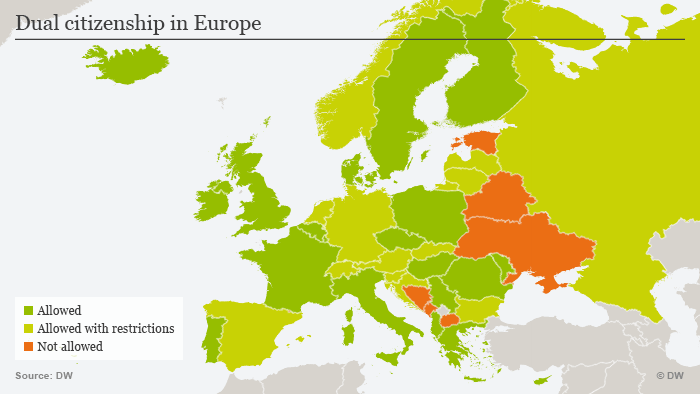
Infografik doppelte Staatsbürgerschaft Europa ENG

German news magazine “Der Spiegel” reports that the CDU plans to campaign against dual citizenship. “We must make far-reaching changes to the policy of the exceptions,” Cemile Giousouf, the chairman of the CDU’s integration network, told the magazine. A paper that will be integrated into the CDU’s election platform suggests that grandchildren of first-generation immigrants may only have German citizenship.

Merkel rejected the demands in December. According to “Spiegel” she is now ready to back a new regulation, probably as a consequence of Recep Tayyip Erdogan’s verbal attacks on German politics and the fact that many Turks living in Germany identify with the Turkish president.

Essen CDU-Bundesparteitag Rede Merkel (picture-alliance/dpa/K. Nietfeld)‘I don’t think we are having an election over dual citizenship,’ said Merkel in December.

France

Most EU states, including France, now allow dual citizenship. French nationals have had the right to dual or multiple nationalities since 1973. In 2009, France stood against the first article of the European Council’s “Convention on the Reduction of Cases of Multiple Nationality and on Military.” The aim of the agreement was to “to reduce as far as possible the number of cases of multiple nationalities, as between member states.”

In France, “jus soli,” meaning birthright citizenship, is practiced. Anyone who is born in France is granted French citizenship regardless of the parents’ nationality.

Sweden

For a long time, Sweden, like Germany, adhered to the “avoidance of dual citizenship” principle. A law adopted in 2001, however, allows Swedish nationals to apply for a different nationality without losing their Swedish passport, provided that the laws of the country permit this. In turn, immigrants in Sweden do not necessarily have to give up their foreign citizenship when they are naturalized.

The sociologist Thomas Faist sees Sweden as a potential role model for other countries. Two passports are seen “not as a problem, but rather as a contribution to integration,” Faist told the German media agency “Integration.” Other Scandinavian countries have similar regulations. In 2014 Denmark passed a law which allows dual citizenship. In Finland, a similar law had already gone into effect in 2003. In Norway, however, dual citizenship is permitted only in exceptional cases.

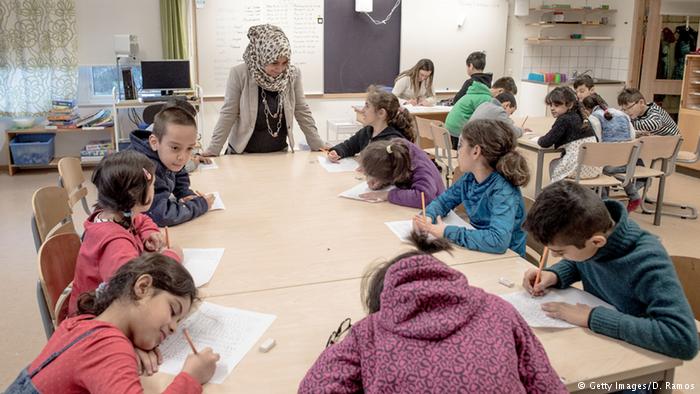
Schweden Integration von Migranten Schulunterricht (Getty Images/D. Ramos)Sweden has long been a country of immigration, but it has tightened its asylum law in recent years

Central and Eastern Europe

Under the nationality law in Poland, Polish citizens cannot be recognized as citizens of other countries at the same time. The possession of a foreign passport, however, is tolerated. Polish citizens cannot avoid civic obligations by using a foreign citizenship to get out of them.

Ukraine does not recognize dual citizenship. Under current laws, newly naturalized Ukrainian citizens must give up other nationalities within two years. Some countries in Eastern and Central Europe, on the other hand, such as the Czech Republic and Romania are open to multiple nationalities. Bulgarian, Serbian and Croatian citizens are entitled to hold dual citizenship, but foreigners wishing to be naturalized must renounce their previous nationality.

Spain

In principle, Spain permits dual citizenship for immigrants from Portugal, Andorra, the Philippines, Equatorial Guinea and Latin American countries with which it has concluded dual citizenship agreements. According to the Spanish constitution, immigrants from other nations must renounce their foreign nationality if they wish to hold Spanish citizenship. Spanish citizens are entitled to dual citizenship if they inform the authorities within three years that they wish to keep their Spanish passport.

Depending on the country, laws differ throughout southern Europe. Monaco and Andorra, for example, prohibit dual nationality but in Portugal, it is permitted.

Source: Dual citizenship in Europe: Which rules apply where? | Germany | DW.COM | 28.03.2017

Trudeau government’s vacant appointments backlog up 80%

Good follow-up story and valid concern regarding the large number of vacancies.

But nice to see that PCO is now tracking more systematically the diversity of appointments and improving representation (of the more than 100 appointments to date, 62 per cent women, 15 per cent visible minorities, 10 per cent Indigenous Canadians):

Five months after Prime Minister Justin Trudeau’s government assured Canadians that its new system would soon fix the backlog of appointments that need to be filled, the problem has gotten much worse.

An analysis by CBC News reveals that one in three governor in council positions — ranging from directors of government agencies to members of tribunals that hear appeals of employment insurance or pension disputes — is currently vacant or occupied by an appointee whose term is past its expiry date.

When CBC first looked at the question in October 2016, 19.6 per cent of the governor in council positions were vacant or past their expiry date.

That number is currently at 35 per cent, although it will drop slightly next week when several appointments to the Immigration and Refugee Board made by cabinet earlier this month take effect.

The backlog in October of more than 300 appointments has now swelled to 572. Of the 515 positions, 354 are vacant. Another 161 are occupied by an appointee, often one named by the previous Conservative government, whose appointment is past its expiry date. However, they are allowed to remain until they are replaced or renewed.

The positions range from lucrative full-time jobs with six-figure salaries to part-time positions that pay per diems and expenses.

There are also 57 vacancies for federally appointed judges, down slightly from the 61 vacancies in October 2016 that prompted concerns about growing backlogs in criminal trials.

In several cases, positions are being filled on a temporary basis because the government was not able to fill them before the incumbent’s term was set to expire. Among them are half of the officers of Parliament — the conflict of interest and ethics commissioner, the commissioner of lobbying and the official languages commissioner, while the chief electoral officer’s position is listed as vacant.

Former prime minister Stephen Harper’s government went on an appointment spree in the weeks leading up to the 2015 election, filling not only most of the positions that were vacant but also making 49 “future appointments” of individuals whose terms weren’t due to be renewed until well after the election.

In October, the government said that the initial backlog was caused in part by the decision to overhaul the appointments process and bring in a more open and balanced merit-based system.

It said that system was up and running, Canadians were applying for the positions and vacancies were being filled.

Five months later, the government said it has received more than 11,000 applications for vacant appointments and more than 100 selection processes are currently underway.

“The more rigorous approach to conducting selection processes represents a significant volume of work,” said Raymond Rivet, spokesman for the Privy Council Office.

Rivet said that since the government launched its new appointments process it has made more than 100 appointments.

“Of this number, 62 per cent have been women, 15 per cent visible minorities, 10 per cent Indigenous Canadians and 50 per cent identify as fully or functionally bilingual.”

However, Conservative MP Tony Clement, former president of the Treasury Board, said the growing backlog of vacant appointments is affecting service to Canadians.

“This clearly a case where these appointments, which are necessary for the proper functioning of government — there could be issues involving people getting their appropriate EI, for instance, or their appropriate pension — are not being processed because of the lack of these appointments.”

Clement blamed the backlog on Trudeau’s director of appointments, Mary Ng, who announced Feb. 15 that she was taking a leave from her job to seek the Liberal nomination in the Toronto-area riding of Markham-Thornhill. The riding became vacant after Trudeau appointed former immigration minister John McCallum as Canada’s ambassador to China.

“It’s very disappointing,” said Clement. “The person in charge of this process is now the Liberal candidate in Markham, and obviously she was spending too much time campaigning for herself and not enough time making recommendations to the prime minister on appointments.”

More federal action needed to restore lost Canadian citizenship rights: Rock and Axworthy

Former Ministers Alan Rock and Lloyd Axworthy argue in favour of the proposed expansion of voting rights for non-resident Canadians in Bill C-33 and repeal of the first generation limit to the transmission of  Canadian citizenship.

The main weaknesses in their arguments:

  • Reinforces a global, more instrumental concept of citizenship, without a meaningful connection to Canada;
  • C-33 only requires a citizen to have been born in Canada in order to have voting rights, irrespective of how little time spent in Canada;
  • Repealing the first generation limit means a further weakening of the meaningfulness of citizenship and connection to Canada, as again the second or subsequent generations could retain citizenship without having lived in Canada;
  • Immigrants wishing to become citizens to be physically present in Canada (four out of six years currently, three out of six as proposed in Bill C-6) and retention after the first generation should, at a minimum, require residency;
  • Like others, they exaggerate the number of Canadians with connections to Canada. Passport data shows about 630,000 active non-resident adult passport holders, not the 2 to 3 million cited. This is a minimal connection test (taxation data shows about 130,000);
  • The exemption to the first generation limit for public servants serving abroad recognizes the fact that they work directly for the government, rotate regularly back to Canada, and pay Canadian taxes. This is quite different from those who spend their entire life abroad, do not return regularly for more than short visits, and for the most part, don’t pay Canadian taxes; and,
  • Largely targeted towards globally mobile professionals, Ministers Rock and Axworthy’s proposal fails to consider the implications for the broader population, whether it be the many non-resident Canadians who simply live their lives abroad without making “important global contributions” or resident Canadians who may feel that granting citizenship without residence devalues the meaning of being Canadian. 

    Their proposal is largely targeted towards those globally mobile professionals without considering the implications to the broader population of non-resident Canadians.

Canada’s former Minister of Democratic Institutions, Maryam Monsef, recently observed that in the 21st century, there are many good reasons why Canadians choose to live overseas, and that there is no reason to create barriers to their participation in democratic processes.

We agree, but would go further. Canadians living and working overseas face government barriers not only in participating in democratic processes, but also in passing along citizenship. These must be addressed.

The occasion for the comments made by Ms. Monsef – recently appointed Minister of Status of Women – was the introduction of legislation to repeal provisions of the federal Fair Elections Act. Adopted in 2014, this statute provides, amongst other things, that Canadians living overseas can vote only within five years of leaving Canada, and must have the stated intention of returning home.

In repealing this provision through Bill C-33, An Act to amend the Canada Elections Act, the federal government will remove one important penalty for Canadians living and working overseas. However, it is overlooking a potentially even greater disincentive.

A little-known 2006 amendment to the Citizenship Act limits Canadian citizenship to just the first-generation of children born to or adopted by Canadians who live outside Canada. Thus, children born to or adopted by Canadian parents who are travelling, studying, or working abroad become citizens of Canada at birth or at the time of adoption, but their children are not entitled to Canadian citizenship if they are born outside Canada.

This is harmful for at least two reasons.

First, the amendment to the Citizenship Act strikes us as discriminatory, and out of step with the principle that “a Canadian is a Canadian is a Canadian,” as articulated by Prime Minister Justin Trudeau. The amendment effectively creates two classes of Canadians: those who can pass along citizenship to their children and those who cannot. Furthermore, the amendment discriminates in favour of federal employees and military personnel who serve outside Canada. Under the current legislation, they are explicitly exempted from the limits on citizenship imposed by the amendment.

Second, Canada is deeply interconnected economically, socially and culturally with communities and countries around the globe. Canadians have a long history of important global contributions in international finance, peacekeeping, United Nations’ service, and humanitarian action, to name a few. We should be encouraging Canadians to venture beyond our borders to contribute to the broader global community, whether this be as students, travellers, or professionals – now, more than ever. Unfortunately, the current provisions of the Citizenship Act may have the opposite effect, by deterring Canadians from going overseas to work.

To date, the government has sought to justify this provision based on “simplicity and transparency.” We respectfully submit that any administrative advantages are substantially outweighed both by the principles of fairness and equity required by Canadian law, and by the importance of maintaining Canada’s standing in, and contributions to, the community of nations.

In terms of scope of impact, it is worth considering that at any point in time, 2-3 million Canadians live, work, or travel overseas. If even 0.5 per cent of these people have children overseas, this would amount to 10,000-15,000 children whose rights are limited and whose options are narrowed by this legislation each year. These numbers underscore the urgency and importance of addressing this matter quickly.

As the Government moves to restore voting rights to Canadians living overseas, it should also restore another fundamental birthright by allowing foreign-born descendants of Canadians who were themselves born outside our country to begin life with Canadian citizenship.

Source: More federal action needed to restore lost Canadian citizenship rights – The Globe and Mail

Judge shortage causing unnecessary legal trauma: MacKay

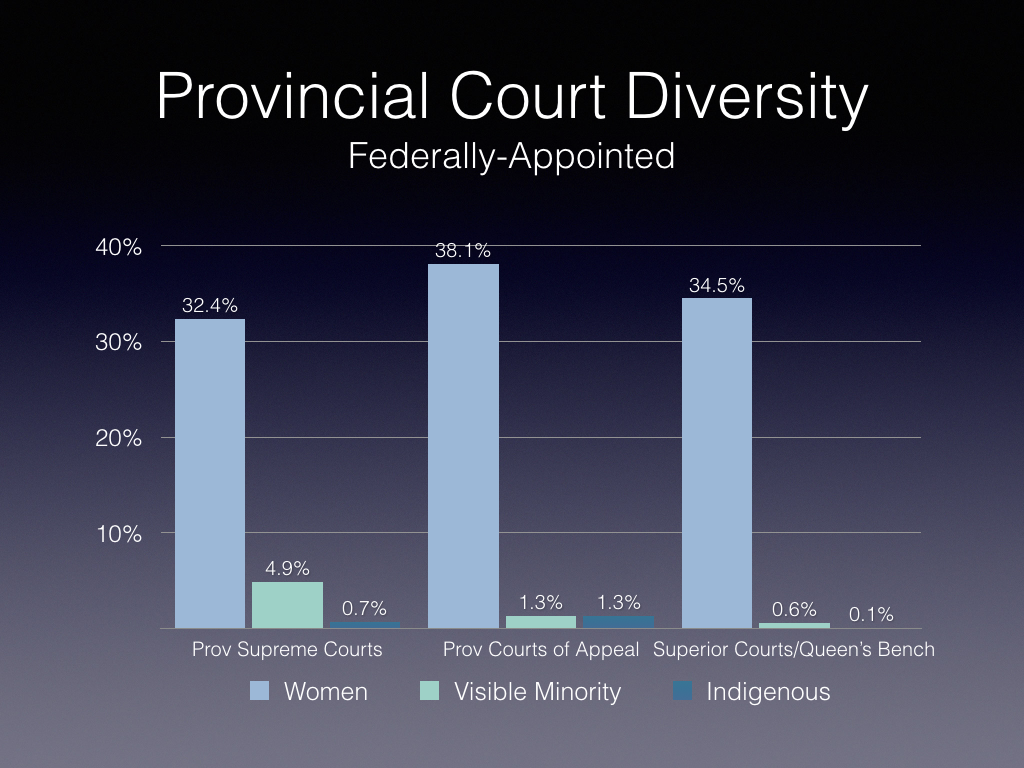
While MacKay is right to criticize the government for its delay in appointing judges, his assertion that under the Conservative government ‘s, “We appointed a judiciary that represented “the face of Canada,” a diverse bench predicated and built on inclusion of all races, creeds, and genders in the legal community across Canada” is false as shown in my 2016 analysis: Diversity among federal and provincial judges – Policy Options).

In contrast, appointments to date of the current government show a marked increase: 57.4 percent women, 6.4 percent for each of visible minorities and Indigenous peoples.

The federal government has a fundamental responsibility to appoint a sufficient complement of judges such that our courts can function properly. Its failure in that regard creates a constitutional crisis that goes to the very rule of law that underpins our justice system.

A lack of judicial appointments in the context of increasing pressure to conduct timely trials equals a systemic miscarriage of justice. With caseloads where they are, the system is at its breaking point.

Add to this difficult dynamic the recent Supreme Court of Canada ruling in the R v Jordan decision, which mandates criminal trials must be heard within 18 months for the so-called lower courts, and 30 months for the Superior ones. Absent compelling circumstances, “delinquent” prosecution equals administrative dismissal.

Due to this artificial prescription dozens of cases have been tossed, including murder and sex assault cases. No trial. No verdict. Worse still, the victims and their families are left without recourse or remediation and no one is accountable. Not fully appreciated as yet, this jarring situation stands to worsen due to the arbitrary deadline, which provides no consideration for the seriousness of the offence.

Against this backdrop we note inertia from the federal government on the appointment of judges to hear these languishing cases. Canadians face an alarming scenario of serious violent charges being vacated due to the acute shortage of judges. “Justice delayed is justice denied” is a maxim never more appropriately invoked than now.

As minister of justice (2013-15) I oversaw the appointment of more than 230 judges; prior to that my government prioritized hundreds more. We appointed a judiciary that represented “the face of Canada,” a diverse bench predicated and built on inclusion of all races, creeds, and genders in the legal community across Canada.

Vacancies on the federally appointed bench is at an all-time high. Sixty-two empty seats of the 840 federally appointed judges, against 14 (the lowest in decades) when my government left office. In June 2015, we appointed a record 22 women: over 60 per cent of the judges appointed on that occasion. We appointed more judges on one day (43) than the current government has in 16 months in office.

Source: Judge shortage causing unnecessary legal trauma: MacKay | Toronto Star