Express Entry Year-End Report 2016

IRCC is to be congratulated on its annual reporting on Express Entry, that contains a wealth of relevant data and information. About 25 percent of economic class immigrants came through Express Entry in 2016.

Have excerpted the into below, in addition to three charts I created based on the data.

The first one shows the number of invitations and the cut-off point as a percentage of the maximum score. It should be noted that the report shows the vast majority of candidates invited have scores between 300-500:

The second shows the top countries of origin by invitations, contrasting 2015 and 2016, where India and China show the greatest increase:

The third chart contrasts the country of origin for Express Entry 2015-16 to the overall country of origin of all immigrants, 2006-15, suggesting a slightly but not dramatic overall shift in terms of visible minority versus non-visible minority immigrants:

Express Entry is Canada’s application management system for certain economic programs including the Federal Skilled Worker Program, Federal Skilled Trades Program, Canadian Experience Class and a portion of the Provincial Nominee Program. Potential candidates express their interest in immigrating to Canada by first completing a profile online that is then pre-assessed to see if they meet criteria of one of the three federal immigration programs mentioned above. Candidates who meet these criteria are given a score by the system based on the information in their profile and ranked against others who also meet these same criteria. Only the candidates with top scores get an invitation to apply for permanent residence.

Express Entry was designed with three main objectives in mind: 1) flexibility in selection and application management, 2) responsiveness to labour market and regional needs and 3) speed in application processing. In its two years of operation, Express Entry has met its objectives.

In 2016, almost 34,000 invitations to apply for permanent residence were issued to Express Entry candidates representing an increase of 3,000 from 2015. Since the launch of Express Entry, a total of 43,202 individuals (applicants and their families) have been admitted to Canada as permanent residents. Key findings indicate that these applicants are highly skilled immigrants and many have studied in fields related to science, technology, engineering, and mathematics. The top ten occupations of these permanent residents included software and computer engineering fields.

Provinces, territories and employers have successfully used Express Entry to fill regional and labour market needs. Express Entry increases the labour market responsiveness of the immigration system by providing employers with a greater role through job offers to candidates which, if all conditions are met, increases their chances of receiving an invitation to apply.

In addition, the processing time commitment of six months for 80% of cases has been met and Immigration, Refugees and Citizenship Canada (IRCC) will continue to monitor the performance of Express Entry and make adjustments as necessary.

To ensure a more fair and responsive immigration system that addresses emerging needs and long-term economic growth for Canada, targeted improvements were made to Express Entry on November 19, 2016. These improvements include the following:

  • Reducing the number of points awarded for job offers to 50 points to candidates with a valid job offer in a National Occupational Classification (NOC) 0, A or B occupation and 200 points to candidates with a valid job offer in a NOC 00 occupation; this change rebalances the Comprehensive Ranking System and allows for more highly skilled candidates to receive an invitation to apply;

  • Awarding points for job offer to certain candidates already in Canada on Labour Market Impact Assessment (LMIA) exempt work permits. For example, candidates who are here under the North American Free Trade Agreement, a federal provincial agreement or Mobilité Francophone no longer need to obtain a LMIA to be awarded job offer points. These candidates must meet certain criteria, such as at least one year of work experience from the same employer who is providing their job offer;

  • Changing the job offer requirement from indeterminate to one year; this allows for more highly skilled candidates working in contract-based industries to have a higher likelihood of receiving an invitation to apply for permanent residence;

  • Awarding 15 points for a one- to two-year diploma or certificate and 30 points for a degree, diploma or certificate of three years or longer, or for a Master’s, professional or doctoral degree of at least one academic year; these changes allow for more former international students, which are a key source of candidates because of their age, education, skills and experience, to be able to transition to permanent residence using Express Entry;

  • Finally, providing 90 days, instead of the previous 60 days, to candidates to complete their application for permanent residence after they receive an invitation to apply.

Source: Express Entry Year-End Report 2016

Pope Francis Gives a TED Talk—and a Warning – The Daily Beast

Another good message from Pope Francis:

He first compared himself to the many migrants and refugees of today, explaining that he was also the son of Italian immigrants to Argentina and wondering if he could have ended up like so many who are now living in the margins.

“I often find myself wondering: ‘Why them and not me?’ I, myself, was born in a family of migrants; my father, my grandparents, like many other Italians, left for Argentina and met the fate of those who are left with nothing. I could have very well ended up among today’s ‘discarded’ people,” he said. “And that’s why I always ask myself, deep in my heart: ‘Why them and not me?’.”

He then moved on to the importance of the development of new technology. “How wonderful would it be if the growth of scientific and technological innovation would come along with more equality and social inclusion,” he said. “How wonderful would it be, while we discover faraway planets, to rediscover the needs of the brothers and sisters orbiting around us.”

Midway through his 18-minute talk, he introduced another favorite theme: hope. “To Christians, the future does have a name, and its name is Hope. Feeling hopeful does not mean to be optimistically naïve and ignore the tragedy humanity is facing,” he said. “Hope is a humble, hidden seed of life that, with time, will develop into a large tree. It is like some invisible yeast that allows the whole dough to grow, that brings flavor to all aspects of life.”

“A single individual is enough for hope to exist, and that individual can be you. And then there will be another ‘you,’ and another ‘you,’ and it turns into an ‘us.’ And so, does hope begin when we have an ‘us?’ No. Hope began with one ‘you.’ When there is an ‘us,’ there begins a revolution.”

Francis, who will be taking a lightening-speed trip to Egypt on Friday, considered by a many a very dangerous trip, then ended with remarks he hoped the world leaders would take to heart. He wasn’t specific, but his listeners in Vancouver—and around the globe—could make their own inferences.

“Please, allow me to say it loud and clear: the more powerful you are, the more your actions will have an impact on people, the more responsible you are to act humbly. If you don’t, your power will ruin you, and you will ruin the other,” said Pope Francis.

“There is a saying in Argentina: ‘Power is like drinking gin on an empty stomach.’ You feel dizzy, you get drunk, you lose your balance, and you will end up hurting yourself and those around you, if you don’t connect your power with humility and tenderness.”

“The future of humankind isn’t exclusively in the hands of politicians, of great leaders, of big companies. Yes, they do hold an enormous responsibility. But the future is, most of all, in the hands of those people who recognize the other as a ‘you’ and themselves as part of an ‘us.’ We all need each other.”

Source: Pope Francis Gives a TED Talk—and a Warning – The Daily Beast

Cultural sensitivities must never override gender equality: Khan

Another good piece by Sheema Khan:

While these attitudes have been ingrained for centuries elsewhere, one would think that migrating to a land where gender equality is emphasized would lead to a change of heart. Apparently, more needs to be done to uproot customs that have been transplanted here. Efforts must come from both within and without affected communities.

We need honest public conversations about these difficult topics. Multicultural sensitivities should never override gender equality, nor should they censor the expression of strong opinions. Let it be said: Both sets of cultural practices are, well, barbaric. They have no place here (or in fact, anywhere). Not only are they “un-Canadian,” they are inhuman.

Government policy is also a necessary tool to combat discriminatory practices.

While Canada has legislation against the practice of FGM, there are no laws that prosecute parents who send their daughters abroad to have the procedure done. In contrast, France and the United States have outlawed “FGM tourism.” It is time for Canada to follow their lead.

And while Ottawa has moved to address FGM, our governments have failed to address female feticide. They ignored the call by Dr. Rajendra Kale, in 2012, to ban disclosure of the sex of a fetus until 30 weeks (after which point an abortion is difficult). South Korea banned such disclosures in 1988, helping to reverse gender imbalance.

Finally, there can be no change unless there is opposition within communities. There will be pressure to circle the wagons in wake of negative media coverage. I still remember an Ottawa community leader telling a local congregation, following the “honour killing” of Aqsa Parvez, that the media were trying to make the Muslim community look “bad.” Outrage was not directed at family violence, but at the media for covering that violence.

Today, many courageous Bohra women who underwent khatna (i.e. FGM) in their childhood, are speaking out against the practice, directing their personal pain toward addressing social justice. They risk ostracization from their own families and excommunication from their faith community.

Who, on the other hand, will speak up for the 4,500 “missing” girls in the Indo-Canadian community, so that female feticide will cease? To the women who abort their daughters: you were not subject to sex-selective abortion – why, then, inflict it on Your daughter-to-be? There will need to be many painful conversations about the central moral issue: aborting a fetus simply because it is female.

Minority communities are in a difficult spot, especially with anti-immigrant sentiment on the rise. However, failing to address harmful cultural practices unequivocally, allows problems to fester and, ultimately, cause even more damage.

Source: Cultural sensitivities must never override gender equality – The Globe and Mail

Inclusion isn’t just a buzz word — and Canada can prove it: Opinion | Toronto Star

The UN special rapporteur needs to do her homework.

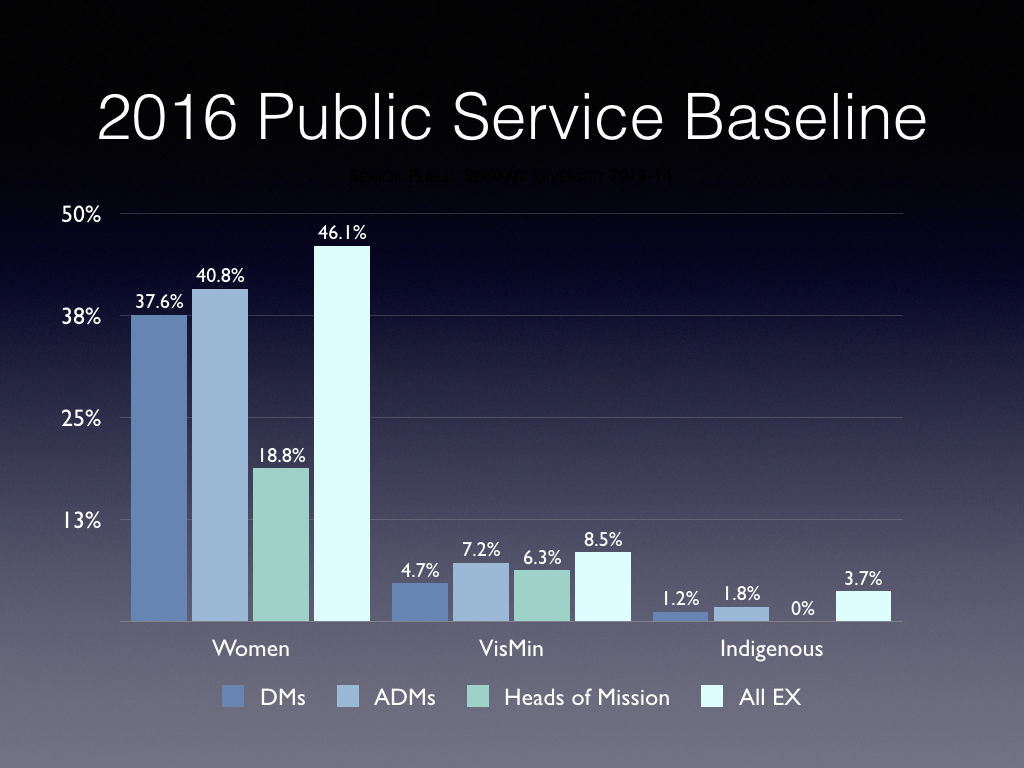
NCCM knows that Canadian public service diversity numbers are reasonably representative of the Canadian population as per the charts and analysis below (for visible minorities, the appropriate benchmark is the number who are also Canadian citizens – 15 percent of the total population). RCMP and municipal police force numbers, however, need improvement:

Federal Employment Equity

Religious Minorities in the Public Public Service

Consider the European Commission’s recent ruling that employers can now force their staff to remove their head scarves at work; it’s no small wonder that Canada sounds like “Disneyland” to minority groups there — this is a place where everyone can freely contribute to the country’s success without having to compromise their personal values or beliefs.

The federal government’s announcement last week that public service applications will be scrubbed of information revealing a person’s race and ethnicity is another noteworthy step. The hope is that such a measure will help reduce proven bias that tends to keep certain groups from accessing the same employment opportunities as everyone else, despite Canada’s Employment Equity Act.

“If you don’t have people represented in the institutions, how will they feel included? Decision making cannot be left to mono-ethnic, mono-linguistic, or mono-religious groups,” said Rita Izsák-Ndiaye, UN special rapporteur on minority issues, during her Ottawa visit. “Young people must see themselves in all state structures. If you don’t see a single policeman from your background, for example, how will you trust the institution?”

The lack of diversity in many of our key public institutions begs the need for more concrete action. Even Silicon Valley — often described as a progressive-haven — is struggling, according to an article in this month’s Atlantic. Companies there are trying all sorts of initiatives, including linking management bonuses to increasing diversity.

The need to address representation gaps are pressing, not only because it makes good business sense, as a new Canadian research study report out this week confirms, but that it reinforces the strength of our social fabric. If Canada is to be a global champion of inclusion it must both spotlight its successes and push harder to address systemic weaknesses by exploring all possible fixes and crafting made-in-Canada solutions.

Source: Inclusion isn’t just a buzz word — and Canada can prove it: Opinion | Toronto Star

Why police now attend my son’s Muslim prayer space at school: Shireen Ahmed

Good account and demystifying:

Lots of Muslim students don’t attend Jummah at my son’s school and sometimes non-Muslim friends peek in. Afterward, everyone heads to the plaza nearby to hang out at Tim Hortons or grab a shawarma.

I never thought these Friday rituals would become a trigger for self-proclaimed secularists and I certainly never expected that Jummah would become a reason to manipulate and terrorize children. I was wrong.

For the past little while, Jummah at various PDSB high schools has been targeted by protesters. They claim that Muslim practices are anti-Semitic, anti-Christian and anti-women, a prejudice they’re sure of though they don’t seem to have had a respectful exchange with a practising Muslim from the Peel district.

They began by arriving en masse at school-board meetings, screaming hateful rhetoric at the families in attendance. Next came anti-Muslim Facebook groups,YouTube videos and pamphlets. Things exploded when the school board decided to let kids write their own sermons instead of reading prewritten ones.

Months of intensifying hate came to a boiling point. A Mississauga imam received a death threat, and Islamophobic graffiti was sprayed on mailboxes near a high school. A Koran was viciously ripped apart at a PDSB meeting, and a $1,000 cash reward was offered for “video proof” of a Muslim youth delivering hateful speech.

To its credit, the PDSB acted swiftly, e-mailing parents with a pledge to take the situation very seriously. Electronic devices were prohibited at Jummah. Two police cruisers parked outside my son’s school every Friday, and officers stood at the back of the gym as more than 300 girls and boys assembled to pray.

I asked my son if the police make him feel safer. “Not really, it’s just protocol,” he said. “I might be able to tell them if something was weird.” He seems unfazed by their presence, which alarms me for a different reason: I don’t want him to think the presence of law enforcement in our racialized community is normal.

I find it both reassuring and troublesome that school-board meetings are now staffed by both plain-clothed and uniformed police, some carrying weapons. Attendees must show government-issued identification. To this, my son says evenly, “They are being careful. That’s their job.”

I asked how he felt after reading hateful messages online: he says he’s angry, yes, but not scared. He admits the amount of blatant Islamophobia in our local area is shocking to him, and I agree. We both thought our richly diverse Peel neighbourhood might be more tolerant.

When I wondered aloud if he’d consider not going to Jummah, he paused for a nanosecond before snorting at my suggestion. “Stop going to Jummah? Seriously? Nah.”

“Mama,” he said, looking me square in the eyes, “if a guy came to our Jummah and started spewing hate and being violent, he would literally have 300 brown and black kids jump at him.”

Safety in numbers, he seemed to be saying, then got up to rush off to a basketball game. I sat alone at the kitchen table, not as comforted as he might have hoped.

Giving khutbahs is a part of the community experience of being Muslim. One does not have to be an imam or a scholar to offer a 15-minute sermon. At my son’s school, the khutbahs are in English, except for very short prayers or Koran verses, and are on topics such as civic duty, patience with family, supporting vulnerable and marginalized people, handling stress and social responsibility.

The supervising teacher has to read through each sermon before it can be delivered, and my son assures me there is nothing “overly political or extreme.” To his knowledge, no one has ever gone rogue.

Preparing to deliver khutbahs teaches young people organization, public speaking and how to mobilize, all important skills for adulthood. A few months ago, a mother of another student at his school reached out to me through Facebook.

She told me her son came home and told her how moved he was by my son’s words on the day’s topic: “respecting mothers and their sacrifices.” I was pleased and a little surprised. That very morning, I was shrieking at him to wake up because he was 25 minutes late, threatening to pour cold water on his sleepy head.

The school Jummah is a crucial space of peer support, one where youth can feel as if their choices and identities are not being attacked or threatened. Youth of colour live in communities that are targets of specific forms of hate, in an age when racists regularly suggest the mass deportation of their communities.

What are young Canadian Muslims supposed to do, other than have faith? Perhaps they already know the answer: gather for Friday congregational prayers, no matter what, and then eat a dozen doughnuts.

Source: Why police now attend my son’s Muslim prayer space at school – The Globe and Mail

Snubbed by Trump, Silicon Valley talent is looking to Canada

The “diversity dividend” to use The Pluralism Project phrase and a major opportunity for Canada.

But it will take a number of years to know whether this is anecdotal or more widespread in impact:

Like many Canadian tech executives, Roy Pereira, CEO and founder of Zoom.ai Inc., struggles to hire and hold on to highly skilled engineers, code writers and seasoned managers. Canadian software engineering grads often head directly to tech hubs like Silicon Valley and San Francisco, or use an entry-level position at the Canadian arms of giants like Google or Facebook as launching pads for U.S. gigs. And who could blame them? The pay is better; the career horizons, wider.

So when Pereira’s small but fast-growing software firm began recruiting for engineers earlier this month, using the usual online channels, he noticed something odd: the number of inquiries from the U.S. and overseas was significantly outpacing those from Canadians. “These were American citizens and sometimes foreign nationals, including a lot of South Asians. They were wanting to come to Toronto.”

He interviewed one woman working for Twitter in Silicon Valley. A member of a visible minority, “she wants to move to Toronto because she doesn’t want to deal with the situation down there,” says the 49-year-old serial entrepreneur, alluding to simmering racial and political tensions, as well as the Bay Area’s soaring living costs. “I’ve never seen that before and I’ve been doing this for a while.”

What’s driving these off-shore inquiries, according to Pereira and other executives in southern Ontario’s tech corridor, are the anti-immigrant signals emanating from Trump administration—not just the notorious travel ban on six Middle Eastern countries, but also uncertainty over potential travel headaches for American residents with family in those regions, stepped-up border scrutiny and, in particular, the fate of specialized H-1B work visas.

Washington issues 85,000 H-1B visas annually through a heavily subscribed lottery, including 20,000 to foreign nationals who obtained graduate degrees from U.S. institutions, many of them engineers and software developers. Trump recently signed an executive order directing federal agencies to review the H-1B program and, presumably, recommend toughening the rules—a change that has significant potential to close off positions for highly skilled professionals from around the world who want to work in the roiling American tech sector. “It’s a top-of-mind issue [for U.S. firms],” says Jeff Loeb, an American who recently jumped to Kitchener, Ont.-based Vidyard as chief marketing officer after 25 years in Boston’s tech industry.

So, amid all the tales about the fraught state of the U.S.-Canada border—north-bound asylum-seekers, cancelled southbound trips by Girl Guides—as well as these potential rule changes, Canadian firms have found themselves in the happy position of transforming all that stateside nationalist/protectionist fervour into a brain gain.

According to a recent Bloomberg report, U.S. universities have seen a decline in applications from Indian students who, sources said, are concerned about visa restrictions and racially motivated attacks, and who increasingly look to countries like Canada, Ireland and New Zealand for higher education and career opportunities. In the past few months, in fact, this unexpected opening has become a point of eager discussion at recruiting and tech-industry conferences, with panelists urging audience members to seize the day. “There’s never been a better time to attract global talent and capital to Canada,” Janet Bannister, a general partner at Real Ventures, a Toronto finance firm, said at one such gathering, alluding specifically to the political situation in the U.S.

At a biotech industry conference last month, Bradly Wouters, a top Toronto University Health Network researcher, observed that “it’s no secret that success in the U.S. has depended on ability to attract talent from around world.” That appeal, he added, is “threatened by the winds of change” and described the moment as “extremely opportunistic” for Canadian companies looking for highly skilled people.

Some tech-industry groups and firms have gone so far as to launch advertising campaigns or open letters aimed at attracting skilled foreign workers. CityLab reported recently that a Vancouver entrepreneur and some counterparts in the San Francisco area have set up a company, True North, that will help foreign nationals find positions in the sprawling tech sector in B.C.’s Lower Mainland. Even Prime Minister Justin Trudeau has gotten in on the act in a guest post on Quora earlier this month, pitching to international students and high-skill workers on Canada’s universities, tech firms and ethnocultural diversity. He offered carrots such as a significantly reduced permit process. “We want to help high-growth companies bring in the talent they need quickly by slashing the processing time for a Canada visa application from six months to just 10 business days,” wrote Trudeau, who didn’t mention Trump by name but slipped in a not-so-veiled dig at the president’s climate change denialism by noting that “our government is committed to evidence-based policy and respecting academic freedom.”

Yet some Canadian tech players say the spike in applications they’re seeing isn’t coming from international engineers so much as the aforementioned Canadian tech graduates who followed their careers to high-paying careers south of the border. “I’ve seen a lot of engineers [from the Universities of Waterloo or Toronto] who went to the U.S. during the 2009-2010 tech boom…who are saying, ‘Hey, we’re thinking of moving back,’” says Derrick Fung, CEO of Drop, a Toronto start-up whose app allows users to earn rewards on top of what their existing card reward programs provide. “We’re attracting people who’ve worked at Facebook and Snapchat.”

Not everyone agrees. Derek Ting, the 29-year-old founder TextNow, a cloud-based, low-cost mobile phone service based in Waterloo, Ont., and with an office in San Francisco, says highly skilled younger people will continue to follow their careers and seek out firms that have a strong culture and a sense of mission, regardless of the ambient political mood.

But Mike Silagadze, founder of the Toronto education software start-up Top Hat, predicts the combination of the high-tension politics, travel headaches and ramped-up protectionism in the U.S. will prompt more of Canada’s young engineers and researchers to pursue careers here. Noting that 80 per cent of Waterloo’s engineering grads go south, he mentions Canadian-born tech superstars such as Stewart Butterfield, who founded Flickr and now runs Slack, or Tesla founder Elon Musk, a South African immigrant who moved to Canada and studied at Queen’s University. “Imagine Elon Musk staying in Canada and starting Tesla here,” muses Silagadze. “That’s transformational.”

Source: Snubbed by Trump, Silicon Valley talent is looking to Canada – Macleans.ca

Should France Have Its Own Version of Islam? – The Atlantic

Interesting in depth interview – worth reading:

With France’s first round of voting complete, far-right candidate Marine Le Pen is among the final two contenders for the presidency, along with centrist Emmanuel Macron. Given how often Le Pen invoked the specter of Islamic fundamentalism throughout her campaign, one might expect French Muslims to be worried about the potential for her to win the May 7 runoff.

But Tareq Oubrou, the popular imam of Bordeaux’s Grand Mosque and a prominent theologian, told me he is not concerned. Nor does he blame those elements in French society that harbor fears of Islam. The morning after the results were announced, he spoke about “legitimate fears” among the French, and seemed to put the burden on Muslims to make Islam more compatible with France and its strong flavor of state secularism, known as laïcité.

Oubrou, who was born in Morocco, is a leading advocate of progressive Islam. Beloved among France’s political elite, he preaches in French as well as in Arabic, critiques the veil or headscarf, insists that Islam is compatible with French ideals at the deepest level, and shrugs off the death threats he gets from radicals.

“It’s religion’s job to institute reform and to respect the laws of the republic,” Oubrou told me, before going on to explain how he and other imams are working to create a new French Islam. This reformed religion, complete with what he calls a “preventive theology,” is meant to be, if not terrorist-proof, at least resistant to being coopted by fundamentalists. Our conversation, which I translated from the French, has been lightly edited for clarity and length.

…

Samuel: In your opinion, what should France’s Muslim leaders be doing to fight radicalization?
Oubrou: We need to pay attention to the training of imams. The terrorist acts have been a shock for imams, and they are starting to take this very seriously. There’s already an intense crisis of conscience: We can’t let our children keep getting seduced online and elsewhere, we have to make an effort to prevent radicalization. Many imams are trying to better explain the Islamic texts that the terrorists use to recruit youth. They’re mobilizing to respond to these interpretations. There’s a theological response underway.
Samuel: Do you think most French people know that imams are fighting this way?
Oubrou: They have no idea. Because there’s no information. Mass media only covers things that aren’t working. And we all know how politicians exploit and aggravate problems so they can propose the solution.Samuel: How are you personally working to make Islam more compatible with the secular values of France?

Oubrou: I myself am working on [an intellectual framework that I call] “the sharia of the minority”—how to adapt Islam, theologically speaking. Muslim theology in France must do the work of acculturating Islam, adapting it to French culture. It’s possible to simplify Islam and preserve what’s important to the Muslim tradition and respect French law and culture. There are a number of Muslims working on a theology of adaptation, to adapt Islam to the West in general and to France in particular.

I am also working on a “preventive theology”—how to elaborate a religious discourse that won’t lend itself to terrorism or fundamentalism.

Samuel: Would it be fair to call your project a reformation?

Oubrou: Yes, it’s a reformation. But it’s always been like this: Every time Islam found itself in a new historical context, it adapted. All religions adapt. Why not Islam?

We need to take into consideration how long it takes to integrate, though. It doesn’t happen in an instant. Islam is a religion that has only relatively recently established itself in France. Simply adapting the theology won’t make people adapt—you need time, too.

Source: Should France Have Its Own Version of Islam? – The Atlantic

In New Orleans, Monument to White Terrorism Finally Falls – The Daily Beast

Interesting account of a part of American history:

Since 1891 a monument celebrating white terrorism has proudly stood in the heart of New Orleans, yet this week the city of New Orleans finally removed the Battle of Liberty Place monument. The monument celebrates an attempt by the white supremacist terrorist group the White League to overthrow the government during Reconstruction, and return the city to being ruled by white oppression. Some residents of the city decried its removal and parroted the ludicrous “History Not Hate” rhetoric, and this only serves as a continuation of the pro-Confederacy propaganda movement the South has waged since the end of Reconstruction. As a society, we can no longer tolerate succumbing to this toxicity.

On Sept. 14, 1874, the White League stormed the New Orleans police station in an attempted coup d’état to remove the governor of New Orleans, Republican William Kellogg, and replace him with John McEnery, who had been his unsuccessful Democratic challenger in the 1872 election. The White League defeated the city’s integrated police department, and took control of the city for a couple of days before President Ulysses S. Grant sent down federal troops to reclaim the city. The White League quickly surrendered the city upon the arrival of federal troops, and the Battle of Liberty Place monument exists to remember the 100 White League members who died in the battle. That is to say, it exists to celebrate those who died in a failed coup with the explicit purpose of returning Louisiana to a white dominated society.

The White League, formed in 1874, was one of the last white terrorist groups that sprang up during Reconstruction. The Ku Klux Klan started in 1865 upon the completion of the war. The White League was founded by Christopher Columbus Nash, a former Confederate soldier who was a prisoner of war during the Civil War. On April 13, 1873, Nash led a white militia in the Colfax Massacre that killed approximately 150 freed blacks. The massacre erupted following white fury at the election of Kellogg to the governorship in 1872. This battle is one of the single biggest massacres of Reconstruction. Soon thereafter Nash formed the White League.

“Having solely in view the maintenance of our hereditary civilization and Christianity menaced by a stupid Africanization, we appeal to men of our race, of whatever language or nationality, to unite with us against that supreme danger,” read the platform of the White League.

Despite their clear racist and terroristic foundations, they represented a more palatable form of terror than the KKK. The White League was more mainstream than the KKK. This brand of terror had become normalized over the previous decade. The White League openly collaborated with the KKK, Southern Democratic politicians, and white business owners who facilitated the Redeemers movement to terrorize freed blacks and Union sympathizers to swing elections in favor of the Democratic Party.

President Grant was so alarmed by the threat to democracy that the White League posed that he wrote about them in his 1874 State of the Union Address: “White Leagues and other societies were formed; large quantities of arms and ammunition were imported and distributed to these organizations; military drills, with menacing demonstrations, were held, and with all these murders enough were committed to spread terror among those whose political action was to be suppressed, if possible, by these intolerant and criminal proceedings.”

In New Orleans, a monument to Robert E. Lee was completed in 1884, and the Battle of Liberty Place monument arrived in 1891. In the early 1900s, Confederate President Jefferson Davis received a monument in 1911, and soon thereafter the “Little Napoleon” P.G.T. Beauregard’s monument was completed in 1915. For over a century New Orleans celebrated and normalized “intolerant and criminal” white supremacy and the erosion of our democratic fabric, yet now all four of these monuments are slated for removal.

In 1932, a plaque was added at the foot of the statue describing that the purpose of the battle was for the “overthrow of carpetbag government, ousting the usurpers” and that “the national election of November 1876 [that ended Reconstruction] recognized white supremacy in the South and gave us our state.”

Since the fall of Reconstruction as before, American society has largely chosen to turn a blind eye toward the reimagining of American history along a skewed, and seemingly polite, white oppressive narrative. We hear people utter absurd statements like, “Slaves and slave-owners got along peacefully before the Civil War.” A defender of the Battle of Liberty Place monument even claimed that his ancestor who died in the battle wasn’t a racist because he did not own slaves.

And all this isn’t as ancient as you might think. The Southern Mount Rushmore in Stone Mountain, Georgia, that depicts Robert E. Lee, Jefferson Davis, and Stonewall Jackson was completed not in 1912 or 1922, but in 1972—at the location of the founding of the second iteration of the Ku Klux Klan in 1915. The Daughters of the Confederacy had been dreaming about this monument since roughly 1912, and construction on the stone carving had been started in 1923, but largely remained unfinished for decades. Then, the Civil Rights movement of the 1960s facilitated a renewed interest in repainting Georgia’s skyline in the image of Confederate heroes. And now all of America can visit this Southern Mount Rushmore, conveniently located at 1000 Robert E. Lee Blvd.

Throughout the late 1800s and 1900s buildings, roads, schools, parks, and more have been named after treasonous Confederates to palatably normalize their terror. Children have been named after Confederate leaders, and even today I’ve had people ask me if Attorney General Jefferson Beauregard Sessions III might have been named after Jefferson Davis. Considering that Jeff Sessions Sr. was born in 1860 at the cusp of the Civil War, and the reverence the South still holds for the Confederacy, this question may not be farfetched. And we may need to ask if he was also named after the “Little Napoleon” Beauregard too.

The pervasiveness of Southern oppression can creep into any aspect of American life, and historically, any form of tolerance for white racial oppression has facilitated the further spreading of white terror and a distorted, whitewashed retelling of American history. New Orleans’ decision to remove these monuments and celebrate the rich diversity that has always existed in the city is a step in the right direction. Hopefully, more municipalities will follow suit and free our society from the shackles of America’s pro-Confederate propaganda.

Source: In New Orleans, Monument to White Terrorism Finally Falls – The Daily Beast

Black students hindered by academic streaming, suspensions: Report

The data is convincing. But the interpretation may miss broader socio-economic factors that also contribute to the gap:

Black children in the GTA may start kindergarten feeling confident and excited to learn, but too many are “gradually worn down” by schools that stream them into applied courses and suspend them at much higher rates than other students, says a new report from York University.

The report found that while academic streaming was supposed to have ended in 1999, black students are twice as likely to be enrolled in applied instead of academic courses compared to their counterparts from other racial backgrounds. And they are more than twice as likely to have been suspended from school at least once during high school.

“Black students face an achievement and opportunity gap in GTA schools,” says the study led by York University professor Carl James.

“All evidence point(s) to the need for action if the decades-old problem is to be addressed.”

The findings were based on data from the Toronto District School Board — the only board to regularly collect race-based statistics, though a similar move is underway at the Peel District School Board. Consultations with 324 black parents, community members, educators, school trustees and students indicated “the same patterns exist in other GTA school boards,” said James.

Because much of the information in the 80-page report was produced by the TDSB’s research department, it comes as no surprise to director of education John Malloy.

“We aren’t running away from what the data is telling us, we’re willing to face it,” he said in an interview.

He said the board’s new equity framework plan launched last fall involves a sweeping review of everything from board policies to personal attitudes among staff and the barriers students of different backgrounds face when it comes to accessing programs and courses.

Streaming, which places students in academic or university-bound courses instead of the more hands-on applied courses based on perceived ability, is a key piece, he said.

The practice has been found to hit low-income kids and certain racial groups such as black students hardest.

Several high schools in Toronto have already launched pilot projects to end streaming in some Grade 9 and 10 courses, so that students aren’t making decisions so early that will affect their futures. And two years ago, a TDSB report called for streaming to be phased out and undertook to expand the pilots. But there are currently only about five in place.

“I think we are beginning to get a groundswell of support,” says Monday Gala, principal of C.W. Jefferys Collegiate, which was the first to begin a destreaming initiative and no longer offers applied options in Grade 9 geography, English, science or French or Grade 10 history, English and science.

But across the system, it’s one change “I wish would move faster,” added Gala. The school provides extra tutoring and lunchtime and after-school support and has seen pass rates increase across the board.

A similar result took place at Runnymede Collegiate, which this year offered only academic English to Grade 9 students and is hoping to add geography next year, said principal Paul Edwards.

Eliminating streaming is one of the many recommendations in the new York University report, which also calls for mandatory collection of race-based data by all school boards to illuminate barriers; use of alternative discipline measures, steps to diversify the teaching workforce, and ministry and board policies to address anti-black racism.

Among its other findings:

  • Between 2006 and 2011 — the latest period for which TDSB data is available — only 53 per cent of black students were in an academic stream program versus 81 per cent of white students and 80 per cent of other racial groups.
  • Forty-two per cent of black students had been suspended at least once during high school compared with 18 per cent of white students and 15 per cent of other racial groups. It also cited more recent stats showing almost half the 213 students expelled in the five-year period ending in 2015-16 were black.
  • Sixty-nine per cent of black students graduated between 2006 and 2011 versus 87 per cent of other non-white students and 84 per cent of white students. Twenty per cent — twice as many as the other groups — dropped out.
  • Fifty-eight per cent of black kids did not apply to post-secondary school versus 41 per cent in the other two groups.

Source: Black students hindered by academic streaming, suspensions: Report | Toronto Star

Liberals repeal Conservative immigrant residency requirement targeting marriage fraud

Balance of risks but tend to share Dench’s view that marriage fraud was blown out of proportion, reflecting a few high profile cases:

The Liberal government is repealing a measure brought in by the Conservatives that required newcomers to live with their sponsoring spouse for two years or face deportation.

The conditional permanent residency status policy, which kicked in October 2012, was designed to clamp down on marriage fraud. But immigrant advocates said it had the effect of trapping some people in violent, abusive relationships.

Scrapping the two-year probation for permanent residency checks off another 2015 Liberal campaign promise, which the government signalled it would pursue last fall.

According to the Privy Council Office website, the cabinet decision was formally taken April 13 and will be published on May 3 in the Canada Gazette, the government’s official newsletter.

A formal government announcement on the change is expected Friday.

Under the Conservative policy, sponsored spouses and partners were given a status of “conditional” permanent residence, and were required to cohabit and remain in a conjugal relationship with their sponsor for two years. If they didn’t, their status could be revoked, leading to deportation.

At the time, former immigration minister Jason Kenney said the change targeted con artists who dupe Canadians into marriage then dump them once they get to Canada. The measure was also designed to deal with “marriages of convenience,” where two persons pretend to be in love for one to gain entry to Canada, often in exchange for money.

Exemptions for abuse

The probation policy allowed for exemptions when there was abuse or neglect by the sponsor, but Janet Dench of the Canadian Council for Refugees said many people didn’t understand the process. They remained trapped in violent relationships, while others who applied for an exception found the ordeal excruciating.

“They often end up getting the exception, but it’s a very difficult process, retraumatizing people who are already broken down by the panic of correspondence and interviews and having to go through everything that they suffered,” she told CBC News.

Dench said reports of fraudulent marriage have been blown out of proportion, and noted there are already provisions in the Immigration and Refugee Protection Act to crack down on people who misrepresent themselves or make false claims.

But Conservative immigration critic Michelle Rempel said the 2012 policy was brought in to address a real problem of marriage fraud, and called the Liberal move to repeal it a “giant step backward.”

“I think it’s the wrong approach,” she said. “I think it erodes public confidence in the integrity of the immigration system and it puts vulnerable persons at greater risk.”

Source: Liberals repeal Conservative immigrant residency requirement targeting marriage fraud – Politics – CBC News