Barbadan distress at investment citizenship • Caribbean Life

A sensible voice in the region on the risks of citizenship-by-investment programs. Note the link to the criminal marketplace, AlphaBay and its founder, Alexandre Cazes:

The recent arrival in Barbados of two persons who exercised their CARICOM rights to a prolonged stay on the island, obtained through a member state’s Citizenship by Investment programme has Prime Minister Freundel Stuart uneasy.

The Barbadian leader has reported that the persons, who are nationals of non-Caribbean countries took advantage of a Citizenship by Investment programme offered in a CARICOM member country to obtain passports of that territory and exercised their right to remain in Barbados for least six months without question as guaranteed under the CARICOM Freedom of Movement convention.

Stuart over the last weekend spoke of the powerless position that local immigration authority found itself in when the two opted to remain on the island after the United States Embassy in Barbados, that covers the entire Eastern Caribbean, refused their applications for visas to travel to the United States.

“The American Embassy turned down the applications for the visas, but the persons involved said ‘we are not going back to where we came from, we have a right to six months stay in Barbados and we want to stay here under our six months stay under the Freedom of Movement regime,’” Stuart said.

Stuart said that the distress brought upon Barbados because of the uncertainty of motive these two CARICOM ‘nationals’ who are not welcomed in the United States is precisely what he has been fighting against when in the past he objected to the citizenship based on investment programmes offered by sister territories.

“I have fought them [heads of governments] at CARICOM over those programmes … because I say to them, when you grant these people citizenship of your country and Barbados is not a part of the transaction, those people become CARICOM citizens and have, based on our Freedom of Movement arrangements, the right to come into Barbados when they like and how they like although we don’t know them,” he said.

“In some cases the persons who are granted citizenship do not have to even come to the country in order to get citizenship or to be able to get a passport,” Stuart noted.

The Barbados prime minister’s outcry Sunday was purely on security grounds because he said he was not unsympathetic to the economic needs of CARICOM nations.

“That is what is going on in the Caribbean because all the countries of the Caribbean are under pressure,” he said, adding, “those programmes keep them [the CARICOM territories] going and allow them to pay their bills from day to day.”

“I have sat as head of government of Barbados at many regional CARICOM meetings and heard their leaders say that if they were not selling their citizenship, if they were not selling passports their countries would be basket cases.”

Stuart refrained from naming the original country of those two persons who received citizenship within CARICOM for money but hinted that, “you have to catch about six or seven different airplanes to get to where they came from.”

Stuart’s revelation of his country’s unease with the legal presence of two suspect persons comes against the backdrop of reports out of Antigua of a now deceased 25-year-old man who obtained Antiguan and Barbudan citizenship in February 2017 being alleged to have masterminded the largest criminal marketplace on the Internet, AlphaBay.

The Antigua Observed newspaper a week ago reported that, “Alexandre Cazes, who with his wife obtained citizenship through the Citizenship by Investment Programme (CIP), allegedly ran the dark website which the US Department of Justice (DOJ) said was used to sell deadly illegal drugs, stolen and fraudulent identification documents and access devices, counterfeit goods, malware and other computer hacking tools, firearms, and toxic chemicals throughout the world.”

“US Attorney General Jeff Sessions hailed the move to shut AlphaBay as the largest darknet shut down in history, and the DOJ is now turning part of its attention to seizing Cazes’ property, including Villa 302 at Nonsuch Bay Condominiums in St. Phillip’s South, Antigua which he purchased under the CIP,” the Observer also stated.

Source: Bajan distress at investment citizenship • Caribbean Life

Malaysia: Group decries govt’s move to ban book promoting ‘moderate’ Islam

Discouraging trend, as in Indonesia:

A PRO-MODERATION group comprising eminent ethnic Malays has questioned the Malaysian government’s move to ban a book it published on “moderate” Islam amid concerns of rising Islamic fundamentalism in the country.

The Home Ministry banned the book authored by the group of predominantly former senior civil servants, who call themselves G25, for being “prejudicial to public order”, reported Malay Mail Online on Thursday.

A notice on the Federal Gazette, dated July 27, listed the prohibition of the book, titled Breaking the Silence: Voices of a Moderation Islam in a Constitutional Democracy under the Printing Presses and Publications (Control of Undesirable Publications) (No 12) Order 2017.

The group’s spokesman Datuk Noor Farida Ariffin said she was shocked by the ban, given the government’s long-standing drive to promote the wassatiyyah (moderation) concept espoused in Islam.

“This is obviously an action intended to suppress free speech. The articles in the book were written by respected academics, lawyers and social activists,” she told Asian Correspondent when contacted.

“They are intellectual articles mainly discussing the place of Islam in the Federal Constitution. None of the articles have criticised Islam or touched on matters of Aqidah ( faith ).”

G25

The G25 group says it will appeal the government’s ban on the book it published. Source: Amazon

Noor Farida, a prominent former judge and diplomat, also suggested the questionable timing of the ban as the book was released back in December 2015.

“This does not make sense as in the nearly two years that the book has been on the market, we have not heard of any of the readers causing public disorder or a public nuisance as a result of reading the book!”

The government, she said, should instead favour the book due to its “moderate” stance. Malaysia promotes an image of moderate Islam internationally, despite the increasing implementation of Syariah law across the country.

The government gazette’s notice stated the printing, importation, production, publishing, sale, issue, circulation, distribution, or possession of the publication is “likely to be prejudicial to public interest”, which led to the nationwide ban.

Noor Farida said the G25 group would seek an explanation from the ministry and appeal the ban.

“We are still discussing this among our group members, but we will appeal and ask the Home Ministry to point out to us what the offending passages prejudicial to public order are,” she was quoted by The Star as saying.

Civil society groups such as the G25 have recently expressed alarm over the northeastern state of Kelantan’s move to amend its religious Islamic laws to allow public caning against “criminals” who breach its strict Syariah code.

At the end of this month, Malaysia’s lower house of Parliament is expected to debate a Bill to amend Act 355 of the Syariah Courts (Criminal Jurisdiction) Act 1965, also known as the controversial RUU355.

The Bill – commonly known as Hadi’s Bill after the man who proposed it – would increase the Syariah punishment caps in Malaysia to a maximum 30 years’ imprisonment, RM100,000 (US$22,400) fine and 100 lashes of the cane – far harsher sentences than those currently implemented under the civil system.

Noor Farida said the G25 promotes moderation and peace and harmony among our people of various faiths and ethnicities.

“We believe in promoting respect for the beliefs of others. And we firmly believe in upholding our secular Federal Constitution against any attempts by religious bigots to turn Malaysia into an Islamic state.”

Australia – Citizenship crisis: MP Julia Banks denies being a Greek citizen amid speculation over her heritage

Given the numbers involved, appears that a review of the current policy may be warranted:

The fallout over MPs’ citizenship rights in foreign countries has widened to engulf more than 20 federal politicians, placing Prime Minister Malcolm Turnbull’s majority government under threat.

Investigations are today underway to determine whether Victorian Liberal MP Julia Banks holds Greek citizenship [later confirmed that she is not – see Banks isn’t Greek, Liberals avoid crisis).

The liberal backbencher was born in Melbourne to parents of Greek heritage.

But she said she has never taken up Greek citizenship, as speculation swirls around her heritage status.

Ms Banks is added to a list of twenty-one other members of the House of Representatives who have spoken of their migrant bloodlines – many during their maiden speeches – The Australian reported.

They include frontbenchers from both the Coalition and Labor such as Deputy Prime Minister Barnaby Joyce, Trade Minister Steven Ciobo, Liberal MP Julia Banks, deputy Labor leader Tanya Pilbersek and Labor MP Steve Georganas.

The resignation from the cabinet of Nationals senator Matt Canavan, after it was revealed he had gained Italian citizenship without being born in, or visiting the country, has shown how vulnerable MPs who could be entitled to foreign citizenship are.

Now MPs such as Joyce, whose father was born in New Zealand and Ms Banks, whose father was born in Greece, face scrutiny over their family heritage.

With speculation over Ms Banks’ Greek heritage, the federal government is bracing for wider political ramifications.

The Coalition holds a one-seat majority in the House of Representatives which bans anyone who is a “citizen or entitled to the rights or privileges of a subject or a citizen of a foreign power”.

The High Court could be asked to determine if Ms Banks’ entitlement to Greek citizenship makes her ineligible, and to rule on whether she should have renounced any citizenship entitlements before nominating.

A disqualification of a member in the lower house would likely lead to a by-election and put a big cloud over the future of the government.

Last night, One Nation Senator Malcolm Roberts became the latest federal politician to become embroiled in the citizenship furore.

He said he did not receive confirmation he had renounced British citizenship until months after the federal election, but is confident of surviving any challenge to his eligibility.

Senator Roberts said he wrote to British officials on May 1 last year asking if he was a UK citizen, given he was born to a Welsh father in India.

He had no reason to believe he was British, but thought it best to double-check while filling out a nomination form for the Senate.

Five weeks later he hadn’t received a response, so wrote again on June 6 – three days before nominations closed – saying that if he had British citizenship, he fully renounced it.

“I’ve taken all steps that I reasonably believe necessary,” Senator Roberts told Sky News.

Source: Citizenship crisis: MP Julia Banks denies being a Greek citizen amid speculation over her heritage

Years after two ships brought 568 migrants to Canada, seven acquittals and one conviction

After all the public outcry – understandable given public concerns about queue jumping but pumped up by then CIC Minister Kenney – only one conviction, although the prosecuting the case may have acted as a deterrent for other ships:

The first vessel — undersized and not built for ocean voyages — laboured toward the B.C. coast in October 2009 with 76 Tamil asylum-seekers onboard.

Then in August 2010, a larger ship — but with the same questionable seaworthiness — was intercepted off the coast with 492 Tamil migrants.

The Ocean Lady and Sun Sea passengers all claimed they were fleeing the ravages of civil war in Sri Lanka. But the Conservative government at the time took an aggressive stance — detaining and building cases against many of the asylum-seekers — as part of a campaign to deter future “irregular arrivals.” A handful of passengers from each ship were also charged with being part of criminal human-smuggling operations.

However, on Thursday, four accused from the Ocean Lady were found not guilty, bringing to seven the total number of acquittals. There has been only one conviction.

“The government has spent years and huge amounts of money to fight the passengers of the Ocean Lady and the Sun Sea — in the courts, in the refugee hearing processes, detaining them as long as they could. All for what?” said Janet Dench, executive director of the Canadian Council for Refugees.

“The charges of criminality and security risks have been shown to be without foundation. … At least we can take pride in the fact that Canadian institutions and courts continue to treat people fairly.”

In the Ocean Lady case, the Crown had tried to argue that Francis Anthonimuthu Appulonappa, Hamalraj Handasamy, Jeyachandran Kanagarajah and Vignarajah Thevarajah played significant roles during the voyage — captain, engine room worker, chief engineer and transportation provider — and thus helped to organize, aid or abet a smuggling enterprise.

But in a decision released Thursday, B.C. Supreme Court Justice Arne Silverman said while there was evidence of organized criminal activity, the Crown had failed to prove beyond a reasonable doubt that the activities of the four men were connected to it or helped to further it.

“There is circumstantial evidence from which it can be argued that common sense dictates that this vessel and voyage could not have been mounted without the assistance of persons involved in organized crime,” Silverman said. “However, there is little evidence of a connection or a furthering ‘through acts’ of the four accused.”

The Supreme Court of Canada helped pave the way for Thursday’s outcome when it found in 2015 that Canada’s human-smuggling laws should not extend to people who are simply assisting family members or providing humanitarian or mutual aid to refugees.

In Thursday’s ruling, Silverman said: “I am satisfied that all of the conduct performed by the four accused was performed in pursuit of that mutual goal and amounts solely to mutual aid.”

All four men smiled, laughed and shook hands in court after the decision came down, The Canadian Press reported.

Mark Jette, a lawyer for one of the accused, said the courts have sent an important message.

“If you’re an internationally active people smuggler or trafficker who’s engaged in this for profit, you’re going to be prosecuted. If you get on a boat and assist yourself and others to get across safely, you’re not a criminal.”

While Thursday’s ruling does not mean the four accused’s refugee claims will automatically be accepted, it does give them a “fighting chance,” he added.

Speaking outside court, Kanagarajah described how he and the other migrants were convinced partway through the ocean journey that they would not survive.

“Most of the refugees believed that we were going to die, because there were so many storms, and the sea was very rough,” he said. “Fortunately we are here today.”

Kanagarajah said he still wants to become a Canadian citizen and plans to go to college to study business.

Earlier this year, three of four men accused of human smuggling in the Sun Sea case — Lesly Emmanuel, Nadarajah Mahendran and Thampeernayagam Rajaratnam — were similarly acquitted by a jury. The jury, however, could not reach a decision regarding a fourth man, Kunarobinson Christhurajah.

Following a retrial, Christhurajah was found guilty in May.

According to the most recent figures available from the Immigration and Refugee Board, eight men from the Ocean Lady were deemed inadmissible and received deportation orders, 36 refugees claims were accepted, and 21 claims were rejected.

In the Sun Sea cases, 22 were ordered deported after being found inadmissible, 230 refugee claims were accepted and 107 claims were rejected.

Source: Years after two ships brought 568 migrants to Canada, seven acquittals and one conviction | National Post

Australia: Immigration as a Security Threat – The New York Times

Waleed Ali on the increasing shift in Australia:

But the idea of a home affairs minister focused on national security makes sense only if we assume immigration is entirely a security problem. This points to the true ideological import of this newly formed department.

Australia began this century with a Department for Immigration and Multicultural Affairs. Back then, the department’s slogan was “Enriching Australia through Migration.” Just over a decade ago it dropped the multiculturalism portfolio entirely, creating instead a Department of Immigration and Citizenship. Now it’s to be rolled into a national security department. Thus, we can chart Australia’s public conception of migration from being a celebrated aspect of its multicultural character to a civic idea whose highest ultimate expression is citizenship to a threat to be managed.

That certainly chimes with Australia’s established rhetoric on asylum seekers, which has dominated public expression of our immigration program. And it might suit the increasingly nationalist belligerence of our age. But it does not suit Mr. Turnbull, a man who until recently was fond of celebrating Australia as “the most successful multicultural society in the world”; a man who only a few weeks ago was declaring that his party was established to be liberal, in contradistinction to conservative.

When the story of the Turnbull government is written, he will have been the prime minister who finally debased immigration in the Australian political imagination. The image last week of the prime minister draped awkwardly in military power will surely accompany that chapter. And those gas masks won’t look much like liberalism. Most likely they won’t look much like success either.

Australian woman’s death reveals the human toll of a police shooting: Kevin Cokley

Good analysis of how both sides tend to exploit the shooting to further their positions:

The shooting of Justine Damond provides low-hanging fruit for debates about racial bias in police shootings. One cynical writer observed that Ms. Damond’s death presents a dilemma among white people, in that they have to decide whether the “blue life” of black Mr. Noor matters more than the white life of Justine Damond. Intentionally polemical, this train of thought maintains that blue lives matter only when police kill unarmed black people, that white people do not get upset over the deaths of innocent black women and men, and that white people will often try to justify why a black individual was shot but never do this in the case of a white victim.

Others will argue that the fact a white woman was killed illustrates there is no systematic racial bias among police officers. They will say that the colour of Ms. Damond’s skin had no bearing on Mr. Noor’s reaction, and that police do the best job that they can given the stressful job they have. Still others will focus on the fact that Mr. Noor was black and a Muslim, and use this to perpetuate racist, anti-Muslim and anti-immigrant rhetoric. Fox News has been especially interested in the nationality of Mr. Noor, with over half of their segments on the story mentioning his Somali background. Juxtapose Fox News coverage with CNN mentioning his Somali background only twice (after prompting) and MSNBC not mentioning it at all.

To be clear, the shooting death of Ms. Damond is ostensibly not about race. It appears to be a very unfortunate set of events where a skittish police officer was startled and used deadly force on an individual he did not see. Mr. Noor was, by all accounts, a soft-spoken and humble man who left a better-paying job to serve his community and bridge the divide between the police, African Americans and the immigrant community. He had taken several training courses and passed all of his gun qualifications. Justine Damond was a beloved individual who worked as a spiritual healer, led meditation workshops and was characterized as being passionate and “the most loving woman.”

Yet, unsurprisingly, in a country stained by racism and constant media coverage of excessive police force against black people, what should be the inconsequential fact of the racial and cultural backgrounds of Justine Damond and Mohamed Noor has now been made consequential by the likes of Fox News and other conservative outlets. Some of these outlets have tried to politicize the shooting by using the race of Ms. Damond and Mr. Noor to further criticize the Black Lives Matter movement, claiming that Black Lives Matter activists have not been as outspoken about the death of a white woman as they have been about the deaths of black people.

This has proven to be blatantly false, as Black Lives Matter activists were involved in organizing and protesting shortly after reporting of the shooting. One Black Lives Matter activist indicated that it was important to respond because the issue has never really been about race, but about police accountability.

Former Republican congresswoman Michele Bachmann added her own racially inflammatory commentary when she talked about the growing Somali population in Minnesota and characterized Mr. Noor as an “affirmative-action hire by the hijab-wearing mayor of Minneapolis” killing a “beautiful, 40-year-old Australian woman” for potentially cultural reasons. Ms. Bachmann’s shameful response underscores the current climate in the United States, where the election of Donald Trump has resulted in the open expression of prejudice and a coarsening of public discourse.

Perhaps the saddest commentary is that instead of focusing on the shooting for what it really is – a police officer’s error that resulted in the tragic loss of life – some have chosen to instead score political points and make this about race and religion. This shooting was not about race. This shooting was not about religion. The fact that this even needs to be said says more about the climate of racial tensions and Islamophobia in the United States than it does about the tragic events involving Mr. Noor and Justine Damond.

Source: Australian woman’s death reveals the human toll of a police shooting – The Globe and Mail

Muslims In The U.S. Face Increased Discrimination, PEW Report Says : NPR

Interesting interview regarding some of the latest findings on American Muslims:

A newly-released poll from the Pew Research Center finds Muslims in the U.S. are facing increased discrimination but are optimistic about being both Muslim and American.

KELLY MCEVERS, HOST:

There are an estimated 3.3 million Muslims in the United States, and that number is growing. Today the Pew Research Center released a wide-ranging poll on Muslims in America. And while almost half the Muslims surveyed reported incidents of verbal or physical abuse in the past 12 months, many still say they are optimistic about their future and about this country. To talk about this, we’re joined now by NPR’s Leila Fadel. You might remember her from her time as NPR’s Cairo correspondent. Now she has taken on a new job covering culture, race and diversity here in the U.S. She is with us from her new base in Las Vegas. Hi there.

LEILA FADEL, BYLINE: Hi.

MCEVERS: So what were the most striking findings in this poll of Muslim-Americans?

FADEL: Well, this is the third Pew poll on Muslims in America in 10 years. And I think the first thing that’s so noticeable is the incredible diversity of Muslim communities in this country. Often Muslims are spoken about as a monolith when, in fact, this is a population that’s really a diverse mosaic. There’s no one ethnic group that dominates the population. It’s African-American. It’s white. It’s Asian. It’s Arab. It’s Latino. And list goes on. And it’s really young. The majority of Muslims in America are under 40.

MCEVERS: And what about that finding that I mentioned in the introduction that Muslims are feeling optimistic?

FADEL: Yeah, it’s interesting. Despite this feeling that they’re not accepted as part of the mainstream, that the president is unfriendly toward Muslims and that discrimination is going up, 7 in 10 respondents really believe in the American dream still, that if you work hard, you can get ahead. And the overwhelming majority are proud to be both American and Muslim. This is what Besheer Mohamed, lead author of the report, had to say.

BESHEER MOHAMED: There’s a thread throughout the survey of this tension that our Muslim respondents tell us about where on the one hand, they’re uncertain about their acceptance by the larger society. But on the other hand, they’re committed to an American identity. And I think this finding that 9 in 10 say they’re proud to be American is sort of a perfect example of that commitment.

MCEVERS: Who did the poll survey?

FADEL: So the poll was conducted on a sample size of about a thousand Muslim adults living in the U.S. And really there’s not that much data out there on Muslims in the U.S. Muslims are a group of people in America that are often spoken about and scrutinized, but there’s very little data, including how many there are because being Muslim is not something you check on the census form.

MCEVERS: You’ve been traveling and visiting a lot of different Muslim communities across the U.S. Does this poll reflect what you’ve been seeing?

FADEL: Well, yeah. I visited communities in Texas and California as well as cities like Chicago and New York and spoke to Muslims in all parts of the country. And it’s funny because in the poll, it seems that women are more worried about discrimination. They’re more worried about their place in society. And I really felt that same way in doing interviews across the country. And I think that’s really because when a woman decides to put a scarf on her head and cover her hair, she suddenly becomes unmistakably Muslim and de facto ambassador of the faith and a de facto target for the faith.

So, you know, I met people like a young girl in California who’s being bullied at school. And she decided to put on the scarf because her mom does, and she loves her mom and admires her mom. And she found at school that suddenly kids were whispering behind her back allahu akbar, pinning things to her backpack. And the teacher was handing out articles about stonings in Afghanistan as an example of her faith. And this is what she was having to deal with and answer for in her faith at just 14 years old while her sister, who doesn’t cover her hair, didn’t have to deal with any of that.

Source: Muslims In The U.S. Face Increased Discrimination, PEW Report Says : NPR

People Suffer at Work When They Can’t Discuss the Racial Bias They Face Outside of It

Interesting HBR-published study on the racial bias link between the outside and work environments by Sylvia Ann Hewlett, Melinda Marshall and Trudy Bourgeois:

Last month, in an unprecedented show of solidarity, 150 CEOs from the world’s leading companies banded together to advance diversity and inclusion in the workplace and, through an online platform, shared best practices for doing so. To drive home the urgency, the coalition’s website, CEOAction.com, directs visitors to research showing that diverse teams and inclusive leaders unleash innovation, eradicate groupthink, and spur market growth. But as Tim Ryan, U.S. Chair and senior partner at PwC and one of the organizers of the coalition, explains, what galvanized the group was widespread recognition that “we are living in a world of complex divisions and tensions that can have a significant impact on our work environment” — and they need to be openly addressed.

At the Center for Talent Innovation, we wanted to look into these suspicions. Do the political, racial, and social experiences that divide us outside of work undermine our contributions on the job? Our nationwide survey of 3,570 white-collar professionals(374 black, 2,258 white, 393 Asian, and 395 Hispanic) paints an unsettling landscape: For black, Asian, and Hispanic professionals, race-based discrimination is rampant outside the workplace. Black individuals are especially struggling, as fully 78% of black professionals say they’ve experienced discrimination or fear that they or their loved ones will — nearly three times as many as white professionals.

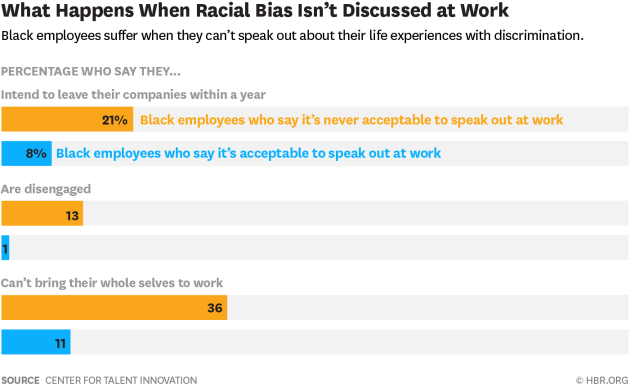
But 38% of black professionals also feel that it is never acceptable at their companies to speak out about their experiences of bias — a silence that makes them more than twice as vulnerable to feelings of isolation and alienation in the workplace. Black employees who feel muzzled are nearly three times as likely as those who don’t to have one foot out the door, and they’re 13 times as likely to be disengaged.

W170626_HEWLETT_WHATHAPPENS


The response, at most organizations, is no response. Leaders don’t inquire about coworkers’ life experiences; they stay quiet when headlines blare reports of racial violence or videos capture acts of blatant discrimination. Their silence is often born of a conviction that race, like politics, is best discussed elsewhere.

But as evidenced by the formation of the coalition and the initiatives we captured in our report, that attitude is shifting. Conscious that breaking the silence begins with their own example, captains of industry are talking about race, both internally with their employees and externally with the public. After a spate of shootings of unarmed black men last summer, Ryan initiated a series of discussion days to ensure that all employees at PwC better understood the experiences of their black colleagues. Michael Roth, CEO of Interpublic Group, issued an enterprise-wide email imploring coworkers to “connect, affirm our commitment to one another, and acknowledge the pain being felt in so many of our communities.” Bernard Tyson, CEO of Kaiser Permanente, published an essay in which, in a plea for empathy, he shared his own experiences of discrimination. And in an emotional recounting of his black friend’s experience outside the office that went viral on YouTube, AT&T chairman Randall Stephenson encouraged employees to get to know each other better.

Leaders who display this kind of courage don’t always see immediate rewards, but in the long term, our research suggests that the payoff could be extraordinary. Of those who are aware of companies responding to societal incidents of racial discrimination, robust majorities of black (77%), white (65%), Hispanic (67%), and Asian (83%) professionals say they view those companies in a more positive way. Interviews with employees at firms like Ernst & Young point to stronger bonds forged between team leaders and members as a result of guidelines disseminated to managers on how to have a trust-building conversation. Town halls at New York Life with members of the C-suite and black executives have likewise paved pathways for greater understanding across racial and political divides.

Source: People Suffer at Work When They Can’t Discuss the Racial Bias They Face Outside of It

Implicit bias against black people linked to police use of lethal force, study suggests

Good summary of some of the latest research on implicit bias and the difficulties in reducing its impact:

New research suggests the way our brains make associations between black people and the physical threat we think they pose is the greatest predictor of police using lethal force against a black person. These biases are held not just by the officers in question, but by the wider communities in which black people are killed by police.

This correlation is reported by a team of researchers led by Eric Hehman, an assistant professor of psychology at Ryerson University, in the journal Social Psychological and Personality Science. Dr. Hehman’s study adds to a growing body of research on implicit bias and how it can influence how police interact with black people.

For their study, Dr. Hehman’s team looked at the results of 2,156,053 U.S. residents who completed Harvard University’s famous Implicit Association Test, an online tool that measures the strength of the associations one makes between white people, black people and good and bad traits. They geolocated the results and analyzed them alongside data on people killed by police in the U.S. during a nine-month period in 2015.

They found that in places where implicit bias against black people and an association between black people and weapons were stronger, there was a disproportionate use of lethal force by police against black residents. Canadian data on fatal police shootings of black people was not available to include in the study, but Dr. Hehman said the principles they were researching could extend to Canada, too.

“We’re measuring the lady down the street who lives on the corner, the person who’s selling you some oranges. Just regular, average community members,” Dr. Hehman said. “But we’re still predicting these extremely potent and important consequences that are by police.”

It may be even more difficult to defeat the implicit biases police officers hold because of the nature of their work. In training simulations where individuals must decide whether or not to shoot armed or unarmed individuals, police who deal with non-white individuals in routinely dangerous situations – such as those on a drug force or SWAT team – have been found to be more likely than beat cops or civilians to shoot unarmed black men.

“In a moment where they’re under extreme stress and duress, they’re not really able to think consciously about what they’re saying, what they’re doing and so on. They’re going to revert back to their instincts,” says Nicholas Rule, a Canada Research Chair in social perception and cognition.

In June, Dr. Rule, who teaches psychology at the University of Toronto, testified at the coroner’s inquest into the death of Andrew Loku. He shared results of one study he did, in which participants consistently guessed that black men, just based on photos of their faces, were larger and stronger than white men of similar build. With those misperceptions came the assumption that more force would be needed to subdue them compared with white men.

In the verdict following the Loku inquest, the jury made several recommendations, one of which Dr. Rule had pushed for: to require all new officers and those requalifying to take the Implicit Association Test – the same one that was used in Dr. Hehman’s research. The jury also suggested officers receive implicit-bias and anti-blackness training.

But there’s little evidence to support implicit-bias training across various sectors. Several analyses found that after 24 hours, the bias-reducing effects of the training had vaporized, usually as a result of the individual returning to their regular life and exposure to the very stereotypes they were trying to stamp out.

Based on decades of research, many social scientists believe the best treatment for bias is what was first described by American psychologist Gordon Allport in 1954 as the “intergroup contact hypothesis” – a theory that the more contact members of a majority group having with a minority group, the less prejudice they feel towards them. But Dr. Allport emphasized that not just any contact would work: the quality was important and required equal status between all individuals.

For this reason, Emilie Nicolas is skeptical of whether anything can change implicit bias in police because of the immutable power dynamics between officers and the people they serve. Ms. Nicolas is the president of the NGO Québec Inclusif, which has been pressing the Quebec government to launch a commission into systemic racism in the province. She says there is a hierarchy between black people and white people that is naturalized through policing. Even if a beat cop spends all his time in a black neighbourhood and hosts community events, the nature of his interactions with residents isn’t the sort of quality contact Dr. Allport’s theory requires.

“Community barbecues are based on the assumption that if you don’t do them, these people may be impolite or whatever,” Ms. Nicolas says. “You don’t have these community barbecues in [wealthy white neighbourhoods] so the very fact that they have them speaks of prejudice that exists.”

Source: Implicit bias against black people linked to police use of lethal force, study suggests – The Globe and Mail

C.P. Champion: ‘New’ citizenship guide shows Liberals are the copy cats

Chris Champion, the Jason Kenney staffer with whom I and my team worked with closely  in 2009, provides useful background and understanding of the Conservative’s approach.

My account of the process and issues can be found on pp 20-25 of my book, Policy Arrogance or Innocent Bias: Resetting Citizenship and Multiculturalism – relevant excerpt here.

While Discover Canada was a vast improvement on the somewhat insipid previous guide (A Look at Canada), with DC’s references to the role of the Crown and historic wrongs and injustices, one can have differing opinions as to how “readable, balanced, inclusive” it is. The absence of mentioning the equality rights of the Charter is but one example.

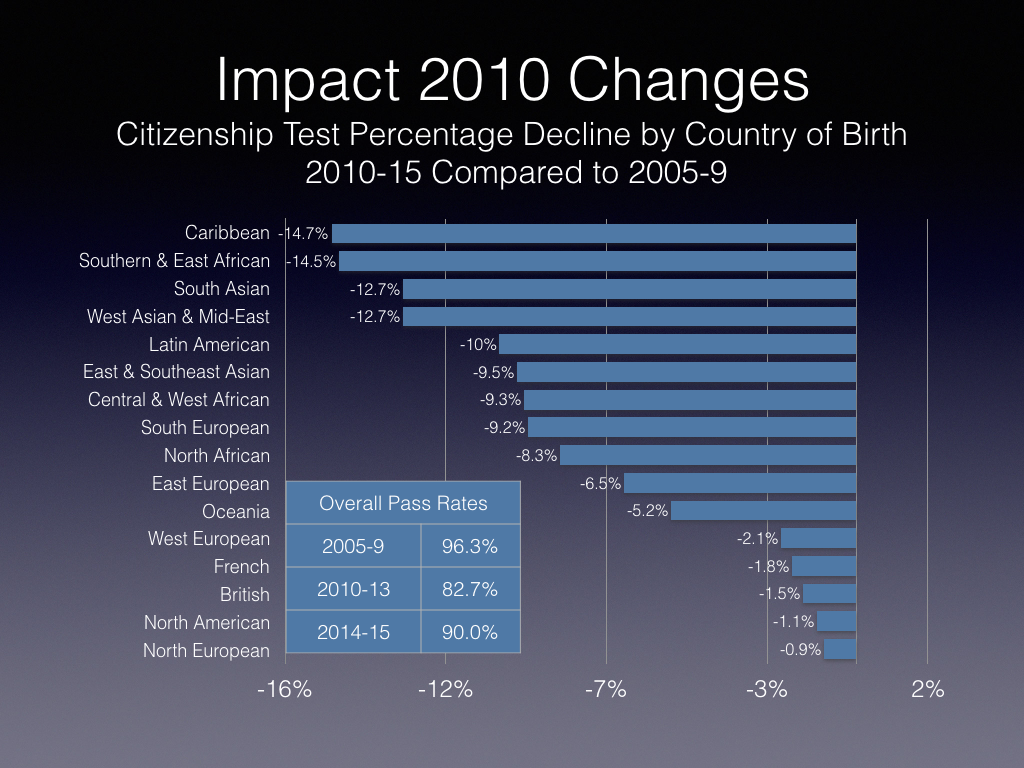
It is telling that, following the introduction of the new guide and related citizenship test, pass rates fell from the (overly) high rate of 96 percent to 83 percent (2010-13), in part  given that the guide and test questions were written at a more advanced level than the formal requirement of Canada Language Benchmark 4.

Lastly, it should come as no surprise to Chris that the change of government would result in a change to the guide. In discussing some of the language and content of the guide, I raised the concern that the guide would not survive a change of government and my consequent advice for more neutral language (and in some cases content).

That being said, I share some of his fears regarding a guide with a weakened sense of how Canada came to be, but prefer to defer more detailed commentary and analysis until  I have read the new guide:

It is no surprise that the Trudeau Liberals intend to replace the Conservatives’ citizenship test study guide this year for Canada’s 150th, or more likely sometime next year, or whenever it’s ready. The only surprise is that it’s taking them so long. After all, there’s very little about it that needs to change. Indeed, the whole idea of changing it, and the ideas they’re including in it, are borrowed from more original thinkers.

Back in 2008, the Conservatives had the idea to create a readable, balanced, inclusive, highly-varied, all-colour guide that showcases Canada’s diversity and values, our history’s triumphs and disasters, including the First Nations experience.

Jason Kenney, the then-minister of citizenship, had the insight that immigrants would welcome the opportunity to learn from a good civics primer that provided a non-boring overview of Canada’s history, warts and all.

I had a front seat in this process, since I was Kenney’s citizenship policy director at the time. Without (I hope) boasting, everything in the book, every word and every spread, photo placement, and caption, crossed my desk (as well as others’, of course, including those of my brilliant colleagues, Alykhan Velshi and Howard Anglin). We consulted Canadians of all political persuasions on it, like former Governor General Adrienne Clarkson, NDP historian Desmond Morton, and former Saskatchewan Lieutenant Governor Lynda Haverstock, who was also a former Saskatchewan Liberal Party leader.

André Pratte, the former editor of the liberal Montreal paper La Presse (who was subsequently appointed to the Senate by Justin Trudeau), endorsed the Tories’ guide, Discover Canada, as “a fine piece of work.” One immigrant from Sri Lanka told us, “I was always proud to be Canadian. But this was the first time anyone told me why I should be.”

The previous guide, A Look at Canada, authorized in the 1980s and unaltered until 2009, contained only a brief paragraph on constitutional monarchy and one on Remembrance Day. Immigrants were left wondering what sort of country they were joining, apart from knowing it was a “nice” place. Citizenship was a right that entailed few clear responsibilities, beyond recycling plastics and paper. Thanks to Kenney’s initiative, applicants for citizenship began learning about the pageant of Canada’s past, including the historic achievements of women, blacks and the disabled.

For the first time, immigrants began learning about the steps that were taken to abolish slavery in Canada in 1793, the wartime imprisonment of Ukrainians, the relocation of Canadian Japanese, the Chinese head tax, residential schools abuse, and the rejection of Jewish refugees in the 1930s.

The notion that Discover Canada contained “too much” about the War of 1812 is a red herring. One recent article said Conservatives added “increased detail” about that war. In reality, we upped the coverage from zero to one paragraph.

The Liberals are being disingenuous when they say respect for treaties with First Nations will be “mandatory” for citizens. In fact, treaties are between First Nations and the Crown, not citizens. It is the Crown (meaning the Government of Canada) that must respect treaties. Yet, in the Liberals’ topsy turvy illogic, it will be “mandatory” for citizens to respect treaties, but “respecting the human rights of others” will be merely “voluntary.”

By the sound of it, the new text will read like Quotations from Justin Trudeau: “Canada has learned how to be strong not in spite of our differences, but because of them.” This platitude was already amply and more informatively manifested in the Conservative version.

More important than merely reproducing bon mots is the need to explain why. Why is Canada a successful society, why do we enjoy “ordered liberty,” and why do we have “unity in diversity,” as Kenney often said in his speeches. Immigrants seeking the freedom and order of Western societies like to be told why. The United Kingdom, the United States, Australia and the Netherlands all improved their citizenship guides around the same time as we did.

The Tories’ guide was an effort to show that our tradition of rights and freedoms was not born of the 1982 Canadian Charter of Rights and Freedoms. Pluralism in Canada is deeply rooted in history and laws — a “tradition of accommodation” founded on English tradition, including the Magna Carta of 1215, the Royal Proclamation respecting native rights in 1763, and the Quebec Act of 1774. The guide recognizes that the early centuries of relations between natives and newcomers were largely positive thanks to “strong economic, religious, and military bonds in the first 200 years of coexistence which laid the foundations of Canada.”

What matters is not the mere fact of diversity but why it has worked in Canada. Will the Grits be able to come up with a better explanation? Will they attempt any explanation at all?

Source: C.P. Champion: ‘New’ citizenship guide shows Liberals are the copy cats