Storm of reaction to news Syrian refugee charged with sex assaults

Good commentary by David Tait of Carleton University on how the media should and should not report on cases like this:

Reports that a man accused of sexual assaults on six Edmonton teenage girls was a Syrian refugee have ignited a firestorm of reaction, from anti-immigration diatribes to criticism about how the media dealt with the story.

Groups that work with refugees in the city have been inundated with calls and texts over the past 24 hours, some from people calling for an end to the refugee program and others from refugees themselves apologizing on behalf of their community.

Erick Ambtman, executive director of the Edmonton Mennonite Centre for Newcomers, said his organization received a message on Twitter from a white supremacist group that included a picture of a Syrian refugee, asking the centre to confirm whether the photo was the same man accused of the crimes.

“It may be just to scare us or to unnerve people,” Ambtman said.

“But around my office that’s what’s happening. People are starting to get really nervous, and the [English] language students are starting to get really nervous.

“And the Syrian students are apologizing for somebody who they don’t even know, because he’s got the same country of origin as they do.

“It’s really spiralling into a really ugly place.”

Soleiman Hajj Soleiman, 39, was arrested Saturday and charged with six counts of sexual assault and six counts of sexual interference after six teenage girls, all younger than 16, told police they were inappropriately touched while swimming at the West Edmonton Mall water park.

…When the media reports stories like this one, decisions about what information is relevant have to be made on a case-by-case basis and sometimes on a day-by-day basis, said David Tait, a professor at Ottawa’s Carleton University who has taught ethics courses at the journalism school.

“Journalists have to sort of go and look at a situation not from the standpoint of, ‘Is there public appetite for this information? Do people want to know it?’ But, ‘Is that detail relevant at this stage to this story?’

“And that’s a very difficult thing to determine as a journalist, because you also have to be careful that you’re not making your judgment for some sort of social engineering purpose.

“To say, ‘Oh I don’t want to make these sorts of people look bad’ or ‘I don’t want to make these sorts of people look good.’ You shouldn’t make your journalistic judgments based on how you want people to think about something, because that’s not the journalistic mission.”

‘Our job is to report what’s going on’

Tait said in this case, while reporting immediately after the arrest was made public, he would have questioned whether details about the accused’s background were relevant.

“My question would be, would we have run additional background details about this person if they were a gay man? A gun owner? If they were Jewish? If they were a fundamentalist Christian? If they were a recent arrival from the United States? If they were any number of other identifiers?”

It’s the responsibility of journalists to try to determine what the public needs to know to understand the story. Once the public has the information, people will make their own choices about what’s relevant to them, he said.

Some will seize on information that confirms their own views about the world and overlook other aspects of the story.

“Our job is to report what’s going on out there in the world,” he said.

The story about the water park allegation, Tait said, “is a classic example of where people these days are rushing to grab details, to use individual facts as weapons instead of looking at those details and saying, ‘How does this fit into my developing understanding of the world?'”

Ambtman said Soleiman came to Canada in January 2016 with his wife and six children, aged one to 13 years. The family was assisted by the Mennonite Centre.

Some commenters are exploiting the fact that a Syrian refugee has been charged with a crime, he said.

“They’re exploiting what’s happened to these girls to say something about immigration, and it’s just a really ugly thing to do. It’s been pretty awful to bear witness to.”

It will be up to the justice system to determine the facts of the case and, if a crime has been committed, punish the person responsible, he said.

“To make this about immigration is just absurd. What has happened is there has been a sexual assault at West Edmonton Mall and six girls are going to be traumatized likely for the rest of their lives because of a crime that somebody perpetrated on them. To me, that’s the concern.
The new underground railroad to Canada

Likely to accelerate under the Trump administration. Good long read by Jason Markusoff:

The taxi stopped at the side of the I-29 interstate after cruising north for about an hour. Their $400 in the cabbie’s pocket, he dropped off Seidu Mohammed and Razak Iyal a two-minute drive short of the North Dakota-Manitoba line. The driver pointed the men toward a darkened prairie field and a row of red blinking lights, wind turbines in the distance. Walk toward those lights, and they could grasp freedom.

“We didn’t feel any sign, but we could feel we are in Canada, because of the cold—very, very intense,” Mohammed recalls. By this point, they were a couple of hours into their trek through field and brush, unsure exactly where to stop. It was Christmas Eve, and fields outside Emerson, Man., were smothered in waist-high snow.

That “Canada” moment Mohammed recalls was a nasty wind gust that overwhelmed these underdressed African migrants, whipping off their flimsy gloves and Mohammed’s ballcap. By the time they wanted to dial 911 for police to retrieve them from the Manitoba roadside, their hands were frozen claws unable to grip a phone.

A trucker eventually rescued them, and a month later they were on a new, safer road, toward possible refugee status in Canada. But their frostbitten fingers are gone. Iyal has one thumb and a half-thumb left. Mohammed has nothing. As the 24-year-old former soccer player lies in his Winnipeg hospital bed a week after the amputation, the ends of his bandaged hands are left open to reveal the skin graft stapled over them to cover the wound. After recalling the extreme burning sensation of that night, the fear he might have died, he can’t stop staring at them in disbelief. “Look at my hands. Look, look,” Mohammed says, cheeks dripping with tears he cannot wipe away.

The duo’s frostbite was a tragic cap to a surprisingly busy year for unanticipated refugees sneaking into Canada via Emerson. The RCMP intercepted 515 refugee claimants crossing near the border post last year—more than in the three previous years combined. They’re intercepted rather than “caught” because they want the police to bring them to the Canada Customs office to make their refugee claims, something current rules don’t let them do by coming in Canada’s front door.

They’re seeking refuge to the north because they fear deportation under the tough U.S. asylum system that existed before Donald Trump—and more and more these days, they’re not even trying their chances in the harsher new regime. “When I got to Canada, I felt so happy. I escaped from Donald Trump,” says Mouna, a Djiboutian who walked across the border three weeks after the U.S. election. The Ghanaian pair’s widely reported frostbite has proven no horror-story deterrent for those desperately seeking safety and freedom. Thirty-nine more arrived to Winnipeg’s largest refugee centre for help in frigid January, including eight on the Monday after the new U.S. President’s refugee and travel ban.

Source: The new underground railroad to Canada

Trudeau must match words with action in Trump era, say critics, rights groups

Government is wise to wait and monitor before changing such a fundamental policy as safe third country. In the end, should the Trump administration continue with such policies, it will likely become harder to resist such calls, on both policy and political grounds:

Justin Trudeau’s invitation on Twitter to “those fleeing persecution, terror & war” attracted global attention as a subtle response to President Donald Trump’s order temporarily banning refugees and immigrants from seven Muslim-majority countries, but now Canadian opposition politicians and human rights groups want Mr. Trudeau to match his words with action.

Mr. Trump’s executive order banned refugees from resettling in the United States for 120 days and nationals from Iran, Iraq, Libya, Syria, Somalia, Sudan, and Yemen from entering the U.S. for 90 days. Thousands of people gathered outside of the U.S. embassy in Washington and consulate in Toronto to protest the decision Monday.

The prime minister’s “diversity is our strength” tweet sent the message that “regardless of [their] faith,” those seeking refuge will find an open door to Canada as the one in the U.S. temporarily closes.

The New Democratic and Green parties, along with Amnesty International’s Canadian and U.S. sections, in turn have called on the federal government to remove the U.S. as a “safe third country” for refugee determination under Canada’s Immigration and Refugee Protection Act.

A 2004 order-in-council giving the U.S. that designation, which was briefly overturned by the Federal Court and later reinstituted by the Federal Court of Appeal, requires most refugees travelling through the U.S. to Canada to make a claim for protection in the U.S.

Amnesty wants Immigration, Refugees, and Citizenship Minister Ahmed Hussen (York-South Weston, Ont.) to immediately rescind the U.S. as a safe country and allow refugees to cross the border and seek asylum in Canada. “The risk of not doing this is going to deny an avenue of protection for people who are going to need it in the days, weeks, and months to come,” said Alex Neve, secretary general of Amnesty International Canada, who believes that Mr. Trump might support the U.S.’s removal as a safe haven.

“It would mean more refugee claimants turning to Canada for protection rather than the United States, which seems to be what he wants,” said Mr. Neve. “Canada doesn’t have to issue a press release loudly and angrily denouncing the U.S.’s refugee-protection record. It’s something that can be done quietly and quickly through an order-in-council.”

Source: Trudeau must match words with action in Trump era, say critics, rights groups – The Hill Times – The Hill Times

No plans to change refugee target in wake of U.S. travel ban: immigration minister

Calibrated response:

As MPs debate U.S. President Donald Trump’s travel ban in the House of Commons, Canada has already confirmed it will not hike its refugee intake target in the wake of a contentious immigration and travel crackdown in the U.S., says Immigration Minister Ahmed Hussen.

Under pressure by the NDP, human rights groups and refugee lawyers to bring more asylum-seekers to Canada, the minister said Canada’s plan will not change in response to an executive order by Trump that suspends the U.S. refugee program and bars entry to nationals from seven Muslim-majority countries.

“Our immigration levels plan has an allocation that is historically high for refugees,” Hussen said. “We intend to maintain that plan.”

Canada’s 2017 immigration plan is set to accommodate 40,000 refugees.

Hussen also rejected calls to suspend the Safe Third Country Agreement, a pact which considers asylum-seekers safe in both Canada and the U.S.

“All the parameters of that agreement are in place and there is no change at this time,” he said.

MPs held an emergency debate Tuesday evening, which concluded around midnight, on the U.S. immigration and travel directives,.

Noting that the U.S. has now agreed to allow in 872 refugees who were already screened and in transit, and were previously denied entry, Hussen said that’s a sign the situation is evolving fast. He added that Canada will closely monitor developments.

“The responsible thing to do is to maintain contact, to continue to engage and make sure we monitor the situation closely to make sure we provide information to Canadians,” he said.

Ottawa U.S. Embassy Trump protest travel ban Jan 30 2017

People gathered outside the U.S. Embassy in Ottawa Monday afternoon to protest an executive order signed by President Donald Trump banning citizens of seven Muslim-majority countries from entering the United States. (CBC)

Call for ‘special measures’

NDP immigration critic Jenny Kwan, who requested the emergency debate, held a news conference Tuesday morning urging the government to lift a cap on privately sponsored refugees and to fast-track refugee claims.

The B.C. MP laid out a number of proposed “special measures” ahead of the debate.

“There is no question that this ban promotes hate and intolerance,” she said. “This ban will have a disastrous effect for thousands of innocent travellers and refugees.”

Calling it “absolutely shocking,” Kwan said the Trump travel ban will have a huge negative impact on the economy, as well as cultural and academic development.

…Conservative immigration critic Michelle Rempel used the debate to launch into an examination of whether Canada was effectively managing its own immigration file.

She questioned whether there was adequate funding to help refugees integrate into Canadian society, and whether it was wise to lift the visa restrictions on Mexicans coming to Canada.

“To respond to the immigration policies of other nations, we must first get our own house in order, and then through those actions, show the world what immigration policy best practice looks like,” Rempel said.

Donald Trump’s Immigration Order Is Horrifying | Time.com

Hopefully, the Trump administration will learn from this and ensure proper vetting of all future policy decisions.

But I am not hopeful given their tendency to dig in rather than listen (the Holocaust Day press release not mentioning Jewish victims being a case in point):

The malevolence of President Trump’s Executive Order on visas and refugees is mitigated chiefly—and perhaps only—by the astonishing incompetence of its drafting and construction.

NBC is reporting that the document was not reviewed by DHS, the Justice Department, the State Department, or the Department of Defense, and that National Security Council lawyers were prevented from evaluating it. Moreover, the New York Times writes that Customs and Border Protection and U.S. Citizen and Immigration Services, the agencies tasked with carrying out the policy, were only given a briefing call while Trump was actually signing the order itself. Yesterday, the Department of Justice gave a “no comment” when asked whether the Office of Legal Counsel had reviewed Trump’s executive orders—including the order at hand. (OLC normally reviews every executive order.)

This order reads to me, frankly, as though it was not reviewed by competent counsel at all.

CNN offers extraordinary details:

Administration officials weren’t immediately sure which countries’ citizens would be barred from entering the United States. The Department of Homeland Security was left making a legal analysis on the order after Trump signed it. A Border Patrol agent, confronted with arriving refugees, referred questions only to the President himself, according to court filings.

. . .It wasn’t until Friday — the day Trump signed the order banning travel from seven Muslim-majority countries for 90 days and suspending all refugee admission for 120 days — that career homeland security staff were allowed to see the final details of the order, a person with the familiar the matter said.

. . .The policy team at the White House developed the executive order on refugees and visas, and largely avoided the traditional interagency process that would have allowed the Justice Department and homeland security agencies to provide operational guidance, according to numerous officials who spoke to CNN on Saturday.

Homeland Security Secretary John Kelly and Department of Homeland Security leadership saw the final details shortly before the order was finalized, government officials said.

Friday night, DHS arrived at the legal interpretation that the executive order restrictions applying to seven countries — Iran, Iraq, Libya, Somalia, Syria, Sudan and Yemen — did not apply to people who with lawful permanent residence, generally referred to as green card holders.

The White House overruled that guidance overnight, according to officials familiar with the rollout. That order came from the President’s inner circle, led by Stephen Miller and Steve Bannon. Their decision held that, on a case by case basis, DHS could allow green card holders to enter the US.

As I shall explain, in the short term, the incompetence is actually good news for people who believe in visa and refugee policies based on criteria other than—let’s not be coy about this—bigotry and religious discrimination. The President has created a target-rich environment for litigation that will make his policies, I suspect, less effective than they would have been had he subjected his order to vetting one percent as extreme as the vetting to which he proposes to subject refugees from Bashar al-Assad and the bombing raids of Vladimir Putin.

Source: Donald Trump’s Immigration Order Is Horrifying | Time.com

Candice Malcolm in the Sun highlights issues pertaining to dual nationals, of particular concern given her husband’s Iranian ancestry, but finds little fault with the other aspects of the executive order:

There is a lot to unpack in Trump’s EO, and while trying to understand the law and its impact, it’s important to separate the facts from the hysteria.

First, and despite the rhetoric, this is not a Muslim Ban.

The vast majority of the world’s Muslims, including all American Muslims, will not be directly affected by this order.

The EO includes a four-month pause on all refugees, and a three-month ban on all citizens of Iran, Iraq, Syria, Libya, Yemen, Somalia and Sudan. The ban includes all citizens of these seven countries, including Muslims, Christians, Jews, and athiests. The order does not list any religion, nor does it ban people from the world’s most populous Muslim countries.

Second, it is untrue that no nationals of the countries on Trump ban list have perpetrated an act of Islamic terrorism on US soil.

Both the 2016 mall attack in St. Cloud, Minnesota and the attack at Ohio State University were carried out by Somali nationals. The Islamic State claimed responsibility for both attacks.

Senators Jeff Sessions and Ted Cruz released a report highlighting the 580 individuals who have been convicted on terrorism charges in the U.S. since the September 11th 2001 terrorist attacks. Of the 380 foreign-born terrorists, 21 were from Somalia, 20 were from Yemen and 19 were from Iraq.

Curiously, the largest terrorists-producing countries, including Pakistan, Lebanon and the Palestinian territories are not included in the blanket ban. Likewise, the 9/11 hijackers were mostly from Saudi Arabia, another country not included in the ban.

That Trump didn’t include these countries is puzzling, and undermines the national security rationale behind this order.

The most troubling aspect of this order is the blanket ban on nationals from seven countries. The wording is clunky – simply saying the US will “suspend entry” for these nationals.

There is a difference between increased screening and a flat-out ban. This is a ban that will turn away lawful residents at the border.

There have been contradictory reports and messages from different government offices, but it seems that the ban applies to legal residents, green-card holders and even dual citizens travelling with Canadian passports.

There have been reports of green-card holders being handcuffed and detained at U.S. airports. This is reckless and wrong.

Trump immigration EO needs major changes 

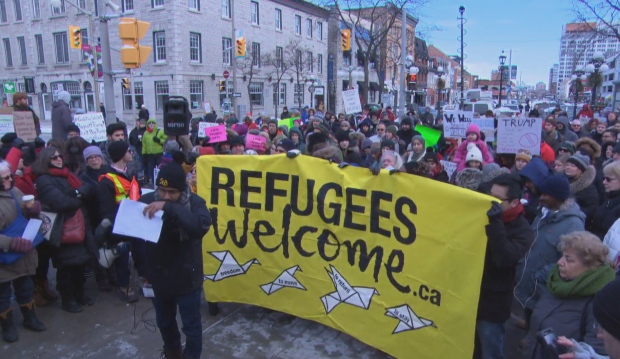
Refugee advocates urge Canada to keep borders open amid Trump directives

Yet another aspect of Canada that will be affected by decisions of the Trump administration:

Refugee advocates are urging Canada to keep its borders open to the world’s most vulnerable people as U.S. President Donald Trump orders the construction of a wall with Mexico and cracks down on illegal immigration.

As promised during the election campaign, Mr. Trump signed executive orders Wednesday to build a wall along the U.S.-Mexico border and strip federal grant money from “sanctuary” states and cities that shield illegal immigrants. Canadian refugee advocates say it’s critical that Canada continue to welcome newcomers, especially amid an unprecedented global refugee crisis that has displaced more than 65 million people.

“It’s absolutely devastating news for refugees around the world,” said Janet Dench, executive director of the Canadian Council for Refugees. “What is happening in the U.S. makes even more important Canada’s openness to refugees because the options are significantly smaller when the U.S. closes its doors.”

Without mentioning Mr. Trump or his policies, Immigration Minister Ahmed Hussen’s office said Wednesday that Canada has “always been welcoming of newcomers and will continue to do so.”

Experts say Canada could see an increase in the number of Mexican immigrants and refugees as a result of Mr. Trump’s anti-immigration sentiments and a recent Canadian policy change. Mexicans who feel unwelcome in the United States may now be looking a little further north to Canada, where the Liberal government lifted a visa requirement for Mexican travellers just last month. The visa requirement had been in place since 2009 when the Conservatives imposed it after a rise in invalid refugee claims from Mexico.

“The spike in Mexican immigration in general, but particularly refugee claims, is definitely going to happen in Canada,” said Toronto-based immigration lawyer Chantal Desloges. “You couldn’t imagine worse timing. We just lifted the visa requirement and now to have things shut down in the U.S., that’s going to be a definite driver.”

The government is prepared to reinstate the visa requirement if the number of Mexican asylum seekers surpasses 3,500 within any 12-month period.

Conservative immigration critic Michelle Rempel said the Mexican visa issue could backfire on the Liberals, especially given the fact that they were warned against it. Immigration department officials opposed the decision last year, arguing that Mexico’s poor human-rights record, high crime rates and low standard of living would drive Mexican refugee claimants to Canada.

“When the government lifted this visa requirement against the advice of bureaucrats and public servants without a formal review, I think Canadians started thinking, ‘Why are they doing that?’” Ms. Rempel said.

Chris Friesen, director of settlement services at Immigrant Services Society of B.C., said his organization is developing contingency plans for a possible influx of Mexican arrivals, including the preparation of housing and legal services.

However, Mexican refugee claimants hoping to flee Mr. Trump’s America and claim status in Canada won’t be able to do so, due to a special arrangement between Canada and the United States. Under the Safe Third Country Agreement, refugee claimants are required to request protection in the first safe country they arrive in and since the United States is considered a safe country by Ottawa, they are not allowed to make a claim in Canada after doing so in the U.S. A few exceptions are made for some refugee claimants, such as unaccompanied minors.

Mexicans aren’t Mr. Trump’s only target. The President is expected to sign executive orders in the coming days blocking the issuing of visas to people from seven Muslim-majority countries in the Middle East and North Africa: Syria, Sudan, Somalia, Iraq, Iran, Libya and Yemen.

NDP immigration critic Jenny Kwan called on Mr. Hussen to present a plan to Canadians outlining how the government will address the implications of Mr. Trump’s immigration policies.

Source: Refugee advocates urge Canada to keep borders open amid Trump directives – The Globe and Mail

Trump’s order to ban refugees and immigrants triggers fears across the globe – The Washington Post

And so it begins:

President Trump’s executive order to tighten the vetting of potential immigrants and visitors to the United States, as well as to ban some refugees seeking to resettle in the country, will shatter countless dreams and divide families, would-be immigrants and human rights activists warned.

The draft order, expected to be signed as early as Thursday, calls for the immediate cessation of ongoing resettlement of Syrian refugees in the United States, rejecting visas for visitors and immigrant hopefuls based partly on their ideology and opinions.

A copy of the draft orders was leaked Wednesday to civil rights groups and obtained by The Washington Post.

“I feel devastated,” said Ibrahim Abu Ghanem, 37, a father of three in the Yemeni capital, Sanaa, whose father and two brothers live in the United States. “This means all my plans are going to go down the drain.”

If the order is enacted, among those immediately affected would be potential immigrants and visitors from seven Muslim countries — Yemen, Iraq, Syria, Somalia, Iran, Libya and Sudan — that are considered by the Trump administration as nations whose citizens “would be detrimental to the interests of the United States.” For the next 30 days, they will not be allowed entry into the United States, even if they have visas and relatives who are U.S. citizens.

Activists protest Trump’s orders to crack down on refugees and undocumented immigrants

The order also calls for halting all admission and resettlement of refugees for 120 days pending the review of vetting procedures. For Syrian refugees, the ban will remain in place until further notice.

Once restarted, annual refugee admissions from all nations would be halved, from a current level of 100,000 to 50,000.

For those affected, the fear is that the order will be a harbinger for even greater restrictions on the horizon for Muslim immigrants, refugees and visitors — fulfilling Trump’s campaign promises of “extreme vetting” of foreigners seeking entry into the United States and installing “a Muslim ban.” Somalia, Syria, Iraq and Iran are among the leading countries of origin of recent refugees to the United States.

“It’s going to be devastating,” said Denise Bell, senior campaigner for refugee and migrant rights for the watchdog group Amnesty International. “Refugees are not a threat. They are the ones fleeing horrific violence. They are trying to rebuild their lives. They want the same safety and opportunities that any of us would want.”

“And so we are scapegoating them in the guise of national security. Instead, we are betraying our own values. We are violating international law,” she said.

Since Wednesday, as news of the impending order spread, lives were quickly affected across the world, particularly among the citizens of the countries immediately targeted. For them, it’s already difficult to get visas or immigrate to the United States. Vetting has been stringent since the Sept. 11, 2001, terrorist attacks, say human rights activists. Even so, many potential Muslim immigrants went through long screening processes, often lasting years, to gain entry to the United States. Now, many find themselves in an emotional and bureaucratic limbo.

Ottawa ends program reuniting Syrian refugees with relatives in Canada

Reasonable given lack of sponsors who may be using other avenues:

The federal government has quietly cancelled a program that matched private Canadian sponsors with Syrian refugees abroad who have relatives in Canada because of low sponsor turnout.

The Syrian Family Links Initiative was discontinued on Dec. 31. While families in Canada had registered more than 8,000 people for the program, only 36 private sponsors applied, for a total of 127 refugees.

“Given the ongoing crisis in Syria, the response by Syrian families in Canada to Family Links has been overwhelming, with 8,025 Syrian refugee family members being registered for sponsorship. Unfortunately, the number of refugees registered far exceeded the number of sponsors available,” read Immigration, Refugees and Citizenship Canada’s website.

“As a result, the Syrian Family Links Initiative will be discontinued on December 31, 2016, due to the low turn-out of sponsors.”

The immigration department said many private sponsors already knew Syrian refugees in Canada with displaced family members overseas, and therefore few of them used Family Links. However, some people involved in refugee sponsorship said the program was not promoted enough.

The government does not track how many Syrian refugees sponsored through Family Links have arrived in Canada,. Nearly 40,000 Syrian refugees had landed in Canada as of Jan. 2 – 21,751 government assisted, 13,997 privately sponsored and 3,923 through a blended program of private and government sponsorship.

Source: Ottawa ends program reuniting Syrian refugees with relatives in Canada – The Globe and Mail

Last-minute wave of Syrian refugees lets Liberals keep their promise – The Hill Times – The Hill Times

Another commitment met:

A trickle of incoming Syrian refugees turned to a stream late last year, helping the federal government to check off one of the key targets from its 2015 election campaign.

Nearly 2,000 government-supported Syrian refugees arrived in Canada in mid-December, bringing the total to more than 25,000 since the Liberal government took power in 2015 and began to admit thousands of people displaced and endangered by the turmoil in and around the Middle Eastern country.

The surge of new arrivals in late 2016 came thanks in part to the government taking a longer look at “a number of” refugee applications from earlier in the year for security or medical reasons, delaying travel to Canada that may otherwise have occurred earlier, according to departmental officials.

People in the refugee resettlement sector were preparing for the December arrivals, said one sector executive. The executive and another said the government tipped them off ahead of time about the expected late-year surge. They said the few thousand government-supported refugees who arrived in the last couple of months of 2016 was nothing compared to the influx in the first two months of the year, when the government pressed to meet its target of bringing in 25,000 refugees through both private and government streams.

Immigration, Refugees, and Citizenship Canada could not provide statistics by press time on how many refugee applications required more time for security or medical screening, or how many of those cases were rejected. Spokesperson Nancy Chan wrote that those individuals had “more complex” cases that required more time to evaluate, but added the government used the same security and health screens for all Syrian refugees.

The government had promised to bring in 25,000 Syrian refugees through its government-assisted and blended refugee programs by the end of the year—not be confused with an earlier target of 25,000 Syrians from private and government streams by the end of February.

…It appeared through much of last year that the government would miss its end-of-year 25,000-person goal, perhaps badly. About 11 new Syrian refugees were entering Canada each day on average between March and the beginning of August, far off the pace needed for the government to hit the target it was then several thousand people shy of, according to data published by the department roughly every week.

However, the number of refugees arriving in Canada rose steadily in the finals months of 2016. About 56 Syrians arrived per day on average in mid-November; that jumped to an average of 77 per day by Dec. 4, then 136 per day between Dec. 11 and Dec. 19, when the government surpassed its target.

The federal immigration department says the surge in new arrivals late in the year was not out of the ordinary; immigration officials worked steadily over the months to meet their year-end target, and there is typically a three-to-six-month delay between when applicants are given their first interview and the time they arrive in Canada, according to emailed responses from Immigration, Refugees, and Citizenship Canada spokespeople.

The government “made it clear” early on to refugee resettlement organizations that there would be a wave of refugees arriving late in the year, said Louisa Taylor, director of Ottawa’s Refugee 613, a coalition of groups that support refugees.

Syrian refugees need better ways to reconnect with their families 

One view by Anneke Smit, Gemma Smyth and Jillian Rogin:

We know that in order to bring in more than 25,000 refugees in just a couple of months, complicated files were avoided, as were single young male refugees. Therefore, some of the most vulnerable were not offered resettlement, even when other members of the family were. In the case of the refugees our group is sponsoring, 10 family members were living together for years under one roof in Lebanon. The nuclear family of husband, wife and four young children was selected for resettlement while the other family members – elderly parents, orphaned nephew, and brother aged 18 – were not. Neither was another sibling, her spouse and young children. Given the limited options for family reunification after arrival in Canada, this selective approach is particularly distressing.

As a result, Syrian refugees will have to look to private sponsorship (groups of five, for example) as their only hope for extended family reunification. This process is complex and financially out of reach for most resettled refugees for at least several years. In the case of “our” family, they found in us a sponsor group willing to raise the funds and sponsor their most vulnerable family members. But that shouldn’t have been necessary had the family been resettled together, or if family reunification channels were more expansive.

This “echo effect” of our massive and laudable Syrian resettlement effort is not going away. During the Kosovo refugee resettlement in 1999, Canada allowed for reunification of a wide array of extended family members of Kosovars already in Canada. We can do the same again today. Along with adequate language training, employment support, mental health counselling and other settlement services, reuniting families is a key part of ensuring this was a job well done.

Source: Syrian refugees need better ways to reconnect with their families – The Globe and Mail