ICYMI: As immigration policy changes, so does work of Catholic organizations

Of note:

Welcoming the stranger,” said Bill Canny, executive director of the U.S. Conference of Catholic Bishops’ Migration and Refugee Services (MRS), who participated in a webinar June 18 addressing the findings of the survey.

One of the changes for institutions such as MRS, Canny said, came about with the Trump administration’s drastic reduction of refugees allowed into the country. Since Congress passed the Refugee Act in 1980, the U.S. had admitted on average 95,000 refugees annually, and faith-based agencies, including many Catholic organizations, had since then stepped in to help with resettlement.

The number of refugees allowed into the country was capped at 45,000 after Donald Trump became president in 2017 and was scaled back to 30,000 refugees for fiscal year 2019. However, the cap does not reflect the actual number of those allowed to enter, it’s simply a limit.

“This had a relatively dramatic effect on the infrastructure that had developed over the last 30 years,” which was a well-oiled network dedicated to helping refugees and their families integrate into the country, Canny said. “There were some 320 affiliates across the U.S. in all states who were receiving refugees, and the Catholic Church, primarily Catholic Charities, represented about 90 of those.”

These days, 45 of those Catholic affiliates remain, Canny said, adding that at the same time that the refugee cap was shrinking, the number of asylum seekers was rising at the southern border.

“Nine resettlement agencies including our own, interestingly, began to turn their attention and resources toward those asylum seekers,” he said.

More funds started being raised for asylum seekers, more staff dedicated to helping them.

“You had a bit of an awakening,” Canny said.

Last year, MRS, which had focused on resettlement, instead mobilized to reunite families separated by a government policy that took children away from parents or guardians if they had entered at the U.S. southern border without documents. After great backlash and public outcry, the government sought the help of Catholic organizations as well as Lutheran Immigration and Refugee Service to help after U.S. courts stepped in to stop the separations and demanded that families who had been separated be reunited by a particular date.

Donald Kerwin, executive director of the Center for Migration Studies, and one of the authors of the survey, said Catholic organizations have been making “extraordinary efforts to adapt and to serve immigrants despite all these various issues.”

The Catholic Legal Immigration Network (CLINIC), for example, has dispatched staff to provide legal help along the U.S.-Mexico border and support for those helping immigrants forced to wait in Mexico until their asylum cases are heard, a new requirement of a policy announced by the Trump administration in late 2018. The “Remain in Mexico” policy requires those seeking asylum to petition at ports of entry and then wait for legal proceedings in Mexico until U.S. courts can hear their case.

Even as Catholic organizations have stepped up efforts to help, the fear some immigrant communities are experiencing is getting in the way of that help. Many are afraid of attending legal consultations that might help with their immigration status, accessing food, and even applying for a public service they’re eligible for, because of fear of deportation or that it might affect chances at citizenship in the future, Kerwin said.

The Trump administration has discussed instituting a “public charge” policy that would hurt immigrants’ chances at permanent residency, citizenship and even threatened deportation for those who sign up for public benefits. Some immigrants can’t tell what kind of help could harm them.

“These are obviously kind of very serious problems, most of all for immigrants, but also for Catholic agencies who are doing extraordinary work in trying to work around these problems,” Kerwin said.

Brian Corwin, executive vice president for Member Services of Catholic Charities USA, who also participated in the webinar, said clients are afraid to ask for help at food pantries and soup kitchens and don’t want to sign up for Supplemental Nutrition Assistance Program (SNAP) benefits for their U.S.-born children, who are eligible, because they are afraid it will affect another family member’s immigration situation.

“People are afraid to come forward, to get help,” Corwin said, recalling that a session to get families to sign up for the SNAP program, also known as food stamps, resulted in people not wanting to take the application and even the few who did, said they likely weren’t going to fill it out “because of fear that it might affect their immigration case and fear that their greencard (a residency card) might be revoked.”

Rampant misinformation, mistrust and “fear of the current rhetoric” are reasons people aren’t seeking help, said staff at one California Catholic Charities, he said.

“We haven’t even begun to do research on (housing) and the issue of mixed family status,” Corwin said.

But there are “bright lights” as agencies push to keep helping by working with dioceses and parishes, saying “we’re going to do something regardless of the climate,” Corwin said.

In places such as Minnesota, when attendance at Mass and other parish events waned after immigrants were apprehended and deported, church workers vowed to think differently. Sensing the fear parishioners had of leaving the house, one priest decided to take Mass to them – to an apartment complex.

“It was a great success,” said Estela Villagran Manancero, director of Latino ministry for the Archdiocese of Saint Paul and Minneapolis, who participated in the webinar.

During major events, some parishes rented large buses to pick up parishioners who were afraid to drive lest they be detained, she said.

“It’s a little more expensive, but then we all can have security that they will not be detained,” said Villagran.

Parishioners in Minnesota also have organized so they can tag along, or drive those who are afraid, to doctor’s appointments, court dates, to take their children to school, Villagran said.

“I think people that are serving are very much committed,” she said.

The survey mirrors what a lot of the organizations and parishes such as the ones in Minnesota are experiencing, Kerwin said, that “here’s more accompaniment … more services designed and geared to the moment that we’re living in. I think charities and parishes are very much focused on this issue.”

Source: As immigration policy changes, so does work of Catholic organizations

‘We didn’t talk about the bombs’: How the 1st cohort of Syrian refugees made it through high school in Canada

Encouraging story on how schools helped these refugees integrate and succeed:

Marwa Nakhleh’s voice barely registers above a whisper as she recounts the horrors she witnessed on the streets of Damascus.

“It was terrible,” she says of seeing a car bomb go off in her neighbourhood, vividly recalling the darkness that followed. “There’s no electricity, and it’s dark, and people looking for their family and their friends.” Her mother, she says, ran out of the house in a panic, trying to find her.

Guns, bombs and people dying are the scenes she registered as an 11-year-old growing up in Syria’s capital.

Nakhleh is among the first wave of Syrian refugees Canada admitted in 2015-2016 — and she’s among the first students from that group who are now graduating from a Canadian high school.

When the Arab Spring became a nightmare for Syria’s civilians in 2011, and what would become one of the deadliest wars in history broke out, Nakhleh’s parents gathered their four children and headed for the nearest safe place — Lebanon, which was already teeming with refugees.

Nakhleh, 19, says she was unable to continue school in Lebanon, where her family spent four years awaiting resettlement.

Families on the run

As the war in Syria raged and spread, Ammar Jouma’s family cautiously watched and waited at their home in the coastal city of Latakia. In 2012, they too were forced to flee, leaving everything behind.

Their search for safety took them to Turkey, where Jouma’s father was able to find a job. But the days were long and the pay meagre, so Jouma, 12 years old at the time, went to work to help support his family.

“We faced a lot of problems there. We faced a lot of tragedies until we came to Canada — and that was three years ago.”

School plays a pivotal role

As the humanitarian crisis deepened in Syria, Canada agreed to resettle an unprecedented 25,000 refugees, most of them families with children.

At Edmonton’s Queen Elizabeth High School, principal Sue Bell assembled the staff and prepared for the influx. The school already had a large population of immigrant students and was set to accept as many of the Syrians as it could handle.

“I know that whoever walks through our door, we’re going to be welcoming and we’re going to have a place for them to be, and they’re going to love it here,” Bell told CBC News in 2015.

Among the 33 students who walked in the door the following autumn were Nakhleh and Jouma. Both were exhausted from their four-year ordeals as refugees. Neither of them spoke any English.

It fell to the director of the school’s English as a Second Language program, Sherri Ritchie, to help them integrate.

“Learning English, sure,” she says of the challenges facing the students. “But I think the biggest thing is a sense of wellness, a sense of safety, relationship, trust. That’s been the biggest thing.”

Many of the students who came to Canada had missed years of school. Some who arrived in their teens had only an elementary school education. Ritchie says the school had to toss out the rule book when it came to dealing with the students.

Their fears had to be accommodated, and remedial classes were offered. As well, Arabic-speaking students who were already in the system served as mentors, helping to bridge language and cultural barriers.

“We didn’t talk about the bombs, we didn’t talk about the gunshots. We just provided safety and relationships, humour and lots of time and understanding,” Ritchie said.

Some students dropped out, but many others have risen to the challenge.

Nakhleh couldn’t wait to begin school when her family arrived in Edmonton in February 2016. “That’s when I got hope back,” she says.

Dropped into a strange culture with a new language, she pushed forward with her academic studies while also volunteering in the community and working part-time.

Jouma says he struggled at first. Even though he was unhappy in Turkey, he didn’t relish the thought of another move, learning a new language and leaving his friends behind.

“If you saw me the first day I came to school you will say this guy will never, never, never get out of here or get his diploma. When I took ESL Level 1, English Level 1, I was really confused about what’s going on.”

Of the 33 Syrian refugee children who began at Queen Elizabeth High School in 2015-16, Nakhleh and Jouma are among the 11 who crossed the stage Thursday to receive their Grade 12 diplomas.

Big hopes for the future

Now that she has graduated, Nakhleh intends to use her refugee experience to help others facing a similar fate.

“When you’ve been in a war and you’ve seen a lot of bad stuff, you have lots of feelings and you don’t know what to do, especially when you go to another country way different from yours,” she says.

Jouma plans to follow in his family’s maritime tradition. Recalling his grandfather’s stories of adventures on the seas, he plans want to attend a marine school in Vancouver.

“I love oceans, even though we don’t have oceans in Edmonton. But one day I will work there. This is my dream — to become a captain for a big ship. A really big ship.”

He will also get his Canadian citizenship in a few months.

Both students say they still love and miss Syria. But they say it is not safe to go back. Canada is now their home.

Source: ‘We didn’t talk about the bombs’: How the 1st cohort of Syrian refugees made it through high school in Canada

A growing source of Canadian asylum-seekers: US citizens whose parents were born elsewhere

Sean Rehaag, who has done some good work analyzing trends of decision making by IRB adjudicators, looks at the recent rise in the number of asylum seekers from the US:

Jokes about moving to Canada became common among progressives in the United States during Donald Trump’s presidential bid. When he won, a spike in U.S. citizens seeking information about how to relocate crashed Canada’s immigration website.

I’m a scholar of Canadian immigration law and will soon become the director of the Centre for Refugee Studies at York University in Toronto. My friends and colleagues in the United States, who still make those jokes, are often surprised when I fill them in on how U.S. immigration patterns in Canada have changed during the Trump administration.

Overall, the number of U.S. citizens who have immigrated to Canada for any reason rose from 7,522 in 2015 to 9,100 in 2017. In contrast with this modest 21% increase, the number of U.S. citizens applying for refugee protection during the same two years spiked by more than 1,000%. It grew from 69 in 2015 to as much as 869 in 2017.

The more than 1,500 U.S citizens who have sought a safe haven in Canada are mainly the children of people fearing deportation due to a change of their immigration status after spending years in the United States. Even with the recent increase, they still account for a small share of total applicants for refugee protection in Canada – only 1% in 2018, for example. Nonetheless, the dramatic growth in the number of refugee claims by U.S. citizens illustrates some of the differences between Canadian and U.S. immigration policies.

Long history

People from the U.S. have been seeking asylum in Canada since at least the 18th century.

Fearing mistreatment in the newly established United States, and drawn by offers of free land, as many as 100,000 British Loyalists fled to what is now Canada during and after the American Revolution.

Many enslaved people seeking liberty via the Underground Railroad, prior to the Civil War, headed to Canada. Around 20,000 to 40,000 made lives for themselves there.

In the 1960s and 1970s, some 100,000 young U.S. men, many with wives and children, came to Canada during the Vietnam War to avoid being drafted into military service – or in some cases after deserting. Canada enacted a law that let these “draft dodgers” immigrate with lawful status. Even though President Jimmy Carter issued a blanket pardon for them when he took office, about half remained in Canada.

More recently, dozens of U.S. soldiers who had voluntarily enlisted in the military and served in the wars in Iraq and Afghanistan sought asylum in Canada to avoid jail time when they deserted because they came to object to those wars. This time, the Canadian government denied most of their refugee claims, saying that they could have possibly qualified for conscientious objector status back home. However, the Canadian public expressed substantial support for these war resisters.

Change of status

The more recent wave of asylum applicants is related to changes in U.S. immigration policy.

Before Trump took office, the U.S. had granted hundreds of thousands of immigrants without papers from Sudan, Nicaragua, Haiti, El Salvador and other countries temporary protected status. These policies protected formerly undocumented immigrants from deportation and let them work legally.

The Trump administration has tried to end temporary protected status for eligible immigrants of many nationalities, despite evidence that many of their countries remained dangerous or their economies were still too unstable for them to return.

For example, the Inter-American Commission on Human Rights, an autonomous agency of the Organization of American States, asserts that Nicaragua operates as “police state” with government-sponsored repression that is resulting in hundreds of deaths and thousands of injuries. The UN Refugee Agency estimates that 62,000 Nicaraguans have fled to neighboring countries in the past year.

For now, the fate of about 300,000 of these immigrants from multiple countries awaits resolution in the courts.

A big share of the families with U.S. citizen-children seeking asylum in Canada today are immigrants from Haiti and other countries who fear losing their temporary protected status. Some people with this status from Nicaragua and Honduras have had it since 1999. Qualifying Sudanese immigrants have been shielded from deportation since 1997. The U.S. granted 59,000 Haitians temporary protected status in 2010, following a big earthquake.

Canada will probably deny the refugee claims of the U.S. citizen children because the system requires applicants to prove a well-founded fear of persecution in their country of origin. In this case, that would be the United States rather than, say, Haiti, Sudan or El Salvador.

But parents who obtain refugee protection in Canada will be able to obtain permanent residence for their children as well, putting them on the path to citizenship in Canada. Many likely will succeed with their claims. Canada approved about half of the refugee claims made in 2018after migrants crossed the U.S. border.

Indeed, some of the families with U.S. citizen children seeking asylum in Canada may figure that they are more likely to succeed in Canada than in the U.S. For example, Canadian refugee law is more permissive than U.S. asylum law for people fleeing gender-based violence or gang violence – both common types of claims for Central American asylum-seekers.

Different policies

Canadian and U.S. immigration policies have always been distinct but the contrast is becoming more stark.

Trump campaigned on an anti-immigrant agenda, while Canadian Prime Minister Justin Trudeau promised voters he would increase the number of resettled Syrian refugees welcomed in Canada. On the same day that Trump first decreed a Muslim travel ban, Trudeau famously tweeted out his hospitality: “To those fleeing persecution, terror & war, Canadians will welcome you, regardless of your faith.”

Under Trudeau’s leadership, the Canadian government has decided to boost the number of immigrants it grants permanent resident status yearly, from 286,000 in 2017 to 340,00 in 2020.

The U.S., with a population that is nearly nine times bigger than its northern neighbor, grants permanent resident status to 1.1 million newcomers. The Trump administration is trying to overhaul the nation’s immigration policy in ways that could cut that number considerably and it has slashed refugee admissions. In April 2019, Trump addressed the rising number of asylum-seekers arriving at the U.S.-Mexico border. “We can’t take you anymore,” he said. “Our country is full.”

As long as these sorts of divergences persist, I believe that immigrants who have been living in the United States for years, some with children who are U.S. citizens, will keep coming to Canada seeking asylum.

Source: A growing source of Canadian asylum-seekers: US citizens whose parents were born elsewhere

Farming project helps Yazidi refugees return to roots

Nice:

Adol Ilyas has farmed for as long as she can remember.

It’s how her family earned their living in northern Iraq, before ISIS swept through their village.

Now, the 52-year-old is getting the chance to return to those roots.

She’s part of a farming initiative launched by a Yazidi refugee resettlement group in Winnipeg, Operation Ezra. Dozens of synagogues, churches and schools are part of the group, which has sponsored a dozen Yazidi refugee families so far. It also works with government-assisted refugees.

The aim of the farming project is to unite the Yazidi community and help refugees who are struggling to meet their own food needs.

Michel Aziza, chair of Operation Ezra, says the farming project began about a year ago as a way to provide food assistance for government-assisted Yazidi refugees. (Warren Kay/CBC)

Nearly five years ago, ISIS militants launched attacks on the religious minority in northern Iraq, killing thousands of Yazidis and abducting and abusing many women and girls. The UN called it a genocide.

Ilyas and five of her children escaped, but her other five children, all adults, remain in refugee camps. Speaking through a translator, she said she worries about them constantly.

But getting the chance to farm has brought back good memories. It has helped her cope.

And she’s not alone.

The Yazidi farming project launched last year, yielding about 315 kilograms of potatoes on donated farmland near Portage la Prairie, Man. ( Pierre Verriere/Radio-Canada)

“This is probably one of the most successful projects that we’ve run,” said Michel Aziza, chair of Operation Ezra.

He said the farming initiative began as a pilot project last year after Operation Ezra realized that government-assisted refugees needed extra food support. Government financial assistance typically ends after a year.

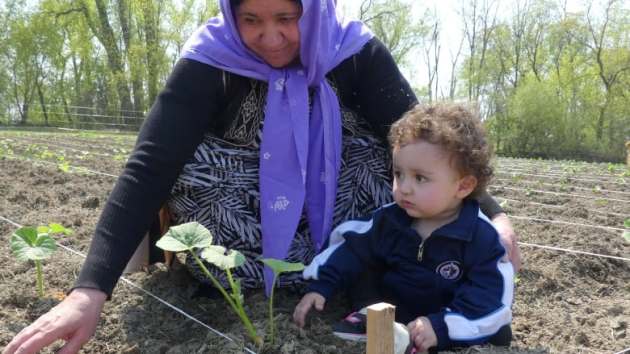
Many of the Yazidi newcomers were farmers. So an idea sprouted for refugees and volunteers to farm potatoes on less than an acre of donated farmland near Portage la Prairie, an hour west of Winnipeg.

The project yielded about 315 kilograms of potatoes last fall.

The hope is that members of the Yazidi refugee community will also be able to sell extra produce at local farmers markets. (Angela Johnston/CBC)

This year, the initiative is much larger.

More than 50 families are farming approximately eight acres of land in nearby St. François Xavier. They’re expecting to harvest about 5,400 kilograms of potatoes, plus dozens of other crops — enough to feed about 250 people for months, and to sell what is left over at local farmers markets.

The goal is for the farming project near St. François Xavier to produce enough food to feed at least 250 people for months, including more than 50 Yazidi families. (Angela Johnston/CBC)

Bo Wohlers, president of Shelmerdine Nurseries, donated this year’s land. He’s a congregant of the Charleswood United Church, which is working with Operation Ezra.

“I thought they deserved a good start in Canada, so we offered the land,” he said.

Refugees can ‘come together as a community’

Aziza says in a world where government-assisted refugees face so many challenges, including language, banking and transportation, to name just a few, the farming project is where they can be themselves and work and socialize together as a community.

That sentiment rings true for Majid Haji, one of Operation Ezra’s privately sponsored refugees. He farmed for more than a decade back in Iraq.

He felt nostalgic when he got out in the field here, he said through a translator.

He was reminded of his home as soon as he touched the soil, he said — although the soil in Iraq was a ‘bit tougher.’

Yazidi refugee Majid Haji says he farmed for more than a decade back home in Iraq. (Warren Kay/CBC)

An official with Immigration, Refugees and Citizenship Canada said the government has resettled more than 1,400 ISIS survivors since 2016, with Yazidis making up more than 85 per cent of that group.

Aziza says Operation Ezra plans to sponsor even more families, and to keep growing the farming program as well.

He thinks the refugees and volunteers could work up to 20 acres next year.

Adol Ilyas says she isn’t thinking that far ahead. She’s still focused on this year’s harvest — and looking forward to harvesting the crops and feeding families.

Source: Farming project helps Yazidi refugees return to roots

How Syrian refugees to Canada have fared since 2015

Early indications for Syrian refugees. Given timing of Census (about a year after arrival), too early to draw definite conclusions. However the longer term analysis of refugee economic outcomes, broken down by private sponsorship and government selected, along with country of birth, are more interesting and informative:

The life of a refugee can be many things—dangerous, wearying, heart-rending, boring, nerve-racking, expensive and full of countless unexpected challenges to overcome. It also appears to be quite noisy.

Right now, for instance, the Kitchener, Ont., apartment of Jehad and Baraa Badr is cacophonous—much of it baby noise. Their older son, Hussam, has dropped by with grandson Zain for a playdate with a neighbour’s young child, who is also visiting. Younger son, Adam, makes his own contribution to the din. As do various electronic devices: some reminders for prayer time, others bringing texts and phone calls from friends and family. Rising above all this clamour, however, is Jehad’s exuberant account of the wonders of life in Canada, his gratitude for the help his family has received so far and his many plans for the future.

“I love being here. I love my friends. I love Canada,” he says loudly and with enthusiasm, his expressive body language making up for obvious struggles with language. “Good equality in Canada. Good government. No Syria government. No help.”

After spending three years in Egypt and Turkey—having left war-torn Syria behind in 2012—Jehad, Baraa and nine-year-old Adam arrived in southwestern Ontario in spring 2016 as part of the massive wave of Syrian refugees admitted into Canada following the last federal election. Hussam and his young family arrived a month later. Two other sons, however, will never arrive. Frustrated by the long wait in Egypt, they paid smugglers to take them across the Mediterranean Sea to Italy and then made their way to Austria, where they now live permanently.

This separation of their family is just one of the many tests the Badrs have had to endure since fleeing their homeland. As with the rest of the more than 50,000 Syrian refugees who have arrived in Canada since 2015, settling into Canadian society requires grappling with the many cultural nuances and obligations of their new home. But most significantly, it means mastering a new language and finding employment. “I need a job,” says Jehad, 59, in his halting, declarative style. “I need English. But job and school? Problem.” It is a problem with both personal and political implications.

If there was a single defining issue of the 2015 federal election, it was debate over the proper national response to the Syrian refugee crisis—a question seared into our collective consciousness by that heart-wrenching photo of young Syrian refugee Alan Kurdi’s lifeless body being carried away on a Turkish beach.

Demands for a political response to the humanitarian emergency immediately changed the course of the federal campaign. Prime Minister Stephen Harper said his government would take a total of 10,000 additional Syrian refugees—arguing that to accept any more would create security risks—while maintaining Canada’s military presence in the Middle East as a check on further crises. Liberal Leader Justin Trudeau upped this to 25,000 refugees by the end of the year, and vowed to withdraw our squadron of CF-18s. NDP Leader Thomas Mulcair topped both of his competitors by saying he’d accept 46,000 over several years, as well as end Canada’s military contribution.

In the end, Canadian voters apparently found Trudeau’s offer of 25,000 refugees the most persuasive. And while he failed to make good on his initial deadline, the Prime Minister’s goal was realized by mid-2016. Since then, the flow has slowed but is nowhere near stopping. The most recent count of Syrian refugees admitted into Canada since the election stands at 58,650, exceeding even Mulcair’s highest bid. For this effort, Canada has earned many admirers. “Thank God for Canada!” read a headline in the New York Times this year, lamenting the fact America under President Donald Trump had accepted only 12,000 Syrian refugees.

But taking in large numbers of refugees to widespread international acclaim is one thing. Integrating them successfully for their own happiness and well-being, and to prevent any urgent political or social issue, is quite another. With nativist sentiment rising around the world, and with the emergence of irregular refugees as a new hot-button political issue in the upcoming federal election, it seems both appropriate and necessary to check on the progress of the class of 2015/16. So how are Canada’s Syrian refugees doing?

Statistics Canada recently took a close look at that first cohort of 25,000 Syrian refugees who landed as of May 10, 2016. Employment is the most important metric by which to gauge the integration of refugees into Canadian society. And here the news seems rather disappointing. Only 24 per cent of adult male Syrian refugees were working, according to census data. For government-sponsored male refugees (as opposed to those sponsored by charities, churches or other private organizations), the employment rate was a mere five per cent. These figures are substantially below the 39 per cent average for male refugees from other countries. The gap between female Syrian refugees and those from other countries is equally significant: eight per cent versus 17 per cent.

Such low rates of employment are largely explained by the demographics and timing of the Syrian refugee cohort. In response to the humanitarian crisis, Canada adjusted its acceptance criteria to include more young families with children and fewer working-age males. Standards for language skills and education were also lowered. More than half the Syrian refugees could not speak an official language, compared to just 28 per cent of refugees from other countries. Among adults, less than half had even a high school diploma. (Neither Jehad nor Baraa Badr are high school graduates.)

For Bessma Momani, professor at the Balsillie School of International Affairs and senior fellow at the Centre for International Governance Innovation, the relatively poor performance of the Syrian refugees in finding work is entirely understandable given their profile. “Canada did a good job of targeting the most vulnerable people,” she says. “This group includes semi-skilled and mostly uneducated people. Some were also injured.” It makes sense that a group chosen for humanitarian reasons would take longer to find their footing in a new country than migrants selected for their employability, she says. Plus, it’s still early days. Many of the Syrian refugees had been in Canada for only a few weeks or months when the census was taken. It would be a supreme accomplishment for anyone to have found a job and learned a new language in such a short time.

As for political fears raised during the 2015 election about security risks and the national capacity to absorb such a large influx of refugees, Momani notes time has proven such claims misplaced. “Canada is a big country with a lot of capacity,” she says. “The debate between 10,000 and 25,000 was really just an arbitrary distinction since we have now taken in over 50,000.” And she highlights how popular providing aid to Syrian refugees proved to be among voters. “I think that surprised many Canadian politicians,” she adds.

Syria’s diaspora may no longer be the dominant political topic in Canada, but refugees remain a key election issue—except that now it’s marked by a growing note of skepticism. After years of pressure from federal Conservatives over the influx of more than 40,000 irregular refugees through unauthorized border crossings, mostly in Quebec, the Trudeau government is now adopting a much tougher stance toward these asylum seekers. The 2019 federal budget, for example, proposes to take away their right to a full refugee hearing; it also boosts funding for border measures to “detect and intercept individuals who cross Canadian borders irregularly.” These irregular border-crossers are mostly from Africa and the Caribbean, not the Middle East.

In another recent development signifying a change in mood toward refugees, the 2019 Ontario budget eliminates all legal aid funding for refugee and immigration programs.

As for the long-term consequences of Canada’s mostly generous approach to refugees, another recent StatsCan study looked at all 830,000 refugees who entered Canada between 1980 and 2009 and found their employment and earnings tend to improve slowly over time, but with some significant variations. Refugees who were privately sponsored seem to do better than those sponsored by the federal government, but this difference evaporates after about a decade.

One puzzle that appears permanent, however, is the role played by culture in the integration process. After 15 years in Canada, StatsCan notes that refugees from certain countries (Yugoslavia, Poland, Colombia, Vietnam, Cambodia, Laos and El Salvador) had earnings largely indistinguishable from immigrants accepted on strict economic criteria. But refugees from some other countries (Iraq, Somalia, Afghanistan, Pakistan and China) appear to do noticeably worse, even after accounting for factors such as education, language skills and age. StatsCan admits it has no real answer as to why such differences persist.

It is perhaps too soon to tell which category the Syrian refugees will fall into, but the early figures show those who arrived in late 2015 are already more likely to have a job than those who came a few months later, suggesting a fairly rapid process of integration. “I think we’ll see a lot of new small businesses coming out of this group of Syrian refugees,” says Momani, noting anecdotally that the national shawarma shop sector appears to be undergoing substantial growth. “I suspect by the next census, the numbers [of employed Syrian refugees] will have greatly improved. There is a lot of early success out there.”

Of course the biggest barrier to early success in the job market remains language. And this often requires some difficult choices for newcomers to Canada.

Shortly after arriving in southwestern Ontario, Jehad [Badr] enrolled in an English language school located in the basement of Waterloo’s First United Church, which supported his family’s refugee claim. “First six months, I go to English school. But I need job. I have rent. You need money,” says Jehad, who owned an auto upholstery repair shop back in Syria.

Mounting bills and a gnawing desire for independence eventually convinced him to drop out in favour of a job at a local patio furniture manufacturer. “I wish I go back to school. Maybe when I am old man,” he laughs. Sometimes Jehad answers questions twice, first in Arabic to his son Hussam, who acts as a language coach, and then again in English.

In contrast, Baraa, 49, has stuck with her language training and is now close to graduating. “When I am done, maybe I study more or look for a job,” she says.

Having chosen work over study, Jehad has already weathered two layoffs in the past two years as a result of the seasonal nature of the patio furniture business. A monthly $3,000 stipend from the church has long since run out and now rent consumes more than half his income. But he remains determined to pay his own way. Responsible for reimbursing the federal government for the cost of his family’s flight from Turkey, Jehad declined the option to pay it back at the modest rate of $9 per month.

“The government got $200 every month. Finished. No debt,” he states proudly, wiping his hands together. To supplement his income, he has also been doing small upholstery jobs on the side. And to save on expenses, he has discovered the wonders of Kijiji. “Six chairs and table. Twenty-five dollar!” he exclaims in disbelief, pointing across his small but homey apartment to his family’s “new” dining room set.

Independent, proud, hard-working and frugal. In many ways, Jehad already seems plenty Canadian. Perhaps the fact the enormous influx of Syrian refugees no longer constitutes a federal election issue can be partly ascribed to Jehad’s impressive work ethic and gregarious nature. As well as his family’s determination to fit into Canadian society. (They will be applying for citizenship shortly.) He even claims to love winter.

“In Syria, when winter comes one day, we drive 50 kilometre to see ice and snow. Everyone excited. Here… ” Jehad tails off, searching for the words to explain how Canadians don’t seem to get quite as excited about the cold stuff. But you get the sense he’ll eventually figure it out. A new home always takes some getting used to.

Source: How Syrian refugees to Canada have fared since 2015

Liberals end ‘unfair’ policy that penalized refugees from so-called ‘safe countries’

Not much left of these measures between court decisions and Liberal policy changes, will see what Andrew Scheer says in his forthcoming policy speech on immigration:

The Liberal government has killed a controversial Harper-era initiative that did not afford all refugees the same rights and instead penalized those who came from so-called “safe countries” like the United States.

Starting immediately, Canada will remove the tight timeframe for their claims to be heard and let them appeal possible rejections, as well as grant them the right to work immediately and receive health care — benefits previously bestowed only on asylum seekers fleeing from war-torn countries and corrupt regimes.

“The system is unfair and treats people differently based on nationality,” Immigration Minister Ahmed Hussen told the Star in a phone interview Thursday. “The policy hasn’t worked. It was meant to introduce efficiency, but it has created the opposite effects. It’s time to go.”

The move by Ottawa follows several Federal Court decisions over the years that have chipped away at the core provisions of the so-called “safe country” policy introduced in 2012 by Stephen Harper’s Conservative government to target rising asylum claims from Eastern Europe and Mexico. The government established a list of safe countries and created a faster processing and removal system for claimants from these nations.

The Liberals’ decision to eliminate the safe country list, to be made public Friday, officially strikes down the last remaining planks of their predecessor’s controversial revamp of the refugee asylum system.

The original reforms aimed to deter “bogus claimants” whose lives weren’t in danger, but who came to Canada for economic opportunities. However, the changes failed to stem the flow of migrants and the Conservatives did not invest the necessary resources to manage the new system.

Refugee claims from these countries were not being processed any faster, said Hussen, and added additional burden to the asylum system that was further stretched over the past two years as a result of a surge of claimants crossing into Canada from the U.S.

“We are getting rid of the last piece of the policy that is responsible for creating the legacy backlog,” said Hussen. Under the safe country regimen, refugees from the list were given limited time for claims to be heard, had restricted access to appeals and health coverage, and faced quick deportation — which the court has ruled violated the Charter of Rights and Freedoms.

Critics have long noted that people from so-called safe countries can still face persecution at home due to sexual orientation, ethnicity and religion, and for a variety of reasons their countries can fail to protect them. They also complained the statutory timelines to process safe country claims were unreasonable and created chaos and further backlogs because the previous government did not put in enough resources to let the refugee board do its job.

The safe country list initially included 23 countries and has since been expanded to 42, including the United States, Czech Republic, Hungary and Mexico.

Hussen said improving the efficiency of the asylum system has always been part of his mandate since being appointed immigration minister in 2017. Under his watch, an independent review of the system was completed, an asylum management board was established to oversee the system, the legacy backlog was cleared and additional resources were pumped in to boost the refugee board’s processing capacity.

The removal of the safe country list, however, has no impact on the bilateral Safe Third Country Agreement with the U.S., which bans refugees from third countries coming through the United States and seeking asylum in Canada at the official ports of entry. These so-called irregular migrants can still seek asylum in Canada if they manage to sneak in and meet exemption requirements — and be processed like all refugees.

In 2018, the federal government invested $74 million over two years to hire 64 refugee judges and 185 support staff to handle the ballooning backlog, which reached 74,000 cases as of the end of March. As part of the 2019 federal budget, Ottawa has added more resources to boost the board’s operation to allow it to process up to 50,000 asylum claims and 13,500 appeals a year by 2021.

Immigration officials said only 12 per cent of asylum claims submitted from Jan. 1, 2013 to March 31, 2019 were from citizens of the designated safe countries.

Source: Liberals end ‘unfair’ policy that penalized refugees from so-called ‘safe countries’

More resources needed for federal agencies processing refugee claims: AG

No surprise here, reflecting some long-term and ongoing issues:

Canada’s refugee and asylum system will continue to be overwhelmed if additional resources are not committed to the three federal agencies responsible for processing refugee claims, the country’s auditor general said Tuesday.

“We project that if the number of asylum claimants remains steady at around 50,000 per year, the wait time for protection decisions will increase to five years by 2024 — more than double the current wait time,” interim Auditor General Sylvain Ricard said in his spring report.

The current backlog, the auditor general said, is “worse than in 2012,” when a mountain of unresolved claims led the Harper government to reform the system.

The federal watchdog said in December last year that some 71,380 people were waiting for their claims to be heard. In March 2010, that number was 59,000.

Canada was the ninth-largest recipient of refugee and asylum claimants in 2017, with some 50,400 claims filed, a number that jumped to 55,000 in 2018.

About 40,000 of those asylum claimants came via the United States, with most crossing into Quebec.

The surge of claimants has put additional pressure on a system that has long grappled with processing delays, the auditor general’s office said — a crunch that is expected to continue if funding levels and processing capacity remains the same.

“Overall we found Canada’s refugee determination system was not equipped to process claims according to the required timelines,” the report notes.

Long wait times

At the end of December 2018, the auditor general’s office said the average wait time for a decision in Canada was two years. As of 2012, refugee claimants are supposed to have a hearing scheduled within 60 days of their arrival in Canada. 

In the March 2019 budget, the Trudeau government pledged $1.18 billion over five years for Canada’s strained refugee claimant system.

“Budget 2019 did provide additional resources to enhance the capacity of the system but it was not clear exactly how it’s going to deal with the backlog and reduce the wait times for claimants,” said Carol McCalla, the principal director of the auditor general’s report on processing asylum claims.

About 65 per cent of claimants have seen their hearings delayed at least once, the auditor general said — an action that led to an additional five-month delay, on average. 

About 25 per cent of claims made saw multiple delays, the auditor general said, noting most of the holdups were “due to administrative issues within the government’s control.” 

In almost half of the cases, hearings were delayed because a member of the Immigration and Refugee Board of Canada was unavailable. 

Another 10 per cent of cases were stalled because security screens were still being processed, even though the necessary paperwork had already been filed in one in five of the cases delayed for security reasons.

CBSA has since reallocated resources to “significantly improve the timeliness of security screening,” the auditor general’s report noted.

Canada’s refugee processing system isn’t utilizing available fast-tracks, either — processes that allow the Immigration and Refugee Board of Canada to decide certain claims by simply reviewing a file rather than hold a hearing. 

The auditor general found the board only expedited about 25 per cent of eligible cases, even though 87 per cent of the remaining eligible cases eventually received a positive outcome. 

“Moreover, we found the Board did not process expedited claims more quickly,” the report said. “On average decisions for expedited claims took about the same amount of time as regular claims.” 

The board, the auditor general noted, announced changes to its expediting processing system in January.

Missing security checks

Processing delays weren’t the only issue flagged by Canada’s auditor general Tuesday. 

Canada’s federal watchdog also found poor quality assurance checks between Canada Border Services Agency and the federal immigration department meant about 400 applicants (or 0.5 per cent) were not subjected to the necessary criminal or identity checks because of system errors or failure to take claimants’ fingerprints. 

“Neither organization systematically tracked whether a criminal records check was always completed because of poor data quality,” the report reads, adding those records are “important for public safety and the integrity of the refugee determination system.”

In a statement Tuesday afternoon, Public Safety Minister Ralph Goodale’s office said initial screening by CBSA of individuals arriving in Canada include biometric and biographic screening.

“This layer of screening screens out individuals with serious criminality. No individuals with serious criminality or security concerns were allowed into admitted to Canada,” Goodale’s office said.

“With respect to the layer of biometric screening examined by the Auditor General, the only new piece of information captured by this layer of screening is whether or not an individual had previously claimed asylum in another country.”

Poor data quality wasn’t the only concern flagged by the auditor general’s office.

Canada’s federal watchdog said poor communication between the three organizations responsible for Canada’s asylum claim system was made worse by the fact the CBSA, the federal immigration department and the Immigration and Refugee Board of Canada use “different information technology systems, with limited interoperability.” 

As a result, the auditor general said it found “important gaps in which information was not shared, such as changes to hearing dates.”

“The system needs to be more flexible to be able to be scalable to increases in demand. As well, improvements are needed in how it uses its resources to share the information and processes the claims more efficiently,” McCalla said.

All three organizations also remain heavily dependent on paper and faxes to share specific claim information, the auditor general said, with the Immigration and Refugee Board of Canada relying “almost exclusively on paper files in its work.” 

“Collecting and sharing information securely and efficiently are critical to the proper processing of asylum claims, especially when claim volumes are high,” the report noted.

In response to the auditor general’s report, all three organizations pledged to improve their quality assurance programs. “Through regular monitoring, issues such as missing, delayed, incomplete, or ineligible claimant information will be identified and addressed in a timely manner by the responsible organization,” reads a statement attributed to the organizations in the report.

Additional work will also be done to improve the department and agency’s technological capabilities, they said, including an eventual shift to digital processing.

Source: More resources needed for federal agencies processing refugee claims: AG

Ontario asks federal government for $45-million to fund legal aid for refugees, immigrants

Pre-federal budget political positioning as much as substance:

Ontario Attorney-General Caroline Mulroney is calling on Ottawa to fully fund a $45-million provincial legal-aid program for immigrants and refugees in Tuesday’s federal budget.

In a letter sent to the federal ministers of justice, immigration and finance, Ms. Mulroney says costs associated with providing immigration and refugee services has “increased significantly” in Ontario as a result of federal government policies.

“Ontario must ensure we have a stable and sustainable system. Let me be clear, this was a federally created challenge, and one our government has called on you previously to fix,” Ms. Mulroney wrote in the letter sent Friday to Justice Minister David Lametti, Immigration Minister Ahmed Hussen and Finance Minister Bill Morneau.

“As you table your budget, I am confident that you will see the need to properly fund Ontario’s legal-aid program, and recognize that the failure to do so will place hardships on those who rely on this system.”

The latest salvo in the battle between Ontario’s Progressive Conservative government and the federal Liberals over the costs associated with immigration and refugee claimants comes as Ottawa is set to table its pre-election budget on Tuesday.

While the number of asylum seekers has been steadily decreasing over the past few months, the Immigration and Refugee Board (IRB) – the arm’s-length body that adjudicates refugee claims – has struggled to keep pace with the number of new cases being added to its backlog of files.

Ontario Premier Doug Ford’s government has already demanded that Ottawa foot a $200-million bill to cover the costs of resettling thousands of asylum seekers crossing into Canada from the United States. And Toronto recently said its proposed 2019 municipal budget will only be balanced if the federal government offers up $45-million to cover the costs of housing the influx of refugee claimants in the city’s shelter system.

Pierre-Olivier Herbert, a spokesman for Mr. Morneau, said the federal government recognizes the importance of proper funding for legal aid. Since 2016, he said, the federal government has increased its contribution for immigration and refugee legal-aid services in six provinces by more than $22-million.

“Our government understands that immigration plays an important role in driving our economy and has contributed to our success as a country. While the Conservatives continue to try to divide Canadians, by promoting fear and misinformation, we will continue to defend our immigration system,” he said.

Legal Aid Ontario, which is responsible for providing legal services to low-income Ontarians, estimates it will spend $45-million this year to deliver its immigration and refugee program, which includes IRB hearings and appeals to federal court. But Ms. Mulroney says the federal government is only contributing $16.9-million to the program, “leaving a shortfall of nearly $28-million that the province is expected to subsidize to support matters of federal jurisdiction.”

Last September, the federal government allocated an additional $10-million to Ontario, on top of a previously committed $7-million.

A report released last December from Ontario’s auditor-general, Bonnie Lysyk, shows Ontario’s portion has risen from $19.3-million in 2014 to $28.4-million in 2018.

The report said Legal Aid Ontario has “faced challenges managing the increase in refugee and immigration cases without a known increase of funding from the federal government,” noting that Ontario receives a lower federal funding portion than other provinces.

It also found Legal Aid Ontario’s “rushed decision-making” in expanding eligibility for certificates contributed to $40-million in deficits over the past two years. A certificate allows a client to retain a private-sector lawyer on one of Legal Aid Ontario’s rosters.

Ms. Mulroney recently named a former Progressive Conservative attorney-general, Charles Harnick, as the new chair of Legal Aid Ontario.

Source: Ontario asks federal government for $45-million to fund legal aid for refugees, immigrants

Islamic State extremism on show at “miserable” Syria camp

Reminder of need for caution regarding wannabe returnees:

AL-HOL CAMP, Syria, March 8 (Reuters) – Foreign women with Islamic State have tried to assault others they deem “infidels” at a camp where they are being held in northeast Syria, attempting to impose their views even as the jihadists are facing territorial defeat, Reuters journalists visiting the site have found.

“They yell at us that we are infidels for showing our faces,” said a Syrian woman at al-Hol camp, where women and children were transferred from Islamic State’s final bastion in eastern Syria. “They tried to hit us.”

The Baghouz enclave is Islamic State’s last shred of populated territory after years of attacks have rolled back its ultra-radical “caliphate” in Syria and Iraq.

But its impending defeat is confronting the U.S.-allies Syrian Democratic Forces (SDF) with the problem of what to do with growing numbers of people, many of them Islamic State followers, emerging from the enclave.

Most have been sent to al-Hol camp, already overcrowded with uprooted Syrians and Iraqis. Camp officials say they do not have enough tents, food, or medicine. Aid workers warn of spreading diseases, and dozens of children have died on the way there.

At least 62,000 people have now flooded the camp, the United Nations said on Friday, way above its capacity. More than 90 percent of the new arrivals are women and children.

The Syrian Kurdish authorities who control the camp have cordoned off the foreign women. On Friday, dressed head-to-toe in black and wearing full face veils, they gathered behind a fence with a locked gate.

“The foreigners throw stones. They swear at the Syrians or Iraqis and at the camp officials. Even the kids make threats,” said a security official at the camp.

‘WE NEED HELP’

Guards have fired in the air to break up a few fights and on one occasion used a taser to pacify a foreign female jihadist detainee, another Syrian woman at the camp said.

Some of the women coming out of Baghouz in recent weeks have displayed strongly pro-Islamic State sympathies.

Hundreds of jihadists have also surrendered. But the Kurdish-led SDF believes the most hardened are still inside, ready for a fight to the death.

Before the final assault on Baghouz, the SDF said it was holding some 800 foreign Islamic State militants and 2,000 of their wives and children. While it has not given updated figures, the numbers have ballooned, prompting fresh calls for support.

“The situation in the camp is very miserable. The displaced are growing very much and we are trying to cover people’s needs as much as we can. But we need help,” said Mazin Shekhi, an official at the camp.

When young children arrive alone, officials deliver them to aid agencies or try to find adults to care for them at the camp for now, he added.

“Even the big tents are full. People are sleeping out in the open.”

The International Rescue Committee said at least 100 people have died, mostly children, en route or soon after reaching the camp, and more than 100 children have arrived on their own. The aid agency warned the camp had reached breaking point.

Women from different countries begged for food or asked about their detained husbands, while young boys kicked a ball around in the dirt amid scores of tents swaying in the wind.

CAMP SKIRMISHES

Some of the tensions at al-Hol reflect friction that has simmered for years between jihadists who travelled to Syria to join Islamic State, “al-Muhajirin”, and locals who were members or lived under its rule.

“There were problems with some people,” said a 30-year-old woman from Turkestan who gave her name as Dilnor.

She said her entire family had moved to Syria to escape oppression at home and “just wanted to live under the caliphate”. Her mother, father and siblings all followed her to Syria.

“The natives … they were kind of rude. They always said the muhajirin are a problem and dirty and so on. It was always like that,” she said outside the wire fence of the pen where she was staying with scores of other women.

“Now (they) are alone, and the muhajirin alone. Now there are no problems.”

Shekhi, the camp official, said foreign women with ties to Islamic State had been kept apart so “they don’t mix” with others. “We put them in a section alone to avoid them making problems with the displaced,” he said.

The foreign women often fought among themselves, he added.

“There are some who are more extremist who don’t accept others. This is happening just among themselves, because they are separated from the Syrians and Iraqis,” he said. “The situation is under control.”

The staunch loyalties of Islamic State followers point to the risk the group will continue to pose after the capture of Baghouz. It is also widely accepted that the militants will still represent a threat, holding remote patches of territory and mounting guerrilla attacks.

Source: Islamic State extremism on show at “miserable” Syria camp

How Canadians opened their hearts to refugees

Nice historical piece regarding the origins of the private sponsorship program and the pivotal role Mennonites played in its creation:

Few government contracts have stood the test of time as well as a simply worded deal between Canada and its people that has not only lasted four decades but continues to bolster the country’s reputation for compassion.

The 11-page sponsorship agreement, signed between Ottawa and the Mennonite Church on March 5, 1979, in response to the “boat people” crisis, became the blueprint for Canada’s private refugee resettlement program that has allowed Canadians to play an active role in helping refugees start a new life here.

“My family and I wouldn’t be here without it,” said Ka Lee-Paine, who was born in a refugee camp in Thailand and came here at age 2 with her family in 1979, among the first wave of people accepted under the private refugee sponsorship program.

“We had complete strangers helping us out. The sponsorship meant I could have a good life, get a great education and be a strong woman,” added the now 42-year-old Kitchener teacher. “Ninety-nine per cent of us do understand how fortunate we are to have made it to Canada and we strive to be productive citizens of this country.”

With the help of groups such as the Mennonite Central Committee serving as guarantors and administrators, Canadians have brought almost 350,000 refugees to Canada by providing the newcomers with at least one year of financial and social support.

During the Syrian refugee crisis, Canada has seen a renewed interest in private sponsorships, which accounted for half of the 60,000 Syrians resettled here; the rest were sponsored by the federal government.

Organizations that have sponsorship agreements with the federal government handle applications from individual community groups, who in turn are responsible for raising funds to support the refugees during their first year in the country as well as creating a social network to help them navigate their new lives and find housing and jobs. There are now more than 100 sponsorship agreement holders, mostly faith groups, across Canada.

The mass exodus of Indochinese refugees was sparked by the fall of Saigon on April 30, 1975. As American soldiers were evacuated from the South Vietnamese capital, Communist troops from the north swept in, hoisting their flags and spreading panic.

Hundreds of thousands of desperate people from Vietnam, Cambodia and Laos fled to neighbouring countries by boat. Many didn’t make it, either drowning at sea or being attacked by pirates. Others ended up languishing for years in overcrowded refugee camps.

In 1978, Ottawa passed a new immigration law with a provision to allow private sponsorships if Canadians would accept full responsibility for the refugees for a year.

But there were no takers, said Mike Molloy, who was director of refugee policies in the Immigration Department at the time.

“Refugee advocates and churches were speaking against it and intimidating others not to get involved. There wasn’t a single sponsorship application coming in,” recalled Molloy, 74, who officially retired from the federal service in 2003.

“The Mennonite Central Committee was a gift. They came to us in late 1978 with a clear altruistic motivation. As a faith community that came here as refugees, they were confident and pragmatic. They played straight with us and we played straight with them.”

Canada had welcomed more than 21,000 Mennonite refugees from Russia in the 1920s and another 8,000 from Eastern Europe after the Second World War, and the community was eager to play a part in helping the boat people, said Bill Janzen, who was tasked by the Mennonite committee with negotiating the deal with Ottawa in 1979.

“Our community was experienced in helping refugees get settled with jobs and a place to live. We had been active with our aid work in Vietnam since 1954. We sympathized with those fleeing from Communist totalitarian regimes,” said Janzen, 75, who was MCC’s office director in Ottawa in 1979.

“It’s human nature to imagine the worst-case scenario and worry about any legal problems, health and financial needs of the people they sponsored. That’s why we decided to step up as an organization for them to fall back on and help them overcome the fear of liability.”

With a mandate from his board to make a deal with the government, Janzen asked for a meeting with senior immigration officials on Feb. 2, 1979. He arrived in Ottawa with a rough outline of what would later turn into the 11-page agreement.

Gordon Barnett, an experienced government negotiator, was Janzen’s counterpart at the bargaining table.

He said one of the sticking points of the negotiation was over the responsibility to provide language classes to privately sponsored refugees.

“It didn’t start out smoothly. Why should the government offer language classes to refugees sponsored by churches? That should be their problem,” recalled Barnett, now 75, who once belonged to a team on the Privy Council tasked with drafting the language rights for the Charter of Rights and Freedoms and who retired from the Immigration Department in 1996.

“It was a time when the Indochinese boat people were filling the news and the government was under undue pressure to do something. We were negotiating with the Mennonites and they were so willing to help. We met a few more times and the deal was signed within weeks.”

The agreement laid out the eligibility of who could be a sponsor and the criteria to be sponsored, as well as the sponsorship process, roles and responsibilities — with Ottawa ultimately agreeing to pick up the tab for language training.

The Mennonite agreement inspired groups such as the Presbyterian Church of Canada and Council of Christian Reformed Churches to follow suit. By August 1979, 28 national church organizations as well as Catholic and Anglican dioceses were on board.

By the end of that year, 5,456 private sponsorships had been received for 29,169 refugees, surpassing the 21,000 goal set by the government.

In the end, Canada would roll out the welcome mat to 60,000 Indochinese refugees in the late 1970s and early 1980s, half of them through private sponsorships.

“When I look back on my career, this agreement with the Mennonites was something I really felt good about. At the end, we had a really well-negotiated document because what we negotiated was fair,” said Barnett.

“I thought when the Indochinese refugee crisis was over, the agreement would become a historical document. I never thought it would go on forever. I’m just amazed that it stood the test of time and is still useful to this day.”

Brian Dyck, the Mennonite committee’s current national migration and resettlement program co-ordinator, said the private sponsorship program is unique in that it allows Canadians to be hands-on in helping refugees.

“You have a broad range of people in the community who bring together their social capital to the process. This has helped build Canadians’ awareness of refugee issues over the last 40 years,” said Dyck. “It helps build social cohesion and instills a stronger sense of volunteerism in Canadians.”

Source: How Canadians opened their hearts to refugees