Front commun contre les propos francophobes

More on the nature of on-line comments. My preference, rather than suppression, is requiring actual names and related authentication, as is done in letters to the editor:

Brodie Fenlon, le directeur des médias numériques pour le réseau CBC, a assuré au groupe par écrit vendredi que les commentaires identifiés seront supprimés. « Nous regrettons que ces commentaires se soient retrouvés sur notre site. Il s’agit d’une situation malencontreuse, mais inévitable lorsque l’on doit traiter un tel volume de commentaires. […] Dorénavant, nous nous assurerons que nos lignes directrices sont appliquées avec encore plus de rigueur et de jugement. » La politique de commentaires de CBC mentionne que les discours haineux, les attaques personnelles, les insultes ou encore les déclarations diffamatoires sont interdits.

En entrevue avec Le Devoir, l’instigateur de la lettre, Michel Doucet, n’est pas rassuré par cette réponse, tant s’en faut. Il exige que la CBC fasse preuve de vigilance en amont plutôt que de simplement retirer les commentaires litigieux après coup.

« Ils retirent les commentaires juste quand on les signale. Mais on ne va pas passer notre journée à surveiller le site de CBC ! C’est à CBC elle-même de veiller à la qualité du contenu », tonne-t-il. Selon l’avocat, il est inacceptable qu’une société d’État« permet[te] qu’on utilise son site de commentaires pour fomenter la division, l’incompréhension et l’intolérance vis-à-vis d’une communauté minoritaire ».

M. Doucet soutient que le phénomène existe « depuis que CBC a ouvert son site aux commentaires » et procède d’une tendance lourde. Chaque fois qu’il est question de sujets liés aux francophones au Nouveau-Brunswick, ces commentaires fusent. « L’autre jour, la ville de Dieppe a annoncé qu’elle aurait un anneau de glace et il y a eu des commentaires ! Un des commentaires qui revient souvent, c’est que les francophones ont tous les bénéfices alors que ce sont les anglophones qui payent tous les impôts. […] On mettrait une photo d’un beau petit chat portant un nom francophone que ces commentaires ressurgiraient », raille-t-il. Lui-même, un militant très en vue des droits linguistiques des francophones, est présenté dans certains commentaires comme un « individu radicalisé ».

Le sujet fait l’objet de conversations dans la communauté francophone néo-brunswickoise depuis très longtemps, raconte-t-il. Aussi, quand il a décidé de prendre la plume dimanche dernier, il a récolté ses 120 signatures prestigieuses en moins de 72 heures. C’est d’ailleurs un sénateur conservateur, Percy Mockler, outré et enflammé, qui a mis Le Devoir au parfum de la situation.

Les signataires demandent à ce que CBC ne permette plus les commentaires provenant de personnes anonymes, comme le font déjà plusieurs sites de médias. M. Fenlon rétorque dans sa lettre que cet anonymat est utile, quoiqu’il fasse l’objet d’un « examen ». « En autorisant l’utilisation de pseudonymes, on permet cependant à toutes les voix de participer au débat, y compris les victimes de crimes et les dénonciateurs d’abus, deux groupes qui, selon nous, ont de bonnes raisons de se cacher derrière l’anonymat. »
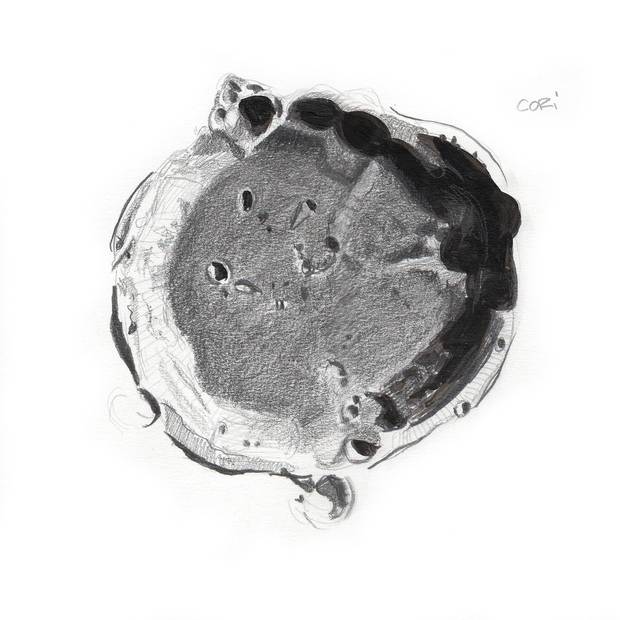
Artist draws moon’s craters named after women to illustrate inequality

web-craters09nw6Lack of historical diversity – only 27 out of 1,600 (0.02 percent):

Last year, Montreal artist Bettina Forget was looking at an atlas of the moon when something suddenly struck her as odd.

She knew the moon’s surface is pockmarked with craters of varying size. These circular depressions are the lasting record of billions of years’ worth of interplanetary bombardment dating back to the formation of the solar system. But, in a way, they also record an artifact of science and culture that hits much closer to home – because, no matter where Ms. Forget looked, the craters were named after men.

Soon, Ms. Forget found herself combing through the International Astronomical Union’s catalogue of lunar features. Of the more than 1,600 named craters on the moon, she discovered that a mere 27 honour famous women in science and space exploration.

That’s when she decided to draw all 27 by hand.

Source: Artist draws moon’s craters named after women to illustrate inequality – The Globe and Mail

The remarkably different answers men and women give when asked who’s the smartest in the class

Interesting:

Anthropologist Dan Grunspan was studying the habits of undergraduates when he noticed a persistent trend: Male students assumed their male classmates knew more about course material than female students — even if the young women earned better grades.

“The pattern just screamed at me,” he said.

So, Grunspan and his colleagues at the University of Washington and elsewhere decided to quantify the degree of this gender bias in the classroom.

After surveying roughly 1,700 students across three biology courses, they found young men consistently gave each other more credit than they awarded to their just-as-savvy female classmates.

Men over-ranked their peers by three-quarters of a GPA point, according to the study, published this month in the journal PLOS ONE. In other words, if Johnny and Susie both had A’s, they’d receive equal applause from female students — but Susie would register as a B student in the eyes of her male peers, and Johnny would look like a rock star.

“Something under the conscious is going on,” Grunspan said. “For 18 years, these [young men] have been socialized to have this bias.”

Being male, he added, “is some kind of boost.” At least in the eyes of other men.

The surveys asked each student to “nominate” their most knowledgeable classmates at three points during the school year. Who best knew the subject? Who were the high achievers?

University of Washington

To illustrate the resulting peer-perception gap, researchers compared the importance student grades had on winning a nomination to the weight of the gender bias. The typical student received 1.2 nominations, with men averaging 1.3 and women averaging 1.1.

Female students gave other female students a recognition “boost” equivalent to a GPA bump of 0.04 — too tiny to indicate any gender preference, Grunspan said. Male students, however, awarded fellow male students a recognition boost equivalent to a GPA increase of 0.76.

“On this scale,” the report asserted, “the male nominators’ gender bias is 19 times the size of the female nominators’.”

Source: The remarkably different answers men and women give when asked who’s the smartest in the class

The problem with newspapers today: the Marty Baron perspective

For those concerned about the future of media and journalism, and who liked the film Spotlight, good piece by Neil Macdonald on the assessment by Marty Baron, the former editor of the Boston Globe featured in the film:

Baron, now executive editor of the Washington Post, acknowledged the economic forces ripping the business to shreds.

Like most media managers, he has an app that shows how many readers are on any story on the paper’s website at any moment, and how long they keep reading. Those metrics are now indices of survival.

But, said Baron, news institutions must place principle ahead of metrics, or our core withers, and we become clickbait hustlers for corporate paymasters who would rather see stories about a Kardashian. (He didn’t quite put it that way, but you get the idea.)

Over dinner, I asked him how media managers in such a shaky financial environment can possibly be expected to operate without fear or favour.

Baron, who actually is as serious in person as the character played by Schreiber, put down his fork and recited a segment from a speech he regularly gives.

It is so on target that I’m going to quote its most salient passage:

“The greatest danger to a vigorous press today,” he begins, “comes from ourselves.

“The press is routinely belittled, badgered, harassed, disparaged, demonized, and subjected to acts of intimidation from all corners — including boycotts, threats of cancellations (or defunding, in the case of public broadcasting) …

“Our independence — simply posing legitimate questions — is seen as an obstacle to what our critics consider a righteous moral, ideological, political, or business agenda.

“In this environment, too many news organizations are holding back, out of fear — fear that we will be saddled with an uncomfortable political label, fear that we will be accused of bias, fear that we will be portrayed as negative, fear that we will lose customers, fear that advertisers will run from us, fear that we will be assailed as anti-this or anti-that, fear that we will offend someone, anyone.

“Fear, in short, that our weakened financial condition will be made weaker because we did something strong and right, because we simply told the truth and told it straight.”

Amen, Brother Baron.

Any reporter who has, for example, ever been based in the Middle East, or has tried to bring some sensible context to a domestic audience whipped into fear about terror, terror, terror, has often seen the mettle of his or her managers tested to the limit.

When Baron’s Washington Post, along with The Guardian, revealed U.S. government lying and law-breaking, courtesy of whistleblower Edward Snowden, public outrage was mostly directed against the newspapers and Snowden himself.

Baron made one other key point. He’s not the first one to make it, but it’s a gleam of optimistic logic in these tumultuous times: Anybody can Google anything, he said. Everyone does.

But the original information, before it is aggregated and re-aggregated a thousand times, has to come from someone with the experience, brains and training to uncover it in the first place.

That is usually the work of credentialed journalism. It’s what Baron did in Boston. The alternative is usually just spin and corporatist fantasy, and let us all hope the latter does not overwhelm the former.

Although, I have my doubts.

Source: The problem with newspapers today: the Marty Baron perspective – Politics – CBC News

Israeli novel Borderlife is cut from school curriculum, becomes bestseller

Seems like these are the kinds of novels that should be read by high school students to help them see the humanity in the other (as should comparable readings be part of Palestinian and Arab curricula):

A novel by an Israeli author about a love affair between an Israeli Jewish woman and a Palestinian Muslim man from the West Bank who meet in New York has been excluded from Israel’s regular high school curriculum, out of concern it might threaten the Jewish identity of students reading it.

The book, written by Dorit Rabinyan and known in English as Borderlife, was recommended for inclusion in the curriculum of upper high school grades by a committee advising the education ministry, which nevertheless decided against it. “Young people of adolescent age tend to romanticize and don’t, in many cases, have the systemic vision that includes considerations involving maintaining the national-ethnic identity of the people and the significance of miscegenation,” a senior ministry official said, according to Ha’aretz, an Israeli newspaper. (The Hebrew word translated by Ha’aretz as “miscegenation” can also mean “assimilation.”) The official, in other words, feared that reading the book might lead students to accept as normal romance between Jews and Muslims.

The education ministry later backtracked to some degree and said the book could be taught in advanced literature classes, but would not be part of the regular curriculum, according to Ha’aretz.

In an interview, Rabinyan describes the novel’s central romance as one in which the protagonists for the first time discover a member of their homeland’s opposite community as an individual. Hilmi, the Palestinian, is simply Hilmi, a man. And Liat “is no longer her Israeli people, her Israeli country, army, government. She’s herself.”

At the same time, Rabinyan says, every individual is shaped by the soil on which they grow, and she wanted to explore the resulting tensions when the two characters connect. “What I was looking into was the power of love to drift us into each other’s identity, and to have our mutual third identity that is born be a threat, be the one that can colour us with the loved one’s colours, and take over and maybe swallow ourselves and our original identity,” she says.

Rabinyan drew on her own past when writing the book. “I did live a year in New York. I did meet a group of young Palestinians who impressed me and really made me tick in a way that inspired me.” But she says that when writing literature, memories are not enough. “We have to add a portion of fantasy.”

The political undertones of the book might not have been Rabinyan’s primary concern, but they are unavoidable. The symbiosis of the couple, she says, is like the symbiosis of Palestinians and Israelis inhabiting the same land between the Jordan River and the Mediterranean Sea. “We have no borderlines between us, and we have no definition of our identities in ways that usually two neighbours have, and this is why we treat one another in such a way that maintains the conflict to be more than just a fight of two gangs over territory,” she says.

Instead, says Rabinyan, the conflict is defined as an existential question of identity. “It’s a matter of the Jewish DNA being threatened by the surrounding Arab culture,” and it is this fear of being swallowed that justifies—demands, even—Jews’ isolation from their Palestinian neighbours.

Source: Borderlife is cut from school curriculum, becomes bestseller

Harvard academic Todd Rose on the fallacy of averages – Macleans.ca

Although I like manipulating and understanding large groups of people, using averages, medians and the like, useful note of caution on some of the limits.

However, analysis of overall trends and groups provides an overall understanding of how different groups are doing, and a frame to understand and address individual variances:

Q: It’s apparent in The End of Average that, while you applaud personalized medicine, what really interests you is education.

A: Education and the workforce: I think these two things go together in terms of human potential. Historically, education has been about batch processing: standardize everything against the average, rank kids, sort them to see who gets more and who really doesn’t deserve to be there. The problem, even if you’re just being selfish from an economic standpoint, is we’re not producing the talent we need: companies tell me that even in their best attempts to hire people, it’s a 50/50 proposition whether that person pans out a year later. We need to develop people rather than process them. But if you accept that, there are huge implications, including a whole different organizing set of principles. Right now, for instance, we resist giving people extra time on exams or for assignments, as though it’s unfair to the faster students. Well, is the purpose of the assessment to understand what they know or to rank them against the average? The whole idea of timing tests is a century old, from a scientist who thought speed and ability were tightly correlated, which they are not. We don’t have that obsession with, say, a driver’s licence: take the test as often as you need; when you pass we’ll allow you to operate a multi-tonne machine.

Q: Are you still working on ways to personalize education?

A: Our role so far has been to clarify for the public a way of seeing this. We use the Air Force analogy: there were expensive things they had to do to get a cockpit suitable for a lot of pilots, like wraparound windshields, but their initial solutions, when they realized average didn’t work, were adjustable seats. How in the world did they not already have adjustable seats in their planes? We’re looking for adjustable seats for education, for basic things that we can do. Solutions are out there in piecemeal that need to be brought to the centre of the system. Abandon fixed-time, grade-based classes; if something is valuable, have mastery focus, where we give a flexibility in time and it’s all about getting you to competency.

Q: If your children were in high school and grading, for lack of a better term, the way you did in high school, do you have solid options that were not available to your parents?

A: Yes, but right now they’re decidedly skewed to people with money. That rubs me wrong. I care deeply about opportunity and fairness, because I grew up really poor. What motivates me is that, for the first time, we can have the knowledge to scale these kind of solutions and make them available to all. But that requires making good choices right now about the way we’ll use our technology, and the purpose we have for education. That’s not going to happen magically. We can make really bad choices and double-down on the system we have, so we have to work at it.

Source: Harvard academic Todd Rose on the fallacy of averages – Macleans.ca

With the Rise of Justin Trudeau, Canada Is Suddenly … Hip? – The New York Times

While this is largely a puff-piece, it reflects some of the rebranding taking place after the election. And in terms of the 17 Canadians it profiled in entertainment and fashion, 7 were women (41 percent) and 5 were visible minority (29 percent):

As Mr. Trudeau and his wife, Sophie Grégoire-Trudeau (along with their three young children, Xavier, Ella-Grace and Hadrien), create a Canadian Camelot, they are casting light on a wider eruption already in progress.

An expanse once stereotyped as the home to square-jawed Mounties and beer-swilling hosers has quietly morphed into a multicultural breeding ground that has given us the Weeknd, who can’t feel his face; the director Sarah Polley, who makes films of subtle power; and the upstart fashion designer Tanya Taylor, whose creations have been worn by Michelle Obama.

The rapper Drake, of Toronto, comes in for a little ribbing now and then, but none other than Jay Z called him the Kobe Bryant of hiphop. And even the latest albumfrom Justin Bieber, the pride of Stratford, Ontario (population 33,430), is — gulp! — pretty terrific.

It’s all very exciting, eh? But still … Canada? The land of hyperpoliteness and constant apology? The home of maple syrup, poutine, the gentle sport of curling and 10 percent of the world’s forests? The country that Spy magazine once said had “cultural Epstein-Barrness”?

As Joe Zee47, the Toronto-raised editor in chief of Yahoo Style, said: “There was always the feeling of being in the shadow of the U.S. For a treat we would take family trips to Niagara Falls, and I’d always want to cross the border and go to Buffalo, to go shopping! Buffalo, N.Y., was my rainbow growing up  it’s where the pot of gold was.”

“Even our national anthem sounds like a sigh: ‘O Canada,’” said the writer and editor Sarah Nicole Prickett, who was born in London, Ontario, and has written for T: The New York Times Style Magazine. “Drake, more than anyone, is the prophet who’s changing that, because, unlike a lot of talented Canadians before him, he accepts embarrassment as a cost of making big art.”

The niceness factor is something that may distinguish Canadian cultural producers. “The first month I lived in Manhattan, in the spring of 2012, I heard that I was ‘nice’ from seven people,” Ms. Prickett said. “That’s when I realized I was Canadian.” But like her confreres Grimes, Ms. Polley and the Weeknd, Ms. Prickett does not produce work that is meant to comfort.

True, Canada has delivered sultans of cool in the past. Amid the polite folk rock of Gordon Lightfoot and Anne Murray, there was the melancholy genius of Joni Mitchell, who was hip enough to win the blessing of Charles Mingus. And we would be foolish to forget the alternately sensitive and raucous Neil Young, who never met an expectation he did not defy. (“Obviously people are delighted with the change that has taken place,” Mr. Young, a California resident, said after Mr. Trudeau’s election. “It’s very positive news.”)

And let us not ignore the coolest cat in a hat, Leonard Cohen, still capable of multiple encores at 81.

Then there are the Canadian kings and queens of comedy like David Steinberg, Lorne Michaels, Mike Myers, Martin Short and Catherine O’Hara, who started out as foils to mainstream American pop culture and ended up shaping it.

Canadians have always been funny, according to the Toronto-born editor of Vanity Fair, Graydon Carter. “S.­J. Perelman used to think that Stephen Leacock was the funniest writer in the world,” Mr. Carter said, referring to the multifaceted author who moved to Canada from his native England at age 6. “And he was. The trouble is, the self-deprecation so regularly on display is often lost on Americans. Now Marty Short is the funniest person in the world — although he’s far too modest to admit it.”

Mr. Zee agrees that Canada has not become hip all at once, with the election of the mediagenic Mr. Trudeau. It is partly a dawning of self-recognition.

“We’ve always had Frank Gehry,” he said.

Source: With the Rise of Justin Trudeau, Canada Is Suddenly … Hip? – The New York Times

ICYMI: I Asked A Computer To Be My Life Coach – Going Beyond Word Clouds

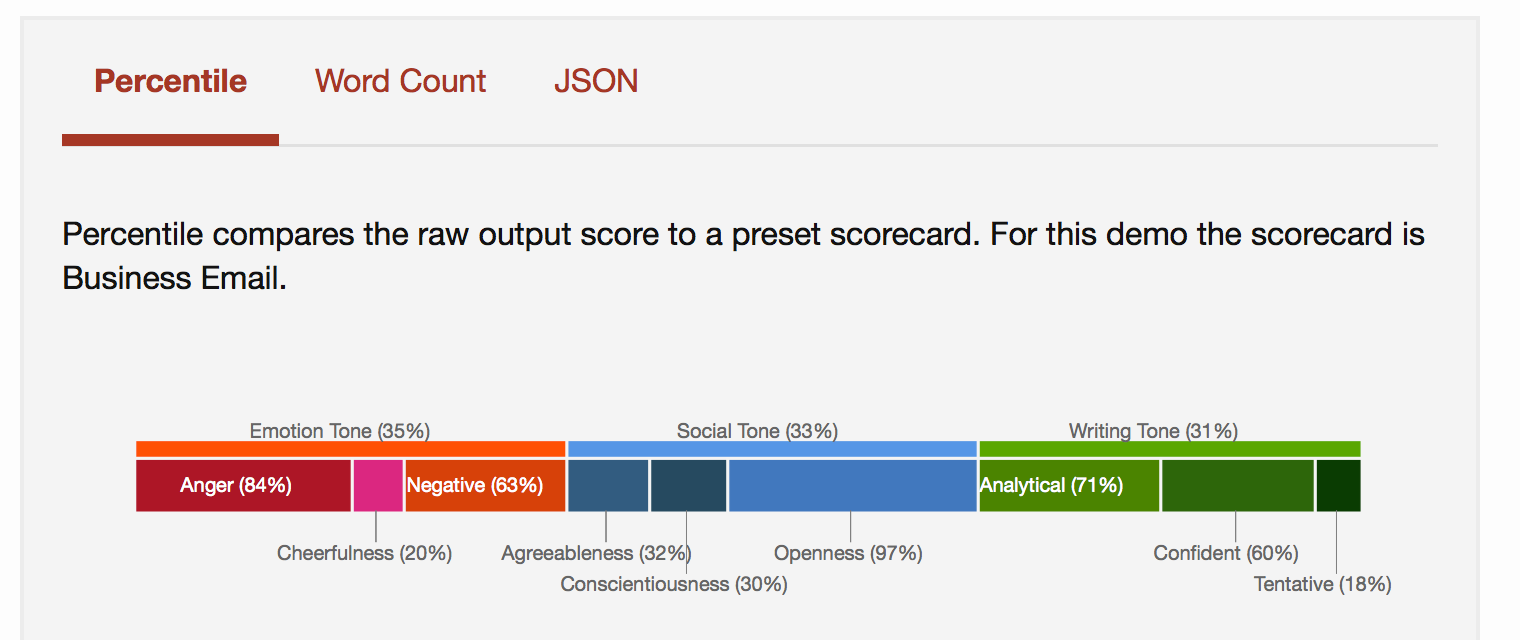
IBM Tone_AnalyzerThis is an interesting application of big data.

For fun, I tried the demo, which is based upon a business email model, on my post, Implementing diversity and inclusion in Parliament: A more complete picture | My piece in the hilltimes.com.

The above analysis was the result. Readers may wish to experiment with their own texts:

The words you use betray who you are.

Linguists and psychologists have long been studying this phenomenon. A few decades ago they had a hunch that the number of active verbs in your sentences or which adjectives you use (lovely, sweet, angry) reflect personality traits.

They have painstakingly pinpointed various insights. For example, suicidal poets, in their published works, use more first-person singular words (like “me” or “my”) and death-related words than poets who aren’t suicidal. People in positions of power are more likely to make statements that involve others (“we,” “us”), while lower-status people often use language that’s more self-focused and ask more questions. Comparing genders, women tend to use more words related to psychological and social processes, while men referred more to impersonal topics and objects’ properties.

(This 2010 paper in the Journal of Language and Social Psychology goes into great detail about the “psychometrics” of words.)

This research suggests that Internet companies such as Facebook and Google, with their troves of written expressions, are sitting on powerful insights about us as people. But if you ask them, “Hey, can you give me the take on me that you’ve got in-house or that you’ve built for advertisers, with my anonymized data?” — they won’t give it to you. I actually did ask, and they don’t have that kind of offering.

But I’ve found someone who does: IBM’s Watson division. Researchers there have taken the personality dictionaries already created by scientists, dropped them into Watson (the computer that won Jeopardy!), and sent it off to apply it to people on Twitter, Facebook, blogs. That forms a digital population of people and personality types. Over time, more text from more people will help Watson get smarter. (Yes, this is machine learning.)

In its own studies, IBM found that characteristics derived from people’s writings can reliably predict some of their real-world behaviors. For instance, people who are less neurotic and more open to experiences are more likely to click on an ad, while people who score high on self-enhancement (meaning, seek personal success) like to read articles about work.

For IBM, these kinds of interpretations can become a business opportunity.

Understanding people to sell them things is obviously a very big business for marketers. IBM senior researcher Rama Akkiraju suggests other uses: by public relations firms looking for journalists who sound friendly on a specific topic; by editors who want their writers to set a certain tone; by employers looking for a worker who fits their corporate culture.

“We’re moving to make it easier for people to consume insights,” she says.

This use of Big Data, of course, raises serious privacy concerns, which we have examined in many stories. In this exploration, I decided to take a deep dive into Watson’s personal insights — what they can teach me about my career choices and my love life (yep, really went there).

Source: I Asked A Computer To Be My Life Coach : All Tech Considered : NPR

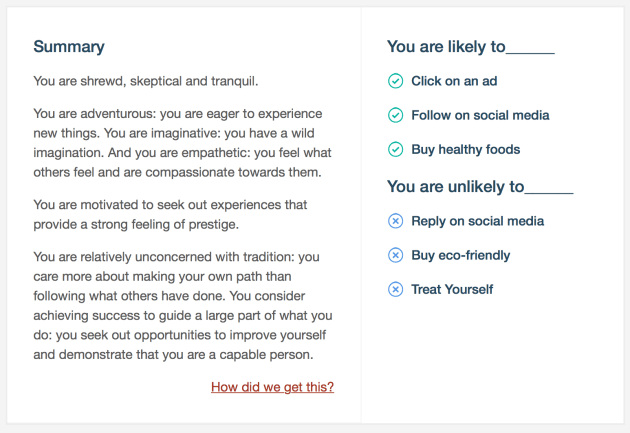
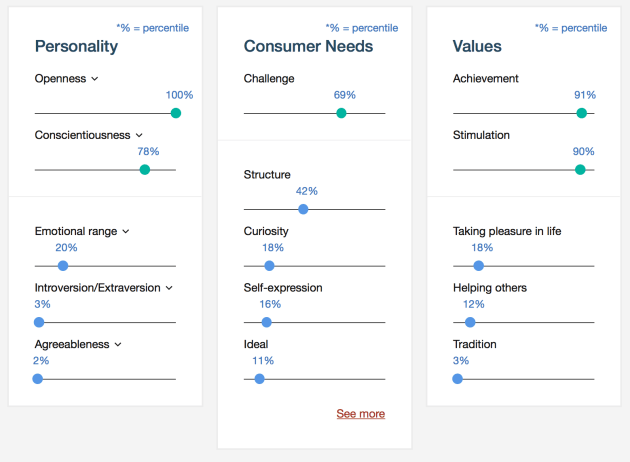
And the Personality Insights tool with respect to the Executive Summary of my book, Multiculturalism in Canada: Evidence and Anecdote:

Personality_Insights_Summary

Personality_Insights_-_Details

A New Study Shows The Hilarious Differences Between American And Canadian Tweets – BuzzFeed News

A good example of using social media analysis to complement polling and other public opinion research.

Would be interesting to see whether this technique could move from the general to more specific (e.g., attitudes towards immigrants and refugees):

Linguists at McMaster University have crunched the numbers, and it turns out Canadians really are nicerand more upbeat than Americans, at least on Twitter.

Linguists at McMaster University have crunched the numbers, and it turns out Canadians really are nicer and more upbeat than Americans, at least on Twitter.

McMaster University / Via dailynews.mcmaster.ca

These two word clouds show the most commonly used words by Americans (on the left) and Canadians (on the right).

Two PhD candidates, Daniel Schmidtke and Bryor Snefjella, sorted through about three million geo-tagged tweets from 2015 to get these results.

You may notice that the American results are partially blurred, because there were so many cuss words. Still, you can make out some other favourites like “hell,” “damn,” and “hate.”

You may notice that the American results are partially blurred, because there were so many cuss words. Still, you can make out some other favourites like "hell," "damn," and "hate."

McMaster University

Yep, there’s definitely some “shit” and “ass” in there.

The Canadian cloud, meanwhile, is dominated by upbeat, positive words like “great,” “amazing,” “gorgeous,” and “favourite.”

The Canadian cloud, meanwhile, is dominated by upbeat, positive words like “great,” “amazing,” “gorgeous,” and “favourite.”

McMaster University.

Also: “habs,” “raptors,” and “leafs.”

“We could see the difference between the two countries’ tweets as soon as we created a word cloud of the findings,” Schmidtke told McMaster Daily News.

Source: A New Study Shows The Hilarious Differences Between American And Canadian Tweets – BuzzFeed News

Seasons Greetings and Happy New Year

The Marsh In Winter

The Marsh in Winter, Julius Griffith

Whatever your tradition or faith, best wishes for the holiday season and the new year.

My blog will resume in early January.