More Thoughts on Multicultural Church: 3 Things to Consider About Multiculturalism

A Christian view of multiculturalism:

For example, a church in Brooklyn may be made up of 100 white-skinned people. On the surface, such a church looks rather homogenous. It is not until you learn that those 100 people are made up of people from the United States, South Africa, Germany, Spain, and a number of other countries that you realize diversity exists despite similar skin tones. The same example works with lots of different ethnicities and cultures.

A multicultural church is not simply about skin tone, but about the intentional, effective engagement of cultures. Racially diverse churches may be as culturally homogeneous as churches that lack racial diversity.

A multicultural church is not one that simply engages a variety of people from different parts of Asia. A multicultural church is one that not only engages with a variety of Asian peoples, but also a variety of Asian cultures.

More Thoughts on Multicultural Church: 3 Things to Consider About Multiculturalism | The Exchange | A Blog by Ed Stetzer.

Survey on Religion, Racism and Intergroup Relations in Canada Shows Differences in Attitudes Among Anglophones, Francophones and Other Groups

January 2014 survey on religious diversity, racism and intergroup relations by ACS and Canadian Race Relations Foundation. Not much surprising, communities tend to focus on their issues (and socialize more from within) and Québec attitudes towards religious diversity more negative. Racism highlights below:

Almost two in three Canadians (62%) report they are “worried” about a rise in racism. Concerns about racism and discrimination against particular groups such as Muslims, Aboriginal Peoples, immigrants and Jews vary greatly from one group to another.  Members of a particular group appear more concerned about a rise in racism and discrimination directed against their own group. Jews show a relatively high level of concern about racism directed against other groups as well. Francophones also show a higher level of concern except as it relates to anti-Aboriginal sentiment.

Survey on Religion, Racism and Intergroup Relations in Canada Shows Differences in Attitudes Among Anglophones, Francophones and Other Groups – Press Release – Digital Journal.

Farzana Hassan: Islamic Reform – Daunting But Needed

Interesting interview with Farzana Hassan, by the Clarion Project (see Sheema Khan: We can end honour killings, but not with films by anti-Muslim zealots and Film wages ‘interfaith campaign’ against abuse of Muslim women for more information on Clarion):

I see little clerical support for an “Islamic Reformation.” Even educated Muslims believe that Islam is perfect and therefore needs no reformation. Reformist Muslims, on the other hand, repudiate sharia provisions and attempt to understand Islamic belief and practice mainly as metaphor. Traditionalists see them as constituting the fringes of Muslim society, even as heretics.  Few heed their call for an Islamic reformation.

From my experience in dealing with Muslims of various stripes and persuasions, I have come to the conclusion that while there is movement toward and away from Islam, the main body of Muslims has remained largely orthodox due to recognizable inertia in Islamic theology. Muslims who challenge traditional interpretations often end up repudiating Islam, at least intellectually. New converts to Islam, on the other hand, embrace the orthodox view simply because it is the entrenched view. The result is stasis within the community of Muslims across the world.

An Islamic reformation is therefore a daunting task. Mullahs and clerics would have to abandon the literalist approach to Islam in favor of its broad principles, especially when there is a blatant contradiction between the two.

I think there is more diversity within the Muslim community, particularly in North America, than Farzana, and other religions (e.g., Catholicism) have some analogous challenges, but this interview gives her more space and nuance than the limitations of a short op-ed.

Farzana Hassan: Islamic Reform — Daunting But Needed | Clarion Project.

Ethnic Origin, Age and Religious Views (US)

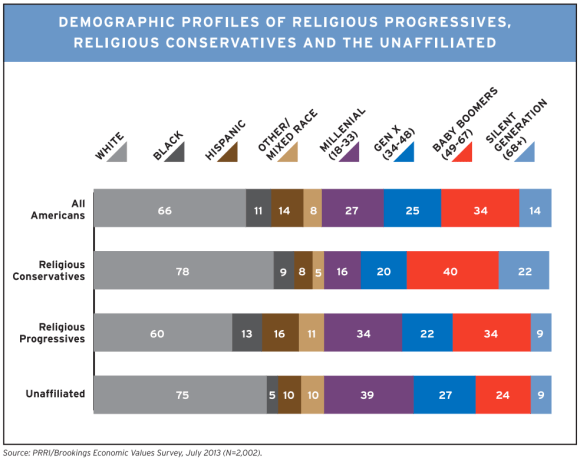
Interesting analysis by Emma Green cross-referencing ethnic origin, age, and religious views in the US:

Blacks, hispanics, and people of mixed race are all more likely to be religious progressives than conservatives; these groups are also among the fastest-growing demographics in the United States. Similarly, Millennials are more than twice as likely to be religious progressives than religious conservatives; in fact, people older than 50 make up more than 60 percent of those who are considered to be religious conservatives. Although it’s impossible to talk to an 18-year-old about her views on culture and predict what she’ll think in two decades, these demographic trends suggest that the religious right is about to start shrinking.

But the question of influence is a little fuzzier. Although more than a third of Millennials are considered religious progressives, roughly 40 percent don’t have any faith at all: A growing number of young people don’t identify with a particular religion. That, along with the fact that an overwhelming majority of religious progressives don’t see religion as “the most important thing in their life,” suggests that faith is losing its overall influence over how people think about social and cultural issues.

Chart Of The Day « The Dish.

The interfaith agreement on the ‘errant weeds’ of Christianity, Islam and Judaism

Interesting piece by Marc Ellis on extremism in all Abrahamic religions – “errant weeds” as he calls it:

But terror in the name of religion – and religious and ethnic identity – is widespread historically and today. Since most believers are not involved directly in the violence that some partake in, we shouldn’t paint with too broad a brush. The September 11th museum video may indeed walk this disturbing fine line. But to hold Islam as a religion, in its expression and in some of its core principles, innocent of violence historically or in the present is absurd.

It’s like pretending that violence in the name of Christianity contradicts Christianity and some of Christianity’s core values as they developed. Thus any violence done in the name of Christianity represents the “hijacking” of Christianity. Taking this perspective, then, through much of Christian history, Christianity has been hijacked. Perhaps we should distinguish the Christianity many Christians want today from – shall we call it – Hijacked Christianity?

Rather than pretending to an innocent tradition, call it Innocent Islam and Innocent Christianity, perhaps it is better to think of a desired separation from Hijacked Islam and Hijacked Christianity. But then how does religion support itself, go global and play its part in the affairs of the state in a way that benefits them and their followers without being hijacked?

To preserve the sense of innocence, religion’s collusion with power is unannounced and behind the scenes. To put it bluntly, you don’t get mosques or churches in the town square without being fully corrupted and embedded in the state while pretending to innocence.

Nor do you get Passover Seders in the White House without being a power to be reckoned with.

Which means we can’t leave out Hijacked Judaism.

The interfaith agreement on the ‘errant weeds’ of Christianity, Islam and Judaism.

David Cameron’s ‘Christian country’ remarks fuel mini media frenzy

David Cameron’s faith and politics statements and the predictable controversy. Had he talked about Christianity’s influence on Britain’s development and values, and linked to the openness to other faiths, likely would have been a non-issue.

Of more interest is the much higher percentage of British who state they have no religion (51 %), likely one of the higher percentages in the world (Canada is about 24 %):

In last year’s British Society Attitudes Survey, 51 per cent of those polled described themselves as having no religion. And the number of those who say they are members of the Church of England continues to fall year by year.

British Attitudes Towards Religion:

No religion: 48 per cent

Church of England: 20 per cent

Other Christian: 17 per cent

Source: British Social Attitudes Survey, 2012

Campbell refers to Cameron as a “bog standard middle England churchgoer.” During his reign as Tony Blair’s chief spin-doctor, Campbell managed to curb any talk of religion with an imperious command delivered from the plinth, telling reporters: “We don’t do God.”

Cameron’s critics accuse him of deciding to “do God” now in a bid to prevent an exodus of more traditional members from his governing Conservative Party to the UK Independence Party or UKIP, running on a staunchly anti-European, anti-immigrant platform.

Also amusing to see former PM Blair’s spin doctor, Alistair Campbell, comment on Cameron without disclosing just how much he suppressed any evidence or news about Blair’s deep religious faith (Blair only “came out,” so to speak, when he left office)

David Cameron’s ‘Christian country’ remarks fuel mini media frenzy – World – CBC News.

Zero-tolerance on FGM doesn’t have to be an attack on multiculturalism

A reminder that change works best from within, and the role that governments, organizations and people can play in making these kinds of cultural changes. Much more productive than just labelling cultures and religions. How best to encourage such dialogue in a way that engages, rather than dismisses, is the challenge:

The problem is that many on both sides of the debate feel they have to pick a side. That supporting multiculturalism is somehow inconsistent with supporting rights for minorities – including women. But we know that cultures are not as fixed and unchanging as powerful advocates within them may like to make out – they shape themselves to the conditions around them, to social and economic imperatives, and they often liberalise rapidly in new worlds and environments by combining a healthy recognition of traditions, backgrounds and cultural practices with new and modernised interpretations of what it means to belong to that culture in a globalising world.

We also know that change within cultures can only happen when advocates and allies within those cultures are empowered to change minds and hearts around them – and this is where governments must focus their efforts when tackling such problems. The most powerful voices are always those on the inside, not the outside – and governments would do well to work with those voices in order to amplify them.

That has been the real success of the campaign on FGM – its increased visibility in the past two years, and the way in which it has made voices more prominent. Campaigners such as Leyla Hussain, an FGM survivor from the campaign group Daughters of Eve are so important for this very reason, as are political advocates such as Jennette Arnold AM and Diane Abbott MP – who have campaigned on this issue and taken a strong position of leadership for some years. All three of these speakers were present at a meeting of the Fabian Women’s Network last week. Abena Oppong-Asare, who chaired the discussion spoke eloquently about the role FGM has played in regulating women’s bodies, desires and self-expression in different cultures.

It is in this direction (of leadership, advocacy and dialogue with communities) that governments must look – if they are to reconcile protecting rights of individuals with the objection that cultural practices are a no-go area for policy makers because those policy makers “just don’t understand”.

New Statesman | Zero-tolerance on FGM doesn’t have to be an attack on multiculturalism.

Ontario Catholic schools grapple with court’s no-religion ruling: Walkom | Toronto Star

One of the historic anomalies in Ontario is a publicly funded separate Catholic school system that was part of the initial bargain of Confederation. A recent court decision allows students to opt-out of religious instruction. Tom Walkom of the Star:

The public sphere is inclusive. Religion is not. With religion, you are either in or out. You are either part of a body of believers or you are not.

Some religions, including Christianity, welcome converts. Many preach tolerance toward other faiths.

But in virtually every religion, there is a fundamental distinction between those who accept certain precepts as true and those who do not. And non-believers are — by definition — wrong.

Ontario’s Catholic schools have already found it hard to navigate the tricky path between church orthodoxy and public acceptability, most recently over the issue of gay-straight student clubs.

Thanks to a 1997 court decision, they have managed to retain the right to discriminate in employment. Catholic schools need not hire non-Catholic teachers.

But if they can’t make their students experience even a little bit of Catholicism — if, in order to qualify for government support, they are simply public schools with a dress code — why bother?

Ontario Catholic schools grapple with court’s no-religion ruling: Walkom | Toronto Star

Chris Selley in the National Post:

The Progressive Conservatives at least tried to address this bizarre inequality: Leader John Tory proposed extending funding to schools of other religions, and was trounced for his efforts by an electorate that then instantly forgot about the issue. They won’t go down that road again. That the Liberals and New Democrats can live with a single, publicly funded religious school system that considers homosexual acts “objectively disordered,” and buses students to pro-life rallies, only gets more astonishing every year.

One might thank Mr. Erazo for shining some light on this absurdity. But alas, nobody’s paying any attention. You can’t stop Ontario’s march of incoherent progress.

Get on your knees and opt-out

Brandeis University rescinds planned honorary degree to outspoken critic of Islam

The latest polemic around Ayaan Hirsi Ali. Clearly, Brandeis did not do its research and background checks and should have anticipated this controversy. While many of the specific criticisms she makes about aspects of Islamic and related cultural practices are valid, she, like many critics (e.g., Pipes) go too far in painting Islam and Muslims with the same brush, rather than recognizing the diversity within Islam and among Muslims. Just imagine substituting Christian, Jewish or Sikh in any of her quotes below:

She has come under criticism for remarks about Islam. In a 2007 interview with Reason magazine, Hirsi Ali was quoted as saying “there is no moderate Islam” and that Islam needed to be defeated.

“Once it’s defeated, it can mutate into something peaceful,” she said. “It’s very difficult to even talk about peace now. They’re not interested in peace.”

That same year, she told the London Evening Standard that Islam is “the new fascism.”

She also characterized Islam as “a destructive, nihilistic cult of death.” she was quoted as saying, “It legitimates murder.”

Her selection by Brandeis sparked an outcry by students, faculty, and national advocacy groups such as the Council on American-Islamic Relations.

“We believe offering such an award to a promoter of religious prejudice such as Ali is equivalent to promoting the work of white supremacists and anti-Semites,” the group stated.

An online petition signed by students and other critics condemned Hirsi Ali’s “extreme Islamophobic beliefs.”

Brandeis University rescinds planned honorary degree to outspoken critic of Islam – Metro – The Boston Globe.

Two opinion pieces on opposite sides of the argument, starting with Rabbi Eric H. Yoffie, defending the decision made by Brandeis:

Ms. Hirsi Ali’s statements on Islam are not incidental to her activism and her life’s work. They stand at the very center of her concern. It goes without saying that Brandeis blundered by not doing its research before making the announcement and embarrassing everyone involved. Still, the only issue for the critics of Brandeis is whether they affirm Ms. Hirsi Ali’s prejudicial and deeply offensive views on Islam as a violent and fascistic religious tradition. If they do, let them say so. And if they don’t, they should acknowledge that Brandeis was right in the decision it made.

Andrew Sullivan takes a very different take:
The rescinding of an honorary degree to Ayaan Hirsi Ali is not exactly an act of punishment. No one has a right to any such degree and Brandeis is fully within its rights to breach basic manners and fail to do basic research about an honoree’s past work. And Ayaan has indeed said some intemperate and extreme things at times about Islam as a whole. But to judge Ayaan’s enormous body of work and her terrifying, pioneering life as a Somali refugee by a few quotes is, I’m afraid to say, all-too-familiar as an exercise in the public shaming of an intellectual for having provocative ideas. There seems to be an assumption that public speech must seek above all else to be “sensitive” rather than provocative, and must never hurt any feelings rather than tell uncomfortable truths. This is a terrible thing for liberal society as a whole and particularly terrible for a university campus, where freedom of thought should be paramount (although, of course, the hard academic left every day attempts to restrict that freedom).
I am more with Rabbi Yoffie on this. Yes, one should consider the life work and not just selected quotes. However, the quotes are consistent in Hirsi Ali’s overall writing and public remarks, and are central to her arguments against Islam in general, not just particular aspects of Islam.
Find it a bit surprising that Sullivan defends her position when his own views on religion are nuanced thoughtful and reflective, unlike the overly broad brush approach of Hirsi Ali.
A bad month for diversity-focused fear-mongers | Toronto Star

Good piece by Natalie Brender on the fear mongers, citing the defeat of the PQ and its values charter, the Mosaic Institute’s study on imported conflicts (Do new Canadians leave old conflicts behind?) and the Pew Research study on how increased diversity tends to correlate with lower levels of violence (Countries With Less Religious Diversity Have More Faith-Based Violence):

Fear-mongers keen on stirring up angst about the increasingly diverse nature of Canadian society have had a bad month of it, on the whole. That’s because three recent sets of evidence suggest that really there’s not that much to worry about in face of a blossoming patchwork of religious headgear being worn, languages being spoken and national soccer teams being cheered for across the land. Such reassurances are relatively undramatic to report on — but it’s worth taking some sedate pleasure in a trio of dogs that didn’t bark alarms of warning in the past month.

A bad month for diversity-focused fear-mongers | Toronto Star.