Erin Anderssen: Religious beliefs do not make it okay to shame and inconvenience other travellers

A reminder that fundamentalism and extremism is not unique to any one religion:

According to The New York Times, there has been an increasing number of cases of Orthodox Jewish men refusing to sit next women during flights, and solving the problem by standing in the aisle until a flight attendant asks the woman to move (to the back of the plane, perhaps?) or finds them a more acceptable spot. For ultra-conservative Orthodox Jewish men, making physical contact with a woman other than their wife is prohibited. Their concern is realistic, given how cramped airline seating is these days.

Switching seats is arguably a minor inconvenience in the big picture, but this is only the latest angle on a recurring debate – how far do we go, both personally and as a society, to accommodate religious freedom in public spaces? Let’s say a fundamentalist Christian got on a plane and refused to sit next to an LGBT couple on their honeymoon – would this be okay? The airlines, on the perpetual hunt for more coin, could always offer passengers a “suitable seatmate surcharge” – choose the sex, gender, weight and race of your preference.

In the New York Times piece, one female passenger agreed to move – just to get the flight going when the man wouldn’t take the window seat beside her. In another example, a man delayed a flight for 15 to 20 minutes because he refused to accept the spot he’d been assigned. The situation has become so common, the Israel Religious Action Center has started a campaign urging women not to give up their seats. Anat Hoffman, the group’s executive director told The New York Times, “I have 100 stories.”

After observing an incident on a flight between New York and Israel, documentary filmmaker Jeremy Newberger told the Times, “I grew up conservative, and I’m sympathetic to Orthodox Jews. But this Hasid came on, looking very uncomfortable, and wouldn’t even talk to the woman, and there was five to eight minutes of ‘What’s going to happen?’ before the woman acquiesced and said, ‘I’ll move.’ It felt like he was being a yutz.”

Erin Anderssen: Religious beliefs do not make it okay to shame and inconvenience other travellers – The Globe and Mail.

Reza Aslan explains why it’s fine to blame ISIS on Islam — and why Islamophobes still have it wrong

Reasonable words and reminders:

“But that’s not very helpful,” he added, “and it’s also not true. A Muslim is whoever says he’s a Muslim. A Christian is whoever says he’s a Christian. A Jew is anyone who says he’s a Jew. If you are saying that this is your identity, and you are acting according to your identity, then we should probably take your word for it. Because it’s not helpful to say ‘no, that has nothing to do with religion,’ because like it or not, these actions are being done in the name of a specific religion.”

“How do we confront that?” Aslan asked. “The knee-jerk response is just to blame religion. If ISIS is killing in the name of Islam, then it’s Islam’s fault. But that’s just a very simple and unsophisticated way of thinking.”

“Listen,” he continued. “I am totally fine with you blaming Islam for ISIS. If you want to place the responsibility for ISIS on Islam, that’s fine with me — as long as you also credit Islam for the people who are fighting ISIS. For while it is true that ISIS are Muslims, it’s also true that so are the tens of thousands who are battling them, and the tens of thousands of victims of ISIS. They’re all Muslim too.”

“So if ISIS is Muslim, and the people they are killing are Muslim, and the people who are fighting ISIS are Muslim — what does that say about Islam?”

“Not much, actually,” he said, answering his own question. “Nothing much, nothing you can make some grand generalization about. If you want to blame religion for all of the bad things that religion does, fine. As long as you are willing to credit religion for all the good things religion does.”

“Of course, that’s usually not the case.”

Reza Aslan explains why it’s fine to blame ISIS on Islam — and why Islamophobes still have it wrong.

A God? That’s complicated. Canadians hanging on to personal faith as organized religion declines: poll | National Post

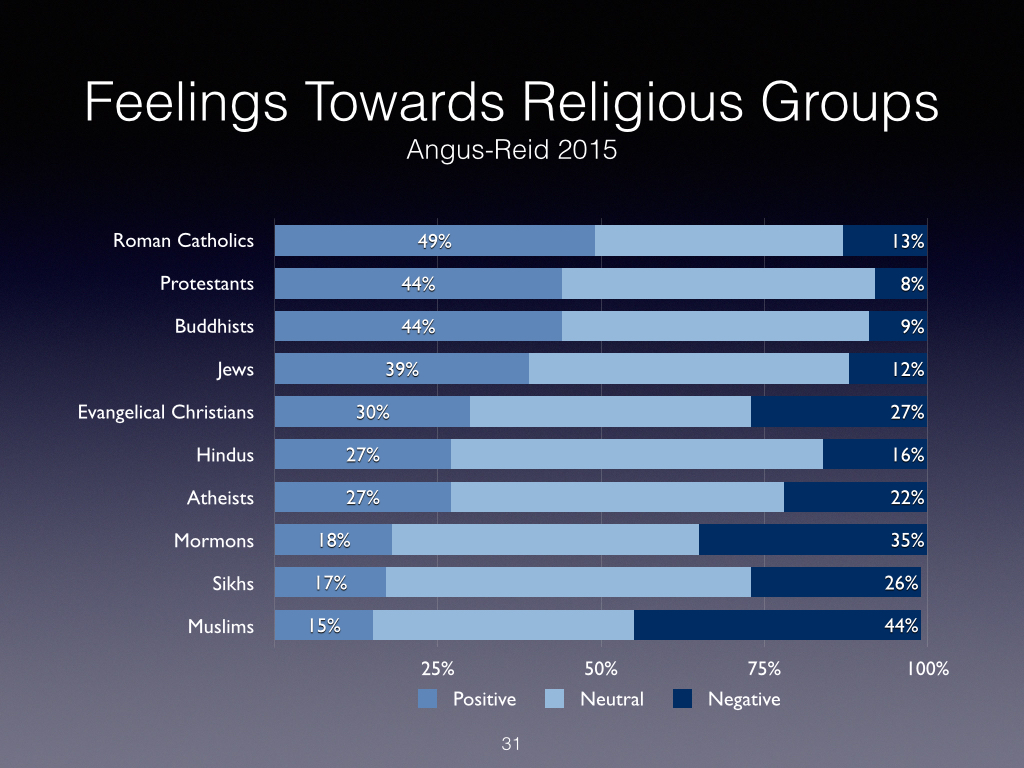
Angus Reid Religon Poll 2015 - Feelings Towards.001The National Post provides a very good infographic summarizing the findings of the recent Angus-Reid survey Religion and faith in Canada today: strong belief, ambivalence and rejection define our views which contains a wealth of information on attitudes and practices and worth reviewing.

Chart above highlights feelings towards different religions and is largely unsurprising.

The chart below provides a relatively rare view of immigration by religion between 2001-11, showing that while religious minorities are a significant share (36 percent), they are still less than Christian immigrants (42 percent). But the median age of religious minorities is younger than for Christians: 32 compared to 41.

Religious Immigration 2001-11.001

A God? That’s complicated. Canadians hanging on to personal faith as organized religion declines: poll | National Post.

Ayaan Hirsi Ali’s ‘Heretic’ – NYTimes.com

Good review of Hirsi Ali’s latest book, “Heritic:”

In “Heretic,” Hirsi Ali forgoes autobiography for the most part in favor of an extended argument. But she has trouble making anyone else’s religious history — even that of Muhammad himself, whose life story she recounts — as dramatic as she has made her own. And she loses the reader’s trust with overblown rhetoric. Many Muslim immigrants in the West grapple with conflicted identities, she writes, leaving them longing for one extreme or another in the pursuit of certainty. She wonders: “Must all who question Islam end up leaving the faith, as I did, or embracing violent jihad?” (Probably not.) She tries to warn Americans about their naïveté in the face of encroaching Islamic influences, maintaining that officials and journalists, out of cultural sensitivity, sometimes play down the honor killings that occur in the West. But it is safe to say there is no shortage of horrified fascination in the topic; she even cites a 3,000-word Time magazine article that, in fact, spelled out every tragic detail of one of her examples.

When Hirsi Ali writes, almost wistfully, that “it is unrealistic to expect a mass exodus from Islam,” even secular readers may begin to wonder if she is their best guide to understanding the religion. (A suitable subtitle for “Heretic” might be: “How to Be a Muslim, if You Must.”)

Unquestionably, Hirsi Ali poses challenging questions about whether American liberals should be fighting harder for the rights of Muslim women in countries where they are oppressed, and she is fearless in using shock tactics to jump-start a conversation. Blasphemy is an essential part of any religious reform, she argues, and defends her right to speak bluntly. “I have taken an enormous risk by answering the call for self-reflection,” Hirsi Ali has said, in response to critics who find her tone abrasive. “I have been convinced more than ever that I must say it in my way only and have my criticism.” There is no denying that her words are brave. Whether they are persuasive is another matter.

Ayaan Hirsi Ali’s ‘Heretic’ – NYTimes.com.

Catholic public health board nominee dumped

Interesting debate in Toronto over what views are acceptable in the Board of Health:

But her voting record as a long-standing trustee did not sit well with several councillors. Kennedy, a registered nurse for 45 years, has voted against gay-straight clubs in schools, HPV vaccinations for young girls and is opposed to abortion.

“Thankfully, council did the right thing,” said Councillor Joe Mihevc, chair of the Toronto Board of Health who introduced the motion to replace Kennedy with Chris Glover, a public school board trustee from Etobicoke.

Mihevc said Kennedy’s “consistent” opposition to gay-straight alliances makes her unsuitable to sit as a board member, he said.

“Would we allow that as a society if it was black-white alliances? That’s what human rights are about and those perspectives in a public health context just won’t work.”

Mayor John Tory supported Kennedy’s appointment, though he said he disagrees “completely” with her views on HPV vaccinations, gay/straight alliances in schools and a woman’s right to choose.

“If we started applying every test based on whether we disagree with somebody’s views on people we appoint to things . . . it’s sure going to change the nature of this place.”

Councillors Paula Fletcher, Gord Perks  and Joe Cressy  did not support Kennedy’s appointment. “These are actually human rights issues, the right for gays and lesbians to lead an equal life in the city of Toronto,” Fletcher said.

Kennedy is the wrong fit because the board of health has an obligation to deliver programs that meet health standards set out in legislation, such as programs to encourage safer sex, Perks said.

“This isn’t about whether you’re trying to get people on the board of health who vote the way you feel,” he said. “It is whether or not we are prepared to appoint people who support the legal mandate of the entity they are being appointed to.”

Catholic public health board nominee dumped | Toronto Star.

Muslim Women Are Fighting To Redefine Islam as a Religion of Equality | TIME

More on some of those pushing for reform within Islam and a more modern and egalitarian interpretation of the texts:

[Zainah] Anwar [director of the global Muslim women’s organization Musawah—Arabic for ‘equality’] was addressing a packed auditorium at the University of London’s School of Oriental and Asiatic Studies for the release of a powerful new weapon for Islamic gender warriors: a book examining how a single verse in the Quran became the basis for laws across the Islamic world asserting Muslim men’s authority—and even superiority—over women. In Men in Charge?, scholars tackle what Musawah has dubbed “the DNA of patriarchy” in Islamic law and custom: the thirty-fourth verse in the fourth chapter of the Quran, among the most hotly debated in the Islamic scripture. The English translations of the verse vary, but one popular one conveys the mainstream takeaway: “Men are in charge of women, because Allah hath made the one of them to excel the other, and because they spend their property [for the support of women.]”

For centuries, male jurists have cited 4:34 as the reason men have control over their wives and the female members of their family. When a wife doesn’t want to have sex, but feels she should submit to her husband, this sense of duty derives from the concept of qiwamah—male authority—derived from Verse 4:34. When a Nigerian wife reluctantly has to agree to her husband taking a second or third wife, this is qiwamah in action, notes the book. The concept of qiwamah “is one of the most flagrant misconceptions to have shaped the Muslim mind over the centuries,” Moroccan Islamic scholar Asma Lamrabet writes. “It assumes that the Quran has definitively decreed the absolute authority of the husband over his wife, and for some, the authority of men over all women.”

While the overall message of the Quran is unchanging, say Muslim reformers, new generations must find their own readings of the sacred texts. As it stands, Islamic fiqh, or jurisprudence, was largely forged during the medieval period, when women’s roles and the concept of marriage and male authority were very different. Why, they ask, should the way that 10th-century Baghdadi men read the Quran dictate the rights of a 21st-century woman? To the reactionaries who charge that these reformers are deviating from Islam, Islamic feminists point out that there is a difference between Islamic jurisprudence—a man-made legal scaffolding developed for the specific conditions of medieval Muslim life—and the divine law itself, which is eternal, unchanging and calls for justice. It’s not the Quran they question, but how particular interpretations of it have hardened into truth. “The problem has never been with the text, but with the context,” legal anthropologist Ziba Mir-Hosseini told the Musawah seminar.

Muslim Women Are Fighting To Redefine Islam as a Religion of Equality | TIME.

Quebec infringed on religious freedom by forcing Catholic school to teach secular course: Supreme Court

On the recent Supreme Court ruling:

Loyola told the Supreme Court it wasn’t challenging the constitutionality of any legislation. But it was invoking a regulatory provision that allows private schools to teach their own version of a course where their program is equivalent, the school said in its factum. However, Quebec’s Education Department doesn’t consider Loyola’s substitute course an equivalent one. One reason is that the approach recommended by the ERC course is non-denominational, while Loyola’s version aims to transmit the Catholic faith, the Quebec government argues.

Loyola has said it would teach all the same content at the ERC course Loyola’s former principal Paul Donovan told the Montreal Gazette on Wednesday.

“We just didn’t want to have to suppress or hold back the Catholic nature of the school,” Donovan said.

Private religious schools in Quebec can teach their own faiths, but separately from the ERC course.

It’s the second time the Supreme Court has weighed in on the course taught in Quebec’s schools since the 2008-2009 school year. A Drummondville couple, who are Catholics, had argued that refusing to exempt their sons from the compulsory course violated their freedom of conscience and religion. But in a unanimous decision, the Supreme Court dismissed their appeal in 2012. The couple hadn’t proved that the ERC course interfered with their ability to pass their own faith onto their children, the decision said.

Quebec infringed on religious freedom by forcing Catholic school to teach secular course: Supreme Court.

Graeme Hamilton’s commentary on the fears of religious fundamentalism in Quebec:

Listening to politicians, it can feel as if Quebec is under assault from religious fundamentalists. The opposition Parti Québécois wants an observer to report annually to the National Assembly on “manifestations of religious fundamentalism.” The Liberal government has a working group to combat radicalism. The Coalition Avenir Québec proposes banning preaching that runs counter to Quebec values.

But those same legislators have no quarrel with a secular fundamentalism that has taken root in the province at the expense of religious rights. On Thursday, the Supreme Court of Canada sent a message to Quebec that its state-sanctioned secularism can go too far.

In a ruling affirming the right of Montreal’s Loyola High School, a private Catholic boys school, to teach its own version of a provincially mandated course on ethics and religion, the court offered a timely reminder to politicians.

“The pursuit of secular values means respecting the right to hold and manifest different religious beliefs,” Justice Rosalie Abella wrote for the majority. “A secular state respects religious differences, it does not seek to extinguish them.”

The pursuit of secular values means respecting the right to hold and manifest different religious beliefs

The ruling specifically applies to a small number of private religious schools in Quebec, but it resonates more widely at a time when governments contend with questions involving religious rights. Recently in Quebec, mosques have run up against obstacles over fears of religious extremism, and a Muslim woman was told she could not appear before a Quebec Court wearing her hijab. The federal government has taken a stand against the face-covering niqab, saying women cannot wear the garments during citizenship ceremonies.

Interference with a religious group’s beliefs or practices is justified only if they “conflict with or harm overriding public interests,” Justice Abella wrote.

… In a partially concurring opinion that argued for less restriction on Loyola, Chief Justice Beverley McLachlin and Justice Michael Moldaver wrote that it is enough for Loyola teachers to treat other religious viewpoints with respect; it does not have to treat them as equally legitimate.

“Indeed, presenting fundamentally incompatible religious doctrines as equally legitimate and equally credible could imply that both are equally false,” they wrote. “Surely this cannot be a perspective that a religious school can be compelled to adopt.”

John Zucchi, whose son was a student at Loyola when the ERC program was introduced and who was a plaintiff in the initial court case, said Thursday’s ruling provides crucial guidance. “This is helping the country to come to what I would call a sane form of secularism,” he said. “We don’t need to shut down one voice in the name of diversity and pluralism, but rather diversity and pluralism mean that all perspectives can be heard and be out in the public square.”

Graeme Hamilton: A secular fundamentalism has taken root in Quebec
‘Behind Sweden’s tirade is a hidden Western agenda to tarnish Islam’ | Arab News

A reminder of some of the beliefs of those allied in the fight against ISIS and their denial of universal human rights:

Sweden and other Western countries have adopted double standards while dealing with human rights as they ignore the killing of thousands in Iraq, Syria and Palestine, and highlight the flogging of an individual in Saudi Arabia as a big issue, said Dr. Mohammed Badahdah, assistant secretary general of the World Assembly of Muslim Youth (WAMY).

Speaking to Arab News, he emphasized that Saudi Arabia’s rules and regulations as well as its judicial system are based on the Qur’an and Sunnah or Shariah. “Shariah laws are not made by Parliament or people’s representatives. They are divine laws given by the Almighty for the welfare and security of the whole humanity,” he explained.

“It’s the duty of all countries and societies to respect religious faiths, beliefs and cultures of different communities in order to promote peace and stability in the world,” Badahdah said while denouncing Swedish Foreign Minister Margot Wallstrom’s anti-Saudi tirade.

“We are not imposing Shariah on others. Why do then Sweden and other Western countries criticize the Kingdom when we are implementing Shariah in accordance with our faith? This is clear interference in our internal affairs and Saudi Arabia will not tolerate such attacks,” he said.

‘Behind Sweden’s tirade is a hidden Western agenda to tarnish Islam’ | Arab News.

Douglas Todd: Spiritual narcissism inflates ego

Douglas Todd on the writings and thoughts of Gerald May on spiritual narcisism:

We can all succumb to narcissism when we have a spiritual growth spurt or philosophical insight. It happens when we begin thinking we are pretty great because we have achieved a level of development others have not.

How it creeps in

Here are six examples of how spiritual narcissism can creep in:

Feeling Chosen: Spiritual seekers who believe they have been “chosen” can become narcissistic. Like being on the playground and getting picked early for a team, nothing boosts self-importance more than feeling one is among the Select.

Striving to be a master: Gerald May distrusts seekers who want to become God-like. Whether they’re Christians, neo-pagans or atheist existentialists, he cites how fearful people often struggle to “amass personal power and control over destiny,” rather than learn to let go and sacrifice.

Working to be good: While many indulge in vices, others strive to be highly moral. Sometimes they go too far. May says some people “so achingly long to be helpful that they are blinded.” The Tao Te Ching advises, “Give up sainthood … and it will be a 100 times better for everyone.”

Over-emphasizing spiritual levels: American ethicist James Fowler created a famous ladder showing how people ascend through stages of spiritual maturity. While May found some validity in it, he cautioned against making spiritual levels so concrete. May would have also critiqued the colour-coded developmental memes of Don Beck’s spiral dynamics. With ladders, it’s too easy to rank yourself on a higher rung.

Lacking forgiveness: It is right to yearn for justice. It is another thing to be unable to get over an injustice, particularly to oneself. The unforgiving, May says, separate themselves from others, and become captives of resentment and superiority. Psychologist Nancy McWilliams refers to people who can’t let go of an injustice as “hyper-vigilant narcissists.”

Brotherly and sisterly love: In discussing active “filial love,” May says there is a danger of doing so to bolster self-regard. Aiding others because of guilt can be spiritually narcissistic. Even though Christianity and Buddhism call for acts of compassion, May says over-helpful people can “lose their experiential connectedness with the divine mystery of life.”

Avoiding the trap

…. he taught the most direct way to discern whether we are surrendering to unconditional love, rather than to self-aggrandizement, is to check to see if our spiritual journey is “deepening our compassion and service to the world.”

Can happen in all fields.

Douglas Todd: Spiritual narcissism inflates ego.

Pew Study On Religion Finds Increased Harassment Of Jews : The Two-Way : NPR

Pew_Forum_Religious_Harassment_2015_pdfThe latest report on harassment of religions, both from governments and by individuals:

The Pew report, which is based on data and reports from 2013, finds that Muslims and Christians face comparable levels of hostility, though Christians are harassed more often by governments, Muslims more often by individuals.

One group faces increased hostility: Jews. Each year since 2007, when Pew began these surveys, the targeting of Jews around the world has gotten worse.

European Jews, in particular, encounter intolerance, says Peter Henne, the lead Pew researcher on the report.

“There’s a pretty marked harassment of Jews in Europe,” he says. “They’re harassed in 76 percent of countries in Europe, which is higher than the number of countries in which they’re harassed in other regions.”

The United States does not get off the hook in the Pew report. It ranks the U.S. as having a “moderate” level of religious harassment, on par with such countries as France, Slovakia and Mongolia.

“In terms of what we see in the United States, there are some issues with land use, churches or mosques trying to build or expand their site and being blocked by local governments,” Henne says. “There are some tensions in prisons — limits on prisoners’ ability to convert or to use things like tobacco in religious ceremonies.”

Overall, the level of religious harassment in 2013 is about the same as it was the year before, according to Pew. But with only seven years of data, it’s hard to see any historical trend.

Pew Study On Religion Finds Increased Harassment Of Jews : The Two-Way : NPR.