“Prophet Mohammad forever,” chant the young Indonesian Muslim musicians. But instead of a mosque, the men are singing at an outdoor concert with a mosh pit full of followers of the country’s first Islamic punk movement.
The movement is the first of its kind in the world’s largest Muslim-majority nation, and has hundreds of members in three of the country’s biggest cities – Jakarta, Surabaya, and Bandung.
Sporting mohawks, leather jackets and baggy jeans, members of the “Punk Muslim” group claim that they, like the original British punk rockers, are still defined by rebellion and an anti-establishment ideology. But they express it by singing about Islamic values, freedom for Palestine, and other social issues facing the global Muslim community.
Ahmad Zaki, one of the movement’s founders, believes the genre of punk is often associated with a “tendency towards misbehaviour” but he wants to change that.
“We can redirect ourselves to better, more positive things,” he said.
Many of the group’s members used to be street performers, and say they have changed drastically since joining the movement. They are now encouraged to form their own bands and write their own songs.
Reza Purnama, a member and a former alcoholic, says others like him are slowly quitting alcohol and their lyrics are becoming more positive.
“People aren’t looking down on us anymore,” he said, referring to a stigma against punks in Indonesia’s largely conservative society.
After every concert, the head-banging audience bow their heads in prayer and listen to sermons – something the movement’s founders hope will redirect their fans on to a more pious path.
Muslims make up nearly 90 percent of Indonesia’s 250 million people and the vast majority of them practise a moderate form of Islam.
Interesting long read by Christopher Lamb on the contrast between Pope Francis and his predecessor in their efforts to engage Islam:
The global growth of Islam and in particular the rise of Islamic extremism have forced recent popes to set out, with increasing urgency, a strategy for engaging the religion.
As Pope Francis’ brief trip to Egypt over the weekend demonstrated, the most recent pontiffs have come up with starkly different approaches—though it’s not yet clear if one is better than the other, or if either will be effective.
When Pope Emeritus Benedict XVI addressed the question of Islamic extremism he did so during a speech at a university in his Bavarian homeland where, as a priest and professor, Joseph Ratzinger had worked decades earlier.
That 2006 address in Regensburg, Germany, was a theological master class on the relationship between faith and reason. But it also angered Muslims who object to Benedict citing a 14th-century Christian emperor who claimed that the Prophet Muhammad had only brought the world things that were “evil and inhuman.”
Moreover, Benedict also delivered his message to Islam from afar.
Francis, on the other hand, has made it his business to try to build bridges with the Muslim world with the energy of a missionary.
That approach was on display during his 27-hour trip to Egypt, viewed as the leader in the majority Sunni Islamic world, and a nation that is making a serious—though controversial—effort to crack down on extremist-inspired violence.
So important to Francis, in fact, is the “personal encounter” with Muslims that the pontiff put his own safety at risk by going to Cairo, a trip that took place less than three weeks after 45 worshippers were killed in bomb attacks on two Egyptian churches.
The pope even shunned a bulletproof vehicle and when he arrived at a sports stadium for an open-air Mass he greeted the crowds from an open-topped golf buggy.
“Whereas previous popes — even in more secure places — have ridden in bulletproof vehicles, Francis showed his courage in Egypt, and his will to be close to the people, by this simple gesture,” explained Gabriel Said Reynolds, a professor of Islamic studies at the University of Notre Dame.
Reynolds took part in a recent Vatican-Muslim forum at Cairo’s Al-Azhar university, a major center of Sunni-Islamic learning with global influence and expertise in interpreting the Quran. The dialogue that Reynolds is part of only restarted under Francis—who was elected in 2013—after relations had soured under Benedict.
Yet even as the current pope pushes for a personal encounter with Islam, his predecessor’s legacy of engaging Islam via a theological challenge to extremist elements among Muslims continues to hold some sway.
Indeed, just as Francis was heading to Egypt a letter appeared from the retired pope to the president of Poland in which Benedict accused “radical Islam” of creating an “explosive situation in Europe.”
Catholic defenders of Benedict’s Regensburg address insist that he correctly addressed some uncomfortable truths within Islam and they point out that the speech led 138 Islamic scholars to write to Benedict in 2007, a letter that paved the way for a new Catholic-Muslim dialogue initiative.
Yet while it was Muslims who approached Benedict a decade ago, under Francis things are the other way round.
Francis’ approach to Islam is characterized by a willingness to “cross over to the other side” — Egypt is the seventh Muslim majority country he has visited in his four years as pope. And a papal visit to Bangladesh, where almost 90 percent of the population are followers of Islam, is planned for later this year.
Francis’ approach to Islam is characterized by a willingness to “cross over to the other side”
This has always been his style. When he was archbishop of Buenos Aires, Francis—then Cardinal Jorge Mario Bergoglio—became the first Catholic bishop to visit Argentina’s Islamic Center, and the Jesuit pope has continued to focus on building personal connections with Muslims.
In Egypt, this was symbolized by his embrace of Sheikh Ahmed el-Tayeb, the grand imam of Al-Azhar mosque, following the pope’s address to their peace conference.
It was a powerful image of Muslim and Christian fraternity that had echoes of St. Francis of Assisi’s mission to Islamic leader Sultan Al-Kamil 800 years ago.
This personal approach has been bolstered by Francis’ consistent refusal to link the Islamic faith per se to terrorism, and has made the Islamic world take notice.
It also meant that when Francis issued one of his strongest and most detailed condemnations of religious violence during his Al-Azhar address, his speech was welcomed and frequently interrupted with applause.
“He knows that the only effective way for his message of peace to touch the hearts of the larger global community is to speak together with leaders of other religious communities,” Reynolds explained.
“He is counting on the prestige of Al-Azhar and its grand imam in particular, to join with him in broadcasting this message.”
I think the notes of caution by the experts cited are valid.
That being said, this initiative will likely be useful in broadening the discussions and debates regarding religion and minority rights, and understanding of Islam.
But I am always cautious about “exporting” models. Each country’s geography, history, demographics is different, and thus policies and programs need to take these differences into account, but within an overall human rights perspective:
Leaders of Nahdlatul Ulama’s youth wing, known as Ansor, say that elements of Shariah, which Muslims consider divine law, are being manipulated by groups like the Islamic State and Al Qaeda to justify terrorist attacks around the world, invoked to rally fighters to battle in the Middle East and elsewhere, and distorted by movements that seek to turn Islam into a political weapon.
“The classical Islamic perspective is dominated by views that position non-Muslims as enemies or, at best, as suspicious figures not worthy of trust,” H. Yaqut Qoumas, Ansor’s chairman, said in an interview.
“Fiqh,” or the body of jurisprudence that applies Shariah to everyday life, “explicitly rejects the possibility of non-Muslims enjoying equal rights with Muslims in the public sphere, including the right to occupy certain positions,” he said. “This classical Islamic perspective continues to possess an extraordinarily powerful authority in the eyes of most Muslims, and is regarded as standard, orthodox Islam.”
Some interpretations of classical Islamic law teach that Muslims have a duty to seek out and fight Christians, Jews and followers of Zoroastrianism until they either convert to Islam or submit to its rule and pay a head tax.
These interpretations have been enthusiastically adopted by the Islamic State.
Also, some interpretations of classical Islamic law, and of certain passages in the Quran, forbid Muslims from having non-Muslim political leaders. Medieval Islamic jurisprudence, still regarded as valid by some, is used to justify slavery and the execution of prisoners.
Photo
A 2006 painting by the Dutch artist John van der Sterren depicts Indonesia’s founding leader, Sukarno, cradling an independence fighter in the 1940s. The rebel’s Christian cross has made the image a symbol of the drive to reinterpret Islamic law.CreditNahdlatul Ulama
Some predominantly Muslim countries have been moving to reinterpret Islamic law within their borders, with some sending delegations to a 2016 international conference of scholars, religious leaders and clergy members in Morocco on protecting the legal rights of religious minorities living among them.
The Indonesian initiative, however, aims to directly approach governments around the world, both Muslim-majority and otherwise, as well as at the United Nations, to achieve a global consensus on reforming what it views as archaic interpretations of Islam.
“The challenge we face is not confined to religious views that emerged through an intellectual process conducted a thousand years ago. We are also confronted by religious and political authorities whose institutions are deeply intertwined with these views, and thus continue to inculcate such teachings among each new generation of Muslims,” Mr. Yaqut said.
The Interpreter Newsletter
Understand the world with sharp insight and commentary on the major news stories of the week.
Nonetheless, some Islamic scholars and experts note that because there are so many diverging interpretations of Islamic law and the Quran, it would be difficult to reach an international consensus on reforms.
“There’s a whole library of interpretations of jihad — Muslims must fight non-Muslim states to expand territory, for example,” said Ruud Peters, an emeritus professor of Islamic law at the University of Amsterdam. “But since the 19th century, there have been interpretations followed by many Muslim states to only defend against attack from non-Muslim states.”
Another problem, scholars and experts said, is the cultural differences among predominantly Muslim countries in interpreting Islamic law. Indonesia, in Southeast Asia, for example, practices one of the most liberal forms of Islam in the world, while simultaneously having a secular government and Constitution, with full rights for Christians, Hindus, Buddhists and other religious minorities.
Saudi Arabia, in the Middle East, however, practices the conservative Wahhabi Islam, and its government does not officially recognize any of its citizens as being Christian.
“If you want to have only one universal interpretation, you have to deal with the cultural differences and also find an international central authority. This is impossible,” said Abdel Rahman El Haj, a professor at Ankara Social Sciences University in Turkey.
He added that while Indonesian Islamic leaders had good intentions, substantive changes would be successful only if support for them emerged within the Arab world.
The Ansor initiative is seen as another move by young Muslims in Indonesia, as well as Islamic clerics and other Muslim organizations in Europe and the Middle East, to push back against extreme, conservative interpretations of Islam.
“The general impression we sometimes get in the West about Islam is one of radicalization,” said Raphaël Lefèvre, a nonresident political Islam scholar at the Carnegie Middle East Center, “while an equally if not more important trend is the ongoing struggle by Muslim clerics to redefine what Islamic law has to say about society and politics in ways deemed more compatible with modern life.”
Commentary by Daniel Williams, Author, Forsaken: The Persecution of Christians in Today’s Middle East:
The Pope seemed as determined to put distance between the image of Islam and the global terrorist wave as address the Christian plight. For instance, Francis dropped statements he had made in other countries that Christian communities in the region face genocide.
Instead, and maybe hopefully, it was left to Ahmed al-Tayeb, the chief imam of al-Azhar, the influential educational and religious complex in Cairo, to offer up a prescription for ending persecution of Christians and other minorities.
Two days in advance of the Pope’s visit, al-Tayeb dismissed the formal discrimination against Christians (and Jews) as practiced under Islamic Caliphates dating from the Seventh Century until the fall of the Ottoman Empire in the 1920s. Presumably, this would include the special poll tax demanded from Christians and Jews living under Islamic rule and any other kind of inequity.
“The Caliphate era was being ruled by certain legislations suited to its era regarding non-Muslims and their rights in the Caliphate. However, it makes sense, and according to Islam as well, that if the political system changes, many related legislations change with it,” Al-Tayeb said.
“There is no doubt that citizenship is the true guarantee to achieving the absolute equality of rights and duties between Muslims and non-Muslims.”
Two months earlier at al-Azhar, a conference between Muslim officials and representatives of Eastern Christian churches concluded with a call for equal citizenship under “the practice of coexistence in a single society founded on diversity, pluralism and mutual recognition.”
The meeting’s closing declaration endorsed the concept of a “National Constitutional state founded on the principles of citizenship, equality and the rule of positive law.” Under such an arrangement, no one could speak of citizens, including Christians, as belonging to a minority, the statement said.
In addition, the conference demanded that any “association of Islam or any other religions with violence be brought to a stop.”
The endorsement of equal citizenship is clearly welcome for anyone seeking an end to persecution of minorities. Al-Azhar is a prestigious institution throughout the Islamic world, although neither al-Tayeb nor any one religious leader speaks for all Muslims.
Of course, the call for a constitutional state and rule of law might ring hollow in Egypt itself, governed as it is by an ex-general who seized power in 2013 from an elected, if incompetent and authoritarian president, Muhammed Morsi, a Muslim Brotherhood leader.
Morsi and thousands of suspected Brotherhood followers have been jailed. Many have death sentences hanging over them. Human rights groups report widespread torture and disappearances.
Although Sisi’s anti-Brotherhood campaign is being carried out in the name of anti-terror, he has found time to imprison secular opposition figures, including some who were involved in the 2011 popular uprising to oust long-time ruler Hosni Mubarak. Sisi has pledged to put Egypt on the road to democracy, yet freedom of the press, speech and labor rights to strike have all been proscribed.
And Copts, the main Christian sect in Egypt, continue to be subject to terrorist brutality and the government’s inability to curb sectarian violence. The Palm Sunday bombings of Coptic churches in the Nile Delta town of Tanta and in Alexandria that took 46 lives were the worst so far this year. In December, a bomb killed 29 worshippers at a church in Cairo. Francis visited the Cairo church on Friday.
Sisi is dealing with a terrorist uprising centered in the Sinai Peninsula, but which has also spread to other parts of Egypt with groups claiming allegiance to the Islamic State, the fundamentalist rebel organization in Iraq and Syria.
In that context, perhaps al-Tayeb was simply limiting his call for plurality and tolerance to the religious realm, and put civil rights issues aside so as not to offend Sisi. This, unfortunately, puts the al-Azhar establishment and even the Coptic hierarchy as tacitly complicit with Sisi’s iron rule.
Francis did a little better, calling for, “unconditional respect” not only for equality and religious freedom but also freedom of expression.
Here is a proposition that may seem self-evident to many people: As societies become more modern, religion loses its grip. Superstition inevitably gives way to rationality. A belief in magic is replaced by a belief in science.
Sociologists call it the “secularization thesis.” In 1822, Thomas Jefferson suggested an early version of it, predicting that Unitarianism “will, ere long, be the religion of the majority from north to south.”
Some data from modern countries support the thesis. Fifty years ago, about four of ten children in England attended Sunday school. Today, it’s only about ten percent. In the United States, just five percent of the population in 1972 reported no religious affiliation. By 2016, one out of four said they were unaffiliated.
Recent research, however, has suggested that religion is more durable than was previously thought. While church attendance has declined sharply in western Europe, secularization has been less evident in the United States. The number of Americans who list their church affiliation as “none” has certainly increased, but more than 70 percent still identify generally as Christian.
A study released this week by the Pew Research Center on the relation in the United States between religiosity and educational attainment (one component of modernization, along with technological change and others) at first glance appears to support the secularization thesis: The more education people have, the less religious they are.
“College graduates are less likely to say they believe in God with absolute certainty,” noted the lead Pew researcher, Gregory Smith. “They are less likely to say that religion is very important in their lives. They are less likely to say they pray regularly, and college graduates are more likely than others to identify themselves as atheists and agnostics.”
A closer look at the data, however, offers a more nuanced picture. While highly educated Jews tend to be less observant than less educated Jews, the relation between education and religiosity is weaker among those Americans with a strong Christian identity.
“Highly educated [Christian] adherents are just as religious, in some cases more religious, than their fellow members who have might have less education,” Smith said. Among mainline Protestants, for example, college graduates were actually found to be more likely than non-college graduates to report weekly church attendance. Regardless of their educational attainment, these Christians find meaning in their church experience.
The sharp rise in the number of Americans who report no religious affiliation may also have an explanation that is unrelated to secularization. Research by Philip Schwadel at the University of Nebraska suggests it may simply be that it was less acceptable 50 years ago to identify as religiously unaffiliated than it is today.
Schwadel and others also argue there are significant differences between the United States and Europe when it comes to the process of secularization. In Europe, organized religion has generally been associated with governments to a far greater degree than in the United States. As a result, anti-government sentiment may have been more likely in Europe to produce antagonism toward the church. Government support for religion in many western European countries may also have weakened the vitality of those church communities.
“When a state creates a relationship with a religion, religious leaders no longer have the same impetus to go out and get people excited,” said Schwadel. “They get money from the state through taxes, so they don’t have to collect money from their congregants.”
In the United States, by contrast, religious leaders have to “hustle” more, Schwadel said. “They need to get more congregants if their church is going to survive.” Perhaps as a result, Americans are more committed than Europeans to their church congregations.
The notion that religious belief and practice have evolved with modernization does remain broadly accepted. As literacy has increased and scientific knowledge has advanced, supernatural explanations for developments in the natural world have become less important. Religion has nevertheless survived, Schwadel argues, because it plays a variety of roles.
“Religion provides people with a lot more than just explanations for the natural world,” Schwadel said. “It provides community. It provides them with friends. It provides them with psychological support and economic support. It provides a lot more than simply an understanding of where they are in the world in relation to the afterlife.”
A 2016 Pew study found that more Americans reported growing feelings of “spirituality” even while saying they were less attached to organized religion. To the extent that churches respond to that need, they will presumably have better prospects for survival.
The question facing religious leaders and sociologists of religion is whether modernization will eventually lead to secularization in the United States and other countries, just as it has in western Europe. Some argue that a diminished emphasis on traditional doctrine about the meaning of salvation, for example, or the existence of heaven and hell, is merely an early sign of growing secularism.
With France’s first round of voting complete, far-right candidate Marine Le Pen is among the final two contenders for the presidency, along with centrist Emmanuel Macron. Given how often Le Pen invoked the specter of Islamic fundamentalism throughout her campaign, one might expect French Muslims to be worried about the potential for her to win the May 7 runoff.
But Tareq Oubrou, the popular imam of Bordeaux’s Grand Mosque and a prominent theologian, told me he is not concerned. Nor does he blame those elements in French society that harbor fears of Islam. The morning after the results were announced, he spoke about “legitimate fears” among the French, and seemed to put the burden on Muslims to make Islam more compatible with France and its strong flavor of state secularism, known as laïcité.
Oubrou, who was born in Morocco, is a leading advocate of progressive Islam. Beloved among France’s political elite, he preaches in French as well as in Arabic, critiques the veil or headscarf, insists that Islam is compatible with French ideals at the deepest level, and shrugs off the death threats he gets from radicals.
“It’s religion’s job to institute reform and to respect the laws of the republic,” Oubrou told me, before going on to explain how he and other imams are working to create a new French Islam. This reformed religion, complete with what he calls a “preventive theology,” is meant to be, if not terrorist-proof, at least resistant to being coopted by fundamentalists. Our conversation, which I translated from the French, has been lightly edited for clarity and length.
…
Samuel: In your opinion, what should France’s Muslim leaders be doing to fight radicalization?Oubrou: We need to pay attention to the training of imams. The terrorist acts have been a shock for imams, and they are starting to take this very seriously. There’s already an intense crisis of conscience: We can’t let our children keep getting seduced online and elsewhere, we have to make an effort to prevent radicalization. Many imams are trying to better explain the Islamic texts that the terrorists use to recruit youth. They’re mobilizing to respond to these interpretations. There’s a theological response underway.Samuel: Do you think most French people know that imams are fighting this way?Oubrou: They have no idea. Because there’s no information. Mass media only covers things that aren’t working. And we all know how politicians exploit and aggravate problems so they can propose the solution.Samuel: How are you personally working to make Islam more compatible with the secular values of France?
Oubrou: I myself am working on [an intellectual framework that I call] “the sharia of the minority”—how to adapt Islam, theologically speaking. Muslim theology in France must do the work of acculturating Islam, adapting it to French culture. It’s possible to simplify Islam and preserve what’s important to the Muslim tradition and respect French law and culture. There are a number of Muslims working on a theology of adaptation, to adapt Islam to the West in general and to France in particular.
I am also working on a “preventive theology”—how to elaborate a religious discourse that won’t lend itself to terrorism or fundamentalism.
Samuel: Would it be fair to call your project a reformation?
Oubrou: Yes, it’s a reformation. But it’s always been like this: Every time Islam found itself in a new historical context, it adapted. All religions adapt. Why not Islam?
We need to take into consideration how long it takes to integrate, though. It doesn’t happen in an instant. Islam is a religion that has only relatively recently established itself in France. Simply adapting the theology won’t make people adapt—you need time, too.
Interesting poll that gives some sense of “religiosity,” in terms of beliefs, compared to general religious affiliation:
Beneath Canadians’ widespread abandonment of places of worship and their negative view of even the word “religion,” a new poll has found a solid core of faith that continues to shape the country.
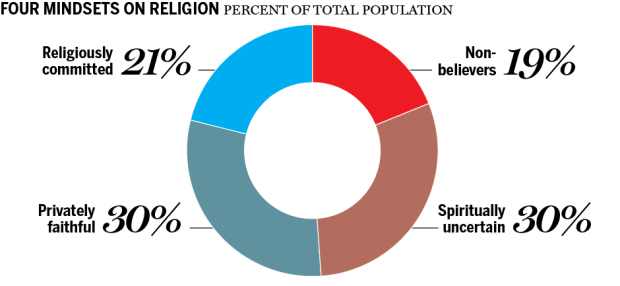
The survey, conducted by the Angus Reid Institute in partnership with Faith in Canada 150, grouped respondents into four categories according to their answers on a range of questions gauging their beliefs and religious practices.
“We have a society that has a secular government and there is a general assumption of faith being very private,” said Ray Pennings, executive vice-president of think tank Cardus. “On the other hand, when you actually take a look at everyday society, the majority of people are people of faith to one degree or another, and faith informs and influences many of the ways we deal with each other on a day-to-day basis.”
Mike Faille/National Post//Angus Reid
The poll classifies 21 per cent of Canadians as religiously committed, meaning they hold a strong belief in God or a higher power and regularly attend religious services. At the other end of the spectrum, 19 per cent of Canadians are pure non-believers.
It is the swath in between, equally divided between what the pollster terms “privately faithful” and “spiritually uncertain,” that offers the greatest insight into Canadians’ evolving beliefs and practices.
The privately faithful, 30 per cent of respondents, “are people who actually believe in God, believe in heaven, believe in an afterlife,” said Angus Reid, the institute’s founder and chairman. “They have largely not been involved in organized religion. They will go to funerals and weddings and that sort of thing, but their faith is largely a private matter, and it’s really driven by their prayer. They pray on a regular basis.”
Mike Faille/National Post//Angus Reid
The spiritually uncertain, also representing 30 per cent, “seem to be a bit confused about where they want to be,” Reid said. “On some issues they kind of side with the non-believers, but they haven’t given up totally on everything.
“They continue to believe that there’s a God, but they’re uncertain about the role of God.”
The poll is part of a multi-faith effort initiated by Cardus called Faith in Canada 150, which aims to highlight the role religion has played historically and continues to play in Canada. The initiative, which has a budget of roughly $1-million, was denied federal funding as part of official 150th anniversary celebrations.
And the accompanying op-ed by Ray Pennings of Cardus:
Despite this religious openness, the same polling indicates a significant disconnect between the perception and reality of faith’s role in today’s Canada.
Simply put, religion has an image problem in Canada. In fact, the word “religion” is more likely to be seen negatively than positively, according to this new poll. Moreover, just over half of Canadians say they disagree with the claim that religion’s overall impact on the world is positive.
About half of Canadians polled say they’re uncomfortable around those who are religiously devout. Throw in terms like born-again, theology and evangelism, and just 15 per cent of respondents associate those words with a positive meaning.
But how well do Canadians actually understand the role faith plays in everyday life? Asked what’s most important in life, the 21 per cent of Canadians who are religiously committed are most likely to prioritize family life, honesty and concern for others.
Conversely, concern for others was a lower priority for non-believers. Instead, they are more likely to select a comfortable life, self-reliance and good times with friends as important. Not to put too fine a point on it, but those who are most likely to pray to God, attend religious services regularly and read the Bible or another sacred text seem most oriented toward others and their welfare.
What about Canadians’ emotional lives? The religiously committed are the happiest amongst us. Fully 47 per cent of them say they’re very happy or extremely happy overall, compared with 35 per cent of non-believers. They also report the highest levels of happiness among friends and in their communities. None of that is terribly surprising. If anything, it simply confirms what other research has shown. It makes sense, then, that the religiously committed are also more likely to be “very optimistic” about the future.
When it comes to community engagement and charitable giving, once again it’s the religiously committed who report the strongest involvement. Slightly more than half of non-believers say they are uninvolved in community groups or activities. That percentage drops to 17 per cent of the religiously committed. In fact, 41 per cent of the religiously committed have at least some involvement in their community, with another 42 per cent reporting heavy involvement.
Almost a third of the religiously committed say they regularly volunteer compared with 13 per cent of non-believers. Dare we ask about charitable giving? Only 12 per cent of non-believers say they try to donate to whatever charities they can. That jumps to 43 per cent among the religiously committed. These are not selfish people.
The numbers present a clear picture: Religiously committed Canadians tend to be the most concerned about others, the happiest and most generous. So, why do Canadians have a negative view of religion? Arguably, the story of faith in Canada is not being well told. The narrative around faith is often negative. Religion is frequently presented as something that divides rather than unites people within communities.
That is part of the reason why Faith in Canada 150 exists, to showcase the role of faith in making Canada the country that it is. That legacy is a story worth telling.
Greek Orthodox Bishop, Metropolit Seraphim of Piraeus has caused controversy by urging Turkish President Recep Tayyip Erdogan to convert to Orthodoxy with Russian President Vladimir Putin as his godfather. And no, it’s not a joke.
In a 37-page letter to Erdogan written in Greek, Metropolit Seraphim asks the Turkish leader to denounce his Islamic faith and be baptised in the Ecumenical Patriarchate of Constantinople.
“If you want to save yourself and your family you should convert to Greek Orthodox Church, the only real faith,” Seraphim writes, reports Keep Talking Greece.
“We propose and we advise you to come to the arms of the Greek Orthodox Church before the end of your life on earth.
“Otherwise, you will unfortunately find yourself, your family and your people in the same place where Allah, Muhammad and his followers are, ie. in the place of suffering, eternal and unending hell.”
He calls on Erdogan to “repent, cry, be humble and believe in Christ,” and claims that “the Holy Trinity of God will open the arms for you”.
If Erdogan is to heed the Metropolit’s advice, he says that the Orthodox faithful on earth and in heaven will rejoice and “the angels in heaven after your enter the true Church!”
In the extensive letter, the Bishop also analyses Greece’s 400 years under Ottoman rule, the Treaty of Lausanne, Turkey’s recent history and the country’s efforts to join the European Union.
Despite concluding his letter with “honour, respect and honest brother love”, it contains a number of remarks in which he insults the Koran, the Prophet Muhammad, and describes Islam as a sect rather than a religion.
A flood of angry anti-Muslim rhetoric on social media was the first sign of how fiercely suburban middle-class homeowners in the central Chinese city of Hefei opposed a planned mosque in their neighborhood. It quickly escalated into something more sinister.
Soon a pig’s head was buried in the ground at the future Nangang mosque, the culmination of a rally in which dozens of residents hoisted banners and circled the planned building site.
Then the mosque’s imam received a text message carrying a death threat: “In case someone in your family dies, I have a coffin for you — and more than one, if necessary.”
“How did things get stirred up to this point?” the imam, Tao Yingsheng, said in a recent interview. “Who had even heard of the Nangang mosque before?”
On the dusty plains of the Chinese heartland, the bitter fight over the mosque exemplifies how a surge in anti-Muslim sentiment online is spreading into communities across China, exacerbating ethnic and religious tensions that have in the past erupted in bloodshed. It is also posing a dilemma for the ruling Communist Party, which has allowed Islamophobia to fester online for years as part of its campaign to justify security crackdowns in the restive region of Xinjiang.
“It has let the genie out of the bottle,” said James Leibold, a professor at La Trobe University in Australia who has tracked the growth of anti-Muslim hate speech on China’s internet.
Interviews with residents and an examination of social media show how a few disparate online complaints by local homeowners evolved into a concerted campaign to spread hate.
Key to it was an unexpected yet influential backer: a Chinese propaganda official, 2,500 kilometers (1,500 miles) away in Xinjiang, whose inflammatory social media posts helped draw people into the streets on New Year’s Day, resulting in a police crackdown.
First mosque in 1780s
A stone inscription outside its gate shows the original Nangang mosque was established in the 1780s by members of the Hui minority, the descendants of Silk Road traders who settled across China centuries ago. In its present form, the mosque has served the area’s 4,500 Hui for decades, its domed silhouette partially hidden by overgrown shrubs in the countryside beyond Hefei’s last paved boulevards.
Over the past 10 years urbanization has come to Hefei, with sprawling development reconfiguring the landscape and its demographic flavor, and Hui leaders had been pushing for years to relocate their mosque to a more convenient urban location.
City planners in November finally selected a site adjacent to the newly built Hangkong New City condominiums, with its $200,000 two-bedroom units, faux-Mediterranean styling and a Volvo dealership across the street.
The project’s homeowners — overwhelmingly members of China’s ethnic Han majority — began complaining on China’s popular microblog Weibo. Some complained the mosque would occupy space promised for a park. Others warned that safety in the area would be compromised.
Others were more blunt: Han residents were uncomfortable that a center for Hui community life would be less than 100 meters from their building, a homeowner who later identified himself in messages to the AP by his surname, Cheng, wrote in a petition posted in December. “And the less said about what happens on Eid al-Adha, the better,” Cheng wrote, referring to the Islamic holiday in which animals are slaughtered for a sacrificial feast. “It’s absolutely shocking.”
I suspect that the Committee witnesses will have a fairly broad range of witnesses from a number of communities that overall will maintain the focus on Islamophobia/anti-Muslim while situating the issues in the broader context of racism and discrimination:
A committee study that Canada’s controversial anti-Islamophobia motion called for is likely to get underway next month, the Sun has learned.
All eyes will be on the Standing Committee on Canadian Heritage as it hears from dozens of witnesses to study the ill-defined phenomenon of Islamophobia, along with other forms of discrimination and racism.
Liberal MP Iqra Khalid’s M-103 passed in the House of Commons by a vote of 201-91 on March 23 after weeks of controversy surrounding the wording of the motion. Now the committee will pick up where the motion leaves off.
While the motion supposedly denounces all discrimination, Islamophobia was the only one that received a specific mention. Khalid has stated her motion was partially inspired by E-411, an online petition exclusively focused on Islam.
A number of mainstream pundits argued during the controversy that the motion was nothing more than a gesture and would never amount to anything.
However now that the issue is headed to committee, it will result in a report that will provide recommendations that may inspire legislation.
Multiple sources confirmed to the Sun that lists of suggested witnesses have already been put forward.
Typically, Liberal, Conservative and NDP members of a committee each put forward their own party list of witnesses and then together they narrow it down to a smaller, mutually agreed upon list.
The witnesses invited to testify for this study will largely determine the scope and tone of the committee meetings. Will they give equal time to representatives of all religions, as well as the non-religious? Will those speaking about Muslim issues be liberal Muslims or more orthodox, pro-sharia voices?
Meanwhile, a petition on the government’s official e-petition website that was created to voice opposition to sharia law gaining a foothold in Canada has reached 42,000 signatures.
The petition that inspired Khalid’s motion reached 70,000 before it was closed for signatures.



 Multicultural Meanderings