Isils Western converts are not motivated by Islam. They are motivated by boredom – Telegraph Blogs

Tim Stanley’s  take on radicalization from a conservative perspective, noting the similarities to Islamic-inspired radicalization to the European young terrorists of the Baader Meinhoff and Red Army in the 1970s:

To this collage of conservative thought, I’d add two observations. First, alienation from Western materialism being expressed through revolution is far from new. It demands comparison with the urban guerilla movements of the 1970s – all of which were predominantly drawn from middle-class kids who saw their parents’ success as a form of collaboration with capitalism and fascism.

Is there any real difference between, on the one hand, Mahmood allegedly abandoning professional achievement and the life of a liberated Western woman for Jihad, and, on the other hand, Ulrike Meinhof of the Red Army Faction abandoning her children and sparkling literary career for a life of assassinations and bombings in the 1970s German terrorist underground? None, except the contrasting ideological manifestations of their malaise.

And, aside from bourgeois angst, Seventies Marxism and contemporary Jihad are linked by a an obsession with America/Israel as a nexus of capital and military power that is responsible for everything wrong with the world and b an unrealistic sense of their ability to do anything about it. They are, in reality, grubby little criminals poking at the system with a blunt dagger. But they believe they are heralds of a New Order. They all suffer from the arrogance of youth.

….I’m not convinced. Aside from the terrible idea of turning history classes into propaganda about how wonderful the Whigs were, I also don’t believe that alienation is generally reduced by attempts at indoctrination. And while theocracy is a wretched idea, it’s pretty self-evident that the undoubted appeal of Anglosphere freedom is limited. That would be – to return to Michael Brendan Dougherty’s observations – because it offers material rewards but little in the way of spiritual sustenance. Mahmood was perfectly aware of the benefits of Anglosphere liberty (Magna Carta, kangaroos and apple pie?) because she had the privilege of growing up in the midst of its wealth and freedom. Yet, still, her family say that she has rejected it. Perhaps because it was not enough. And that’s the challenge that the West faces when fighting for the souls of narcissistic revolutionaries. What we have to offer as an alternative is, for many of them, not enough.

Isils Western converts are not motivated by Islam. They are motivated by boredom – Telegraph Blogs.

From the National Post, a profile on Aqsa Mahmood, the woman mentioned in Stanley’s piece:

Inside the life of a 20-year-old Scottish woman who ran away to become a hardline supporter of ISIS  
The Myth of the Invisible Jetsetting Jihadi | TIME

Good series of articles putting the risks – they are real – of returning ISIS and other extremists to the West.

Starting with the Globe’s Doug Saunders, who notes:

In other words, there is a good chance that at least one Canadian will return to attempt an attack here. While returning terrorist fighters are nowhere near Canada’s top terrorist threat in terms of numbers, they should certainly be watched very closely by intelligence agencies.

This is where you’ll find one small silver lining in this otherwise dark development: By going abroad to fight, such Canadians become very easy for intelligence agencies to notice, track and monitor. “We’re going to know who these guys are and we’re going to watch them closely as they transit home,” Brookings counterterrorism scholar Will McCants told an interviewer this week. The fact that these fighters aggressively use Twitter, Facebook and YouTube as propaganda tools makes them even easier to find.

Plus, their mortality rate is very high, and rising. So viewed from another angle, by going abroad to fight, our extremists – already very few in number – are self-culling dramatically and rendering themselves far more visible to authorities.

They are a genuine threat, but not the largest or most ominous one facing us. We should be afraid, but we should not be very afraid.

Homegrown terror – be afraid, sort of afraid

From Time’s David Sternam, a similar message:

Three years into the Syrian civil war, there has been only one lethal attack in the West – the murder of four people at a Jewish museum in Brussels by Mehdi Nemmouche, a veteran of the Syrian jihad. In the United States, no one returning from or seeking to join a Syrian jihadist group has even been charged with plotting an attack inside the United States. In comparison, there have been two deadly incidents in the United States committed by individuals motivated by far right ideology in the past six months. If thousands of extremists were only a plane ride away from American cities, one would hardly expect such a limited record of Syria related violence in the West.

None of this is to say that Jihadist groups in Syria should be allowed to fester and develop the capability to conduct attacks in the United States, or that it is impossible that a returning Syrian foreign fighter will evade the layered defenses that protect the American homeland. That Abu Salha was able to return undetected to the United States after participating in Jihadist training should concern law enforcement. The layered defense system may need reinforcement to deal with new challenges, but the constraints it imposes upon jihadist activity ought not be obscured, particularly when making the case that the threat posed by foreign fighters calls for military action. Doing so does a great disservice to the admirable efforts of Muslim communities, local and federal law enforcement, and American citizens in confronting Jihadist extremism at home.

The Myth of the Invisible Jetsetting Jihadi | TIME.

Calls for parliamentary testimony on radicalization and the implications for Canada:

Liberals want hearings on Islamic radicals who have returned to Canada

Lastly, a good overview and profile of ISIS in the Globe:

 How a former U.S. prisoner of war created an Islamic state 

RCMP looking at ways to identify young people at risk of becoming radicalized

Good overview by Douglas Quan on the various approaches being taken to reduce the numbers of those drawn to extremism:

For those who show signs of becoming involved in violent extremism but who have not yet crossed that threshold, the RCMP is developing an intervention program — set to roll out by the end of the year — designed to link those individuals with community mentors for “advice, support and counselling.”

Dash confirmed that public safety officials have been studying different intervention models, such as the Berlin-based EXIT program, which provides help to Germans trying to leave the neo-Nazi movement. A few years ago, the group created an offshoot program to support families of radicalized Muslims.

Dash declined to say what criteria the RCMP have developed to decide who merits intervention. She did say that someone who expresses extremist views is not necessarily going to be radicalized to violence. “It could be just someone who is being curious. We don’t want to stigmatize anybody.  There’s no one-size-fits-all indicator,” Dash said.

Experts say various “diagnostic tools” have been developed around the world to assess where someone falls on the “spectrum of dangerousness,” but no consensus has been reached on which one is best.

In the U.K., a police-led early-intervention program called Channel saw in its early days referrals of young people simply for wearing what were deemed to be “radical” clothes, according to a 2012 report by the International Centre for the Study of Radicalisation and Political Violence. “People were not sure what to look for and so they erred on the side of caution,” a Channel coordinator was quoted as saying.

The program has since developed a “vulnerability assessment” framework consisting of 22 behaviours to look out for. They include spending time in the company of extremists, changing style or appearance to accord with the group, loss of interest in friends, and condoning violence or harm towards others.

RCMP looking at ways to identify young people at risk of becoming radicalized | canada.com.

And Wesley Wark, as usual, pointed in his criticism for the lack of serious discussion by the Government:

The 2014 Public Report on the Terrorist Threat to Canada sums all this up. Whether you agree with the government statement or not (and maybe there are other things we should be worrying about, such as cyber threats, climate change impacts, pandemics, a new Cold War, etc…) the report moves our thinking into the present and nudges us out of a frame of reference dominated by legacy fears of Al Qaeda.

So why the whisper? Maybe the government can’t find the headline in its own report. Maybe it feels uneasy because it can’t say with certainty what the exact threat to Canada from terrorism is in the post-Al Qaeda age. Maybe it feels the public doesn’t really need an education on the new terrorism threats or is not interested. Maybe it thinks there are no votes here. Whatever the answer, it’s simply not right. We need a little less megaphone on the world stage and a little more at home.

Wesley Wark: Where’s the megaphone on the threat to Canada?

ISIS: The Death Rattle Of Islamism? « The Dish

Interesting take by Jonah Shepp:

This is all by way of saying, as a reminder, that “Caliph Ibrahim” Baghdadi represents Muslims about as thoroughly as Tony Alamo represents Christians. The fact that he has attracted enough funding and followers to run roughshod over northern Iraq and eastern Syria is nothing to brush off, but it’s not winning him any friends, and it doesn’t make his ideology any less ridiculous. It’s certainly not “Islam”, at least not as any Muslim I know practices it. That’s why I suspect it will fail, like most grandiose visions of world domination do. And by radicalizing the Islamic heartland against radicalism, as it were, perhaps ISIS will take the entire edifice of radical Islamism down with it.

The Death Rattle Of Islamism? « The Dish.

Canadian International Council – Canadas hub for international affairs » How to Stop Canadians From Becoming Jihadists

Not sure that this article says much that is new. Yes, a variety of approaches, both “soft and hard” should be used, but no matter how good and varied the programs, and no matter how engaged the community and Imams, some will persist and reject the “soft approach” and try to skirt the security approach.

No easy solutions, but this article would benefit from greater acknowledgement of existing soft approaches and Canadian agencies learning from the experience of other governments, a lot has been done here:

While the spirit of these initiatives is welcome, considering the secretive process involved and the RCMP as the lead agency, it seems this counter-radicalization strategy may take a strong, policing, approach to the issue. Also, the government will reportedly make the RCMP the intended first point of contact for concerned community members and parents, meaning community reluctance to involve the police will potentially hamper the ability of the government to address radicalization early and effectively.

Instead, community policing should be coupled with soft approaches to pre-emptively deal with radicalization and should not end when the individual attempts to or successfully travels overseas. This requires a whole-of-government approach, one which includes Public Safety Canada and the RCMP, to create a positive effect on identifying and curbing the growth of extremism and reintegrating those caught in its clutches.

As Mubin Shaikh, former CSIS informant in the Toronto-18 case and currently a PhD student in terrorism studies said in an interview: “A counter-narrative should include Canada’s Muslim community in cooperation with the government, private industry and non-profits. It should include theological appeals and work on the strengths of multiculturalism.” Such a counter-narrative must de-legitimize the extremist narrative by using both the strengths of Canada’s pluralistic society and religious guidance based upon Islamic teachings.

These young men must be made to feel that they are a part of Canadian society, as well as made to understand that their actions are not religiously condoned. This approach must involve community leaders, relatives, colleagues, social workers and organizations with experience in de-radicalization.

Canadian authorities must learn from the counter-radicalization programs of their European peers: which tactics and strategies work; how to partner with impacted communities; how to integrate individuals into Canadian society; and, how best to disrupt the networks that exploit these individuals. Only then will it be possible to fully understand and address the issue of radicalization in Canada, to pre-emptively tackle threats to Canadian security and deal fairly and equitably with radicalized individuals and the communities in which they live.

Canadian International Council – Canadas hub for international affairs » How to Stop Canadians From Becoming Jihadists.

Sheema Khan is more concrete and focused on some of the “soft” initiatives and actions that are needed to reduce radicalization:

Second, rather than pointing fingers at all Muslims and fanning the flames of Islamophobia, there must be meaningful partnerships in which Muslim communities play an important role in rooting out extremism. Muslim communities are the best sensitized to observe changes, which can be subsequently reported to authorities and/or addressed by community programs that focus on religious literacy about jihad, messaging against extremism, support for converts, mentoring, constructive channelling of political grievances and the special role of mothers.

The post-9/11 environment sent a chill about discussions of the “j” word. This naturally led to underground discussions, away from mainstream counternarratives. Today, the topic of jihad must be addressed openly by imams. Religious literacy about its strict conditions and unequivocal prohibition of violence against non-combatants is essential. For example, the British government has appealed to anti-extremist imams to counteract the seeds of radicalization.

Muslims can play an important role by speaking out against atrocities committed in the name of Islam. Muslims throughout the world have spoken and demonstrated forcefully against the Islamic State’s brutality. Strong community abhorrence provides a powerful alternative to the romanticized extremist jihad message.Converts to Islam often lack community support networks and in-depth knowledge of religious sources. Programs need to be developed to provide both elements in order to prevent their exploitation.

Partner with Muslims to root out extremism – The Globe and Mail.

Extremism loves company: Sunstein

Cass Sunstein on the psychology of radicalization.

What nudge does he suggest to reduce polarization and extremism?

Why does group polarization occur? The first answer involves information. Suppose that most group members begin by thinking that some religious group, leader or nation is evil. If so, they will hear a lot of arguments to that effect. As they absorb them, they will be inclined to move toward a more extreme version of their initial judgment.

People also care about their reputations, so some group members will adjust their positions in the direction of the dominant view. A disturbing implication is that if group members listen only to one another, and if most of them have extremist tendencies, the whole group might well march toward greater radicalism and even brutality.

Writing in 1998, Russell Hardin, a political scientist at New York University, drew attention to the “crippled epistemology of extremism,” by which he meant to emphasize how little extremists know. Focused on Islamic fundamentalists, Hardin was concerned about what happens “when the fanatic is in a group of like-minded people, and especially when the group isolates itself from others.”

In the years ahead, the international effort to combat violent extremism will sometimes require force, and it will sometimes require economic pressure. But it will succeed only if it disrupts recruitment and radicalization by enclaves of like-minded people.

Bloomberg’s Cass R. Sunstein (pay wall)

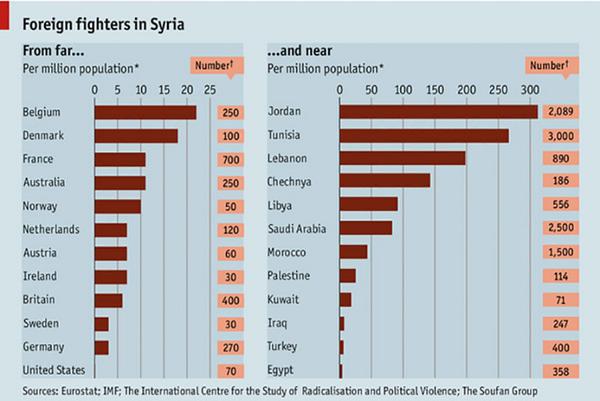
David Cameron seeks to seize passports of Islamist fighters

From The Economist

From The Economist

More on efforts to curb home-grown radicalization in the UK. While these are “hard” approaches to prevention, UK has also invested considerably in “soft” approaches as well.

As with all these initiatives, particularly their expanded application of revocation to prevent born-Britons without dual nationality to return home, questions about who decides and whether the person accused can defend himself.

One thing to hold them for investigation (legitimate), another to make a decision without due process.

One could argue that refusing entry, understandable from a security perspective, simply means that any such extremist would return to Syria or Iraq to continue their brutality, rather than being under the watch of the police in the UK:

“There are two key areas where we need to strengthen our powers to fill specific gaps in our armoury. These are around preventing suspects from travelling and dealing decisively with those already here who pose a risk.”

David Cameron’s new anti-terrorism proposals come days after the U.K. raised its terrorism alert to its second-highest level.

Cameron said he would bring in new “specific and targeted legislation” to give the police powers to temporarily seize a suspects passport at the border to give authorities time to investigate them. Currently only Britain’s interior minister has the power to withdraw a passport.

He also said the government would consult on a discretionary power to prevent Britons from returning home if they have pledged allegiance to extremist causes. This would extend existing powers which can only be applied to foreign nationals, naturalized citizens and those with dual nationalities.

David Cameron seeks to seize passports of Islamist fighters – World – CBC News.

Meanwhile, in Canada, more on the RCMP’s High Risk Travel Case Management Group approach to prevention (see also 2014 Public Report on the Terrorist Threat to Canada):

While the report’s emphasis is on prevention and intervention, several recent cases related to the Syrian conflict have raised questions about the effectiveness of efforts to reason with determined youths blinded by zeal.

After serving a prison sentence for his role in the Toronto 18 terrorist group, which plotted bomb and shooting attacks in southern Ontario, Ali Dirie used a fraudulent passport to travel to Syria, where he fought and died last August.

A British Columbia man charged with terrorism in July, Hasibullah Yusufzai, 25, was known to Canadian authorities because of a previous trip he had made to Afghanistan. Although he was on a no-fly list, he still managed to make his way to Syria using a passport that did not belong to him.

When Ahmad Waseem returned to Windsor, Ont. after he was wounded in combat in Syria, his mother hid his passport, his mosque counseled him and police spoke to him. But he returned to Syria last year and now calls the Islamic State of Iraq and Al-Sham his “brothers.” He has been charged with passport fraud.“

Early intervention through a joint community/law enforcement response is no guarantee that a person will not radicalize to violence,” the report says. “However, early intervention is one constructive way to deter potential violent extremists from causing harm.”

Canadian government plans ‘targeted interventions’ to stop citizens from joining armed Islamists in Syria

Gregory and Collin Gordon, Calgary brothers, join ranks of Canadians fighting for ISIS

The latest extremists from Calgary and again, no particular pattern as the brothers, born in Canada and converts to Islam, appeared to be well-adjusted and integrated. What made them change? And how did Calgary become a centre?:

“All I know about Collin is that he moved back home [to Calgary] and started to be hardcore Muslim,” said Akan Swisslizz Ekpenyong, a Vancouver-based hip hop artist who used to host parties with Collin in Kamloops and was his classmate.

Ekpenyong said it became increasingly difficult to communicate with Collin due to his religious beliefs — and that’s when he decided to “unfriend” him on Facebook. Ekpenyong had no idea how extreme Collin would eventually become.

No one CBC News spoke with can explain how exactly Collin went from sports, hip hop and tweets about wanting to marry American rapper Nicki Minaj in early 2012, to becoming one among thousands of foreign fighters trying to establish an Islamic state in the Middle East.

Heartbroken and confused, their parents told CBC News that they raised their children to be peaceful, kind and smart — and that both were well educated and never had any run-ins with the law.

Asking the media for privacy, the parents of the Gordon brothers provided the following statement to CBC News: “We would like all to know we love and miss our sons dearly. We are deeply concerned for their safety. At this time we refuse to speculate with regards to the end of their story. We continue to keep hope alive.”

And while their parents are keeping hope alive, Collin’s social media photos portray someone who has become well-adjusted to life as a foreign jihadi.

As Canadian-born, without dual citizenship, their citizenship could not be revoked unlike other members of the Calgary cell not-born in Canada.

Gregory and Collin Gordon, Calgary brothers, join ranks of Canadians fighting for ISIS – CBC News – Latest Canada, World, Entertainment and Business News.

Terrorists may lose Norwegian citizenship – The Local

Another country considering citizenship revocation in cases of terrorism:

Minister of Children and Equality, Solveig Horne, said to the media: “This is a strong signal to people wanting to take part in terror operations and wars.”

The Norwegian government believes it is important to look at new measures to oppose radical behavior connected to terrorism.

Horne said: “We will turn over every stone to find the necessary measures to prevent radicalization and extremism. We will begin discussion about introducing regulations on revocation for any citizen causing serious damage to vital government interests or who has volunteered to serve in foreign military services.”

Terrorists may lose Norwegian citizenship – The Local.

Ottawa jihadi seeking ‘martyrdom’ with ISIS in Syria | Ottawa Citizen

Profile of an Ottawa man fighting with ISIS in Syria:

Counter-terrorism officials say they are concerned that Canadian fighters who survive the conflicts in Syria and Iraq may return home to spread anti-Western radicalism and conduct terrorist attacks, but Maguire does not seem to want to leave.

“He said he’s not coming back,” his aunt, Allison McPherson, said in the Ontario family’s first public comments about their plight. “My sister doesn’t expect that she will ever see him again, and probably won’t ever see him again alive.”

As a boy, Maguire had a tough time, she said. After his mother left an abusive relationship and then suffered health problems, he was raised partly by his grandparents. “John is a very smart kid,” McPherson said, “but there was always something kind of closed off, and he kept to himself. And, of course, that’s exactly what these people are looking for — a bright guy, kind of a loner, needing a place to fit in.”

According to his online profile, he went to Hillcrest High School and once wanted to be a hockey player or motocross racer. He left home for California for a few months but returned  and enrolled at the University of Ottawa.

During the fall 2012 term, he began musing on Twitter about the brutality of President Bashar Al-Assad, writing, “how can I sleep with what is happening in Syria.” But the friend said Maguire was not an activist and had displayed little interest in issues in the Muslim world.

“Now we’re all just confused. What I’m trying to figure out is how it all began,” he said. Was he swayed by something he found on the Internet? Did someone influence him? Was he upset about events abroad? “I wish I knew what it was, and I wish I could have prevented it.”

As Canadian-born, and presumably not a dual citizenship, he would not be subject to citizenship revocation unlike other extremists not born but raised in Canada.

Ottawa jihadi seeking ‘martyrdom’ with ISIS in Syria | Ottawa Citizen.