Kinsella on Ifill: The kind of things you hear from bigots

Valid observation:

Bigot.

That word — along with the corollaries racist, sexist, hater, et al. — get thrown around a lot, of course.  It happens so often, these days, that those words have lost all meaning.  Like they say: if everyone is a racist, then no one is a racist.

But Erica Ifill keeps at it, just the same.

To Erica, seemingly, everyone who isn’t like her — that is, a person with dark skin — is less than her.  She’s been preaching division for years now, on social media and behind a paywall at the Hill Times.  She calls herself “an award-winning anti-oppression journalist and economist.”

Full disclosure: I happily wrote for the Hill Times for years.  When I was there, my editor was mainly Kate Malloy.  Kate and I agreed that Hill Times columnists were not allowed to take cheap shots at each other, in the paper or elsewhere.

But if an occasion arose where criticism was merited, then the target would get a heads-up.

Other media have the same rule.  When Ezra Levant and I did commentary at the Sun News Network, for example, we promised we wouldn’t go after each other — even though we didn’t particularly like each other.  And we didn’t.

Despite that, I picked up the Hill Times one morning, where I found a column Erica Ifill had written about me.  Among other things, she said I was toxic, unethical, disloyal, and that I had never “lived up to any modicum of respectable conduct.” And so on.  Pretty good zingers, if not terribly original.

And then, she said I was a racist.

Given that I’ve spent most of my adult life documenting and opposing racism, that one was over the line — particularly coming from a newspaper I wrote for, and published without the courtesy of a heads-up.  So, I quit, and I haven’t looked at the Hill Times since.

Until this week, that is.  This week, Erica unburdened herself of some opinions that — if the world was still in any way sane — would see her losing her gigs at the Hill Times, Canadaland, CBC and the like.  She won’t, but she should.

When Bingo, a Toronto Police dog was allegedly shot by one Kenneth Grant — the day after Grant allegedly shot and killed one Sophonias Haile in Etobicoke — Ifill was unmoved.  Here’s what she put on Twitter (as it was then known):

“It’s amazing to me how white people show more compassion to animals than to people on the street. You people are reprehensible.” She then posted a graphic of a white person and a dog, mouth on mouth.  It even looked sort of sexual.  “WHITE PEOPLE BEFORE THEY LEAVE THE HOUSE,” the graphic read.

Can you imagine what would happen if a white columnist at the the Hill Times said that about black people?

Anyway. People were outraged, of course, because what the Hill Times columnist posted was insane.  But she wouldn’t back down.  She posted a “study” that read, in part: “The use of dogs as tools of oppression against African Americans has its roots in slavery and persists today in everyday life.”

“Slavery.” And here we simply thought that a dog had been shot and killed: turns out the dog deserved it, because of slavery.  So said Erica, who wrote: “F*** Bingo. Guess he ran out of luck.” She then posted a smiling emoticon.

And, even then, she wouldn’t concede that she had gone too far. “Free speech is for white people and white feelings only,” she declared. She’d experienced a “whitewash,” she said. She was “glad y’all are offended,” she said.

For the Hill Times’ Erica Ifill, all of this is great fun.  A giggle.  She calls white people racist all the time.

She has suggested that “white people” have “a Nazi phase.” That Canada was “built on white supremacy and the fascism of right-wing, Christian dogma.”  That Canada has “white supremacist and seditious elements within.”

Even the Justin Trudeau government is white supremacist, apparently: “When it comes to racism and white supremacy, this country continues to be two-faced. While the Trudeau government denounces white supremacist extremism at home, it meets with them in the dark.”

And so on, and so on.  When you hear that Erica celebrated the death of Queen Elizabeth — a woman who “bathed in the blood of my ancestors” — well, none of this stuff is particularly shocking anymore.

It is, however, the sort of anti-white racism and black supremacy upon which Louis Farrakhan built his Nation of Islam empire.  It is dishonest and damaging and divisive.

It is also the sort of thing you hear from bigots.

Like Erica Ifill.

— Kinsella is the author of the bestselling Web of Hate, and the leader of the group Standing Together Against Misogyny and Prejudice, which led a successful campaign against a pro-Nazi newspaper in Toronto.

Source: KINSELLA: The kind of things you hear from bigots

Review: The underlying philosophy of Black Lives Matter

Of interest:

In 1923, amid a wave of lynchings, Claude McKay wrote the sonnet “If We Must Die.” He was faced with a society structured by white supremacy and anti-Blackness, a society that wanted Blacks “to die like hogs/ hunted and penned in an inglorious spot.” Confronted with this uniquely American form of death, McKay proclaimed that “we’ll face the murderous cowardly pack/ Pressed to the wall, dying, but fighting back.” For McKay, the nobility and humanity of Black people was forged in fighting the monsters of white supremacy.

A similar vision animates Vincent Lloyd’s Black Dignity: The Struggle Against Domination. For Lloyd, dignity is not something abstracted from a notion of “humanity.” It is wrested from the teeth of domination. It is asserted in the struggle against oppression. It is born the moment the slave seizes his master and throws him down. Perhaps most important for Lloyd, dignity is Black.

Much of Lloyd’s book is about looking at centers of ontological resistance to domination, such as Black love, Black family and Black magic.

Begun while he participated in protests in Ferguson, Mo., and continued in seminars and libraries, Lloyd’s book focuses on the words of generations of Black freedom fighters. To the struggle, he offers the contribution of a keen intellect articulating the underlying philosophy of Black Lives Matter. While I disagree with aspects of his book, his core argument is a profound challenge to anyone who takes seriously the struggle for human dignity, antiracism and the work of dismantling white supremacy.

Lloyd’s philosophy depends on some fundamental claims. The first is that we must understand the “depths of anti-Blackness shading America” such that anti-Blackness “is at the center of everything, for everyone.” It is not an incidental, localized or past reality. It is reality. For Lloyd, philosophy is meant to help us understand reality and, more important, to resist and overthrow that reality. Resistance to domination is not on behalf of some antecedent given of human dignity that does not say anything about actual reality. Such abstracted claims about dignity (“all lives matter”) cannot resist anti-Black reality.

Instead, dignity is “something you do, a practice, a performance, a way of engaging the world…. It necessarily means struggle against domination.” The world is oppression; dignity is the refusal of the world. It is dying but fighting back. Black dignity is found in that fighting back. Since anti-Blackness is the primary form of domination, Black dignity is the primary form of enacted dignity.

Philosophers must begin from that fighting back in order to understand reality. Thus Lloyd places a great deal of importance on the distinction between the ontic and the ontological. Generally, these terms would refer to questions about the being of a specific object (ontic) and the being of beings (ontological). You might say the former is small-picture metaphysics and the latter is big-picture. For Lloyd, both have to do with the struggle against domination. The ontic struggle has to do with specific sites of struggle, a struggle against a particular center of domination. The ontological has to do with “struggle aimed at domination” itself. As with McKay’s poem, fighting is not only specific to instances. In asserting Black dignity, one fights the whole system of domination.

Much of Lloyd’s book is about looking at centers of ontological resistance to domination, such as Black love, Black family and Black magic. Each chapter leans into the claim that racism is not just personal or even systematic; it is the being of reality. According to Lloyd, multiculturalism, liberalism and the American project are to be discarded as expressions of that ontology. Since domination is reality, abolitionism is about abolishing everything.

It is here that some of the weaknesses of the book appear. First, Lloyd seems uninterested in Black voices that differ from his more radical approach, voices that show a majority of Black Americans want serious reform of the police and criminal justice system but do not want the abolishment of either. Those voices see arguments like those for defunding of the police as a form of political colonization by urban elites. What does Lloyd think of the majority of African Americans, who agree that “Black dignity” is a non-negotiable struggle and as a consequence want more and better policing? In his book, Black conservatives go unmentioned while establishment Black liberals are depicted as the purveyors of vacuous expressions of multiculturalism.

Perhaps these Black voices belong to those who are just “dreamers” or are trapped by respectability. But then what to make of Martin Luther King Jr., Frederick Douglass or Rosa Parks? They wanted America to live up to its ideals, not abolish them. Lloyd doesn’t let these voices disturb his text. Rather, he states that “Black dignity is the philosophy of Black Americans.” But whose philosophy of Black dignity? Which vision of antiracism? For Lloyd, “One view is right, others might seem right but are wrong.” Ironically, this sentiment seems to feed into what Lloyd, in Compact magazine, has criticized as an antiracist cult that seeks to silence dialogue.

Lloyd argues we should center dignity discourse on Black dignity. He rightly recognizes other forms of intersecting oppression, but his account still centers on Black dignity as the first philosophy, such that “all philosophy must be routed through the Middle Passage” and understood in light of “domination’s chief paradigm, Blackness.” But shouldn’t we also center dignity on the Indigenous, the refugee, the unborn or the disabled? Lloyd is right that dignity is something struggled for. However, that struggle does not fabricate a dignity not already there; it brings to light the truth of dignity that is always already there.

If white supremacy is to be overcome, anti-Blackness cast down as sin and blasphemy, and Black dignity centered as fundamental reality, we will need books like Lloyd’s.Black dignity is an ethical, even ontological, preferential option for dignity. But if we hold this at the expense of intrinsic human dignity, then other voices and other ways of asserting dignity will be lost. This means we lose the grounding of natural law that Lloyd powerfully presents in his book Black Natural Law. The danger in losing this is that the struggle may devolve into centers of competing power with little orientation to a justice beyond power.

Making dignity entirely performative—and thus downplaying intrinsic dignity and natural law—is likely tied to how ontological Lloyd makes domination. Domination, as reality, is not a privation of a more original good but is instead the original and ultimate position and thus the position that is never overcome. “The object of ontological struggles is,” Lloyd tells us, “impossible to achieve.” More than 500 years of racial domination speak to the truth of this claim. But there are other stories of when people cast down domination. In this, I wish that Lloyd had been willing to be more than a philosopher by being a theologian. As King puts it: “the ringing cry of the Christian faith is that our God is able.” Believing domination can be overcome is not “a fantasy of domination itself,” as Lloyd puts it, but a conviction about God and humanity.

If white supremacy is to be overcome, anti-Blackness cast down as sin and blasphemy, and Black dignity centered as fundamental reality, we will need books like Lloyd’s. For all my criticisms, he does the work of philosophizing on behalf of Black dignity. He is right that dignity must be found and asserted in the struggle for dignity.

But there is a grace beyond assertion. Later in his life, Claude McKay converted to Catholicism, finding in it the only source of racial unity. He “turned to God for great strength to fight” while holding to “the Sacred Light.” We should, too. Starting from Black dignity and from the dignity of all who are oppressed, we may someday—by that sacred light and our efforts—find ourselves with human dignity, achieved.

Source: Review: The underlying philosophy of Black Lives Matter

Go and See: When can Chinese Canadians stop being foreigners in our home?

While written from the perspective of Chinese Canadians, they note the commonality of experience among visible minority groups and potential threats from foreign are legitimate concerns:

This July 1 marks the 100th anniversary of the enactment of the Chinese Exclusion Act, a racist law that for 24 years excluded all but a few Chinese from coming to Canada. Numerous events are being held to commemorate the occasion.

Many would suggest this is a time for celebration. After all, isn’t everything much better now, and aren’t there so many successful Chinese Canadians?

If so, how do you account for the fact that the Chinese Canadian community experiences higher than average poverty rates, including higher than Black and South Asian Canadians? How do we respond to social-science studies that show job seekers with Chinese or Asian-sounding last names have a 28-per-cent lower chance of getting interviews, as compared to those with Anglo names? And how do we explain the consistent themes of anti-Asian racism that can be traced from over a century ago to our modern manifestations of individual and systemic racism.

As Chinese Canadians, in addition to combating the “model minority myth,” we face constant challenges to our sense of belonging. At best, it comes as a microaggression in the form of a “friendly” query asking, “Where are you from?” However innocent these inquiries may sometimes sound, they reinforce assumptions about who is a “real” Canadian, and are a reminder that we are seen as the “other.” At worse, this stereotype of Asian Canadians as perpetual foreigners fuels xenophobia and hateful attacks that are trying to drive us, the “foreigners,” to “go back to where we came from.”

Telling Chinese Canadians, regardless of where we were born, to “go back to China” is sadly nothing new. The Canadian government took the lead in 1885 by imposing the infamous Chinese Head Tax on every Chinese person entering Canada as soon as Chinese railway workers finished building the Canadian Pacific Railway connecting our country from coast to coast. When that did not stop enough Chinese coming here, the Canadian government passed the Chinese Exclusion Act in 1923, to essentially exclude all Chinese from entering until this racist Act was repealed in 1947.

Different governments’ racist actions have reverberated throughout Canadian history, marching in step with the dehumanization of the Chinese, as shown by the public violence of the 1907 riots by white mobs in Vancouver’s Chinatown, and the 1919 ransacking of Toronto’s Chinatown. More recently, the COVID-19 pandemic unleashed racist hate and violent attacks aimed at Chinese across the country, driving home the same message of who belongs and who is the “other.”

The current public discourse about foreign interference by China has added a layer of complexity to the already precarious discussion around anti-Asian racism. We know that negative views about China can contribute to more racism against Chinese Canadians, especially because of the perpetual foreigner stereotype, where our loyalty to Canada may be questioned. At the same time, concerns about anti-Chinese racism should not be abused as a tool to suppress legitimate discussions about potential threats from foreign regimes. As Canadians, we all have the same concerns about protecting our democracy. To achieve this shared goal, we must confront the threats posed both internally by the white supremacy movement and externally by foreign regimes. We must not play politics with our national security.

We must also respect the diverse communities of our 1.8 million Chinese Canadians, including many who have been here for generations and many who were not born in China. By dehumanizing a group and stripping away individual identities, racism affects our sense of belonging in different parts of our lives. For example, when some of us enter a meeting or an event, we scan the room for those who look like us: another person of colour, or better yet, another Chinese. More often than not, we are faced with a sea of mostly white, male faces, who are likely oblivious to our sense of being “othered,” even as they point to the presence of “minorities” as a sign of their commitment to diversity. Meanwhile, we gravitate toward the handful of racialized people in the room and wonder how our token representation might actually make a difference. Likewise, we look to important announcements like judicial appointments and ask if the one or two Chinese Canadians who get the nod will be the last ones as the government fills their unspoken quota.

Ultimately, discrimination and racism is not unique to Chinese Canadians. As we mark our community’s long history of exclusion on July 1, let us take the opportunity to collectively call upon our governments and all those with power and influence to combat racism and oppression of all forms.

If only one day we could walk into any room, and not have to ask ourselves again: Are we here as tokens, or do we truly belong?

Amy Go is president and Gary Yee is vice-president of the Chinese Canadian National Council for Social Justice.

Source: When can Chinese Canadians stop being foreigners in our home?

McWhorter: Reparations Should Be an End, Not a Beginning

Thoughtful discussion of the issues and approaches, and the need to shift the focus to class and class-based orientation to race:

For a long while, reparations for Black Americans has been more a debate topic than a reality. But of late, the reality may be catching up with the debate. Since last year, Evanston, Ill., has been granting $25,000 payments to be applied to housing to Black people and their descendants who were discriminated against during the redlining era. This year, the program has been extended to enable grantees to take simple cash payments. In San Francisco, a task force has suggested that eligible Black people receive onetime payments of $5,000,000 each; a statewide task force has proposed a somewhat more modest plan with a sliding scale of payments topping out at $1.2 million. The New York State Legislature has passed a bill that would create its own commission to consider reparations, and there will doubtless be more such proposals nationwide.

I’ve never been a fan of the idea of reparations. I know that various groups of Americans have been granted reparations in the past, such as the descendants of Japanese Americans placed in internment camps during World War II. And I certainly believe that Black Americans have deserved reparations. It’s more that I have questioned the idea of what I would regard as newreparations. I see us as having already been granted reparations on multiple occasions.

Affirmative action can be seen as an enormous reparations policy, although the term is rarely used in that context. In the late 1960s, welfare payments were made easier to receive and maintain at the behest of organizations such as the National Welfare Rights Organization, in what we would now call reparation for past injustices. The Community Reinvestment Act of 1977, if we rolled the dice again, could well have been called a “Reparation Act,” linking banks’ requests for mergers and new branches to their assisting the credit eligibility of people in lower-income neighborhoods.

And there are, of course, thorny questions that prevail in any discussion of reparations: If payments are to be made to individuals, what would qualify a person as Black and discriminated against? (William Darity Jr. and A. Kirsten Mullen’s “From Here to Equality” has a proposal for this.) If payments are to organizations, which ones could we designate as best for Black people and on what basis? (The pioneer analyst of the subject, Boris Bittker, raised this question decades ago.)

But one does not wish to ossify. I’m not interested in contrarianism for its own sake; I seek what is good for Black people. And if 77 percent of Black people approve of something — as a recent Pew poll suggested — I had better have solid grounds to oppose it.

If your opinions never evolve, you’re either not paying attention or not genuinely interested. One example: School vouchers looked very promising for Black kids 20 years ago, and I used to speak up for them despite it making me seem as though I were a Republican. But they do not seem to have had much effect on achievement in the long run, and my enthusiasm has decreased. There’s a reason I haven’t devoted a newsletter to vouchers lately.

Opposition to reparations would make sense if they were actively harmful — for instance, by encouraging a sense of dependence or entitlement — but that seems unlikely of a one-time dispersal. It would also make sense to oppose reparations if the funds seemed likely to go to waste, such as those given with insufficient directives as to what they were to be used for. But the most common idea now, largely sparked by Ta-Nehisi Coates’s landmark 2014 article in The Atlantic, is to focus on housing assistance specifically to compensate for the redlining era, decades in which residents of “Black” neighborhoods were denied mortgages, insurance and other benefits that lead to homeownership.

This newer focus is different from simply sending a check in the mail for racial injustices writ large that were suffered in a distant past. Redlining was not all that long ago. It played a major role in the wealth gap that exists between white and Black people today. And being able to afford better-quality housing would be of concrete and immediate benefit to Black people, enabling them to escape many of the manifestations of inequity based on race.

So I am open to experiments with this new conception of reparations. I could imagine supporting them with articles, talks, podcast appearances and the like. But I would do so only under an impression of a general consensus that these reparations would also offer a form of closure, a signature turning of the corner in American race relations.

Brilliant work by Black intellectuals such as Barbara Fields and Adolph and Touré Reed has long argued that fixing today’s America will require a focus on class rather than race. After reparations, it would be time to stop sidelining this work. Racism and inequity would not disappear. Policies that address those issues and help Black people succeed would of course continue, but they would focus less on race than on specific economic needs, such as fostering jobs that don’t require a college degree, giving preferences in admissions and hiring based on socioeconomics, rethinking the War on Drugs and teaching reading via the phonics method that science has demonstrated to be the strongest tool.

In a scenario such as this one, reparations would serve not only as a compensation for past injustice but also as the start of a new, class-based orientation toward the nation’s progress on race. Is such a compromise possible, as opposed to a continuation of the mantra that “America doesn’t want to talk about race”? I have my doubts. But I would be happy to be proved wrong.

Source: Reparations Should Be an End, Not a Beginning

Black Canadians gave views on racism in the justice system and experiences with police. Results were ‘stunning’

Of note:

The rift between Black Canadians and the country’s criminal justice system runs particularly deep and wide, according to the results of Canada’s first Black Canadian National Survey.

A report released this week by York University’s Institute for Social Researchreveals that 90 per cent of Black Canadians believe that racism in the criminal justice system is a serious problem. They are closely followed in that belief by the country’s Indigenous people, at 82 per cent.

The survey also outlines the extent of Black Canadians’ deep mistrust of the nation’s police services as well.

In the 12 months prior to the survey, more than one in five Black Canadians (22 per cent) reported being unfairly stopped by police — an experience less than half as common in any other racial or ethnic group. Only five per cent of white Canadians, for example, reported unfair stops.

The survey numbers suggested this seems to happen more in the country’s coastal provinces than anywhere else. In Atlantic Canada, 40 per cent of Black males reported being stopped unfairly by police in the previous 12 months. In B.C. that figure was 41 per cent. By comparison, the rates in Ontario and Quebec were 30 and 31 per cent respectively.

Lorne Foster, York University’s Research Chair in Black Canadian Studies and Human Rights and one of the co-authors of the survey report, calls those numbers “stunning.”

“It kind of makes me gasp, in a sense, to think that 22 per cent of randomly collected Black respondents across the country suggest that they’ve had unfair encounters with police,” he says.

He says although many people think of the racial profiling and racial discrimination of Blacks by police as a big-city problem, that the data from the Atlantic Provinces and B.C. — where the percentage of Blacks reporting unfair stops by police was almost 20 points higher than the national average — calls that idea into question.

“There is, in policing, the usual theory that all our police services are good. (And) if there’s something wrong, it’s only a few bad apples and there’s a few bad apples in every good barrel,” he says. “That argument has existed for a long time — that the police services are basically and fundamentally fair and unbiased.

“This data sort of belies that.”

The RCMP did not respond to requests for comment on the results of the survey.

Under former commissioner Brenda Lucki, the Mounties eventually acknowledged ongoing problems with systemic racism and discrimination. Lucki’s Vision 150 program was designed, over the course of five to seven years, to transform the RCMP, in part by addressing those discrimination problems — problems that have, since 2018 lead to the national police force paying out or potentially facing some $2.4 billion worth of damages in multiple class action lawsuits.

Part of that program was a three-hour, online course, United Against Racism launched in November 2021. It was stipulated by the RCMP as mandatory for all employees to complete by September 2022.

As of Jan. 1, 2023, only 51.6 per cent had completed the course. When that data is filtered to include only RCMP members — regular officers and special constables — the figure drops sightly to 51 per cent.

The data is the result of a hybrid survey (using three different ways of collecting responses) of almost 7,000 Canadians, the majority — 5,697 — chosen randomly from across the country.

Foster is quick to point out, though, that the data this survey does not actually allow researchers to make determinations of racial profiling.

“But it does suggest, because the numbers are so disparate for Black communities, that there could be issues there. And they should be looked into.”

He likens it to a patient getting an X-ray and doctors seeing a shadow in the lungs. There’s definitely something abnormal there, but it will take more tests to find out what exactly it is.

The survey results also reveal that Black Canadians see their workplaces as an epicentre of racial discrimination, says Foster.

Seventy-five per cent of Black Canadians said they have experienced workplace racism and think it’s a problem. Another 47 per cent believe they have been treated unfairly by an employer regarding hiring, pay or promotion in the 12 months prior to the survey.

Seventy per cent of other non-whites also see workplace racism as a serious problem. By contrast, 56 per cent of white Canadians don’t see racism in the workplace as a problem or believe it to be a minor issue.

The survey results — which also include Black Canadians’ opinions on racism in health care, child care and social services — go a long way to establishing the importance of collecting specific race-based data.

“Race data has not been collected in this country in any kind of consistent and proper way. Not by Stats Canada, not by anybody,” says Foster.

That’s just beginning to change, though, beginning with Ontario, with Nova Scotia closely following suit. Foster has been involved with both provincial governments in helping them learn to collect that data.

In Ontario, he says, all police services are required to collect race data on use of force incidents and some police departments — Toronto among them — are collecting race data on strip searches as well. In Nova Scotia both the Health and Justice ministries have committed to collecting race-based data.

Beyond the startling numbers in the survey, says Foster, it’s a model for the rest of the country’s police services and public sector services to examine and improve their operations through the lens of collected race-based data.

“The point of this kind of research is that it really maps out these kinds of structural vulnerabilities in these public sector institutions, and it kind of points to the quality of life gaps,” he says.

“We’re a mixed race society that’s never been studied along racial lines. And this is the first salvo into that. And I’d hope that it would be followed up with many, many more.”

Source: Black Canadians gave views on racism in the justice system and experiences with police. Results were ‘stunning’

B.C. creates anti-racism data committee, releases research priorities

Reasonable research priorities:

The British Columbia government has released 12 priorities for anti-racism research in its first update since the Anti-Racism Data Act came into effect last June.

The province says the focus will be in areas such as racial diversity within the public service, interactions with the justice system and how health care and education differs for various demographic groups.

The act allows for the safe collection and use of personal information for the purposes of identifying and eliminating systemic racism, and requires the province to release statistics annually while establishing research priorities every two years.

Attorney General Niki Sharma says the priorities for 2023 to 2025 were identified by people of various racialized groups and will provide “a road map for how government can meaningfully improve services” for them.

The province has also released its first-year progress report outlining the work done under the act, including the creation of an 11-person anti-racism data committee appointed last September.

Mable Elmore, the parliamentary secretary for anti-racism initiatives, says the province will also develop “broader anti-racism legislation,” which is expected to be introduced next year.

“The work we’re doing not only outlines a path forward, but it illustrates our commitment to transparency and collaboration every step of the way as we work together to eliminate systemic racism,” she told a news conference Monday.

“The next step is to move us beyond identifying barriers and to hold governments accountable.”

June Francis, chair of the anti-racism data committee, said she welcomes updated legislation, but hopes the government begins taking action on anti-racism initiatives now.

“I think that there is no reason for all … governments to not take action. These 12 areas will model, will work hard, will focus, but all governments should be paying attention and starting their own process of anti-racism and decolonization,” she said.

“There’s no reason to pause. I hope this will model the change, and that this change will trigger and ripple across all of government.”

Research priorities identified by the anti-racism data committee include:

1. Racial diversity within the B.C. Public Service;

2. Interactions with the justice system and analysis of complaints model;

3. Health outcomes and understanding of how the system is performing for different demographic groups;

4. Understanding how students across demographic groups access and use education supports and their outcomes;

5. Children, youth and family wellness at home and away from home;

6. Economic inclusion;

7. Homelessness, housing supply and security.

Research priorities identified by Indigenous Peoples:

1. Health outcomes for Indigenous Peoples to understand experiences from an intersectional and holistic perspective;

2. Education outcomes for First Nations, Métis and Inuit students from kindergarten to Grade 12 to understand experiences, including their access to and use of available supports;

3. Social determinants of safety from a holistic lens and fill related data gaps;

4. Commitment to advance the collection and use of disaggregated demographic data;

5. Conduct research in a way that acknowledges, respects and upholds the rights of Indigenous groups.

Source: B.C. creates anti-racism data committee, releases research priorities

Report finds democracy for Black Americans is under attack

Of note:

Extreme views adopted by some local, state and federal political leaders who try to limit what history can be taught in schools and seek to undermine how Black officials perform their jobs are among the top threats to democracy for Black Americans, the National Urban League says.

Marc Morial, the former New Orleans mayor who leads the civil rights and urban advocacy organization, cited the most recent example: the vote this month by the Republican-controlled Tennessee House to oust two Black representatives for violating a legislative rule. The pair had participated in a gun control protest inside the chamber after the shooting that killed three students and three staff members at a Nashville school.

“We have censorship and Black history suppression, and now this,” Morial said in an interview. “It’s another piece of fruit of the same poisonous tree, the effort to suppress and contain.”

Both Tennessee lawmakers were quickly reinstated by leaders in their districts and were back at work in the House after an uproar that spread well beyond the state.

The Urban League’s annual State of Black America report being released Saturday draws on data and surveys from a number of organizations, including the UCLA Law School, the Southern Poverty Law Center and the Anti-Defamation League. The collective findings reveal an increase in recent years in hate crimes and efforts to change classroom curriculums, attempts to make voting more difficult and extremist views being normalized in politics, the military and law enforcement.

One of the most prominent areas examined is so-called critical race theory. Scholars developed it as an academic framework during the 1970s and 1980s in response to what they viewed as a lack of racial progress following the civil rights legislation of the 1960s. The theory centers on the idea that racism is systemic in the nation’s institutions and that they function to maintain the dominance of white people in society.

Director Taifha Alexander said the Forward Tracking Project, part of the UCLA Law School, began in response to the backlash that followed the protests of the George Floyd killing in 2020 and an executive order that year from then-President Donald Trump restricting diversity training.

The project’s website shows that 209 local, state and federal government entities have introduced more than 670 bills, resolutions, executive orders, opinion letters, statements and other measures against critical race theory since September 2020.

Anti-critical race theory is “a living organism in and of itself. It’s always evolving. There are always new targets of attack,” Alexander said.

She said the expanded scope of some of those laws, which are having a chilling effect on teaching certain aspects of the country’s racial conflicts, will lead to major gaps in understanding history and social justice.

“This anti-CRT campaign is going to frustrate our ability to reach our full potential as a multiracial democracy” because future leaders will be missing information they could use to tackle problems, Alexander said.

She said one example is the rewriting of Florida elementary school material about civil rights figure Rosa Parks and her refusal to give up her seat to a white rider on a Montgomery, Alabama, bus in 1955 — an incident that sparked the bus boycott there. Mention of race was omitted entirely in one revision, a change first reported by The New York Times.

Florida has been the epicenter of many of the steps, including opposing AP African American studies, but it’s not alone.

“The things that have been happening in Florida have been replicated, or governors in similarly situated states have claimed they will do the same thing,” Alexander said.

In Alabama, a proposal to ban “divisive” concepts passed out of legislative committee this past week. Last year, the administration of Virginia Gov. Glenn Youngkin, a Republican, rescinded a series of policies, memos and other resources related to diversity, equity and inclusion that it characterized as “discriminatory and divisive concepts” in the state’s public education system.

Oklahoma public school teachers are prohibited from teaching certain concepts of race and racism under a bill Republican Gov. Kevin Stitt signed into law in 2021.

On Thursday, the Llano County Commissioners Court in Texas held a special meeting to consider shutting down the entire public library system rather than follow a federal judge’s order to return a slate of books to the shelves on topics ranging from teenage sexuality to bigotry.

After listening to public comments in favor and against the shutdown, the commissioners decided to remove the item from the agenda.

“We will suppress your books. We will suppress the conversation about race and racism, and we will suppress your history, your AP course,” Morial said. “It is singular in its effort to suppress Blacks.”

Other issues in his group’s report address extremism in the military and law enforcement, energy and climate change, and how current attitudes can affect public policy. Predominantly white legislatures in Missouri and Mississippi have proposals that would shift certain government authority from some majority Black cities to the states.

In many ways, the report mirrors concerns evident in recent years in a country deeply divided over everything from how much K-12 students should be taught about racism and sexuality to the legitimacy of the 2020 election.

Forty percent of voters in last year’s elections said their local K-12 public schools were not teaching enough about racism in the United States, while 34% said it already was too much, according to AP VoteCast, an expansive survey of the American electorate. Twenty-three percent said the current curriculum was about right.

About two-thirds of Black voters said more should be taught on the subject, compared with about half of Latino voters and about one-third of white voters.

Violence is one of the major areas of concern covered in the Urban League report, especially in light of the 2022 mass shooting at a grocery store in Buffalo, New York. The accused shooter left a manifesto raising the “great replacement theory ” as a motive in the killings.

Data released this year by the FBI indicated that hate crimes rose between 2020 and 2021. African Americans were disproportionately represented, accounting for 30% of the incidents in which the bias was known.

By comparison, the second largest racial group targeted in the single incident category was white victims, who made up 10%.

Rachel Carroll Rivas, deputy director of research with the Southern Poverty Law Center’s Intelligence Project, said when all the activities are tabulated, including hate crimes, rhetoric, incidents of discrimination and online disinformation, “we see a very clear and concerning threat to America and a disproportionate impact on Black Americans.” 

Source: Report finds democracy for Black Americans is under attack

Scholastic wanted to license her children’s book — if she cut a part about ‘racism’

Yet another sad tale from the publishing world:

Maggie Tokuda-Hall was thrilled when she first saw the offer from the publishing giant.

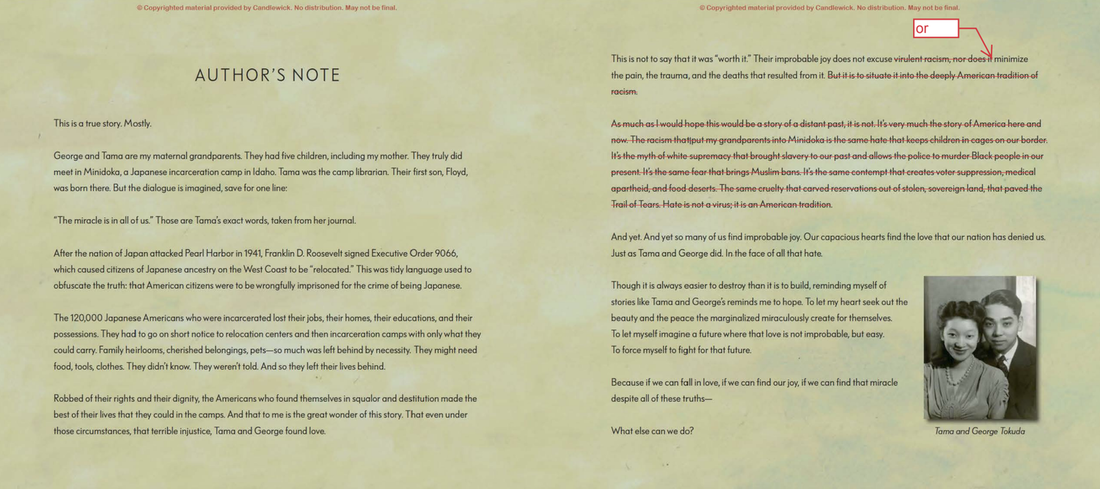
Scholastic wanted to license her 2022 children’s book Love in the Library. The deal would draw a wider audience to her book — a love story set in a World War II incarceration camp for Japanese Americans and inspired by her grandparents, about the improbable joy found “in a place built to make people feel like they weren’t human.”

Then she read Scholastic’s suggested revisions to her book, included in the same email as the offer news. Her excitement at the opportunity was almost immediately tempered.

The publishers only suggested edit was to the author’s note: Scholastic had crossed out a key section that references “the deeply American tradition of racism” to describe the tale’s real-life historical backdrop — a time when the U.S. government forcibly relocated more than 120,000 Japanese Americans to dozens of internment sites from 1942-1945.

Scholastic gave its reasons for the suggested change in an email to the author and her original publisher, Candlewick Press, citing a “politically sensitive” moment for its market and a worry that the section “goes beyond what some teachers are willing to cover with the kids in their elementary classrooms.”

“This could lead to teachers declining to use the book, which would be a shame,” Scholastic’s email said.

The deal with Scholastic was contingent on not only nixing that section, according to the author, but removing the word “racism” from the author’s note entirely.

Scholastic made the suggested revisions above to Tokuda-Hall’s book in an attachment it sent to her original publisher. “They wanted to take this book and repackage it so that it was just a simple love story,” the author wrote on her blog.

Infuriated by what she called a “horrific demand for censorship,” Tokuda-Hall gave Scholastic a hard no.

The author called the offer deeply offensive in an email to Candlewick Press, which passed along Scholastic’s proposal, a response she posted publicly to her website on Tuesday.

“I’m typically a very compromising person,” the Oakland, Calif.-based author, who is Asian American, told NPR. “But when you omit the word racism from a story about the mass incarceration of a single group of people based on their race, there’s no compromise to be had with that if you can’t agree on basic facts.”

Maggie Tokuda-Hall, a children’s author based in Oakland, Calif., rejected an offer from Scholastic to license her book after the publisher proposed an edit that would cut a section referencing “racism.”

Without its proper context, she said, the story “runs the risk of just being like a lovely little love story. And that’s not what it is. To pretend otherwise would do a disservice not just to [my grandparents], but also to the 120,000 other people who were incarcerated at the time.”

Scholastic issues an apology

Two days after the author first spoke out about the offer, Scholastic said it had apologized to Tokuda-Hall for its editing approach, in a statement sent to NPR on Thursday night.

“In our initial outreach we suggested edits to Ms. Tokuda-Hall’s author’s note,” the company’s CEO Peter Warwick wrote in a statement. “This approach was wrong and not in keeping with Scholastic’s values. We don’t want to diminish or in any way minimize the racism that tragically persists against Asian-Americans.”

Scholastic said that during the process it had failed to consult its “mentors” for the Rising Voices collection — authors and educators from Asian American, Native Hawaiian and Pacific Islander communities — and has since reached out to them to hear their concerns. “We must never do this again,” Warwick wrote

Scholastic, which had planned to feature Love in the Library as part of its “Rising Voices Library” collection highlighting AANHPI voices, said it hopes to restart the conversation with Tokuda-Hall with the aim of sharing the book with the author’s note unchanged.

It’s not yet clear whether Tokuda-Hall will consider their revised offer.

“That conversation is not concluded and so I do not have any comment yet,” she told NPR in an email.

The author says publishers are silencing marginalized voices

To Tokuda-Hall, her experience with Scholastic is another instance in which publishers are yielding to conservative advocacy groups in the face of recent battles over book bans and author censorship.

In one case, a Florida textbook publisher removed all explicit references to race from its lesson materials about civil rights icon Rosa Parks in order to win approval from Florida’s Department of Education, The New York Times reported last month.

Publishers, she wrote on her website before the Scholastic apology, “want to sell our suffering, smoothed down and made palatable to the white readers they prioritize. … Our voices are the first sacrifice at the altar of marketability.”

It’s impossible to put a price on what Tokuda-Hall may sacrifice from rejecting the deal with Scholastic, a trusted, powerhouse publisher in the children’s market that affords authors exposure. She feared that speaking publicly about the offer could harm her reputation and career.

“Children’s book authors — we’re fighting over nickels. It’s not exactly gangbusters, this industry,” she said. “So, when you’re presented with any opportunity to get your story, and particularly a story that you deeply believe in, in front of more eyes, it’s a huge opportunity.”

But she thinks kids and their families have the most to lose from situations like this.

“I think they’re losing the opportunity to talk about the truth, to learn the truth, to discuss it,” she said. “No substantive change for the better can be made without reconciliation with the truth.”

Since going public with her experience, the author says, she’s heard from other marginalized writers and people in the publishing industry — largely people of color and queer people, she says — who have also had to make difficult choices about their work and how its presented.

“My DMs have been absolutely full,” she said. “People sharing pretty horrific stories that they’re just too afraid to share in public.”

Some authors and others in the publishing world responded publicly in support of Tokuda-Hall.

“By refusing to let this story be situated in context of government oppression and enslavement of other marginalized groups, past and present, It makes it safe for them to say ‘historically, mistakes were made, but look at how successful Japanese American communities are now,’ ” literary agent DongWon Song tweeted. “This is white supremacy. This is how it operates.”

Author Martha Brockenbrough has collected close to 400 signatures on a letter to Scholastic calling on the publisher to feature Love in the Library without edits.

Before she received Scholastic’s apology, Tokuda-Hall said that, whether or not the publisher apologizes, her “greatest fear is that this is a momentary flurry of outrage, but nothing changes. And other creators are asked to make horrible choices like this going forward in the dark.”

Source: Scholastic wanted to license her children’s book — if she cut a part about ‘racism’

Lisée: «Nègres blancs d’Amérique» 55 ans après

Lisée on the history and the context of when the book was written, and its questionable relevance today in terms of current challenges:

L’auteur était le plus souvent debout. En l’absence de chaise ou de table, il écrivait penché sur le lit superposé du haut. Il n’avait pas de stylo, c’était interdit. Il usait ses bouts de crayon à mine, sans rien avoir pour les aiguiser. En haut de chaque page subtilisée à la cantine, il écrivait, en anglais, « Notes for my lawyer », seule façon d’avoir le droit de mettre quoi que ce soit sur papier. Il ne savait pas d’où venait sa soudaine fluidité d’écriture. D’autant qu’il sortait d’une grève de la faim d’un mois qui lui avait soustrait 25 kilos. Il pouvait écrire de jour comme de nuit, l’ampoule ne s’éteignait jamais.

« La fatigue provenait moins de la faim que du bruit infernal qui régnait dans la prison, a-t-il raconté. À toute heure du jour, il se trouvait des détenus pour taper à corps perdu sur les murs métalliques des cellules ou pour improviser des rythmes assourdissants de tam-tam. D’autres hurlaient jusqu’à épuisement leur terreur ou leur désespoir. D’autres encore s’ouvraient les veines et déclenchaient par leur acte un tumulte ahurissant. Un Noir mit le feu à ses vêtements et chercha ainsi à s’immoler. Un autre se jeta tête première du deuxième étage de notre section. Un troisième fut battu à mort par les surveillants dans sa cellule. »

C’est ainsi qu’est né l’essai québécois le plus lu au monde. Celui qui fit scandale, lors de sa publication il y a 55 ans. Celui dont le titre seul, aujourd’hui, peut mettre fin à des carrières journalistiques ou universitaires, scandaliser le CRTC, pousser une commission scolaire anglophone de Montréal à apposer un autocollant pour cacher le mot offensant dans chaque exemplaire d’un manuel.

Pierre Vallières et son camarade Charles Gagnon occupaient cette cellule de la prison des hommes de New York, surnommée The Tombs, Le sépulcre, en septembre 1966, pour avoir « troublé la paix » en manifestant devant l’édifice de l’ONU en faveur de l’indépendance du Québec. Les deux prisonniers sont surtout accusés d’avoir organisé, plus tôt cette année-là à Montréal, des attentats du Front de libération du Québec.

Vallières noircit donc les pages « avec la fébrilité de celui qui sait qu’il peut être déporté à tout instant et qui profite de chaque minute de libre expression qu’il lui reste encore ». Il pond donc en deux mois 90 % d’une oeuvre qui fera 540 pages chez l’imprimeur. Les deux tiers des feuillets sont déjà sortis de la prison lorsque l’extradition vers Montréal se produit.

Paniqué à l’idée que le dernier tiers sera saisi par des policiers québécois, qui eux lisent le français, Vallières offre un troc aux agents américains de l’immigration venus le saisir au sortir de sa prison : il ne résistera pas physiquement à cette nouvelle arrestation si les agents remettent les pages restantes à son avocat. Si ces agents n’avaient pas tenu parole, rapporte Vallières, le livre n’existerait pas. L’auteur est absent du lancement, le 14 mars 1968, car emprisonné et en procès pour les attentats qui lui sont attribués.

Vallières tenait à son titre, mais l’idée n’était pas neuve. Comme le rappelle Daniel Samson-Legault dans sa méticuleuse biographie de Vallières, Le dissident, chez Québec Amérique (que je recommande chaudement), l’expression avait été utilisée avant lui par Marie-Victorin, les journalistes Jean Paré, Yves Michaud et quelques autres pour décrire la condition des Canadiens français.

Vallières la reprend à répétition dans l’ouvrage et s’en sert comme d’un synonyme d’« opprimé ». Il l’associe d’ailleurs à toutes les victimes du capital, y compris aux ouvriers blancs américains. « C’est en anglais que ce concept se formula spontanément dans ma tête. White Niggers of America. Les Noirs américains furent les premiers, et pour cause, à saisir ce que pouvait être, sur les rives du Saint-Laurent, la condition particulière des Québécois francophones. »

Il ne dit pas à quels Noirs il fait référence, mais on sait que le leader noir américain de l’époque, Stokely Carmichael, qui viendra à Montréal, n’a rien à redire sur cette appropriation sémantique. De même, après avoir trouvé le titre très drôle, Aimé Césaire, inventeur du concept de « négritude », dira que Vallières avait bien compris qu’il ne s’agissait pas que de couleur de peau. Vallières use avec autant de liberté du terme « esclavage », une condition qu’il dit retrouver chez tous les dépossédés. On est dans l’hyperbole, pas dans la nuance.

Le livre fait fureur. Environ 50 000 exemplaires vendus au Québec, presque autant aux États-Unis, sans compter les versions allemande, espagnole et italienne. Brusquement, en 1969, l’auteur, l’éditeur — le poète et futur ministre péquiste Gérald Godin pour la maison Parti pris — et même la dactylo sont accusés d’avoir, en publiant l’ouvrage, fait oeuvre de sédition. Un crime passible de 14 ans d’emprisonnement.

Le ministre de la Justice de l’Union nationale, Rémi Paul, fait saisir tous les exemplaires en circulation, y compris celui du dépôt légal à la Bibliothèque nationale du Québec. L’accusation n’aura pas de suite. Le livre reprendra sa carrière en 1972, une fois passée la crise d’Octobre (pendant laquelle les felquistes le font lire à leur otage britannique, James Cross).

Faut-il le relire aujourd’hui ? Seulement si on veut prendre la mesure de la dépossession dans laquelle étaient plongés les Québécois du début des années 1960. Vallières décrit le délabrement et l’insalubrité de son quartier, Jacques-Cartier, sur la Rive-Sud (en forçant le trait, nuance son biographe, mais même…). Le récit biographique du jeune révolté reste poignant, celui de sa recherche intellectuelle, entre Teilhard de Chardin, Sartre, Marx et le Che, est fastidieux, mais ne manque pas de sincérité. Son appel à la violence révolutionnaire, au moment du formidable essor du Québec social, syndical, laïque, culturel et politique de 1966, était, même à l’époque, une erreur et un leurre.

Le problème n’est pas que Nègres blancs d’Amérique ait mal vieilli. Il fait simplement partie de l’histoire. Il est dans notre rétroviseur. Il a peu — rien ? — à nous dire sur le Québec d’aujourd’hui ou de demain. Son titre, seul, résonne comme un cri de liberté, comme l’audace de dire des choses avec des mots forts, en les détournant ou en leur faisant violence. Un doigt d’honneur aux censeurs d’hier et d’aujourd’hui.

Source: «Nègres blancs d’Amérique» 55 ans après

McWhorter: Today’s Woke Excesses Were Born in the ’60s

McWhorter’s reflections always of interest, including these on the “performative” aspects of activism:

Various books I’ve been reading lately have me thinking about 1966. I have often said that the history of Black America could be divided between what happened before and after that year.

It was a year when the fight for Black equality shifted sharply in mood, ushering in an era in which rhetoric overtook actual game plans for action. It planted the seed for the excesses of today’s wokeness. I wouldn’t have been on board, and I’m glad I was only a baby that year and didn’t have to face it as a mature person.

The difference between Black America in 1960 and in 1970 appears vaster to me than it was between the start and end of any other decade since the 1860s, after Emancipation. And in 1966 specifically, Stokely Carmichael made his iconic speech about a separatist Black Power, the Student Nonviolent Coordinating Committee he led expelled its white members (though Carmichael himself did not advocate this), the Black Panther Party was born, “Black” replaced “Negro” as the preferred term, the Afro went mainstream, and Malcolm X’s “The Autobiography of Malcolm X” (written with Alex Haley) became a standard text for Black readers.

I doubt most people living through that year thought of it as a particularly unique 365 days, but Mark Whitaker, a former editor of Newsweek, has justified my sense of that year as seminal with his new book, “Saying It Loud: 1966 — the Year Black Power Challenged the Civil Rights Movement.” Whitaker has a journalist’s understanding of the difference between merely documenting the facts and using them to tell a story, and his sober yet crisp prose pulls the reader along with nary a lull.

But one question keeps nagging at me: Why did the mood shift at that particular point? The conditions of Black America at the time would not have led one to imagine that a revolution in thought was imminent. The Civil Rights Act of 1964 and the Voting Rights Act of 1965 had just happened. The economy was relatively strong, and Black men in particular were now earning twice or more what they earned before World War II. As the political scientist and historian duo Abigail and Stephan Thernstrom noted in their book “America in Black and White,” “Before World War II, Black bank tellers, bookkeepers, cashiers, secretaries, stenographers, telephone operators or mail carriers were rare. By 1970 they were very common, though far more in the north than in the south.”

And as to claims one might hear that Black America was uniquely fed up in 1966, were Black people not plenty fed up in 1876, or after World War I or World War II?

What Whitaker so deftly chronicles strikes me less as a natural development from on-the-ground circumstances than as something more elusive for the historian: the emergence and influence of that mood shift I referred to. Carmichael memorably said: “The only way we gonna stop them white men from whuppin’ us is to take over. We been saying freedom for six years and we ain’t got nothin’. What we gonna start saying now is Black Power!”

The dramatic impact was obvious. But what did Black Power mean, and how much change on the ground did this kind of rhetoric ever actually result in? What were Carmichael’s concrete plans for action in the first place?

There was always a certain performative element in the man: not for nothing was he referred to as Starmichael. Whitaker recounts Carmichael’s proposing having Harlem “send one million Black men up to invade Scarsdale” — but really?

The N.A.A.C.P. head Roy Wilkins was infuriated at a crucial summit meeting between leading Black groups where Carmichael referred to Lyndon Johnson as “that cat, the president” and recommended publicly denouncing his work. This was a key conflict between an older style seeking to work within the only reality available and a new style favoring a kind of utopian agitprop.

Figures like Carmichael and Black Panthers Huey Newton, Eldridge Cleaver and H. Rap Brown fascinate from a distance, with their implacable fierceness and true Black pride shocking a complacent “Leave It To Beaver” America. Plus their fashion sense — the berets, the leather jackets — was hard not to like. It all made for great photos and good television. But at the time, affirmative action and the Fair Housing Act of 1968, supported by those white “cats” responding to the suasion of people like Wilkins and Martin Luther King Jr., were making a real difference in Black lives, central to encouraging the growth of the Black middle class.

This difference between mood and action is relevant to the historian Beverly Gage’s magnificent new biography, “G-Man: J. Edgar Hoover and the Making of the American Century.” The book’s 800-plus pages are so Caro-esque in detail, context and narrative energy that I have dragged the hardback across the Atlantic and back; Gage somehow makes a page turner out of the life of a man with the stage presence of a toad.

Where Hoover comes in on the 1966 issue is a common observation of his, which was that the Black-led urban riots of the Long, Hot Summer, and the general change in mood from integrationist to separatist, was not solely a response to the frustrations of poverty. Of course, Hoover couldn’t get much further than seeing Black people as having simply given in to a general anti-establishment degeneracy, egged on by Communist influence. That was one part nonsense (the Communist one) and one part racism.

Hoover was bred in a Southern city (D.C.) at the turn of the 20th century, post Plessy v. Ferguson. He came of age embraced by a fraternity steeped in post-Reconstruction “lost cause” ideology about Black people. His late-career persecution of the Panthers with F.B.I. technology and tactics was nastier — and more reckless with people’s lives — than his earlier witch hunt against white Communists had been.

Yet, his sense that the new developments were not caused by socioeconomics was not entirely mistaken. Rather, I suspect that much of why leading Black political ideology took such a menacing, and even impractical, turn in the late 1960s was that white America was by that time poised to hear it out. Not all of white America. But a critical mass had become aware, through television and the passage of bills like the Civil Rights Act, that there was a “race issue” requiring attention.

It’s a safe bet that if Black leaders had taken the tone of Carmichael and the Panthers in 1900 or even 1950, the response from whites would have been openly violent and even murderous. The theatricality of the new message was in part a response to enough whites now being interested in listening.

The problem was that so much of the message, at that point, was a kind of Kabuki, as the Black essayist Debra Dickerson memorably put it a while ago. Savory, dramatic poses were often more important than plans. This was perhaps a natural result of the fact that the remaining problems were challenging to address. With legalized segregation, disenfranchisement and residential Balkanization now illegal, the question was what to do next and how. “Black Power” did not turn out to be the real answer: It all burned out early — Whitaker identifies signs that this would happen as soon as the end of 1966.

Daniel Akst’s lucid group biography, “War By Other Means: The Pacifists of the Greatest Generation Who Revolutionized Resistance,” demonstrates people of the era engaging in action that brings about actual change. Following the lives and careers of the activists Dorothy Day, Dwight Macdonald, David Dellinger and Bayard Rustin, one senses almost none of the detour into showmanship that so infused 1966. While Carmichael made speeches that, to many, were suggestive of violence, and later moved to Africa, Rustin, for example, essentially birthed the March on Washington.

I hardly intend that Carmichael’s brand of progressivism has only been known among Black people. Today it has attained cross-racial influence, serving as a model for today’s extremes of wokeness, confusing acting out for action. One might suppose that the acting out is at least a demonstration of leftist philosophy, perhaps valuable as a teaching tool of sorts. But is it? The flinty, readable “Left is Not Woke” by Susan Neiman, the director of the Einstein Forum think tank, explores that question usefully.

Neiman limns the new wokeness as an anti-Enlightenment program, despite its humanistic Latinate vocabulary. She associates true leftism with a philosophy that asserts “a commitment to universalism over tribalism, a firm distinction between justice and power and a belief in the possibility of progress” and sees little of those elements in the essentializing, punitive and pessimistic tenets too common in modern wokeness. Woke “begins with concern for marginalized persons, and ends by reducing each to the prism of her marginalization,” she writes. “In the focus on inequalities of power, the concept of justice is often left by the wayside. Woke demands that nations and peoples face up to their criminal histories. In the process it often concludes that all history is criminal.”

Neiman critiques pioneering texts of this kind of view, such as Michel Foucault’s widely assigned book, “Discipline and Punish,” and his essay “What is Enlightenment?,” in which he scorns “introducing ‘dialectical’ nuances while seeking to determine what good and bad elements there may have been in the Enlightenment.” In this cynical and extremist kind of rhetoric, Neiman notes that “you may look for an argument; what you’ll find is contempt.” And the problem, she adds, is that “those who have learned in college to distrust every claim to truth will hesitate to acknowledge falsehood.”

All of these books relate to a general sense I have always had, that in 1966 something went seriously awry with what used to be called “The Struggle.” There is a natural human tendency in which action devolves into gesture, the concrete drifts into abstraction, the outline morphs into shorthand. It’s true in language, in the arts, and in politics, and I think its effects distracted much Black American thought — as today’s wokeness as performance also leads us astray — at a time when there was finally the opportunity to do so much more. I will explore what that more was in another column, but in the meantime, Whitaker, Neiman, Akst and — albeit more obliquely — Gage are useful in showing why 1966 was such an important turning point in the story.
Source: Today’s Woke Excesses Were Born in the ’60s