The Tories approach a point of no return and other commentary on M-103

Terry Glavin’s usual trenchant commentary:

During the debate on the motion in the House, Khalid said she defines Islamophobia as “the irrational hate of Muslims that leads to discrimination.” That’s perfectly fine, too, but what makes no sense was Khalid’s statement that she refused Conservative MP (and party leadership hopeful) Erin O’Toole’s offer to help win unanimous consent for her motion by tightening it up, because that would have meant “watering it down.”

In a parallel topsy-turviness, Joly has objected to David Anderson’s alternative motion, which replicates Khalid’s motion except for the ambiguous term Islamophobia, because it’s a “weakened and watered down version.”

It’s true to say, as Scott Reid does, that seemingly benign injunctions against “Islamophobia” have been put to the squalid purpose of placing the Muslim religion and the practices of authoritarian Islamic regimes off limits to criticism. But it’s also fair to say that “anti-Muslim bigotry” doesn’t sufficiently capture the full-throated paranoid lunacy animating the nutcase wing of the Conservative support base these days.

“Racism” doesn’t quite cover it. “Hatred” doesn’t quite get at it. Whatever term you like, it’s more than merely ironic that those who make the most hysterical claims about clandestine Islamic conspiracies at the centre of Justin Trudeau’s government are also the ones shouting the loudest that an irrational fear of Islam isn’t even a thing.

It’s not as though the Liberals are blameless in all this. They could have welcomed O’Toole’s efforts at reaching out to find a compromise, but they didn’t. And the Liberals do seem quite content to have the Conservatives squirming and chafing against the appearance that the reason they object to the term Islamophobia is that they themselves are Islamophobic, whatever that might mean. It is not as though it bothers the Liberals that the Conservatives are stuck with the crazy talk coming from several of the leadership candidates these days.

Trudeau may have given away more than he intended last week when he was confronted at a community meeting in Iqaluit about why he reneged on his electoral reform promises. Raising the spectre of proportional representation opening the door to “fringe” parties, Trudeau asked, rhetorically: “Do you think that Kellie Leitch should have her own party?”

Clearly, Trudeau doesn’t want that. For starters, it would mean decent Conservatives couldn’t be tarred so easily with the indecencies committed by the party’s fringe factions. It would mean bigot-baiting the Conservative Party would be that much harder to do. In the meantime, it’s up to the Conservatives to get themselves sorted, and after the sordid events of the past few days, their options are limited:

Isolate, quarantine, amputate or purge.

Source: The Tories approach a point of no return – Macleans.ca

Campbell Clark in the Globe:

It’s one thing for MPs to say they oppose the motion. But it’s another to accept the bogus reasoning.

One is the slippery-slope argument. Mr. Levant is telling Canadians that once a Commons committee starts studying the vague notion of Islamophobia and what to do about it, they’re going to propose laws that make it illegal to criticize Islam, and restrict free speech.

The obvious weakness in that is that Motion M-103 doesn’t even ask the committee to propose laws, nor could it force them – let alone the kind that stifle free speech. If they ever did, MPs could vote against it then. And it still could not violate constitutional guarantees on free speech.

If Conservative objections really were about a vague term, some deal-making would be in order. There are arguments that in some countries the term has been used to refer to any criticism of Islam.

Of course, this motion calls for MPs to study it, so they could define it.

But Liberals were unwilling to compromise when the Conservatives asked them to change “Islamophobia” to “hatred for Muslims.”

But it’s not about the word. Ironically, it’s about fear.

All this began when Montreal-area MP Frank Baylis started a petition last year to assert that all Muslims should not be equated with a few extremists. NDP Leader Tom Mulcair later asked for unanimous consent for a motion condemning Islamophobia – and got it on his second attempt on Oct. 26.

Conservative House Leader Candice Bergen responded to Mr. Mulcair’s motion with her own, condemning religious discrimination.

Both were adopted. The word Islamophobia was fine for Conservatives then, before they got scared.

Source:  Conservative MPs are afraid of Motion 103, and things it can’t do 

The contrary view, and the conflation of Islamophobia/anti-Muslim hate with free speech concerns, comes from Farzana Hassan in the Sun, who appears not to have understood what the motion covers and what it does not:

When we challenge a certain Islamic practice, we are careful to exclude the moderate majority and focus our attention on a small segment of the Muslim community. Yet some claim that even such discussion conflates the radicals with the moderates.

If Khalid believes such discussions include all Muslims, she is unwittingly admitting that all Muslims are indeed like the fundamentalists.

Khalid is mistaken if she believes any rational discussion on Islamic practice castigates all Muslims. She must understand that any well-intentioned and constructive discussion on a religious practice or ideology is a fundamental right of every Canadian.

There is no phobia of Islam in Canada. There is genuine resentment toward orthodox Islam. But it has little to do with the usual public discourse.

Some practices, whether we discuss them in public or not, are commonly known to be associated with orthodox Islam, such as polygamy, wife battery and ostracism of religious minorities.

It is up to moderate Muslims to distance themselves from these outrages as much as possible. So far no robust public challenge to such practices has emerged from moderate segments of the community.

Without such a grassroots challenge any social observer, professional or amateur, can form any opinion on orthodox Islam, whether positive or negative.

We know some Muslims are working to institute gender equality, and others are partners with the government in fighting terror. However, these efforts need to become the norm rather than the exception. Once this takes place, the world will automatically begin to see Muslims in positive light.

Prime Minister Justin Trudeau has talked about finding the right balance between protecting a religious minority and also protecting our Charter rights.

The answer to his dilemma is simple: Do not put the slightest dent in our right to free speech.

To balance this, the prime minister can take more measures to protect the security of all minorities with tighter law enforcement and stricter punishments for alleged offenders like Alexandre Bissonnette.

Source: I’m a liberal Muslim and I reject M-103

Lastly, an article on Iqra Khalid’s reading out the hateful emails and tweets she has received, providing proof of the validity of M-103 and its specific reference:

The Liberal MP who tabled an anti-Islamophobia motion says she has been inundated with hate mail and death threats.

Mississauga, Ont. MP Iqra Khalid told the House of Commons today she received more than 50,000 emails in response to M-103, many of them with overt discrimination or direct threats.

“I have asked my staff to lock the office behind me as I now fear for their safety,” she said. “I have asked them not to answer all phone calls so they don’t hear the threats, insults and unbelievable amount of hate shouted at them and myself.”

She described a “chilling” video posted on YouTube that called her a terrorist sympathizer and disgusting human being.

“‘I’m not going to help them shoot you, I’m going to be there to film you on the ground crying. Yeah, I’ll be there writing my story with a big fat smile on my face. Ha ha ha. The Member got shot by a Canadian patriot,'” she read, quoting from the video.

And that, she said, was just tip of the iceberg. Here are some other messages she received and read in the House:

  • “Kill her and be done with it. I agree she is here to kill us. She is sick and she needs to be deported.”
  • “We will burn down your mosques, draper head Muslim.”
  • “Why did Canadians let her in? Ship her back.”
  • “Why don’t you get out of my country? You’re a disgusting piece of trash and you are definitely not wanted here by the majority of actual Canadians.”

Khalid said she has also received many messages of support.

Source: ‘Kill her and be done with it’: MP behind anti-Islamophobia motion reads out hate mail

Growing group of Tory leadership hopefuls oppose move to have House of Commons denounce Islamophobia

Funny, I don’t recall any Conservatives expressing concerns about singling out Antisemitism when they were in power and launched a number of initiatives (e.g., hosting an international conference on combatting antisemitism, jointing the International Holocaust Remembrance Alliance) that were sometimes at the expense of general anti-racism and discrimination messaging and programming.

And was there not also a strong political aspect to the Conservative government’s efforts with respect to Canadian Jews? Interim Leader Ambrose should be mindful of stones and glass houses:

A growing number of Conservative leadership rivals are declaring their opposition to a Liberal MP’s motion to have the House of Commons denounce Islamophobia and other forms of systemic racism.

And the interim leader of the party, Rona Ambrose, is also likely to vote against the motion, which will be debated Wednesday, as she accuses the Liberals of purposefully trying to sow division in her party with the initiative.

The opposition to the anti-Islamophobia motion by Kellie Leitch, Maxime Bernier, Andrew Scheer and others is likely to play well with a Conservative base that, according to several polls, is more suspicious and wary of Muslim immigrants than other groups of voters.

But as more Tories oppose the motion, their political opponents will have more of a chance to charge that Conservatives are intolerant at best and bigoted at worse, a resurrection of criticisms that hurt them at the ballot box in 2015 after the party unveiled a promise to institute a “Barbaric Practices Snitch Line” and vowed to repeal citizenship for new Canadians in some circumstances.

“Voting against this motion is simply nonsensical,” said Karl Belanger, who spent 19 years as a top adviser to three leaders of the federal NDP. “‎No matter what the convoluted explanation is, you are voting against condemning Islamophobia and all forms of systemic racism and religious discrimination. That will stick.”

The resolution at hand is known as M-103. It was put before the House of Commons in early December by Iqra Khalid, a first-time Liberal MP who represents Mississauga—Erin Mills, Ont.

The motion is scheduled for an hour’s worth of debate in the House of Commons late Wednesday afternoon. And while there is a chance a vote could be held during that hour, the more likely outcome from a procedural standpoint is that a vote will be put off until early April.

Ambrose said she believes the Liberals will want to keep the issue front-and-centre for weeks before bringing it to a final vote.

“We know they are doing this purely for politics,” she said.

Khalid, who was born in Pakistan, wants to accomplish three things with M-103: First, that the House “condemn Islamophobia and all forms of systemic racism and religious discrimination;” second, that the House of Commons Standing Committee on Canadian Heritage be instructed to study the issue of “eliminating systemic racism and religious discrimination including Islamophobia;” and, finally; that the federal government collect data on hate crimes for further study.

Scheer, in a recent fundraising letter to his supporters, said one of the reasons he will vote against Khalid’s motion is that it could be construed as a move to stifle free speech. He also says the motion does not define “Islamophobia” and, in any event, he says he cannot vote for a motion that singles out one religion for special status.

“It is also important to note that we already have laws that protect Canadians against discrimination based on their faith. We also have laws against inciting violence,” Scheer said.

Bernier cites similar reasons for his opposition to M-103 but, in a Facebook post over the weekend, said he could support the motion if the word “Islamophobia” was removed from motion.

“We should reaffirm everyone’s right to believe in and criticize whatever belief they want, whether it is Islam, Christianity, Judaism, Hinduism, atheism, or any other,” Bernier said.

MP Brad Trost, who is also running for the leadership, said Jews and Christians are more likely to be victims of faith-based intolerance. He called Khalid’s motion “a farce.”

Steven Blaney, too, will vote against the motion: “While I recognize the value of promoting respect for all religion, I intend to oppose M-103, a motion that is not well defined and clearly represents a threat to freedom of expression.”

For his part, Erin O’Toole, another leadership candidate, has reached out to Khalid with some suggestions to modify the amendment so that it might find more support among Conservative MPs.

Khalid was not available for an interview Monday but, when she tabled her motion last December, she told the House of Commons, ” I am a young, brown, Muslim, Canadian woman. When I moved to Canada in the 1990s — a young girl trying to make this nation my home — some kids in school would yell as they pushed me, ‘Go home, you Muslim,’ but I was home. I am among thousands of Muslims who have been victimized because of hate and fear.

“I am a proud Canadian among hundreds and thousands of others who will not tolerate hate based on religion or skin colour. I rise today with my fellow Canadians to reject and condemn Islamophobia.”

Her motion, if it passes, would not change any Canadian laws, as Bernier correctly noted in his Facebook post. Moreover, House of Commons standing committees are often asked to study a particular issue and make recommendations to the government on a course of action.

Governments sometimes act on committee recommendations, but they just as often ignore them.

But Ambrose, in an interview with the National Post Monday evening, said she worries her work trying to empower women and girls in Muslim communities could be branded Islamophobic if she criticizes the views of some Muslim men.

“Our members are really concerned about this as a freedom of speech issue,” Ambrose said. For Conservatives, it will be a “free vote,” which means they may vote as they choose. Ambrose said she is open to amendments that deal with her concerns about speech.

“We absolutely condemn all forms of hatred, racism and violence,” Ambrose said.

Source: Growing group of Tory leadership hopefuls oppose move to have House of Commons denounce Islamophobia | National Post

And David Akin’s latest update and interview with Iqra Khalid, the MP sponsoring the motion:

Liberal MP Iqra Khalid said she is keen to allay the “fear and anxiety” some Canadians have about her attempt to have the House of Commons denounce Islamophobia, systemic racism and intolerance.

In an exclusive interview Tuesday with the National Post, Khalid, a Pakistan-born first-time MP from Mississauga, Ont., said she is not willing to alter her  motion, which has been given the parliamentary designation M-103, even though some Conservative MPs have suggested she do so and even though she says she has been subjected to “a lot of hatred” and abuse since she first proposed the motion last December.

“Watering down the motion will not be in the best interests of Canadians who are working to fight this (intolerance),” Khalid said.

Debate on M-103 is expected to begin at about 5:30 pm ET Wednesday in the House of Commons and run for about an hour. And while it is procedurally possible that a vote could also happen Wednesday, it is much more likely that the vote will be put off until early April.

Khalid will find significant support from her own caucus colleagues and from the NDP but not as much from the Conservative benches. Rona Ambrose, the interim Conservative party leader, in an interview with the National Post Monday, said she is opposed to Khalid’s motion and several of the contenders to become permanent leader also oppose it.

Liberal MP keen to allay ‘fear and anxiety’ on anti-Islamophobia motion but will not change it in face of ‘hatred’

Étude: la charte des valeurs québécois aurait attisé la discrimination

Not surprising but nice to see this confirmed in a more systematic manner:

Le débat sur la charte des valeurs a-t-il ouvert la porte à plus de racisme ? Depuis l’attentat à la Grande Mosquée de Québec, plusieurs membres de la communauté musulmane accusent le projet du Parti québécois d’avoir alimenté les tensions sociales et engendré des gestes violents à leur endroit. Une très rare étude sur la question, obtenue par La Presse, tend à leur donner raison.

Les jeunes plus sensibles

« La charte a-t-elle généré une solidarité accrue autour d’une identité commune ou a-t-elle sapé l’harmonie sociale ? » Voilà la question à laquelle ont tenté de répondre des chercheurs de l’UQAM et des universités Laval et McGill depuis 2014. Leur étude, qui cible les jeunes, est « très exploratoire », prévient Ghayda Hassan de l’UQAM. « C’est un projet pilote qui n’est pas nécessairement représentatif. » Il s’agit toutefois d’une très rare, sinon de la seule étude scientifique sur le sujet depuis 2014. L’équipe de Mme Hassan a interrogé 441 étudiants de l’UQAM (30,5 % d’hommes, 69,5 % de femmes). Pourquoi l’université ? D’abord parce que « les tensions intercommunautaires ont de graves conséquences pour les jeunes », lit-on. Aussi, « comparativement à la population générale, les étudiants sont plus susceptibles de connaître la charte ».

Discrimination

« Bien que le but de la charte était de placer la laïcité et l’égalité des femmes au coeur du débat public et politique, nos résultats montrent qu’il a eu des conséquences négatives », écrivent les chercheurs. Le tiers des étudiants ont déclaré avoir vécu personnellement ou avoir été témoins d’une forme de discrimination ethnique ou religieuse depuis la charte des valeurs. Un chiffre « plus élevé que prévu », qui a surpris les chercheurs. Les cas de discrimination étaient plus nombreux chez les immigrants, ainsi que chez ceux qui se sont identifiés comme biculturels ou appartenant à des groupes culturels ou religieux minoritaires par rapport aux Québécois « de souche » ou aux personnes s’identifiant comme catholiques. Les participants qui se disaient en faveur de la charte ont rapporté moins de discrimination que ceux qui y étaient opposés.

Perceptions transformées

Bonnes ou mauvaises, les relations intercommunautaires au Québec ? Le débat sur la charte a complètement changé la vision des jeunes sur cette question. Alors qu’ils voyaient majoritairement les relations intercommunautaires comme étant positives avant la charte, leur perception est devenue largement négative après, surtout chez les femmes, les immigrants et ceux qui s’identifient comme des minorités culturelles ou religieuses. C’est plus de la moitié des étudiants qui entrevoyaient un avenir sombre pour les relations entre les communautés. Seulement 20 % croyaient en un avenir positif. « L’étude révèle que la question de l’identité nationale québécoise est très sensible et sous-tend des tensions intercommunautaires importantes », écrivent les chercheurs.

Femmes musulmanes

Les femmes de confession musulmane ont été parmi les plus touchées par la charte, nous explique la chercheuse Ghayda Hassan, notamment parce que le débat sur le projet du PQ a beaucoup tourné autour du port du voile islamique. L’étude démontre que la couverture médiatique, en « dépeignant les symboles religieux comme des menaces au vivre-ensemble », en centrant son discours « autour de la sécularisation préconisée par la charte, a contribué à des manifestations de discrimination et d’ethnicisation dirigées surtout contre des femmes musulmanes immigrées, perçues comme des menaces pour la construction de la nation ».

Encore des séquelles ?

Dans la foulée de l’attentat dans une mosquée de Québec, plusieurs membres de la communauté musulmane ont montré du doigt la charte des valeurs. Visiblement, plus de deux ans après l’abandon du projet, les séquelles se font toujours sentir. Mais ont-elles encore un impact réel dans la société ? « Étant donné que le projet de charte a été abandonné lorsque le gouvernement du Parti québécois a été battu en 2014, les effets négatifs que nous avons observés ont peut-être disparu. Cependant, le débat sous-jacent est encore vivant », écrivent les chercheurs.

Source: Étude: la charte des valeurs aurait attisé la discrimination | Gabrielle Duchaine | National

Liberal MP’s anti-Islamophobia motion set for debate next week

Hate Crimes Comparison.004

Statistics Canada Annual Police Reported Hate Crimes

Canada already has hate speech laws (unlike south of the border) and tracks police reported hate crimes (although StatsCan stopped writing its analysis of the data).

While I favour tracking, analyzing and messaging that covers all forms of racism, prejudice and discrimination, community specific messaging can be part of raising awareness, addressing concerns and reassuring communities. The previous government paid particular attention to antisemitism given the concerns of Canadian Jews.

My reading of the motion is that it has an appropriate focus on data collection and analysis, places Islamophobia within the broader context of racism and discrimination. with the resulting policy recommendations to be developed within that context by Canadian Heritage:

Members of Parliament will debate a motion to condemn Islamophobia and track incidents of hate crime against Muslims in the House of Commons next week.

Motion 103 was tabled by Mississauga, Ont., Liberal backbencher Iqra Khalid last fall, but will be discussed in the  aftermath of last month’s mass shooting at a Quebec City mosque. It calls on government to “condemn Islamophobia and all forms of systemic racism and religious discrimination.”

The text of the motion also asks the government to:

  • Recognize the need to quell the increasing public climate of hate and fear.
  • Request the heritage committee study how the government could develop a government-wide approach to reducing or eliminating systemic racism and religious discrimination, including Islamophobia.
  • Collect data to contextualize hate crime reports and to conduct needs assessments for impacted communities and present findings within 240 calendar days.

The motion, scheduled for one hour of debate on Wednesday, has generated a backlash online, with petitions garnering thousands of signatures opposing the motion.

Some critics have mischaracterized M-103 as a “bill” or a “law” rather than an non-binding motion.

Some have warned that Canada is moving towards criminalizing Islamophobia or even to the implementation of Islamic law, called Shariah, in Canada.

Khalid declined requests for an interview from CBC News.

When she tabled the motion on Dec. 5, 2016, she described her experience as a “young, brown, Muslim, Canadian woman.”

“When I moved to Canada in the 1990s, a young girl trying to make this nation my home, some kids in school would yell as they pushed me, ‘Go home, you Muslim’ — but I was home. I am among thousands of Muslims who have been victimized because of hate and fear,” she said.

“I am a proud Canadian among hundreds and thousands of others who will not tolerate hate based on religion or skin colour. I rise today with my fellow Canadians to reject and condemn Islamophobia.”

E-petition condemning Islamophobia

On the same day Khalid tabled her motion, an e-petition with nearly 70,000 signatures was tabled that called on the House of Commons to join the signatories in recognizing that “extremist individuals do not represent the religion of Islam, and in condemning all forms of Islamophobia.”

Barbara Kay, a columnist for the National Post and contributor to The Rebel Media, worries about the potential impact on freedom of expression and special protections for a single religious group.

“There are a lot of countries in Europe where criticism of Islam, even if not entrenched in law as a hate crime, are being interpreted by police and law enforcement, social workers — the whole spectrum of the state apparatus. They have been internalized by those within the public service as wrong, and if not criminal then absolutely morally wrong, and therefore Muslims are a group that must be protected from this very offensive speech,” she said in an interview with CBC.

Kay said anti-hate speech laws have traditionally targeted human beings, not ideas. She questioned the need to single out Islamophobia, and argued there are more hate crimes against Jews than Muslims in Canada.

Hate crimes in Canada

According to Statistics Canada, in 2013 there were 326 police-reported hate crimes motivated by hatred of a religion or religious group, about 28 per cent of all hate crimes.

Those targeting Jewish populations were the most frequently reported, accounting for 56 per cent of religious hate crimes in 2013, according to the most recent data available. There were 181 hate-motivated crimes targeting the Jewish religion reported by police in 2013, compared to 65 crimes motivated by hatred against the Muslim religion.

In her report and a video for The Rebel website, Kay said blasphemy laws conceived according to Shariah law could creep into Canada.

She said that could have a chilling effect on free speech and ultimately mean some of her columns could be deemed Islamophobic and subject to penalties.

“I’m worried. All Canadians should be worried,” she wrote.

Push for broader discussion

B.C. Conservative MP Dianne Watts said she supports the motion but wants a broader discussion about how to end any act of hate or discrimination based on race or religion.

“We just look at what happened at the mosque in Quebec and it’s such a horrible thing to have happen in Canada because that’s not who we are, that’s not what we’re about and we have to do everything we possibly can as legislators and as a community to make sure it doesn’t happen again,” she said.

Source: Liberal MP’s anti-Islamophobia motion set for debate next week – Politics – CBC News

Motion text: Motion M-103

Americans View Islam Less Negatively Than They Did A Year Ago | The Huffington Post

Not sure the extent to which this is positive (fewer negative views) or negative (greater political polarization) but ironic given the words of the Trump campaign and the words and actions of the Trump administration:

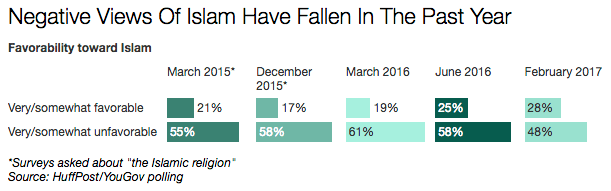
Americans’ view of Islam are, by and large, hostile. But negative opinions of the religion have dropped significantly during the past year, a new HuffPost/YouGov poll finds, despite ― or perhaps in response to ― the anti-Islam rhetoric often espousedby President Donald Trump and his advisers.

Last March, Americans were 42 points more likely to view the religion negatively than they were to view it positively. That gap dropped to 33 points by June, and to 20 points in the most recent survey, the lowest it’s been since HuffPost/YouGov surveys first asked the question nearly two years ago.

HUFFINGTON POST

At least one other pollster has noticed a similar shift. Shibley Telhami, the director of the University of Maryland Critical Issues Poll, wrote in The Washington Post earlier this year about having seen attitudes toward “Muslim people” growing progressively more favorable between November 2015 and October 2016 ― even after Trump’s anti-Muslim rhetoric and the terrorist attacks in San Bernardino, California, and Orlando, Florida.

He attributed some of the change to polarization, noting that the biggest driver was evolving opinions among Democrats, and, to a lesser extent, independents.

“As on almost all issues, partisan divisions intensified during a highly divisive election year,” he wrote. “The more one side emphasized the issue — as happened with Trump on Islam and Muslims — the more the other side took the opposite position. … Trump the president should have more sway. But he is starting at place where partisanship is not diminishing, and where his presidential rhetoric mirrors his words as a partisan candidate.”

Breaking down the two most recent HuffPost/YouGov surveys along party lines yields similar results, suggesting that the Trump administration’s rhetoric has actually galvanized Democrats, and some independents, into greater support of Islam.

HUFFINGTON POST

In June 2016, Democrats, Republicans and independents all held net negative views of Islam, although the gap was most pronounced among Republicans. Since then, Democrats’ opinions of the religion have improved significantly ― favorable opinions have risen by 11 points, while unfavorable opinions have fallen by 13 points.

Quebec media, politicians express regret over Islam rhetoric in wake of mosque attack

Hopefully, a lasting lesson, not just an immediate one:

Across the province, political operators and media stars offered a range of regrets and conciliatory statements for their failure to take into account the weight carried by their constant analysis of the faith, practices and extremist fringes of Islam dating back more than 10 years.

Journal de Montréal columnist Lise Ravary wrote she has come to realize many citizens fail to catch the nuance between extremism and simple religious devotion in her writing as she has argued for a more secular state.

Parti Québécois Leader Jean-François Lisée admitted he has gone too far sometimes. His party long pushed for legislation that would limit religious accommodation in the province and restrict religious symbols and clothing in interactions with the state. Mr. Lisée once warned the burka – a head-to-toe covering some Muslim women wear – is a security risk because it could conceal firearms for a terrorist attacker.

“It wasn’t a good idea to bring that idea into the Quebec debate,” Mr. Lisée told reporters Tuesday. “It’s not easy to be Muslim in the 21st century. We could turn down our language while still debating our values.”

The Bloc Québécois federal party quietly took down an ad from the 2015 election that depicted a niqab – an all-covering black Muslim veil – transforming into a puddle of oil.

As for “radio poubelle” or “trash radio” as critics call it, Quebec City Mayor Régis Labeaume said the province must “reject … those who enrich themselves with hatred.”

One emotional talk radio host in the city admitted Tuesday to an airwave obsession with radical Islam and expressed his shame that his address book was empty when he needed to talk to local Muslim citizens. “I don’t think a week passes that I don’t talk about their religion, about radical Islam. When I wanted to talk to our own [Muslim] people, I figured out we don’t know any. We didn’t have a number,” said Sylvain Bouchard, morning host on FM93. Mr. Bouchard is far from the meanest host on Quebec City airwaves, and several of his competitors angrily denied going too far.

Muslims in Quebec City and across the province were buoyed by large public rallies of support in recent days but they wonder how much the public debate can change.

“Trash radio constantly wants to talk about Islam and it does us immense harm. We are a small community here and huge numbers of people listen to that radio. They see us, they don’t talk to us, they think we’re monsters,” said Yassin Boulnemour, a friend and co-worker of Abdelkrim Hassane, a 41-year-old father of two who was killed in the attack. “If you want to show us your solidarity, stop listening to the radio.”

Majdi Dridi, an organizer with the Quebec arm of the Muslim Association of Canada, said he hopes authorities will take more seriously routine acts of hate and Islamophobia the community encounters. “It’s time now to fine our points of commonality instead of talking about differences and how to accommodate them.”

Not all of the political and media actors are ready to forget about their agenda for limiting the place of Islam in the public sphere. Bernard Drainville, the former PQ member cabinet minister who in 2013 drafted the failed charter of values that would have limited religious dress in the public service among other measures, took to his current TV and radio commenting gigs to say the debate must go on – after a respectful pause.

Source: Quebec media, politicians express regret over Islam rhetoric in wake of mosque attack – The Globe and Mail

ICYMI: Will Britain’s new definition of antisemitism help Jewish people? I’m sceptical | David Feldman

David Feldman on the risks of the expanded IHRA definition (the examples section) and its lack of recognition of the linkages to other forms of prejudice, discrimination and hate:

The text also carries dangers. It trails a list of 11 examples. Seven deal with criticism of Israel. Some of the points are sensible, some are not. Crucially, there is a danger that the overall effect will place the onus on Israel’s critics to demonstrate they are not antisemitic. The home affairs committee advised that the definition required qualification “to ensure that freedom of speech is maintained in the context of discourse on Israel and Palestine”. It was ignored.

The IHRA definition has been circulating for over a decade and has already been buried once. It is almost identical to the European Union monitoring commission’s working definition, formulated in 2005 as part of the global response to the second intifada in the early 2000s. The definition was never accorded any official status by the EUMC and was finally dropped by its successor body, the Fundamental Rights Agency.

The definition has been resurrected just as we are moving to new times. David Friedman, who will soon become President Trump’s ambassador to Israel, has denounced the “two-state” solution. The prospect of continued Israeli dominion over disenfranchised Palestinians, supported by a US president whose noisome electoral campaign was sustained by nods and winks to anti-Jewish prejudice, is changing the dynamic of Jewish politics in Israel and across the world.

In this new context, the greatest flaw of the IHRA definition is its failure to make any ethical and political connections between the struggle against antisemitism and other sorts of prejudice. On behalf of Jews it dares to spurn solidarity with other groups who are the targets of bigotry and hatred. In the face of resurgent intolerance in the UK, in Europe, the United States and in Israel, this is a luxury none of us can afford.

Source: Will Britain’s new definition of antisemitism help Jewish people? I’m sceptical | David Feldman | Opinion | The Guardian

Let’s Work Together To Bring Down Canada’s Hierarchy Of Prejudice | Jack Jedwab

From both a policy and operational perspective, there is a challenge of finding a balance between community specific and general anti-discrimination approaches (see my earlier critique of partial approaches – The Canadian government must do more to combat hate crimes in Canada: Fogal, Godoy and Ansong, an example of not building a broad coalition):

Two year-end surveys of Canadians, respectively conducted by Forum Research Group and by Abacus, provide some potentially useful insights into the relationship between discrimination and prejudice. The surveys remind us that prejudice is uneven, and that some groups are viewed less favourably than others. In effect, the surveys reveal that Asians, Blacks and Jews are less likely to be regarded unfavourably by Canadians than are Muslims and Aboriginal Peoples, and that the latter two groups are also more likely than are others to be seen as objects of discrimination.

Although we’ve rarely described it as such, there has always been a hierarchy in the way racial, ethnic and language communities are viewed. Over time, what’s changed is how unfavourably some groups are viewed when compared with others. There is little doubt that prejudice towards Muslims has surged since September 2001 and by consequence they’ve moved to the top of the list of those regarded most unfavourably.

It’s not just where Muslims rank that has evolved. The gap has also widened in the extent to which they’re viewed more unfavourably. As a result, when looking across the list of groups in the two surveys, it’s possible to ascertain that prejudice towards Blacks and Jews is less important than it was in the past, simply by virtue of the fact that the percentage of persons expressing animosity towards them is currently much lower than it is for Muslims.

Eradicating negative stereotypes is essential in the fight against prejudice and discrimination.

This may also give rise to the broader conclusion that societal prejudice and discrimination are in decline. Yet the more cogent observation would be that, with time, there has been a displacement in the degree and the intensity of negative feeling towards those groups that become the object of greater public attention.

Amongst the issues raised by the hierarchy of prejudice and the accompanying perception of discrimination is identifying who’s best situated to combat this destructive phenomenon. It’s a key question for policy makers, educators and anti-racist activists. Often the leaders of those communities whose members are more likely to have experienced prejudice assume that they best understand discrimination and are therefore most qualified to combat it. Conversely, they may also feel that persons who have not been victims of prejudice are ill equipped to deal with it.

Explaining why some groups were liked or overlooked and others were disliked was difficult according to the renowned psychologist Gordon Allport. Yet there is consensus that eradicating negative stereotypes is essential in the fight against prejudice and discrimination. Stereotypes are generalizations that arise when people are either unable or unwilling to acquire the necessary information to make proper assessments about groups. Prejudices are not simple to debunk as they provide reassurance for people’s impressions.

Victims of prejudice may indeed be best placed to undo negative stereotypes about the communities with which they are identified. It’s also true that common stereotypes that serve to denigrate certain groups vary and hence some may assume different approaches are needed to tackle them. In other words, the common stereotypes about Muslims differ from the ones about Jews which in turn differ from those about Blacks, etc. However the removal of one stereotype may have no impact whatsoever on diminishing another. Indeed this appears to be confirmed by the persistence of a hierarchy of prejudice as revealed in the surveys referred to above.

Ideally victims of prejudice should band together across communities to insist that the generalizations that underlie stereotypes are wrong. Ideally they need to work with persons who have not been victims of prejudice and that perhaps previously harbored negative stereotypes and thankfully have since evolved. In the absence of such efforts we can expect some Canadians to continue to provide a rational and/or justification for why some groups deserve to seen more unfavourably than others.

Source: Let’s Work Together To Bring Down Canada’s Hierarchy Of Prejudice | Jack Jedwab

Black people 3 times more likely to be street checked in Halifax, police say

Not surprisingly but still alarming and similar data to that of other cities such as Toronto:

Ashley Taylor tenses up every time he sees a police cruiser because he knows what could be coming next.

“Being pulled over by the police for me,” the Nova Scotia resident said, taking a pause, “it’s normal.”

Taylor, 42, estimates he has been stopped by police an average of three times a year. The student support worker at Dartmouth High School in said it usually happens on his drive to work.

“Is it racial profiling? Possibly.”

He’s not surprised to hear a CBC News Investigation finding that Halifax police are more likely to stop and check people who are black.

In fact, according to information released by Halifax Regional Police, black people are three times more likely to be the subject of a so-called street check than white individuals.

Graphic

Halifax Regional Police began recording data of street checks in 2005. (CBC)

Street checks are used to “look at individuals who are doing suspicious activity,” said police Chief Jean-Michel Blais.

Source: Black people 3 times more likely to be street checked in Halifax, police say – Nova Scotia – CBC News

Anti-Semitism Is on the Rise From Both Sides. Just Not How You Think. – Forward.com

J.J. Goldberg on left and right-wing antisemitism and the political divide:

In effect, the walls of mutual hostility and suspicion that cut through the American body politic — and, in slightly different form, through the Jewish community — have left much of the public believing that anti-Semitism is a unitary problem that exists over there, on the other side, while they are unable to see the parallel problem on its own side. The denial is not just shortsighted but also dangerous. Both strains of anti-Jewish ideology have been responsible for multiple deadly attacks specifically targeting Jews and Jewish institutions on U.S. soil over the past quarter-century, since the uptick began. In fact, according to my own research via FBI data and online newspaper archives around the country, the two strands, far-right and anti-Israel, are both implicated in roughly the same number of such attacks during that period.

The line separating sharp, activist opposition to Israeli policy from hatred of its existence isn’t always easy to see. Nor is it hard and fast. Fifty years of the Israeli military ruling over millions of Palestinians without citizenship or political rights are generating a time bomb of Western-liberal frustration. Palestinian activists exploit the frustration to pressure Israel and advance their cause. It all becomes devilishly complicated: There’s hatred of Israel because of what it is. There’s also hatred fanned by what Israel does.

At the same time, there’s an element of right-wing American anti-Semitism that is not prejudice but actual policy opposition to the social agenda of the Jewish advocacy community. American Jews have worked in an organized fashion for the past century to promote a set of broadly liberal principles, including pluralism, minority rights, church-state separation and international engagement. Significant strains of conservatism object to some or all of those principles. Some conclude that the Jewish community is their adversary. Others avoid mentioning Jews, fearing they’ll be accused of anti-Semitism.

Here, too, the line between hatred of Jews and opposition to Jewish policy is not impermeable. There are conservative critics of Israeli policy who bridle at the taboo on open criticism and let their disagreements morph into hostility. Like Israeli self-defense, Diaspora Jewish hypersensitivity is sometimes capable of fanning the very hostility it is meant to deter.

Source: Anti-Semitism Is on the Rise From Both Sides. Just Not How You Think. – Opinion – Forward.com